It's truly hot and humid here today, but I managed to get away from my (home) office for a few minutes, enough time to take a few pictures of some plants that are apparently flourishing in our early summer weather.
Here are several campanulas, C. nitida, C. 'Maie Blyth, C. chamissonis and what I believe is C. rotundifolia. All nice, and there are more to come over the next week or so.
Very nice! I especially like C. nitida... It seems very odd and amazing to me that this is a variety of C. persicifolia (C. persicifolia var. planiflora)! The bicoloured flowers on C. chamissonis really stand out too.
Is that a perennial snapdragon behind and to the left of C. nitida?
There is a brief lull in the troughs and alpine beds, but a few new things in the perennial borders... A white form of Cortusa matthioli popped up a few years ago; Mertensia primuloides; Mertensia ciliata; Myosotis sylvatica has reached weed proportions... but it's too pretty to pull out! :'( (This is a familiar story.... by next year, I'll probably be on a rampage to get rid of it!! ;D)
And I thought I'd better take a pic of this now, as there is a very high likelihood that these dinner-plate-size leaves will soon be shredded in a hailstorm! Astilboides tabularis:
Those big leaves do look like a hail risk, good luck! We've had a couple of close-calls with rain that was almost hail and hail that wasn't heavy enough to do damage... but no damage yet!
Myosotis (presumably sylvatica) has survived here in some overgrown plantings of my mother's and is showing its colours in some areas I have dug or weeded.. it certainly seems like it could overwhelm delicate areas, I was thinking I'd find some isolated spots to let it do its thing.. can it handle much dryness?
The Myosotis sylvatica growing wild here prefere moist conditions. I have never found it in dry situations.
Nice big leaves Lori. Can't you hide under them in a hailstorm ;D?
My Mertensia primuloides pop up on unexpected sites every year but M ciliata is always killed by slugs.
Peter, you do grow some interesting plants, especially "bluebells" (The Campanula genus is bluebell (blåklokke) in Norwegian). The C. rotundifolia is native here but rarely makes such mounds.
My Mertensia primuloides pop up on unexpected sites every year but M ciliata is always killed by slugs.
Really! Never seen a slug on my ciliata - maybe I need some of your slugs as it's getting a bit out of control! On second thoughts, you have Arion vulgaris (brunskogsnegl) don't you?
Myosotis (presumably sylvatica) has survived here in some overgrown plantings of my mother's and is showing its colours in some areas I have dug or weeded.. it certainly seems like it could overwhelm delicate areas, I was thinking I'd find some isolated spots to let it do its thing.. can it handle much dryness?
Yes, Lori, the plant in the background is Antirrhinum hispanicum, which I've had in that spot for 3 years. I originally bought it from Wrightman's, and it's filled out a bit more each year, and this season it's been blooming for 2 weeks, and shows no indication of slowing down. I've never seen any seedlings from it, but I'm going to make an effort to collect some seed and see if I can germinate it. It's not 'showy' but it always catches a visitor's eye if they are looking at that section of the garden.
Peter, its a gorgeous plant-- I always loved snapdragons, so the idea of small hardy relatives is very appealing.. I've looked at them in catalogues, but haven't grown any yet...
Lori, you can always spread the wealth of those very nice Mertensia spp. at you chapter plant sales, and the seed to the rest of us! ;D
Peter, another edition of very choice plants! Our wild Campanula rotundifolia never grows in such a large clump, either. I am growing seed of C. r. Olympica, and it seems to want to be a larger mass. But I have never grown our native phenotype in "captivity." Maybe it would respond similarly?
Peter, another edition of very choice plants! Our wild Campanula rotundifolia never grows in such a large clump, either. I am growing seed of C. r. Olympica, and it seems to want to be a larger mass. But I have never grown our native phenotype in "captivity." Maybe it would respond similarly?
C rotundifolia is super super common here.. if I knew what seedlings looked like, I bet it would be one of the most common volunteers in pots and bed...lol generally it doesn't form visibly large clumps because its mixed with other plants, but once in a while I see quite a clump (sometimes I can see some developing in mowed areas and work around them) .. however they are generally longer stemmed than Peter's lovely form.. I haven't tried putting them in a tended bed yet either to see what they'd do.. I suspect a sunny lean spot might bring out the best compact form.. however, I'm unlikely to use such a scarce spot for a native that grows quite nicely if taller in shady/semi shady places...lol
Interesting... C. rotundifolia does form clumps in the garden here and flowers profusely. The foothills plants are especially spectacular - dense cylinders that turn the roadsides blue! I'll have to try to get pix this year... stopping on the side of the highway with cars blasting by (at 140 km/hr, as Cohan mentioned) has deterred me so far! The plants in the alpine/subalpine are relatively sparse, as shown here: http://nargs.org/smf/index.php?topic=343.msg3995;topicseen#msg3995
RickR wrote:
Lori, you can always spread the wealth of those very nice Mertensia spp. at you chapter plant sales, and the seed to the rest of us! ;D
I'll certainly try to collect seed if you are interested... if only I could just send you a dozen seedlings! It's unrelated but I find it amusing that I am actually having to weed out ligularia seedlings this year! There are LOTS of offspring from 3 plants I grew a few years ago from a seed order that was very kindly shared with me. (Remember Jan from the Far North forum? Are you out there, Jan? :)) If I recall correctly, they were supposed to be be L. japonica but aren't, instead appearing to be a species/hybrid similar to L. dentata and another with more kidney-shaped leaves - nice flowers on both types.
Peter, it's interesting that you have not seen seeding from your Antirrhinum hispanicum. I've had what I thought was Antirrhinum sempervirens for 9 years now... but it suddenly occurred to me that perhaps it's actually A. glutinosum ("Gummy Snapdragon") which is synonymous with A. hispanicum! The plants were labelled as Snapdragon 'Gummy' or 'Gummi'(?), which I took to be a cultivar name as they were being sold as bedding plants, oddly enough! Anyway, one plant died out a couple of years ago and the other one seems to be declining. I've seen no seedlings either, unfortunately, and I have not been able to collect seed either. Do you suppose this is something that could be propagated by cuttings?
EDIT: On second thought, after a closer look at your photo, Peter... my plant has white flowers with a hint of yellow and a tiny bit of purple streaking, and the leaves seem to be smaller and rounder than on yours, so maybe it really is A. sempervirens, despite the way it was labelled.
Huge thunderstorm yesterday afternoon with hail and the works. Fortunately, the hail didn't last too long and not much damage done. The new crevices on the cliff held up quite well. I was afraid I'd find plants in a puddle at the bottom but nothing got washed out. The acantholimons are starting, and convolvulus and Moltkia petraea are continuing to bloom. We really needed the rain.
Edited to add plant names from photos to allow "Search" capability. Acantholimon ulicinum Inula rhizocephala
Spectacular, John! Actually, the cacti and yuccas(?) are so gorgeously architectural, who would need flowers anyway?? But since they're there... Is the big purple plant on the right one of the desert-y salvias? Also, what are the yellow-flowered ones? I think I see tall penstemons in the front left area... ?
Cohan, here is what seedlings of Campanula rotundifolia look like... the foliage soon becomes linear (second photo) and the rounded-to-variably shaped lower leaves die down later on:
Thanks, Lori.. I suspect those seed leaves could be found in almost all of my outdoor pots, and all beds...lol.. it took me a while to recognise any sort of foliage on C rotundifolia at all, since they usually grow in mixed grass and forb situations here, and their foliage is next to invisible there.. Since I've started to notice clumps in mossy areas etc where they are more obvious...
Spectacular, John! Actually, the cacti and yuccas(?) are so gorgeously architectural, who would need flowers anyway?? But since they're there... Is the big purple plant on the right one of the desert-y salvias? Also, what are the yellow-flowered ones? I think I see tall penstemons in the front left area... ?
The purple one is Salvia dorrii, the yellows are Erigeron linearis, and Eriophyllum lanatum var. integrifolium. Yes you do see Penstemon speciosus in the foreground.
Thought I'd check in to let you all know, things are still blooming in the High Desert!
John, I wasn't anxious you should run out of blooming or other interesting plants ;) In fact, I assumed you were busy gardening ;D
Spiegel wrote:
Huge thunderstorm yesterday afternoon with hail and the works. Fortunately, the hail didn't last too long and not much damage done. The new crevices on the cliff held up quite well. I was afraid I'd find plants in a puddle at the bottom but nothing got washed out. The acantholimons are starting, and convolvulus and Moltkia petraea are continuing to bloom. We really needed the rain.
Speaking of precipitation, we have had terrific rain the last days here. However the weather has been worst in the eastern parts. Lots of roads closed, railways closed, houses damaged etc. We had to check our mountain cabin but had to a 2 1/2 hours longer drive due to a landslide damaging 300m of the main road. Arrived midnight (it is not dark but quite good driving light even in foggy, rainy weather). This is one of the main roads:
My Mertensia primuloides pop up on unexpected sites every year but M ciliata is always killed by slugs.
Really! Never seen a slug on my ciliata - maybe I need some of your slugs as it's getting a bit out of control! On second thoughts, you have Arion vulgaris (brunskogsnegl) don't you?
S.
Do you need another degree? It is possible by studying gastropods in my garden :-[ I have them all; with and without shells, black, brown, red, grey, yellow, two-coloured, soft, hard, small, big, round, flat etc. Quite a menagerie :(
I'm in Oslo for the long weekend. Travelled down past the site of Trond's picture on the night train just hours before the railway was closed, oblivious to the unfurling drama! :o
Thought I'd check in to let you all know, things are still blooming in the High Desert!
John, I wasn't anxious you should run out of blooming or other interesting plants ;) In fact, I assumed you were busy gardening ;D
Spiegel wrote:
Huge thunderstorm yesterday afternoon with hail and the works. Fortunately, the hail didn't last too long and not much damage done. The new crevices on the cliff held up quite well. I was afraid I'd find plants in a puddle at the bottom but nothing got washed out. The acantholimons are starting, and convolvulus and Moltkia petraea are continuing to bloom. We really needed the rain.
Speaking of precipitation, we have had terrific rain the last days here. However the weather has been worst in the eastern parts. Lots of roads closed, railways closed, houses damaged etc. We had to check our mountain cabin but had to a 2 1/2 hours longer drive due to a landslide damaging 300m of the main road. Arrived midnight (it is not dark but quite good driving light even in foggy, rainy weather). This is one of the main roads:
No damages at our place but very wet :o
I always wish I had a rocky property, but I'm glad not to have this kind of run-off!
Trond: I did find and disposed of the free slug you sent in your parcel ;)
Oh, that one? It was meant as a free sample to increase your stock. No, I am very sorry. I did my best to avoid slugs but they are everywhere :(
I was glad not to have your slug problems today-- I was doing some weeding in places that are not really cultivated, but there either are plants remaining from some old beds, or wild plants, and I am just reducing the numbers(size may be a better term, I'm not digging them out, just pulling off what I can) of dandelions, grasses and clovers, to give the other plants a competitive edge! Anyway, there has been quite a bit of rain the last few weeks, so everything was very lush and damp from rain today, and I was pulling up large handfuls of greenery, and very happy not to have one squished slug in my hands!
Speaking of squished slugs (or even not squished), that is some amazingly slippery substance they produce... surely there must be some use for it? An industrial lubricant, a non-frictional fluid?? Trond, you could be rich if you just find a market for your slug population... or its excretions, anyway. ;D
Draba kitadakensis; first bloom on Linum aff. cariense, from seed last year; I'm excited to see that at least one of last year's Sedum pilosum will bloom; Asperulaboissieri, also from seed last year.
Lori, are you planting directly into the tufa, or into a crevice which includes tufa 'crumbles?' The last 3 look like you're right in the tufa, but they are also too lush (in my experience) for direct planting. But in any case, they are beautiful plants, which I have killed once, but am going to try, try again.
Peter, all of those plants are not in the tufa itself but in the soil between the tufa blocks, with tufa bits as a top dressing... the soil is too rich, I know. (I was instructed/directed at the time to use up a bunch of potting soil, so I bit my tongue and made it as lean as I could with other amendments... This year, it has been noted that "those plants look too big", so as we soon add on to this tufa bed and use a much leaner mix, it should be a lot more successful... without having to go through a big argument! A small sacrifice to have made... ;D) I have been planting saxifrages directly into crevices and small holes drilled in the tufa, and they seem to be doing very well so far... even the ones grown in larger pots which then had their roots shaken bare and cruelly exposed prior to being shoved into the holes. It didn't seem to faze them, oddly enough.
I was surprised just now to see a flower on the scruffy little Delosperma that I grew from seed last year (and was surprised to see alive this spring).... Delosperma alpinum - as you can see, it's not a large flower, or a large plant!
And another from my extensive collection of plants with virtually insignificant flowers... :rolleyes: Correction: It's Arenaria kansuensis, a Chinese species:Arenariadensiflora - a very attractive cushion (hmmm, wonder if that's supposed to be "densifolia"?) and very subtle flowers... at least the ants like them.
Both really cute, Lori! Love the little Delo still :) looks like its slowly making a little patch of itself.. The Arenaria reminds me of something that grows on hummocks or anthills in the sloughs here--not nearly as compact as that, but similar colouring and flowers in little mounds..haven't yet tried moving any to the yard, but I will...
Love the little Delo still :) looks like its slowly making a little patch of itself..
That's the way it looked last year, even when it was still in a pot indoors... just stringy and odd. Perhaps the individual rosettes at the ends of the stems have to ability to root in, I don't know.
Thought I'd check in to let you all know, things are still blooming in the High Desert!
Nice to see the Salvia dorrii, John. I recall seeing that in the high desert. It was either in Nevada or on the way to Nevada from Salt Lake. I recall it being very aromatic. Is it that way in the garden as well?
We had to drive up to our mountain cabin to take a look to see if it still was there - and it was. Friday and Saturday the rain poured down but Sunday and today was sunny and warm. Had a stroll in the meadow surrounding the cabin.
The common catsfoot (Antennaria dioica) grows everywhere and has all colours from red (OK Lori, PINK) to white and all melanges thereof. Notice the difference between the male and female plants (this species is dioic).
Although many plants are naturally occurring here in the meadow have I "helped" establish some. Most of them are from places nearby but some are from abroad ;)
Erigeron boreale (I am not quite sure the name is correct) grows in higher mountains not far away. The very tiny meadowrye, Thalictrum alpinum grows naturally in the meadow.
Ajuga pyramidalis is common from sealevel to the alpine zone but Anemone narcissiflora (from seed) is a foreigner. However, it doesn't look exactly like the plants I have observed in Switzerland though.
Lychnis alpina is common on higher ground and it does tolerate and probably needs heavy metals in the soil. I brought two plants with me many years ago. Now they are hundreds! Myosotis alpestris is everywhere and in moist and wet soil is Pinguicula vulgaris common although I have planted it in this spot where it slowly spreads by seed.
Really great plants, Lori. Those flowers don't seem so insignificant to insects! I'll be seeing the insignificant flowers of Syneilesis intermedia this year, myself. That Delosperma is so purple... then what is its winter color?
Trond, you mentioned Antennaria dioica being dioic (in America, we say dioecious). It reminded me that a few days ago a branch broke of my male Kentucky Coffee tree (Gymnocaladus dioicus). And I had a close up opportunity to examine the flowers...
Nice selection, Trond, I think I like them all! Cute Erigeron; the Thalictrum flowers are very similar to my local species (venulosum? without checking..) but it is maybe 40-60cm at a guess.. Antennarias all over here, too, though none as dark as your darkest..
The common catsfoot (Antennaria dioica) grows everywhere and has all colours from red (OK Lori, PINK) to white and all melanges thereof...
Okay, we are in colour alignment now... though I must say your last one is as close to red as pink every gets! ;D ;D
Interesting.... I never realized that the name A. dioica reflected that it was dioecious... By coincidence, a friend grew Thalictrum alpinum this year and gave me a couple of plants, so it's especially nice to see photos of the mature plants.
The Kentucky coffee tree has very different flowers, Rick. How big has it gotten so far?
A few things in the rock garden... Ajania (Tanacetum) tibeticum, a bit big for its spot, but it will be moved when more space is available; Campanula chamissonis, from seed a couple of years ago, starting to bloom:
I take it back... Potentilla porphyrantha is actually blooming quite well this year, for whatever reason; Potentilla rupestris 'Pygmaea':
Veronica thymoides ssp. pseudocinerea; Alyssum lepidoto-stellatum, from seed last year:
Elsewhere in the yard... Lamium orvala (x2); Silene xrobotii 'Rolly's Favorite':
The Lamium is quite charming, just enough of an improvement over its weedy cousins (which i still sort of like, even though they sprout almost instantly here in almost any cleared soil...).. is it a woodlander?
Thanks, Lori and Trond, I'll keep it in mind on my endless theoretical list ;D Maybe I should start a real list, but I find when I get to catalogues and trade lists, the species available are usually not the same ones I have seen someplace, so I just look up the new ones!
In the rock garden: Centaurea epirota; Erigeron pinnatisectum; Lesquerella arizonica; Dianthus glacialis alpinus (a repeat), from seed last year:
The alpine campanulas are starting to bloom (I'll be boring you a lot with these in the next while! ;D)... Campanula alpestris; Campanula saxifraga - actually a darker richer royal purple:
And elsewhere in the yard... Castilleja miniata, Penstemon confertus and Antennaria dioica are starting to bloom:
A little penstemon I bought... I'll have to try to key it out... can anyone ID it and save me the trouble? ;D
And a mat-forming veronica, whose identity I failed to record! Again, any ideas?:
Always lots of treasures :) My fave in this bunch is the Centaurea! ( I guess you'd have to say, 'fave what? fave plant for coolness, fave plant for garden impact?' for coolness!)
When I planted these, from big box store bulbs, I was expecting spring bloom, along with the Scillas and retic Iris I planted at the same time... shows how much I knew ;) on the plus side, they have performed much better in this bed than either of the above (maybe these appreciate the soggy springs they've had more than the others?)--they went in fall 09, and this year they have increased dramatically, with 4-6 flower stems per bulb.. they actually look quite nice with the Pulsatilla vulgaris (also multiplying, from two plants--should be a couple more in bloom next year|) in the same bed (many seed heads, but a few late flowers still) though I haven't managed a photo that really captures the effect.. I guess you wouldn't plant either with anything too delicate, but I don't mind if these spread a bit, though the bed's not that large...
Muscari Pulsatilla vulgaris (I forgot the name..something common and cheap)
When I first got this little Veronica a couple of years ago, I was disappointed when I realised the flowers weren't more like the ones Lori showed above! But you know, they kinda grew on me, especially those which are more liberally splashed with blue/violet.. I put one plant in a big pot I have Semps and Sedums in, and it croaked in the first winter, but seedlings came up later and are wending their way amongst the succulents (hopefully I wont regret that, but they don't seem vigorous enough here to be a problem), flowering again this year... Veronica repens
Another pot was kept separate, I forget what happened to it, whether it had winter issues or dried out at some point, but I have some plants coming along in a couple of pots anyway.. showing a bit more blue here.... and one of the self sown clumps of Myosotis (sylvatica?) we were talking about, these at the weedy edge of an old bed, beside the rebuild-in-progress rock garden
Cohan, muscari are still in bloom here, and Iris reticulata finished very recently (may still be the odd one in bloom if I look hard) - both are later blooming among the spring bulbs, for me at least. If you want earlier spring bulbs, plant crocus and puschkinia. Scillas are later here than those two, but earlier than the bulk of the muscari. Of course, this has been a late spring too...
Cohan, muscari are still in bloom here, and Iris reticulata finished very recently (may still be the odd one in bloom if I look hard) - both are later blooming among the spring bulbs, for me at least. If you want earlier spring bulbs, plant crocus and puschkinia. Scillas are later here than those two, but earlier than the bulk of the muscari. Of course, this has been a late spring too...
I only have a few retic Iris, and only one flowered this year, and only several more came up at all--maybe they don't like the spring wet in this bed-- I didn't realise this spot is prone to being very very wet for some time: after it belatedly comes out of the snow, water runs there from farther back in the shade...lol However, that one Iris, along with the Scillas in the same bed, flowered looong ago (okay, maybe it just feels long...lol).. The Iris and Pulsatilla started in the second week of May, Scilla was about a week later in the same bed, and I'm sure they all could have been a few weeks sooner in a sunnier, warmer bed (mind you, warmish weather just started in May); Cory solida was the same time, though in an even later to thaw bed.. I'll be planting some seedlings .. of those in various places..
Hopefully I'll get a bed ready in a warmer spot this year, and crocus will be among the first things to get... I was kind of disappointed with these Muscari being so late, at first, but now, they are putting on such a nice show that all is forgiven...lol
In Toronto, the Iris reticulata were the first things to flower, if I remember right.........


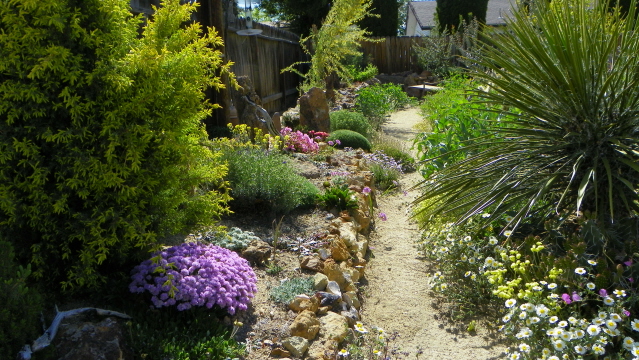

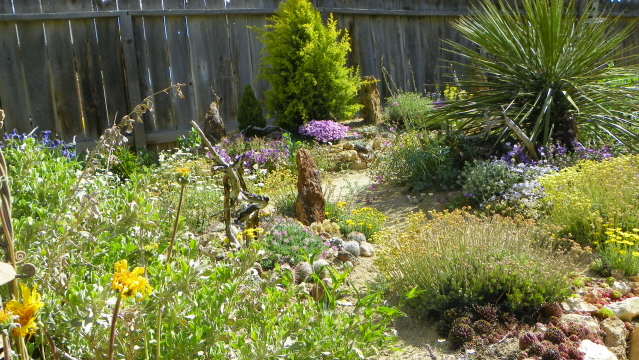
Comments
Peter George
Re: What do you see on your garden walks?
Wed, 06/08/2011 - 2:07pmIt's truly hot and humid here today, but I managed to get away from my (home) office for a few minutes, enough time to take a few pictures of some plants that are apparently flourishing in our early summer weather.
Here are several campanulas, C. nitida, C. 'Maie Blyth, C. chamissonis and what I believe is C. rotundifolia. All nice, and there are more to come over the next week or so.
Lori S. (not verified)
Re: What do you see on your garden walks?
Wed, 06/08/2011 - 9:14pmVery nice! I especially like C. nitida... It seems very odd and amazing to me that this is a variety of C. persicifolia (C. persicifolia var. planiflora)! The bicoloured flowers on C. chamissonis really stand out too.
Is that a perennial snapdragon behind and to the left of C. nitida?
Lori S. (not verified)
Re: What do you see on your garden walks?
Wed, 06/08/2011 - 9:35pmThere is a brief lull in the troughs and alpine beds, but a few new things in the perennial borders...
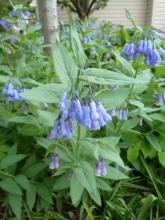
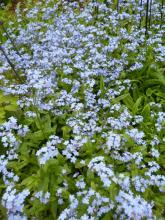
A white form of Cortusa matthioli popped up a few years ago; Mertensia primuloides; Mertensia ciliata; Myosotis sylvatica has reached weed proportions... but it's too pretty to pull out! :'( (This is a familiar story.... by next year, I'll probably be on a rampage to get rid of it!! ;D)
And I thought I'd better take a pic of this now, as there is a very high likelihood that these dinner-plate-size leaves will soon be shredded in a hailstorm!
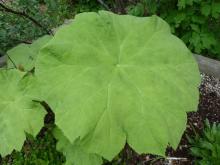
Astilboides tabularis:
cohan (not verified)
Re: What do you see on your garden walks?
Wed, 06/08/2011 - 10:13pmThose big leaves do look like a hail risk, good luck! We've had a couple of close-calls with rain that was almost hail and hail that wasn't heavy enough to do damage... but no damage yet!
Myosotis (presumably sylvatica) has survived here in some overgrown plantings of my mother's and is showing its colours in some areas I have dug or weeded.. it certainly seems like it could overwhelm delicate areas, I was thinking I'd find some isolated spots to let it do its thing.. can it handle much dryness?
Trond Hoy
Re: What do you see on your garden walks?
Wed, 06/08/2011 - 10:44pmThe Myosotis sylvatica growing wild here prefere moist conditions. I have never found it in dry situations.
Nice big leaves Lori. Can't you hide under them in a hailstorm ;D?
My Mertensia primuloides pop up on unexpected sites every year but M ciliata is always killed by slugs.
Peter, you do grow some interesting plants, especially "bluebells" (The Campanula genus is bluebell (blåklokke) in Norwegian). The C. rotundifolia is native here but rarely makes such mounds.
Stephen Barstow
Re: What do you see on your garden walks?
Wed, 06/08/2011 - 11:46pmReally! Never seen a slug on my ciliata - maybe I need some of your slugs as it's getting a bit out of control! On second thoughts, you have Arion vulgaris (brunskogsnegl) don't you?
S.
Lori S. (not verified)
Re: What do you see on your garden walks?
Thu, 06/09/2011 - 5:13amIt will grow anywhere in the yard.
Peter George
Re: What do you see on your garden walks?
Thu, 06/09/2011 - 7:48amYes, Lori, the plant in the background is Antirrhinum hispanicum, which I've had in that spot for 3 years. I originally bought it from Wrightman's, and it's filled out a bit more each year, and this season it's been blooming for 2 weeks, and shows no indication of slowing down. I've never seen any seedlings from it, but I'm going to make an effort to collect some seed and see if I can germinate it. It's not 'showy' but it always catches a visitor's eye if they are looking at that section of the garden.
cohan (not verified)
Re: What do you see on your garden walks?
Thu, 06/09/2011 - 10:54amThanks, Lori, I'll try it in a few spots..
Peter, its a gorgeous plant-- I always loved snapdragons, so the idea of small hardy relatives is very appealing.. I've looked at them in catalogues, but haven't grown any yet...
Richard T. Rodich
Re: What do you see on your garden walks?
Thu, 06/09/2011 - 7:02pmLori, you can always spread the wealth of those very nice Mertensia spp. at you chapter plant sales, and the seed to the rest of us! ;D
Peter, another edition of very choice plants! Our wild Campanula rotundifolia never grows in such a large clump, either. I am growing seed of C. r. Olympica, and it seems to want to be a larger mass. But I have never grown our native phenotype in "captivity." Maybe it would respond similarly?
cohan (not verified)
Re: What do you see on your garden walks?
Thu, 06/09/2011 - 8:18pmC rotundifolia is super super common here.. if I knew what seedlings looked like, I bet it would be one of the most common volunteers in pots and bed...lol generally it doesn't form visibly large clumps because its mixed with other plants, but once in a while I see quite a clump (sometimes I can see some developing in mowed areas and work around them) .. however they are generally longer stemmed than Peter's lovely form.. I haven't tried putting them in a tended bed yet either to see what they'd do.. I suspect a sunny lean spot might bring out the best compact form.. however, I'm unlikely to use such a scarce spot for a native that grows quite nicely if taller in shady/semi shady places...lol
Lori S. (not verified)
Re: What do you see on your garden walks?
Thu, 06/09/2011 - 9:57pmInteresting... C. rotundifolia does form clumps in the garden here and flowers profusely. The foothills plants are especially spectacular - dense cylinders that turn the roadsides blue! I'll have to try to get pix this year... stopping on the side of the highway with cars blasting by (at 140 km/hr, as Cohan mentioned) has deterred me so far! The plants in the alpine/subalpine are relatively sparse, as shown here:
http://nargs.org/smf/index.php?topic=343.msg3995;topicseen#msg3995
I'll certainly try to collect seed if you are interested... if only I could just send you a dozen seedlings!
It's unrelated but I find it amusing that I am actually having to weed out ligularia seedlings this year! There are LOTS of offspring from 3 plants I grew a few years ago from a seed order that was very kindly shared with me. (Remember Jan from the Far North forum? Are you out there, Jan? :)) If I recall correctly, they were supposed to be be L. japonica but aren't, instead appearing to be a species/hybrid similar to L. dentata and another with more kidney-shaped leaves - nice flowers on both types.
Peter, it's interesting that you have not seen seeding from your Antirrhinum hispanicum. I've had what I thought was Antirrhinum sempervirens for 9 years now... but it suddenly occurred to me that perhaps it's actually A. glutinosum ("Gummy Snapdragon") which is synonymous with A. hispanicum! The plants were labelled as Snapdragon 'Gummy' or 'Gummi'(?), which I took to be a cultivar name as they were being sold as bedding plants, oddly enough! Anyway, one plant died out a couple of years ago and the other one seems to be declining. I've seen no seedlings either, unfortunately, and I have not been able to collect seed either. Do you suppose this is something that could be propagated by cuttings?
EDIT: On second thought, after a closer look at your photo, Peter... my plant has white flowers with a hint of yellow and a tiny bit of purple streaking, and the leaves seem to be smaller and rounder than on yours, so maybe it really is A. sempervirens, despite the way it was labelled.
Lori S. (not verified)
Re: What do you see on your garden walks?
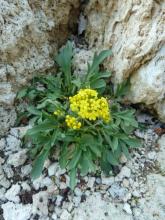
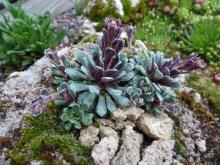
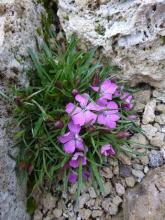
Thu, 06/09/2011 - 10:18pmPatrinia sibirica; Saxifraga 'Whitehill'; Dianthus glacialis from seed last year:
Anne Spiegel
Re: What do you see on your garden walks?
Fri, 06/10/2011 - 5:59amHuge thunderstorm yesterday afternoon with hail and the works. Fortunately, the hail didn't last too long and not much damage done.
The new crevices on the cliff held up quite well. I was afraid I'd find plants in a puddle at the bottom but nothing got washed out.
The acantholimons are starting, and convolvulus and Moltkia petraea are continuing to bloom. We really needed the rain.
Edited to add plant names from photos to allow "Search" capability.
Acantholimon ulicinum
Inula rhizocephala
John P. Weiser
Re: What do you see on your garden walks?
Fri, 06/10/2011 - 9:13amThought I'd check in to let you all know, things are still blooming in the High Desert!
cohan (not verified)
Re: What do you see on your garden walks?
Fri, 06/10/2011 - 10:38amJohn, still looking really great!
Anne, congrats on no puddle of plants! Cute Inula...
Richard T. Rodich
Re: What do you see on your garden walks?
Fri, 06/10/2011 - 7:41pmWow, John! EVERY plant is so interesting!
Lori S. (not verified)
Re: What do you see on your garden walks?
Fri, 06/10/2011 - 10:02pmSpectacular, John! Actually, the cacti and yuccas(?) are so gorgeously architectural, who would need flowers anyway?? But since they're there... Is the big purple plant on the right one of the desert-y salvias? Also, what are the yellow-flowered ones? I think I see tall penstemons in the front left area... ?
Lori S. (not verified)
Re: What do you see on your garden walks?
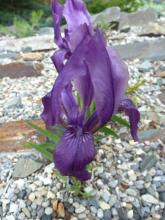
Fri, 06/10/2011 - 10:43pmIris chamaeiris:
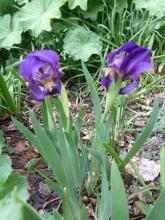
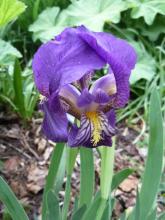
Iris timofejewii:
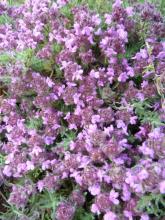
Thymus neiceffii:
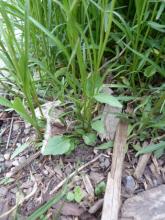
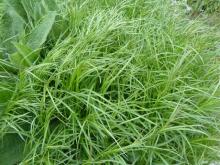
Cohan, here is what seedlings of Campanula rotundifolia look like... the foliage soon becomes linear (second photo) and the rounded-to-variably shaped lower leaves die down later on:
cohan (not verified)
Re: What do you see on your garden walks?
Fri, 06/10/2011 - 11:08pmThanks, Lori.. I suspect those seed leaves could be found in almost all of my outdoor pots, and all beds...lol.. it took me a while to recognise any sort of foliage on C rotundifolia at all, since they usually grow in mixed grass and forb situations here, and their foliage is next to invisible there.. Since I've started to notice clumps in mossy areas etc where they are more obvious...
John P. Weiser
Re: What do you see on your garden walks?
Sat, 06/11/2011 - 12:27amThe purple one is Salvia dorrii, the yellows are Erigeron linearis, and Eriophyllum lanatum var. integrifolium. Yes you do see Penstemon speciosus in the foreground.
Trond Hoy
Re: What do you see on your garden walks?
Sat, 06/11/2011 - 7:51amJohn, I wasn't anxious you should run out of blooming or other interesting plants ;) In fact, I assumed you were busy gardening ;D
Speaking of precipitation, we have had terrific rain the last days here. However the weather has been worst in the eastern parts. Lots of roads closed, railways closed, houses damaged etc.

We had to check our mountain cabin but had to a 2 1/2 hours longer drive due to a landslide damaging 300m of the main road. Arrived midnight (it is not dark but quite good driving light even in foggy, rainy weather).
This is one of the main roads:
No damages at our place but very wet :o
Trond Hoy
Re: What do you see on your garden walks?
Sat, 06/11/2011 - 8:03amDo you need another degree? It is possible by studying gastropods in my garden :-[ I have them all; with and without shells, black, brown, red, grey, yellow, two-coloured, soft, hard, small, big, round, flat etc. Quite a menagerie :(
Stephen Barstow
Re: What do you see on your garden walks?
Sat, 06/11/2011 - 1:22pmI'm in Oslo for the long weekend. Travelled down past the site of Trond's picture on the night train just hours before the railway was closed, oblivious to the unfurling drama! :o
Stephen Barstow
Re: What do you see on your garden walks?
Sat, 06/11/2011 - 1:24pmTrond: I did find and disposed of the free slug you sent in your parcel ;)
cohan (not verified)
Re: What do you see on your garden walks?
Sat, 06/11/2011 - 2:16pmI always wish I had a rocky property, but I'm glad not to have this kind of run-off!
Trond Hoy
Re: What do you see on your garden walks?
Sat, 06/11/2011 - 10:17pmOh, that one? It was meant as a free sample to increase your stock. No, I am very sorry. I did my best to avoid slugs but they are everywhere :(
cohan (not verified)
Re: What do you see on your garden walks?
Sat, 06/11/2011 - 11:40pmI was glad not to have your slug problems today-- I was doing some weeding in places that are not really cultivated, but there either are plants remaining from some old beds, or wild plants, and I am just reducing the numbers(size may be a better term, I'm not digging them out, just pulling off what I can) of dandelions, grasses and clovers, to give the other plants a competitive edge! Anyway, there has been quite a bit of rain the last few weeks, so everything was very lush and damp from rain today, and I was pulling up large handfuls of greenery, and very happy not to have one squished slug in my hands!
Lori S. (not verified)
Re: What do you see on your garden walks?
Sun, 06/12/2011 - 9:45amSpeaking of squished slugs (or even not squished), that is some amazingly slippery substance they produce... surely there must be some use for it? An industrial lubricant, a non-frictional fluid?? Trond, you could be rich if you just find a market for your slug population... or its excretions, anyway. ;D
Draba kitadakensis; first bloom on Linum aff. cariense, from seed last year; I'm excited to see that at least one of last year's Sedum pilosum will bloom; Asperula boissieri, also from seed last year.
Peter George
Re: What do you see on your garden walks?
Sun, 06/12/2011 - 12:38pmLori, are you planting directly into the tufa, or into a crevice which includes tufa 'crumbles?' The last 3 look like you're right in the tufa, but they are also too lush (in my experience) for direct planting. But in any case, they are beautiful plants, which I have killed once, but am going to try, try again.
Lori S. (not verified)
Re: What do you see on your garden walks?
Sun, 06/12/2011 - 12:51pmPeter, all of those plants are not in the tufa itself but in the soil between the tufa blocks, with tufa bits as a top dressing... the soil is too rich, I know. (I was instructed/directed at the time to use up a bunch of potting soil, so I bit my tongue and made it as lean as I could with other amendments... This year, it has been noted that "those plants look too big", so as we soon add on to this tufa bed and use a much leaner mix, it should be a lot more successful... without having to go through a big argument! A small sacrifice to have made... ;D) I have been planting saxifrages directly into crevices and small holes drilled in the tufa, and they seem to be doing very well so far... even the ones grown in larger pots which then had their roots shaken bare and cruelly exposed prior to being shoved into the holes. It didn't seem to faze them, oddly enough.
I was surprised just now to see a flower on the scruffy little Delosperma that I grew from seed last year (and was surprised to see alive this spring).... Delosperma alpinum - as you can see, it's not a large flower, or a large plant!
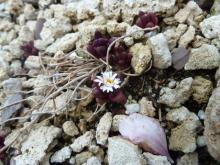
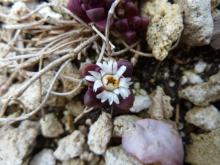
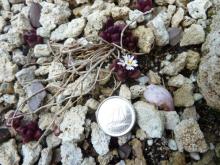
And another from my extensive collection of plants with virtually insignificant flowers... :rolleyes:
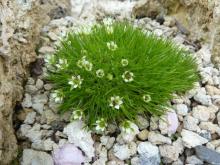
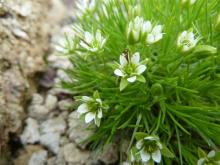
Correction: It's Arenaria kansuensis, a Chinese species: Arenaria
densiflora- a very attractive cushion(hmmm, wonder if that's supposed to be "densifolia"?)and very subtle flowers... at least the ants like them.cohan (not verified)
Re: What do you see on your garden walks?
Sun, 06/12/2011 - 2:23pmBoth really cute, Lori! Love the little Delo still :) looks like its slowly making a little patch of itself..
The Arenaria reminds me of something that grows on hummocks or anthills in the sloughs here--not nearly as compact as that, but similar colouring and flowers in little mounds..haven't yet tried moving any to the yard, but I will...
Lori S. (not verified)
Re: What do you see on your garden walks?
Sun, 06/12/2011 - 4:35pmThat's the way it looked last year, even when it was still in a pot indoors... just stringy and odd. Perhaps the individual rosettes at the ends of the stems have to ability to root in, I don't know.
cohan (not verified)
Re: What do you see on your garden walks?
Sun, 06/12/2011 - 4:58pmSeems like they should root-- I thought it looked like they already had-- guess time will tell..
Anne Spiegel
Re: What do you see on your garden walks?
Mon, 06/13/2011 - 6:03amNice to see the Salvia dorrii, John. I recall seeing that in the high desert. It was either in Nevada or on the way to Nevada from Salt Lake. I recall it being very aromatic. Is it that way in the garden as well?
Trond Hoy
Re: What do you see on your garden walks?
Mon, 06/13/2011 - 12:24pmWe had to drive up to our mountain cabin to take a look to see if it still was there - and it was.
Friday and Saturday the rain poured down but Sunday and today was sunny and warm. Had a stroll in the meadow surrounding the cabin.
The common catsfoot (Antennaria dioica) grows everywhere and has all colours from red (OK Lori, PINK) to white and all melanges thereof. Notice the difference between the male and female plants (this species is dioic).
Trond Hoy
Re: What do you see on your garden walks?
Mon, 06/13/2011 - 1:03pmAlthough many plants are naturally occurring here in the meadow have I "helped" establish some. Most of them are from places nearby but some are from abroad ;)
Erigeron boreale (I am not quite sure the name is correct) grows in higher mountains not far away. The very tiny meadowrye, Thalictrum alpinum grows naturally in the meadow.
Ajuga pyramidalis is common from sealevel to the alpine zone but Anemone narcissiflora (from seed) is a foreigner. However, it doesn't look exactly like the plants I have observed in Switzerland though.
Lychnis alpina is common on higher ground and it does tolerate and probably needs heavy metals in the soil. I brought two plants with me many years ago. Now they are hundreds!
Myosotis alpestris is everywhere and in moist and wet soil is Pinguicula vulgaris common although I have planted it in this spot where it slowly spreads by seed.
Richard T. Rodich
Re: What do you see on your garden walks?
Mon, 06/13/2011 - 5:55pmReally great plants, Lori. Those flowers don't seem so insignificant to insects! I'll be seeing the insignificant flowers of Syneilesis intermedia this year, myself.
That Delosperma is so purple... then what is its winter color?
Trond, you mentioned Antennaria dioica being dioic (in America, we say dioecious). It reminded me that a few days ago a branch broke of my male Kentucky Coffee tree (Gymnocaladus dioicus). And I had a close up opportunity to examine the flowers...
cohan (not verified)
Re: What do you see on your garden walks?
Mon, 06/13/2011 - 9:12pmNice selection, Trond, I think I like them all!
Cute Erigeron; the Thalictrum flowers are very similar to my local species (venulosum? without checking..) but it is maybe 40-60cm at a guess..
Antennarias all over here, too, though none as dark as your darkest..
Lori S. (not verified)
Re: What do you see on your garden walks?
Mon, 06/13/2011 - 10:04pmVery nice plants, Trond!
Okay, we are in colour alignment now... though I must say your last one is as close to red as pink every gets! ;D ;D
Interesting.... I never realized that the name A. dioica reflected that it was dioecious...
By coincidence, a friend grew Thalictrum alpinum this year and gave me a couple of plants, so it's especially nice to see photos of the mature plants.
The Kentucky coffee tree has very different flowers, Rick. How big has it gotten so far?
A few things in the rock garden...
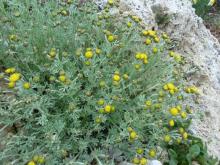
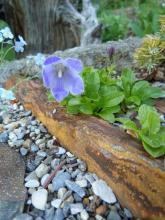
Ajania (Tanacetum) tibeticum, a bit big for its spot, but it will be moved when more space is available; Campanula chamissonis, from seed a couple of years ago, starting to bloom:
I take it back... Potentilla porphyrantha is actually blooming quite well this year, for whatever reason; Potentilla rupestris 'Pygmaea':
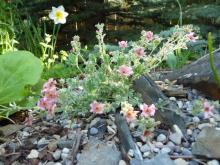
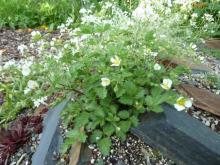
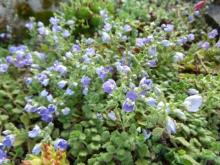
Veronica thymoides ssp. pseudocinerea; Alyssum lepidoto-stellatum, from seed last year:
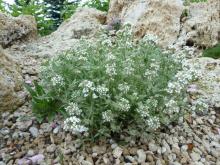
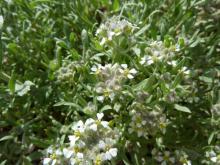
Elsewhere in the yard...
Lamium orvala (x2); Silene xrobotii 'Rolly's Favorite':
cohan (not verified)
Re: What do you see on your garden walks?
Mon, 06/13/2011 - 11:17pmThe Lamium is quite charming, just enough of an improvement over its weedy cousins (which i still sort of like, even though they sprout almost instantly here in almost any cleared soil...).. is it a woodlander?
Trond Hoy
Re: What do you see on your garden walks?
Tue, 06/14/2011 - 10:25amNot a bad selection you show either, Lori ;) The pygmy P rupestris is interesting and P porphyrantha looks very good!
Cohan, here Lamium orvala is very good in shady woodland.
Lori S. (not verified)
Re: What do you see on your garden walks?
Tue, 06/14/2011 - 11:39amThanks, Trond.
Lamium orvala is very nice in shade here too.
cohan (not verified)
Re: What do you see on your garden walks?
Tue, 06/14/2011 - 1:32pmThanks, Lori and Trond, I'll keep it in mind on my endless theoretical list ;D
Maybe I should start a real list, but I find when I get to catalogues and trade lists, the species available are usually not the same ones I have seen someplace, so I just look up the new ones!
Lori S. (not verified)
Re: What do you see on your garden walks?
Tue, 06/14/2011 - 9:58pmIn the rock garden:
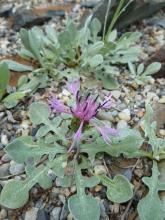
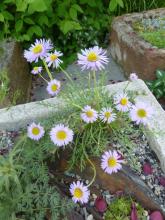
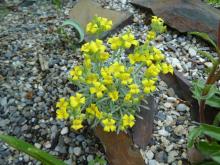
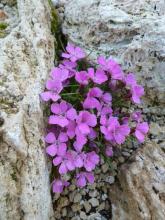
Centaurea epirota; Erigeron pinnatisectum; Lesquerella arizonica; Dianthus glacialis
alpinus(a repeat), from seed last year:The alpine campanulas are starting to bloom (I'll be boring you a lot with these in the next while! ;D)...
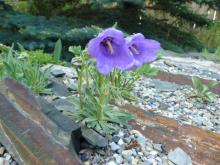
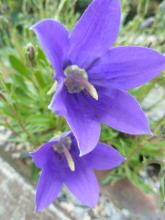
Campanula alpestris; Campanula saxifraga - actually a darker richer royal purple:
And elsewhere in the yard...
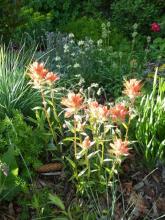
Castilleja miniata, Penstemon confertus and Antennaria dioica are starting to bloom:
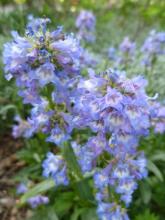
A little penstemon I bought... I'll have to try to key it out... can anyone ID it and save me the trouble? ;D
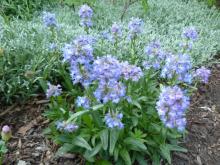
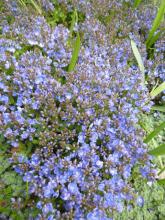
And a mat-forming veronica, whose identity I failed to record! Again, any ideas?:
cohan (not verified)
Re: What do you see on your garden walks?
Tue, 06/14/2011 - 10:38pmAlways lots of treasures :) My fave in this bunch is the Centaurea! ( I guess you'd have to say, 'fave what? fave plant for coolness, fave plant for garden impact?' for coolness!)
cohan (not verified)
Re: What do you see on your garden walks?
Wed, 06/15/2011 - 12:32amWhen I planted these, from big box store bulbs, I was expecting spring bloom, along with the Scillas and retic Iris I planted at the same time... shows how much I knew ;) on the plus side, they have performed much better in this bed than either of the above (maybe these appreciate the soggy springs they've had more than the others?)--they went in fall 09, and this year they have increased dramatically, with 4-6 flower stems per bulb.. they actually look quite nice with the Pulsatilla vulgaris (also multiplying, from two plants--should be a couple more in bloom next year|) in the same bed (many seed heads, but a few late flowers still) though I haven't managed a photo that really captures the effect.. I guess you wouldn't plant either with anything too delicate, but I don't mind if these spread a bit, though the bed's not that large...
Muscari Pulsatilla vulgaris
(I forgot the name..something common and cheap)
cohan (not verified)
Re: What do you see on your garden walks?
Wed, 06/15/2011 - 12:59amWhen I first got this little Veronica a couple of years ago, I was disappointed when I realised the flowers weren't more like the ones Lori showed above! But you know, they kinda grew on me, especially those which are more liberally splashed with blue/violet..
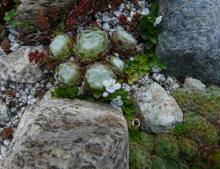
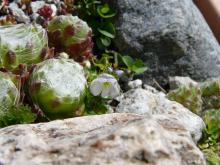
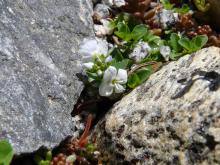
I put one plant in a big pot I have Semps and Sedums in, and it croaked in the first winter, but seedlings came up later and are wending their way amongst the succulents (hopefully I wont regret that, but they don't seem vigorous enough here to be a problem), flowering again this year...
Veronica repens
Another pot was kept separate, I forget what happened to it, whether it had winter issues or dried out at some point, but I have some plants coming along in a couple of pots anyway.. showing a bit more blue here.... and one of the self sown clumps of Myosotis (sylvatica?) we were talking about, these at the weedy edge of an old bed, beside the rebuild-in-progress rock garden
Lori S. (not verified)
Re: What do you see on your garden walks?
Wed, 06/15/2011 - 12:10pmCohan, muscari are still in bloom here, and Iris reticulata finished very recently (may still be the odd one in bloom if I look hard) - both are later blooming among the spring bulbs, for me at least. If you want earlier spring bulbs, plant crocus and puschkinia. Scillas are later here than those two, but earlier than the bulk of the muscari. Of course, this has been a late spring too...
cohan (not verified)
Re: What do you see on your garden walks?
Wed, 06/15/2011 - 5:37pmI only have a few retic Iris, and only one flowered this year, and only several more came up at all--maybe they don't like the spring wet in this bed-- I didn't realise this spot is prone to being very very wet for some time: after it belatedly comes out of the snow, water runs there from farther back in the shade...lol However, that one Iris, along with the Scillas in the same bed, flowered looong ago (okay, maybe it just feels long...lol).. The Iris and Pulsatilla started in the second week of May, Scilla was about a week later in the same bed, and I'm sure they all could have been a few weeks sooner in a sunnier, warmer bed (mind you, warmish weather just started in May); Cory solida was the same time, though in an even later to thaw bed.. I'll be planting some seedlings .. of those in various places..
Hopefully I'll get a bed ready in a warmer spot this year, and crocus will be among the first things to get... I was kind of disappointed with these Muscari being so late, at first, but now, they are putting on such a nice show that all is forgiven...lol
In Toronto, the Iris reticulata were the first things to flower, if I remember right.........
Pages