The Hepatica is native here! Just a short walk from here there is a huge swath of them all in various shades of blue & pink. I'll post some pics of them soon. The yellow Hellebore is flowering for the first time this year.....it was an unnamed seedling..a lucky plant pick!
Trond: a magnificent Glaucidium - as good if not better than the plants I saw in the far north of Norway (Troms and Vesteraalen) a couple of years ago (including white flowered)!
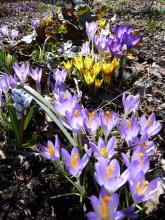
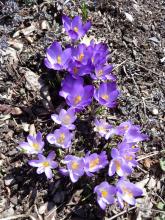
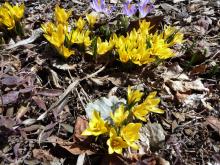
After a long wait, there are finally some crocus in bloom here!
Good show, Lori! Nice range of colours... I was moving snow from my one ill-placed bed with spring bulbs, and there are some shoots ready to go! (and a lot of water on one side, and an acre of snow still to melt beside it...lol).. I'm gradually figuring out how things work on this piece of land-- I paid attention to sun exposure right off the bat, but didn't think about snow melt times (varying by many weeks!), drainage patterns, wet (low) and dry (high) ends of the property!
Trond: a magnificent Glaucidium - as good if not better than the plants I saw in the far north of Norway (Troms and Vesteraalen) a couple of years ago (including white flowered)!
Thank you Stephen ;D I had to struggle with molluscs some years to the plant got big enough to tolerate some slug attack! I haven't been that lucky with the white I have tried. Slugs devour the young growth.
Lori, nice to see some flowers from you!
Cohan, do you have a dominant direction from where the wind blows? At our mountain cabin the wind often is north-westerly and make huge heaps of snow on the leeward side of the house where we have our table and chairs. I often have to remove huge amounts of snow there before we can enjoy the sun. Not this year though, the snow seemingly evaporated in no time :o
Not a very established plant yet (and unnamed), but one I received from Betty Ann Addison, owner of Rice Creek Gardens here in Minnesota. My other C. solida are rather blah pink/reds yet still nice, but I like this one especially. It seems to have a distinctly flattish apron of foliage. The variegated grass in the upper left is Arrhenatherum elatius ssp. bulbosum 'Variegatum'. Quite a mouthful, and not invasive at all here, despite is "bulbous" habit.
The variegated grass in the upper left is Arrhenatherum elatius ssp. bulbosum 'Variegatum'. Quite a mouthful, and not invasive at all here, despite is "bulbous" habit.
Re- Arrhenatherum elatius ssp. bulbosum - a common find at prehistoric sites in Europe, the edible tubers were no doubt gathered for food, although very fiddly! I did have this but I think I've lost it...
Nice Cory, Rick! I was looking at the bed my only clone so far is in, and one end is starting to come out of the snow, the end with the C solida is still a foot or more under.. moved some snow from beside the bed to speed things along ... Trond, my one real plus on this property (naturally directly related to the minuses ;) is that there is not a lot of wind in here, since we have trees on 4 sides, with the only real gap being the driveway (and there are trees and an old house which block some of that wind from the rest of the property..)-- which is southeast: the source of some nasty weather systems, but not the most common.. So, wind is a factor, but not the major one..or rather it probably is, but in some complicated interaction with trees I have not totally figured out..
Re- Arrhenatherum elatius ssp. bulbosum - a common find at prehistoric sites in Europe, the edible tubers were no doubt gathered for food, although very fiddly! I did have this but I think I've lost it...
I never knew the tubers are edible, thanks Stephen! How are they prepared? I love trying new thing like this, even if it might only be once. (Also enjoyed your comment regarding Dentaria/Cardamine.) I've never tried growing the grass from seed, but I do get seed heads, if you would like some seed.
Off-hand I don't know how they were prepared - a tradition that doesn't seem to have survived to modern times. I also haven't eaten them myself yet, so I can't tell you that I survived the experience (so, careful and don't overdo it the first time :) ).
Yes, I'd love to try some seed, thank you - as I noted mine seems to be quite dead...
I also haven't eaten them myself yet, so I can't tell you that I survived the experience (so, careful and don't overdo it the first time :) ).
Yes, I'd love to try some seed, thank you - as I noted mine seems to be quite dead...
I'm not the adventurous sort when it comes to wild edibles. I want solid evidence, so I won't be the guinea pig. I've grown Coryphantha vivipara for 15 years and known of its supposed edibility for at least that long, but I will be tasting the berries for the first time this year.
Regarding seed of Arrhenatherum elatius ssp. bulbosum, if memory serves, it was mid summer. I'll email you then, too.
How tall is this grass, Rick? google images didn't help much with scale.. interestingly, among the first few pics were some of charred remains from ancient sites! So based just on that quick glance, I'd say roasted!
Spring seems to have arrived here. It's a good year for Magnolia soulangeana. Frequently the buds or flowers get blasted by frost - nothing worse looking than a tree with blackened buds and black petals hanging down. This year it's lovely. The early plants in the crevice garden are starting too. The Petrocallis pyrenaica is blooming in a natural crevice, the phlox in a man (woman)-made one.
Rick, it was a really good year for the magnolia. Some years there are no flowers because of heavy frosts. It's worth it to have a year like this. The petrocallis really seems to respond to crevice planting.
Wow, I have never seen a Magnolia soulangeana bloom like that! When I first saw the thumbnail, being so floriferous I just assumed it was a crabapple!
Rick, Magnolia soulangeana is almost a prerequisite tree here in Massachusetts, along with Rhododedron 'PJM' and Forsythia bushes. I don't grow any Forsythia, I don't need to, they're *everywhere* here. So, back to Magnolia soulangeana, they typically bloom here with unbelievable profusion similar to Anne's photo, and they are found in just about every other yard, some are old, huge, and spectacular. They are however subject to the "surprise" late freeze that will blast the flowers in 1 out of every 3 years. This year they are breathtaking... no surprise frost.
This spring Magnolias have been fantastic overall... I think the long slow season is their salvation. Here are some shots taken recently, of Magnolia stellata - pink form (got this at a NARGS seedling sale for $1, hard to beat that price ;D), and M. denudata 'Forrest Pink', thought to actually be a hybrid with M. denudata rather than a selected form. In 2008, my tree of 'Forrest Pink' was smashed to bits in the December 2008 ice storm. I drastically cut it way back to stubby stumps for branches, and 3 years later it is looking super fine indeed. Unlike M. soulangeana, this one almost never gets hit by late frosts. Also, the flowers are more striking, huge floppy affairs, intense rose on the outside, palest pink-white inside, and exuding a heavenly sweet fragrance that perfumes the entire garden. The pink-flowered M. stellata is also heavily perfumed, but spicy and intoxicating. Below these tap-rooted trees, grow all sorts of spring ephemerals such as Trillium species.
It is no doubt. Magnolias tolerate and maybe prefere cold winters but they do best where the summers are really hot! (At least hotter than here)
Mark, do you get seeds of your stellata pink form? Stellata is good here and I have one in my garden (very floriferous this spring btw) but it is white.
Mark, I've had a different experience here with Magnolia stellata and have given up growing it. It seemed far more susceptible here to spring frosts than M. soulangeana. An added part of the equation here is wind and that may be what M. stellata doesn't like. Rhododendron p.j.m. never liked the wind here and is not part of the garden. Everyone I know, of course, grows it very well. Everything in the crevice gardens starting to burst into bloom. No time to photograph!
People in these parts experiment with Magnolia stellata... how satisfactory it is, especially here in the chinook zone, I don't know.
I'd have to look it up to be sure, but if I remember correctly from Toronto, that might be the one I don't care for...lol--I don't know the species, really, but remember there were some with very elegant more closed upright flowers, and others with narrower petals in floppy flowers that made me think of tissue paper flapping around on the trees...lol.. I'd have to look them up...
My yard is kinder to trees to than some spots-- a lot of wind shelter...
It is no doubt. Magnolias tolerate and maybe prefere cold winters but they do best where the summers are really hot! (At least hotter than here) Mark, do you get seeds of your stellata pink form? Stellata is good here and I have one in my garden (very floriferous this spring btw) but it is white.
Yes, it makes lots of bright orange red seeds, I think I have a few potted seedlings in my "nursery area". I can collect seed this fall.
Actually, Cohan, it might fit your description, but I always liked it because in this area it blooms before Magnolia soulangeana. Which may have been the problem. This is a cold garden with no protection from wind. At any rate, it just didn't thrive in my garden. (Translation - it died!)
It is no doubt. Magnolias tolerate and maybe prefere cold winters but they do best where the summers are really hot! (At least hotter than here) Mark, do you get seeds of your stellata pink form? Stellata is good here and I have one in my garden (very floriferous this spring btw) but it is white.
Yes, it makes lots of bright orange red seeds, I think I have a few potted seedlings in my "nursery area". I can collect seed this fall.
Mark, if you do not set up a nursery, you can make a fortune selling seeds ;D
Look Todd, I'm catching up! ;D First flower on Besseya alpina, barely starting to bloom - from seed in 2009.
First bud on Paraquilegia microphylla, planted last year! (Well, it's a start! ;))
I don't expect these will be any great shakes in the flower department (we'll see soon), but the foliage is nice and furry... Arabis androsacea, from seed last year:
Still waiting for Thlaspi kurdicum to let loose...
Saxifraga sancta v. macedonica... with a seedling, ex. Sax. 'Mrs. Winifred Bevington' growing in it! (Sheesh, the only seedling I've found... why did it have to give me a dilemma of whether or not to pull it out of the other plant?!?)
Androsace carnea 'Alba'... which will change quite a bit in appearance as the flower stems elongate:
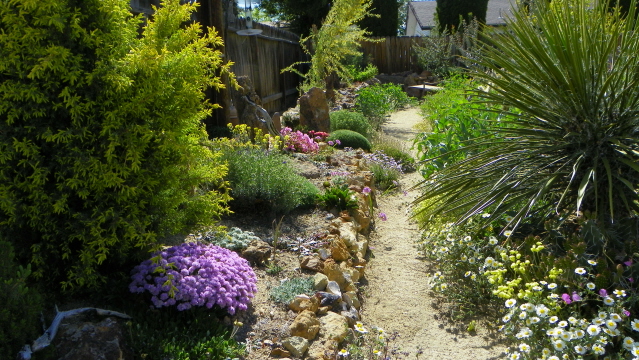
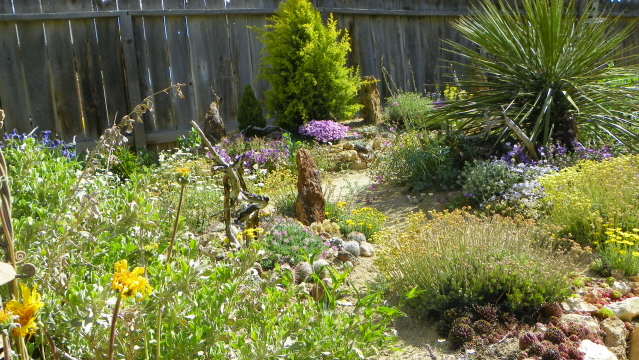
A few pictures taken of our sand bed this spring - started in 2007 and the Yucca is really going places! From top to bottom: Yucca whipplei, Aquilegia grahamii, Lupinus albifrons, Ptilotrichium spinosum, Stachys citrina in foreground; overall view of sand bed, newer planting in front (still to be top-dressed with grit); Arenaria tetraquetra (lovely tight cushion - one of the great attributes of this type of culture); Poygala calcarea (a real winner, self-sowing gently) and Dianthus haematocalyx; Asplenium ceterach (the 'Rusty Back fern', a really useful indicator plant, showing drought by curling up its fronds. I will definitely try more small xerophytic ferns in the bed as time goes on - Asplenium trichomanes also grows well).
This is only a very small bed in our very large garden but gives an inordinate amount of pleasure. I am tempted now to try a more elaborate 'berm' as I have seen in American articles, for genera like Eriogonum, Penstemon, and a host of others. Unfortunately our climate may not be summer-hot enough to succeed with some, and Acantholimon for example grow well but do not flower.
There are a lot more plants to come later into the summer so I will post some of these later on.
Despite cold nights, spring is here and every day there seems to be something new. 1. Phlox pungens - crevice garden 2. Phlox pulvinata - trough 3. Petrocallis pyrenaica - crevice
Rick - yes the stakes were for a winter cover with dutch lights. We normally only have intermittant snow and plenty of rain over winter and after a year with no cover quite a few plants did less well. The bed is simply a deep hole (ca. 30-45cm) filled with, in my case, a sharp potting grit made from heat shattered flint (the larger grades are used for 'pebble' dashing on houses). At the time I wondered if this would be too sharp compared to the normal sharp sand or ballast that is recommended, but it works well given supplementary watering in dry spells like we are having at the moment. There is no organic matter except that which comes with the plants (I don't wash the roots when I plant). However, I haven't put in a membrane underneath and so worms are steadily bringing up soil and quite a few of the plants must have got their roots down into the soil anyway. So far I have used no fertiliser though i know some growers recommend this.
I was particularly stimulated by the photographs in Ken Druse's book, 'The Collector's Garden', of the Kelaidises garden in Denver, which is infinitely more interesting than a lawn! Unfortunately we don't have that extreme climate here but it would be great to create something similar with different plants.
Updates on Thlaspi kurdicum and my first Besseya alpina:
I'm pleased to see that Cheiranthus roseus did not bloom itself to death last year... whether these are non-blooming plants from the previous year, or if some might not be totally monocarpic, I'm not sure. Happy to see some apparent seedlings too.
Lori, love the Besseya alpina. I'm growing that and get wonderful foliage and no flowers (both B.alpina and B.wyomingensis). Must be doing something wrong. I'm really fond of all the plants with those fancy exserted stamens (such a Valeriana supina). Here are some of the things in bloom in the crevice garden and nearby.
If only we could grow Lewisia tweedyi and Eritrichium howardii outside! It would make the garden incredibly exciting. I've grown them both in pots and enjoyed them, but somehow it's not the same. One question for anyone keen on Astragalus and Oxytropis - I've always thought these would be ideal sand bed plants but I've never had much success. I'd also like to try the little lupins (and at least L. albifrons does well and I should try some of its smallest forms). Do these plants grow in American gardens?
I grow as many Astragalus and Oxytropis and Trifoliums as possible. They're my favorites, but a lot of planning has to be done. Mine have great drainage, both in the mix and also they are placed where they get very positive air drainage and full sun. Lupinus albifrons does well here but is not long-lasting. Some astragali are easier than others. An easy one to start with is Astragalus monspessulans. Also Oxytropis multiceps. Most of the Rocky Mountain peas seem to need to dry out at the crown in our moist climate and have moisture available way down. Crevice planting has been very successful so far, more so than the sand bed. And dry screes are also good. They are not natural plants here in the northeast, but with some attention can do quite well, at least well-enough to keep a pea-lover like me happy.
Thanks Anne - so perhaps I do need to make a crevice garden as an adjunct to the sand beds, or maybe grow some of these plants between crevices in troughs. The only species I have grown really well is Astragalus utahensis, which does remarkably well in a pot. But reading of these plants in Claude Barr's 'Jewels of the Plains' and elsewhere is very appealing. I haven't tried species of Trifolium.
I've got a few more pictures from our sand bed which is slowly being top-dressed with new grit - a slow old process but very satisfying. With all the talk of crevice gardens (especially in the UK), its a great surprise more comment is not made of sand beds - they are equally effective for many plants, but do perhaps need more care and cover over the winter. Perhaps they are just too easy!
From top: Edraianthus pumilio (in its superb silver-leaved form owerinianus) Stachys citrina Silene hookeri (what a plant!) Thymus 'Peter Davis' Overall view of bed with Yucca whipplei and Dasylirion species
There is also a beautiful annual gentian flowering, G. syringea, from the Himalayas (see under G. nivalis thread elsewhere)
Yesterday was beautiful, and my Daphnes are all in bloom. Here are a couple, Daphne x napolitana and Daphne cneorum 'Porteous.' The latter was purchased from Wrightman's 3 years ago, and was about the size of a bottle cap. It's been unbelievably floriferous, and is now about 18 inches in diameter, and still totally prostrate. Harvey told me that he found it in Barrie Porteous' garden, stuck away in one of his huge troughs, and took a few cuttings. What a find!
Re: sand beds. They are indeed easy, especially if they are like mine and are just pure sand. Yours looks very good. High desert plants love them as do many penstemons, townsendias and eriogonums. I've found that I can grow a wider range of plants here in crevice gardens. The close spaces between rocks remain cooler and seem to retain more moisture deep down. I think even a western plant growing in dry as a bone clay with big cracks from drought have some moisture available to them deep down. Ranunculus seguieri, a snow-melt plant and not a drought-lover, can grow in the Dolomiotes in bare high meadow spots in soil that looks and acts much like western clay. That may be partly due to their preferring their own company and putting themselves in places without much competition, but also because there is moisture available to them well below the surface.



Comments
cohan (not verified)
Re: What do you see on your garden walks?
Mon, 04/25/2011 - 10:45amNice one to come home to :)
Lori S. (not verified)
Re: What do you see on your garden walks?
Mon, 04/25/2011 - 2:46pmAfter a long wait, there are finally some crocus in bloom here!
Amy Olmsted
Re: What do you see on your garden walks?
Mon, 04/25/2011 - 5:43pmThe Hepatica is native here! Just a short walk from here there is a huge swath of them all in various shades of blue & pink. I'll post some pics of them soon.
The yellow Hellebore is flowering for the first time this year.....it was an unnamed seedling..a lucky plant pick!
Stephen Barstow
Re: What do you see on your garden walks?
Tue, 04/26/2011 - 12:15amTrond: a magnificent Glaucidium - as good if not better than the plants I saw in the far north of Norway (Troms and Vesteraalen) a couple of years ago (including white flowered)!
cohan (not verified)
Re: What do you see on your garden walks?
Tue, 04/26/2011 - 11:26amGood show, Lori! Nice range of colours...
I was moving snow from my one ill-placed bed with spring bulbs, and there are some shoots ready to go! (and a lot of water on one side, and an acre of snow still to melt beside it...lol).. I'm gradually figuring out how things work on this piece of land-- I paid attention to sun exposure right off the bat, but didn't think about snow melt times (varying by many weeks!), drainage patterns, wet (low) and dry (high) ends of the property!
Trond Hoy
Re: What do you see on your garden walks?
Tue, 04/26/2011 - 12:35pmThank you Stephen ;D I had to struggle with molluscs some years to the plant got big enough to tolerate some slug attack! I haven't been that lucky with the white I have tried. Slugs devour the young growth.
Lori, nice to see some flowers from you!
Cohan, do you have a dominant direction from where the wind blows? At our mountain cabin the wind often is north-westerly and make huge heaps of snow on the leeward side of the house where we have our table and chairs. I often have to remove huge amounts of snow there before we can enjoy the sun. Not this year though, the snow seemingly evaporated in no time :o
Richard T. Rodich
Re: What do you see on your garden walks?
Tue, 04/26/2011 - 3:35pmNot a very established plant yet (and unnamed), but one I received from Betty Ann Addison, owner of Rice Creek Gardens here in Minnesota. My other C. solida are rather blah pink/reds yet still nice, but I like this one especially. It seems to have a distinctly flattish apron of foliage. The variegated grass in the upper left is Arrhenatherum elatius ssp. bulbosum 'Variegatum'. Quite a mouthful, and not invasive at all here, despite is "bulbous" habit.
Corydalis solida
Stephen Barstow
Re: What do you see on your garden walks?
Wed, 04/27/2011 - 5:52amRe- Arrhenatherum elatius ssp. bulbosum - a common find at prehistoric sites in Europe, the edible tubers were no doubt gathered for food, although very fiddly! I did have this but I think I've lost it...
...oh, and nice pictures all...
cohan (not verified)
Re: What do you see on your garden walks?
Wed, 04/27/2011 - 4:43pmNice Cory, Rick! I was looking at the bed my only clone so far is in, and one end is starting to come out of the snow, the end with the C solida is still a foot or more under.. moved some snow from beside the bed to speed things along ...
Trond, my one real plus on this property (naturally directly related to the minuses ;) is that there is not a lot of wind in here, since we have trees on 4 sides, with the only real gap being the driveway (and there are trees and an old house which block some of that wind from the rest of the property..)-- which is southeast: the source of some nasty weather systems, but not the most common.. So, wind is a factor, but not the major one..or rather it probably is, but in some complicated interaction with trees I have not totally figured out..
Richard T. Rodich
Re: What do you see on your garden walks?
Wed, 04/27/2011 - 5:57pmI never knew the tubers are edible, thanks Stephen! How are they prepared? I love trying new thing like this, even if it might only be once. (Also enjoyed your comment regarding Dentaria/Cardamine.) I've never tried growing the grass from seed, but I do get seed heads, if you would like some seed.
Stephen Barstow
Re: What do you see on your garden walks?
Thu, 04/28/2011 - 1:26amOff-hand I don't know how they were prepared - a tradition that doesn't seem to have survived to modern times. I also haven't eaten them myself yet, so I can't tell you that I survived the experience (so, careful and don't overdo it the first time :) ).
Yes, I'd love to try some seed, thank you - as I noted mine seems to be quite dead...
Richard T. Rodich
Re: What do you see on your garden walks?
Thu, 04/28/2011 - 6:34amI'm not the adventurous sort when it comes to wild edibles. I want solid evidence, so I won't be the guinea pig. I've grown Coryphantha vivipara for 15 years and known of its supposed edibility for at least that long, but I will be tasting the berries for the first time this year.
Regarding seed of Arrhenatherum elatius ssp. bulbosum, if memory serves, it was mid summer. I'll email you then, too.
cohan (not verified)
Re: What do you see on your garden walks?
Thu, 04/28/2011 - 11:00amHow tall is this grass, Rick? google images didn't help much with scale.. interestingly, among the first few pics were some of charred remains from ancient sites! So based just on that quick glance, I'd say roasted!
Anne Spiegel
Re: What do you see on your garden walks?
Thu, 04/28/2011 - 12:01pmSpring seems to have arrived here. It's a good year for Magnolia soulangeana. Frequently the buds or flowers get blasted by frost - nothing worse looking than a tree with blackened buds and black petals hanging down. This year it's lovely. The early plants in the crevice garden are starting too. The Petrocallis pyrenaica is blooming in a natural crevice, the phlox in a man (woman)-made one.
Trond Hoy
Re: What do you see on your garden walks?
Thu, 04/28/2011 - 2:19pmBeautiful plants, Anne!
I have planted a Magnolia soulangeana at my summerhouse and my sister reported it was in full flower now - but I have no time to go and look :(
Richard T. Rodich
Re: What do you see on your garden walks?
Thu, 04/28/2011 - 8:27pmGee Ann, I'm still waiting for my Cornus mas (Cornelian Cherry) to bloom here. Seems you posted yours "ages" ago....
Wow, I have never seen a Magnolia soulangeana bloom like that! When I first saw the thumbnail, being so floriferous I just assumed it was a crabapple!
Especially like the Petrocallis, too.
Anne Spiegel
Re: What do you see on your garden walks?
Fri, 04/29/2011 - 4:21amRick, it was a really good year for the magnolia. Some years there are no flowers because of heavy frosts. It's worth it to have a year like this. The petrocallis really seems to respond to crevice planting.
Mark McDonough
Re: What do you see on your garden walks?
Sat, 04/30/2011 - 9:25pmRick, Magnolia soulangeana is almost a prerequisite tree here in Massachusetts, along with Rhododedron 'PJM' and Forsythia bushes. I don't grow any Forsythia, I don't need to, they're *everywhere* here. So, back to Magnolia soulangeana, they typically bloom here with unbelievable profusion similar to Anne's photo, and they are found in just about every other yard, some are old, huge, and spectacular. They are however subject to the "surprise" late freeze that will blast the flowers in 1 out of every 3 years. This year they are breathtaking... no surprise frost.
This spring Magnolias have been fantastic overall... I think the long slow season is their salvation. Here are some shots taken recently, of Magnolia stellata - pink form (got this at a NARGS seedling sale for $1, hard to beat that price ;D), and M. denudata 'Forrest Pink', thought to actually be a hybrid with M. denudata rather than a selected form. In 2008, my tree of 'Forrest Pink' was smashed to bits in the December 2008 ice storm. I drastically cut it way back to stubby stumps for branches, and 3 years later it is looking super fine indeed. Unlike M. soulangeana, this one almost never gets hit by late frosts. Also, the flowers are more striking, huge floppy affairs, intense rose on the outside, palest pink-white inside, and exuding a heavenly sweet fragrance that perfumes the entire garden. The pink-flowered M. stellata is also heavily perfumed, but spicy and intoxicating. Below these tap-rooted trees, grow all sorts of spring ephemerals such as Trillium species.
Trond Hoy
Re: What do you see on your garden walks?
Sun, 05/01/2011 - 12:35amIt is no doubt. Magnolias tolerate and maybe prefere cold winters but they do best where the summers are really hot! (At least hotter than here)
Mark, do you get seeds of your stellata pink form? Stellata is good here and I have one in my garden (very floriferous this spring btw) but it is white.
Anne Spiegel
Re: What do you see on your garden walks?
Sun, 05/01/2011 - 5:17amMark, I've had a different experience here with Magnolia stellata and have given up growing it. It seemed far more susceptible here to spring frosts than M. soulangeana. An added part of the equation here is wind and that may be what M. stellata doesn't like. Rhododendron p.j.m. never liked the wind here and is not part of the garden. Everyone I know, of course, grows it very well. Everything in the crevice gardens starting to burst into bloom. No time to photograph!
cohan (not verified)
Re: What do you see on your garden walks?
Sun, 05/01/2011 - 4:12pmGreat to see those Magnolias :) as far as I know, none hardy here...
Lori S. (not verified)
Re: What do you see on your garden walks?
Sun, 05/01/2011 - 5:48pmPeople in these parts experiment with Magnolia stellata... how satisfactory it is, especially here in the chinook zone, I don't know.
Richard T. Rodich
Re: What do you see on your garden walks?
Sun, 05/01/2011 - 7:16pmMagnolia stellata is the hardiest for Minnesota, and outperforms M. soulangeana most years. M. salicifolia regularly outperforms soulangeana, too.
cohan (not verified)
Re: What do you see on your garden walks?
Sun, 05/01/2011 - 9:13pmI'd have to look it up to be sure, but if I remember correctly from Toronto, that might be the one I don't care for...lol--I don't know the species, really, but remember there were some with very elegant more closed upright flowers, and others with narrower petals in floppy flowers that made me think of tissue paper flapping around on the trees...lol.. I'd have to look them up...
My yard is kinder to trees to than some spots-- a lot of wind shelter...
Mark McDonough
Re: What do you see on your garden walks?
Mon, 05/02/2011 - 6:22amYes, it makes lots of bright orange red seeds, I think I have a few potted seedlings in my "nursery area". I can collect seed this fall.
Anne Spiegel
Re: What do you see on your garden walks?
Mon, 05/02/2011 - 11:11amActually, Cohan, it might fit your description, but I always liked it because in this area it blooms before Magnolia soulangeana. Which may have been the problem. This is a cold garden with no protection from wind. At any rate, it just didn't thrive in my garden. (Translation - it died!)
Trond Hoy
Re: What do you see on your garden walks?
Mon, 05/02/2011 - 1:07pmMark, if you do not set up a nursery, you can make a fortune selling seeds ;D
Lori S. (not verified)
Re: What do you see on your garden walks?
Mon, 05/02/2011 - 8:05pmLook Todd, I'm catching up! ;D First flower on Besseya alpina, barely starting to bloom - from seed in 2009.
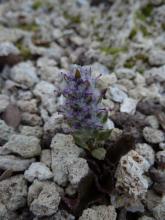
First bud on Paraquilegia microphylla, planted last year! (Well, it's a start! ;))
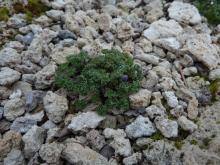
I don't expect these will be any great shakes in the flower department (we'll see soon), but the foliage is nice and furry... Arabis androsacea, from seed last year:
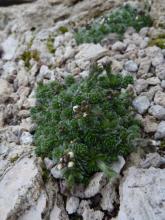
Still waiting for Thlaspi kurdicum to let loose...
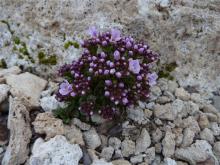
Saxifraga sancta v. macedonica... with a seedling, ex. Sax. 'Mrs. Winifred Bevington' growing in it! (Sheesh, the only seedling I've found... why did it have to give me a dilemma of whether or not to pull it out of the other plant?!?)
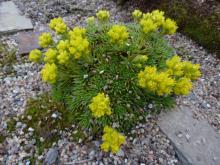
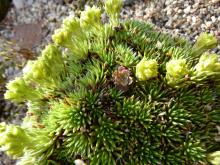
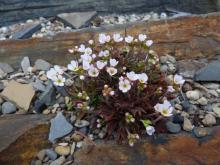
Androsace carnea 'Alba'... which will change quite a bit in appearance as the flower stems elongate:
Trond Hoy
Re: What do you see on your garden walks?
Tue, 05/03/2011 - 12:09pmThose are cute, all, Lori!
Regarding the sax seedling: We all want to pick our neighbours, you know - if we could ;)
Richard T. Rodich
Re: What do you see on your garden walks?
Tue, 05/03/2011 - 8:05pmThe Thlaspi kurdicum is especially captivating...
Can't wait to see it burst out!
Tim Ingram (not verified)
Re: What do you see on your garden walks?
Wed, 05/04/2011 - 12:44amA few pictures taken of our sand bed this spring - started in 2007 and the Yucca is really going places! From top to bottom: Yucca whipplei, Aquilegia grahamii, Lupinus albifrons, Ptilotrichium spinosum, Stachys citrina in foreground; overall view of sand bed, newer planting in front (still to be top-dressed with grit); Arenaria tetraquetra (lovely tight cushion - one of the great attributes of this type of culture); Poygala calcarea (a real winner, self-sowing gently) and Dianthus haematocalyx; Asplenium ceterach (the 'Rusty Back fern', a really useful indicator plant, showing drought by curling up its fronds. I will definitely try more small xerophytic ferns in the bed as time goes on - Asplenium trichomanes also grows well).
This is only a very small bed in our very large garden but gives an inordinate amount of pleasure. I am tempted now to try a more elaborate 'berm' as I have seen in American articles, for genera like Eriogonum, Penstemon, and a host of others. Unfortunately our climate may not be summer-hot enough to succeed with some, and Acantholimon for example grow well but do not flower.
There are a lot more plants to come later into the summer so I will post some of these later on.
Richard T. Rodich
Re: What do you see on your garden walks?
Wed, 05/04/2011 - 12:10pmI can see why you're so proud. There are so many interesting plants nestled in there!
Were the wooden stakes used for winter protection for the Yucca and Juniper?
Trond Hoy
Re: What do you see on your garden walks?
Wed, 05/04/2011 - 12:15pmTim, very impressive!
Your sand bed is it sand throughout or do you mix in some organic matter?
Anne Spiegel
Re: What do you see on your garden walks?
Wed, 05/04/2011 - 7:34pmDespite cold nights, spring is here and every day there seems to be something new.
1. Phlox pungens - crevice garden
2. Phlox pulvinata - trough
3. Petrocallis pyrenaica - crevice
Trond Hoy
Re: What do you see on your garden walks?
Wed, 05/04/2011 - 11:41pmAll I want for Christmas is some new crevices ;D . . . not between my two front teeth though.
Tim Ingram (not verified)
Re: What do you see on your garden walks?
Thu, 05/05/2011 - 12:44amRick - yes the stakes were for a winter cover with dutch lights. We normally only have intermittant snow and plenty of rain over winter and after a year with no cover quite a few plants did less well. The bed is simply a deep hole (ca. 30-45cm) filled with, in my case, a sharp potting grit made from heat shattered flint (the larger grades are used for 'pebble' dashing on houses). At the time I wondered if this would be too sharp compared to the normal sharp sand or ballast that is recommended, but it works well given supplementary watering in dry spells like we are having at the moment. There is no organic matter except that which comes with the plants (I don't wash the roots when I plant). However, I haven't put in a membrane underneath and so worms are steadily bringing up soil and quite a few of the plants must have got their roots down into the soil anyway. So far I have used no fertiliser though i know some growers recommend this.
I was particularly stimulated by the photographs in Ken Druse's book, 'The Collector's Garden', of the Kelaidises garden in Denver, which is infinitely more interesting than a lawn! Unfortunately we don't have that extreme climate here but it would be great to create something similar with different plants.
Lori S. (not verified)
Re: What do you see on your garden walks?
Thu, 05/05/2011 - 8:34pmSpectacular plants, Tim and Anne!
Updates on Thlaspi kurdicum and my first Besseya alpina:
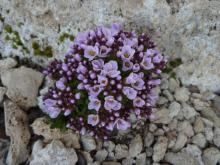
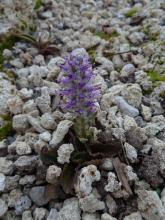
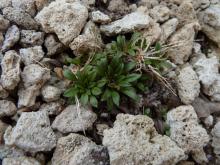
I'm pleased to see that Cheiranthus roseus did not bloom itself to death last year... whether these are non-blooming plants from the previous year, or if some might not be totally monocarpic, I'm not sure. Happy to see some apparent seedlings too.

Anne Spiegel
Re: What do you see on your garden walks?
Fri, 05/06/2011 - 3:40amLori, love the Besseya alpina. I'm growing that and get wonderful foliage and no flowers (both B.alpina and B.wyomingensis). Must be doing something wrong. I'm really fond of all the plants with those fancy exserted stamens (such a Valeriana supina).
Here are some of the things in bloom in the crevice garden and nearby.
Anne Spiegel
Re: What do you see on your garden walks?
Fri, 05/06/2011 - 3:42amOOps. Sorry, I posted Eritrichium howardii twice. And it's Coronilla not corponilla, sorry again.
Tim Ingram (not verified)
Re: What do you see on your garden walks?
Fri, 05/06/2011 - 10:56amIf only we could grow Lewisia tweedyi and Eritrichium howardii outside! It would make the garden incredibly exciting. I've grown them both in pots and enjoyed them, but somehow it's not the same. One question for anyone keen on Astragalus and Oxytropis - I've always thought these would be ideal sand bed plants but I've never had much success. I'd also like to try the little lupins (and at least L. albifrons does well and I should try some of its smallest forms). Do these plants grow in American gardens?
Anne Spiegel
Re: What do you see on your garden walks?
Fri, 05/06/2011 - 12:27pmI grow as many Astragalus and Oxytropis and Trifoliums as possible. They're my favorites, but a lot of planning has to be done. Mine have great drainage, both in the mix and also they are placed where they get very positive air drainage and full sun. Lupinus albifrons does well here but is not long-lasting. Some astragali are easier than others. An easy one to start with is Astragalus monspessulans. Also Oxytropis multiceps. Most of the Rocky Mountain peas seem to need to dry out at the crown in our moist climate and have moisture available way down. Crevice planting has been very successful so far, more so than the sand bed. And dry screes are also good. They are not natural plants here in the northeast, but with some attention can do quite well, at least well-enough to keep a pea-lover like me happy.
Anne Spiegel
Re: What do you see on your garden walks?
Fri, 05/06/2011 - 12:29pmToday in the garden, an unkown but very beautiful astragalus. Creamy yellow flowers, everything is very furry. Label long lost to the antlered rats.
Cliff Booker
Re: What do you see on your garden walks?
Fri, 05/06/2011 - 12:32pmGLORIOUS plant Anne and grown to perfection!
Anne Spiegel
Re: What do you see on your garden walks?
Fri, 05/06/2011 - 2:59pmThanks, Cliff. It is indeed gorgeous, but WHAT IS IT? Anyone have any ideas? It is definitely an astragalus.
Tim Ingram (not verified)
Re: What do you see on your garden walks?
Fri, 05/06/2011 - 3:15pmThanks Anne - so perhaps I do need to make a crevice garden as an adjunct to the sand beds, or maybe grow some of these plants between crevices in troughs. The only species I have grown really well is Astragalus utahensis, which does remarkably well in a pot. But reading of these plants in Claude Barr's 'Jewels of the Plains' and elsewhere is very appealing. I haven't tried species of Trifolium.
Toole (not verified)
Re: What do you see on your garden walks?
Fri, 05/06/2011 - 6:19pmYummy :P :P
From another pea lover.
Cheers Dave
Trond Hoy
Re: What do you see on your garden walks?
Mon, 05/09/2011 - 3:46amBetter to loose the label than that plant!
Tim Ingram (not verified)
Re: What do you see on your garden walks?
Mon, 05/09/2011 - 4:50amI've got a few more pictures from our sand bed which is slowly being top-dressed with new grit - a slow old process but very satisfying. With all the talk of crevice gardens (especially in the UK), its a great surprise more comment is not made of sand beds - they are equally effective for many plants, but do perhaps need more care and cover over the winter. Perhaps they are just too easy!
From top: Edraianthus pumilio (in its superb silver-leaved form owerinianus)
Stachys citrina
Silene hookeri (what a plant!)
Thymus 'Peter Davis'
Overall view of bed with Yucca whipplei and Dasylirion species
There is also a beautiful annual gentian flowering, G. syringea, from the Himalayas (see under G. nivalis thread elsewhere)
Peter George
Re: What do you see on your garden walks?
Mon, 05/09/2011 - 6:22amYesterday was beautiful, and my Daphnes are all in bloom. Here are a couple, Daphne x napolitana and Daphne cneorum 'Porteous.' The latter was purchased from Wrightman's 3 years ago, and was about the size of a bottle cap. It's been unbelievably floriferous, and is now about 18 inches in diameter, and still totally prostrate. Harvey told me that he found it in Barrie Porteous' garden, stuck away in one of his huge troughs, and took a few cuttings. What a find!
Anne Spiegel
Re: What do you see on your garden walks?
Mon, 05/09/2011 - 6:44amRe: sand beds. They are indeed easy, especially if they are like mine and are just pure sand. Yours looks very good. High desert plants love them as do many penstemons, townsendias and eriogonums. I've found that I can grow a wider range of plants here in crevice gardens. The close spaces between rocks remain cooler and seem to retain more moisture deep down. I think even a western plant growing in dry as a bone clay with big cracks from drought have some moisture available to them deep down. Ranunculus seguieri, a snow-melt plant and not a drought-lover, can grow in the Dolomiotes in bare high meadow spots in soil that looks and acts much like western clay. That may be partly due to their preferring their own company and putting themselves in places without much competition, but also because there is moisture available to them well below the surface.
Pages