
A bit of a falsehood for my first posting on this thread :) --(however i promise that my next posting will be of a trip to view alpines at sea level --then into the mountains proper).
I thought members might be interested in seeing what most of New Zealand would have looked like, before land clearance and timber harvesting reduced the size of the native podocarp forests.
These forests can still be found in some parts of the North Island------ and here at the bottom of NZ in my home province of Southland. The largest podocarp forests are on the West Coast of the South Island.
Podocarp forests are a mixture of tall podocarps and smaller trees with an understorey of shrubs, plants and ferns and soil and climate conditions play a major role in determining which species are the most dominant .
In Southland, Totara ,(up to 30 mtrs in height),grows closest to the coast, on almost pure sand. As the soil nutrient levels increase, Mataï and Rimu appear. With Kahikatea ,(up to 60mtrs in height),on the wetter sites.
Although they belong to the conifer family which reproduces using cones, podocarps spread their seeds through berries which are transported by being passed through birds. Because of the abundant range of fruits, podocarp forests also support larger communities of insects and birds such as bellbird and tui .
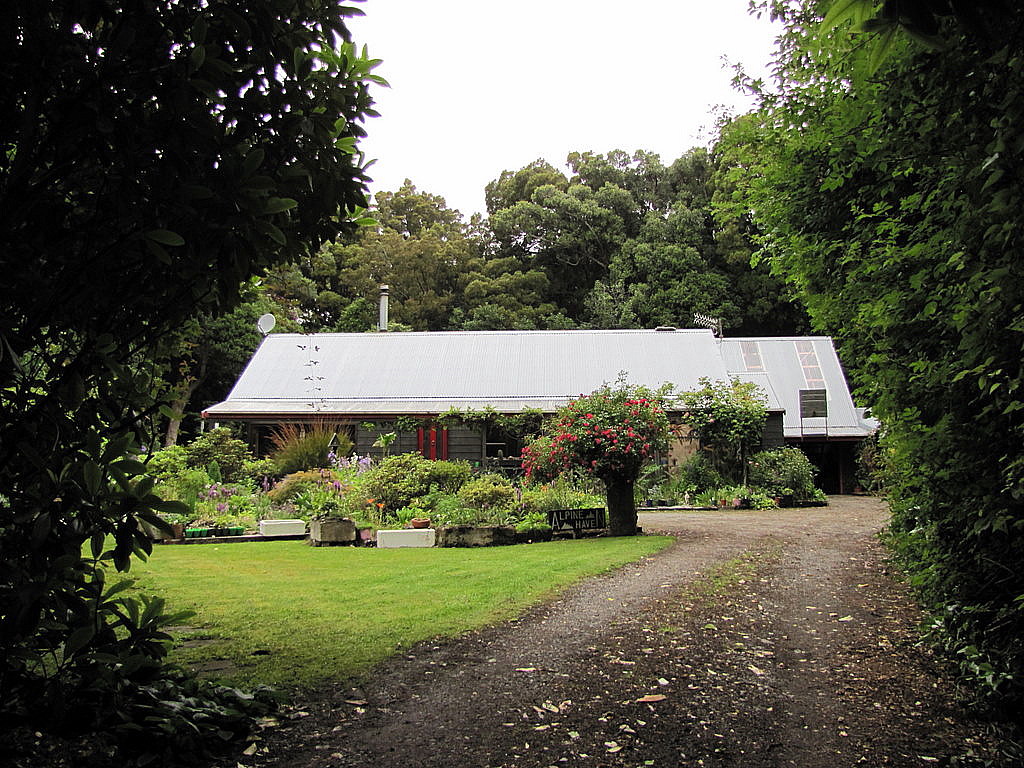
Our residence is situated in one of these forest ,(bush), remnants which backs onto a larger public native reserve and although we are only a couple of ks from the coast our bush has most of the large forest trees mentioned above.
The first pic is of our house surrounded by bush on all sides to give you an idea of scale.
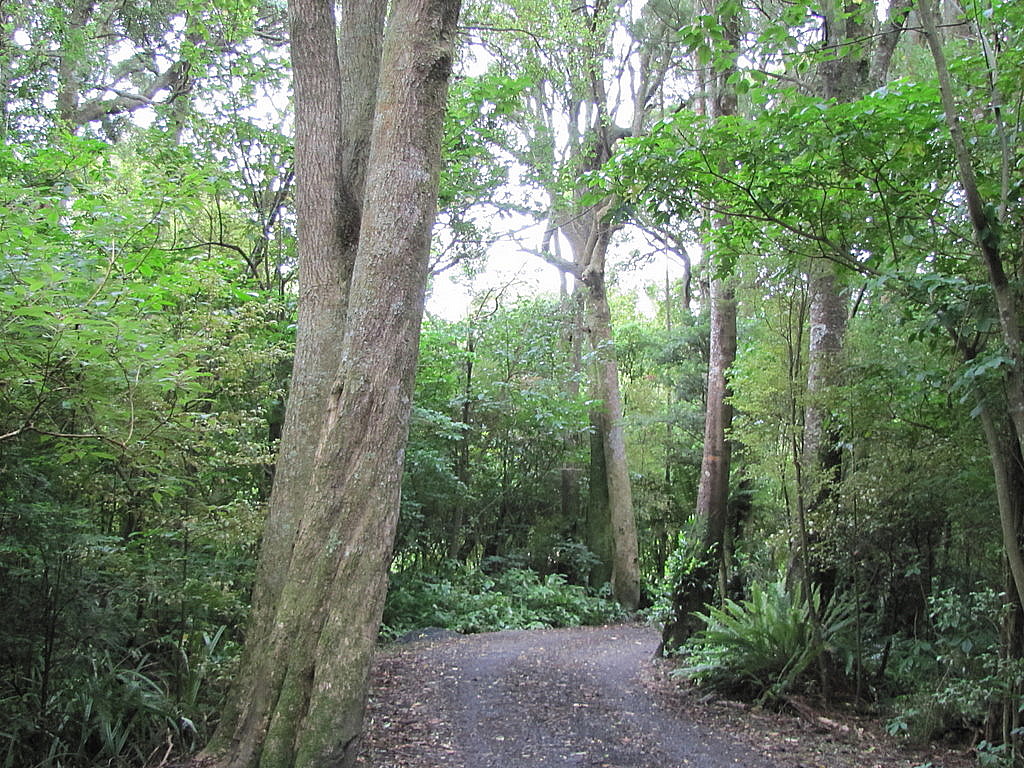
The following pics are of the various genera of dominant trees ,various ferns –Asplenium and Blechnum sps ---–the long strap like leaves of the bush flax ,Astelia ---the stringy bark of a tree Fuchsia and finally the impressive Dicksonia,(tree ferns),all within a few metres of our back door.
Cheers Dave.
Comments
cohan (not verified)
Re: New Zealand Alpine Flora
Sat, 12/01/2012 - 10:55amNice views and plants, Steve- that Ranunculus is quite striking!
Trond Hoy
Re: New Zealand Alpine Flora
Sat, 12/01/2012 - 12:40pmHave to agree with Cohan, the Mount Cook Lily is magic! But so are a lot of the other NZ plants too :o
Fran, I read somewhere that NZ has more divaricate plants than other countries but it is not clear why as you can find similar climate and soil other places. Divarication is not restricted to one or two genera either but exists in many plant families. Maybe it has something to do with extinct browsing megafauna?
Steve Newall (not verified)
Re: New Zealand Alpine Flora
Sun, 12/02/2012 - 1:02amHi Trond - I think you are right about the megafauna browsing . http://en.wikipedia.org/wiki/Moa . As well as divarication in many genera there is juvenile foliage in others . This juvenile foliage is not as yummy as the mature foliage and generally the juvenile foliage lasts until the species reaches 4-5m and is well clear of moa browsing .
Fran - The broom we have here is a bad weed as Dave has mentioned but I have also seen it in Washington state . It is not as bad a weed there as it is here but may do so given time
Tim - As you have spotted , the Hooker Valley and Mt.Cook lilies have a lot to do with Cook . The mountain - named after Cook , Ranunculus lyallii - named after the ships botanist and the specimens were sent back to Hooker at Kew .
I never tire of our scenery , flora or fauna and I feel privileged to call it home .
Cohan - Thanks bud . I think our buttercups have the best flowers of our alpine plants but overrall NZ alpine flowers struggle to compete with the flora from the rest of the world .
cohan (not verified)
Re: New Zealand Alpine Flora
Sun, 12/02/2012 - 3:31pmSteve, I haven't focussed specifically on the flower power of NZ Alpines, but they are absolutely top notch for cool factor- and while pretty flowers are great, I'd happily grow some very cool plants with just okay flowers :) I doubt many of your alpines are hardy enough for here, though!
Toole (not verified)
Re: New Zealand Alpine Flora
Sat, 12/15/2012 - 12:34amVisited the city's feature park ,(Queens Park),this morning .
Near the main entrance, Brachyglottis huntii was in full bloom --a highly aromatic plant ,(like a number of the Genus in NZ ),i was pleased to see a number of youngsters had been planted out as a few of the mature trees are looking a bit scraggly.
It's a great year for the NZ Cabbage Tree ,Cordyline australis ---Flowers emit a strong scent of Jasmine --lovely :-*
My main reason for visiting was in the hope that a number of natives in the Subantarctic Garden would be in bloom.I wasn't disappointed....However i had a short stop on the way,to visit the Tuatara enclosure,where one of inhabitants was out warming his/her self ,(maybe a male because of the defined spines along it's back :-\).
A short walk through the building and out onto the path and a view of the megaherbs.Its' a small garden with a boardwalk through the middle.
A single plant of Bulbinella rossii and a mass of Anisotome lyallii.
Cheers Dave.
Toole (not verified)
Re: New Zealand Alpine Flora
Sat, 12/15/2012 - 1:04amSteve showed a pic about a month ago of his Anisotome latifolia's flowering --they are in bloom down here now.
The strong growths of Acaena
magellanica. Edit--- Should be Acaena minor antarctica.Creeping Lobelia angulata.
Stilbocarpa polaris ,(i think i saw one of these at Steve's place last month).
Carex trifida --i often use this when landscaping for clients---it's so tough and i love the dark flowering heads.
The highlight was Myosotis capitata ---a number were showing the effects of what i presume is their dislike of high air temp /high humidity.Stunning plants all the same.
Wasn't too sure on this Aciphylla .. looks like Aciphylla dieffenbachii to me :-\
Hopefully i have identified all the plants correctly . :-\
I also visited the native rock garden where the various mainland Aciphylla's were in bloom and going ballistic .... :o I'll post a few pics of that garden tomorrow.
Cheers Dave.
cohan (not verified)
Re: New Zealand Alpine Flora
Sat, 12/15/2012 - 11:00amWhat a lot of great plants! the trees are very impressive- Cordyline spp here are only houseplants, usually languishing in poorly lit corners or temporary summer bedding/basket plants for a bit of texture...
The Anisotome latifolia with the lilac flowers is great!
That is an Aciphylla?? (the maybe dieffenbachii) I had no idea there were species that look like this- I expect them to look more like Yuccas! A quick google showed me there are at least a couple of these softer plants that show their family connection!
Trond Hoy
Re: New Zealand Alpine Flora
Sat, 12/15/2012 - 12:35pmCorydalisCordyline of course! isn't hardy outside here in winter either, however I grow 3 specimens in pots! I would love to have them in the garden all year though! I have never tried Brachyglottis huntii but B 'Sunshine' survives most winters. MY favorites in this great bouquet of pretty plants are Bulbinella rossii and Anisotome latifolia!Steve Newall (not verified)
Re: New Zealand Alpine Flora
Sat, 12/15/2012 - 10:09pmNice Dave . They have a really good native section there . The Aciphylla dieffenbachii is what you think it is . The Acaena maybe A.minor antarctica . Was out at the beach today - 28C and the dog really needed a bath . She had not seen waves before but she is now a surfer dog .
Toole (not verified)
Re: New Zealand Alpine Flora
Sat, 12/15/2012 - 10:24pmThanks all.
Steve
Yip you are correct the Acaena is A.minor antarctica :).I'll make an edit above.
Was hot here too today.
Cheers Dave.
Toole (not verified)
Re: New Zealand Alpine Flora
Sat, 12/15/2012 - 10:46pmIt doesn't end there Cohan .
There's even a Celmisia ,(C.lyallii), that resembles an Aciphylla when not in bloom --it has the common name of 'false spaniard' .....
Cheers Dave.
cohan (not verified)
Re: New Zealand Alpine Flora
Sun, 12/16/2012 - 4:33pmThose Celmisias really do seem to have all the bases covered foliarly, don't they?
Mark McDonough
Re: New Zealand Alpine Flora
Mon, 12/17/2012 - 6:04amMany thanks Dave and Jandals, for the continuing saga of New Zealand alpine flora. I've been mostly lurking when I haven't had sufficient time to respond properly, but the alpine scenery and incredible plants shown here are truly exciting and educational, many NZ plants seem pure whimsy as they're so different and intriguing (Aciphylla, for example).
Clematis afoliata surprises me, very different than one's normal connotation of the genus. The alpine mats and buns of Pimelia (prostrata and pulvinaris) are exquisite, as is Myosotis uniflora. Love the trees too, Brachyglottis is a new genus to me, attractive.
The plant on the recent batch of photos that most resonates is Bulbinella rossii, wish I could grow that beauty, but all indications are it's not reliably hardy in colder climates. The Bulbinella has me thinking about the unusual distribution of the genus, split between South Africa and New Zealand. The ones posted on Pacific Bulb Society wiki galleries show beautiful plants from South Africa, but these more sparse and narrow leaves species have a somewhat different look than B. rossii, the latter with foliage that is broad and as much of the show as the flowers.
http://www.pacificbulbsociety.org/pbswiki/index.php/Bulbinella
Toole (not verified)
Re: New Zealand Alpine Flora
Mon, 12/17/2012 - 3:37pmThanks for the kind comments Mark
It's educational for me as well as i don't know everything and it's been terrific going out in the field with other folk having a lot of fun and learning from them.
To visit the Subantartic Islands is on my bucket list --just gotta get over my fear of water and convince Hilda she should come as well as i think it will be cheaper in the long run than her flying to Sydney on a shopping frenzy.... ;) ;D ;D
Cheers Dave.
cohan (not verified)
Re: New Zealand Alpine Flora
Mon, 12/17/2012 - 11:21pmHow far/long to travel is it to get to those islands from main population centres in NZ?
Toole (not verified)
Re: New Zealand Alpine Flora
Thu, 12/20/2012 - 11:12pmSorry for the delay in replying Cohan .....Xmas rush and all that,as well as sorting out my gear for the next couple of days botanising in the 'hills'.
The subantartic Islands are well spread out --the middle land mass which are the Auckland Islands are about 460 Ks south from here, so i understand over a days travel by boat .
Cheers Dave.
cohan (not verified)
Re: New Zealand Alpine Flora
Fri, 12/21/2012 - 8:19pmOh, that's a long time in a boat! for a landlubber like me at least ;)
Steve Newall (not verified)
Re: New Zealand Alpine Flora
Thu, 12/27/2012 - 2:26amHope you have all had a good time with family and friends over the Christmas break .
Managed to get away for a few days before Christmas with Doug Logan and his son Jack (12) . Our main mission was to get to the top of Hoary Head , a limestone mountain near the top of the south island . It's a little hard to get to so we thought we would cheat and go in a helicopter . Unfortunately this requires the mountain to be free of cloud and although it was a nice day in the lowlands the clouds remained about the hills . So at 2pm it was called off for the day and we set off for some sightseeing after a refreshing swim in the outdoor pool at the camping ground .
On Takaka Hill we found Kanuka (Kunzea ericoides) and Manuka ( Leptospermum scoparium) both flowering in the same area . It was a good chance for Doug to show off skills and teach me how to tell them apart properly . It's easy when someone shows you and much better than my method of telling them apart "They are spelt slightly differently"
So Manuka on the top and the smaller flowers of Kanuka underneath
After visiting a couple of gardens it was off to Pupu springs , the largest cold water springs in the southern hemisphere . 14000 litres/sec . The water is very clear after its slow journey through the marble mountains and horizontal visibility is 63 metres . We saw some nice fish but the water was so clear I ended up taking pictures of a fish's shadow thinking it was a fish . I have tried to show both below
A drive to Collingwood followed and at the beach there were plants of Spinifex sericeus and Desmoschoenus spiralis , 2 native species of sand binders .
The one below is Desmoschoenus spiralis
The day finished with tea in Takaka and a call from the wife . The former was very enjoyable but there technical problems with the latter when she found out we were having a good time and I wasn't getting any work done . Fortunately Doug and I came up with a very cunning plan to calm my most illustrious leader down but it required an itinerary change later
The next day dawned beautifully clear and at 7am we headed off to the helipad and were soon on our way up the hill . Jack had a great view from the front seat . Hoary Head is all limestone and is the only home of the world's smallest clematis , C.marmoraria . We found lots of plants in flower
There was also Pimelea nitens
and Poranthera alpina
I headed off down the hill to visit a large sinkhole where I used to camp when I walked to Hoary Head in years gone by . Older and wiser(?) now . Saw a lovely white Astelia nervosa . Unfortunately with some leaf damage due to browsing goats
White pellicles on the leaf
Steve Newall (not verified)
Re: New Zealand Alpine Flora
Thu, 12/27/2012 - 2:43amThere were also plants of Astelia graminea
Craspedia lanata
Anisotome aromatica (?)
Notothlaspi australe
Anaphalioides bellidioides
and a Brachyscome sp
A highlight of the day was Myosotis arnoldii and its unusual flower colours . Sometimes the flowers are almost black . Doug and Jack found a yellow one
The city of Nelson is on the other side of the bay
Steve Newall (not verified)
Re: New Zealand Alpine Flora
Thu, 12/27/2012 - 3:15amThe last part of our journey involved Doug driving a road he swore he was never going to drive again , but it was going to keep my most illustrious leader off my back . His sacrifice was greatly appreciated . Soooo , instead of going up the Cobb Valley we went to Mt.Stokes in the Marlborough Sounds . We also left our flash camping ground behind for a night under the stars . Well it would have been if the clouds had gone away . So we were a little damp in the morning which reminded us of a previous trip where we had left a perfectly good camping ground behind for a night under the rain clouds (see NZAGS journal) .
However , on the bright side , the big snails ( Powelliphanta spp ) were out in the rain on the Mt.Stokes track . These guys/gals (apparently they can choose) live for 20 years and their shells can reach 90mm in diameter . They hatch from eggs and there is one below
The weather was awful on top of Mt.Stokes and Jack and Doug sheltered underneath the solar panels to stay dry
It was a tantalising glimpse of what was on offer and I would love to go back on a nice day . I don't get to see many new species of Celmisia these days so it was nice to see Celmisia rutlandii for the first time
Bulbinella hookeri I have seen before
...and we saw a lot of the mountain cabbage tree - Cordyline indivisa . And this was what I was supposed to be looking for , to see if there were any flowers . Which , sadly , there were none . However I could tell the wife I tried
It was nice to change into dry clothes back at the car then it was 6 hours driving to Doug's house ( part of that on the sweary sweary road ) and then another 6 hours drive to my place . Arrived home early Christmas morning and waved at Santa whenever I saw him
Mark McDonough
Re: New Zealand Alpine Flora
Thu, 12/27/2012 - 5:51amJandals, fascinating trip and equally fascinating plants, thanks for posting these. I've never seen the likes of Myosotis arnoldii, what unusual colors. As a long time fan of New Zealand flora, I was curious about Proanthera alpina, couldn't find it at first, then with the magic of google where it suggests likely matches it came up with Poranthera alpina; I think that's it... the "r" and "o" position was transposed :) Aparently it was once named Oreoporanthera, and can be found under that name too when doing a search.
http://www.nzpcn.org.nz/c/flora/factsheets/NZPCN_Species_610.pdf
The plant labeled as Euphrasia species looks like Notothlaspi rosulatum to me, what do you think?
Steve Newall (not verified)
Re: New Zealand Alpine Flora
Thu, 12/27/2012 - 10:16amThanks Mark . I should have picked up on the Notothlaspi australe when I saw it and also when I processed the picture . Well spotted . The Poranthera alpina was a new find for me ( with help from Rebecca Bowater) and a genus I was unfamiliar with . As luck would have it there is a new book out on NZ Alpines (Above the Treeline) and it's in there
Trond Hoy
Re: New Zealand Alpine Flora
Thu, 12/27/2012 - 11:40amAlthough the weather has been reasonable today I have spent most of the time indoors looking through old documents and pictures to decide what to take care of and what to throw away. Not the most exciting way to spend a day though!
Jandals, had to take a look at this site for cheering up myself a little ;D Wouldn't mind taking a walk among plants and mountains :-\
How much cold does the mountain cabbage tree take?
Tim Ingram (not verified)
Re: New Zealand Alpine Flora
Thu, 12/27/2012 - 2:43pmThe mulled wine and Christmas pudding is only just wearing off! Fantastic plant of Astelia nervosa, the equal of any of the whitest celmisias like 'David Shackleton'. And the habitat shot of the Myosotis is really fine. Nice to see these plants as the rain keeps pouring down outside.
Richard T. Rodich
Re: New Zealand Alpine Flora
Thu, 12/27/2012 - 4:56pmReally interesting stuff, Steve. I thought you must have been kidding about the snail egg, but I was wrong!
Even more interesting, as I was reading, is that Powelliphanta spp. are carnivorous snails.
(And Trond, apparently they can eat slugs, too.) :o
Trond Hoy
Re: New Zealand Alpine Flora
Fri, 12/28/2012 - 12:08amRick, I do consider it ;) However it isn't easy to smuggle neither snails nor eggs - they are too big!
Steve Newall (not verified)
Re: New Zealand Alpine Flora
Fri, 12/28/2012 - 12:26amNot a lot Trond . They are a plant that likes to live halfway up the hill . Too cold on the tops and too cold on the valley floor . They also like a lot of moisture . There are some in cultivation here in the south but I don't know about further north .
I'm sure the slugs have nightmares about Powelliphanta snails as apparently they take a long time to munch them
Sounds like you had a good time Tim . I had my first alcohol free Christmas . Mainly because I fell asleep under a cherry tree after lunch
Pleased about that Rick . Doug must have been telling the truth . He's a regular font of knowledge
Cliff Booker
Re: New Zealand Alpine Flora
Fri, 12/28/2012 - 1:33amSuperb stuff (as always), Steve ... are helicopter lifts very expensive?
Steve Newall (not verified)
Re: New Zealand Alpine Flora
Fri, 12/28/2012 - 9:34amThat one was cheaper than normal Cliff only $85 . Rebecca Bowater knew somebody and the pilot was happy to stay up there with us (which really helps with the price) . Next December we will be going someone further away from base and it will cost between $300 and $400 each and we are going to make sure Mr.Toole is there as well . There is also a helicopter base near Mt.Cook should you wish to try this most excellent way of ascending a hill
Trond Hoy
Re: New Zealand Alpine Flora
Fri, 12/28/2012 - 9:43amA bit difficult to spot plants from a helicopter? ;)
Toole (not verified)
Re: New Zealand Alpine Flora
Fri, 12/28/2012 - 11:21pmSeeing Dougs wonderful pics on the SRGC and yours here brings me to tears Steve :'( :'( ;)
I so wish now that i had traveled up with guys ....
Anyway i managed a visit recently ,a couple hours up the road to the Rastus Burn Conservation Area –Remarkables Range near Lake Wakatipu ,Central Otago.
I was surprised on how much snow was still about however I managed to spend a number of hours searching around on the lower slopes, although I was bit early for a number of genera .
The forecast for the next few days is for this warm spell to end and snow is expected down to about 1000 mtrs so it looks like it will be a later visit to view gems higher up on the shady slopes…..
Apologies on the clarity of some of the pics –I was ‘playing around ‘with different shooting modes and lenses.
Aciphylla simplex on fellfield near Lake Alta.
Toole (not verified)
Re: New Zealand Alpine Flora
Fri, 12/28/2012 - 11:42pmHard grey growths of Chionohebe thomsonii in cushion field , along with Myosotis pulvinaris in full bloom and Hectorella caespitosa needing a day or two….. .
In wet areas Ranunculus ensyii --a smaller species by NZ standards but a mass of yellow everywhere. The plants that had leaves with red margins being the most attractive.
Toole (not verified)
Re: New Zealand Alpine Flora
Fri, 12/28/2012 - 11:58pmThe predominate cushion here is Dracophyllum muscoides that form large moss like
mats .
In amongst the snow tussock grassland the vivid colouring of Aciphylla kirkii.
In a cool spot the creeping caterpillar like growths of one of the smaller mountain foxgloves, Ourisia glandulosa .
Acaena saccaticupula with a nice colour combination of red lichen on the base of the rock.
Further down the access road Aciphylla aurea.
Final view back up the road to the Remarkables .
Cheers Dave.
Trond Hoy
Re: New Zealand Alpine Flora
Sat, 12/29/2012 - 11:20pmNot a bad trip Dave! What altitude is it?
Cushion plants are remarkable - we have none here, the nearest would probably be the moss campion Silene acaulis.
Aciphylla is an interesting genus and so is Ourisia ;) In fact, they're all interesting. Even the familiar genera look very exotic!
Michael J Campbell (not verified)
Re: New Zealand Alpine Flora
Sun, 12/30/2012 - 3:20amDave, what is that blue thing with the white fluffy stuff behind the hill in the last picture? We don't have anything like that here ;D ;D ;D
Trond Hoy
Re: New Zealand Alpine Flora
Sun, 12/30/2012 - 5:00amMichael, don't boast! I'm sure that you have more of it than I have ;)
Cliff Booker
Re: New Zealand Alpine Flora
Sun, 12/30/2012 - 12:10pmAnother magnificent report, Dave ... many thanks once again.
Toole (not verified)
Re: New Zealand Alpine Flora
Sun, 12/30/2012 - 1:40pmHello Hoy --I park my motorbike at the carpark at 1600m and it's a gradual climb up to Lake Alta at about 1800m.
Didn't see any of that this morning as i spent 2 hours on the mountain bike.Actually i found pedaling in the rain today quite exhilarating ......(I know I'm not well ! ;D ;D).
Thanks Cliff
Looking forward to your visit out here next year Bud. (See comment to Michael just above --I've started training already ;D ;) ).
Cheers Dave.
cohan (not verified)
Re: New Zealand Alpine Flora
Wed, 01/02/2013 - 4:07pmWow as always :)
Steve- So many great whites--Astelia graminea, Craspedia lanata, , Anaphalioides bellidioides and the Myosotis!!
I always assume NZ plants would not be hardy here, but have recently seen a couple of alpines listed as z4, which starts to get within the realm of possibility, at least ;D
Dave- love the Acaena's overall red, and more great Aciphyllas- would love to grow one of those :)
Steve Newall (not verified)
Re: New Zealand Alpine Flora
Fri, 01/04/2013 - 10:47amI remember reading about a woman growing Raoulia australis in Ontario where it survived -35C . In continental Europe I saw some expats growing outside happily and like the Raoulia australis , they were all riverbed plants .
Raoulia australis , R.haastii , Muehlenbeckia axillaris , Geranium sessiliflorum nigricans and Acaena inermis are some that I remember . They all like to be in the mountains but on the valley floor . Summer temps are hot - high 30's and winter temps are cold - -15 to -20 , with minimal snow cover . They have to cope with dry periods whilst growing in gravel and it can be very windy so they have to be tough .If you want to try some from seed let me know and I will pick some for you and send it fresh .
The original seed collection for the Celmisia Inshriach hybrids was the Gertrude Valley , where there are also weather extremes with unreliable snow cover , and these hybrids have done very well in Scotland .
Although I have been often asked to collect seed at the highest altitudes to optimise hardiness I think anything that grows on the valley floor will be hardier than something high on the hill that is buried under snow all winter and where the temperature is always near 0C at ground level .
Our buttercups would probably survive your winter (they go dormant ) but your summers would be too hot and dry
Lori S. (not verified)
Re: New Zealand Alpine Flora
Fri, 01/04/2013 - 11:00amWrightman's Alpines in Ontario sells Raoulia glabra, for one.
Well, dry-ish, yes. Hot, no. If you ever visit, be sure to bring your woolies! ;D
Toole (not verified)
Re: New Zealand Alpine Flora
Sun, 01/06/2013 - 1:11amThanks Cohan
Yes i thought Steve's white Astelia to be a beauty too .
Here's some pics of a trip i made just over a week ago, down to the coastal area of Omaui ,a few kilometres south of where i live.
I wasn't alone --i took 'Monty' ,(12 months old),along for his first real field trip .I was bit concerned on what would happen if he came face to face with a NZ sea lion as i had seen some tell tale tracks last year ,however the only 'incident' was the hound trying to catch up with a rabbit.
Anyway onto the plants ....
Raoulia hookeri var hookeri with the still waters of Foveaux Strait in the background.(It has a nice silver look to it Lori).
Coastal bind weed Calystegia soldanella poking out from it's house. :)
It's a great year for flowering of the ground covering Samolus repens--- a lovely little thing when you get up close --- 2 pics of close ups.
Worked all weekend as we have a UK visitor ,Norman Thomas, staying with us from tomorrow for the next few days---- so if the weather holds ,moisture wise,we hope to head away looking at Celmisia's and a few other weeds ;).
Thankfully the temps are forecast to be at least 10c cooler than the 30c plus conditions we had yesterday. :P :P :P
Cheers Dave.
Trond Hoy
Re: New Zealand Alpine Flora
Sun, 01/06/2013 - 2:47amSamolus repens is quite nice! And completely unknown to me . . . . At my summerhouse Calystegia sepium is the coastal bindweed and have spread to gardens as the ultimate weed! Raoulia is also a decorative plant to my liking!
Steve Newall (not verified)
Re: New Zealand Alpine Flora
Sun, 01/06/2013 - 9:38amNice Dave . Pleased Monty behaved himself and I bet he had a great time . I see that the horizontal rain that usually accompanies me to Omaui was missing
Wil take my woolie hat with me just in case I head north across the border .
Maybe Ranunculus crithmifolius might grow at your place
Lori S. (not verified)
Re: New Zealand Alpine Flora
Sun, 01/06/2013 - 10:27amSamolus repens is really beautiful!
Well, a hat is good... For our hikes here, even though we usually pick fair weather and go out in shorts and T-shirts, we have never regretted carrying packs filled with all-weather gear (rain jacket, fleece jacket, insulated pants, gloves, warm hat, light wind pants and jacket) - we quite often use it all! ;D
This thread is very helpful for getting some kind of a grasp on which New Zealand natives might be possible to grow here. Thanks!
Toole (not verified)
Re: New Zealand Alpine Flora
Sun, 01/06/2013 - 2:44pmOops --just realized i hadn't included a pic of the Raoulia hookeri
var hookeri in my last posting ---Duh !! ;D
Cheers Dave.
Mark McDonough
Re: New Zealand Alpine Flora
Sun, 01/06/2013 - 6:44pmVery nice Dave, we always think of Raoulias as high mountain plants, not as beach-goers; very interesting. Great scenic shot.
Trond Hoy
Re: New Zealand Alpine Flora
Mon, 01/07/2013 - 12:22amEasier to see it here, I admit that. Was sure you talked about some of the whitish heaps in the first picture ;D
Cliff Booker
Re: New Zealand Alpine Flora
Mon, 01/07/2013 - 12:22pmWell worth waiting for, Dave!!!
cohan (not verified)
Re: New Zealand Alpine Flora
Mon, 01/07/2013 - 11:22pmDave-I agree about Samolus- very cute :)
Steve, what gear you'd need across the border would really depend on where you cross- interior southern British Columbia would be more of a continuation of some of the places you visited this year in the U.S. with hot dry summers, and parts of southern Alberta, away from the mountains, can also be quite warm, though Alberta generally has more of its rainfall in summer than B.C.. Lori and I are nearer the foothills, so our summers can be pleasantly warm and sunny with chilly nights, or we can have some wet and chilly days thrown in through the summer (with nights not far above frost or even frost, possible at almost any time), and being a bit farther north,and just barely outside the foothills biome in boreal mixed forest, my climate is a fair bit wetter than Lori's, year, round. This past summer, while we had more warm days than the couple of previous years, I still had to water outdoor seed pots only a small handful of times between May and August, and actually germinated some winter growing South African plants outdoors over summer! (they had to come indoors in early fall).. so, hot and dry are not big concerns in my garden ;D - dry years are not unknown here, just not recently!
Any seed you think might have a chance would be welcome indeed :) Thanks!
Pages