
Forums:
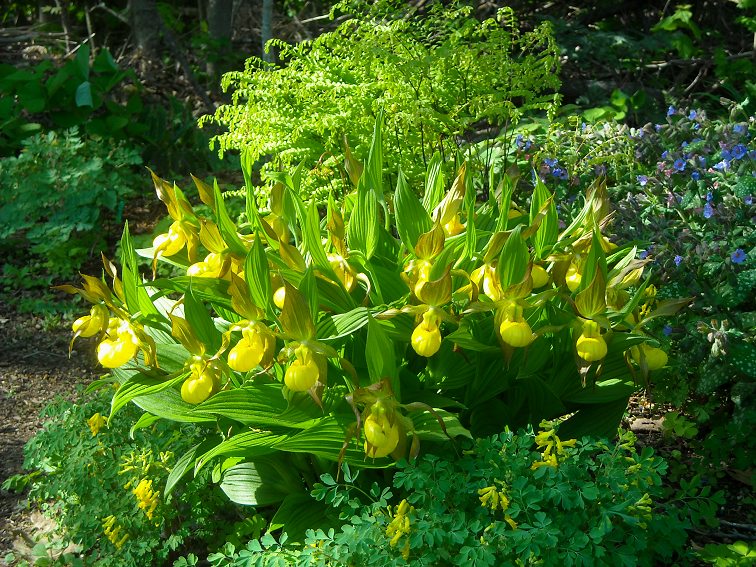
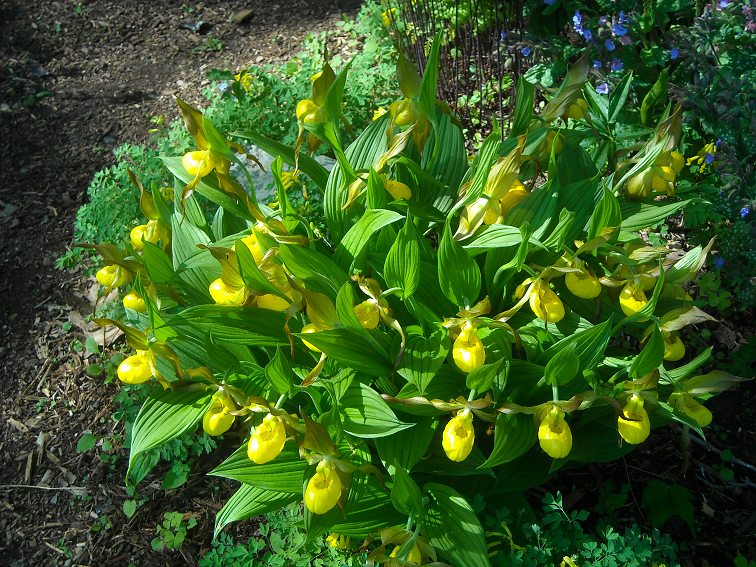
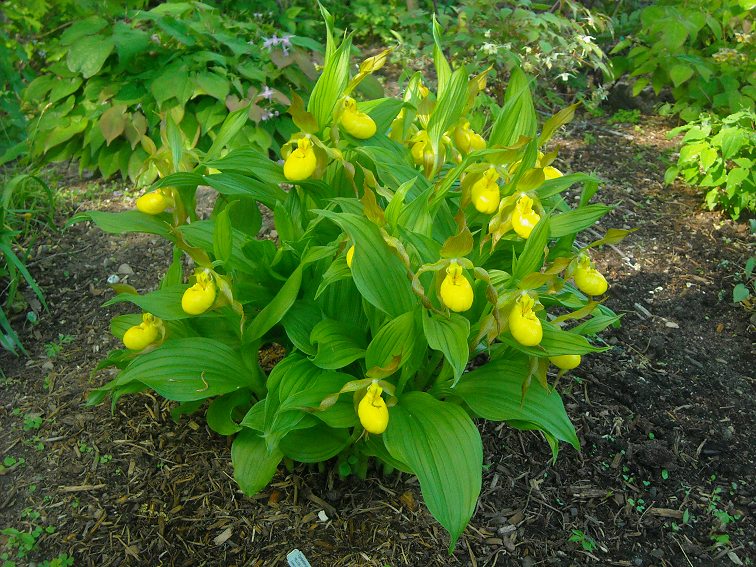
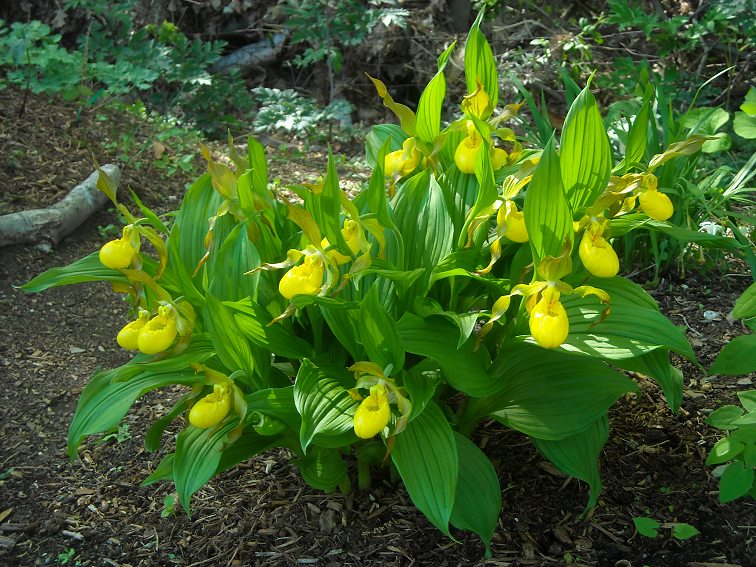
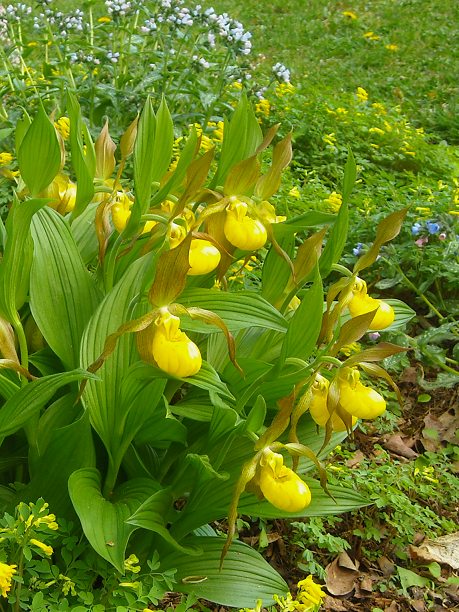
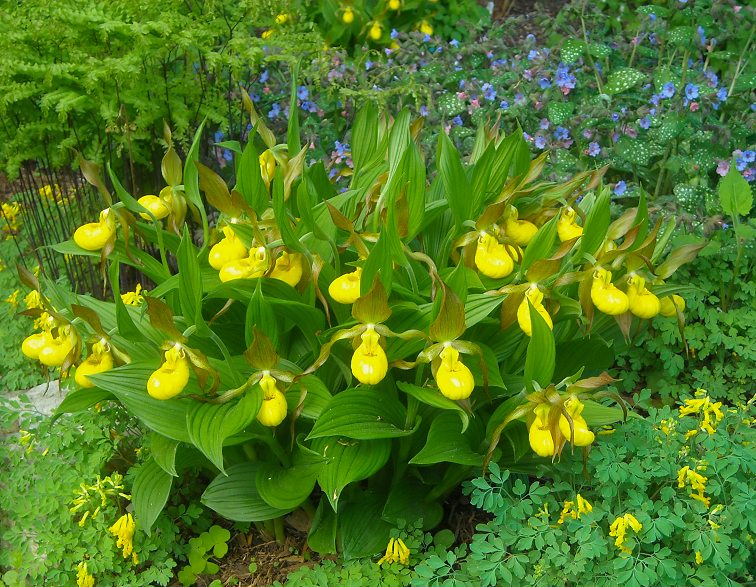
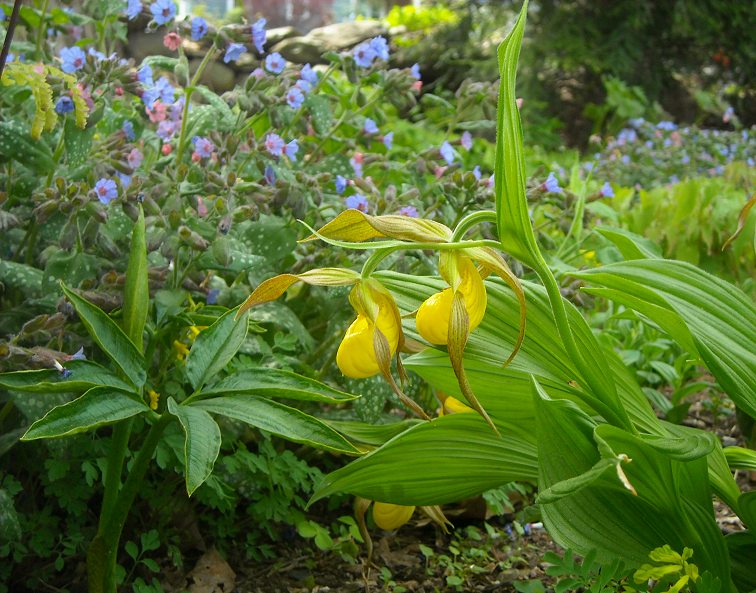
I'm starting this thread for terrestrial orchids, such as Cypripedium. I'll start out with a common "cyp" familiar to many of you, Cypripedium parviflorum var. pubescens. I know I went overboard shooting photos, but I just had to show some images, the plants have outdone themselves this year. Three unseasonably hot days pushed these along faster than I could have imagined, when they were just barely hinting as showing buds mere days ago. The bigger of my two large clumps has 32 pips this year.


Comments
Mark McDonough
Re: Terrestrial Orchids
Sun, 01/20/2013 - 6:45amGordon, thanks for the tip on Cypripedium acaule on the Thimble Farms site. Even though this species grows in the woods nearby, I've never had luck growing it over the long term; maybe the revealed formula is the key.
When I was a boy at around age 10, I first came across Habenaria psychodes (as it was named in those days), and would go visit each spring to see this fine fringed orchid, and other nice woodland plants like masses of Clintonia borealis, and the aforementioned Cyprepedium acaule. You'll have to show us some photos when your plants are in bloom.
Plantanthera psycodes
http://plants.usda.gov/java/profile?symbol=PLPS2
http://wisplants.uwsp.edu/scripts/detail.asp?SpCode=PLAPSY
Gordon Tingley
Re: Terrestrial Orchids
Sun, 01/20/2013 - 7:25amHi Mark,
I'm just hoping that everything survives the wild temperature swings we have been getting over the past week, and into the week ahead (+9 c today, -7 tomorrow, and down to a high of -12 c by Thursday).
From what I have read, Cypripedium acaule requires an extremely acidic medium for its root zone. I've heard of folks amending the plant site with masses of pine needles to drop the pH as far as possible. I remember visiting a patch of them as a child, seeing them growing in rock crevices filled with mosses and the like. To be honest, I thought they'd perish from drought, but I guess these spots collected enough rain runoff to keep the plants happy.
cohan (not verified)
Re: Terrestrial Orchids
Sun, 01/20/2013 - 1:42pmHope your new plants do well, Gordon- we have those temperature swings here as well, but it's quite normal-- we were above freezing part of the week (+12 some days ago) with a high of 15C today...
Here are a couple of pics of our local Spiranthes- S romanzoffiana-- I have more and better pics somewhere, but this is the first set I came across. I know them from two sites nearby, though there are surely more. They used to grow on the farm, but have been shaded out over the years as woodies etc grew up.
Both sites are on roadsides and in the ditch in one case, moist areas (though this site, right at the edge of the gravel road must get dry on occasions, even though it is wet just below the road). Soils are mostly clayey subsoils left after road building many years ago, and any humus layer must be very thin.. There are quite a few plants at both sites, and all small, probably 15 cm more or less.
The last shot shows the habitat for this site, in the grassy verge with Parnassia palustris, Gentianopsis crinita, sedges, clover etc..
Gordon Tingley
Re: Terrestrial Orchids
Wed, 01/23/2013 - 7:43amHi Cohan, tanks for the Spiranthes photos. There are a few species locally, though none on our property. I hope to add Spiranthes cernua var. odorata 'Chadd's Ford' to the garden, along with a handful of Dactylorhizas and Cypripediums over the next few years.
This year we seem to be having a Calgary style winter... snow, then chinook-like conditions- snow vanishes overnight, and the cold descends again. It was -18 C overnight- the coldest it has been since we moved here in 2009. There are a couple of plants in the garden which will have a real challenge pulling through this cold. Euphorbia 'Tasmanian Tiger' is out there, braving the cold, and I somehow doubt it will survive (rated zone 7-8).
Who knows what will pull through this winter... but I'm definitely looking forward to adding a few new gems to the place come springtime.
Mark McDonough
Re: Terrestrial Orchids
Wed, 01/23/2013 - 8:16amGordon, have you perused the hardy orchid offerings at Thimble Farms in British Columbia; the list of Bletilla is great (would love to try a hardy yellow one), but the vast list of Cypripedium is unbelievable, mouth-watering photos of most of them. Considering what they are, the prices are within reason; I would gladly spring for trying a few. Given that Cypripedium calceolus var. pubescens does splendidly here, I would love to try more hardy cyps, including many hybrids that have this cyp as one of its parents.
Warning: viewing this page may induce diminishment of one's wallet and bank account ;)
http://www.thimblefarms.com/cypripedium.html
cohan (not verified)
Re: Terrestrial Orchids
Wed, 01/23/2013 - 11:09amGordon- I guess it will be a good test winter for you.
I'm still awaiting time and new test plants here to tell me how things do with my winters- I have more persistent snow cover than Calgary, and hopefully that will help with some things such as woodlanders, but based on some of Lori's observations in Calgary, and my very early observations, I suspect it will be a disadvantage with some drylanders that don't appreciate the extra moisture, especially during spring melt period.
-18 sounds very mild to me as a maximum low, so I'm sure you can grow all sorts of things that are out of the question here :)
Mark- Frasers T.F. does have some great stuff! I've never ordered yet, but looked at the list for years..
Trond Hoy
Re: Terrestrial Orchids
Wed, 01/23/2013 - 12:40pmHere are three of the lesser and one of the more flashy orchids growing wild "everywhere" although not at my acreage of course.
Coeloglossum viride, Corallorhiza trifida, Listera cordata and Orchis mascula.
cohan (not verified)
Re: Terrestrial Orchids
Wed, 01/23/2013 - 10:45pmNice ones, Trond
Coeloglossum is listed for Alberta, and not uncommon- but if I have seen it, I did not distinguish it from the great numbers of greenish Platanthera- quite possible, since google shows me some plants which do not have that extra bit of colour yours seem to, but rather do look like the many green bog orchids here (which I do like, but very common and not showy, so they don't get the attention of a Calypso!)
Listera cordata is also listed for Alberta, but not as many sites, and I'm quite sure I have not seen it..
Corallorhiza trifida is common on my acreage and around it- interesting, since I do not remember it at all from my younger years here..
Of course we have nothing like the purple Orchis...lol
Trond Hoy
Re: Terrestrial Orchids
Thu, 01/24/2013 - 12:13pmCoeloglossum viride is very variable in colour and the ones I picture are darker than most.
Listera cordata is very common in moist spruce forrests but do not flower every year. Some years they are everywhere other years you don't find any.
Although you don't have Orchis mascula you do have Calypso!
Gordon Tingley
Re: Terrestrial Orchids
Thu, 01/24/2013 - 2:25pmI have some catching up to do with you all.... have been busy clearing driveways for the neighbours. Mark- I visited Fraser Thimble Farm when I lived in Vancouver. The only reason I'm not still in the poorhouse was because I was a student at the time, and had no place to build the woodland garden of my dreams. They have such an incredible assortment of plants for the conoisseur. I would have loved to walk out of there with at least a dozen Cyps, Dactylorhizas, Calanthes, and a few pots full of Pleiones as well. Was also drooling over the Dicksonia antarctica ferns. They used to carry a hybrid Pleione 'Shantung' that was an amazing peachy golden tone. I can still dream of the day I have a bulb pan full of them. They also regularly offer discounted mature Trilliums for sale- Trillium 'noid', bags of them. Maybe I'll take them up on it one of these years and see if we can come up with who they all are!
Cohan, we have been here since October 2009, and this is the first time we've had extended cold below -10 C. The average winter high is at this time of year is -1 C, and we haven't had anything warmer than -13 for the past week. It will be interesting to see if Acanthus mollis, and Euphorbia 'Tasmanian Tiger' manage to pull through. It wouldn't be all that hard on things if only the snow would stick around.
Trond- Nice photos! I've always liked the genus Orchis, and would love to try growing a few. The other European genus that has caught my attention is Ophrys. I haven't seen many in my travels, but remember reading articles on their pollination biology. One local plant that sadly is not on our acreage is Arethusa bulbosa. This little gem, and a few other of our local plants can be found on Brier Island, a great spot for plant and bird lovers. Here is a link to a photo page in the Nova Scotia Wild Flora Society showing Arethusa and several other gems:
http://www.nswildflora.ca/specPics/jSwift/Brier1/Brier1.html
cohan (not verified)
Re: Terrestrial Orchids
Thu, 01/24/2013 - 4:31pmIt looks like the European Coeloglossum is a bit showier- some dark or light but less green, and more compact inflorescences.
Yes, we do have Calypso and Amerorchis - though I haven't seen it since I've been back, the patch where it used to grow was logged, and it's one of those things you'd be unlikely to see out of flower.. also Corallorhiza maculata
cohan (not verified)
Re: Terrestrial Orchids
Fri, 01/25/2013 - 11:49amDefinitely no rocks around here for Coeloglossum (I'll need to look more closely this year to see if it's there, but I suspect so)- for surface rocks you have to get into the foothills!
Trond Hoy
Re: Terrestrial Orchids
Sat, 01/26/2013 - 12:38amYou are welcome, Lis!
Coeloglossum viride is rather common both at the coast and in the lower alpine region here although I have only seen the alpine forms. It is not always rocky where it grows as it can be rather boggy too but not very acidic.
All these are growing on rocky outcroppings but with plenty of alkaline water seeping in the cracks. The first picture shows the companion plants.
cohan (not verified)
Re: Terrestrial Orchids
Sat, 01/26/2013 - 11:19amI don't know about Ontario, Lis, but in the west it seems our Coeloglossum looks little like Trond's.
Here is a plant that I think may be it, I'm going to have to look more closely this year, but note the long bracts which I think are characteristic of the species.. I need to reqad through the keys some more to see if there is any other important character I'm missing...In any case, images I've seen online of North American examples look more like my plant and not like Trond's at all..
My feeling is that the more or less extended bracts may be a matter of the maturity of the inflorescence, but I could well be wrong... I will need to mark some plants this year and keep closer track! Whatever these are, there are tons of them here ;)
Trond Hoy
Re: Terrestrial Orchids
Sat, 01/26/2013 - 11:19pmCohan, the last plant you show (marked Platanthera) looks like a Coeloglossum. The others do look like Platanthera! Genetically Coeloglossum is close to Dactylorhiza and may be sunk into it.
cohan (not verified)
Re: Terrestrial Orchids
Sun, 01/27/2013 - 11:23amThanks for the input, Trond, I will need to look at them more closely this year- although I regularly photograph them, being not very showy and super common they don't attract much close attention- I've started to accumulate photos that focus on things like bracts and leaf characters.
All those (bog orchids) here are very similar- more or less lanceolate leaves, green to greenish white flowers- we have no species with ovate leaves or white flowers.. All the photos were labelled Platanthera originally, since until this discussion I had not even noticed that Coeloglossum was even in the running...lol
Checking through my books now, I see why I was not thinking of Coeloglossum: two of my books list it as a synonym for Habenaria, even Platanthera, and the only one that uses that as the main name (also gives Habenaria as synonym) shows a very leafy plant that doesn't look like those around here...
I think the other Platanthera in my photos above could be P hyperborea..
Tony Willis (not verified)
Re: Terrestrial Orchids
Sun, 01/27/2013 - 12:00pminteresting rather than exciting a North American native
Platanthera stricta
cohan (not verified)
Re: Terrestrial Orchids
Sun, 01/27/2013 - 2:41pmSimilar to the natives here, Tony, though, I think, a more expansive inflorescence than some.
Jan Jeddeloh
Re: Terrestrial Orchids
Wed, 03/06/2013 - 8:06pmHey, orchid junkies,
Did you know you can germinate Bletilla seed on peat pellets? I started some on agar but had to move them out of test tubes once contamination set in and found the seedlings seemed to take transplanting well. After reading that Bletilla is one of the few orchid seeds with an endosperm I decided to give the old peat pellet method a whirl. It's what I do for fern starting. I take peat pellets, put them in a heat proof clear plastic container (like a plastic shoe box of The Container Store's accessory box), pour boiling water in and slap the lid on. This more or less sterilizes it and slows down the growth of moss and other undesirable crude. Once I've sowed my seed under the lights it goes. I had bletilla germination, little bitty green protocorms, in under a month. It'll be interesting to see how they do.
Jan
Claire Cockcroft
Re: Terrestrial Orchids
Wed, 04/10/2013 - 10:06pmI have only four different kinds of pleiones but this one, 'Tongariro', is a rapid multiplier and a precocious bloomer. I usually have plenty of bulbils to spare and would be happy to trade them.
Amy Olmsted
Re: Terrestrial Orchids
Thu, 04/11/2013 - 5:43amclaire I have tried Pleione a couple time and always manage to kill them! :P I would love to trade with you for one and any growing tips you might have to pass along.
I've got loads of Cyclamen hed., named Primula auricula, Primula sieboldii and other things.
Claire Cockcroft
Re: Terrestrial Orchids
Thu, 04/11/2013 - 9:52amMy biggest tip for growing pleiones (from my experience killing a few!) is that they seem to like cool. I grow them on the north side of my house in pots on a sand bed. In the winter they are covered to keep excessive rain off but are outside in the frame, where they have survived many cold spells. They like to be cool and dry in the winter -- don't store them in the house unless you have some very cold rooms. I repot every year with fresh mix and I top them with dried spaghum to keep the soil damp because I use a very coarse mix.
Tony Willis (not verified)
Re: Terrestrial Orchids
Fri, 04/12/2013 - 6:40amSeveral of my Mediterranean ones flowering now
Ophrys lutea
Ophrys fusca two forms
Orchis anatolica
Orchis mascula ssp olbiensis
Trond Hoy
Re: Terrestrial Orchids
Sat, 04/13/2013 - 12:31amNice! No need of a fungus partner?
Mark McDonough
Re: Terrestrial Orchids
Sat, 04/13/2013 - 6:49amTony, exquisite orchids with pristine detail; always been a fan of Ophrys.
Claire, the pan of Pleione is picture perfect :o :o
Tony Willis (not verified)
Re: Terrestrial Orchids
Sat, 04/20/2013 - 2:32pmSome more in flower
Aceras anthropophorum
Ophrys lutea
Ophrys speculum
Ophrys cretica in the wild
Mark McDonough
Re: Terrestrial Orchids
Sun, 04/21/2013 - 8:31amThe Ophrys are unbelievable, it's like looking at those ink-blot (Rorschach tests), what does one see. In O. speculum, it looks just like a big ol bumble bee, but look again, and one might see a fierce open-jawed monkey face glaring at you, fascinating. Ophrys cretica is equally stunning.
Here I just have the single terrestrial orchid, Cypripedium parviflorum v. pubescens, in two large clumps, so I fixate on those. The "eyes" just showed up a few days ago, and there I go again counting the eyes or noses or pips (not sure of best term), even though too early to see all the growth points yet. Early count was 54, but last year I had over 80 stems, so there are more coming. My second clump was squashed last year when a gigantic sugar maple fell over, but I'm pleased to report it looks none the worse for the trauma, with about 50 noses.
My friend, Marsha Russell, who gave me this Cyp in the first place, has convinced me to dig and divide one of the two large clumps this summer after flowering, and I can give her some plants back and I'll spread some divisions around the garden, its what gardening friends do :)
cohan (not verified)
Re: Terrestrial Orchids
Sun, 04/21/2013 - 11:05amAwesome orchids, Tony!
Longma (not verified)
Re: Terrestrial Orchids
Sun, 04/21/2013 - 11:09amSeconded!!! Beautifully grown Tony. :o
Hope you'll show us those Cypripedium parviflorum v. pubescens in bloom Mark, 8) must be a marvellous sight. :o
Trond Hoy
Re: Terrestrial Orchids
Mon, 04/22/2013 - 10:39amBeautiful!
I have tried to establish different orchids in the garden but with little success :-\
Tony Willis (not verified)
Re: Terrestrial Orchids
Mon, 04/22/2013 - 12:23pmThe only two that grow outside with me are dactylorhiza and platanthera both of which self seed around the garden.
A couple of Calypso bulbosa in flower a month later than last year.
Richard T. Rodich
Re: Terrestrial Orchids
Mon, 04/22/2013 - 1:07pmVery choice, Tony.
Until now, I had always thought that Calypso leaves were sessile.
Trond Hoy
Re: Terrestrial Orchids
Mon, 04/22/2013 - 11:37pmI have tried both Platanthera, Dactylorhiza and Orchis in the garden and they grow well for a year or two but then disappear. I suspect slugs are to blame - as usual!
Calypso, she is beautiful!
Claire Cockcroft
Re: Terrestrial Orchids
Sun, 04/28/2013 - 4:26pmAs dactylorhizas are budding up, I get an opportunity to enjoy their leaves. I started with D. fuchsii, D. maculata, and D. majalis and now have a hybrid swarm with various leaf patterns. Think of it as promises of things to come!
Trond Hoy
Re: Terrestrial Orchids
Mon, 04/29/2013 - 1:51amBravo Claire! They look healthier and more decorative than the ones I usually find in the nature!
Margaret Young
Re: Terrestrial Orchids
Mon, 04/29/2013 - 4:54amI love the variation that arises in these plants. Those leopard spots in P1050903 are really different. 8)
cohan (not verified)
Re: Terrestrial Orchids
Mon, 05/13/2013 - 10:58amNice spotted leaves!
Sadly, the one wild Calypso near my acreage- just a few tens of metres away on the farm- seems to have disappeared since last year :( I'll keep watching the spot, but no sign of the usual overwintering leaves, and no spring bud :(
Saori (not verified)
Re: Terrestrial Orchids
Mon, 05/13/2013 - 8:25pmI like your Ophrys very much, Tony!
Claire, please post pics of your Dactylorhizas when they bloom!
I don't have many terrestrial orchids in my garden, yet, but here is my little contribution: Galearis spectabilis f. gordinierii.
Lori S. (not verified)
Re: Terrestrial Orchids
Fri, 05/17/2013 - 12:36pmMaybe it is still early, Cohan? I was out looking and looking for my little yellow lady's slipper and finally found it... it's just some fuzzy little nubs sticking out the ground about 1 cm at this stage, and I imagine it's a little more advanced here than there.
Claire Cockcroft
Re: Terrestrial Orchids
Fri, 05/17/2013 - 6:25pmThe first of the dactylorhizas are blooming -- hybrids -- D. fuchsii crossed with something, I assume. Regardless of the parentage, they are a delight to see.
Richard T. Rodich
Re: Terrestrial Orchids
Fri, 05/17/2013 - 7:07pmAnd really nice markings on those, too, Claire.
Much more showy than most, I'd say. :)
Lori S. (not verified)
Re: Terrestrial Orchids
Fri, 05/17/2013 - 7:41pmA delight indeed! They are fantastic, Claire!
Tony Willis (not verified)
Re: Terrestrial Orchids
Sat, 05/18/2013 - 11:45amClaire
lovely to see most of mine are at an early leaf stage and will not flower until mid June.
here is Dactylorhiza sambucina yellow form in flower with me now. I saw hundreds of these last week in Greece.
Longma (not verified)
Re: Terrestrial Orchids
Sat, 05/18/2013 - 12:09pmThat's a lovely plant Tony. :o Is it a difficult one ? Love the 'Vanilla Ice Cream' colour.
We've recently made up a 'Terrestrial Orchid bed', especially for the easier grown of this group. This one should be in there one day, so long as its not too tricky??
Trond Hoy
Re: Terrestrial Orchids
Sun, 05/19/2013 - 1:22amDon't think D. sambucina is difficult. It's a native of Norway and although rare it is abundant where it is found. I do see it in the road verges where I drive every spring. It flowers in May here. They seems to like the mulch of sand they get every winter from the road! In Sweden they have the red form too but in Norway we have only the yellow form.
Tony Willis (not verified)
Re: Terrestrial Orchids
Sun, 05/19/2013 - 5:44amIt looks as though it should be easy to grow - it is a pig of a thing and never grows well with me. I think it needs very cool conditions with plenty of light which I cannot provide
Longma (not verified)
Re: Terrestrial Orchids
Sun, 05/19/2013 - 7:11amI'll probably give it a miss then, thanks Tony. As I'm new to these orchids I only want to try the easiest of easy ones to begin with. So far that means Epipactis gigantea and Dactylorhiza fuchsii. A good friend has some Anacamptis pyramidalis waiting for me to pick up also. ;D
Mark McDonough
Re: Terrestrial Orchids
Tue, 05/21/2013 - 12:04pmClaire, your Dactylorhizas are magnificent, both for the variable leaf mottling (wow), but also for the variable flower markings; genetics running amock! In the second photo of your D. fuchsii hybrids, the markings on each flower mimics Edvard Munch's ghostly "the scream".
Tony, the vanilla icecream color D. sambucina is delightful. I'm going to have to expand my horizons and start growing more hardy orchids.
Tony Willis (not verified)
Re: Terrestrial Orchids
Tue, 05/21/2013 - 1:33pmA change from the tuberous ones is Cephalanthera longifolia which is rhizomatus and comes from coniferous forests. It is completely hardy
Longma (not verified)
Re: Terrestrial Orchids
Tue, 05/21/2013 - 2:04pmBeautiful.
Pages