Lori, be wary of Calylophus serrulatus. I've been growing it for 8 years, and it's a beautiful plant, but it can be a thug. It seems as though every seed germinates, and in 2 or 3 years you'll be pulling them out by the dozens. You may want to deadhead it and leave it growing solo, or maybe with one or two companions.
I don't know, Cohan. I couldn't bear the format of Alpine-L and disconnected myself from it some time ago, so I am not aware of what might be there now.
Peter, very interesting about Calylophus serrulatus. I'll keep a watch out. Thanks.
Gosh Lori, your collections never end! (Mind you, none of us are complaining...)
The seed head structure of Calyptridium umbellatum is interesting. Are those white things the seeds - so that they would pop out similar to magnolia sees in their heads?
The seed head structure of Calyptridium umbellatum is interesting. Are those white things the seeds - so that they would pop out similar to magnolia sees in their heads?
Magnolia sieboldii
I don't know - I'll have to take my hand lens out to look at C. umbellatum... not sure if those are seeds or not (and not something I have noticed before); offhand, I suspect the seed pods have not opened yet.
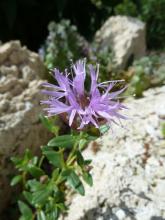
Not much new among the alpines of late... here are a few current or recent photos. Monardella odoratissima v.odoratissima, purchased this spring from Beaver Creek:
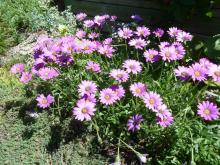
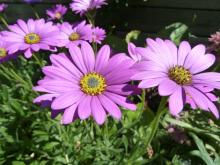
I said something mildly disparaging earlier about the usual volume of bloom on Osteospermum barberiae var. compactum 'Purple Mountain', but actually, this perennial is performing very well this year. (Maybe I don't pay close enough attention?)
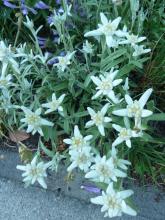
Out along the front sidewalk, edelweiss, Leontopodium alpinum:
A very modest bloom this year on what is currently my only South American species, Junellia wilczekii:
Among the "regular" perennials... Crambe cordifolia - wonderful plant. The inflorescences are a meter across and the little 4-petaled flowers are honey-scented; the leaves are big and shiny and rugose. If it looks a little the worse for wear, it is because I just disentangled (from the adjacent clematis) and staked up the big flower stalks, after the strong winds lately.
A few late flowering plants on the sand bed. Eucomis schijffii has now come into flower and is such a fine little plant! The latest flowering campanula I have is C. tommasinianus, and not knowing this genus so well it is very enjoyable to discover more of them. Another plant looking good just now is a small and tidy form of Gentiana septemfida (subsp. grossheimii), which has been a good doer on the bed ever since first planted. That blue is incomparable and it is nice that we can grow this when all the beautiful autumn flowering Asiatic species are next to impossible.
And just to bring back the idea of foliage - Cotula hispida and Daphne petraea make quite a good pairing, and on a broader scale our front garden has just had a good weed and tidying! (It doesn't always look like this!).
Nice selection of plants, Rick! Isn't H. altissima an incredibly tall one too? I imagine it's also highly scented (even more so than other species daylilies), given that it's night-blooming? That is an amazing Arisaema.
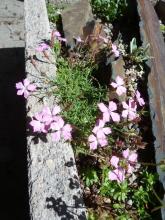
Not much happening in the troughs now, just this little Dianthus in bloom:
General garden shots... A cv. of Lychnis chalcedonica, beleaguered lilies (first botrytis, then lily beetles! >:() starting to bloom, Salvia nemorosa ssp. tesquicola:
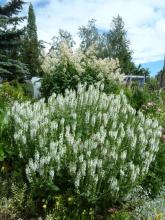
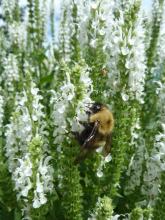
Salvia nemorosa 'White Hill'- much loved by bees - and Persicaria polymorpha:
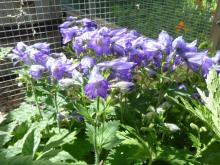
Delphinium brunonianum (with the cat pen in the background):
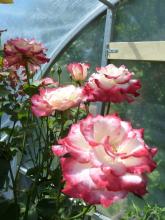
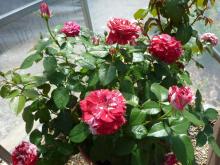
Some of Stuart's roses in the greenhouse... 'Amsterdam' (was supposed to be a fragrant double something-or-other but not so when received); 'Double Delight'; 'Rock'n'Roll':
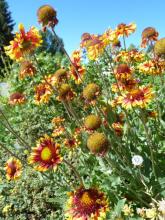
Gaillardia grandiflora cv. out in Palliser's Triangle:
Tim, I like the Cotula hispida, especially. Any tips (from anyone) on growing it?
Is that a Dierama sp. I see in the garden pic?
Lori, Hemerocallis altissima grows about 5ft in my garden. The foliage, though not particularly pretty, never gets ratty looking as with most daylilies. It is fragrant, but I have learned not to rely heavily on my nose. I inherited my smelling sense from my mom, and she couldn't smell a lot of things that others can, and vice versa. The scent of my Carolina Alspice flowers (Calycanthus floridus) is heavenly, according to friends. The flowers smell like Elmer's glue to me. ;D I like the look and shape of the flowers best anyway. I used to also grow Calycanthus fertilis, but the flower buds were very pointy compared to the round ones of C. floridus, and so not as desirable in my eyes.
I like the Cotula hispida, especially. Any tips (from anyone) on growing it?
I tried it a couple of times in the past without overwintering success... however, I did not have any rock gardens at my disposal then, so who knows? If I run across it again, I'll give it a another try.
Lori and Rick - thanks! The Cotula has been a bit of a mixed success in the past but is better on the sand bed. It tends to die back quite badly in the winter, even with cover, but then grows away again with the spring (although that's not especially unusual, quite a few plants do the same thing, probably because we don't have the benefit of prolonged snow cover). Yes, there are a couple of dieramas in the garden shot - they add a huge amount to the garden and we have had a long dry and warm spring and cooler wetter summer this year which must suit them well.
I've never come across Hemerocallis altissima - it must be really dramatic flowering at 5ft! And the flowers are very delicate and refined. Something to look out for. Amongst Lori's remarkable collection of plants I am very taken by Heterotheca. I have plans, if I can find a source, to develop a tufa garden and this would give the opportunity to grow a whole new range of plants. The only problem is the rest of the garden may get a bit neglected......
In the mountain pastures you can find red (or nearly red - what do you say Lori? Well, orange-red then.) coloured Hieracium species. You can also find similar plants as garden escapes along the road. The naming is confused but maybe this is Hieracium aurantiacum.
We have a few native species of Hieracium in Minnesota (mostly in the north), and two or three introduced species. I never realized, until now, that there are so many species here.
Ooooh, beautiful orange-red! Isn't a common name for that plant "foxes and cubs"?
Edit: "Fox and cubs", maybe. I know that it is considered sort of an invasive plant, but I think I'd gladly let it roam around!
The whole tribe is "banned" in Victoria - a friend of mine was taken to court for selling it! (an overly zealous Plant policeperson reported her and threatened her unnecessarily - the judge threw out the case!) Unfortunately this weed has infiltrated the alpine regions and is present in our alps now :( .
Right now it's winter in Australia and it's been cold enough to freeze our buns! :o Dianthus
I have the two most important Day Lilies which are cultivated for food in China (Golden Needles which are the dried wilted flowers) growing next to each other in my garden (first picture at the bottom) - altissima is the much higher one in the background.
I found an interesting Chinese web site showing lots of pictures of fields of Hemerocallis citrina cultivated for food - what a site that must be!:
The last picture shows last summer's "haul" from my garden last summer - you can both enjoy the flowers and eat as you harvest when they have wilted!
Stephen, how does one eat dried day lily flowers? Are they reconstituted first?
Ahh, used in hot and sour soup, apparently... i thought I'd read that somewhere before. Hmm, wonder if the soup I had the other day for lunch had any then?
Fermi wrote:
The whole tribe is "banned" in Victoria... Unfortunately this weed has infiltrated the alpine regions and is present in our alps now :( .
Well, that's a cautionary tale worth heeding. (And, needless to say, I have enough invasive plants as is!) Hey, we got frozen buns here too... but only figuratively - evenings are cool here plus there was a darn cold wind on top of it by the time I got home. :P
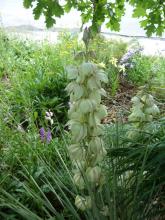
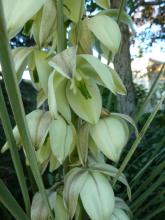
An old Yucca glauca in bloom in what is getting to be quite a shaded area, as the bur oak grows up:
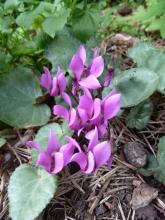
Cyclamen purpurascens, a silver-leafed plant. I dug this up from under the Scots pine where it had been very happy and put it at the front of the bed where it could be seen other than by crawling under the tree on hands and knees... it resented the move somewhat but is hanging on.
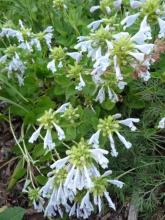
Mystery Dracocephalum sp.; any ideas?
Lilium 'Painted Pixie' with a native erigeron/aster(?) that I need to figure out... it's currently in beautiful bloom in the park too.
How does Telekia speciosa behave at your place, Lori? It is weedy in my garden, selfsowing everywhere! As i have said before - I have to find some of those perennial Linum species or cultivars!
Not exactly garden plants, but some flowering here at our mountain cabin now: Parnassia palustris - very common where the soil is wet but not with stagnant water and not acidic either.
Trifolium medium - an interesting clover much nicer than the red clover (T. pratense).
How does Telekia speciosa behave at your place, Lori? It is weedy in my garden, selfsowing everywhere!
It has not been a pest here yet... actually, I have yet to find a seedling! (That's not to say I don't have many other plants that I spend a lot of time weeding out!)
Excellent photos of Parnassia palustris! What amazingly intricate flowers... as is said in Flora of Alberta, "staminodia gland-tipped, small, united in 5 scale-like clusters, opposite the petals"... wonderful detail (no matter what the scientific words are to describe it)!
That's a very attractive clover. My Trifolium rubens- which I really enjoy seeing - got munched down by jack rabbits this spring for the first time and so are not performing well this year.
Are the flowers on Omalotheca norvegica fully open? I've never even heard of the genus.
Not much happening in my rock gardens, so here is a few from the perennial beds... Sanguisorba dodecandra, from subalpine meadows in the European alps, now in bloom:
Azorella trifurcata, forming a rolling landscape of odd, plastic-like (to the touch) foliage:
Calamintha grandiflora... I really like it but do weed out a lot of them, since they get quite large.
Wow Trond, what an amazing parnassus! Once again, Lori and I seem to be thinking along the same lines. I too blew up you photographs to find great detail from your most excellently executed photos! A VERY interesting flower from a taxonomic point of view, too. If I may, I reposted your pics to ask: What's this? And this? And this? (nice insect, too!)
It would seem that the Omalotheca norvegica is open. I think I see pistils...
Lori, your "field of Azorella" is quite the trick photo ;D. And what an interesting Aconitum anthoroideum!
Lori, the Calamintha alpina (I think the name was changed) grows near snow line in the Dolomites. It stays low in the garden but will seed itself where happy (sun, sun and more sun). It's a no-care plant with nice, bright purple flowers. Better to transplant self-sown seedlings when young.
I've had that one before, Anne, though it didn't stick around for long (in regular soil, that is). I'll have to try it again some day.
RickR wrote:
Wow Trond, what an amazing parnassus! If I may, I reposted your pics to ask: What's this? And this? And this?
Oooh, I know, I know!! The middle arrow on the left photo and the left arrow on the right photo are the "staminodia gland-tipped, small, united in 5 scale-like clusters, opposite the petals". Cool!
It's nice to see all these rather more vigorous perennials now the alpines are beginning to fade. I grow Cephalaria gigantea; it is quite a plant and self-sows very freely. Here it grows with the giant 'lettuce' Cicerbita (Lactuca) plumieri, and I always think that in combination with Inula magnifica (which also self-sows) you could develop an amazing 'Giant Meadow'.....Slightly off key from alpines but there you go!!
About the Parnassus staminodia, Lori: I thought so. But did you notice they are not opposite the petals? On the other side of the flower from each staminode, is not a petal, but the area between petals ???.
Tim, there are historical accounts of American tall grass prairies where the vegetation was so tall that one had to be on horseback to see across them. While I'm sure there are some remnants of same further east where the climate is more lush, I've never seen such a scenario in Minnesota. Our lush prairielands have been tiled and drained for agriculture. I do have a vivid memory of a tall grass prairie when I was about 10 years old, and it was way over my head. I was quite proud of my self as I navigated through it with a compass to find the Kawishiwi River.
Thanks for comments ;D In fact I have tried to take pictures of the grass of Parnassus and other white (and yellow) flowers without luck many times. My automatic camera does not like white or yellow and try to focus on more coloured parts. This time however a nice cloud made the perfect light seemingly.
Here's a more detailed section of the picture:
The Saxifragaceae usually have 5 sepals, 5 petals and 5+5 stamens. Parnassus has 5 sepals, 5 petals, 5 staminodia with nectar glands and 5 stamens.
And another one - here the flowers are a bit older.
I do not know the insects, small flies maybe, the longer ones is probably a kind of Thrips. One of your arrows Rick, points to a stamen without the anther, the others point to a insect, the staminoid, nectar glands and the seedpod consisting of 4 carpels as Lori says!
The flowers of the Omalotheca (a member of the Asteraceae) are fully open Lori! Rick is right. You can see male and female parts in different flower heads. The plant is called setergråurt in Norwegian (gråurt= "grey wort").
Trond, those would be excellent entries in the NARGS photo contest. One of the classes weighs heavily on technical aspect of the photo. These would really wow the judges and members alike!
I don't think I have any good (or bad) photos of tall grass prairies. The tend to look like a bunch of big weeds in a photo unless there is a lot of color. I recall snapping some nice mid grass prairie shots in Blue Mounds state park years ago in western Minnesota. I have to see if I can dig them up and scan a few. I haven't looked at those pics in years, so it would be fun.
About the Parnassus staminodia, Lori: I thought so. But did you notice they are not opposite the petals? On the other side of the flower from each staminode, is not a petal, but the area between petals ???.
Quite right!
Trond, yes, Sedum populifolium is perennial and very hardy.
Trond, those would be excellent entries in the NARGS photo contest. One of the classes weighs heavily on technical aspect of the photo. These would really wow the judges and members alike!
I don't think I have any good (or bad) photos of tall grass prairies. The tend to look like a bunch of big weeds in a photo unless there is a lot of color. I recall snapping some nice mid grass prairie shots in Blue Mounds state park years ago in western Minnesota. I have to see if I can dig them up and scan a few. I haven't looked at those pics in years, so it would be fun.
Photo contest? I hadn't thought of that :D
Mid grass prairie is approved ;)
Apropos to Lori's Aconitum, here's the native species Aconitum septentrionale. The colours of the flowers vary a lot, mostly they are dirty blue but some are better.
Nice colour range... it's always interesting to see those natural variations.
A natural grassland likened to the appearance of "big weeds"?!? Oh, please! :o (I'm sure the audience here is sophisticated enough to appreciate a grassland - no need to apologize in any way for its nature. :) )
In the rock garden... The zig-zag flower stems of Acantholimon kotschyi ssp. laxispicatum are finally starting to open...
Convolvulus lineatus var. angustifolius continues to bloom:
As do Saponaria pumilio, Bolanthus cherlerioides, Campanula hawkinsiana, and, amazingly, Asperula boissieri (what a plant!):
And an interesting Papaver sp. from the NARGS seedex, collected in Tajikistan... I'm looking through Christopher Gray-Wilson's Poppies to see if I can figure out which it is:
Lori, I've had that poppy for 15 years, and although I've usually called it Papaver rubrifragum, I'm still not sure. It seeds around quite a bit, and I have a few plants with doubles, but like so many 'alpine' poppies, it's hard to identify with certainty. But IF i had to make a call, P. rubifragum is what it is.
I would caution you on the possibility that it will show up everywhere, so be careful with the seedheads!!
Peter and Anne, yes, it does seem pretty well a ringer for Papaver ruprifragum (which I have out front)... leaves maybe very slightly different, but I'll have to study up. As it was collected in Tajikistan, I guess either it was cultivated/escaped (as P. ruprifragum's natural range is limited to Spain) or some very similar species?!?
EDIT: Although... Papaver ruprifragum is said to have glabrous (smooth, hairless) sepals, while this one has hairy sepals... On that note, my poppy out front has hairy sepals too.
Thanks for the spider ID, Lori. That little point and shoot Lumix camera has its shortfalls, but does impress me quite a bit. And the photo was taken in a somewhat upfacing position, too!
It seems I've been waiting all season for the right time for a "best pic" of Silene uniflora 'Compacta'. It's been blooming off and on all spring and summer, but always with not-so-perfect flowers. I blame it on the excessive heat and/or my inattentive "nurturing". After weeks of daily high temps in the 85-95+ F range, this flower opened yesterday, on the first 75 degree day in a month. It even has a lavender tint, which it never exhibited before, even on cooler spring days ???. Captured the morning of its first day open, Silene uniflora 'Compacta'.
Trifolium rubens has managed a few blossoms, after being munched to the ground by jack rabbits this spring:
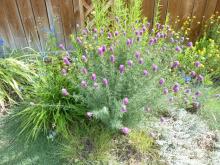
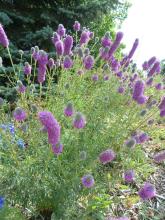
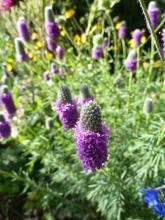
One of my favourite prairie natives, Dalea purpurea.... those out in the park are as big this summer as I have ever seen them, with the unusual amount of rain, but still are dwarfed by these in the front yard, where they flourish despite lousy soil:
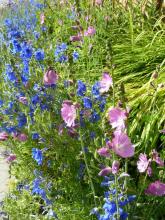
Also out along the sidewalk, Sidalcea malviflora and Delphinium grandiflorum:
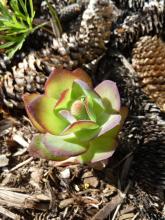
Orostachys iwarenge, from seed this spring and apparently putting up a flower stalk... not sure I'm terribly pleased by this! ???



Comments
Peter George
Re: What do you see on your garden walks?
Thu, 07/21/2011 - 11:54amLori, be wary of Calylophus serrulatus. I've been growing it for 8 years, and it's a beautiful plant, but it can be a thug. It seems as though every seed germinates, and in 2 or 3 years you'll be pulling them out by the dozens. You may want to deadhead it and leave it growing solo, or maybe with one or two companions.
cohan (not verified)
Re: What do you see on your garden walks?
Thu, 07/21/2011 - 11:56amLori, Love the pink Senecio.. is this the same one Jane in Colorado showed on Alpine -L? Anyway, a good one to watch for :)
Lori S. (not verified)
Re: What do you see on your garden walks?
Thu, 07/21/2011 - 12:04pmI don't know, Cohan. I couldn't bear the format of Alpine-L and disconnected myself from it some time ago, so I am not aware of what might be there now.
Peter, very interesting about Calylophus serrulatus. I'll keep a watch out. Thanks.
Richard T. Rodich
Re: What do you see on your garden walks?
Thu, 07/21/2011 - 9:21pmGosh Lori, your collections never end! (Mind you, none of us are complaining...)
The seed head structure of Calyptridium umbellatum is interesting. Are those white things the seeds - so that they would pop out similar to magnolia sees in their heads?
Magnolia sieboldii
Lori S. (not verified)
Re: What do you see on your garden walks?
Thu, 07/21/2011 - 9:41pmI don't know - I'll have to take my hand lens out to look at C. umbellatum... not sure if those are seeds or not (and not something I have noticed before); offhand, I suspect the seed pods have not opened yet.
Wow, the magnolia seeds are very showy!
Lori S. (not verified)
Re: What do you see on your garden walks?
Sat, 07/23/2011 - 10:22pmNot much new among the alpines of late... here are a few current or recent photos.
Monardella odoratissima v.odoratissima, purchased this spring from Beaver Creek:
I said something mildly disparaging earlier about the usual volume of bloom on Osteospermum barberiae var. compactum 'Purple Mountain', but actually, this perennial is performing very well this year. (Maybe I don't pay close enough attention?)
Out along the front sidewalk, edelweiss, Leontopodium alpinum:
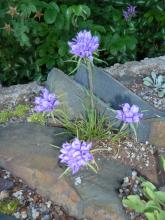
Edraianthus graminifolius:
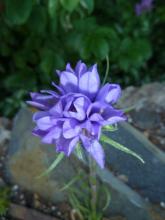
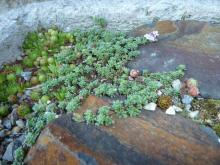
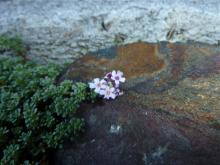
A very modest bloom this year on what is currently my only South American species, Junellia wilczekii:
Among the "regular" perennials...
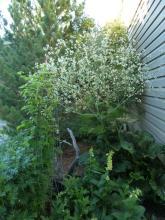
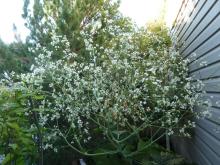
Crambe cordifolia - wonderful plant. The inflorescences are a meter across and the little 4-petaled flowers are honey-scented; the leaves are big and shiny and rugose. If it looks a little the worse for wear, it is because I just disentangled (from the adjacent clematis) and staked up the big flower stalks, after the strong winds lately.
Richard T. Rodich
Re: What do you see on your garden walks?
Sat, 07/23/2011 - 11:49pmPerfect siting for that South American, Lori. Really nice plants, all of them.
Some "regular" plants from my garden:
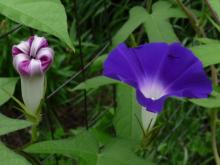
Japanese Morning Glory (Ipomea nil)
Frst generation hybrids of mine: Hemerocallis 'Siloam Ury Winnifred' x H. altissima
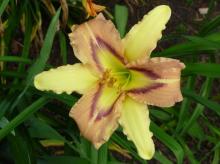
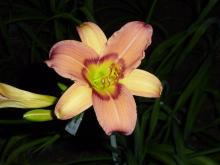
Siloam Ury Winnifred
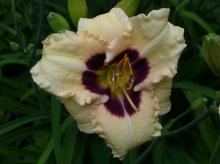
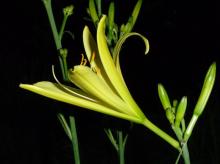
Night blooming Hemerocallis altissima
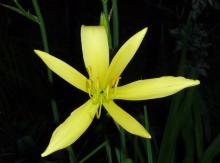
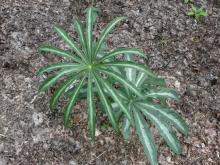
A very nice form of Arisaema consanguineum - I think
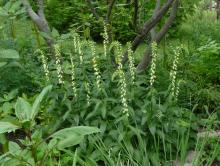
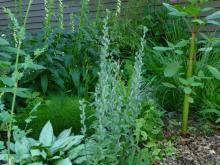
Digitalis ferruginea and Fibigia clypeata
Tim Ingram (not verified)
Re: What do you see on your garden walks?
Sun, 07/24/2011 - 11:05amA few late flowering plants on the sand bed. Eucomis schijffii has now come into flower and is such a fine little plant! The latest flowering campanula I have is C. tommasinianus, and not knowing this genus so well it is very enjoyable to discover more of them. Another plant looking good just now is a small and tidy form of Gentiana septemfida (subsp. grossheimii), which has been a good doer on the bed ever since first planted. That blue is incomparable and it is nice that we can grow this when all the beautiful autumn flowering Asiatic species are next to impossible.
And just to bring back the idea of foliage - Cotula hispida and Daphne petraea make quite a good pairing, and on a broader scale our front garden has just had a good weed and tidying! (It doesn't always look like this!).
Lori S. (not verified)
Re: What do you see on your garden walks?
Sun, 07/24/2011 - 12:18pmVery nice, Tim! Your garden is a source of unending wonder!
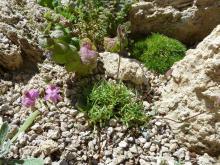
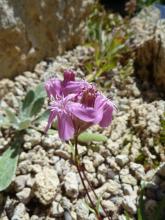
Saponaria caespitosa, one of many treasures bought this spring from Rundle Wood:
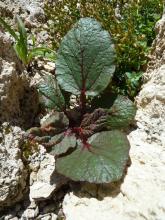
Rheum rhizostachyum, from seed last year:
Buds on Papaver sp., from the NARGS seedex (collected by Panayoti in Tajikistan)... I'm eagerly awaiting the bloom to see what it is!
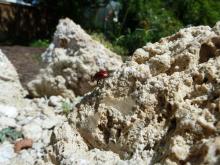
A cute little red and black striped guy beetling his way across the tufa:
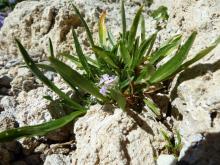
A late bloom on Cheiranthus roseus:
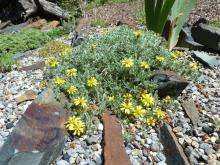
Heterotheca jonesii:
Lori S. (not verified)
Re: What do you see on your garden walks?
Sun, 07/24/2011 - 12:47pmNice selection of plants, Rick! Isn't H. altissima an incredibly tall one too? I imagine it's also highly scented (even more so than other species daylilies), given that it's night-blooming? That is an amazing Arisaema.
Not much happening in the troughs now, just this little Dianthus in bloom:
General garden shots...
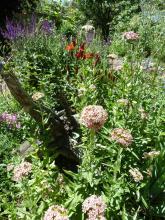
A cv. of Lychnis chalcedonica, beleaguered lilies (first botrytis, then lily beetles! >:() starting to bloom, Salvia nemorosa ssp. tesquicola:
Salvia nemorosa 'White Hill'- much loved by bees - and Persicaria polymorpha:
Delphinium brunonianum (with the cat pen in the background):
Some of Stuart's roses in the greenhouse... 'Amsterdam' (was supposed to be a fragrant double something-or-other but not so when received); 'Double Delight'; 'Rock'n'Roll':
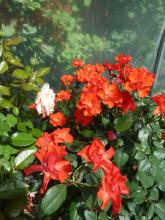
Gaillardia grandiflora cv. out in Palliser's Triangle:
Richard T. Rodich
Re: What do you see on your garden walks?
Sun, 07/24/2011 - 9:05pmTim,
I like the Cotula hispida, especially. Any tips (from anyone) on growing it?
Is that a Dierama sp. I see in the garden pic?
Lori,
Hemerocallis altissima grows about 5ft in my garden. The foliage, though not particularly pretty, never gets ratty looking as with most daylilies. It is fragrant, but I have learned not to rely heavily on my nose. I inherited my smelling sense from my mom, and she couldn't smell a lot of things that others can, and vice versa. The scent of my Carolina Alspice flowers (Calycanthus floridus) is heavenly, according to friends. The flowers smell like Elmer's glue to me. ;D I like the look and shape of the flowers best anyway. I used to also grow Calycanthus fertilis, but the flower buds were very pointy compared to the round ones of C. floridus, and so not as desirable in my eyes.
Hemerocallis altissima
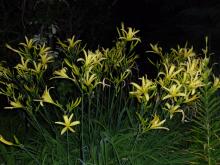
(That's Lilium szovitsianum to the right.)
Lori S. (not verified)
Re: What do you see on your garden walks?
Sun, 07/24/2011 - 10:11pmI tried it a couple of times in the past without overwintering success... however, I did not have any rock gardens at my disposal then, so who knows? If I run across it again, I'll give it a another try.
Tim Ingram (not verified)
Re: What do you see on your garden walks?
Sun, 07/24/2011 - 11:57pmLori and Rick - thanks! The Cotula has been a bit of a mixed success in the past but is better on the sand bed. It tends to die back quite badly in the winter, even with cover, but then grows away again with the spring (although that's not especially unusual, quite a few plants do the same thing, probably because we don't have the benefit of prolonged snow cover). Yes, there are a couple of dieramas in the garden shot - they add a huge amount to the garden and we have had a long dry and warm spring and cooler wetter summer this year which must suit them well.
I've never come across Hemerocallis altissima - it must be really dramatic flowering at 5ft! And the flowers are very delicate and refined. Something to look out for. Amongst Lori's remarkable collection of plants I am very taken by Heterotheca. I have plans, if I can find a source, to develop a tufa garden and this would give the opportunity to grow a whole new range of plants. The only problem is the rest of the garden may get a bit neglected......
Harold Peachey
Re: What do you see on your garden walks?
Mon, 07/25/2011 - 5:26amcuter red guy-looks like lily leaf beetle-get him while you can!
Lori S. (not verified)
Re: What do you see on your garden walks?
Mon, 07/25/2011 - 8:02amHarold, no, it's definitely not a lily beetle (which are not striped or the same shape as that guy) - I have become very familiar with those!
Trond Hoy
Re: What do you see on your garden walks?
Wed, 07/27/2011 - 11:32amIn the mountain pastures you can find red (or nearly red - what do you say Lori? Well, orange-red then.) coloured Hieracium species. You can also find similar plants as garden escapes along the road. The naming is confused but maybe this is Hieracium aurantiacum.
Lori S. (not verified)
Re: What do you see on your garden walks?
Wed, 07/27/2011 - 8:55pmOoooh, beautiful orange-red! Isn't a common name for that plant "foxes and cubs"?
Edit: "Fox and cubs", maybe. I know that it is considered sort of an invasive plant, but I think I'd gladly let it roam around!
Richard T. Rodich
Re: What do you see on your garden walks?
Thu, 07/28/2011 - 10:08amWe have a few native species of Hieracium in Minnesota (mostly in the north), and two or three introduced species. I never realized, until now, that there are so many species here.
Fermi de Sousa
Re: What do you see on your garden walks?
Fri, 07/29/2011 - 12:23amThe whole tribe is "banned" in Victoria - a friend of mine was taken to court for selling it! (an overly zealous Plant policeperson reported her and threatened her unnecessarily - the judge threw out the case!) Unfortunately this weed has infiltrated the alpine regions and is present in our alps now :( .
Right now it's winter in Australia and it's been cold enough to freeze our buns! :o
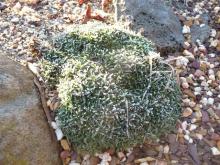
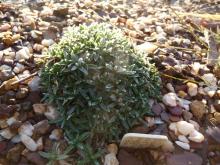
Dianthus
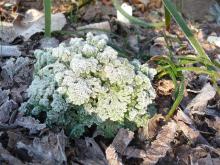
Onosma nana
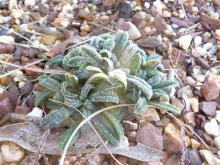
Teucrium sp (from the seedex as Salvia caespitosa!)
cheers
fermi
Fermi de Sousa
Re: What do you see on your garden walks?
Fri, 07/29/2011 - 12:31amHere are some winter time flowers from central Victoria,
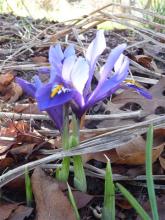
Reticulata Iris "Harmony"
Crocus flavus
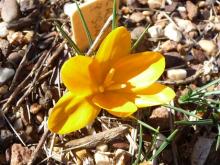
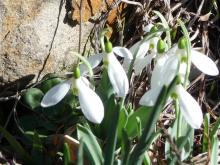
Galanthus elwesii
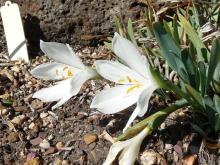
Sternbergia candida
cheers
fermi
Stephen Barstow
Re: What do you see on your garden walks?
Fri, 07/29/2011 - 2:03amI have the two most important Day Lilies which are cultivated for food in China (Golden Needles which are the dried wilted flowers) growing next to each other in my garden (first picture at the bottom) - altissima is the much higher one in the background.
I found an interesting Chinese web site showing lots of pictures of fields of Hemerocallis citrina cultivated for food - what a site that must be!:


The last picture shows last summer's "haul" from my garden last summer - you can both enjoy the flowers and eat as you harvest when they have wilted!
Richard T. Rodich
Re: What do you see on your garden walks?
Fri, 07/29/2011 - 5:29amThose are some really nice, tight buns ;D, Fermi...
Stephen, how does one eat dried day lily flowers? Are they reconstituted first?
Lori S. (not verified)
Re: What do you see on your garden walks?
Fri, 07/29/2011 - 9:45pmAhh, used in hot and sour soup, apparently... i thought I'd read that somewhere before. Hmm, wonder if the soup I had the other day for lunch had any then?
Well, that's a cautionary tale worth heeding. (And, needless to say, I have enough invasive plants as is!)
Hey, we got frozen buns here too... but only figuratively - evenings are cool here plus there was a darn cold wind on top of it by the time I got home. :P
Lori S. (not verified)
Re: What do you see on your garden walks?
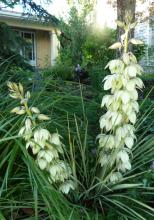
Sat, 07/30/2011 - 12:53pmAn old Yucca glauca in bloom in what is getting to be quite a shaded area, as the bur oak grows up:
Cyclamen purpurascens, a silver-leafed plant. I dug this up from under the Scots pine where it had been very happy and put it at the front of the bed where it could be seen other than by crawling under the tree on hands and knees... it resented the move somewhat but is hanging on.
Mystery Dracocephalum sp.; any ideas?
Lilium 'Painted Pixie' with a native erigeron/aster(?) that I need to figure out... it's currently in beautiful bloom in the park too.
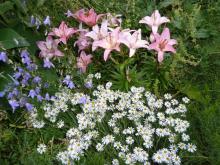
Lori S. (not verified)
Re: What do you see on your garden walks?
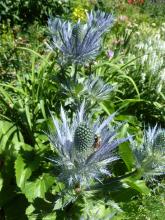
Sat, 07/30/2011 - 3:48pmEryngium alpinum:
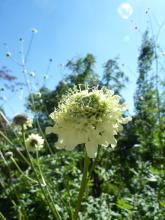
I always find it very hard to photograph this one, Cephalaria gigantea... reaching for the sky:
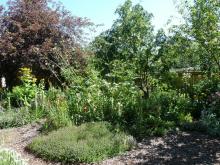
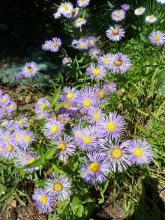
Erigeron speciosus:
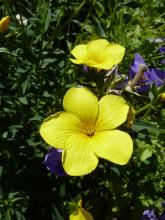
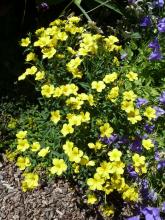
Linum flavum 'Compactum':
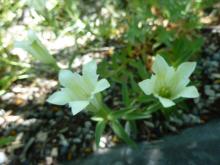
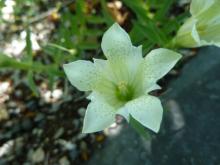
Gentiana gelida:
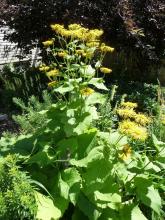
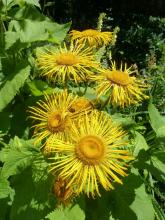
Telekia speciosa:
Trond Hoy
Re: What do you see on your garden walks?
Mon, 08/01/2011 - 2:29pmHow does Telekia speciosa behave at your place, Lori? It is weedy in my garden, selfsowing everywhere!
As i have said before - I have to find some of those perennial Linum species or cultivars!
Not exactly garden plants, but some flowering here at our mountain cabin now:
Parnassia palustris - very common where the soil is wet but not with stagnant water and not acidic either.
Trifolium medium - an interesting clover much nicer than the red clover (T. pratense).
Omalotheca norvegica. A shortlived perennial.
Lori S. (not verified)
Re: What do you see on your garden walks?
Mon, 08/01/2011 - 7:05pmIt has not been a pest here yet... actually, I have yet to find a seedling! (That's not to say I don't have many other plants that I spend a lot of time weeding out!)
Excellent photos of Parnassia palustris! What amazingly intricate flowers... as is said in Flora of Alberta, "staminodia gland-tipped, small, united in 5 scale-like clusters, opposite the petals"... wonderful detail (no matter what the scientific words are to describe it)!
That's a very attractive clover. My Trifolium rubens - which I really enjoy seeing - got munched down by jack rabbits this spring for the first time and so are not performing well this year.
Are the flowers on Omalotheca norvegica fully open? I've never even heard of the genus.
Not much happening in my rock gardens, so here is a few from the perennial beds...
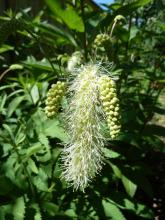
Sanguisorba dodecandra, from subalpine meadows in the European alps, now in bloom:
Azorella trifurcata, forming a rolling landscape of odd, plastic-like (to the touch) foliage:
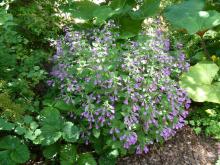
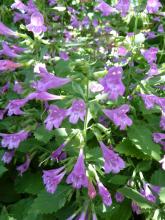
Calamintha grandiflora... I really like it but do weed out a lot of them, since they get quite large.
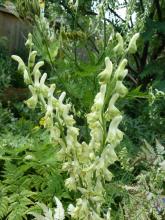
Aconitum anthoroideum, an 8-footer with attractive foliage (early on, at least - I haven't seen it in some time in that tangle of foliage!):
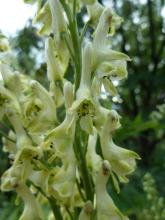
http://nargs.org/smf/index.php?topic=274.msg9228;topicseen#msg9228
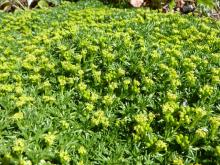
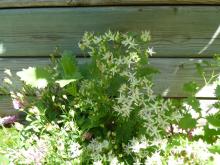
An odd sedum with big, toothed leaves, fragrant flowers, and woody stems - Sedum populifolium:
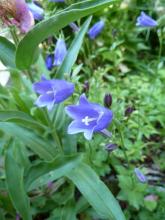
Adenophora tashiroi:
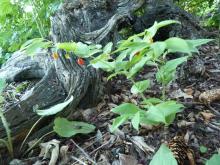
Colourful seedpods on Streptopus roseus:
A couple of the many colours of self-sown Delphinium grandiflorum - the usual electric blue, and a variation:
Richard T. Rodich
Re: What do you see on your garden walks?
Tue, 08/02/2011 - 12:21amWow Trond, what an amazing parnassus! Once again, Lori and I seem to be thinking along the same lines. I too blew up you photographs to find great detail from your most excellently executed photos! A VERY interesting flower from a taxonomic point of view, too. If I may, I reposted your pics to ask:
What's this? And this? And this? (nice insect, too!)
It would seem that the Omalotheca norvegica is open. I think I see pistils...
Lori, your "field of Azorella" is quite the trick photo ;D. And what an interesting Aconitum anthoroideum!
Anne Spiegel
Re: What do you see on your garden walks?
Tue, 08/02/2011 - 7:31amLori, the Calamintha alpina (I think the name was changed) grows near snow line in the Dolomites. It stays low in the garden but will seed itself where happy (sun, sun and more sun). It's a no-care plant with nice, bright purple flowers. Better to transplant self-sown seedlings when young.
Lori S. (not verified)
Re: What do you see on your garden walks?
Tue, 08/02/2011 - 8:14amI've had that one before, Anne, though it didn't stick around for long (in regular soil, that is). I'll have to try it again some day.
Oooh, I know, I know!! The middle arrow on the left photo and the left arrow on the right photo are the "staminodia gland-tipped, small, united in 5 scale-like clusters, opposite the petals". Cool!
Tim Ingram (not verified)
Re: What do you see on your garden walks?
Tue, 08/02/2011 - 9:49amIt's nice to see all these rather more vigorous perennials now the alpines are beginning to fade. I grow Cephalaria gigantea; it is quite a plant and self-sows very freely. Here it grows with the giant 'lettuce' Cicerbita (Lactuca) plumieri, and I always think that in combination with Inula magnifica (which also self-sows) you could develop an amazing 'Giant Meadow'.....Slightly off key from alpines but there you go!!
Richard T. Rodich
Re: What do you see on your garden walks?
Tue, 08/02/2011 - 9:56amAbout the Parnassus staminodia, Lori: I thought so. But did you notice they are not opposite the petals? On the other side of the flower from each staminode, is not a petal, but the area between petals ???.
Tim, there are historical accounts of American tall grass prairies where the vegetation was so tall that one had to be on horseback to see across them. While I'm sure there are some remnants of same further east where the climate is more lush, I've never seen such a scenario in Minnesota. Our lush prairielands have been tiled and drained for agriculture. I do have a vivid memory of a tall grass prairie when I was about 10 years old, and it was way over my head. I was quite proud of my self as I navigated through it with a compass to find the Kawishiwi River.
Trond Hoy
Re: What do you see on your garden walks?
Tue, 08/02/2011 - 12:57pmThanks for comments ;D In fact I have tried to take pictures of the grass of Parnassus and other white (and yellow) flowers without luck many times. My automatic camera does not like white or yellow and try to focus on more coloured parts. This time however a nice cloud made the perfect light seemingly.
Here's a more detailed section of the picture:
The Saxifragaceae usually have 5 sepals, 5 petals and 5+5 stamens. Parnassus has 5 sepals, 5 petals, 5 staminodia with nectar glands and 5 stamens.
And another one - here the flowers are a bit older.
I do not know the insects, small flies maybe, the longer ones is probably a kind of Thrips. One of your arrows Rick, points to a stamen without the anther, the others point to a insect, the staminoid, nectar glands and the seedpod consisting of 4 carpels as Lori says!
The flowers of the Omalotheca (a member of the Asteraceae) are fully open Lori! Rick is right. You can see male and female parts in different flower heads. The plant is called setergråurt in Norwegian (gråurt= "grey wort").
Trond Hoy
Re: What do you see on your garden walks?
Tue, 08/02/2011 - 1:33pmI have never seen that Sedum before, Lori. Is it peraennial?
I would love to see a tallgrass prairie, Rick!
Tim, I have just transplanted a piece of the wild Cicerbita alpina to our moutain cabin ;D
Richard T. Rodich
Re: What do you see on your garden walks?
Tue, 08/02/2011 - 7:27pmTrond, those would be excellent entries in the NARGS photo contest. One of the classes weighs heavily on technical aspect of the photo. These would really wow the judges and members alike!
I don't think I have any good (or bad) photos of tall grass prairies. The tend to look like a bunch of big weeds in a photo unless there is a lot of color. I recall snapping some nice mid grass prairie shots in Blue Mounds state park years ago in western Minnesota. I have to see if I can dig them up and scan a few. I haven't looked at those pics in years, so it would be fun.
Lori S. (not verified)
Re: What do you see on your garden walks?
Tue, 08/02/2011 - 10:11pmQuite right!
Trond, yes, Sedum populifolium is perennial and very hardy.
Anne Spiegel
Re: What do you see on your garden walks?
Wed, 08/03/2011 - 3:15amLori, it's very long-lived in scree and blooms a long time.
Trond Hoy
Re: What do you see on your garden walks?
Wed, 08/03/2011 - 6:22amPhoto contest? I hadn't thought of that :D
Mid grass prairie is approved ;)
Apropos to Lori's Aconitum, here's the native species Aconitum septentrionale. The colours of the flowers vary a lot, mostly they are dirty blue but some are better.
Lori S. (not verified)
Re: What do you see on your garden walks?
Wed, 08/03/2011 - 8:46amNice colour range... it's always interesting to see those natural variations.
A natural grassland likened to the appearance of "big weeds"?!? Oh, please! :o (I'm sure the audience here is sophisticated enough to appreciate a grassland - no need to apologize in any way for its nature. :) )
Lori S. (not verified)
Re: What do you see on your garden walks?
Thu, 08/04/2011 - 8:55pmOops, did I scare everyone off? :-[
In the rock garden...
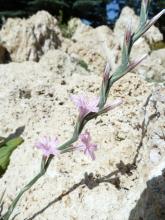
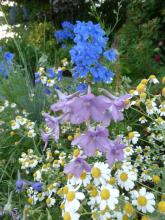
The zig-zag flower stems of Acantholimon kotschyi ssp. laxispicatum are finally starting to open...
Convolvulus lineatus var. angustifolius continues to bloom:
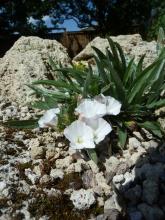
As do Saponaria pumilio, Bolanthus cherlerioides, Campanula hawkinsiana, and, amazingly, Asperula boissieri (what a plant!):
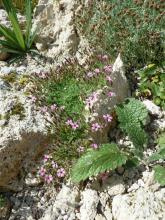
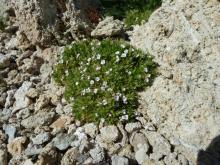
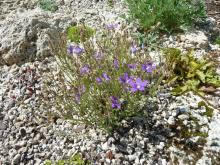
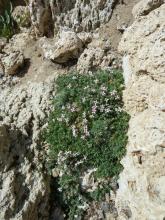
And an interesting Papaver sp. from the NARGS seedex, collected in Tajikistan... I'm looking through Christopher Gray-Wilson's Poppies to see if I can figure out which it is:
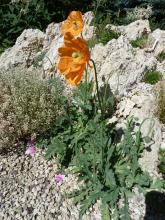
And so what's happening in your yards?
Toole (not verified)
Re: What do you see on your garden walks?
Fri, 08/05/2011 - 1:15amWell :).......a shot of Crocus in shade.
Cheers Dave.
Trond Hoy
Re: What do you see on your garden walks?
Fri, 08/05/2011 - 1:10pmThat is a nice bunch!
Peter George
Re: What do you see on your garden walks?
Fri, 08/05/2011 - 1:36pmLori, I've had that poppy for 15 years, and although I've usually called it Papaver rubrifragum, I'm still not sure. It seeds around quite a bit, and I have a few plants with doubles, but like so many 'alpine' poppies, it's hard to identify with certainty. But IF i had to make a call, P. rubifragum is what it is.
I would caution you on the possibility that it will show up everywhere, so be careful with the seedheads!!
Anne Spiegel
Re: What do you see on your garden walks?
Fri, 08/05/2011 - 2:04pmPeter, I think I have it too, and while lovely and able to take drought in stride, it has become a pest.
Lori S. (not verified)
Re: What do you see on your garden walks?
Sat, 08/06/2011 - 8:41amBeautiful crocus, Dave! Nice bicolor effect.
Peter and Anne, yes, it does seem pretty well a ringer for Papaver ruprifragum (which I have out front)... leaves maybe very slightly different, but I'll have to study up. As it was collected in Tajikistan, I guess either it was cultivated/escaped (as P. ruprifragum's natural range is limited to Spain) or some very similar species?!?
EDIT: Although... Papaver ruprifragum is said to have glabrous (smooth, hairless) sepals, while this one has hairy sepals... On that note, my poppy out front has hairy sepals too.
Richard T. Rodich
Re: What do you see on your garden walks?
Sat, 08/06/2011 - 9:27amExactly!
This turned up, webbing over my pots yesterday. Any arachiphiles out there for an ID?
The spider is really much prettier. There were magenta hues on its legs that don't show in the pic.
Lori S. (not verified)
Re: What do you see on your garden walks?
Sat, 08/06/2011 - 9:56amWhat a beauty! (And what an excellent photo!) It's a golden orb-weaver, not sure of the genus-species.
Fermi de Sousa
Re: What do you see on your garden walks?
Mon, 08/08/2011 - 11:55pmLori,
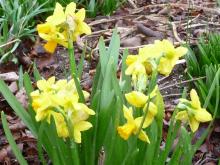
I love your summer rock garden flowers! Here are some from our winter:
Narcissus hybrid, probabaly "Quince"
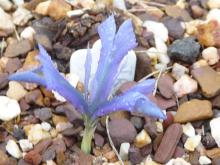
Iris "Dance On"
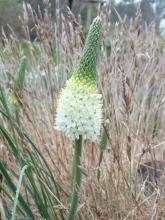
Bulbinella received as B. caudafelis but maybe B. eburnifolia
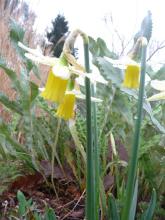
Narcissus cyclamenius hybrid
cheers
fermi
Richard T. Rodich
Re: What do you see on your garden walks?
Tue, 08/09/2011 - 9:06pmThanks for the spider ID, Lori. That little point and shoot Lumix camera has its shortfalls, but does impress me quite a bit. And the photo was taken in a somewhat upfacing position, too!
It seems I've been waiting all season for the right time for a "best pic" of Silene uniflora 'Compacta'. It's been blooming off and on all spring and summer, but always with not-so-perfect flowers. I blame it on the excessive heat and/or my inattentive "nurturing". After weeks of daily high temps in the 85-95+ F range, this flower opened yesterday, on the first 75 degree day in a month. It even has a lavender tint, which it never exhibited before, even on cooler spring days ???. Captured the morning of its first day open, Silene uniflora 'Compacta'.
Lori S. (not verified)
Re: What do you see on your garden walks?
Sun, 08/14/2011 - 10:08pmNice to see spring again, Fermi! Hmm, I wonder how hardy Bulbinella are??
Very nice, Rick - great to have reblooming plants!
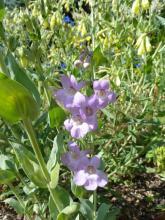
A late-blooming stem on Penstemon secundiflorus:
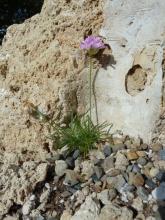
Armeria juniperifolia, just recently planted:
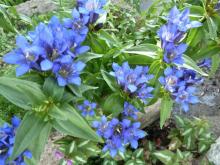
Gentiana septemfida:
Trifolium rubens has managed a few blossoms, after being munched to the ground by jack rabbits this spring:
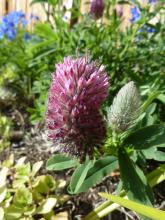
One of my favourite prairie natives, Dalea purpurea.... those out in the park are as big this summer as I have ever seen them, with the unusual amount of rain, but still are dwarfed by these in the front yard, where they flourish despite lousy soil:
Also out along the sidewalk, Sidalcea malviflora and Delphinium grandiflorum:
Orostachys iwarenge, from seed this spring and apparently putting up a flower stalk... not sure I'm terribly pleased by this! ???
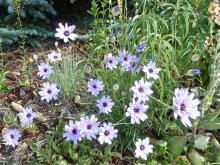
Catananche caerulea:
Pages