
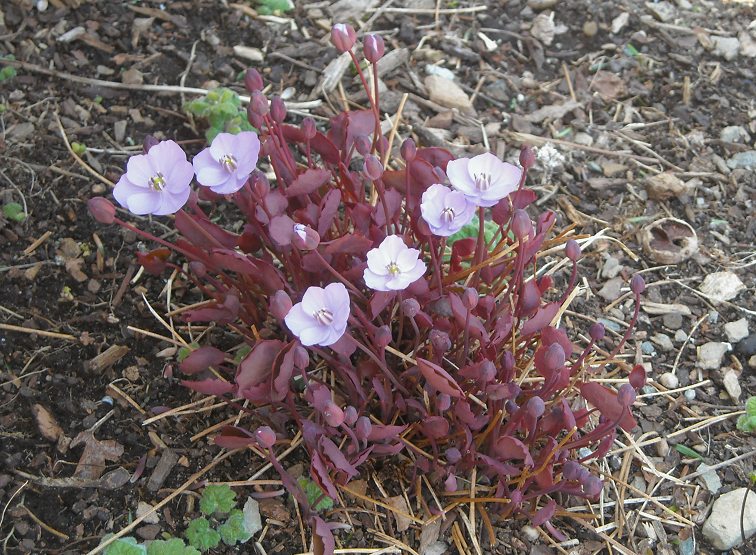
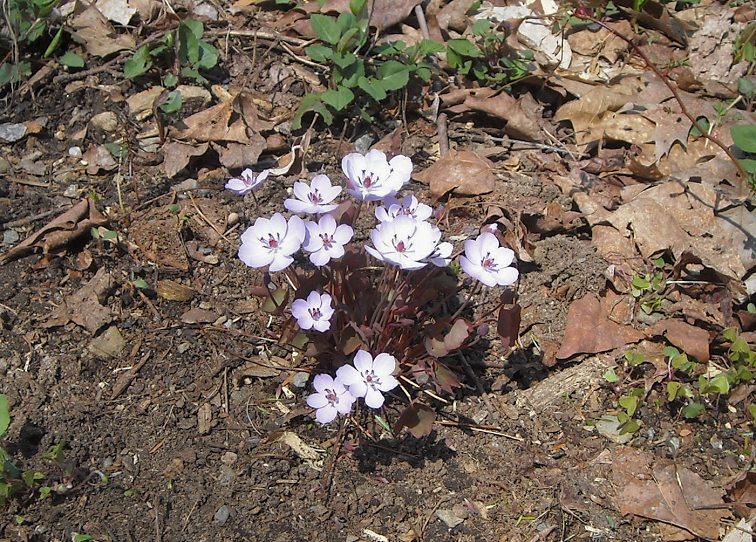
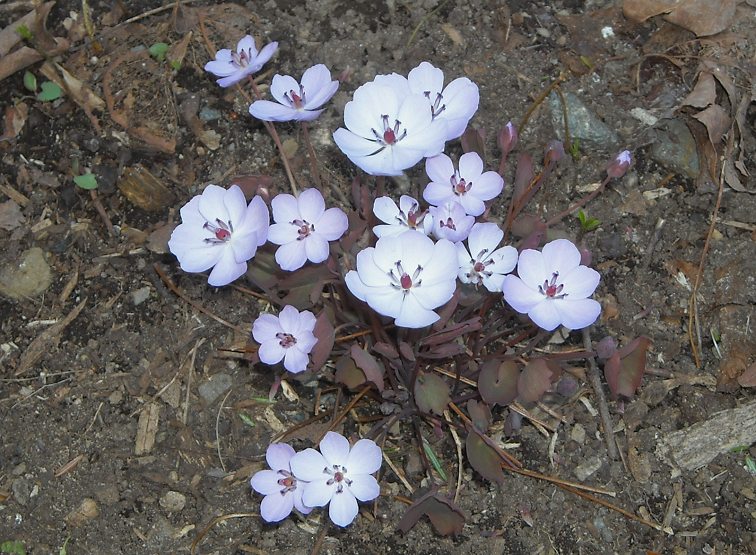
Just starting to flower is Jeffersonia dubia, fun to watch as they emerge, the foliage is beet red and rubbery looking (Photo 1). My plants are from a good dark color form, just opening their first couple blooms... flower color is deeper than what the photo captured. However, I wanted to showcase a form that Darrell Probst collected, CPC 3.10.97 (Cobblewood Plant Collection), selected on account of it's dark flowers (although my normal form are darker) and the red seed pods. In full flower on 04-04-2010, I note some other differences: the ovary is red (green in other dubia forms) and the stamens dark tipped (light color in other dubia forms).
Sun is very strong today, and my daughter's cheap entry-level Nikon Coolpix does a terrible job with white or light-colored flowers, and after several tries, settled on these washed out looking photos, but it is the best I can do. In the last photo, I used a sun baffle to tone down the bright light.
Comments
Richard T. Rodich
Re: Jeffersonia
Mon, 04/05/2010 - 10:02amA 2009 "normal" J. dubia with a few extra petals. I like the variation of leaf form whthin the species too. I use a perhaps better quality, but still a point and shoot camera - a Lumix TZ4. It has an exposure setting I have since learned to used to my advantage for light color rendition. I'll bet the Coolpix has something similar. In fact most of my flower pics are now taken with an exposure of minus .5 to minus 1.
The second pic is the same plant today. I guess it really likes where it is. The anticipation is killing me.
Lori S. (not verified)
Re: Jeffersonia
Mon, 04/05/2010 - 10:09amWow, what an absolutely spectacular plant, Rick! My very modest ones have not even started to emerge yet.
Richard T. Rodich
Re: Jeffersonia
Mon, 04/05/2010 - 10:11amThanks, Lori.
It's pretty easy to see that the dark colored stamens show up a lot better on Mark's, and in my eyes are much more attractive. I can't decide whether I like the green or the red ovaries better.
Trond Hoy
Re: Jeffersonia
Mon, 04/05/2010 - 11:04amI had to look for my own Jeffersonia which grows in deep shade of a conifer, and there it was but not more than an inch or two! Nice to see what comes!
Where do you grow your plants?
Mark McDonough
Re: Jeffersonia
Mon, 04/05/2010 - 6:19pmDoes anyone know of any attempts at hybridizing the American Jeffersonia diphylla with the Asian J. dubia? This year I have J. diphylla ready to bloom, with bloom time overlapping, with J. dubia, and wonder if hybrids are possible, and then again, why even try when the theoretical hybrids might inherit the bad habit of American J. diphylla blooms lasting just a single day. But now that I have two different J. dubia clones to play with, maybe I'll give it a try.
The American plant, even though flowering is ridiculously brief (1 day), is still a good garden plant; short when flowering, but after flowering the stems and foliage get rather largish to 18" tall or so, and as broad, forming a most handsome display, worth growing for the unique "twinleaf" form and the intriguing large pipe-like fleshy seed pods that open up as if a hinged pot lid.
The American species does not like disturbance, so the first photo shows a seedling plant now growing within several feet of its Asian relative. Photos 2 and 3 show the now 22-year-old clump of J. diphylla, never getting overly large in size but always showing up in a part of my woodland that is too far to reach with a hose and largely goes uncultivated. The second shot was taken today under cloud cover, the 3rd shot when suddenly the late afternoon sun shone though, giving a different aspect of this handsome woodlander.
Mark McDonough
Re: Jeffersonia
Mon, 04/05/2010 - 6:43pmRick, your Jeffersonia really does have great "flower power". Keep a watch on your mult-petallous ones, maybe worth separating out. Mine are quite consistent, although rather darker flowered than many (I need to post some photos taken in a friends garden, where my plants came from). In most years, I forget about cleaning them up in late fall or the winter, so the mass of old stems creates a mess that can be tugged at and mitigated to some extent, but otherwise detracts from the spring flower show.
Mark McDonough
Re: Jeffersonia
Mon, 04/05/2010 - 6:52pmMy Jeffersonia dubia plants were advancing more today, thanks to another rather warm sunny day, so a couple of photos ensue. I also include a few photos from 2009, where flowering in afternoon light caught my camera's attention. Note the image dates, we're 2 weeks earlier this year than last year, also earlier than in the last 10 years. The last photo is taken in my friend's garden, Marsha Russell, a very shaded garden where the bright sun-induced red emerging foliage was not so prominent, showing lovely blue flower shades.
Richard T. Rodich
Re: Jeffersonia
Mon, 04/05/2010 - 11:05pmAnd I thought I might be the only one attempting the cross of the two species. Thought about it last summer. Mine don't overlap bloom time, but I don't think storing the dubia pollen for the short time would be a problem. Freezing it might also be an option, as they do with Lilium pollen.
Oh if you could only see the mom of the plant I posted here. Single flowers only, but a most exquisite iridescent blue hue to the lavender. And the petals sparkle!
Regarding crossong, I have a potential problem: this J. dubia never sets seed, while my other plants do. What plant part(s) seem to be sterile, I don't know.
Trond Hoy
Re: Jeffersonia
Tue, 04/06/2010 - 1:53amDo you need fresh seed to get get good results or can old seed do?
Mark McDonough
Re: Jeffersonia
Tue, 04/06/2010 - 4:24amTrond, I believe the seed is ephemeral and needs to be planted shortly after harvesting.
Rick, it's too bad your special form isn't setting seed... maybe that particular plant is sterile.
My plants set lots of seed. I would always get a few self-sown seedlings, but a few years ago I started "assisting" the plant by scratching in the seed, sowing it in situ, and that has worked really well. They'll make a decent little flowering clump in 3 years. Just checked yesterday, and batches of seed are coming up... in the first photo, the just-emerging seed is within inches of the mother plant, so I assume this was not sown by me, but is just self-sown seedlings. The second photo shows a couple 2-year old seedlings, to the right of the pink Corydalis solida.
Mark McDonough
Re: Jeffersonia
Tue, 04/06/2010 - 4:32amMy garden tends to be very dry, and where I had first planted them, they just site there and flower reliably each spring, but do not bulk up, and the self-sown seedlings would germinate but few have grown on to maturity... just too dry. So, I started trying them all around the garden; they definitely appreciate good humus-rich soil and enough moisture to kept them actively growing... the foliage gets lush when grown under more favorable conditions. My gardening friend who first gave me this species, gardens under the constant shade of a grove of pines and hemlocks, where they flowered and grew well, but didn't show that beet red new growth as they do when they're grown in a deciduous woodland and get lots of spring sunshine.
Trond Hoy
Re: Jeffersonia
Tue, 04/06/2010 - 11:00amWhen I get more plants I have to try different places! The one I have now grows under a dense hemlock but I have broadleaved trees too. The soil consist of almost pure humus. Can be dry in May and June but I very seldom use a hose to water the plants.
Mark McDonough
Re: Jeffersonia
Wed, 04/07/2010 - 7:10pmSo, has anyone tried crossing the two Jeffersonia species, the North American J. diphylla and the Asian J. dubia? Both are easy growers, but long appreciated that the Japanese (and from other Asian countries) is the better of the two species, being more showy with longer lasting blue flowers. Has anyone attempted crosses between the two species?
This year, being the earliest spring on record here in Northeastern USA, with a current heat wave accelerating the season, both species are in bloom at the same time, a rare occurrence. So what to do... try hybridizing, what else? Does anyone know of any success in hybridizing these two species? I certainly dabbed pollen both ways today, given the rare occurrence of both blooming at the same time. We'll see what transpires in a few years.
Also today, I spied some seedling plants of J. diphylla in a woodland area of my property well beyond the reaches of water hoses, and I was struck by the dark blackish coloration of the leaves on some J. diphylla seedlings; photos show this coloration. They are yet to bloom, so I still have about 2 days of Jeffersonia hybridization opportunity available. Hey Aaron, what sort of variation have you spotted on this plant?
Richard T. Rodich
Re: Jeffersonia
Thu, 04/08/2010 - 9:23amWow, I must have not so worthy diphylla genetics, or else you have really nice ones, Mark. Or is it just all the rain you've been getting?
These are the blooms on mine from last year. While J. dubia in the same garden is blooming now, J. diphylla is only five inches high.
Mark McDonough
Re: Jeffersonia
Fri, 04/09/2010 - 9:14amRick, your plant looks like many do... with space between the petals. Never really thought about my plant being anything different or special, but Twinleaf is rather variable based on photos I've looked at (see photo links below). In my plant, the petals overlap for a fuller looking flower.
Not sure where I got my plant originally, had it when I was a boy, at age 10 I started a wildflower garden, and most likely bought my plant at a local nursery. When I moved to my current location 23 years ago, I dug up lots of plants still growing in my old gardens at my parents house, so my plant sources all the way back to my original plant. The plant in my photograph, has been in the same spot for those 23 years :o :o... talk about longevity! In all those years it hasn't seeded around much, just in the last few years has it started to spread. I upload a photo taken yesterday, still looking good (even though I took off a few flowers, to use as pollen material for attempted crosses), and a photo of a young seedling. Now that I train my eye looking for seedling plants, I'm finding them all over the place.
Around midday (noon) the pollen on both species is ripe and ready. I dabbed pollen of dubia onto diphylla (easy to see the purplish pollen on the yellow stigma) and I tried the reverse cross as well. I'll let you know in about 4 years whether I get hybrids ;D
Four pages of photos showing Jeffersonia diphylla, some flower variability, but the leaf shape and size vary dramatically. And I love the seedpods, some photos here.
http://www.flickr.com/search/?w=all&q=%22Jeffersonia+diphylla%22&m=text#...
(By the way folks, using Flickr photo searches is a fast way to find photos of plants one is interested in seeing. Mind you, there will be some misidentifications, such as a few J. dubia showing up as diphylla. Use "Search - Everyone's Uploads" then put quotes around the plant botanical name as the search criteria.)
Cute little one, distinctively cut leaves
http://www.flickr.com/photos/sklockwood/4158868636/
Image of J. diphylla BONAP Distibution Map
Richard T. Rodich
Re: Jeffersonia
Sat, 04/10/2010 - 9:33pmIndeed your foliage is different than mine also.
Bowden (not verified)
Re: Jeffersonia
Sun, 04/11/2010 - 11:37amHello all,
I've been thinking about moving my Jeffersonia dubia, only because it is under a Rhododendron that is beginning to cover it too much and it isn't so visible anymore, although it still seems happy where it is. I've also wondered about dividing it when I move it. Is this advisable and if so, when would be the best time?
Mark McDonough
Re: Jeffersonia
Sun, 04/11/2010 - 8:01pmHi Paul, welcome to NARGS Forum!
I received my plants from a friend who was closing her nursery; she had gobs of Jefferesonia dubia and we dug them in late summer or early fall, then I literally sliced into the very dense mats of roots to separate them, and they did just fine. However, my guess is the best time to move any spring ephemeral is in early summer, well after the plant has flowered and had time to set seed, then divide, replant, and water well to re-establish them before fall/winter. Jeffersonia dubia seeds around like crazy, always wondered why the plant is considered such a high-priced specialty, when it is so ready to reproduce itself. Seedlings can be moved any time to semi-shady spots and they'll do just fine.
Mark McDonough
Re: Jeffersonia
Sun, 04/11/2010 - 8:05pmRck, your largely untoothed Twinleaf plants has me thinking, I must increase my Twinleaf form representation here, to start getting a wider range of forms. The leaves on your plant are not dentate as they are in mine, more of the classic "Twinleaf" form. Again, this is the fascinating aspect of growing plant species, so much variation, often moreso than one imagines.
Richard T. Rodich
Re: Jeffersonia
Sun, 04/11/2010 - 8:11pmI've never had a need to divide any Jeffersonia (but maybe this year), but I do transplant mature seedlings regularly from our Arboretum garden for our Chapter sale. Because of convenience, I transplant after they bloom and leaves are mature. They weather the transplanting just fine.
BTW, my best tool for dividing plants is one of those Ginsu knives that are never supposed to dull. It's true! I bought it at a garage sale, just to try, and after years of use, it still cuts through soil and plant rhizomes/tubers/roots like butter. It is the cat's meow for trimming soil balls to fit into pots for the Chapter plant sale. If I ever lost it, I would definitely go out and buy another.
Mark McDonough
Re: Jeffersonia
Sun, 04/11/2010 - 8:18pmThank Rick, maybe I should get a Ginsu knife for slicing up Epimedium, they're an absolute bear to divide, the rhizomes grow so dense and tough.
Richard T. Rodich
Re: Jeffersonia
Mon, 04/12/2010 - 1:07pmDefinitely! Try to get with the longest and least flexible cutting blade available.
Todd Boland
Re: Jeffersonia
Tue, 04/13/2010 - 10:40amNo sign of my dubia yet.....mine is a deeper blue version than any of the ones shown. A pic from 2 years ago.
Trond Hoy
Re: Jeffersonia
Tue, 04/13/2010 - 12:51pmThis was nice, Todd! Have to try hard to get hold of different colors of Jeffersonia.
Richard T. Rodich
Re: Jeffersonia
Sat, 05/22/2010 - 6:41pmI looked at my three pods of clean crosses of Jeffersonia dubia x J. diphylla. They may have taken since they have not withered and feel solid. However they are consistently three-quarters the size of normal pods. I am very hopeful.
Trond Hoy
Re: Jeffersonia
Sun, 05/23/2010 - 12:24pmAre you prepaired to do embryo rescue if necessary? Maybe they have to little endosperm.
Richard T. Rodich
Re: Jeffersonia
Sun, 05/23/2010 - 3:54pmNo, I am not prepared to do ER. I am hoping the smaller pods are just due to less efficient fertilization and fewer seeds, rather than smaller seeds.
Mark McDonough
Re: Jeffersonia
Sun, 05/23/2010 - 6:30pmRick, we're on parallel efforts here. On my plant where I attempted Jeffersonia dubia x J. diphylla, the four pods the pods look normal sized I suppose, but then again, I did not compare their size to regular J. diphylla elsewhere in the yard. Same with the pods on a plant I dedicated to trying J. dubia x diphylla :D
I have been doing some garden visits recently, and invariably both species are being grown, and I find the leaf and plant variability interesting me, to the point I'll ask for seed from some of the various sorts, to increase the gene pool. The first photo is a pod on my attempted Jeffersonia dubia x J. diphylla, and the next two photos are a good looking leaf form in the garden of Peter George's fine garden in Central Massachusetts.
Richard T. Rodich
Re: Jeffersonia
Mon, 05/24/2010 - 5:07pmI see you used J. dipylla as the pod parent, Mark. Did you also do the reciprocal cross? I only did J. dubia x J. diphylla, but left open pollinated pods attached on the same plant. I decided I didn't want the ants eyeing my prize pods as the only ones available for ravaging. This way, if I miss the initial ripening, there is a good chance my special pods will be left alone long enough for me to harvest them.
Mark McDonough
Re: Jeffersonia
Mon, 05/24/2010 - 6:29pmYup, I tried the cross both ways... anxiously awaiting seed pods to ripen. Meanwhile I've been very busy with trying to stay ahead of ripening Epimedium seed. I used approx. 25 different epimediums on which I hand pollinated each and every flower over a period of weeks, plus I'm sowing seed of some open-pollinated varieties I'm interested in, as they will hybridize with their eppie neighbors. It's like shucking peas in miniature, squeezing out the little green bean-like seeds. Have to cover the seed flats with fine wire mesh, as any flat left out becomes prime romping digging grounds for chipmunks. After sowing my first 6 flats, intending on protecting the flats the following day... too late, chipmunks already went crazy with digging them up! I anticipate similar sowing process for the Jeffersonia, direct fresh sowing of seed into peat flats, which will remain shaded and kept mildly moist all summer and left out all winter, hopefully for spring germination.
Mark McDonough
Re: Jeffersonia
Tue, 05/25/2010 - 11:45amSeed pods on Jeffersonia dubia started shedding today, time to harvest and sow. :D
Mark McDonough
Re: Jeffersonia
Wed, 06/09/2010 - 8:49amSeed of my attempted Jeffersonia diphylla x dubia cross were harvested and sown on May 30, 2010 (see first photo).
Interestingly, seed of regular Jeffersonia diphylla down in the wild shady woodland part of my property only just ripened today, fully 5 weeks later! Photos 2-4 show the seed harvest which is being sent to seed purveyor Kristl Walek in Canada. There is nothing easier (and more fun) than the "pop and pour" seed cleaning on Jeffersonia. The seeds cannot be dried out, so they will be packed in barely moist vermiculite in a plastic zip-lock bag.
Trond Hoy
Re: Jeffersonia
Wed, 06/09/2010 - 10:08amYou give your seeds a worthy start, Mark, feeding them with chocolate cake!
Richard T. Rodich
Re: Jeffersonia
Wed, 06/09/2010 - 10:47amReally nice plump pods, Mark. And gosh, there is enough to eat (if they were edible)! I hadn't even thought of chocolate cake, LOL, but they remind me of wheat berries.
I had done three clean crosses of J. dubia x J. diphylla, with the stigma protected from before the petals opened and after hand pollination. As what seems to often happen, I was watching, waiting, watching, waiting ... checking every day, and then some urgency comes about, and I don't check for several days. Two of the pods had opened and released all their seed. :( Just yesterday, I had checked the third, gently squeezing to see if it would pop. Not yet.
But today it did and below is the result: three "seeds."
-- One small, flat (empty) and off color.
-- One small, fairly plump, but obviously not developed as it should be.
-- One normal size, and looking very viable! A fitting Birthday present, as this is mine and Donald Duck's special day.
Maybe I didn't have to wait until the pod pops with a squeeze. It had already turned whitish for several days. What do you think, Mark (or anyone)?
Mark McDonough
Re: Jeffersonia
Wed, 06/09/2010 - 11:44amFirst of all, Happy Birthday! Mine is coming up this Sunday, yay geminis.
Too bad Rick, on missing most the seed; hate when that happens. The pods on Jeffersonia don't look hardly any different when they're approaching readiness (turning whitish) and when they are ready. I've been going out every day for the last two weeks, giving the pods a gentle squeeze near the top, and just three days ago, a couple gave a slight pop and the seam between the "lid" and main body of the pod separated... I could see the browning seeds inside. I left them a few more days, checking each morning, but this morning when trying my second test for readiness; a slight bend on the pod, the pods readily detached when barely touched, so all seed was harvested. However, I could have harvested the seed sooner, when the lid seam on one or two pods pops under gentle pressure.
I was similarly waiting on Jeffersonia dubia seed (regular open-pollinated seed), and dang these things suddenly ripen and start spilling without much warning, must have missed 30-40% of the pods, but still collected enough to sow a 3' x 4' patch in the garden for a lollapalooza of seedlings next spring, if the chipmunks, squirrels, and mice don't get them first.
Never having grown Iris cristata from seed, I have been checking developing pods every few days by picking a green pod and breaking it in half... the green pods don't look very different than 4 weeks ago, but today the seed looks like it is now firm enough and viable. And with Iris koreana seed I showed on another thread, the ready pods are very green... the only way to tell for readiness is size (they get big) and sampling one, breaking it in half to see what the seeds looks like inside. I believe I have some Trillium seed ready too... a friend of mine who grows lots of trillium from seed with high germination, tells me to harvest before they are visibly ripe and spilling... I guess it requires a knack of knowing when such things are ready... again, the benefits of being unemployed is having time to putter around in the garden every day.
Trond Hoy
Re: Jeffersonia
Wed, 06/09/2010 - 2:03pmHappy birthday, Rick!

Richard T. Rodich
Re: Jeffersonia
Wed, 06/09/2010 - 9:13pmThanks for the well wishes, Trond and Mark!
Mark, neither my J. diphylla or J. dubia pods ever detach from the stem. As they open, the stems bend at the base, allowing each stem and pod to lay horizontally on the ground.
I lost my Trillium luteum seed last year by waiting too long. The pod was so plump and promising, but one day I went out and a hole had been cut in the pod wall, and every seed removed.
I have always waited for iris pods to change color and begin to crack before harvesting. Never had a problem with seed theft. Should I be gathering earlier? Is there a distinction between beardless and bearded iris n this respect?
Mark McDonough
Re: Jeffersonia
Fri, 06/11/2010 - 6:26pmI think the method of harvesting Iris seed can be different depending on species and on section within the genus. For dwarf bearded Iris, like the two fat pods I have on I. suaveolens, I'll let the pods crack open. On Iris koreana and henryi, in years past I never got seed... waited too long and something always got to them first, the seeds are ripe and ready when the pods are green, so this is the first year I got lots of seed on both and sowed them straight away. Now I'm still testing Iris cristata pods... lots of plump pods, but its a learning experience for me, I have never collected seed on I. cristata varieties before, never a need because they're so easy to just divide up... but now being interesting in hybrid variations, I want to try sowing and germinating the seed. Tested the pods again today, they're close to ready, but I'm still waiting a few more days.
Mark McDonough
Re: Jeffersonia
Sun, 06/13/2010 - 7:41amI recently visited the garden of George Newman in southern New Hampshire, an extensive naturalistic garden and haven for approximately 800 species of native plants. There were dozens of large patches of Jeffersonia diphylla throughout his woodlands, each patch 9' (3 meters) or more across. It turns out, there were colonies representing two leaf forms, both from seed he collected near Syracuse, New York, many years ago. Unfortunately, I did not get photos of his more predominant form, a low growing one a foot tall or less, with rather smallish saw-tooth paired leaves... cute and different from my robust plants that can be 2' tall (or more) x a 2-1/2' spread (60 cm x 75 cm wide) in mature clumps.
What really caught my eye, was a second leaf form, just a bit taller, with strongly 3-lobed leaves, of with the top lobes on the paired leaflets overlap, giving a rather distinct look. I uploaded 3 photos showing this leaf form. Excuse the darkness of the photos, the skies were heavy with thick clouds and rain. Most seed pods had been broken into by animals that apparently eat the pods, but I was allowed to harvest any pods intact, of which there were several pods from each form. It'll be interesting to increase one's gene pool of this unique and lovely wildflower.
Richard T. Rodich
Re: Jeffersonia
Sun, 06/13/2010 - 7:58pmWow, Mark, that's pretty spectacular!
Trond Hoy
Re: Jeffersonia
Mon, 06/14/2010 - 11:21am2' tall? My Jeffersonia never exceeds 1/2'!
These leaves are very different from anything I have seen (but I haven't seen much of Jeffersonia!). It seems to be moist where they grow?
Mark McDonough
Re: Jeffersonia
Mon, 06/14/2010 - 4:41pmIt was very moist (wet in places) in George Newman's garden, yet his Jeffersonia clones only reached 12" or so. My plant that reaches 24" tall is growing in dry open woodland under moisture-wicking sugar maples. There is lots of genetic differences in leaf size, shape, and plant height; little has been done about selecting different forms although I know of one start-up nursery that has two J. diphylla selections on their list (but because their list was "provisional" or a preview, I'm not allowed to divulge).
Trond Hoy
Re: Jeffersonia
Tue, 06/15/2010 - 10:45amInterresting! I have always thought of Jeffersonia as rather small plants with size like Hepaticas!
Mark McDonough
Re: Jeffersonia
Tue, 06/22/2010 - 8:54pmI have received fresh seed of the white form of Jeffersonia dubia, which is being grown and shown in the UK, and with luck, I'll get germination and in a few years have this gorgeous white form here in the USA.
http://www.srgc.org.uk/smf/index.php?action=dlattach;topic=5303.0;attach...
Trond Hoy
Re: Jeffersonia
Tue, 06/22/2010 - 11:27pmThat is something to crave!
Woodard (not verified)
Re: Jeffersonia
Tue, 11/30/2010 - 5:38pmFascinating discussion and photos! I look forward to updates on these seed projects. Though out of season, here are some photos of J. dubia. They were taken this past spring at Hantaek Botanical Garden, an hour or two southwest of Seoul.
Mark McDonough
Re: Jeffersonia
Tue, 11/30/2010 - 9:26pmGorgeous Jeffersonia clumps there. Do you have more photos of Korean plants to share with us on the forum sometime? During the winter months, or any time for that matter, it is perfectly fine to show plants not current with the date of posting. Do you grow both Jeffersonia species in Tennessee? I'm sure J. diphylla is native where you are, have you found much variation in this species?
Trond Hoy
Re: Jeffersonia
Tue, 11/30/2010 - 11:56pmThis is exactly what I want in my garden. How do I accomplish that??
And I join Mark, I am ready to digest more pictures from Korea.
Mark McDonough
Re: Jeffersonia
Wed, 12/01/2010 - 5:49amTrond, I believe the seed is ephemeral and needs moist packing. I sent seed to people in the UK (small moist packed), I could send some next year in the spring 2011 harvest, but you'll have to remind me. :D
Trond Hoy
Re: Jeffersonia
Wed, 12/01/2010 - 8:30amVery kind of you, Mark. I don't think I'll forget to remind you!
Pages