
Adverse Weather
I have wanted to start this topic since spring 2011, but it seems I've not found the time, that is until now. Here I am, sitting in a cold dark house, 3rd day without power, with dim candlelight flickering, but bright Android phone screen, with small but fully capable access to nargs forum.
Our long and warm (at times hot) autumn abruptly came to an end with a Halloween surprise, the combination of leaves still on the trees and 14" heavy wet snow created the perfect storm. The damage to trees and shrubs is devastating, 15'-18' ornamental trees looked like 4'-5' snow muffins, how could a big tree possibly be inside? I didn't want to know, but as the snow started melting, it was heartbreaking to see all the shattered stems, the branches peeled off as easy as peeling a banana. For some of these trees, maybe I should just cut them off at ground level and let a strong sucker become the new start.
I don't mind the lack of power, cold house, difficulty finding anything open (such as gas stations), long gas lines... I do regret the waste from the need to throw away most food in my warmed up refrigerator and freezer, but it sickens me to see the devastation to my yard and garden. Pictures coming, once power is restored in a few days.
It is these types of setbacks that surely test a gardener.
Comments
deesen (not verified)
Re: Garden Adversity
Tue, 11/01/2011 - 2:42amCommiserations Mark.
Amy Olmsted
Re: Garden Adversity
Tue, 11/01/2011 - 5:47amSo sorry to hear about your garden devastation....my parents in western Mass. are experiencing the same, although they have power back on. Up here in central Vermont we were very lucky, but the southern parts...not so much.
Tim Ingram (not verified)
Re: Garden Adversity
Tue, 11/01/2011 - 11:33amThe one consolation is how well many plants are able to recover from such severe weather; or if they don't the new opportunities that arise to replant. After the 1987 'hurricane' here, certainly the most dramatic and devastating weather I have ever experienced, there was a great rush to tidy up and repair. In time though it became obvious that those woodlands that were left to themselves recovered best. It is a little different in your own backyard though!
Mark McDonough
Re: Garden Adversity
Tue, 11/01/2011 - 1:20pmThanks everyone. I know that trees will come back; I saw this first hand after our record-breaking ice storm of December 2008, where many (most trees) were heavily damaged or destroyed. I had a Magnolia tripetala 'Petite' (it's still a BIG one in spite of its name ;)) snap off at the base in that storm, and each year I've been selecting out what I think is the strongest sucker-sprout, and each year it would eventually break off at the heal, but finally this year I have a strong sprout and the tree is already about 10-12 feet tall (I haven't even ventured down to take a look at it after this surprise early snow).
My fringe tree (Chionanthus virginicus) has been my pride and joy, planted out some 10-12 years ago as a 5-6' "whip". Each winter it was stripped of bark at the base and girdled by rodents, but one year a sucker survived and became large enough to establish. Carefully pruning this tree, a rather unwieldy grower but responding to pruning, it has become a beautiful specimen, and a single-trunked version (typically they're multi-stemmed). Sadly, this is one of the worst hit trees in the garden.
I'm at work (with power, still no power back at home), and here are some pics. I wanted to do a before and after photo display, but maybe later.
Some general views of the snow... remember, just 20 days prior, I ran the Boston Half Marathon, and it broke a 45 year heat record for Boston on that date, reaching 83 F in Boston, 86 F in more inland towns, to my chagrin as it was way too hot to run a marathon yet I did... and a mere 20 days layer we get February arctic blast and early snow well before leaves drop. No moderation whatsoever.
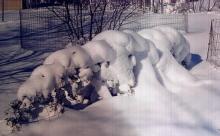
In this view, these are 12-18' trees under the snow, not 5' shrubs.
Approximate 14' Chionanthus virginicus compressed to a 4'-5' tall "snow muffin"
...after the snow melted off, bonsai version of Chionanthis virginicus.
Cornus kousa 'Milky Way', it was about 16'-17' tall. It is underplanted with hybrid Epimedium plants.
Richard T. Rodich
Re: Garden Adversity
Tue, 11/01/2011 - 5:09pmWith global climate change, it looks like your climate is trending toward bad winter storms, Mark. Not a good thing. Minnesota is trending with long, dry falls. The effect of the seemingly never ending La Niñas, we are told.
Adventitious buds are never strong at the point of emergence, especially at the get-go. It grew 10-12 ft in one season? :o I would assume a single tall whip?
Panayoti Kelaidis
Re: Garden Adversity
Tue, 11/01/2011 - 6:57pmYour note confirmed my worst frears, Mark. You have had a taste of Rocky Mountain weather: we have untimely snows most years (had one last week, another on the way tonight). In between the snow melts and there were crocuses still blooming...
I urge you not to cut things too quickly: we had an unbelievable spring snow in 2003 (over 4' of wet snow in March) that shattered EVERGREENS and snapped pines and spruces at the base. Few trees were spared some breakage. It was so vast, so colossal that it took weeks and months to clean up after it. It was amazing how things bounced back and plants we thought were goners today show little evidence of the damage they sustained. Nature is amazingly regenerative...
Heed that! As hard as it is to believe! And our thoughts are with you...hope you get your power back soon!
Panayoti
Anne Spiegel
Re: Garden Adversity
Wed, 11/02/2011 - 2:58pmMark, just got our power - out since Saturday. The house was 44 degrees and without lights, heat, water, phone. Everything back now and life is good. Damage to trees extensive. Pictured is Magnolia soulangeana. It didn't bloom every year due to frrquent late, killing frosts, but made up for everything the years it did bloom.
Robert Nold
Re: Garden Adversity
Wed, 11/02/2011 - 6:11pmThis looks too much like Denver, in September, October, March, April, or May. In the March blizzard of '03, I had a 7m tall Cupressus bakeri snap right in half, an equally tall C. arizonica laid out flat on the ground, etc., etc.
The trees recovered, and so did I (sort of), but now I stay up at night knocking snow off things I don't want broken. I even set the alarm for 2 a.m. or so, and knock off the snow with a push broom, and one of those extension poles made for painting the house.
Bob
Lori S. (not verified)
Re: Garden Adversity
Wed, 11/02/2011 - 6:41pmSo sorry to hear about the rotten weather and all the damage, Anne and Mark. I hope things, your prized trees, especially, will prove to be more resilient than they seem at present.
Mark McDonough
Re: Garden Adversity
Wed, 11/02/2011 - 6:49pmBob, excellent idea (setting alarm, and push-broom off the snow at night), certainly worth doing. I did this on my trees and shrubs in the monring, but then it was too late for many of them. I'm going to do that procedure next time!
Ann, sorry to see the damage on your Magnolia, the magnolias have big leaves that catch snow/ice and have brittle wood that snaps under pressure; my pink star magnolia is a wreck, and my large M. denudata 'Forrest Pink' that got wiped out in the ice storm of Dec 2008 came back remarkable in the last three years, but suffered more damage this time around (extensive). On the other hand, my black-leaf birch (Betula 'Black Prince'), a fastigiate tree, is incredibly flexible, the tip of the 20' tree touching the ground; I shook off the snow, and it stood back up after a day. I should grow nothing but birch trees, they're like rubber.
Finally gave in, after 4 days of no electricity and cold in the house, my wife and I are at a hotel tonight, what luxury to have TV, lights, warmth, and internet :)
Mark McDonough
Re: Garden Adversity
Wed, 11/02/2011 - 6:56pmYes Rick, the sprout grew with remarkable vigor, I think loving the heat and abundant rain. I still don't know the outcome on this tree, after the morning after the storm I have not been home during daylight to check it out. There is a single tall main whip, but then more suckers appeared, which i need to remove.
Thanks for your comments Panayoti, I will try to "work with" the remains to see what restorative growth might occur.
Anne Spiegel
Re: Garden Adversity
Wed, 11/02/2011 - 7:13pmI understand, Mark. Joe and I would have gone to friends who had power but most of them have cats, and Ranger does not accept cats. So we stayed with the dog (large german shepherd) and it wasn't too terrible. We were out of the house most of the day someplace warm. Thank heavens the power cam on late this afternoon.
Richard T. Rodich
Re: Garden Adversity
Wed, 11/02/2011 - 8:37pmThe New England version of tuckamores ;D ;)
I remember once after a series of such storms, one right after another, I built an igloo with blocks of snow cut from my driveway. It didn't even last the night before it caved in, but for a first try I was quite proud of myself. In my younger days, toughing out such an "adventure" was labeled fun. Now, not so much, but it is still an adventure (not that I would ever look forward to it...).
With their sinewy wood quality, one can also add Chamaecyparis (False cypress) to the "rubber tree" list. This is Chamaecyparis thyoides, in a past season. A few days later, it too returned to its completely upright position.
Robert Nold
Re: Garden Adversity
Fri, 11/04/2011 - 7:31amTaking no chances here. Picea pungens 'Fastigiata' all tied up for the winter.
Taken this morning.
Bob
Schier (not verified)
Re: Garden Adversity
Fri, 11/04/2011 - 11:40amI'm taking no chances here either, although this morning was the first snow,
just a skiff. Well, I guess I am taking a chance, I have only built a protection for
the Pinus strobus 'pendula' that I planted this spring. The rest of this years' new shrubs
and trees will be on their own. We don't tend to get as much of the heavy wet stuff
in the fall as in the spring. Then it can be nasty and heartbreaking, so I really feel
for you all that were blasted with it. I'm really not very fond of snow- but I do hope that we get some before the temperatures really start to dip, and if it's going to snow, there
may as well be plenty of it - just not so much at once! ( not asking for much, am I ..)
Robert Nold
Re: Garden Adversity
Fri, 11/04/2011 - 6:12pmSeveral years ago I was visiting a country club in Colorado Springs (to show slides) and noticed the columnar conifers were all wrapped with twine. It occurred to me there might be good reason for this and after the blizzard of '03 (or after some other blizzard) the spruce pictured had it branches all askew and they wouldn't grow back upright. I started wrapping it a winter or so after and have had no damage since.
So far ....
(It wouldn't be such a big deal to me if I hadn't spent so much money on a fastigiate blue spruce. I didn't look at the price tag when I picked it up and by the time I'd gotten to the cash register it was too late.)
Bob
Richard T. Rodich
Re: Garden Adversity
Fri, 11/04/2011 - 8:05pmMultitrunked arborvitae dominate the nursery market, a terrible trait for areas with heavy snow as the individual stems can splay apart. But I have only seen single stemmed trees in the wild. I have inquired, of learned people, where in the world this trait originates, but no one has been able to tell me. Has anyone ever seen an arborvitae (Thuja sp.) in the wild that was naturally multistemmed?
Stephen Barstow
Re: Garden Adversity
Sat, 11/05/2011 - 1:15amSorry to hear about this severe weather, the complete reverse of last year. I remember we had snow in October and temperatures had sunk to -10C at this time whilst Mark continued to show his onions in bloom! I was struck by how different our climates were! This year, we're well into November and still not a single frost here and the long-term forecast is the same and all sorts of warmth records are being set! I remember the climatologists forecasting a few years ago that in 50 years we wouldn't have frost here until December in some years. Well, we're not going to be far off that prediction already this year! Change is happening faster than we realise...
youngman54 (not verified)
Re: Garden Adversity
Sat, 11/05/2011 - 1:17amGee whiz!! I thought we had it bad the last couple of years but nothing like what you guys on the other side of the pond have been getting.
I suppose we should be grateful we live on a relatively small island ( UK ) in the Atlantic and have a maritime climate. its been so mild +20 oC / 68f we have narcissus 3" above the ground in November? We have had our 1st frost -1 / 30f so should hopefully slow things down. if it doesn't cool down we will have Narcissus flowers for Xmas.
Mark McDonough
Re: Garden Adversity
Sat, 11/05/2011 - 5:32pmFollowing up on thje damage done to Chionanthus virginicus (Fringe Tree), today was bright and mild, time to do some cleanup. Most branches were damaged, so the best pruning approach seemed to be to cut it back drastically, hoping that in a few years time with will be able to recover.
Leaving a few long willowy branches didn't make sense, so all was cut back to short solid trunks and severed branch bases. In the right-hand photo, the red line indicates a cut I made on a large low branch that had split under the weight of snow.
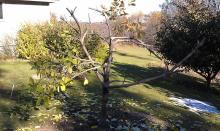
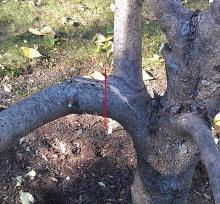
A heap of limbs cut off. On the right, the finished pruning job. Planted under this tree are many bulbous plants, such as Fritillaries and bulbous Alliums.
I gathered up all the seed, many still hanging on thje branches, like dangling olives, many others gathered up on the ground. I will sow these. Interestingly, Chionanthus is dioecious, my tree is male, but it has the ability to produce some female flowers and depending on the year, varying quanity of seed set.
And lest we forget, here are some photos of the plant in flower, the flowers richly perfumed scenting a large part of the yard.
Never got a change to see the fall color this year, so here's a view from 2010 (center, yellow leaves), with Oxydendron arboreum (Sourwood Tree) on the right... the latter survived this snowstorm but lost the top 7-8' with 3 leaders snapped off and some other shapely branches.
Trond Hoy
Re: Garden Adversity
Sun, 11/06/2011 - 1:28amA terrible weather you have had over there!
Although I experience heavy snow and broken treelimbs sometimes it has never been like that. When it happens I remove broken limbs and make a clean cut along the trunk or main branch and never leave stumps. Last time i had to do this was 3 years ago when a Magnolia soulangiana was badly damaged (by late snow in April) at our summerhouse. (A lot of mature pines suffered even worse and lost almost all their limbs.) Now the magnolia is back to its previous heights.
Mark, the fringe tree is (or was?) a beauty! Hope it regenerates well.
Anne Spiegel
Re: Garden Adversity
Sun, 11/06/2011 - 3:34amMark, I'm so sorry to hear about the damage to your oxydendron. Is this the first time it has had snow damage? I was planning to plant one in the spring. It's one of my favorite trees.
Mark McDonough
Re: Garden Adversity
Sun, 11/06/2011 - 4:41amAnn, Oxydendron arboreum is a slow growing but a strong and rugged weather-resistant tree. It almost never requires pruning. I can't remember its age exactly, but I'm thinking it is about 16 yrs old now, and the first time any branches broke was in our disasterous December 2008 ice storm, where the single leader snapped off, and some minor breakage lower down.
It was worse this time around, the 3 new leaders that grew in since 2008 all snapped off, and some other main branches broke, leaving gaps in the outline of the tree. But having 14" wet heavy snow in October while trees still have their leaves on is not a normal situation. The photo below is not very good, but shows the tree as of yesterday, with the broken leaders on the grown and other broken branches already removed. It will recover, damage was not that extensive.
I would advise planting this tree, it's one of the most beautiful and elegant trees. It is also tap-rooted and very late to leaf out, so it provides an ideal plantable home to bulbs underneath.
Richard T. Rodich
Re: Garden Adversity
Sun, 11/06/2011 - 7:24amWhen pruning, the general rule is not to leave stumps so as to preserve branch integrity, but I don't think it applies in this case.
When all the sprouting that will occur will originate from latent or adventitious buds under the bark, I don't see an advantage. The whole reason for the branch integrity rule is that when branches grow from normal buds produced at the twig stage, their attachment to the base stem is knit deeply into the structure of the base stem wood, making it strong. Latent and adventitious buds begin at the wood's surface, and so are "pasted" onto the base stem, rather than having a deep anchor that is part of the base stem's internal structure.
Thus, the area where the new branch attaches to the old stem becomes the weak link in the new branch's integrity. Witness how young water sprouts (that arise from adventitious buds) in a fruit tree's canopy easily snap off at their base. (Water sprouts are often erroneously called suckers.) This demonstrates their weak attachment to the base stem.
However years down the road, the overall branch structure could (and probably would) look better with less initial stubs. But because the new branches originate from latent or adventitious buds, technically, the smaller the caliper of the base stem, the more sound the branch attachments would be that arise from that stem. And certainly, as new branches grow, the parts of the stubs that remain stubs should be cut back.
Trond Hoy
Re: Garden Adversity
Sun, 11/06/2011 - 8:30amRick, I don't disagree with you. When I said stumps I am talking about something shorter than let's say 15cm depending on the thickness. If a "stump" is as long or longer than that and additionally have twigs I cut back to a sound twig. However branches damaged by snow almost always break or are teared off at or near the stem.
Mark McDonough
Re: Garden Adversity
Sun, 11/13/2011 - 11:55amOptimism springs eternal... if my devestated Chionanthus virginicus tree doesn't spring back from such a drastic pruning, there is always seed! I know I sowed the seed too thickly, but if I get a few trees out of it, then I can rejuvenate my affair with the beautiful Fringe Tree. Actually, this past spring 2011, 3 self-sown seedlings appeared; I can pot these up next spring and consider planting them out or offering up at a seedling sale.
I wonder... my Fringe Tree is male, but evidently it sometimes produces female flowers and I do occassional get some of the dark blue olive-like "fruits" (very hard seed with a thin-layer blue pulp and skin on the outside), I wonder what percentage of male/female seedling trees one will end up with. May never know, I don't have that much space to grow them on.
Mark McDonough
Re: Garden Adversity
Sat, 11/26/2011 - 6:42amGarden Adversity - Squirrels
While I have great admiration for oaks (mostly red oaks in my area, Quercus rubra), a major downside to oaks in New England are armies of gray squirrels that spend every living moment of daylight burying acorns in my garden; they're particularly attracted to soft freshly planted beds, so everyday beds of hybrid Epimedium seedlings look like a meteor-riddled lunar surface, with collateral damage of seedlings uprooted and languishing about. Of course in spring, the squirrels are at it again, incessantly digging little potholes EVERYWHERE in search of their beloved acorns, digging millions of holes with failed attempts. For the rest of the growing season I pull out oak seedlings by the hundreds if not thousands... until autumn returns and the cycle repeats.
Oak seedlings are strongly tap-rooted and difficult to pull out, even in the early stages of emergence. I often find the seedlings popping up in pots, seed flats and even in troughs (I now cover all seed flats with wire mesh). As I write this message on a laptop and staring out my dining room window, several squirrels are jumping about madly digging and buying acorns in a new hybrid Epimedium bed that I made this summer, each planted acorn ritualistically patted down these infernal rats with fuzzy tails ;) >:(
I haven't even begun to rant about chipmunks yet!
Anonymous (not verified)
Re: Garden Adversity
Sat, 11/26/2011 - 1:29pmThe biggest problem I have had with squirrels is they like to pull over my oriental lilies and steal the flowers when they are in bud. The worst part is they break the oriental lilies off at the base when they pull them over. After this occurs the oriental lilies do not resprout during that season. I am hoping they will have enough energy to come up again next year.
I have actually been allowing certain weeds like chenopodium to grow in this bed because I think the squirrels avoid the thicker vegetation. They probably realize the neighbor's cat might be hiding in such a place.
I have learned to cover my seed trays. I also cover bulbs for a few weeks until the smell of dug earth has dissipated. This smell is what draws the squirrels to freshly planted bulbs. The squirrels are very eager to discover what kind of treat you might have hidden for them.
My best humane suggestion for dealing with the squirrels is to use a live trap to catch them and relocate them to some distant woods. I have been told that some people put a little spray paint on the squirrel's tail to determine if any relocated squirrels have returned.
It seem that everyone loves them and enjoys feeding them in my neighborhood. The result being, I cannot relocate them. I also have to deal with an artificially increased population of these garden menaces.
James
Richard T. Rodich
Re: Garden Adversity
Sat, 11/26/2011 - 4:28pmNearby neighbors have Ohio buckeye, Black walnut and Butternut tees. Their seedlings are even worse than oaks, in my opinion. (I've had a lot of experience with oaks at my parents' house, too.) But there is really only one squirrel that frequents my yard and that's plenty enough. How do I know there is only one, and not just one at a time?
Well, one day this happened:
The poor thing was stuck there for hours. I was hoping a raptor would swoop down and snatch him. We have many that reside here at the edge of farm country. But alas, he finally freed himself and limped away. I had no squirrel visits for about two weeks. That's how I know there is only one.
Mark McDonough
Re: Garden Adversity
Sat, 11/26/2011 - 5:46pmI've always wondered about cactus gardens in suburban areas, whether small animals, or even dogs, get stuck. Now I know ;D These days I don't have much compassion for squirrels and chipmunks, although I too would feel bad about one stuck in such a prickly situation, thanks for showing this example.
At any given time, there are a dozen+ gray squirrels on or close-by my property, dozens more all around nearby, there are red squirrels too. When I'm inspired to temporarily reduce the population, I use two Havahart (non-lethal) traps, a larger one for gray squirrels, and a smaller one for chipmunks and red squirrels. They're easy to catch with either peanuts or peanut butter as bait. I release the catch about a mile away. One has to be discreet about relocating these rodents, as I've heard you can get fined for doing this (although ironically it's perfectly okay to kill them if one is so inclined, but I don't kill them). This gets tedious, but after a couple weeks of trapping and relocating 10-20 varmints, I can be relatively squirrel/chipmunk free for a couple weeks, but soon new ones move in.
Anonymous (not verified)
Re: Garden Adversity
Sat, 11/26/2011 - 7:04pmHaving an outdoor cat would also scare off your rodents. They say females are the best since they actually stick around.
Someone abandoned a cat at an apartment complex where I used to live. The previous owners had declawed the cat so it was unable to hunt for itself. We felt sorry for the cat and fed it. Once this cat had regained its strength after a few weeks we stopped feeling sorry for it. When it was not desperately hungry, it was a really mean cat. It started chasing me around my apartment trying to attack me. I took a towel, caught the cat in it, and put it back outside.
We watched this cat chase the squirrels around. The fat town squirrels were not very predator savy. The cat never caught the squirrels, just ran circles around them until they escaped up a tree. This kind of cat would be a good deterrent to keep squirrels out of a garden.
In the end, this cat ended up in some animal rescue cat barn in the country. A cat that attacks people is not exactly the adoptable type.
James
Mark McDonough
Re: Garden Adversity
Sat, 11/26/2011 - 8:20pmThere are 3 roaming neighborhood cats in my yard all the time (every day), and they're hunting. So far, I have only found evidence of moles (rare) and mourning doves being killed (mourning doves love to sit on the ground to sun themselves, thus easy prey). The squirrel/chipmunk/vole/mole population doesn't seem the slightest bit deterred. Personally, I think having a cat to do the job is a red herring. In fact, I'm irritated by cats who come into the yard and spray (stinks) or those who use rock-garden sandy soil as their toilet, either digging up plants in one's sandy beds, or worse yet, burying their turds in the soil and then the gardener "discovering" the foul turd squeezed within their hand while planting or cultivating an area.
Anonymous (not verified)
Re: Garden Adversity
Sun, 11/27/2011 - 12:39amMark, I let someone who actually has a garden/greenhouse cat take this one.
James
externmed (not verified)
Re: Garden Adversity
Sun, 12/18/2011 - 9:50amAh yes, garden adversity. I've been making vole feeders the last two days. Stryrofoam dinner plates on top of styrofoam bowls, with 3 little feet and a one inch mouse hole on the low side. I feel like Caddyshack, but the voles girdled almost everything up to a 8 inch apple tree last season *and collected* and ate large mounds of tulips and crocus. The resurgence of coyotes make cats a doubtful prospect. Then there are the deer (with Lyme disease for us) woodchucks and rabbits - and - slugs and snails, misc. caterpillars, spider mites and ants which seem to particularly like my sand bed - especially the part that I specially prepared for Lewisia rediviva; and fungus. (Oh I forgot beavers, they haven't been a problem in the garden, yet as far as I know.)
So Mark are Alliums impervious to any or most of these?; if so, watch out, I may be converting to all Allium.
Crazy extremely warm November. Realized yesterday that Allium thunbergii is full of ripe seeds--never matured seed before. Many Crocus, Alliums and some Colchicum have foliage up, way too much. Forecast to go to 14F tonight and then 45+F in a few days with rain. Made up my mind I'm going to cover the tender stuff today with pine needles. With info from all accounts, will resist the urge to cover cacti. Though covering with a sash open on the ends seems safe.
Good luck to all with their adversities.
Charles S MA USA Z 6a+/-
Peter George
Re: Garden Adversity
Sun, 12/18/2011 - 10:09amAll I can say about cats is that I have 2 that go outside, and in the past 10 years I've had no squirrels, no chipmunks and a very tiny number of voles in the gardens. Once in a while a find a bird, sometimes as many as 3 or 4 a summer, but I find at least 5 dead voles every week from April through October. I grow catnip in my 'butterfly' garden, and the cats love to congregate there, so they stay close to the plants most of the time.
So from my standpoint, cats are a huge benefit. And my property is about 3 1/2 acres, almost entirely surrounded by stone walls, which are normally home to literally hundreds of chipmunks. My cats, by the way, do their 'bathrooming' out of sight, usually behind my barn is the loose soil around the foundation. I don't garden there, nor do I even spend any time there, so it works out perfectly for them and for me.
And one more think; my cats keep neighbor cats off the property, so I don't have to deal with visitors who don't respect my garden beds, etc. And of course being somewhat rural, we have coyotes, foxes, fishers and weasels who also hunt the rodents, and sometimes the local cats, so we don't usually let ours stay out overnight.
Mark McDonough
Re: Garden Adversity
Sun, 12/18/2011 - 1:36pmI suspect chipmunk and squirrel populations is not strictly even or averaged situations, there might be influencing factors, with areas of population at much greater density than others. In my area, mature red oaks are a dominant feature of the deciduous woods, as are black walnut trees, probably supporting much greater populations of these varmints. The oaks produce incredible profusion of acorns; intended on taking a photo this autumn where it would be easy to gather up wheelbarrows full of acorns in minutes... I thought it would make for a funny photo op, never took the photo though. Judging from the squirrel diggings this fall, it was a big year for black walnuts too... just went out to toss some vegetable matter in a compost heap, and noticed that even with the ground frozen, there were several fresh large "potholes" in my Epimedium seedling beds... with heavy-thick shells of black walnuts in evidence, several Epimedium seedlings dug up as collateral damage and lying there bare-rooted and frozen...grrrrr!
When I first moved to my current town, my wife and I saw three homes that we liked, one was in a more wooded population, and I remember to this day one thing that struck me most; dozens upon dozens of gray squirrels frolicking about, everywhere one looked... the woods were almost entirely red oak. Instead, I chose my current location, with a whole acre of sun and some distance from nearby woodlands, the flanking woodlands having lots of sugar maples. Even so, chipmunks, plus red and gray squirrels are plentiful. In my more ambitious chipmunk removal periods, I could catch as many as 10-12 a day. Each live critter was put into a large trash barrel with leaves at the bottom, and at the end of the day, I would drive them several miles away to be released. With the squirrels, I need a new regime and will resort to more drastic measures, trapping them and then... :o
Charles, after 24 years in my current location, only recently have woodchucks and rabbits moved in (the last 2 years), the woodchucks being particularly destructive. I think it's very possible for pests that have not been an issue whatsoever for many years, suddenly become a problem by moving in, and with subsequent broods of young ones, they keep coming back.
Ever since I've been here, I've been battling mole damage... It never gets any better, no relief. here are a couple photos last winter / early spring, after a thick mantle of 12-18" of snow receded, the tunneling damage in lawn and garden areas can be extensive (even when I winter baited). One doesn't see the damage until spring. Regarding Alliums, it's somewhat of a myth that Alliums keep the critters away, they do not, and I have lost large patches of Allium due to tunneling. At times, I feel like Bill Murray in CaddyShack too, going to war with rats with fluffy twitchy tails, and various tunneling vermin.
Mark McDonough
Re: Garden Adversity
Sun, 12/18/2011 - 1:43pmSometimes garden adversity happens in small and memorable ways.
I had excellent germination of Aquilegia saximontana from Jane Hendricks seed. Then one day I noticed a disturbance in the flat, and lo and behold, it was a toad. Now, I understand the benefits of toads in the garden, invariably I get one or two that'll scoop out a seed pot (they like round ones best) and half bury themselves in their cozy nest, But why is it they always seem to target the best thing one's growing? :(
I gently scooted the little fellow out of the flat, replanted the disturbed seedlings as well as I could, then covered the flat with wire mesh (my new seed sowing standard, otherwise chipmunks, squirrels, and occassional toads, will surely dig in each and every pot).
Trond Hoy
Re: Garden Adversity
Tue, 12/20/2011 - 7:01amSeems that slugs and snails - and occasionally a rat or squirrel - isn't always the worse problem after all :-\
You know Mark, toads or slugs in pots where you have you most precious plants is as it is according to Murphy's laws ;)
Red oak, is it Q. rubra? And black walnut, J. nigra?
Anne Spiegel
Re: Garden Adversity
Wed, 12/21/2011 - 8:30amYesterday was the last day of hunting season and the hunter who has come here for many years bagged his last deer of the year - a mega-doe weighing in at almost 200 lbs. Her size was probably due to the number of my plants she had been eating. One more down and too many more to go.
externmed (not verified)
Re: Garden Adversity
Wed, 12/21/2011 - 9:22pmAnne, Congrats on one less deer - probably would have had twins.
Sometimes smoke bombs will work for woodchucks in their holes, usually takes serveral tries.
If I really have to get one, Campanula "Elizabeth" in a sufficiently large have-a-heart seems to work 80%+. About $7.00 for the plant and nothing left once it's spent several hours in a trap with a woodchuck.
Charles MA USA
Mark McDonough
Re: Garden Adversity
Fri, 12/23/2011 - 6:55amCharles, I have tried the smoke bombs before... one needs to know the entrances to their burrow (if there is more than one), to seal all but one ahead of time, make sure the critter is inside, and light the bomb and cover with some heavy chunks of sod to contain the smoke. Unfortunately they nest in an area with brush piles that is not easy to access or contain, and of recent, they burrow under my garden shed without any good way of getting at the varmints. It is yet another project, to excavate around my shed circumferance, and install heavy wire mesh, and backfill. Maybe I should try your large Havahart trap idea, with the sacrificial Elizabeth Campanula.
http://woodchuck-x.com/smokebomb.htm
Just visited the Havahart website, has anyone tried the Critter Ridder animal repellent?
http://www.havahart.com/store/animal-repellents/3146
http://www.havahart.com/
Schier (not verified)
Re: Garden Adversity
Fri, 12/23/2011 - 3:48pmMark I know, almost any varmint seems to pick on the best thing, the thing that you've tried hardest to grow etc. I've had too many "heartbreaking" mornings in my little greenhouse, almost unable to believe my eyes. It can't be gone, where the **** is it???
But yes it's gone. I've been doing the screen thing over the seedlings, kind of a pain in the neck but it works, so screening it is.
Jan Jeddeloh
Re: Garden Adversity
Fri, 12/23/2011 - 7:00pmWell, I live in the slug capitol of the world. Red, black, grey, multicolored, introduced, native we have them all. As to the native banana slug which, according to the naturalists, doesn't eat living plants just decaying matter, well, I must have a special breed of banana slug because I can assure you they do eat living plants. Now that we don't have a dog I'm going to use both the iron phosphate bait and the metaldehyde bait this year. And if it takes out a coyote or two that's all to the good. I have an indoor/outdoor cat and we always worry about her becoming dinner.
And moles. I hate moles. They always unearth a plant you really care about, not something destined for the compost heap. We used to have a former barn cat who was really good at catching moles- she knocked off five babies in one day-but she died last spring. Our remaining cat has a sweet disposition but isn't much for "moleing". And because of the coyote problem any future cats need to be indoor only. I can't tell you how many "missing cat" flyers I see around the neighborhood......My hands are both very small and not that strong so setting traps really isn't an option for me. My husband doesn't seem to be willing to do this for me and my neighbor is now a former trapper (really the guy used to work as a fur trapper) Mostly I just curse...
For anyone who wants to try trapping their stray cats my neighbor did say to make sure you get a fair sized trap. Cats don't like to crawl into small traps.
Jan
Jan
Mark McDonough
Re: Garden Adversity
Fri, 12/23/2011 - 7:27pmThis is my new standard seed sowing procedure; all flats or pots must be covered with some sort of protection from digging varmints. This "hardware cloth" is not terribly expensive at a hardware store, it is easily snipped with a pair of wire snips, and easily bent over the flats to hold them in place. The one thing to look out for is the germinating seedlings popping through the wire mesh and making it difficult to remove the mesh without damaging seedlings. Typically I watch for germination, and when it occurs, loosen the wire mesh piece and create a sort of teepee or arched "hoop house" effect over the flat... still keeps the squirrels out yet allows the seedlings to grow without getting tangled in the mesh.
Jan, I feel your pain, the slug issue in the Pacific Northwest is not to be underestimated; it was a huge eye-opener when I lived in the Seattle, Washington area. And yes, banana slugs ate plants like there was no tomorrow.
Tim Ingram (not verified)
Re: Garden Adversity
Sat, 12/24/2011 - 4:14amGood idea Mark - I do very much the same thing for certain seed (umbellifers, hellebores and so on) which seem really attractive to various varmints. I also constructed a seed frame from wire mesh. I had thought one of our greenhouses would be mouse proof for germinating seed pots but they always manage to find a way in! The biggest problem we have had is with flowering size hellebores in the greenhouse - the young flower buds at ground level are chewed off by mice very early on in October before you think of putting down any bait. This happens to a lesser extent in the garden too and is a good reason to cut away the old hellebore foliage early on in the winter so there is no cover for mice. Cats would definitely be good!
Trond Hoy
Re: Garden Adversity
Sun, 12/25/2011 - 5:01amI have cats - or rather the neighbours have cats in my garden but the cats are doing more harm than goo. They always dig resting places in the bed and make droppings everywhere but I can't say the number of rodents drops!
Besides, the cats don't eat slugs :(
TStuart (not verified)
Re: Garden Adversity
Wed, 12/28/2011 - 11:47amThe active ingredients of Critter Ridder come from black pepper and chili peppers. Seems like one can test it without visiting the garden center.
A very good repellent for many animals is castor oil. The EPA lists it as effective with dogs, cats, moles, deer, rabbits, and squirrels. This info sheet lists other plant oil repellents, most of them for insects:
http://www.epa.gov/oppbppd1/biopesticides/ingredients/factsheets/factsheet_plant-oils.htm
In commercial formulations castor oil is encapsulated in dry granules. One product is MoleMax. Their claims extend to voles, gophers, armadillos and skunks. Anyone suffering from armadillo invasions?
Richard T. Rodich
Re: Garden Adversity
Wed, 12/28/2011 - 3:21pmThanks for that EPA link, Tom. I never would have thought of mustard, and it sure seems like a lot of pant oils deter cats and dogs.
And welcome to the forum! We hope to see more of you and your gardens, here.
Mark McDonough
Re: Garden Adversity
Thu, 12/29/2011 - 6:47amHello Tom, good to see you on NARGS Forum! Very interesting information and link, I'll need to explore options more. Regarding Critter Ridder being derived from black pepper & chili pepper, then I have already tried similar treatment. With my Epimedium seedling beds currently very attractive to squirrel digging, I tried generous sprinkling with black and hot red pepper. Then I would observe from my dining room window while working on my laptop, and watched as multiple squirrels were busy, busy, busy digging their infernal holes everywhere, completely undeterred by the pepper; in fact, they seemed to enjoy the extra seasoning in their bland diet ;) I did similar treatment around my garden shed that had a family of woodchucks (gophers) living under it, and the heavy dousing of hot red pepper seemed to do the trick, they didn't like it, and after repeated reapplications of pepper, they seemed to have moved away from that exact location, although I would still spot them in the yard and garden, so they didn't go far.
The problem with the pepper, particularly red pepper, it is extremely expensive (on a per pound basis) if bought at a grocery store. I would have to find a source for buying it in bulk. The other problem is that the effectiveness of pepper is quickly diminished when exposed to rain for any lengthy period.
I hadn't heard of MoleMax, but looked it up. Reading the user reviews of the products on Amazon.com can be revealing... besides the typical spectrum of feedback from complainers to "happy campers", some respondants gave substantive reports of using the product over a number of years, giving credible body of evidence that in the long run this particular product was not effective for them, and it became very expensive, to a point where they decided not to use the product anymore.
But I value these leads and tips, and will explore options in much greater detail, as ammunition in vermin warfare in 2012. Meanwhile, back to squirrels, I plan on trying a new tactic, and that is to trap them in winter when perhaps they are more vulnerable. The squirrels remain active all winter (unlike chipmunks), and will probably be easy to trap with some enticing morsels of food. If I could deplete the local squirrels population in my immediate area well before spring, maybe there would be less breeding going on, thus fewer squirrels to contend with next spring.
Peter George
Re: Garden Adversity
Thu, 12/29/2011 - 6:59amSquirrels, like many other 'critters' that bother gardens and gardeners, won't be affected by trapping them in the winter. They breed like crazy, and they will fill any territory that is available. If you had a 100 acre property, you could reduce their population sufficiently IF you trapped them for the entire fall winter and spring seasons over the entire property, but with a small property such as yours, it won't work. You might consider raising owls. They LOVE squirrels.
Pages