I did not know that Ypsilandra would come from leaf cuttings.... will be trying it soon, though.... thanks Tim!
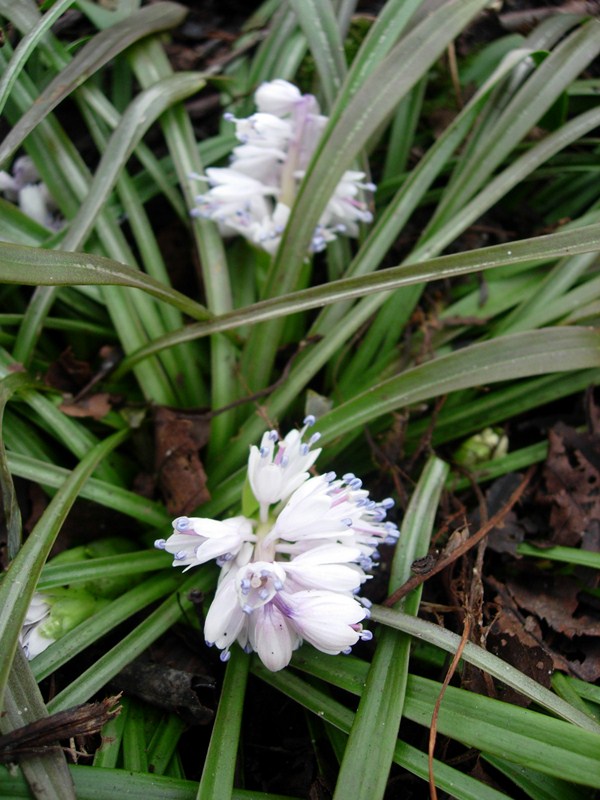
It does! - and so does the related Heloniopsis. The easiest way is to just push the end of a growing leaf in the compost. The picture shows a couple of damaged leaves that were removed and put in compost
Wim, you have some choice stuff there...months ahead of me...my hosta are not even showing themselves. I have never seen that blue cory for sale in canada. I expect the tuberous types would do better here. C. solida is now seeding into my lawn! That one is almost TOO prolific!
I must try the leaf cutting technique with the Heloniopsis....it would be nice to get more of that one.
Lots of good thought-provoking posts here, I'm just catching up. I too had no idea about the possibility of leaf cuttings with Ypsilandra & Heloniopsis, go figure.
Wim, no one has yet commented on your Ramberlea. I assumed this to be an intergeneric hybrid between Ramonda and Haberlea, and googling it, it is certainly the case. What comes up in Google is one called x Ramberlea 'Inchgarth' (Ramonda myconi var. alba x Haberlea rhodoptera 'Virginalis'). All that I see photos of have blue lavender flowers, on your x Ramberlea plant the flowers look near white. Are there additional color forms resulting from that intergeneric cross? I really like your R. myconi var alba, looking happy indeed.
Last year I was sent some rhizomes of Polygonatum roseum, and as I watched for signs of life this spring, I had all but given up hope, but should have known better... some Polygonatum species are late to emerge. Sure enough it popped up, and at about 4" (10 cm) tall so far, it has a few cute little pink flowers. Researching the species, it does grow up to 1-2' tall, although most sites report about 18" (45 cm).
Wim, you asked in the Epimedium 2011 topic (http://nargs.org/smf/index.php?topic=630.msg9009#msg9009), what it was that's growing under Arisaema sikokianum. Here is a closer view, the undergrowth is Oxalis acetosella, which makes a luxuriant soft groundcover. Some people may shudder at the thought, this plant can certainly spread far and wide, but as it's roots are so close to the surface it doesn't really compete that much except with very small plants, so it's a good companion for Arisaema and larger woodland plants.
Just behind the Arisaema is my clump of Cypripedium reginae, or Showy Ladyslipper Orchid, which increased from 8 growth points to 12 this year. I love this species, not only for the beautiful long-lasting flowers, but because it flowers much later than many cyps.
I have also grown Polygonatum roseum but it is an excellent slug bait and doesn't last long. My attempt to grow ladyslippers has almost failed too. Only one left and slugs are attacking it now and then :'(
@ Mark, concerning the Ramberlea: it was this one I got: http://www.kevockgarden.co.uk/plantlist/ramberlea.htm, so it might just be a white Ramonda (it has a soft pink tinge). I had never seen any other cross between Ramonda and Haberlea except for the cultivar named 'Inchgarth' after the garden of the breeders who made this cultivar: Brian and Maureen Wilson. So that was why I bought this particular cross, to see if there are other colors possible from a cross like that. There's also a cross between Jancaea and Ramonda which is very beautiful, called Jancaemonda, you can see one here: http://www.srgc.org.uk/smf/index.php?topic=509.msg12815#msg12815
I'm one of those people who shudders at the thought of having O. acetosella as a groundcover ;) ;)... I think it's working towards world-domination ;) ;)
Wow, absolutely beautiful scenes, Mark! The photo of A. sikokianum is especially ethereal! Can't wait to see the cyp in bloom, too.
Great Arisaema photo, Trond. Eliot and Barbara Coleman used ducks to control slugs and snails... I doubt you'd want to travel to your cabin with a cage of ducks in tow but it would be an interesting thought. ;) (They are American organic gardeners who have published some very sensible books and had an organic gardening show on PBS TV. Anyway, they had an enclosure for their pair of ducks that consisted of a shelter at one end and a hardware cloth "run", and the assembly could be lifted and moved on a daily basis to give them new grazing grounds. They called it "Duckingham Palace"... )
We are supposed to get a week of rain, starting today... wish I could send you 3-4 days worth!
It will take many more years for these to fill in and put on a good show, but here's a start ...Isopyrum biternatum* with white flowers, and Anemonella thalictroides 'Rosea' (both planted a few years ago), and Sanguinaria canadensis 'Plena', planted a couple of years ago.
Has anyone got any rain for our woodland? Hardly any since February - the garden is parched!
If you have the pipeline I have the water! We had a very sunny and warm April but May has been rather wet. However the temperature has been higher than normal. More rain expected all the week.
Regarding Oxalis as groundcover - I prefere oxalis to any other groundcover plant! Oxalis is easy to grow and easy to remove, does not compete with the other plants and charming! And you can eat it!
I have grown Anemonella for years but they refuse to expand - only a few flowers a year :(
Skulski wrote:
Wow, absolutely beautiful scenes, Mark! The photo of A. sikokianum is especially ethereal! Can't wait to see the cyp in bloom, too.
Great Arisaema photo, Trond. Eliot and Barbara Coleman used ducks to control slugs and snails... I doubt you'd want to travel to your cabin with a cage of ducks in tow but it would be an interesting thought. ;) (They are American organic gardeners who have published some very sensible books and had an organic gardening show on PBS TV. Anyway, they had an enclosure for their pair of ducks that consisted of a shelter at one end and a hardware cloth "run", and the assembly could be lifted and moved on a daily basis to give them new grazing grounds. They called it "Duckingham Palace"... )
I have read about people in Norway using ducks (Peking duck?) to control those molluscs but I have no wish to try! As you imagine: ducks in a cage! When the kids were small they had rabbits (they wanted a dog). We brought them with us every time we travelled except abroad. I am very glad that time came to an end!
Regarding slug control, one of our Chapter members uses chickens.
Lori, only your 'Rosea' is Thalictrum (Anemonella) thalictroides. The white form is another species. Leaves are completely different, and I think you will find that your white one's flowers always have five petals, while Thalictrum thalictroides blooms usually have more. The single flower or umbel of T. thalictroides is always subtended by a single whorl of leaves. Our common name for T. thalictroides is May flower, and they are native in the woods here. I do grow them in my garden, too. They are great fillers, flower much longer in the garden than in the wild, and I always have lots of volunteers to weed out. ;D
Oh, yes, that jolted my feeble memory, Rick! Thank you! The white one is Isopyrum biternatum.... right? ;D
RickR wrote:
Thalictrum thalictroides... they are native in the woods here. I do grow them in my garden, too. They are great fillers, flower much longer in the garden than in the wild, and I always have lots of volunteers to weed out. ;D
Many people will be extremely envious to hear that! ;D
Oh, yes, that jolted my feeble memory, Rick! Thank you! The white one is Isopyrum biternatum.... right? ;D
I do believe you are correct on that, but another name change: Enemion (Isopyrum) biternatum
I have seen this one growing wild in southern Minnesota, building height (to 1+ ft) as it continues to add flowers to the stem. (Flowers are not necessarily terminal.) I have not seen it occur as a single stem, but usually find it as a clump 10-18 inches in diameter.
At last! Clintonia andrewsiana has opened its flowers ;D I have planted this elegant plant in my woodland where it now reahes 80cm tall with 3 flowering stems.
At last! Clintonia andrewsiana has opened its flowers ;D I have planted this elegant plant in my woodland where it now reahes 80cm tall with 3 flowering stems.
Fantastic Clintonia Trond, the best species for sure. I have always wanted to grow this one; your post reminds me to put this higher up on my list. How did you keep the slugs away ;)
At last! Clintonia andrewsiana has opened its flowers ;D I have planted this elegant plant in my woodland where it now reahes 80cm tall with 3 flowering stems.
At last! Clintonia andrewsiana has opened its flowers ;D I have planted this elegant plant in my woodland where it now reahes 80cm tall with 3 flowering stems.
Fantastic Clintonia Trond, the best species for sure. I have always wanted to grow this one; your post reminds me to put this higher up on my list. How did you keep the slugs away ;)
Did you grow it from seed or purchased plants?
Thanks all ;D
Clintonia seems to be immune to slug attack! They are however hard to get hold of (here). I think I bought two small rhizomes from Paul Christian (rare plants) some years ago. When I find seeds offered I buy. They're late to germinate and seedlings grow slowly.
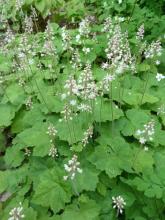
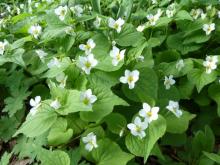
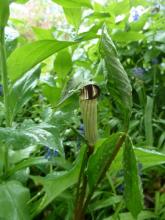
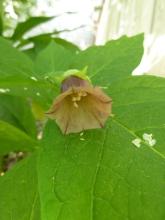
Tiarella cordifolia; Viola canadensis; Arisaema triphyllum; Scopiola carniolica; Geranium macrorrhizum 'Spessart' covered by a flurry of chokecherry petals; Phlox stolonifera... and I spy the leaves of another couple of Cypripedium parviflorum seedlings in there!
Lori, I have some seedlings to plant out sometime soon-- Tiarella-- from Kristl, maybe cordifolia? look similar, but have slight red markings on the leaves (not going out now to check the tags.. the mosquitoes are fierce these days), and A. triphylla... do either of these need anything special in siting? Extra moisture, extra room to spread, part day sun or all shade? (of course I can and will google, but just to get some first hand Alberta input...lol)
Cohan, neither gets any special care in my yard, no extra watering, zilch. (Well, nothing else gets special care either.) Full to part shade is fine. The tiarella will eventually spread enough to form a nice bed after a few years - certainly not invasively. Re. the Arisaema.... well, mine have certainly never needed extra room... ;D. Rather more of a single specimen novelty (starting from 3-4 corms that I was kindly sent - one survived) even after a very, very long time... I've never had fertilized seeds on them. Apparently, the flowers are dioecious and I only ever get one flower on a plant, and I only have one plant of a couple of species! Has anyone else in this area grown them?
Perhaps you have one of the T. wherryi selections?
Cohan, neither gets any special care in my yard, no extra watering, zilch. (Well, nothing else gets special care either.) Full to part shade is fine. The tiarella will eventually spread enough to form a nice bed after a few years - certainly not invasively. Re. the Arisaema.... well, mine have certainly never needed extra room... ;D. Rather more of a single specimen novelty (starting from 3-4 corms that I was kindly sent - one survived) even after a very, very long time... I've never had fertilized seeds on them. Apparently, the flowers are dioecious and I only ever get one flower on a plant, and I only have one plant of a couple of species! Has anyone else in this area grown them?
Perhaps you have one of the T. wherryi selections?
Tks, Lori... I forgot to check that tag on Tiarella again... I think its a species, I had in mind its a wild form, but its (a pot of seedlings) from seed from Gardens North, and she does have both wild and garden seed .. I'll just have to remember to look at the tag..lol My Arisaema are also seedlings from wild Ontario seed from a trade, not sure how many are in the pot, several at least, maybe fewer now than what germinated last year...
I looked today, its Tiarella cordifolia and tag does not give a wild collected location, so it could be seed of garden forms, I'd have to ask Kristl if she remembers what she had that year.. here are the seedlings..
Thanks, Lis! These plants are already a fave of mine with those gorgeous leaves-- hopefully some will show even more red over time.. flowers will just be a bonus :) Some shade is good, since I don't have that much full sun space, anyway--but half day sun I have lots, and dappled to deeper shade... I'll probably separate them and try a few spots..
The draping displays them nicely... some patches are in flower here, though most seem to be just in bud last I looked.. they rarely get space to themselves though, and have to be viewed through other vegetation.. There are many places where they grow in mowed areas--fine for the plants, but i'm not always successful avoiding the flowers....
they [Linnaea borealis] rarely get space to themselves though, and have to be viewed through other vegetation.. There are many places where they grow in mowed areas--fine for the plants, but i'm not always successful avoiding the flowers....
In northern Minnesota where I see Twinflower commonly, I find them most often in pine needle duff where surface vegetation and understory are sparse. They virtually have the whole place to themselves! This is also where Pipsissewa (Chimaphila umbellata) grows.
I've been very busy during the last couple of weeks so it seems I have a lot to catch up to on this forum.
Lori, love your shadeplants, especially the Arisaema and the twinflowers. Cohan, your pot full of Tiarella seedlings look as if they are really enjoying themselves.
Here are some shade lovers which are flowering here now.
The white form of Anemonopsis macrophylla (sometimes sold as cv. 'White Swan') Arisaema candidissimum Arisaema fargesii Arisaema speciosum Arisaema tortuosa Deinanthe caerulea Epipactis gigantea and Primula florindae
they [Linnaea borealis] rarely get space to themselves though, and have to be viewed through other vegetation.. There are many places where they grow in mowed areas--fine for the plants, but i'm not always successful avoiding the flowers....
In northern Minnesota where I see Twinflower commonly, I find them most often in pine needle duff where surface vegetation and understory are sparse. They virtually have the whole place to themselves! This is also where Pipsissewa (Chimaphila umbellata) grows.
If I ever finish posting pics from my one day in the mts, lol, I will show some of the Linnaea here in the yard, and surrounding woods where they grow in any kind of soil and moisture conditions except standing water, nor are they common in the driest under spruce spots (the only places we have with barish ground).. they are common under and among grasses, shrubs, and numerous forbs with mosses, lichens and fungi as well
I love the pin-striped Arisaema, Wim! It's nice to see the beautifully-grown Deinanthe in both Rick's and Wim's gardens. (Mine has succumbed to drought and general mistreatment... sigh.)
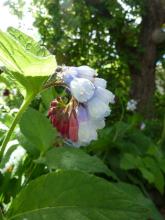
I suppose this is a woodlander of sorts... I believe it's Symphytum grandiflorum (maybe a cultivar, but if so, I've lost its name), and it's looking very attractive with it's white, blue and red inflorescences. Despite it's common name, creeping comfrey, it has remained in the same spot over a few years now; should I be on the watch for world-domination?
Deinanthe caerulea is another one of my acquisitions that was woefully mistreated in its early years due to my ignorance of its needs. For three or four years it was an "ephemeral", emerging in the spring and in just 3-4 weeks going dormant. I guess it was wondrous that it even survived that hot, summer baked, rich clay. When I moved it to a proper site, it really jumped into growth. It produces zillions of viable seeds, although I have not seen any volunteers yet.
I still grow comfrey also. I hold over from when I used to dry the leaves to brew a most delicious tea. It is still my favorite, tasting much like orange and black peko. But there are some reports of it being carcinogenic, So I hardly drink it anymore. I received the plant from my neighbor, who drinks it religiously, as did his father in Italy. so I don't know what its real taxonomic designation is, but I guessed it as Symphytum x uplandicum. Yours is much more garden worthy, Lori. I'm not sure if it ever produces viable seed. One year I tried in earnest to collect seed for someone; I think I got two seeds that looked good, but I never found out if they actually grew or not.
I haven't grown comfrey, but I have got the impression that once you plant it, its for life... supposed to produce wonderful compost (really deep roots that bring nutrients from deep soils), some sort of fertiliser tea as well..
I also grow Comfrey - my introduction to it in the 80s as a tea plant and vegetable coincided with the carcinogen scare, so I left it alone. I grow the selection Symphytum x uplandicum "Bocking 14", a selection made by the Henry Doubleday Research Association in the UK who championed this "wonder plant" until the scare. It is also used to make comfrey fertiliser as Cohan says (just fermented leaves, like nettle water) and that's how I use it today. It behaves very well in a garden, not spreading invasively like some of the species.
Much to look at here! Deinanthe is a favorite of mine but my plants can't match yours! They're often damaged by slugs. Comfrey is a weed in my garden, selfsowing all over the place. However it is easy to remove when young. Twinflower is very common here except the driest places. I love their spicy fragrance. Arisaemas are always special but the speciosum is not the least!
Still going strong, flowering for the last month and a half, is Kirengoshoma palmata. Last year, the plants completely collapsed in the record-breaking drought and looked hideous, this small genus of Japanese woodlanders is the plant equivalent of a canary in a mine, one of the first plants to show water stress and flag with the slightest whiff of dryness. This year we've had ample rainfall, and these large plants (to 5' tall x 5' wide) drip at the tips with waxy yellow flared trumpets. The foliage is unique, bold, and attractive as well.
I'm always interested in what blooms attract hummingbirds; today I heard the close whir of a hummingbird's wings, as it visited each and every flower on my large Kirengoshoma stands, the first time I witnessed this particular hummingbird nectar choice. In the second photo, I marked a red arrow where the hummingbird is, and included an enlarged insert; sorry for the poor photo quality but the entry-level camera I share with my daughter is useless for action photography and macro photography, but you'll get the idea.
Well grown, Mark! My plants do not show any colour to the flowers yet. They are very late flowering here.
Have you considered if your plants belong to the Koreana group/Kirengeshoma koreana? If I remember rightly the Korean form opens the flowers more and has a stiffer stem. My plants are very lax. But this can be temperature related of course.
"Have you considered if your plants belong to the Koreana group/Kirengeshoma koreana? If I remember rightly the Korean form opens the flowers more and has a stiffer stem. My plants are very lax. But this can be temperature related of course."
I agree too...the plants we have at work labeled K. palmata are much more cascading and a bit more closed than yours Mark. The K. koreana haven't started blooming yet, but I'll bet they are going to look just like yours.
"Have you considered if your plants belong to the Koreana group/Kirengeshoma koreana? If I remember rightly the Korean form opens the flowers more and has a stiffer stem. My plants are very lax. But this can be temperature related of course."
I agree too...the plants we have at work labeled K. palmata are much more cascading and a bit more closed than yours Mark. The K. koreana haven't started blooming yet, but I'll bet they are going to look just like yours.
Very interesting Amy, you've given me something to look at more closely. And when I start looking up Kirengeshoma palmata and koreana, the puzzle deepens and I'm no closer to an answer! What I'd like to find is a definitive publication that delineates the difference between palmata and koreana, and on that front, I haven't yet found anything conclusive. First, there's the reference to the "koreana group" or K. palmata koreana group", suggesting ambiguity on the two "species". There's even uncertainty regarding the family and taxonomic standing, originally placed in Saxifragaceae but some authorities now placing it in Hydrangeaceae, and the genus is listed as "status unresolved" in The Plant List. http://www.theplantlist.org/tpl/search?q=Kirengeshoma
I also have a plant that came to me as K. koreana, which has leaves that look decidedly different, although my plant languishes in a drier part of the garden... not sure if it's still alive. It has never flowered for me.
So, I very might very have Kirengeshoma (the koreana group), but who really knows.
After a long search, I did find this one recent (2010) paper. While very technical, it does have some taxonomic language that is helpful, which makes clear that there are two species, and where each is native to. http://www.amjbot.org/content/97/6/e48.full
Here's an excerpt: Kirengeshoma (Hydrangeaceae) comprises two extant species, Kirengeshoma palmata Yatabe and Kirengeshoma koreana Nakai, both of which inhabit warm temperate-deciduous forests in eastern China/southern Japan (K. palmata) and South Korea (K. koreana) (Qiu et al., 2009). Kirengeshoma koreana is restricted to one locality, Mt. Baek-unsan, whereas K. palmata is known from four sites in eastern China (Zhang et al., 2006) and three in southern Japan (Chang et al., 2007). Because of their small range size and small number of populations, both species are treated as “endangered” in China, Japan, and Korea (Qiu et al., 2009) and are considered “critically endangered” by the International Union for the Conservation of Nature (IUCN). Both species are of high ornamental value because of their large attractive flowers and beautiful leaves. Kirengeshoma palmata is also a medicinal plant, containing biologically active flavonoids in roots and rhizomes (Zhang et al., 2006).
1. Kirengeshoma species are from Japan, Korea, AND China, the latter is almost never mentioned.
2. There is a color map showing where the species are found.
3. From the text "While all populations were originally identified as Kirengeshoma palmata (Yatabe 1890) the Korean population was subsequently described as Kirengeshoma koreana (Nakai, 1935), even though this is not always accepted"
Still haven't found a document that lists the taxonomic differences between the two species! Most references to K. palmata describe a plant 1 meter tall (some say 120 cm, so a trifle taller). My plant gets 5-6; tall (almost 2 meters), so perhaps my plants are K. koreana after all, although without a botanical description of K. koreana, it is still hard to know for sure. Also, as Amy suggests, the more flared flowers suggest K. koreana too, as most photos I've seen of K. palmata have more drooping bell-shaped flowers that don't open as much, but that isn't consistent across the photos I've found... maybe the two species are mixed up in cultivation.
Here's a drawing of K. palmata from the Flora of China. Interesting to see the base of the stems are square in cross-section, I have not noticed this before. Also interesting, Flora of China still places the genus in Saxifragaceae. http://www.efloras.org/object_page.aspx?object_id=12438&flora_id=2
Maybe I have flogged this horse long enough ;), but I wanted to share a recent development.
While perusing a garden center, and checking out the "shade perennials" area, some of the tables were pretty well picked over, but there it was, sitting by itself, a lone Kirengeshoma koreana. So, I had to buy it, and then compare with my garden plants identified as K. palmata.
Placing the plant right up to my 6' tall plants I have under the name of K. palmata (still in nice bloom by the way), the two plants couldn't be more different. The newly purchased K. koreana has thickish, waxy, heavily rugose leaves, whereas my garden plants of K. palmata have smooth matte grayish-green leaves 4-5x the size, looking completely different. In the closeups of "koreana" you'll notice how the upper stem cauline leaves are "alternate" whereas the "palmata" leaves are strictly "opposite". When the buds open on "koreana" I'll take side-by-side photos of both in bloom to compare. I'm still hoping to find an actual botanical description of K. koreana, with which to compare to palmata.
Kirengeshoma "palmata" still in good and ample flowering, the end of August 2011. It helps that we've had ample rain this summer, and the impressive 5' wide x 6' tall clumps have been blooming throughout July and August.

Comments
Diane Clement
Re: Miscellaneous Woodlanders
Wed, 05/04/2011 - 2:28pmIt does! - and so does the related Heloniopsis. The easiest way is to just push the end of a growing leaf in the compost. The picture shows a couple of damaged leaves that were removed and put in compost
Todd Boland
Re: Miscellaneous Woodlanders
Thu, 05/05/2011 - 3:28pmWim, you have some choice stuff there...months ahead of me...my hosta are not even showing themselves. I have never seen that blue cory for sale in canada. I expect the tuberous types would do better here. C. solida is now seeding into my lawn! That one is almost TOO prolific!
I must try the leaf cutting technique with the Heloniopsis....it would be nice to get more of that one.
Mark McDonough
Re: Miscellaneous Woodlanders
Sun, 05/22/2011 - 8:44amLots of good thought-provoking posts here, I'm just catching up. I too had no idea about the possibility of leaf cuttings with Ypsilandra & Heloniopsis, go figure.
Wim, no one has yet commented on your Ramberlea. I assumed this to be an intergeneric hybrid between Ramonda and Haberlea, and googling it, it is certainly the case. What comes up in Google is one called x Ramberlea 'Inchgarth' (Ramonda myconi var. alba x Haberlea rhodoptera 'Virginalis'). All that I see photos of have blue lavender flowers, on your x Ramberlea plant the flowers look near white. Are there additional color forms resulting from that intergeneric cross? I really like your R. myconi var alba, looking happy indeed.
Some links I found:
http://www.kevockgarden.co.uk/plantlist/ramberlea_inchgarth.htm
http://www.gesneriadsociety.org/Membership/ForMembershipBanner/XRamberle...
http://www.srgc.org.uk/discus/messages/283/14204.jpg
Mark McDonough
Re: Miscellaneous Woodlanders
Sun, 05/22/2011 - 8:52amLast year I was sent some rhizomes of Polygonatum roseum, and as I watched for signs of life this spring, I had all but given up hope, but should have known better... some Polygonatum species are late to emerge. Sure enough it popped up, and at about 4" (10 cm) tall so far, it has a few cute little pink flowers. Researching the species, it does grow up to 1-2' tall, although most sites report about 18" (45 cm).
The species description can be found in Flora of China (height there given as 40-80 cm):
http://www.efloras.org/florataxon.aspx?flora_id=2&taxon_id=200027866
The plant range includes Kazakhstan, Kyrgyzstan, Tajikistan, & Russia, so no doubt the species will be variable across such a huge range.
Mark McDonough
Re: Miscellaneous Woodlanders
Sun, 05/22/2011 - 9:57amWim, you asked in the Epimedium 2011 topic (http://nargs.org/smf/index.php?topic=630.msg9009#msg9009), what it was that's growing under Arisaema sikokianum. Here is a closer view, the undergrowth is Oxalis acetosella, which makes a luxuriant soft groundcover. Some people may shudder at the thought, this plant can certainly spread far and wide, but as it's roots are so close to the surface it doesn't really compete that much except with very small plants, so it's a good companion for Arisaema and larger woodland plants.
Just behind the Arisaema is my clump of Cypripedium reginae, or Showy Ladyslipper Orchid, which increased from 8 growth points to 12 this year. I love this species, not only for the beautiful long-lasting flowers, but because it flowers much later than many cyps.
Trond Hoy
Re: Miscellaneous Woodlanders
Sun, 05/22/2011 - 11:51amI have also grown Polygonatum roseum but it is an excellent slug bait and doesn't last long. My attempt to grow ladyslippers has almost failed too. Only one left and slugs are attacking it now and then :'(
This Arisaema is left unharmed though.
WimB (not verified)
Re: Miscellaneous Woodlanders
Mon, 05/23/2011 - 1:44amI tried to take some leaf-cuttings of Ypsilandra on the 26th of February, here you can see the result: http://www.vrvforum.be/forum/index.php?topic=316.msg11658#msg11658. It's really quite easy.
@ Mark, concerning the Ramberlea: it was this one I got: http://www.kevockgarden.co.uk/plantlist/ramberlea.htm, so it might just be a white Ramonda (it has a soft pink tinge). I had never seen any other cross between Ramonda and Haberlea except for the cultivar named 'Inchgarth' after the garden of the breeders who made this cultivar: Brian and Maureen Wilson. So that was why I bought this particular cross, to see if there are other colors possible from a cross like that.
There's also a cross between Jancaea and Ramonda which is very beautiful, called Jancaemonda, you can see one here: http://www.srgc.org.uk/smf/index.php?topic=509.msg12815#msg12815
I'm one of those people who shudders at the thought of having O. acetosella as a groundcover ;) ;)... I think it's working towards world-domination ;) ;)
Lori S. (not verified)
Re: Miscellaneous Woodlanders
Mon, 05/23/2011 - 8:58amWow, absolutely beautiful scenes, Mark! The photo of A. sikokianum is especially ethereal! Can't wait to see the cyp in bloom, too.
Great Arisaema photo, Trond. Eliot and Barbara Coleman used ducks to control slugs and snails... I doubt you'd want to travel to your cabin with a cage of ducks in tow but it would be an interesting thought. ;) (They are American organic gardeners who have published some very sensible books and had an organic gardening show on PBS TV. Anyway, they had an enclosure for their pair of ducks that consisted of a shelter at one end and a hardware cloth "run", and the assembly could be lifted and moved on a daily basis to give them new grazing grounds. They called it "Duckingham Palace"... )
Tim Ingram (not verified)
Re: Miscellaneous Woodlanders
Mon, 05/23/2011 - 10:24amHas anyone got any rain for our woodland? Hardly any since February - the garden is parched!
Lori S. (not verified)
Re: Miscellaneous Woodlanders
Mon, 05/23/2011 - 10:47amWe are supposed to get a week of rain, starting today... wish I could send you 3-4 days worth!
It will take many more years for these to fill in and put on a good show, but here's a start ... Isopyrum biternatum* with white flowers, and Anemonella thalictroides 'Rosea' (both planted a few years ago), and Sanguinaria canadensis 'Plena', planted a couple of years ago.
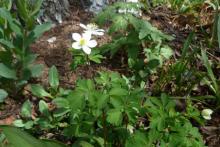
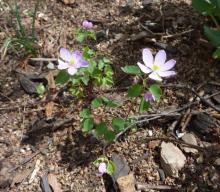
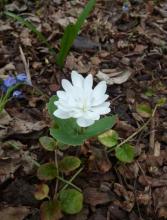
*Name edited for correction!
WimB (not verified)
Re: Miscellaneous Woodlanders
Mon, 05/23/2011 - 11:21amI cant' send you any either, Tim. We have (had) very dry weather also, maybe I should start thinking about growing more Cacti and Onco's ;) ;)
Trond Hoy
Re: Miscellaneous Woodlanders
Mon, 05/23/2011 - 1:42pmIf you have the pipeline I have the water! We had a very sunny and warm April but May has been rather wet. However the temperature has been higher than normal. More rain expected all the week.
Trond Hoy
Re: Miscellaneous Woodlanders
Mon, 05/23/2011 - 1:58pmRegarding Oxalis as groundcover - I prefere oxalis to any other groundcover plant! Oxalis is easy to grow and easy to remove, does not compete with the other plants and charming! And you can eat it!
I have grown Anemonella for years but they refuse to expand - only a few flowers a year :(
I have read about people in Norway using ducks (Peking duck?) to control those molluscs but I have no wish to try! As you imagine: ducks in a cage! When the kids were small they had rabbits (they wanted a dog). We brought them with us every time we travelled except abroad. I am very glad that time came to an end!
Richard T. Rodich
Re: Miscellaneous Woodlanders
Mon, 05/23/2011 - 7:18pmI so enjoy seeing all these treasures!
Regarding slug control, one of our Chapter members uses chickens.
Lori, only your 'Rosea' is Thalictrum (Anemonella) thalictroides. The white form is another species. Leaves are completely different, and I think you will find that your white one's flowers always have five petals, while Thalictrum thalictroides blooms usually have more. The single flower or umbel of T. thalictroides is always subtended by a single whorl of leaves. Our common name for T. thalictroides is May flower, and they are native in the woods here. I do grow them in my garden, too. They are great fillers, flower much longer in the garden than in the wild, and I always have lots of volunteers to weed out. ;D
Lori S. (not verified)
Re: Miscellaneous Woodlanders
Mon, 05/23/2011 - 8:11pmOh, yes, that jolted my feeble memory, Rick! Thank you! The white one is Isopyrum biternatum.... right? ;D
Many people will be extremely envious to hear that! ;D
Richard T. Rodich
Re: Miscellaneous Woodlanders
Mon, 05/23/2011 - 9:21pmI do believe you are correct on that, but another name change:
Enemion (Isopyrum) biternatum
I have seen this one growing wild in southern Minnesota, building height (to 1+ ft) as it continues to add flowers to the stem. (Flowers are not necessarily terminal.) I have not seen it occur as a single stem, but usually find it as a clump 10-18 inches in diameter.
Trond Hoy
Re: Miscellaneous Woodlanders
Mon, 06/13/2011 - 1:22pmAt last! Clintonia andrewsiana has opened its flowers ;D I have planted this elegant plant in my woodland where it now reahes 80cm tall with 3 flowering stems.
Mark McDonough
Re: Miscellaneous Woodlanders
Mon, 06/13/2011 - 4:42pmFantastic Clintonia Trond, the best species for sure. I have always wanted to grow this one; your post reminds me to put this higher up on my list. How did you keep the slugs away ;)
Did you grow it from seed or purchased plants?
Lori S. (not verified)
Re: Miscellaneous Woodlanders
Mon, 06/13/2011 - 8:14pmA really spectacular plant, Trond!
cohan (not verified)
Re: Miscellaneous Woodlanders
Mon, 06/13/2011 - 8:58pmVery flashy for a woodland plant!
Stephen Barstow
Re: Miscellaneous Woodlanders
Mon, 06/13/2011 - 10:16pmCongratulations on the Clintonia, Trond. Never seen that species in Norway before!
Trond Hoy
Re: Miscellaneous Woodlanders
Tue, 06/14/2011 - 10:03amThanks all ;D
Clintonia seems to be immune to slug attack! They are however hard to get hold of (here). I think I bought two small rhizomes from Paul Christian (rare plants) some years ago. When I find seeds offered I buy. They're late to germinate and seedlings grow slowly.
Lori S. (not verified)
Re: Miscellaneous Woodlanders
Tue, 06/14/2011 - 7:13pmTiarella cordifolia; Viola canadensis; Arisaema triphyllum; Scopiola carniolica; Geranium macrorrhizum 'Spessart' covered by a flurry of chokecherry petals; Phlox stolonifera... and I spy the leaves of another couple of Cypripedium parviflorum seedlings in there!
cohan (not verified)
Re: Miscellaneous Woodlanders
Tue, 06/14/2011 - 7:37pmLori, I have some seedlings to plant out sometime soon-- Tiarella-- from Kristl, maybe cordifolia? look similar, but have slight red markings on the leaves (not going out now to check the tags.. the mosquitoes are fierce these days), and A. triphylla... do either of these need anything special in siting? Extra moisture, extra room to spread, part day sun or all shade? (of course I can and will google, but just to get some first hand Alberta input...lol)
Lori S. (not verified)
Re: Miscellaneous Woodlanders
Tue, 06/14/2011 - 9:16pmCohan, neither gets any special care in my yard, no extra watering, zilch. (Well, nothing else gets special care either.) Full to part shade is fine. The tiarella will eventually spread enough to form a nice bed after a few years - certainly not invasively.
Re. the Arisaema.... well, mine have certainly never needed extra room... ;D. Rather more of a single specimen novelty (starting from 3-4 corms that I was kindly sent - one survived) even after a very, very long time... I've never had fertilized seeds on them. Apparently, the flowers are dioecious and I only ever get one flower on a plant, and I only have one plant of a couple of species! Has anyone else in this area grown them?
Perhaps you have one of the T. wherryi selections?
Lori S. (not verified)
Re: Miscellaneous Woodlanders
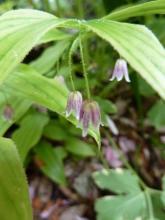
Thu, 06/16/2011 - 9:59pmStreptopus roseus:
cohan (not verified)
Re: Miscellaneous Woodlanders
Fri, 06/17/2011 - 12:33amTks, Lori...
I forgot to check that tag on Tiarella again... I think its a species, I had in mind its a wild form, but its (a pot of seedlings) from seed from Gardens North, and she does have both wild and garden seed .. I'll just have to remember to look at the tag..lol
My Arisaema are also seedlings from wild Ontario seed from a trade, not sure how many are in the pot, several at least, maybe fewer now than what germinated last year...
cohan (not verified)
Re: Miscellaneous Woodlanders
Fri, 06/17/2011 - 10:28pmI looked today, its Tiarella cordifolia and tag does not give a wild collected location, so it could be seed of garden forms, I'd have to ask Kristl if she remembers what she had that year.. here are the seedlings..
cohan (not verified)
Re: Miscellaneous Woodlanders
Mon, 06/20/2011 - 12:01pmThanks, Lis! These plants are already a fave of mine with those gorgeous leaves-- hopefully some will show even more red over time.. flowers will just be a bonus :)
Some shade is good, since I don't have that much full sun space, anyway--but half day sun I have lots, and dappled to deeper shade... I'll probably separate them and try a few spots..
Lori S. (not verified)
Re: Miscellaneous Woodlanders
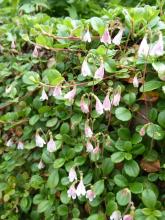
Sat, 06/25/2011 - 3:12pmFlowers on Linnaea borealis, which is growing in an acid bed and is draping nicely down the side:
cohan (not verified)
Re: Miscellaneous Woodlanders
Sat, 06/25/2011 - 11:39pmThe draping displays them nicely... some patches are in flower here, though most seem to be just in bud last I looked.. they rarely get space to themselves though, and have to be viewed through other vegetation.. There are many places where they grow in mowed areas--fine for the plants, but i'm not always successful avoiding the flowers....
Richard T. Rodich
Re: Miscellaneous Woodlanders
Sun, 06/26/2011 - 8:07amIn northern Minnesota where I see Twinflower commonly, I find them most often in pine needle duff where surface vegetation and understory are sparse. They virtually have the whole place to themselves! This is also where Pipsissewa (Chimaphila umbellata) grows.
WimB (not verified)
Re: Miscellaneous Woodlanders
Sun, 06/26/2011 - 11:26amI've been very busy during the last couple of weeks so it seems I have a lot to catch up to on this forum.
Lori, love your shadeplants, especially the Arisaema and the twinflowers.
Cohan, your pot full of Tiarella seedlings look as if they are really enjoying themselves.
Here are some shade lovers which are flowering here now.
The white form of Anemonopsis macrophylla (sometimes sold as cv. 'White Swan')
Arisaema candidissimum
Arisaema fargesii
Arisaema speciosum
Arisaema tortuosa
Deinanthe caerulea
Epipactis gigantea
and Primula florindae
cohan (not verified)
Re: Miscellaneous Woodlanders
Sun, 06/26/2011 - 1:07pmIf I ever finish posting pics from my one day in the mts, lol, I will show some of the Linnaea here in the yard, and surrounding woods where they grow in any kind of soil and moisture conditions except standing water, nor are they common in the driest under spruce spots (the only places we have with barish ground).. they are common under and among grasses, shrubs, and numerous forbs with mosses, lichens and fungi as well
Richard T. Rodich
Re: Miscellaneous Woodlanders
Sun, 06/26/2011 - 9:32pmA very nice Arisaema collection, Whim! (Arisaema speciosum gives me the giggles.) :D
A pic from a previous year, my Deinanthe caerulea has a yellow, twisty stigma.
WimB (not verified)
Re: Miscellaneous Woodlanders
Mon, 06/27/2011 - 2:09amA. speciosum is really nice (and a new addition to my garden since this year).
The stigma's of my Deinanthe caerulea and of my Deinanthe bifida are white....
Lori S. (not verified)
Re: Miscellaneous Woodlanders
Mon, 06/27/2011 - 9:03pmI love the pin-striped Arisaema, Wim!
It's nice to see the beautifully-grown Deinanthe in both Rick's and Wim's gardens. (Mine has succumbed to drought and general mistreatment... sigh.)
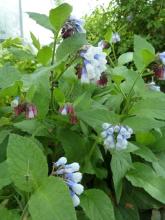
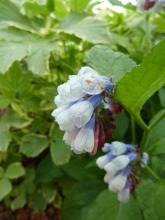
I suppose this is a woodlander of sorts... I believe it's Symphytum grandiflorum (maybe a cultivar, but if so, I've lost its name), and it's looking very attractive with it's white, blue and red inflorescences. Despite it's common name, creeping comfrey, it has remained in the same spot over a few years now; should I be on the watch for world-domination?
Richard T. Rodich
Re: Miscellaneous Woodlanders
Mon, 06/27/2011 - 9:46pmDeinanthe caerulea is another one of my acquisitions that was woefully mistreated in its early years due to my ignorance of its needs. For three or four years it was an "ephemeral", emerging in the spring and in just 3-4 weeks going dormant. I guess it was wondrous that it even survived that hot, summer baked, rich clay. When I moved it to a proper site, it really jumped into growth. It produces zillions of viable seeds, although I have not seen any volunteers yet.
Richard T. Rodich
Re: Miscellaneous Woodlanders
Mon, 06/27/2011 - 10:06pmI still grow comfrey also. I hold over from when I used to dry the leaves to brew a most delicious tea. It is still my favorite, tasting much like orange and black peko. But there are some reports of it being carcinogenic, So I hardly drink it anymore. I received the plant from my neighbor, who drinks it religiously, as did his father in Italy. so I don't know what its real taxonomic designation is, but I guessed it as Symphytum x uplandicum. Yours is much more garden worthy, Lori. I'm not sure if it ever produces viable seed. One year I tried in earnest to collect seed for someone; I think I got two seeds that looked good, but I never found out if they actually grew or not.
cohan (not verified)
Re: Miscellaneous Woodlanders
Mon, 06/27/2011 - 11:22pmI haven't grown comfrey, but I have got the impression that once you plant it, its for life... supposed to produce wonderful compost (really deep roots that bring nutrients from deep soils), some sort of fertiliser tea as well..
Stephen Barstow
Re: Miscellaneous Woodlanders
Tue, 06/28/2011 - 1:10amI also grow Comfrey - my introduction to it in the 80s as a tea plant and vegetable coincided with the carcinogen scare, so I left it alone. I grow the selection Symphytum x uplandicum "Bocking 14", a selection made by the Henry Doubleday Research Association in the UK who championed this "wonder plant" until the scare. It is also used to make comfrey fertiliser as Cohan says (just fermented leaves, like nettle water) and that's how I use it today. It behaves very well in a garden, not spreading invasively like some of the species.
WimB (not verified)
Re: Miscellaneous Woodlanders
Tue, 06/28/2011 - 7:40amLori,
A. fargesii is one of the easiest Arisaema's to grow...if I get seeds this year, I'll send you some.
I find it very easy to grow as long as you don't let it get too dry (see pic)
Trond Hoy
Re: Miscellaneous Woodlanders
Thu, 06/30/2011 - 12:16amMuch to look at here!
Deinanthe is a favorite of mine but my plants can't match yours! They're often damaged by slugs.
Comfrey is a weed in my garden, selfsowing all over the place. However it is easy to remove when young.
Twinflower is very common here except the driest places. I love their spicy fragrance.
Arisaemas are always special but the speciosum is not the least!
Mark McDonough
Re: Miscellaneous Woodlanders
Sun, 08/14/2011 - 7:26pmStill going strong, flowering for the last month and a half, is Kirengoshoma palmata. Last year, the plants completely collapsed in the record-breaking drought and looked hideous, this small genus of Japanese woodlanders is the plant equivalent of a canary in a mine, one of the first plants to show water stress and flag with the slightest whiff of dryness. This year we've had ample rainfall, and these large plants (to 5' tall x 5' wide) drip at the tips with waxy yellow flared trumpets. The foliage is unique, bold, and attractive as well.
I'm always interested in what blooms attract hummingbirds; today I heard the close whir of a hummingbird's wings, as it visited each and every flower on my large Kirengoshoma stands, the first time I witnessed this particular hummingbird nectar choice. In the second photo, I marked a red arrow where the hummingbird is, and included an enlarged insert; sorry for the poor photo quality but the entry-level camera I share with my daughter is useless for action photography and macro photography, but you'll get the idea.
Trond Hoy
Re: Miscellaneous Woodlanders
Mon, 08/15/2011 - 12:29amWell grown, Mark!
My plants do not show any colour to the flowers yet. They are very late flowering here.
Have you considered if your plants belong to the Koreana group/Kirengeshoma koreana? If I remember rightly the Korean form opens the flowers more and has a stiffer stem. My plants are very lax. But this can be temperature related of course.
Amy Olmsted
Re: Miscellaneous Woodlanders
Tue, 08/16/2011 - 5:05pm"Have you considered if your plants belong to the Koreana group/Kirengeshoma koreana? If I remember rightly the Korean form opens the flowers more and has a stiffer stem. My plants are very lax. But this can be temperature related of course."
I agree too...the plants we have at work labeled K. palmata are much more cascading and a bit more closed than yours Mark. The K. koreana haven't started blooming yet, but I'll bet they are going to look just like yours.
Mark McDonough
Re: Miscellaneous Woodlanders
Sun, 08/21/2011 - 6:07amVery interesting Amy, you've given me something to look at more closely. And when I start looking up Kirengeshoma palmata and koreana, the puzzle deepens and I'm no closer to an answer! What I'd like to find is a definitive publication that delineates the difference between palmata and koreana, and on that front, I haven't yet found anything conclusive. First, there's the reference to the "koreana group" or K. palmata koreana group", suggesting ambiguity on the two "species". There's even uncertainty regarding the family and taxonomic standing, originally placed in Saxifragaceae but some authorities now placing it in Hydrangeaceae, and the genus is listed as "status unresolved" in The Plant List.
http://www.theplantlist.org/tpl/search?q=Kirengeshoma
I also have a plant that came to me as K. koreana, which has leaves that look decidedly different, although my plant languishes in a drier part of the garden... not sure if it's still alive. It has never flowered for me.
So, I very might very have Kirengeshoma (the koreana group), but who really knows.
Mark McDonough
Re: Miscellaneous Woodlanders
Sun, 08/21/2011 - 6:10amAfter a long search, I did find this one recent (2010) paper. While very technical, it does have some taxonomic language that is helpful, which makes clear that there are two species, and where each is native to.
http://www.amjbot.org/content/97/6/e48.full
Here's an excerpt:
Kirengeshoma (Hydrangeaceae) comprises two extant species, Kirengeshoma palmata Yatabe and Kirengeshoma koreana Nakai, both of which inhabit warm temperate-deciduous forests in eastern China/southern Japan (K. palmata) and South Korea (K. koreana) (Qiu et al., 2009). Kirengeshoma koreana is restricted to one locality, Mt. Baek-unsan, whereas K. palmata is known from four sites in eastern China (Zhang et al., 2006) and three in southern Japan (Chang et al., 2007). Because of their small range size and small number of populations, both species are treated as “endangered” in China, Japan, and Korea (Qiu et al., 2009) and are considered “critically endangered” by the International Union for the Conservation of Nature (IUCN). Both species are of high ornamental value because of their large attractive flowers and beautiful leaves. Kirengeshoma palmata is also a medicinal plant, containing biologically active flavonoids in roots and rhizomes (Zhang et al., 2006).
Mark McDonough
Re: Miscellaneous Woodlanders
Sun, 08/21/2011 - 6:44amHere's another taxonomic paper on Kirengeshoma. It is very technical and way over my head, but one can glean a few factual tidbits from the paper. http://onlinelibrary.wiley.com/doi/10.1111/j.1469-8137.2009.02876.x/pdf
1. Kirengeshoma species are from Japan, Korea, AND China, the latter is almost never mentioned.
2. There is a color map showing where the species are found.
3. From the text "While all populations were originally identified as Kirengeshoma palmata (Yatabe 1890) the Korean population was subsequently described as Kirengeshoma koreana (Nakai, 1935), even though this is not always accepted"
Still haven't found a document that lists the taxonomic differences between the two species! Most references to K. palmata describe a plant 1 meter tall (some say 120 cm, so a trifle taller). My plant gets 5-6; tall (almost 2 meters), so perhaps my plants are K. koreana after all, although without a botanical description of K. koreana, it is still hard to know for sure. Also, as Amy suggests, the more flared flowers suggest K. koreana too, as most photos I've seen of K. palmata have more drooping bell-shaped flowers that don't open as much, but that isn't consistent across the photos I've found... maybe the two species are mixed up in cultivation.
Here's a drawing of K. palmata from the Flora of China. Interesting to see the base of the stems are square in cross-section, I have not noticed this before. Also interesting, Flora of China still places the genus in Saxifragaceae.
http://www.efloras.org/object_page.aspx?object_id=12438&flora_id=2
This link describes the Japanese derivation of the name Kirengeshoma:
http://www.rhs.org.uk/Gardens/Rosemoor/About-Rosemoor/Plant-of-the-month...
Mark McDonough
Re: Miscellaneous Woodlanders
Sat, 08/27/2011 - 7:15amMaybe I have flogged this horse long enough ;), but I wanted to share a recent development.
While perusing a garden center, and checking out the "shade perennials" area, some of the tables were pretty well picked over, but there it was, sitting by itself, a lone Kirengeshoma koreana. So, I had to buy it, and then compare with my garden plants identified as K. palmata.
Placing the plant right up to my 6' tall plants I have under the name of K. palmata (still in nice bloom by the way), the two plants couldn't be more different. The newly purchased K. koreana has thickish, waxy, heavily rugose leaves, whereas my garden plants of K. palmata have smooth matte grayish-green leaves 4-5x the size, looking completely different. In the closeups of "koreana" you'll notice how the upper stem cauline leaves are "alternate" whereas the "palmata" leaves are strictly "opposite". When the buds open on "koreana" I'll take side-by-side photos of both in bloom to compare. I'm still hoping to find an actual botanical description of K. koreana, with which to compare to palmata.
Kirengeshoma "palmata" still in good and ample flowering, the end of August 2011. It helps that we've had ample rain this summer, and the impressive 5' wide x 6' tall clumps have been blooming throughout July and August.
Pages