
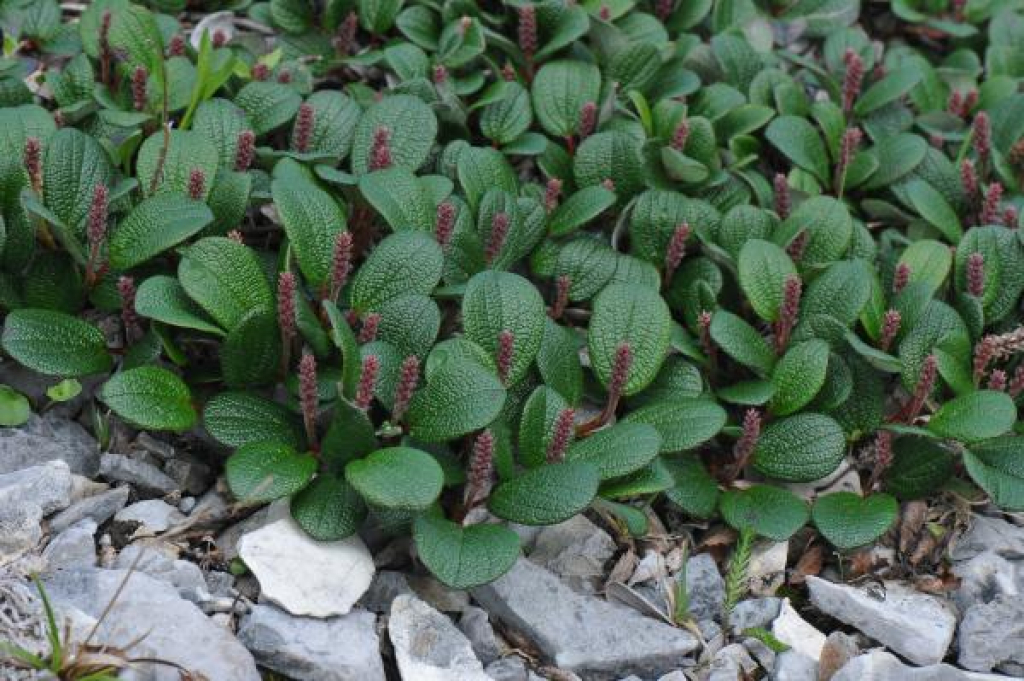
The net-veined willow is native to the Arctic and sub-Arctic regions of the northern hemisphere as well as high elevations of European mountains and Canadian Rockies. It is a prostrate species forming mats of deep-green, glossy, almost plastic-like foliage. The leaves are distinctively veined and round to oval in outline. Leaf size is variable from 1.5 to 4.5 cm in diameter. The petioles are often dark red.
Like all willows, plants are either male or female. Both produce 1 to 3 centimeter long catkins in late May through early July. Male catkins become yellow as they release pollen while female catkins remain purple-green.
Late May through early July in the wild but as early as April in warmer climates.
This willow requires full sun and a well-drained but not too dry a site. In the wild, they prefer limestone substrates but it is not confined to it. In warmer regions, protection from mid-day sun might be advised. Winter hardiness is not a problem as they are native to Arctic regions. The main limiting factor is summer temperatures. They are not fond of extended periods above 25 C.
Cuttings or seed