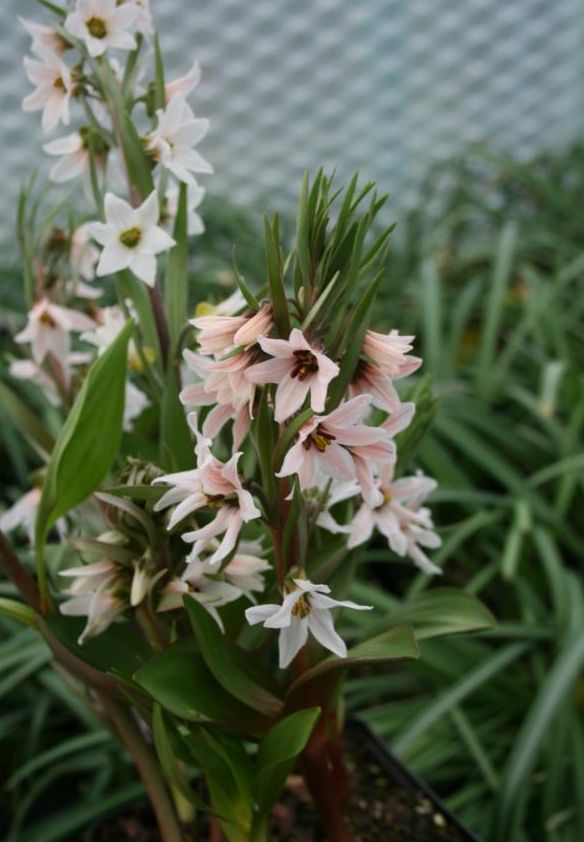
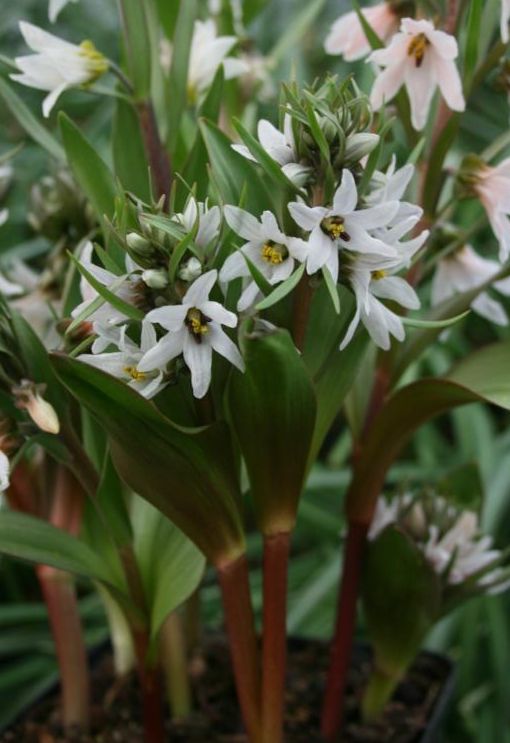
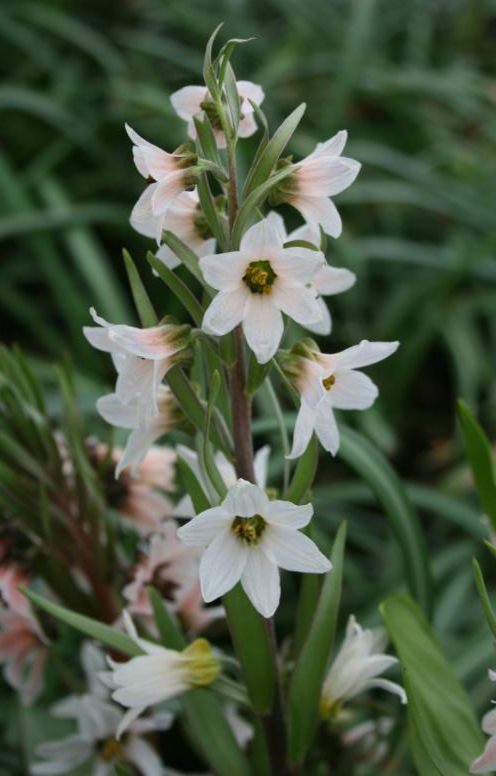
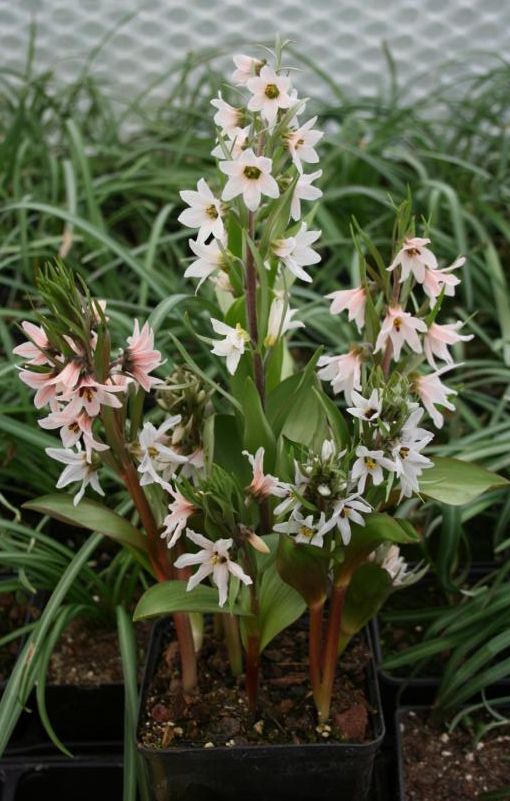
Roland, this colony of Frits is lovely with the slight variation in colour. How do you cultivate them? I've had them germinate before but have never got them to flowering size. What hints can you give? You already have my address ;D cheers fermi
I grow them in bulb potting-mixture I will post the mix later
I am not home but in Toulouse for a plant-show as far as you heart about it there was a shooting here but the killer (he killed 6 or 7 people last weeks in Toulouse) is killed today so everything is save now and people can save come to the show
I would be exploring more Frits were it not for lily beetle that are so attracted to them. I do have a few species, and I keep a watchful eye and hand-pick any lily beetles seen.
Fritillaria pudica is in bloom here, but this year I'm disappointed to discover more than half of my colony has disappeared :( In the photo, there's a gap between the flowering plants on the left and right, the plants inbetween are gone. I also had numerous younger plants from scratched-in-seed, although most of these have disappeared to. Not sure why the partial loss, the've been happy where they are, seeding and bulking up over the past 10 years.
Left photo: Fritillaria pudica. In the lower left is the foliage of Tulipa bifloriformis, in the center are Tulipa seedlings (3 year). Right photo: view of F. pudica and the silvery leaves of T. bifloriformis, the buds have yet to open (that I know of), still waiting for sun, the colony of this small early blooming Tulipa widened quite a bit from sowing seed in situ.
In this photo, at top-center is the foliage (there are buds too, but they can't be seen) of F. crassifolia ssp. kurdica, and in the lower center, is a colony of 2-year old seedlings of that Frit, where I have direct-sown seeds. I find that sowing seed directly in the garden to be very successful, as one can see from this small thicket of little gray spears, "no fuss no muss" gardening. In the same bed are many seedlings of crocus species and other choice bulbs.
Fritillaria pudica is in bloom here, but this year I'm disappointed to discover more than half of my colony has disappeared :( In the photo, there's a gap between the flowering plants on the left and right, the plants inbetween are gone. I also had numerous younger plants from scratched-in-seed, although most of these have disappeared to. Not sure why the partial loss, the've been happy where they are, seeding and bulking up over the past 10 years.
I wonder if Fritillaria spp. have the propensity to skip a season(or more) of above ground growth, like many Lilium spp.? Even undisturbed, I have had that happen with multiple species of lilies.
Mark, you have such wonders in your garden! I love the "sow-in-place" philosophy. F. pudica in nature, with the contrast of snow, is fantastic - the flowers seem to glow. Excellent photos, John!
Do you grow anything else with the bulbs Mark? I have a small bed in our lawn which is mainly devoted to bulbs inspired by the bulb walk at Sissinghurst. But it becomes bare in the summer so I have some small later flowering perennials amongst the bulbs. These look pretty special species so I imagine need more space - will be really nice to see how those direct sown colonies develop; I have only done this with snowdrops and it has been very effective.
John, great photos, and such a compact form, looking very different in growth than mine, beautiful juxtaposed with snow. I originally got mine as "rice grains" at 10 for $1 from Jane McGary, about 20 rice grains came, quite a bargain and fun to wait 4-5 years to maturity.
I remember finding dwarf plants in full flower in the Wenatchee Mountains, Washington, literally growing in running water (spring snow melt), areas that would be bone dry in a few weeks. It kept good company, commingling with Olsynium douglasii in various shades of purple and pink.
Tim, many of my bulbs are planted in Hibiscus syriacus "shrub rings", late-to-leaf tap-rooted shrubs that are perfect for underplanting with bulbs. I like the idea of growing small bulbs this way, I enjoy seeing crocus bulk up into floriferous clumps, jumping right out of the soil. Each year I enlarge the rings a bit to make room for more bulbs and sown-in-place bulb seed ;) In the summer, when all bulbs are dormant and the dried foliage wisked away, the mulched bed is a simple backdrop for the real focus of the mid-summer to autumn season, the extravaganza of bloom on Hibiscus syriacus (selected single-flowered forms like 'Blue Bird'). A happy combination.
Oh, by the way Tim, Fritillaria elwesii is most elegant the way the flowers are displayed, its been added to my list :)
Wow John, such healthy and bulked up looking frits! The color is so vivid!
Tim, your F. elwesii is so artistic: it's like it's not even real... ---------------------------- Some Fritillaria camschatcensis seedlings, 3 years old I think, are looking nice. (Once again, I never said I am an attentive grower.) Seed from the Kenai Peninsula, Alaska.
I have almost given up frits as they are excellent slug food except the common Snake's head. But you guys give me the spur to try again! And Mark, although Hibiscus syriacus do overwinter here it don't like our cool summers so flowers are rare :-\
I can't claim much credit for the Frit. elwesii; it is actually a potful that came from Jim Archibald's greenhouse when I visited him a few years ago, and so it holds rather a good memory! Kevin Pratt, who co-wrote a book on Fritillarias, describes many species that might grow successfully in the garden and I am trying more and more from seed (like raddeana and eduardii and affinis, which is wonderfully variable and a good doer), but it will be quite a few years before any of these show any flowers. Fortunately (touch wood) we don't suffer badly from slugs, but do have Lily beetle!
Thank all of you for your kind comments about my photos of the pudica. It won't be long now and they will be hard to spot as their season is nearly over. I usually can spot them out of the corner of my eye. You walk along head bowed scanning the brush and dead cheatgrass, then eureka a flash of yellow, among the drab grays of spring, catches your eye. Always a pleasure to see and smell. They have a sweet fragrance similar to Asiatic lilies but much more muted in it's intensity.
Slugs are worse often they cut the flower-stem (one or more years lost) and are more difficult to trace lily-beetles are easy to handle and just eat a piece of the leafs or flowers (before I kill them)
Seems like the red lily beetle larvae may head for the bulb at some stage, and leave nothing. Al least I've had some (lily) plants totally disappear without an alternative explanation. Charles Swanson MA USA
I've never heard of lily beetle larvae eating anything but above ground parts. I could be wrong, though. I have seen slugs eat lily bulbs, even here in Minnesota where it is drier than Massachusetts. I'll bet that that is a more probable scenario.
Slugs are by far the worse of the two. Having gardened in one of the slug capitals of the world for four years, the Puget Sound area of Washington State, where hordes of "banana slugs" as big as cigars ravage herbaceous plants nightly (daily too, when it's rainy), I'd much rather be in a drier climate where slugs are not a major concern, if at all.
At least lily beetles are small and festively colored (although the larvae that can hatch if the eggs are left to develop are gross), and the beetles can be hand-picked and disposed up without much fuss. The plant types they attack is relatively few, versus the much broader range of plants attacked by slugs. And besides, I find oversized slugs and their oversized abundance of slime just plain disgusting, and squishing them borders on being a nightmarish experience.
This year the lily beetles showed up extra early, no doubt brought about by the two weeks of summer-in-winter temperatures, I found them on the emerging shoots of Frits. Killed the ones I found, but after the return to reality and back to freezing temperatures, I haven't seen any since.
Rick, that's one fine pot of Fritillaria camschatcensis you show there. Maybe next year you'll be able to show us some bloom, isn't the anticipation the best part!
Two views today of F. crassifolia ssp. kurdica taken today, the first showing the main plant in bud, love the gray curling foliage and low downturned flower stems. The second is a repeat of a view showing sown-in-place 2nd year seedlings of the same Frit, taken with my wife's new Canon Powershot digital camera.
Those bulbs look really happy Mark! I've never managed to establish crassifolia in our garden but it is a wonderful species in foliage and flower (mind you nearly all frits. are when you get hooked on them I think, such extraordinary and unique flowers).
I wonder if Fritillaria spp. have the propensity to skip a season(or more) of above ground growth, like many Lilium spp.? Even undisturbed, I have had that happen with multiple species of lilies.
Well I just answered my own question: Last season I thought I lost my white form of Fritillaria meleagris, as it never showed above ground, even though it had flowered multiple years before. This year it is back strong. (Left:white form, right: purple.) Also in the pic is, Hieracium villosum, Fibigia clypeata, a single sprig of Penstemon cobaea, and Gentiana septemfida.
I wonder if Fritillaria spp. have the propensity to skip a season(or more) of above ground growth, like many Lilium spp.? Even undisturbed, I have had that happen with multiple species of lilies.
Well I just answered my own question: Last season I thought I lost my white form of Fritillaria meleagris, as it never showed above ground, even though it had flowered multiple years before. This year it is back strong. (Left:white form, right: purple.) Also in the pic is, Hieracium villosum, Fibigia clypeata, a single sprig of Penstemon cobaea, and Gentiana septemfida.
Some of my white F meleagris have a tendency to reflex their petals. I'll try to take picture of one. Here are the common types and a double (with two double flowers to the stem) that popped up in my garden.
Another entry regarding Fritillaria camschatcensis. These are grown from my own seed produced by plants given to me from the upper panhandle of Alaska. To make a long story short, they were accidentally fertilized with a concentrated fertilizer, and after repeated drenches of clear water and a few days, it was clear they were still not at all happy. I unpotted them, rinsed them off and potted them up again in a fresh medium. Certainly not a good way to grow them, but it did offer me a chance to examine the bulbs. So continues my fascination with plant anatomy...
I have to say, these have gone through a lot of abuse in their life... they are already five years old! From the original seedling pot being misplaced, to being completely overun by liverworts, with a couple dozen plants plants in a four inch pot for four years, I think they have done pretty well. In the fall of 2010 these (and four others) were transplanted into a 3.5 x 3.5 x 5 inch deep pot. They certainly responded well after that. Clearly, one can see the strong delineation of the larger scales, verses the smaller scales that were produced earlier.
Rick, given what those plants had to endure, they look totally healthy, surprising to see so many bulblets (is that the right term with Frits?). Thanks for taking the time and effort to show so clearly what the plants are up to underground; most educational.
Just yesterday I dug up Arisaema amurense 'Jagged Edge' (dwarf form found and named by Darrell Probst) that was being swamped by an Epimedium, there were lots of new tubers so it is spreading nicely (albeit unnoticed, under the exuberant epimedium foliage), and I thought I should take some photos of my replanting effort, but with muddy hands, swatting at mosquitos, and daylight waning, I stayed on task and finished my replanting without photos.
Shown is the slow growing Fritillaria unibracteata, one of the few correctly labeled items obtained in my one and only order to Chen Yi nine years ago. It has finally made a few offsets, and this spring I moved one plant to my woodland & Epimedium bed, where it is setting a nice fat pod (although it feels empty to the touch).
Ps: Trond, I like the flared white F. meleagris, an elegant flower.
Rick, given what those plants had to endure, they look totally healthy, surprising to see so many bulblets (is that the right term with Frits?).
The number of scales (at least that's what they are called with lilies) didn't surprise me too much, as I had seen the poor things in earlier years when I remove a layer of liverworts from a former pot, and the bulbs were then exposed. It seems F. camschatcensis, as a species, normally has more than other (most?) frits, too.
McDonough wrote:
Thanks for taking the trime and effort to show so clearly what the plants are up to underground; most educational.
Here it is the other way: I buy a nice bulb and it may flowers the first season if the slugs don't find it but then it is doomed and diminishes each year . . . . . .
Dave, that one is a beauty, a species I've always wanted to grow.
Thanks guys I've not found it easy --lost a few over the years to rot..
On the other hand this one is far more accommodating --shot today of Fritillaria kotschyana in a pot --i have it also in a couple of troughs where it increases well.
Maybe I should try this one! Don't need a ladder to look at the flower, anyway ;)
Hoy ---up until a couple days ago the pot was on top of our water tank ,(currently the sunniest spot in the property),..... and that situation required a step ladder .... ;D ;D
McDonough wrote:
Dave, that Fritillaria kotschyana is a charmer!
Hopefully i'll have time the next day or two Mark to take a pic of it showing the flowering further on ,with petals divided from each other and the tips curved outwards.
Hoy ---up until a couple days ago the pot was on top of our water tank ,(currently the sunniest spot in the property),..... and that situation required a step ladder .... ;D ;D
Cheers Dave.
Dave, I remember that photo you posted (many months ago) showing the plants aloft. When a gardener (also from down under, by coincidence) on another forum complained he had no room left and had to move pots just to get to others, I showed him that pic! ;D
Hoy ---up until a couple days ago the pot was on top of our water tank ,(currently the sunniest spot in the property),..... and that situation required a step ladder .... ;D ;D
Cheers Dave.
Dave, I remember that photo you posted (many months ago) showing the plants aloft. When a gardener (also from down under, by coincidence) on another forum complained he had no room left and had to move pots just to get to others, I showed him that pic! ;D
:D :D
Here's Frit Kostchyana at full flowering --pic taken yesterday on a cloudy dull day.
Maybe I should try this one! Don't need a ladder to look at the flower, anyway ;)
Hoy ---up until a couple days ago the pot was on top of our water tank ,(currently the sunniest spot in the property),..... and that situation required a step ladder .... ;D ;D
Cheers Dave.
Well, I hadn't thought of that possibility ;D (In fact I was thinking of Rick's tall plant)
It's been Fritillaria seed planting time for me, and the deed is all done. Yesterday I also finished repotting fritillaria seedlings. I would have waited another year, but I was afraid the soil mix was too heavy, and they were suffering because of it. So I am trying an new media, Fafard 52 mix that is much more airy, as the base for my ammended soil. Once again, you all get to trudge through with me in my fascination with underground structures. At this stage, the different species look a lot alike, especially in the photographs.
The same batches of Fritillaria seed, at least for me, have more of a habit of sprouting multiple years than most other genera. Sometimes one year can make a big difference: Fritillaria pallidiflora - 2 & 3 year seedlings.
Sometimes a little difference: F. pyrenaica - 1 & 2 year, F. carica - 1 & 2 year, F. pallidiflora - 1 & 2 year.
Some not much difference: F. collina - 1 & 2 year seedlings.
The smallest ones, F. montana. Had I been more observant, I wouldn't have repotted these, being only one season old, but in my haste it just... happened.
A representative Fritillaria camschatcensis. This one likes the moisture retentive soils and is treated differently.
You can see some fragile new roots on some bulbs. I suspect they would be more robust in the right soil mix, and it probably would have been better if I repotted earlier, before they emerged. Roots on the F. camschatcensis, however, seemed to not be in a yearly growth and death cycle. They seem quite perennial. Are there other Frits that do this?

Comments
Richard T. Rodich
Re: Fritillaria 2012
Wed, 03/21/2012 - 8:18pmI have F. stenathera year old seedlings just coming up in pots in the last couple days.
Roland, how old would you say those beauties of yours are? I don't think I have ever seen such superbly grown specimens!
bulborum (not verified)
Re: Fritillaria 2012
Wed, 03/21/2012 - 11:36pmThey are five years old seedlings
I got them from a Dutch friend
I hope there is plenty of seeds to share this summer
Roland
Trond Hoy
Re: Fritillaria 2012
Thu, 03/22/2012 - 4:54amI fully agree! And if you get enough seed . . . . .
bulborum (not verified)
Re: Fritillaria 2012
Thu, 03/22/2012 - 12:18pmThe ones interested in seed
just pm me your address
and I send the seeds this summer (if there are seeds set)
Roland
Trond Hoy
Re: Fritillaria 2012
Thu, 03/22/2012 - 1:32pmThanks, Roland ;)
Fermi de Sousa
Re: Fritillaria 2012
Thu, 03/22/2012 - 3:26pmRoland,
this colony of Frits is lovely with the slight variation in colour.
How do you cultivate them?
I've had them germinate before but have never got them to flowering size. What hints can you give?
You already have my address ;D
cheers
fermi
bulborum (not verified)
Re: Fritillaria 2012
Thu, 03/22/2012 - 3:33pmFermi I put you on the list
I grow them in bulb potting-mixture
I will post the mix later
I am not home but in Toulouse for a plant-show
as far as you heart about it
there was a shooting here
but the killer (he killed 6 or 7 people last weeks in Toulouse) is killed today
so everything is save now
and people can save come to the show
Roland
Mark McDonough
Re: Fritillaria 2012
Sun, 04/01/2012 - 5:46amRoland, awesome F. stenanthera!
I would be exploring more Frits were it not for lily beetle that are so attracted to them. I do have a few species, and I keep a watchful eye and hand-pick any lily beetles seen.
Fritillaria pudica is in bloom here, but this year I'm disappointed to discover more than half of my colony has disappeared :( In the photo, there's a gap between the flowering plants on the left and right, the plants inbetween are gone. I also had numerous younger plants from scratched-in-seed, although most of these have disappeared to. Not sure why the partial loss, the've been happy where they are, seeding and bulking up over the past 10 years.
Left photo: Fritillaria pudica. In the lower left is the foliage of Tulipa bifloriformis, in the center are Tulipa seedlings (3 year).
Right photo: view of F. pudica and the silvery leaves of T. bifloriformis, the buds have yet to open (that I know of), still waiting for sun, the colony of this small early blooming Tulipa widened quite a bit from sowing seed in situ.
In this photo, at top-center is the foliage (there are buds too, but they can't be seen) of F. crassifolia ssp. kurdica, and in the lower center, is a colony of 2-year old seedlings of that Frit, where I have direct-sown seeds. I find that sowing seed directly in the garden to be very successful, as one can see from this small thicket of little gray spears, "no fuss no muss" gardening. In the same bed are many seedlings of crocus species and other choice bulbs.
Richard T. Rodich
Re: Fritillaria 2012
Sun, 04/01/2012 - 6:12amI wonder if Fritillaria spp. have the propensity to skip a season(or more) of above ground growth, like many Lilium spp.? Even undisturbed, I have had that happen with multiple species of lilies.
John P. Weiser
Re: Fritillaria 2012
Sun, 04/01/2012 - 6:50amRoland,and Mark
Nice plants!
Here is the reginal form of F. pudica found along the eastern Sierras.
Lori S. (not verified)
Re: Fritillaria 2012
Sun, 04/01/2012 - 9:18amMark, you have such wonders in your garden! I love the "sow-in-place" philosophy.
F. pudica in nature, with the contrast of snow, is fantastic - the flowers seem to glow. Excellent photos, John!
Tim Ingram (not verified)
Re: Fritillaria 2012
Sun, 04/01/2012 - 10:13amDo you grow anything else with the bulbs Mark? I have a small bed in our lawn which is mainly devoted to bulbs inspired by the bulb walk at Sissinghurst. But it becomes bare in the summer so I have some small later flowering perennials amongst the bulbs. These look pretty special species so I imagine need more space - will be really nice to see how those direct sown colonies develop; I have only done this with snowdrops and it has been very effective.
A few examples on the bulb bed:-
Fritillaria kotschyana
Scilla melaina
Muscari pseudomuscari
Fritillaria elwesii
Mark McDonough
Re: Fritillaria 2012
Sun, 04/01/2012 - 5:23pmJohn, great photos, and such a compact form, looking very different in growth than mine, beautiful juxtaposed with snow. I originally got mine as "rice grains" at 10 for $1 from Jane McGary, about 20 rice grains came, quite a bargain and fun to wait 4-5 years to maturity.
I remember finding dwarf plants in full flower in the Wenatchee Mountains, Washington, literally growing in running water (spring snow melt), areas that would be bone dry in a few weeks. It kept good company, commingling with Olsynium douglasii in various shades of purple and pink.
Tim, many of my bulbs are planted in Hibiscus syriacus "shrub rings", late-to-leaf tap-rooted shrubs that are perfect for underplanting with bulbs. I like the idea of growing small bulbs this way, I enjoy seeing crocus bulk up into floriferous clumps, jumping right out of the soil. Each year I enlarge the rings a bit to make room for more bulbs and sown-in-place bulb seed ;) In the summer, when all bulbs are dormant and the dried foliage wisked away, the mulched bed is a simple backdrop for the real focus of the mid-summer to autumn season, the extravaganza of bloom on Hibiscus syriacus (selected single-flowered forms like 'Blue Bird'). A happy combination.
Oh, by the way Tim, Fritillaria elwesii is most elegant the way the flowers are displayed, its been added to my list :)
Richard T. Rodich
Re: Fritillaria 2012
Sun, 04/01/2012 - 9:33pmWow John, such healthy and bulked up looking frits! The color is so vivid!
Tim, your F. elwesii is so artistic: it's like it's not even real...
----------------------------
Some Fritillaria camschatcensis seedlings, 3 years old I think, are looking nice. (Once again, I never said I am an attentive grower.) Seed from the Kenai Peninsula, Alaska.
Trond Hoy
Re: Fritillaria 2012
Sun, 04/01/2012 - 11:41pmI have almost given up frits as they are excellent slug food except the common Snake's head. But you guys give me the spur to try again!
And Mark, although Hibiscus syriacus do overwinter here it don't like our cool summers so flowers are rare :-\
Tim Ingram (not verified)
Re: Fritillaria 2012
Mon, 04/02/2012 - 1:21amI can't claim much credit for the Frit. elwesii; it is actually a potful that came from Jim Archibald's greenhouse when I visited him a few years ago, and so it holds rather a good memory! Kevin Pratt, who co-wrote a book on Fritillarias, describes many species that might grow successfully in the garden and I am trying more and more from seed (like raddeana and eduardii and affinis, which is wonderfully variable and a good doer), but it will be quite a few years before any of these show any flowers. Fortunately (touch wood) we don't suffer badly from slugs, but do have Lily beetle!
Trond Hoy
Re: Fritillaria 2012
Mon, 04/02/2012 - 8:25amWhat is the worse - slugs or beetles :-\
John P. Weiser
Re: Fritillaria 2012
Mon, 04/02/2012 - 11:13amThank all of you for your kind comments about my photos of the pudica. It won't be long now and they will be hard to spot as their season is nearly over. I usually can spot them out of the corner of my eye. You walk along head bowed scanning the brush and dead cheatgrass, then eureka a flash of yellow, among the drab grays of spring, catches your eye. Always a pleasure to see and smell. They have a sweet fragrance similar to Asiatic lilies but much more muted in it's intensity.
bulborum (not verified)
Re: Fritillaria 2012
Tue, 04/03/2012 - 12:36amSlugs are worse
often they cut the flower-stem (one or more years lost)
and are more difficult to trace
lily-beetles are easy to handle
and just eat a piece of the leafs or flowers (before I kill them)
R
externmed (not verified)
Re: Fritillaria 2012
Tue, 04/03/2012 - 10:24amSeems like the red lily beetle larvae may head for the bulb at some stage, and leave nothing. Al least I've had some (lily) plants totally disappear without an alternative explanation.
Charles Swanson MA USA
Richard T. Rodich
Re: Fritillaria 2012
Tue, 04/03/2012 - 6:16pmI've never heard of lily beetle larvae eating anything but above ground parts. I could be wrong, though. I have seen slugs eat lily bulbs, even here in Minnesota where it is drier than Massachusetts. I'll bet that that is a more probable scenario.
Mark McDonough
Re: Fritillaria 2012
Tue, 04/03/2012 - 7:21pmSlugs are by far the worse of the two. Having gardened in one of the slug capitals of the world for four years, the Puget Sound area of Washington State, where hordes of "banana slugs" as big as cigars ravage herbaceous plants nightly (daily too, when it's rainy), I'd much rather be in a drier climate where slugs are not a major concern, if at all.
At least lily beetles are small and festively colored (although the larvae that can hatch if the eggs are left to develop are gross), and the beetles can be hand-picked and disposed up without much fuss. The plant types they attack is relatively few, versus the much broader range of plants attacked by slugs. And besides, I find oversized slugs and their oversized abundance of slime just plain disgusting, and squishing them borders on being a nightmarish experience.
This year the lily beetles showed up extra early, no doubt brought about by the two weeks of summer-in-winter temperatures, I found them on the emerging shoots of Frits. Killed the ones I found, but after the return to reality and back to freezing temperatures, I haven't seen any since.
Mark McDonough
Re: Fritillaria 2012
Tue, 04/03/2012 - 8:35pmRick, that's one fine pot of Fritillaria camschatcensis you show there. Maybe next year you'll be able to show us some bloom, isn't the anticipation the best part!
Two views today of F. crassifolia ssp. kurdica taken today, the first showing the main plant in bud, love the gray curling foliage and low downturned flower stems. The second is a repeat of a view showing sown-in-place 2nd year seedlings of the same Frit, taken with my wife's new Canon Powershot digital camera.
Tim Ingram (not verified)
Re: Fritillaria 2012
Wed, 04/04/2012 - 12:57amThose bulbs look really happy Mark! I've never managed to establish crassifolia in our garden but it is a wonderful species in foliage and flower (mind you nearly all frits. are when you get hooked on them I think, such extraordinary and unique flowers).
Richard T. Rodich
Re: Fritillaria 2012
Fri, 04/06/2012 - 6:54pmWell I just answered my own question:
Last season I thought I lost my white form of Fritillaria meleagris, as it never showed above ground, even though it had flowered multiple years before.
This year it is back strong. (Left:white form, right: purple.) Also in the pic is, Hieracium villosum, Fibigia clypeata, a single sprig of Penstemon cobaea, and Gentiana septemfida.
Trond Hoy
Re: Fritillaria 2012
Fri, 04/06/2012 - 11:17pmWhat a relief, Rick ;)
Looks pretty dry there, do you lack rain?
Poulsen (not verified)
Re: Fritillaria 2012
Wed, 04/25/2012 - 5:12amFritillaria hybrids flowering now.
They are a result of a hybridisation program involving F. eduardii, F. imperialis and F. raddeana
Breeders website: www.keizerskroon.net
Poulsen (not verified)
Re: Fritillaria 2012
Wed, 04/25/2012 - 5:20amAnd here comes the pictures...
kalle-k.dk (not verified)
Re: Fritillaria 2012
Sun, 04/29/2012 - 9:01amMy Fritillaria meleagris flowering now, also my double flowred alba. I got it several years ago from a friend as found it in a garden with a old farm.
Richard T. Rodich
Re: Fritillaria 2012
Sun, 04/29/2012 - 5:33pmNice plants, Poulsen. I would imagine the hybrids are hardier and more vigorous?
And welcome to the forum!!
Karl, I have never heard of a Fritllaria meleagris with reflexed petals.
Very pretty, though.
Trond Hoy
Re: Fritillaria 2012
Mon, 04/30/2012 - 1:51amSome of my white F meleagris have a tendency to reflex their petals. I'll try to take picture of one.
Here are the common types and a double (with two double flowers to the stem) that popped up in my garden.
Trond Hoy
Re: Fritillaria 2012
Wed, 05/02/2012 - 1:21pmHere's one of the hite ones. The flower is more open and reflexed than the red ones. And they flower about a week later too!
Richard T. Rodich
Re: Fritillaria 2012
Fri, 05/04/2012 - 9:25pmAnother entry regarding Fritillaria camschatcensis. These are grown from my own seed produced by plants given to me from the upper panhandle of Alaska. To make a long story short, they were accidentally fertilized with a concentrated fertilizer, and after repeated drenches of clear water and a few days, it was clear they were still not at all happy. I unpotted them, rinsed them off and potted them up again in a fresh medium. Certainly not a good way to grow them, but it did offer me a chance to examine the bulbs. So continues my fascination with plant anatomy...
I have to say, these have gone through a lot of abuse in their life... they are already five years old! From the original seedling pot being misplaced, to being completely overun by liverworts, with a couple dozen plants plants in a four inch pot for four years, I think they have done pretty well. In the fall of 2010 these (and four others) were transplanted into a 3.5 x 3.5 x 5 inch deep pot. They certainly responded well after that. Clearly, one can see the strong delineation of the larger scales, verses the smaller scales that were produced earlier.
Mark McDonough
Re: Fritillaria 2012
Sat, 06/02/2012 - 7:54amRick, given what those plants had to endure, they look totally healthy, surprising to see so many bulblets (is that the right term with Frits?). Thanks for taking the time and effort to show so clearly what the plants are up to underground; most educational.
Just yesterday I dug up Arisaema amurense 'Jagged Edge' (dwarf form found and named by Darrell Probst) that was being swamped by an Epimedium, there were lots of new tubers so it is spreading nicely (albeit unnoticed, under the exuberant epimedium foliage), and I thought I should take some photos of my replanting effort, but with muddy hands, swatting at mosquitos, and daylight waning, I stayed on task and finished my replanting without photos.
Shown is the slow growing Fritillaria unibracteata, one of the few correctly labeled items obtained in my one and only order to Chen Yi nine years ago. It has finally made a few offsets, and this spring I moved one plant to my woodland & Epimedium bed, where it is setting a nice fat pod (although it feels empty to the touch).
Ps: Trond, I like the flared white F. meleagris, an elegant flower.
Richard T. Rodich
Re: Fritillaria 2012
Sat, 06/02/2012 - 5:16pmThe number of scales (at least that's what they are called with lilies) didn't surprise me too much, as I had seen the poor things in earlier years when I remove a layer of liverworts from a former pot, and the bulbs were then exposed. It seems F. camschatcensis, as a species, normally has more than other (most?) frits, too.
Bulbs are beautiful things, too!
http://allthingsplants.com/thread/view/4020/Species-Lily-Bulbs/?offset=0
Lori S. (not verified)
Re: Fritillaria 2012
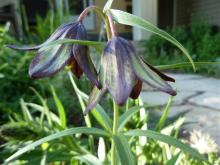
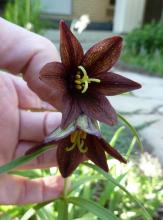
Mon, 06/11/2012 - 9:33pmWell, I finally have flowers on F. camschatcensis, after years and years of seeing one leaf!
Trond Hoy
Re: Fritillaria 2012
Mon, 06/11/2012 - 10:34pmLori, you are still luckier than me ;)
Here it is the other way: I buy a nice bulb and it may flowers the first season if the slugs don't find it but then it is doomed and diminishes each year . . . . . .
Richard T. Rodich
Re: Fritillaria 2012
Wed, 06/13/2012 - 9:16amThe conversation regarding allthingsplants.com and the photo gallery has been moved here: :)
http://nargs.org/smf/index.php?topic=1098.0
-- moderator
bulborum (not verified)
Re: Fritillaria 2012
Wed, 07/18/2012 - 12:49amHello Hoy
there aren't plenty seeds
but I can send you some seeds
just PM your address
Roland
Toole (not verified)
Re: Fritillaria 2012
Sat, 08/18/2012 - 2:04amTaken this afternoon --Frit aurea.
Yummy :P
Cheers Dave.
Mark McDonough
Re: Fritillaria 2012
Sat, 08/18/2012 - 7:03amDave, that one is a beauty, a species I've always wanted to grow.
Trond Hoy
Re: Fritillaria 2012
Sat, 08/18/2012 - 11:35pmMe too. And I have tried :-\
Toole (not verified)
Re: Fritillaria 2012
Fri, 08/24/2012 - 2:28amThanks guys
I've not found it easy --lost a few over the years to rot..
On the other hand this one is far more accommodating --shot today of Fritillaria kotschyana in a pot --i have it also in a couple of troughs where it increases well.
Cheers Dave.
Trond Hoy
Re: Fritillaria 2012
Sat, 08/25/2012 - 10:20amMaybe I should try this one! Don't need a ladder to look at the flower, anyway ;)
Mark McDonough
Re: Fritillaria 2012
Sat, 08/25/2012 - 6:59pmDave, that Fritillaria kotschyana is a charmer!
Toole (not verified)
Re: Fritillaria 2012
Sun, 08/26/2012 - 2:39amHoy ---up until a couple days ago the pot was on top of our water tank ,(currently the sunniest spot in the property),..... and that situation required a step ladder .... ;D ;D
Hopefully i'll have time the next day or two Mark to take a pic of it showing the flowering further on ,with petals divided from each other and the tips curved outwards.
Cheers Dave.
Richard T. Rodich
Re: Fritillaria 2012
Sun, 08/26/2012 - 5:05amDave, I remember that photo you posted (many months ago) showing the plants aloft. When a gardener (also from down under, by coincidence) on another forum complained he had no room left and had to move pots just to get to others, I showed him that pic! ;D
Toole (not verified)
Re: Fritillaria 2012
Tue, 08/28/2012 - 12:53am:D :D
Here's Frit Kostchyana at full flowering --pic taken yesterday on a cloudy dull day.
Cheers Dave
Trond Hoy
Re: Fritillaria 2012
Tue, 08/28/2012 - 1:42pmWell, I hadn't thought of that possibility ;D (In fact I was thinking of Rick's tall plant)
Richard T. Rodich
Re: Fritillaria 2012
Thu, 09/13/2012 - 9:54pmIt's been Fritillaria seed planting time for me, and the deed is all done. Yesterday I also finished repotting fritillaria seedlings. I would have waited another year, but I was afraid the soil mix was too heavy, and they were suffering because of it. So I am trying an new media, Fafard 52 mix that is much more airy, as the base for my ammended soil. Once again, you all get to trudge through with me in my fascination with underground structures. At this stage, the different species look a lot alike, especially in the photographs.
The same batches of Fritillaria seed, at least for me, have more of a habit of sprouting multiple years than most other genera. Sometimes one year can make a big difference:
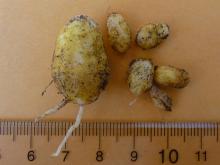
Fritillaria pallidiflora - 2 & 3 year seedlings.
Sometimes a little difference:
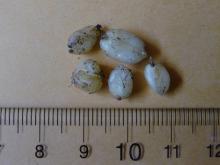
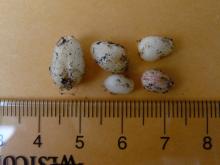
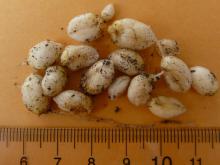
F. pyrenaica - 1 & 2 year, F. carica - 1 & 2 year, F. pallidiflora - 1 & 2 year.
Some not much difference:
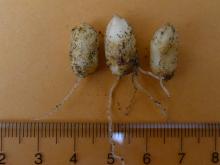
F. collina - 1 & 2 year seedlings.
The smallest ones, F. montana. Had I been more observant, I wouldn't have repotted these, being only one season old, but in my haste it just... happened.
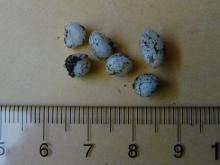
A representative Fritillaria camschatcensis. This one likes the moisture retentive soils and is treated differently.
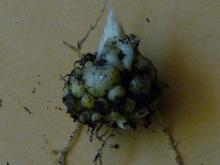
You can see some fragile new roots on some bulbs. I suspect they would be more robust in the right soil mix, and it probably would have been better if I repotted earlier, before they emerged. Roots on the F. camschatcensis, however, seemed to not be in a yearly growth and death cycle. They seem quite perennial. Are there other Frits that do this?
Pages