Arctostaphylos/Arctous alpinus also grows close to the ground. Here with Empetrum nigrum. The Empetrum berries (krekebær) are very good if you are thirsty.
Your three creepers also grow here, but Betula nana is replaced by B. pumila...I have no idea how to tell them apart. We grow B. pumila in our BG, but the plants have become more upright over the years, although still under 3 feet in height. The fall colour is bright red, quite unusual for a birch where yellow is more standard.
Arctostaphylos/Arctous alpinus also grows close to the ground. Here with Empetrum nigrum. The Empetrum berries (krekebær) are very good if you are thirsty.
Do these species grow near you? Or are they at higher elevations? Some of these I see in the mountains, not here, but not sure at what elevation they start, but also there is no dry or rocky or sandy soil close by, once you get to the edge of the foothills biome, things are quite different-sandy places, but also more precipitation.... We have one of the small birches, I haven't figured them out yet, with small round leaves, but it grows to at least a couple of metres tall here, in wet places... could no doubt be pruned to modest size, but not flat...
Arctostaphylos/Arctous alpinus also grows close to the ground. Here with Empetrum nigrum. The Empetrum berries (krekebær) are very good if you are thirsty.
Do these species grow near you? Or are they at higher elevations? Some of these I see in the mountains, not here, but not sure at what elevation they start, but also there is no dry or rocky or sandy soil close by, once you get to the edge of the foothills biome, things are quite different-sandy places, but also more precipitation.... We have one of the small birches, I haven't figured them out yet, with small round leaves, but it grows to at least a couple of metres tall here, in wet places... could no doubt be pruned to modest size, but not flat...
My photos show plants from the interior high altitude (that is 1100-1200m) biome above treeline, relatively dry moraine and rocky outcroppings. All those shrubs grow here too but only as relicts on rocky outcroppings near sea levels. Some places here forests never established due to grazing and fire-agriculture since early ages. (Which is in rapid change now.)
Not exactly groundhugging but certainly small enough to be perfect for the trough or rock garden... Ulmus parvifolia 'Davidii'. It is amazingly dwarfed - the largest leaves I measured were 5mm in the largest dimension.
I'm not sure if these are hardy enough to survive here. (Unfortunately, I stupidly murdered both specimens that I tried on different occasions by planting them in conditions that were way too dry... the poor things did not even survive long enough to see if winter would kill them. :-\)
Siskiyou Nursery, when it was run by Baldassare Mineo, carried several of these Ulmus parvifolias, from the tiny to the one I bought, which was supposed to be 7' after 10 years. I bought three and planted them, not knowing if they would be hardy. I'll try and find the pictures. They turned out to be irresistable to the antlered rats and two of them are bonsais as a result. They are the two planted farthest from the house. The one in a raised bed right next to the house is a nice size now and apparently hardy. It took the deer some years to start in on it and they changed the shape forever. It's probably 8' or 9' now. The one drawback to this lovely thing is that the density of the branches makes it very susceptible to damage from late ice storms.
7-10' is a very appealing size for 'trees' to me... do these ever make seed, Anne? Are they mutations of a larger species, or is this a naturally small species?
Cohan, I used to save old nursery catalogs and then ran out of room and tossed all but the most current. I recall that Ulmus parvifolia 'Seiju' was one of the ones offered but I seem to remember that it was a very small one. I thought that the one I bought was naturally small, but who knows? Phyllis Gustafson might remember because she may ahve been working at Siskiyou at the time. The attached pictures show the three trees I planted. First is a "bonsai" farthest from the house. Next one is a little closer, and the last is the one the deer left alone for some years. They trimmed off all the bottom branches and an ice storm late winter 2010 broke off most of the top half of the tree.
Sorry, picture #1 didn't make it. Attached is picture of "deer bonsai" planted farthest from the house. All three were planted in exactly the same soil and at the same time and size. Who would believe the results? (Anyone living in proximity to antlered rats would!)
Wow! I like them all, the shape of the biggest is lovely, but the smaller ones look great too, and the stature would be great in certain plantings..
As for antlered rats, I don't think we have anything like your issues, but deer and moose keep many things pruned around here--Sorbus/Mountain Ash is a challenge here, and note my comments in my Salix thread!
Lori, as you can see from the pictures, Ulmus parvifolia is a good candidate for bonsai. Plant the one that's supposed to be a small tree and I will give you some of my antlered rats to do the job for you
Lori, the other night I drove up my driveway and a herd of 22 deer scattered. They move too fast to count beyond 22. These kinds of numbers are beyond mere challenges. We desperately need wolves and mountain lions.
Good grief, with a deer population like that, how do you keep your beautiful yard from being eaten down to the nub?!? :o Is it fenced?
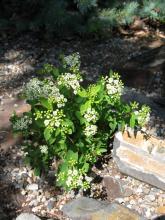
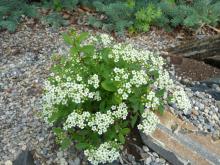
Here's another shrub that's suitable for the rock garden (mine is ~15cm; it's said to get to 30cm on one site I saw)... again, not exactly groundhugging - Spiraea decumbens:
Spirea decumbens is a new acquaintance for me, Lori! All spireas I know of are big or very big, often untidy shrubs. This certainly is something to plant. When does it flower?
Good grief, with a deer population like that, how do you keep your beautiful yard from being eaten down to the nub?!? :o Is it fenced
Skulski wrote:
Good grief, with a deer population like that, how do you keep your beautiful yard from being eaten down to the nub?!? :o Is it fenced?
Here's another shrub that's suitable for the rock garden (mine is ~15cm; it's said to get to 30cm on one site I saw)... again, not exactly groundhugging - Spiraea decumbens:
No, it isn't fenced because we live on rock. I would need to win the lottery to afford the fencing needed. The new water garden is fenced with 8' high wire mesh. It's located at the bottom of the property where there's soil and fencing was a possibility. One of the prettiest sights for me is to look through the fence and see all that expanse of snow without hoof prints! The rest of the garden is a war zone between me and the deer. They have taught me that penstemons and daphnes (and occasionally Lewisia tweedyi) can be eaten to the nub and come back. The shrubby penstemons literally become bonsaied and bloom like crazy - ditto the daphnes.
Just came across a nice looking low-growing Lonicera (decumbent stems) while combing through the pages of Plantarium Russia (a site for the vascular plants of Russia and neighboring countries).
One that I have been trying to introduce into my garden for years now is Ceanothus prostratus. A low mat shrub found across the northern Sierra, Siskiyou and Cascade mountain ranges. I find it to be common on well drained slopes in open pine forest were it gets good reliable snow cover. It will root as it runs so seems to be a good candidate for increase by cuttings, sadly such it is not the case. I have tried cuttings and layering many times and failed. Last year I dug a two or three year old seedling and moved it into a well drained raised bed that is shaded by a Scotch pine. I was speculating that it may require the mycorrhiza found in the pine litter. Last summer it just sat there and did not put on any top growth. The last word is still out on it. This spring I see some green on the few leaves it has left, but it's to soon to see new growth yet.
I believe a number of Lonicera collections were made during Panayoti's expedition to Kazahkstan the summer of 2010, so possibly some new ones will get introduced in the future.
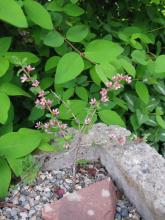
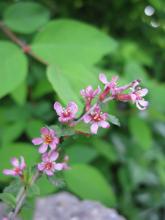
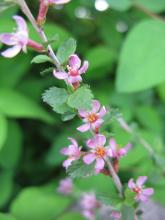
Here's what I bought a couple of years ago as Prunus aff. prostrata... hope it lives up to its name and becomes prostrate. :o (The way it's planted maybe isn't too good for promoting laxness... should probably move it into a crevice so it can flow downhill, if it has a mind to.)
Lori, that Prunus prostrata in your trough is a sweet little thing. The link you gave to the Crete site is terrific, with lots of great plant pics. I have never really given P. prostrata a second thought, but seeing the incredibly dense prostrate plants from Crete has my head spinning, if only a super compact form like that could be had. Thanks for opening our eyes on this one.
John, sometimes I think I should live in California (if I wasn't such a stubborn New Englander ;)) so that I could grow such things as Ceanothus. When I lived in the Seattle area and would frequent the University of Washington campus, even though this is not a xeric area in the slightest, many shrubby Ceanothus were grown making wide low shrubs smothered in heavenly blue flowers. I've been tempted with trying some of the prostrate or low growing sorts, although I don't think they will do well in this climate. I do plan on adding the lovely white-flowered Ceanothus americanus (New Jersey Tea) to the garden sometime, although a larger shrub.
Lori, that Prunus prostrata in your trough is a sweet little thing. The link you gave to the Crete site is terrific, with lots of great plant pics. I have never really given P. prostrata a second thought, but seeing the incredibly dense prostrate plants from Crete has my head spinning, if only a super compact form like that could be had. Thanks for opening our eyes on this one.
John, sometimes I think I should live in California (if I wasn't such a stubborn New Englander ;)) so that I could grow such things as Ceanothus. When I lived in the Seattle area and would frequent the University of Washington campus, even though this is not a xeric area in the slightest, many shrubby Ceanothus were grown making wide low shrubs smothered in heavenly blue flowers. I've been tempted with trying some of the prostrate or low growing sorts, although I don't think they will do well in this climate. I do plan on adding the lovely white-flowered Ceanothus americanus (New Jersey Tea) to the garden sometime, although a larger shrub.
I thought Kristl (Gardens North) had a low eastern Ceanothus, but I don't see one now, so either its gone, or quite likely I'm thinking of some other genus...lol
Here's what I bought a couple of years ago as Prunus aff. prostrata... hope it lives up to its name and becomes prostrate. :o (The way it's planted maybe isn't too good for promoting laxness... should probably move it into a crevice so it can flow downhill, if it has a mind to.)
That is a splendid Prunus, Lori! Can't you put some heavy stuff on it if it isn't prostrate enough for you? ;)
Maybe that 3 feet of snow on top of it this year will do the trick. ;)
Probably! Likely age (i.e. repeated snows ;D , increased length/weight will help.. I vaguely remember reading about this or some other Prunus which was supposed to become flatter over time.. On the other hand, I have a large 30 year plus juniper here which annually gets flattened by snow, and bounces back to about 4 feet..
Maybe that 3 feet of snow on top of it this year will do the trick. ;)
The cumulative snowfall of over 7' here this winter takes its toll on shrubs, and even low-branched trees. When the snow compresses and turns to a rock-hard layer, it has the effect of slowly crushing woody plants. I have a Cornus 'Celestial Pink' (C. florida x kousa hybrid) near the end of my driveway that was partially buried under 8' snow embankments. Now, with the snow-pack compressing, it is ripping off the lower branches as the ice layer lowers itself.
Luckily our snow is usually lighter than yours, Mark, and usually doesn't go as icey as it melts.. I thought after all of our up and down warm weather in early Feb, with melting days (though more settling than real melting away from buildings) and warm temps that our snow would be icier, but I had to dig a path some tens of metres to another section of bush for firewood cutting, the other day, and surprisingly, the snow (18inches or so in that area) was granular but still very loose apart from a thin crust a few inches from the surface (from the warm spell).. the exceptions were a few places where tracks crossed the path, those were frozen, and around a spruce, where icy melt had fallen into the snow..
We are supposed to be above freezing next week, so we'll see if this stuff starts to go, will take some time, esp in the shade where snow can linger very late...
Even our usually loose snow takes it toll on shrubs especially when it gets wet in spring rain. I have seen such hard snow in the mountains in southern France but it is rare here, it develops when you have repeatedly strong sun/cold nights. What you call crust Cohan, we call "skare" and it is what we want for Easter! Then you can ski wherever you want (if the day doesn't get too hot) 8)
Sometimes we get enough skare to walk on, but not usually for an adult, and not usually for very long/far.. skiing would be more possible, but you couldn't ski in the bush here--not enough space between shrubs/trees etc...lol snowshoes, maybe... In some places in the mixed woods where the snow is only a half foot deep anyway, you can walk a bit more on the skare...
Rain of any volume in spring is quite rare, here.. usually we are dry in spring except for late snow! That is probably the most dangerous snow for shrubs/trees here: we can have heavy wet snowfall when things are already leafed out, that is when branches break! Maybe this is why most native trees do not make very large limbs to start with?
Sometimes we get enough skare to walk on, but not usually for an adult, and not usually for very long/far.. skiing would be more possible, but you couldn't ski in the bush here--not enough space between shrubs/trees etc...lol snowshoes, maybe... In some places in the mixed woods where the snow is only a half foot deep anyway, you can walk a bit more on the skare...
Rain of any volume in spring is quite rare, here.. usually we are dry in spring except for late snow! That is probably the most dangerous snow for shrubs/trees here: we can have heavy wet snowfall when things are already leafed out, that is when branches break! Maybe this is why most native trees do not make very large limbs to start with?
You'll be astonished where I can ski! When my daughters were kids we always went through the densest birch woods for joy ;D Even with skareføre (thick crust which carry a skier) you often sink to your waist when loosing tempo in the birch-wood where the snowpack is loose :o We had a special wood called "sikk-sakk-skogen" (the-zig-zag-wood) where we loved to ski.
I have also noticed that trees (especially pines) from areas with heavy snow have shorter limbs. Quite obvious why.
Clearly you are more ambitious skiers than me ;D Actually, I'm sure you could dodge the trees easily enough here, but the tangle of rose, ribes, loniceras, shepherdia etc on the ground I think would be very hard to ski through without getting stuck, and the snow is not deep enough to bury them completely; Likewise, wet areas with dense willow, birch and alder--all dense clusters of thin trunks, are very hard even to walk through... Spruce limbs here are not terribly short, but nor are they very thick, and they are very flexible, so they have no problem.. Poplars and birches can have a bit of an issue with wet heavy snow, usually only once they are in leaf... We have a long weekend at the end of May--popular time for a late heavy snow ;D
I know too well the damge from compacted snow as it melts...I used to have plenty of rhododendrons but have replaced most with deciduous azaleas as the latter are not so prone to the pancake effect.
I am rather fond of our native prostrate form of Shepherdia canadensis...it is a truly prostrate form and comes true from seed (as they don't root for beans from cuttings)
I know too well the damge from compacted snow as it melts...I used to have plenty of rhododendrons but have replaced most with deciduous azaleas as the latter are not so prone to the pancake effect.
I am rather fond of our native prostrate form of Shepherdia canadensis...it is a truly prostrate form and comes true from seed (as they don't root for beans from cuttings)
WOW! I had no idea that existed! Would love to grow that :) The standard form is common here..
Wow, put me on the someday list for that special seed too, please, Todd!
Do you see a difference in growth between male and female plants? We are supposed to have Shepherdia canadensis and S. argentea here, but I think I have only seen S. argentea.

Comments
Trond Hoy
Re: Groundhugging shrubs.
Mon, 08/02/2010 - 1:55pmArctostaphylos/Arctous alpinus also grows close to the ground. Here with Empetrum nigrum. The Empetrum berries (krekebær) are very good if you are thirsty.
Trond Hoy
Re: Groundhugging shrubs.
Mon, 08/02/2010 - 2:02pmHere is the alpine azalea Loiseleuria procumbens with fruit.
Trond Hoy
Re: Groundhugging shrubs.
Mon, 08/02/2010 - 2:06pmNot for the rock garden: Betula pubescens ssp. czerepanovii. Some trees are dead. The leaves eaten by birch moth.
Todd Boland
Re: Groundhugging shrubs.
Wed, 08/04/2010 - 3:21amYour three creepers also grow here, but Betula nana is replaced by B. pumila...I have no idea how to tell them apart. We grow B. pumila in our BG, but the plants have become more upright over the years, although still under 3 feet in height. The fall colour is bright red, quite unusual for a birch where yellow is more standard.
Lori S. (not verified)
Re: Groundhugging shrubs.
Sat, 08/14/2010 - 8:16amA tiny Betula nana 'Ingwersen's Form' (ex. Norway) in a dry trough... if only I could grow some beautiful lichen to make it more at home...
Trond Hoy
Re: Groundhugging shrubs.
Sat, 08/14/2010 - 11:01amHave you ever tried to grow lichens? Many spread by fragmentation, you can take pieces and just put them where you want them.
Todd Boland
Re: Groundhugging shrubs.
Fri, 08/27/2010 - 4:48pmI've never tried lichens but mosses grow VERY well in my troughs!
cohan (not verified)
Re: Groundhugging shrubs.
Sun, 02/20/2011 - 10:41amDo these species grow near you? Or are they at higher elevations? Some of these I see in the mountains, not here, but not sure at what elevation they start, but also there is no dry or rocky or sandy soil close by, once you get to the edge of the foothills biome, things are quite different-sandy places, but also more precipitation....
We have one of the small birches, I haven't figured them out yet, with small round leaves, but it grows to at least a couple of metres tall here, in wet places... could no doubt be pruned to modest size, but not flat...
Trond Hoy
Re: Groundhugging shrubs.
Sun, 02/20/2011 - 12:27pmMy photos show plants from the interior high altitude (that is 1100-1200m) biome above treeline, relatively dry moraine and rocky outcroppings. All those shrubs grow here too but only as relicts on rocky outcroppings near sea levels. Some places here forests never established due to grazing and fire-agriculture since early ages. (Which is in rapid change now.)
Anne Spiegel
Re: Groundhugging shrubs.
Sun, 02/20/2011 - 4:37pmAnd they grow very well on tufa, Todd - even in this dry, sunny garden.
Lori S. (not verified)
Re: Groundhugging shrubs.
Sun, 02/20/2011 - 4:41pmYes, moss LOVES tufa here too!
Lori S. (not verified)
Re: Groundhugging shrubs.
Mon, 02/21/2011 - 6:15pmNot exactly groundhugging but certainly small enough to be perfect for the trough or rock garden...
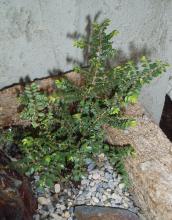
Ulmus parvifolia 'Davidii'. It is amazingly dwarfed - the largest leaves I measured were 5mm in the largest dimension.
I'm not sure if these are hardy enough to survive here. (Unfortunately, I stupidly murdered both specimens that I tried on different occasions by planting them in conditions that were way too dry... the poor things did not even survive long enough to see if winter would kill them. :-\)
Trond Hoy
Re: Groundhugging shrubs.
Tue, 02/22/2011 - 8:38amAn extraordinary elm, Lori!
I have never seen anything like it here.
cohan (not verified)
Re: Groundhugging shrubs.
Tue, 02/22/2011 - 10:11amThat Ulmus looks familiar--was that Wrightman's or Beavercreek? Cute little thing..
Anne Spiegel
Re: Groundhugging shrubs.
Thu, 02/24/2011 - 8:23amSiskiyou Nursery, when it was run by Baldassare Mineo, carried several of these Ulmus parvifolias, from the tiny to the one I bought, which was supposed to be 7' after 10 years. I bought three and planted them, not knowing if they would be hardy. I'll try and find the pictures. They turned out to be irresistable to the antlered rats and two of them are bonsais as a result. They are the two planted farthest from the house. The one in a raised bed right next to the house is a nice size now and apparently hardy. It took the deer some years to start in on it and they changed the shape forever. It's probably 8' or 9' now. The one drawback to this lovely thing is that the density of the branches makes it very susceptible to damage from late ice storms.
cohan (not verified)
Re: Groundhugging shrubs.
Thu, 02/24/2011 - 11:56am7-10' is a very appealing size for 'trees' to me... do these ever make seed, Anne? Are they mutations of a larger species, or is this a naturally small species?
Anne Spiegel
Re: Groundhugging shrubs.
Thu, 02/24/2011 - 1:12pmCohan, I used to save old nursery catalogs and then ran out of room and tossed all but the most current. I recall that Ulmus parvifolia 'Seiju' was one of the ones offered but I seem to remember that it was a very small one. I thought that the one I bought was naturally small, but who knows? Phyllis Gustafson might remember because she may ahve been working at Siskiyou at the time. The attached pictures show the three trees I planted. First is a "bonsai" farthest from the house. Next one is a little closer, and the last is the one the deer left alone for some years. They trimmed off all the bottom branches and an ice storm late winter 2010 broke off most of the top half of the tree.
Anne Spiegel
Re: Groundhugging shrubs.
Thu, 02/24/2011 - 1:14pmSorry, picture #1 didn't make it. Attached is picture of "deer bonsai" planted farthest from the house. All three were planted in exactly the same soil and at the same time and size. Who would believe the results? (Anyone living in proximity to antlered rats would!)
cohan (not verified)
Re: Groundhugging shrubs/taller Ulmus
Thu, 02/24/2011 - 2:05pmWow! I like them all, the shape of the biggest is lovely, but the smaller ones look great too, and the stature would be great in certain plantings..
As for antlered rats, I don't think we have anything like your issues, but deer and moose keep many things pruned around here--Sorbus/Mountain Ash is a challenge here, and note my comments in my Salix thread!
Lori S. (not verified)
Re: Groundhugging shrubs.
Thu, 02/24/2011 - 2:15pmThe one I showed, U. parvifolia 'Davidii' is said on the Wrightman's site to get to 40cm.
Anne Spiegel
Re: Groundhugging shrubs.
Thu, 02/24/2011 - 7:55pmLori, as you can see from the pictures, Ulmus parvifolia is a good candidate for bonsai. Plant the one that's supposed to be a small tree and I will give you some of my antlered rats to do the job for you
Lori S. (not verified)
Re: Groundhugging shrubs.
Thu, 02/24/2011 - 8:46pmAnne, sounds like you (and most of the rest of developed North America) could use some predators!
Well, the way I've grown U. parvifolia 'Davidii' to date - that is, as an annual - it will certainly never outgrow its trough! ;D
Anne Spiegel
Re: Groundhugging shrubs.
Fri, 02/25/2011 - 8:46amLori, the other night I drove up my driveway and a herd of 22 deer scattered. They move too fast to count beyond 22. These kinds of numbers are beyond mere challenges. We desperately need wolves and mountain lions.
Lori S. (not verified)
Re: Groundhugging shrubs.
Fri, 02/25/2011 - 7:55pmGood grief, with a deer population like that, how do you keep your beautiful yard from being eaten down to the nub?!? :o Is it fenced?
Here's another shrub that's suitable for the rock garden (mine is ~15cm; it's said to get to 30cm on one site I saw)... again, not exactly groundhugging - Spiraea decumbens:
Trond Hoy
Re: Groundhugging shrubs.
Sat, 02/26/2011 - 2:30amSpirea decumbens is a new acquaintance for me, Lori! All spireas I know of are big or very big, often untidy shrubs. This certainly is something to plant. When does it flower?
Anne Spiegel
Re: Groundhugging shrubs.
Sat, 02/26/2011 - 4:54amNo, it isn't fenced because we live on rock. I would need to win the lottery to afford the fencing needed. The new water garden is fenced with 8' high wire mesh. It's located at the bottom of the property where there's soil and fencing was a possibility. One of the prettiest sights for me is to look through the fence and see all that expanse of snow without hoof prints! The rest of the garden is a war zone between me and the deer. They have taught me that penstemons and daphnes (and occasionally Lewisia tweedyi) can be eaten to the nub and come back. The shrubby penstemons literally become bonsaied and bloom like crazy - ditto the daphnes.
Lori S. (not verified)
Re: Groundhugging shrubs.
Sat, 02/26/2011 - 9:50amWell, I guess that's a bit of a silver lining!
Trond, S. decumbens blooms in June-July here, much the same as the bigger spiraeas in our short season.
Mark McDonough
Re: Groundhugging shrubs.
Mon, 03/07/2011 - 9:10amJust came across a nice looking low-growing Lonicera (decumbent stems) while combing through the pages of Plantarium Russia (a site for the vascular plants of Russia and neighboring countries).
Lonicera alberti
Kazakhstan, mountain-steppe zone between Terskey Alatau Mts. Ketmen, ca. 2000 m.
http://www.plantarium.ru/page/image/id/78333.html
cohan (not verified)
Re: Groundhugging shrubs.
Mon, 03/07/2011 - 10:33amThat's a cool one for sure!
John P. Weiser
Re: Groundhugging shrubs.
Mon, 03/07/2011 - 12:57pmOne that I have been trying to introduce into my garden for years now is Ceanothus prostratus. A low mat shrub found across the northern Sierra, Siskiyou and Cascade mountain ranges.
I find it to be common on well drained slopes in open pine forest were it gets good reliable snow cover. It will root as it runs so seems to be a good candidate for increase by cuttings, sadly such it is not the case. I have tried cuttings and layering many times and failed.
Last year I dug a two or three year old seedling and moved it into a well drained raised bed that is shaded by a Scotch pine. I was speculating that it may require the mycorrhiza found in the pine litter. Last summer it just sat there and did not put on any top growth.
The last word is still out on it. This spring I see some green on the few leaves it has left, but it's to soon to see new growth yet.
http://calphotos.berkeley.edu/cgi-bin/img_query?rel-taxon=contains&where...
http://plants.usda.gov/java/profile?symbol=CEPR
Trond Hoy
Re: Groundhugging shrubs.
Mon, 03/07/2011 - 1:36pmJohn, that's a plant I would like to introduce to my garden too!
Mark, when are you off to Kazakhstan to collect seed? ;)
Mark McDonough
Re: Groundhugging shrubs.
Mon, 03/07/2011 - 4:27pmI believe a number of Lonicera collections were made during Panayoti's expedition to Kazahkstan the summer of 2010, so possibly some new ones will get introduced in the future.
Lori S. (not verified)
Re: Groundhugging shrubs.
Mon, 03/07/2011 - 7:32pmThat's a very nice honeysuckle, Mark... excellent internet-combing, as always!
Gee, Ceanothus prostratus is an unusual looking plant... what a combination of interesting features! I can see why it's worth the efforts, John!
Here's another one that fits the bill... Prunus prostrata:
http://en.wikipedia.org/wiki/Prunus_prostrata
http://www.west-crete.com/flowers/prunus_prostrata.htm
http://picasaweb.google.com/lh/photo/7pbhSyvghFKm8AFss7g3TA
And in fruit:
http://www.west-crete.com/dailypics/crete-2007/8-18-07.shtm
Here's what I bought a couple of years ago as Prunus aff. prostrata... hope it lives up to its name and becomes prostrate. :o (The way it's planted maybe isn't too good for promoting laxness... should probably move it into a crevice so it can flow downhill, if it has a mind to.)
Moyles (not verified)
Re: Groundhugging shrubs.
Mon, 03/07/2011 - 8:18pmLas pilitas (laspilitas.com ) lists Ceanothus prostatus as available ... good folks ... I recommend them ....
Mark McDonough
Re: Groundhugging shrubs.
Tue, 03/08/2011 - 4:19pmLori, that Prunus prostrata in your trough is a sweet little thing. The link you gave to the Crete site is terrific, with lots of great plant pics. I have never really given P. prostrata a second thought, but seeing the incredibly dense prostrate plants from Crete has my head spinning, if only a super compact form like that could be had. Thanks for opening our eyes on this one.
John, sometimes I think I should live in California (if I wasn't such a stubborn New Englander ;)) so that I could grow such things as Ceanothus. When I lived in the Seattle area and would frequent the University of Washington campus, even though this is not a xeric area in the slightest, many shrubby Ceanothus were grown making wide low shrubs smothered in heavenly blue flowers. I've been tempted with trying some of the prostrate or low growing sorts, although I don't think they will do well in this climate. I do plan on adding the lovely white-flowered Ceanothus americanus (New Jersey Tea) to the garden sometime, although a larger shrub.
cohan (not verified)
Re: Groundhugging shrubs.
Wed, 03/09/2011 - 12:12amI thought Kristl (Gardens North) had a low eastern Ceanothus, but I don't see one now, so either its gone, or quite likely I'm thinking of some other genus...lol
Trond Hoy
Re: Groundhugging shrubs.
Wed, 03/09/2011 - 11:41amThat is a splendid Prunus, Lori! Can't you put some heavy stuff on it if it isn't prostrate enough for you? ;)
Lori S. (not verified)
Re: Groundhugging shrubs.
Wed, 03/09/2011 - 11:45amMaybe that 3 feet of snow on top of it this year will do the trick. ;)
cohan (not verified)
Re: Groundhugging shrubs.
Wed, 03/09/2011 - 11:49amProbably! Likely age (i.e. repeated snows ;D , increased length/weight will help.. I vaguely remember reading about this or some other Prunus which was supposed to become flatter over time..
On the other hand, I have a large 30 year plus juniper here which annually gets flattened by snow, and bounces back to about 4 feet..
Mark McDonough
Re: Groundhugging shrubs.
Wed, 03/09/2011 - 11:53amThe cumulative snowfall of over 7' here this winter takes its toll on shrubs, and even low-branched trees. When the snow compresses and turns to a rock-hard layer, it has the effect of slowly crushing woody plants. I have a Cornus 'Celestial Pink' (C. florida x kousa hybrid) near the end of my driveway that was partially buried under 8' snow embankments. Now, with the snow-pack compressing, it is ripping off the lower branches as the ice layer lowers itself.
cohan (not verified)
Re: Groundhugging shrubs.
Wed, 03/09/2011 - 12:07pmLuckily our snow is usually lighter than yours, Mark, and usually doesn't go as icey as it melts.. I thought after all of our up and down warm weather in early Feb, with melting days (though more settling than real melting away from buildings) and warm temps that our snow would be icier, but I had to dig a path some tens of metres to another section of bush for firewood cutting, the other day, and surprisingly, the snow (18inches or so in that area) was granular but still very loose apart from a thin crust a few inches from the surface (from the warm spell)..
the exceptions were a few places where tracks crossed the path, those were frozen, and around a spruce, where icy melt had fallen into the snow..
We are supposed to be above freezing next week, so we'll see if this stuff starts to go, will take some time, esp in the shade where snow can linger very late...
Trond Hoy
Re: Groundhugging shrubs.
Wed, 03/09/2011 - 12:45pmEven our usually loose snow takes it toll on shrubs especially when it gets wet in spring rain. I have seen such hard snow in the mountains in southern France but it is rare here, it develops when you have repeatedly strong sun/cold nights. What you call crust Cohan, we call "skare" and it is what we want for Easter! Then you can ski wherever you want (if the day doesn't get too hot) 8)
cohan (not verified)
Re: Groundhugging shrubs.
Wed, 03/09/2011 - 2:03pmSometimes we get enough skare to walk on, but not usually for an adult, and not usually for very long/far.. skiing would be more possible, but you couldn't ski in the bush here--not enough space between shrubs/trees etc...lol snowshoes, maybe...
In some places in the mixed woods where the snow is only a half foot deep anyway, you can walk a bit more on the skare...
Rain of any volume in spring is quite rare, here.. usually we are dry in spring except for late snow! That is probably the most dangerous snow for shrubs/trees here: we can have heavy wet snowfall when things are already leafed out, that is when branches break! Maybe this is why most native trees do not make very large limbs to start with?
Trond Hoy
Re: Groundhugging shrubs.
Thu, 03/10/2011 - 12:23amYou'll be astonished where I can ski! When my daughters were kids we always went through the densest birch woods for joy ;D Even with skareføre (thick crust which carry a skier) you often sink to your waist when loosing tempo in the birch-wood where the snowpack is loose :o We had a special wood called "sikk-sakk-skogen" (the-zig-zag-wood) where we loved to ski.
I have also noticed that trees (especially pines) from areas with heavy snow have shorter limbs. Quite obvious why.
cohan (not verified)
Re: Groundhugging shrubs.
Thu, 03/10/2011 - 9:45amClearly you are more ambitious skiers than me ;D Actually, I'm sure you could dodge the trees easily enough here, but the tangle of rose, ribes, loniceras, shepherdia etc on the ground I think would be very hard to ski through without getting stuck, and the snow is not deep enough to bury them completely; Likewise, wet areas with dense willow, birch and alder--all dense clusters of thin trunks, are very hard even to walk through...
Spruce limbs here are not terribly short, but nor are they very thick, and they are very flexible, so they have no problem.. Poplars and birches can have a bit of an issue with wet heavy snow, usually only once they are in leaf...
We have a long weekend at the end of May--popular time for a late heavy snow ;D
Todd Boland
Re: Groundhugging shrubs.
Sun, 03/13/2011 - 9:13amI know too well the damge from compacted snow as it melts...I used to have plenty of rhododendrons but have replaced most with deciduous azaleas as the latter are not so prone to the pancake effect.
I am rather fond of our native prostrate form of Shepherdia canadensis...it is a truly prostrate form and comes true from seed (as they don't root for beans from cuttings)
Trond Hoy
Re: Groundhugging shrubs.
Sun, 03/13/2011 - 9:45amTodd, that one is a winner! I really like it ;D
If you have spare seed I would love to try it ;)
cohan (not verified)
Re: Groundhugging shrubs.
Sun, 03/13/2011 - 10:07amWOW! I had no idea that existed! Would love to grow that :) The standard form is common here..
Richard T. Rodich
Re: Groundhugging shrubs.
Sun, 03/13/2011 - 8:11pmWow, put me on the someday list for that special seed too, please, Todd!
Do you see a difference in growth between male and female plants? We are supposed to have Shepherdia canadensis and S. argentea here, but I think I have only seen S. argentea.
Is that an Erica sp. that I see it growing with?
Trond Hoy
Re: Groundhugging shrubs.
Sun, 03/13/2011 - 11:47pmI'll guess it is an Empetrum, crowberry!
Pages