Forums:
Now I have acquired Rhodohypoxis 'Hebron' and two other cultivars and I am going to try them outside. 'Hebron' at least should be hardy here.


Now I have acquired Rhodohypoxis 'Hebron' and two other cultivars and I am going to try them outside. 'Hebron' at least should be hardy here.
Comments
Panayoti Kelaidis
Re: Rhodohypoxis
Wed, 06/02/2010 - 12:05amThat's wild!
I am amazed that Rhodohypoxis are not proving hardier in more places: they are universal in the high Drakensberg...growing alongside lots of plants that are indestructible in gardens. I remember seeing a big planting in a garden near Goteborg...but I think he protected them in winter with some cover.
Harold Peachey
Re: Rhodohypoxis
Wed, 06/02/2010 - 3:59amHere in Central New York Rhodohypoxis baurii are proving extremely adaptable. I grow them in the open garden, a bog and even in a sand bed-all are thriving and blooming nicely.
Mark McDonough
Re: Rhodohypoxis
Wed, 06/02/2010 - 11:16amReally? That's interesting news... Harold, your climate and mine can't be that different, so perhaps a glimmer of hope these can be tried outside.
Trond Hoy
Re: Rhodohypoxis
Wed, 06/02/2010 - 1:28pmI have read about people here in Norway growing Rhodohypoxis outside for years and I bought the variety 'Hebron' from a nursery in Northern Norway, they claim it is very hardy. I tried some in a pot some years ago and they survived for several years. I kept the pot completely dry in winter so the plants presumably died of lack of water!
Jan Jeddeloh
Re: Rhodohypoxis
Sun, 10/03/2010 - 8:37pmI don't think rhodohypoxis give a rip about winter moisture but they sure care about air around their roots. I have some growing in the spaghnum layer of my carnivorous plant bog and they're very happy and very frost hardy despite the 40 inches (1 meter) of rain we get in the winter. I'm sure the issue is drainage aka air around the roots because I had tried them in various positions in the open garden and they disappeared over the winter. But in the well aerated spaghnum layer they're quite happy, coming up reliably every year.
I keep my pots of rhodohypoxis dry in the winter so obviously they don't require much moisture in winter. They just don't mind it if their roots are properly aerated.
Jan in Portland, Oregon, Zone 8 where it should start raining for at least the next six months soon.
Reed (not verified)
Re: Rhodohypoxis
Sat, 10/09/2010 - 11:03amRhodohypoxis do great outside in Oregon. I have them growing in both my rock garden and in open ground with clay soil and we are no strangers to cold winter wet weather here in the Pacific Northwest. Nearly all my bulbs from South Africa do well outside even with our cold winter snaps the last two years down to about 10 or so deg.F..
Trond Hoy
Re: Rhodohypoxis
Sat, 10/09/2010 - 11:14amReed, this gives me hope! What other S.A. bulbs do you grow? Have you started them from seed? (Silverhill maybe?)
Richard T. Rodich
Re: Rhodohypoxis
Sat, 10/09/2010 - 3:44pmWe have a Chapter member that grows a Rhodohypoxis sp. here in Minnesota. Of course, she grows it as a tender bulb, and overwinters the tuberous rhizomes inside.
Welcome to the forum Reed!
Matt Mattus
Re: Rhodohypoxis
Mon, 11/15/2010 - 7:28pmI've grow many Rhodohypoxis, wintering them over in the greenhouse under a bench, where they go dry in the winter, and then outdoors in the spring and summer, where they bloom like crazy. I have tried some in troughs, as temporary annuals, but they never survive the winters here in central Massachusetts, nor do I expect them to. I may try some in the alpine beds, or even in the ground, since I am curious if I have some sweet spots where they might survive, such as near a foundation.
I have so many Rhodohypoxis varieties now ( all with lost labels), that I simply divide them in the winter, and plant up window boxes with them, that I use in the summer to edge the deck with. The flowers a dense and full in the early spring, but the foliage is equally as fine in the summer, since it remains grass-like and attractive in a simple way.
Mark McDonough
Re: Rhodohypoxis
Mon, 11/15/2010 - 7:51pmHello Matt, welcome to the forum, so glad you made it over here!
I don't currently grow any Rhodohypoxis, but am certainly tempted by them. I have but one windowsill in my basement deep enough that I can overwinter tender things, and I use it to overwinter my collection of little yellow Nothoscordum species... perhaps you have some from those that I spread around the New England Chapter NARGS meetings. Since they grow and flower both in the autumn and in spring, I wonder how these little yellow cuties would look growing together with white, pink, and red Rhodohypoxis. The Nothoscordums, like N. montevidense, also take some frost but I understand are not overly hardy... but I have never tested them. Perhaps, like your plan to find that microclimate sweet spot for Rhodohypoxis outdoor winter trials, I could try the same with Nothoscordum.
By the way, Frank Simpson in southern New Hampshire has Agapanthus that are perfectly hardy in New England, I thought these were a myth too. So, maybe some Rhodohypoxis are worth trying outdoors, or even trying some seed-grown ones outdoors with the chance of hardier progeny.
Reed (not verified)
Re: Rhodohypoxis
Wed, 11/17/2010 - 10:30pmI don't know how cold they can take, but I know they can take 9 deg f. without snow cover, I know that is not as cold as many your zones though. But cold and wet sometimes are worse and I do fall in that category.
Richard T. Rodich
Re: Rhodohypoxis
Thu, 11/18/2010 - 5:22pmJames, 9 degrees F seems pretty cold even thought the bulbs are underground. Is the ground frozen, and to the depth of the "bulbs"? And how deep are the "bulbs"? Did you say you knew the species of your Rhodohypoxis?
Matt Mattus
Re: Rhodohypoxis
Sun, 11/21/2010 - 5:34pmHere are a few images of my Rhodohypoxis containers from earlier this year, in spring. As I mentioned, I plant my Rhodohypoxis baurii in window boxes, which I then bring into the cold greenhouse for the winter, where they remain dry under the benches. I divide them ever few years, and now have many.
Lori S. (not verified)
Re: Rhodohypoxis
Sun, 11/21/2010 - 8:45pmThey look spectacular, Matt!
Trond Hoy
Re: Rhodohypoxis
Sun, 11/21/2010 - 11:45pmImpressive!
It seems you are growing Diascia and Jovellana in pots too. Are those hardy in your climate?
Richard T. Rodich
Re: Rhodohypoxis
Mon, 11/22/2010 - 7:55pmAnd may I say Matt, spectacular and impressive!
The Chapter member here in Minnesota that grows them sifts through the soil each fall to find the subterranean structures to overwinter dormant inside. It would seem just growing them in a pot or trough and bringing in the container for winter would be a lot simpler.
Mark McDonough
Re: Rhodohypoxis
Mon, 11/22/2010 - 8:35pmMatt, impressive planters indeed! In the photo named "rhodo3.jpg", is the pale bluish-white shrubby plant a Prostanthera (Australian mintbush) or a Calamintha, looks like a Lamiaceae to me.
Trond Hoy
Re: Rhodohypoxis
Tue, 11/23/2010 - 9:06amMark, I think you are right. I first took it for a Jovellana but Prostanthera cuneata is a better candidate.
Reed (not verified)
Re: Rhodohypoxis
Thu, 12/02/2010 - 9:05amJames, 9 degrees F seems pretty cold even thought the bulbs are underground. Is the ground frozen, and to the depth of the "bulbs"? And how deep are the "bulbs"? Did you say you knew the species of your Rhodohypoxis?
Hi Rick,
Sorry It took me so long to reply I have been busy with school. But yes, the ground was frozen solid for three days last winter and about a week the winter before. I plant mine about 2-3 inches deep, but the ones that I had growing in clay soil were only about 1 inch under the soil line. I am still very surprised the ones in the clay soil lived. The ones I grow ouside for sure is Rhodohypoxis baurii. I will say that nearly all the ones that I forgot to take into the garage that I was growing in pots did die. (the cold snap came with very little warning and it was not reported to get that cold) So now the only ones I have left are the few that lived the winter in the pots and the others that I planted out in the ground.
Richard T. Rodich
Re: Rhodohypoxis
Thu, 12/02/2010 - 5:13pmThanks James. That gives me a good idea of how cold the soil really got. (not very, compared to Minnesota standards) But about what I might expect there. :)
Matt Mattus
Re: Rhodohypoxis
Sat, 12/25/2010 - 7:20pmHi folks, yes, it is a Prostanthera cuneata, one that I purchased in Portland, OR at the WWSW in 2008. I keep three species of Prostanthera in my cool greenhouse, they do so well since they can handle a little freeze every now and then ( when the gas runs out!). The diascia is not hardy here, I purchase young plants in late winter, and they bloom until mid-July, when it gets hot and humid.
Panayoti Kelaidis
Re: Rhodohypoxis and Diascia
Sun, 12/26/2010 - 3:39pmI've enjoyed the comments about Rhodohypoxis hardiness: obviously much to learn there...
Many Diascia are moderately hardy in Denver if pampered in a perfect site and soil: after all, the perennial sorts almost all come from high altitudes in the Drakensberg...
BUT One species is Very Tough: Diascia integerrima, particularly in the dwarf race that was introduced through Plant Select called 'Coral Canyon' is tough as nails. I've been ransacking my computer (apparently I don't have pictures on it here..dammit!) but there are lots on the internet: check out this URL:
http://www.google.com/images?hl=en&safe=off&biw=1090&bih=442&gbv=2&tbs=i...
I collected seed from which 'Coral Canyon' was selected in 1998 with Jim Archibald a short distance above Rhodes on the way to Naude's Nek in the East Cape mountains (very cold area). Typical integerrima can get to be a yard tall, this race stayed much more compact, in the wild only a foot tall or less. In the garden it can get bigger, especially in rich soil. It has persisted for ten years in some sites for us here, and is one of the most long blooming and gratifying perennials. Many Plant Select cooperators sell plugs: you must try it!
Trond Hoy
Re: Rhodohypoxis
Sun, 12/26/2010 - 10:49pmSome Diascias even make nice plants in Northern Norway and are sold by nurseries far north:
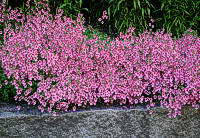
http://www.stewo.no/stauder_d.htm
They sell Delosperma basuticum too: