The Hyacinthoides bulb has to have a (short) stem inside where the roots grow from. Have you ever made a longitudinal cut through the bulb?
Your wish is my command...at least sometimes ;D It seems roots emerge from a particular part of the stem within the bulb (and not the basal plate), regardless of where they emerge on the bulb surface.
I wish my wife would say that more often ;D
I think the roots emerge from the new basal plate - the one to be next year. They grow through the bulb scales in slightly different directions. Interesting. - Hope you could spare that bulb, you can possibly plant it though - now you have two ;)
No lovely irises, no pretty lewisias, no gorgeous clematis but snow. Saturday was sunny as the Sun's day should be. However we are struck by an untimely snowstorm here in the mountains. It is a bit early in the season even here in 1000m ASL.
Sounds like you may have to put the flip-flops in storage , Trond . They tend to flick the snow up your back and could give you a back chill when out walking in the snow . Especially that soft powdery stuff .
Oh yeah! I go barefoot ;) Then I don't get wet socks either. . . .
Tim, I am jealous on your Indian summer - we had two whole days of it last week! Ceratostigma is a genus I have thought to try outside at home but I'm afraid our summers isn't warm enough :(
The Hyacinthoides bulb has to have a (short) stem inside where the roots grow from. Have you ever made a longitudinal cut through the bulb?
Your wish is my command...at least sometimes ;D
It seems roots emerge from a particular part of the stem within the bulb (and not the basal plate), regardless of where they emerge on the bulb surface.
Fascinating stuff! Just look at how the roots emerge from the internal stem right through the bulb mass.
We are having quite an Indian summer in southern England with unseasonably warm days reaching nearly 30°C Good for extending the flowering of some plants. One of the loveliest autumn shrubs is Ceratostigma willmottianum, which is reliably hardy with us, though sometimes cut to the ground in winter. It really is a gentian-blue; quite exquisite.
Tim, when I was just a teenager, just a few years ago ;D, I grew Ceratostigma plumbaginoides, rated zone 5 here but I found it wasn't reliable hardy and only lasted a couple years. I understand however, when it is happy, it can spread rather aggressively but probably worth the effort for those blue autumn flowers and red bracts. Ceratostigma willmottianum looks enticing, but I doubt it would be hardy here.
A couple of our native paper daisies [attachthumb=2]
cheers fermi
Fermi, I really like the native "paper daisies" you show. Are these Helichrysum species?
And don't tease me with the Pacific Coast Iris, I've never been able to grow them successfully, but just look at the colors and forms you got from seed :o, love the rotund yellow one! The dwarf bearded Iris named forms are luscious too.
I found another plant in flower today: Impatiens omeiana. It is always blooming very late.
Trond, the flowers look like they're made of plastic, so shiny and smooth. I was at a used bookstore in central Massachusetts, saw a book on the genus Impatiens, and now I'm kicking myself for not buying it... I already selected more than enough books to buy.
Jamdals, ditto the previous comments, I'm anxious to see your large Clematis marmoraria in full flower, what a gem. Also your white Lewisia tweedyi isn't have bad either ;)
I think the roots emerge from the new basal plate - the one to be next year. They grow through the bulb scales in slightly different directions. Interesting. - Hope you could spare that bulb, you can possibly plant it though - now you have two ;)
After I posted, I thought about this more and I was coming to the same conclusion. I was going to post here to see what you all thought about "my" theory, but I've already got my answer! This is particularly interesting, as until now I hadn't known that true bulbs could have annual basal plates.
McDonough wrote:
Fascinating stuff! Just look at how the roots emerge from the internal stem right through the bulb mass.
At first I thought the same thing: how interesting. But then I thought how we can grow new blood vessels through our own tissues, and how adventitious buds grow through, and I guess it is not so remarkable after all.
Fermi, I really like the native "paper daisies" you show. Are these Helichrysum species?
And don't tease me with the Pacific Coast Iris, I've never been able to grow them successfully, but just look at the colors and forms you got from seed :o, love the rotund yellow one! The dwarf bearded Iris named forms are luscious too.
Hi Mark, these were helichrysums but now are Leucochrysum albicans and forma tricolor. As far as irises are concerned we seem to be in an ideal climate for a great number of sorts other than the ones that want lots of coolth! Here's Siberian iris "Blue Bird"
Yesterday was a rainy day! I felt like Oliver, singing "Food, glorious food..." (except "rain, glorious rain..."). But it was a reason to take off and visit other gardeners, so I visited two chapter members across town.
It's cyclamen time here and both members have nice specimens. Yul is from Slovenia, and he grows Cyclamen purpurascens sourced from the area near Bled (in Slovenia). Bled is a famous tourist destination and the area is home of what could be the darkest color forms of the species. Here is a couple of his plants in the garden (not particularly dark, though):
No doubt, many of you have seen a similar picture of Lake Bled. This print hung in my Grandmother's house for as long as I can remember.
A dreary day, and great for taking photos in some respects, and in others, not so good. The view from Yul's balcony is envious, and we had some lunch while it down poured. But it let up now and then that opted for some nice pics.
Gorgeous leaf forms on Cyclamen purpurescens! :o :o
I love Tricyrtis but I have miserable luck with them, they always die out. The longest one I kept was the incredible T. macranthopsis with fat tubby bells of golden yellow heavily speckled inside... had it for about 4-5 years.
Nice yard Lori . I guess this post is technically from my yard too . ...from my metre doesn't have the same ring to it .
Whilst posting these pictures I have realised that I grow a lot of variety alba's . I think that even though I am growing some exotic plants , I have a subconscious love of NZ flora where there is so much alba they had to drop the epithet because it became tedious.
Took these pictures today because we are supposed to get a lot of rain tonight and tomorrow and I really hope that we get some .
The party may not be over, but with 8" of snow on the ground and lows in the lower teens...the season will not be the same. And just a few days earlier, the fall color was the best I'd seen in Denver. And these tresures shown below were just a smattering of the flowers you could find. I kinda got stuck on the colchicums and crocuses however. I think most of them will come through the cold just fine. I just hope the still green oaks and rowans will still color up after such chilly nights: next week is predicted to be glorious Indian Summer. Such are the challenges of gardening on the steppes of America!
I've always tried to grow crocuses but generally fought a losing battle against the rabbits in recent years. They are the most exquisite of plants and I shall keep trying! Lori - I really like the 'silvers' in your garden, just my sort of plants. I am interested to see Arabis androsacea having just bought this from Ron McBeath. It looks a very tidy plant.
Most of the show in our garden is now the autumn colours which have arrived in just the last few days. The sand bed in the front garden is overlooked by Gleditsia triacanthos 'Sunburst', which is soft-yellow throughout they year but is more richly coloured now. One of the few flowering shrubs is Grevillea rosmarinifolia 'williamsi', virtually never out of flower and a really good form of the species selected in New Zealand (according to the 'Grevillea Book'). In the back garden the colours tend to go with a certain disarray; hostas exemplify this rather well. We have a wide range of apple varieties in the garden too which add to the autumn picture.
Your garden looks very intriguing, Tim! I am amazed how you grow Western Americans. I am on 80 feet of pure sand on my current garden, and struggle to grow many of our westerners (which prefer clay). I am mystified by your mentioning Arabis androsacea: I just cleaned the seed of it today to send to NARGS exchange: this is the first time it has set much seed, although I have grown it for years: it isn't as compact or woolly as A. bryoides, but its much easier to grow and similar (and permanent). We had our first hard frost last Wednesday (and 8" of wet snow) which knocked many of the gloriously colored leaves off trees--we'd been having a memorable and resplendant fall color season. The oaks and rowans are only just coloring, and they came through the frost pretty well, so there will be more to look at in the next month (including a few last crocuses, and other tardy flowers!). Gleditsia triacanthos 'Sunburst' is commonly grown in Denver, incidentally, where it can be spectacular in its pale yellow coloration for weeks on end in early summer. When it finally gets really hot mid-June or so it turns a typical dark green for us: you do have many blessings in more maritime climates, you see!
The rabbits have not bothered my crocuses. I think it is because my crocuses are in the front of my house. Rabbits tend to spend most of their time near cover. My back yard is edged with evergreen shrubs and a chain link fence. Rabbits love chain link fences because they can escape through them and predators cannot follow. The rabbits usually stay near the shrubs in my back yard grazing on lawn grass and weeds. The only exception was when I parked a car on the driveway near a garden in my front yard. This car provided excellent over head cover for the rabbits. It was also parked near the chain link fence that extends from my back yard around the side of my house. My expensive coneflower cultivars were being nibbled to stubs. A little chicken wire solved this problem. A neighbor recently has let their cat wander the neighborhood. It is not surprising that the garden in my backyard has become a favorite hunting destination. I do not want to debate the issue of outdoor cats. However, this has caused the few surviving rabbits to rarely leave the cover of taller weeds in a neglected corner of the yard. My wife and I miss seeing the rabbits lazily grazing on our lawn. In winter I did have a problem with rabbits eating small twigs and stripping bark on my smaller shrubs. I found this was easily solved by removing snow that was covering lawn grass. The rabbits would flock to the patch of exposed lawn grass leaving my shrubs alone. This worked as long as I quickly removed the snow after each storm. I was lazy after one storm and was not motivated to shovel my grass. The rabbits soon started crewing up my shrubs which was all the motivation I required! I guess the moral of the story is ... if you do not plant near cover and the rabbits have a better food source then you probably won't have a problem with them. If this is not feasible, then some chicken wire will solve the problem.
What I have been growing as Arabis androsacea is essentially stemless* (though the plant description, below, said 4cm stems), and quite furry. The seeds were from Holubec and described as: "ex. Turkey: Ala Dag, 2200m, limestone scree; small cushions, white hairy rosettes, white flowers on 4cm long stems; 2009 seed". I have photos of them in full bloom somewhere in my vast, unlabelled(grrr!!) photo collection but only this recent photo showing a late, repeat bloom is readily available:
What rabbit species do you have coming to your garden, James? Must be very small ones to get through chain link fences, unless maybe the styles of mesh are much bigger there than what is used here? (N. B. It would be really helpful if you could add your general location to your signature or to your profile, so that readers can see how closely their situations relate to yours in terms of geographics, climates, zones, etc.. :)) Here, the rabbits one sees most often in the city are whitetail jackrabbits - big, long-legged, long-eared critters of the open plains that are not much tied to cover. (I suppose people who live on the edges of the ravines may have the smaller, cuter snowshoe hares coming into their yards, but I don't know if that is so.) I don't have any real complaints with their feeding... so many plants for them to choose from in the yard and elsewhere that their impact is small. Well, okay, I admit I sometimes get mildly irritated at their nibbling my drabas in the troughs out front, though this seems to be a new thing related to the recent snowy winters we've had, where snow has covered things they'd probably otherwise be eating. They also seem to have found my Trifolium rubens irresistible this spring, and munched it to the ground, but it recovered. Oh well, overall, very minor damage and I don't begrudge them their choice of food. :)
"What rabbit species do you have coming to your garden, James?"
Cottontail Rabbits - Sylvilagus floridanus
"Must be very small ones to get through chain link fences, unless maybe the styles of mesh are much bigger there than what is used here? ... Here, the rabbits one sees most often in the city are whitetail jackrabbits - big, long-legged, long-eared critters of the open plains that are not much tied to cover. (I suppose people who live on the edges of the ravines may have the smaller, cuter snowshoe hares coming into their yards, but I don't know if that is so.)"
Actually, neither jackrabbits nor snowshoe hares are rabbits.
The plant of Arabis androsacea I have looks closer to Lori's than Panayoti's, though I have yet to see it in flower. I am not sure we are too successful with western American alpines here, and there is certainly not a strong tradition of growing such plants in the garden; most growers in the AGS concentrate more on exhibiting plants, and in a curious way I think that this can tend to restrict the range of plants grown. My dream would probably be the old alpine house at Wisley from the 1980's which was beautifully planted with dryland alpines by Ralph Haywood (who used to work with Joe Elliott at his famous Broadwell nursery). How much has alpine gardening taken off around Denver? There seems to be a much better link between Botanic Gardens and horticulture in the States than in the UK - ie: the sense of partnership in growing and learning about plants.
Here, Gleditsia triacanthos 'Sunburst' (Sunburst honelocust) is only all yellow in the spring, and with fall color. As leaves mature in summer, they turn green, while new leaves are still yellow.
Tim, what is that pine with the long weeping needles in your second to last pic, (and also the pine behind it). Is it a P. wallichiana?
I am also befuddled by James's chain link fence comment. We have cottontails here, and they are kept out by what we call chain link.
The absolute cutest rabbits I've ever seen were the "Texas fightin' bunnies" (or so we referred to them) that we saw in spring in Rio Grande Village campground in Big Bend N.P. years ago; I suppose it was mating or play or territorial behavior, as a pair of tiny bunnies (relative to the jackrabbits I'm used to, anyway) would rear up and box each other for a bit... and then, just as suddenly, lose interest and start munching on something instead! Hardly fights to the death (thank heavens)! ;) From range maps, it would seem they were either desert (Sylvilagus audubonii) or eastern cottontails.... danged charming to watch, whatever they were up to!
"I suppose it was mating or play or territorial behavior, as a pair of tiny bunnies (relative to the jackrabbits I'm used to, anyway) would rear up and box each other for a bit..."
I have seen such displays in Illinois. It is a rare year that we get such a treat. The rabbit population fluctuates wildly. When the population of rabbits is high they often behave in this manner. They will be sitting in a group. One rabbit will will charge another rabbit. The rabbit on the receiving end will often jump into the air so the charging rabbit ends up running underneath it. It is fun to watch these bunny games.
The cottontail rabbits in my area are an edge species. This is the reason they love backyards so much. In large open grasslands cottontail rabbits are almost never seen. If you do see a rabbit it is almost invariably near a brush pile or some other form of cover. In wild areas they tend to stay near the woodland edge where thickets give them cover and a winter food source.
It is interesting to me that certain species are so selective about habitat type. For example, grassland birds will not use an area unless it is 100's and sometimes 1000's of treeless acres. The structure of vegetation is very important for certain species. It is a rare prairie that is over 20 acres. You can see how this posses a big problem for grassland birds. Luckily, structure is more important to birds than quality vegetation. They have been able to hang on in hayfields and rotationally grazed pastures. Given the rarity of areas large enough to support grassland birds, much effort go toward creating the large treeless areas they require.
Rick - both pines were grown from seed. The first one is the Mexican Pinus patula (a poor specimen that I had left over from the nursery with a very twisted stem, but it has made a nice plant). The lower one is P. ponderosa which is growing at quite an alarming rate! I don't grow wallichiana but it is a beautiful specimen in a friend's garden - one of the best pines I think.
Yes, had I thought of it, patula would have been my first guess. Also had wondered if the second one might be P. pondersosa. Mine grows 1.5-2ft (46-60cm) per year.
Well, Panayoti and Lori, I'll be looking out for that one on the Seedex list when it arrives! This spuria iris arrived as a volunteer seedling in a bed of summer dormant bulbs - how it got there I don't know, though it does grow in our neighbour's frontyard, about 200 yds away! It appears to be Iris orientalis
This white siberian iris has done well,
While a mauve-blue one is less floriferous this year, though the Sprekelia formosissima next to it has been brilliant!
In the "bog garden" a couple of Louisiana iris have opened, possibly "John's Lucifer'
Thanks to some of the leaves still on the trees, the damage was extensive. Magnolia soulangeana, not a relaible bloomer every yeare due to frequent late frosts, but very beautiful when it did bloom.
Anne - really sad to see such damage to the magnolia. It is the most extraordinary tree in flower. I remember a large tree in Canterbury near us which was savagely pruned one year with no thought for its shape. Now though after some years it has grown out and made quite a shapely specimen again. (Not that such pruning is to be recommended!!). I hope we are not in for another severe (relatively) winter here, as I am still clearing up after the last one.
These will probably be my last views of 'Fall' in my garden.
I love the color in my Fothergilla major 'blue shadow.'
The Spireas have nice color from Spring to Fall. The ones that were abused at the home improvement store have the deepest color. This is the opposite of what I would expect.
The 'Front Path Garden' has Coreopsis auriculata, Geranium sanguineum, and Armeria maritima. The Geranium sanguineum is particularly beautiful because some of the leaves are red while others are green. This gives the plant a Christmas look.
I included the Alberta Spruce surrounded by Snapdragons because I like the echo of shape between the pavers and the Spruce. I cannot take credit for this design. It was here when I purchased my home. I only planted the Snapdragons.
The Red Maples are one of my favorite trees for Fall color.
The last picture is of Pineapple Sage. I planted this for my hummingbirds. It did not begin blooming until after all the hummingbirds had migrated South. Since it did not accomplish its purpose, I will not be planting Pineapple Sage in the future.
The Magnolia soulangiana I grow at our summerhouse lost the top of its main stem and some limbs due to heavy late snow a couple of years ago but now it is completely regrown. I removed the broken limbs and doctored the wounds with a sharp knife but did nothing else.
Now snow or frost here, in fact it is extraordinary mild for the season. The last days have reached 15C in daytime and not less than 11C at night. However, two nights with 0-2C a couple of weeks ago transformed the colours of the leaves and heavy rain later defoliated almost all the deciduous trees and shrubs so not much fall colour to show. In stead some plants still flower and Viburnum farrerii is in full bloom with fragrant flowers.
Wow, unimaginable, Trond! I am scraping the bottom of the barrel here... and winter usually comes much sooner than this. Here is a bit of fall colour on Townsendia parryi:
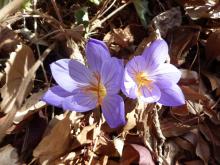
The sun is very low in the sky now but if it shines on these autumn crocus, they might manage to open again:
I always enjoy the pinky tones of little bluestem, Schizachyrium scoparium. I've lost the name of this other grass, but it's looking nice now.
This Stachys inflata seedling looks like it's put on a wool sweater for the cold weather:
Helleborus caucasicus is still defiantly green and looking incongruous against all the yellows and browns:
The 'Front Path Garden' has Coreopsis auriculata, Geranium sanguineum, and Armeria maritima. The Geranium sanguineum is particularly beautiful because some of the leaves are red while others are green. This gives the plant a Christmas look.
- I just had to post a closer picture of Geranium sanguineum to show you what I was talking about above.
Very nice, James. Geranium sanguineum is probably my favourite geranium species for its very long bloom and terrific fall colour.
Amy, you have a lot going on there. I wonder if anyone grows Spiranthes odorata here? Seems like it should not be such a stretch. It's very surprising to me to see an orchid still in bloom!
Lori, I think Spiranthes odorata is actually rather a stretch for Amy. In her more interior Northern climate it does not appear to be very strong. I think Goodyeara would be much better for Amy's garden.
In contrast, I think Spiranthes odorata would be a greenhouse plant in Alberta.
You have two native Ladies'-tress Orchids. They are Spiranthes lacera var. lacera and Spiranthes romanzoffiana.
The range of Spiranthes lacera var. lacera just makes it into Northeastern Alberta. It is found in or near Jack Pine Forests. This means it likes nutrient poor sandy, gravelly, or rocky areas that experience periodic fire. However, it may also occur in rock outcrops where enough fuel is never present to carry fire.
Spiranthes romanzoffiana lives in wetlands.
It likely be best to observe these plants in the wild, rather than attempting cultivation. Spiranthes lacera var. lacera is listed as being rare in your province.
James the other plant with the P. auricula is another unamed and unflowered auricula from seed. The Spiranthes are actually quite hardy here in the garden coming through pretty tough winters.
Amy, That slightly out of focus unflowered Primula auricula had me imagining one of my Mexican Pinguliculas. Of course, Mexican Pinguliculas are a house plant in my climate.
I am surprised you are finding Spiranthes odorata to be hardy in Vermont. The USDA lists the range of Spiranthes odorata as only extending as far North as New Jersey. Is it possible the plant you are growing is actually Spiranthes cernua? Here is the key for these two species from the flora of North America.
26 (25) Plants to 50 cm; leaves comparatively slender, ascending to spreading (flaccidly so because of membranaceous blades with thickened midrib); petioles of basal leaves less than 6 mm wide; leaves wholly basal or lower sheaths with ascending-spreading blades; perianth usually 8–11 mm; lip membranaceous to fleshy, less than 7 mm wide. 14 Spiranthes cernua
+ Plants to 100 cm or more; leaves broad, ascending to spreading (rigidly so because of aerenchymatous thickening of blade); petioles of basal leaves 7 mm or more wide; blades spreading-recurved on proximal cauline sheaths, frequently also on distal, leaves then extending to inflorescence; perianth (4–)10–18 mm (shorter in young or depauperate plants); lip fleshy, (4–)7–9.5 mm. 13 Spiranthes odorata
I am surprised you are finding Spiranthes odorata to be hardy in Vermont. The USDA lists the range of Spiranthes odorata as only extending as far North as New Jersey.



Comments
Trond Hoy
Re: What do you see on your garden walks?
Mon, 10/10/2011 - 1:06pmI wish my wife would say that more often ;D
I think the roots emerge from the new basal plate - the one to be next year. They grow through the bulb scales in slightly different directions. Interesting. - Hope you could spare that bulb, you can possibly plant it though - now you have two ;)
Trond Hoy
Re: What do you see on your garden walks?
Mon, 10/10/2011 - 1:07pmOh yeah! I go barefoot ;) Then I don't get wet socks either. . . .
Trond Hoy
Re: What do you see on your garden walks?
Mon, 10/10/2011 - 1:13pmTim, I am jealous on your Indian summer - we had two whole days of it last week!
Ceratostigma is a genus I have thought to try outside at home but I'm afraid our summers isn't warm enough :(
Mark McDonough
Re: What do you see on your garden walks?
Mon, 10/10/2011 - 4:03pmFascinating stuff! Just look at how the roots emerge from the internal stem right through the bulb mass.
Mark McDonough
Re: What do you see on your garden walks?
Mon, 10/10/2011 - 4:10pmTim, when I was just a teenager, just a few years ago ;D, I grew Ceratostigma plumbaginoides, rated zone 5 here but I found it wasn't reliable hardy and only lasted a couple years. I understand however, when it is happy, it can spread rather aggressively but probably worth the effort for those blue autumn flowers and red bracts. Ceratostigma willmottianum looks enticing, but I doubt it would be hardy here.
Ceratostigma plumbaginoides photo:
http://www.soonerplantfarm.com/index.cfm?fuseaction=plants.plantdetail&p...
Mark McDonough
Re: What do you see on your garden walks?
Mon, 10/10/2011 - 4:14pmFermi, I really like the native "paper daisies" you show. Are these Helichrysum species?
And don't tease me with the Pacific Coast Iris, I've never been able to grow them successfully, but just look at the colors and forms you got from seed :o, love the rotund yellow one! The dwarf bearded Iris named forms are luscious too.
Mark McDonough
Re: What do you see on your garden walks?
Mon, 10/10/2011 - 4:17pmTrond, the flowers look like they're made of plastic, so shiny and smooth. I was at a used bookstore in central Massachusetts, saw a book on the genus Impatiens, and now I'm kicking myself for not buying it... I already selected more than enough books to buy.
Jamdals, ditto the previous comments, I'm anxious to see your large Clematis marmoraria in full flower, what a gem. Also your white Lewisia tweedyi isn't have bad either ;)
Richard T. Rodich
Re: What do you see on your garden walks?
Mon, 10/10/2011 - 5:08pmRegarding the Hyacinthoides bulb root initiation:
After I posted, I thought about this more and I was coming to the same conclusion. I was going to post here to see what you all thought about "my" theory, but I've already got my answer! This is particularly interesting, as until now I hadn't known that true bulbs could have annual basal plates.
At first I thought the same thing: how interesting. But then I thought how we can grow new blood vessels through our own tissues, and how adventitious buds grow through, and I guess it is not so remarkable after all.
Trond Hoy
Re: What do you see on your garden walks?
Wed, 10/12/2011 - 11:38amWell, fascinating then!
Fermi de Sousa
Re: What do you see on your garden walks?
Thu, 10/13/2011 - 12:27amHi Mark,
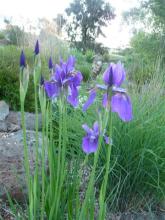
these were helichrysums but now are Leucochrysum albicans and forma tricolor.
As far as irises are concerned we seem to be in an ideal climate for a great number of sorts other than the ones that want lots of coolth!
Here's Siberian iris "Blue Bird"
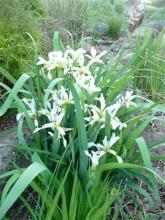
And Iris (spuria ssp) halophila
cheers
fermi
Richard T. Rodich
Re: What do you see on your garden walks?
Thu, 10/13/2011 - 11:19pmYesterday was a rainy day! I felt like Oliver, singing "Food, glorious food..." (except "rain, glorious rain..."). But it was a reason to take off and visit other gardeners, so I visited two chapter members across town.
It's cyclamen time here and both members have nice specimens. Yul is from Slovenia, and he grows Cyclamen purpurascens sourced from the area near Bled (in Slovenia). Bled is a famous tourist destination and the area is home of what could be the darkest color forms of the species. Here is a couple of his plants in the garden (not particularly dark, though):
No doubt, many of you have seen a similar picture of Lake Bled. This print hung in my Grandmother's house for as long as I can remember.
Yul showed me a book he recently received:
http://www.botanicni-vrt.si/content/view/130/1/lang,en/
Jože Bavcon also has written small books on crocus and another genus that I don't recall at the moment.
A dreary day, and great for taking photos in some respects, and in others, not so good. The view from Yul's balcony is envious, and we had some lunch while it down poured. But it let up now and then that opted for some nice pics.
Richard T. Rodich
Re: What do you see on your garden walks?
Thu, 10/13/2011 - 11:35pmThen on to Jean's house, and more Cyclamen purpurascens.
and Cyclamen hederifolia. Not as hardy as purpurascens for us in Minnesota, but some get away with it.
And time for some tea and cardamom bread...and šlivovic ;D
Tricyrtis usually doesn't make a splash this far north, but Jean grows Tricyrtis formosana 'Butterfly Cloud' and 'Miyazaki' very well.
Maybe I can stump someone here: can you guess what this is?
Mark McDonough
Re: What do you see on your garden walks?
Sat, 10/15/2011 - 11:45amGorgeous leaf forms on Cyclamen purpurescens! :o :o
I love Tricyrtis but I have miserable luck with them, they always die out. The longest one I kept was the incredible T. macranthopsis with fat tubby bells of golden yellow heavily speckled inside... had it for about 4-5 years.
Is the seed pod a Cimicifuga?
Richard T. Rodich
Re: What do you see on your garden walks?
Sat, 10/15/2011 - 6:50pmRight. Cimicifuga racemosa
Here's the foliage to go with it:
Lori S. (not verified)
Re: What do you see on your garden walks?
Sun, 10/16/2011 - 10:44amWell, you certainly had me stumped, Rick! Your friend certainly does have a beautiful view and a beautiful garden.
Here are a few late-bloomers in the yard... Arabis androsacea; Osteospermum barberiae var. compactum 'Purple Mountain'; Hylotelephium 'Autumn Joy':
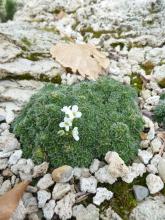
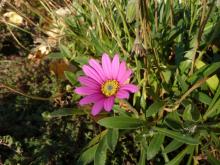
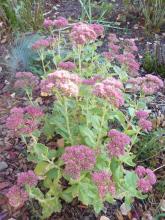
Some interesting foliage... and hopes of flowers to come:
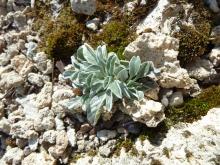
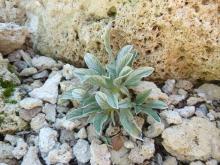
Convolvulus suendermanii (x2) - bought from Beaver Creek this spring
Potentilla divina:
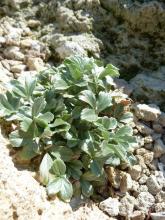
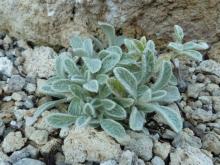
Sideritis phyrgia:
Androsace albana:
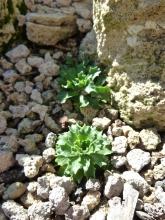
Saxifraga callosa:
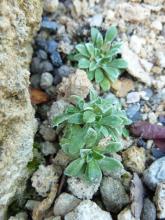
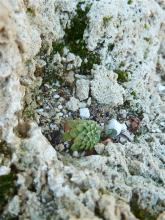
A tiny thing, snuggled into a crevice in the tufa - Saxifraga umbellulata v. pectinata:
Steve Newall (not verified)
Re: What do you see on your garden walks?
Mon, 10/17/2011 - 1:15amNice yard Lori . I guess this post is technically from my yard too . ...from my metre doesn't have the same ring to it .
Whilst posting these pictures I have realised that I grow a lot of variety alba's . I think that even though I am growing some exotic plants , I have a subconscious love of NZ flora where there is so much alba they had to drop the epithet because it became tedious.
Took these pictures today because we are supposed to get a lot of rain tonight and tomorrow and I really hope that we get some .
Gentiana verna alba
Meconopsis pseudointegrifolia
and just to prove there is an exception to every rule , non-white flowers on Pittosporum tenuifolium . Also fragrant and popular with bees
Toole (not verified)
Re: What do you see on your garden walks?
Mon, 10/17/2011 - 1:47amIt's on its way Steve --the wet stuff started here a few hours ago...
Lovely shot of the Gentiana ,(and the Clematis marmoraria on the other thread).
Cheers Dave.
Panayoti Kelaidis
Re: What do you see on your garden walks?
Thu, 10/27/2011 - 8:56pmThe party may not be over, but with 8" of snow on the ground and lows in the lower teens...the season will not be the same. And just a few days earlier, the fall color was the best I'd seen in Denver. And these tresures shown below were just a smattering of the flowers you could find. I kinda got stuck on the colchicums and crocuses however. I think most of them will come through the cold just fine. I just hope the still green oaks and rowans will still color up after such chilly nights: next week is predicted to be glorious Indian Summer. Such are the challenges of gardening on the steppes of America!
Tim Ingram (not verified)
Re: What do you see on your garden walks?
Sun, 10/30/2011 - 3:56amI've always tried to grow crocuses but generally fought a losing battle against the rabbits in recent years. They are the most exquisite of plants and I shall keep trying! Lori - I really like the 'silvers' in your garden, just my sort of plants. I am interested to see Arabis androsacea having just bought this from Ron McBeath. It looks a very tidy plant.
Most of the show in our garden is now the autumn colours which have arrived in just the last few days. The sand bed in the front garden is overlooked by Gleditsia triacanthos 'Sunburst', which is soft-yellow throughout they year but is more richly coloured now. One of the few flowering shrubs is Grevillea rosmarinifolia 'williamsi', virtually never out of flower and a really good form of the species selected in New Zealand (according to the 'Grevillea Book'). In the back garden the colours tend to go with a certain disarray; hostas exemplify this rather well. We have a wide range of apple varieties in the garden too which add to the autumn picture.
Panayoti Kelaidis
Re: What do you see on your garden walks?
Sun, 10/30/2011 - 5:23amYour garden looks very intriguing, Tim! I am amazed how you grow Western Americans. I am on 80 feet of pure sand on my current garden, and struggle to grow many of our westerners (which prefer clay). I am mystified by your mentioning Arabis androsacea: I just cleaned the seed of it today to send to NARGS exchange: this is the first time it has set much seed, although I have grown it for years: it isn't as compact or woolly as A. bryoides, but its much easier to grow and similar (and permanent). We had our first hard frost last Wednesday (and 8" of wet snow) which knocked many of the gloriously colored leaves off trees--we'd been having a memorable and resplendant fall color season. The oaks and rowans are only just coloring, and they came through the frost pretty well, so there will be more to look at in the next month (including a few last crocuses, and other tardy flowers!). Gleditsia triacanthos 'Sunburst' is commonly grown in Denver, incidentally, where it can be spectacular in its pale yellow coloration for weeks on end in early summer. When it finally gets really hot mid-June or so it turns a typical dark green for us: you do have many blessings in more maritime climates, you see!
Panayoti Kelaidis
Re: What do you see on your garden walks?
Sun, 10/30/2011 - 6:25amJust found a picture of Arabis androsacea, Tim!
Anonymous (not verified)
Gardening With Rabbits
Sun, 10/30/2011 - 10:42amTim,
The rabbits have not bothered my crocuses. I think it is because my crocuses are in the front of my house. Rabbits tend to spend most of their time near cover. My back yard is edged with evergreen shrubs and a chain link fence. Rabbits love chain link fences because they can escape through them and predators cannot follow. The rabbits usually stay near the shrubs in my back yard grazing on lawn grass and weeds.
The only exception was when I parked a car on the driveway near a garden in my front yard. This car provided excellent over head cover for the rabbits. It was also parked near the chain link fence that extends from my back yard around the side of my house. My expensive coneflower cultivars were being nibbled to stubs. A little chicken wire solved this problem.
A neighbor recently has let their cat wander the neighborhood. It is not surprising that the garden in my backyard has become a favorite hunting destination. I do not want to debate the issue of outdoor cats. However, this has caused the few surviving rabbits to rarely leave the cover of taller weeds in a neglected corner of the yard. My wife and I miss seeing the rabbits lazily grazing on our lawn.
In winter I did have a problem with rabbits eating small twigs and stripping bark on my smaller shrubs. I found this was easily solved by removing snow that was covering lawn grass. The rabbits would flock to the patch of exposed lawn grass leaving my shrubs alone. This worked as long as I quickly removed the snow after each storm. I was lazy after one storm and was not motivated to shovel my grass. The rabbits soon started crewing up my shrubs which was all the motivation I required!
I guess the moral of the story is ... if you do not plant near cover and the rabbits have a better food source then you probably won't have a problem with them. If this is not feasible, then some chicken wire will solve the problem.
Sincerely,
James
Lori S. (not verified)
Re: What do you see on your garden walks?
Sun, 10/30/2011 - 11:23amWhat I have been growing as Arabis androsacea is essentially stemless* (though the plant description, below, said 4cm stems), and quite furry. The seeds were from Holubec and described as: "ex. Turkey: Ala Dag, 2200m, limestone scree; small cushions, white hairy rosettes, white flowers on 4cm long stems; 2009 seed". I have photos of them in full bloom somewhere in my vast, unlabelled(grrr!!) photo collection but only this recent photo showing a late, repeat bloom is readily available:
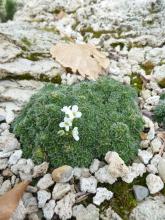
*Edit: Wait, the stems do elongate with time. Here's another photo:
http://nargs.org/smf/index.php?topic=274.msg8868;topicseen#msg8868
Lori S. (not verified)
Re: What do you see on your garden walks?
Sun, 10/30/2011 - 12:44pmWhat rabbit species do you have coming to your garden, James? Must be very small ones to get through chain link fences, unless maybe the styles of mesh are much bigger there than what is used here? (N. B. It would be really helpful if you could add your general location to your signature or to your profile, so that readers can see how closely their situations relate to yours in terms of geographics, climates, zones, etc.. :))
Here, the rabbits one sees most often in the city are whitetail jackrabbits - big, long-legged, long-eared critters of the open plains that are not much tied to cover. (I suppose people who live on the edges of the ravines may have the smaller, cuter snowshoe hares coming into their yards, but I don't know if that is so.)
I don't have any real complaints with their feeding... so many plants for them to choose from in the yard and elsewhere that their impact is small. Well, okay, I admit I sometimes get mildly irritated at their nibbling my drabas in the troughs out front, though this seems to be a new thing related to the recent snowy winters we've had, where snow has covered things they'd probably otherwise be eating. They also seem to have found my Trifolium rubens irresistible this spring, and munched it to the ground, but it recovered. Oh well, overall, very minor damage and I don't begrudge them their choice of food. :)
Anonymous (not verified)
Gardening With Rabbits
Sun, 10/30/2011 - 2:43pm"What rabbit species do you have coming to your garden, James?"
Cottontail Rabbits - Sylvilagus floridanus
"Must be very small ones to get through chain link fences, unless maybe the styles of mesh are much bigger there than what is used here? ... Here, the rabbits one sees most often in the city are whitetail jackrabbits - big, long-legged, long-eared critters of the open plains that are not much tied to cover. (I suppose people who live on the edges of the ravines may have the smaller, cuter snowshoe hares coming into their yards, but I don't know if that is so.)"
Actually, neither jackrabbits nor snowshoe hares are rabbits.
Sincerely,
James
Lori S. (not verified)
Re: What do you see on your garden walks?
Sun, 10/30/2011 - 2:52pmYeah, right, they're hares.
Tim Ingram (not verified)
Re: What do you see on your garden walks?
Sun, 10/30/2011 - 3:30pmThe plant of Arabis androsacea I have looks closer to Lori's than Panayoti's, though I have yet to see it in flower. I am not sure we are too successful with western American alpines here, and there is certainly not a strong tradition of growing such plants in the garden; most growers in the AGS concentrate more on exhibiting plants, and in a curious way I think that this can tend to restrict the range of plants grown. My dream would probably be the old alpine house at Wisley from the 1980's which was beautifully planted with dryland alpines by Ralph Haywood (who used to work with Joe Elliott at his famous Broadwell nursery). How much has alpine gardening taken off around Denver? There seems to be a much better link between Botanic Gardens and horticulture in the States than in the UK - ie: the sense of partnership in growing and learning about plants.
Richard T. Rodich
Re: What do you see on your garden walks?
Sun, 10/30/2011 - 5:13pmHere, Gleditsia triacanthos 'Sunburst' (Sunburst honelocust) is only all yellow in the spring, and with fall color. As leaves mature in summer, they turn green, while new leaves are still yellow.
Tim, what is that pine with the long weeping needles in your second to last pic, (and also the pine behind it). Is it a P. wallichiana?
I am also befuddled by James's chain link fence comment. We have cottontails here, and they are kept out by what we call chain link.
Lori S. (not verified)
Re: What do you see on your garden walks?
Sun, 10/30/2011 - 7:07pmThe absolute cutest rabbits I've ever seen were the "Texas fightin' bunnies" (or so we referred to them) that we saw in spring in Rio Grande Village campground in Big Bend N.P. years ago; I suppose it was mating or play or territorial behavior, as a pair of tiny bunnies (relative to the jackrabbits I'm used to, anyway) would rear up and box each other for a bit... and then, just as suddenly, lose interest and start munching on something instead! Hardly fights to the death (thank heavens)! ;) From range maps, it would seem they were either desert (Sylvilagus audubonii) or eastern cottontails.... danged charming to watch, whatever they were up to!
Fall colour on Arabis procurrens 'Variegata':
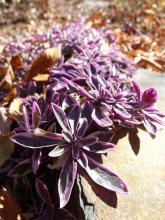
Autumn crocus, looks like I'm down to one this year:
Richard T. Rodich
Re: What do you see on your garden walks?
Sun, 10/30/2011 - 9:16pmThe veining on those crocus are quite striking, and they seem to have a glow in the centers, too!
Anonymous (not verified)
Gardening With Rabbits
Mon, 10/31/2011 - 3:19am"I suppose it was mating or play or territorial behavior, as a pair of tiny bunnies (relative to the jackrabbits I'm used to, anyway) would rear up and box each other for a bit..."
I have seen such displays in Illinois. It is a rare year that we get such a treat. The rabbit population fluctuates wildly. When the population of rabbits is high they often behave in this manner. They will be sitting in a group. One rabbit will will charge another rabbit. The rabbit on the receiving end will often jump into the air so the charging rabbit ends up running underneath it. It is fun to watch these bunny games.
The cottontail rabbits in my area are an edge species. This is the reason they love backyards so much. In large open grasslands cottontail rabbits are almost never seen. If you do see a rabbit it is almost invariably near a brush pile or some other form of cover. In wild areas they tend to stay near the woodland edge where thickets give them cover and a winter food source.
It is interesting to me that certain species are so selective about habitat type. For example, grassland birds will not use an area unless it is 100's and sometimes 1000's of treeless acres. The structure of vegetation is very important for certain species. It is a rare prairie that is over 20 acres. You can see how this posses a big problem for grassland birds. Luckily, structure is more important to birds than quality vegetation. They have been able to hang on in hayfields and rotationally grazed pastures. Given the rarity of areas large enough to support grassland birds, much effort go toward creating the large treeless areas they require.
Sincerely,
James
Tim Ingram (not verified)
Re: What do you see on your garden walks?
Mon, 10/31/2011 - 10:47amRick - both pines were grown from seed. The first one is the Mexican Pinus patula (a poor specimen that I had left over from the nursery with a very twisted stem, but it has made a nice plant). The lower one is P. ponderosa which is growing at quite an alarming rate! I don't grow wallichiana but it is a beautiful specimen in a friend's garden - one of the best pines I think.
Richard T. Rodich
Re: What do you see on your garden walks?
Mon, 10/31/2011 - 11:18amYes, had I thought of it, patula would have been my first guess. Also had wondered if the second one might be P. pondersosa. Mine grows 1.5-2ft (46-60cm) per year.
Fermi de Sousa
Re: What do you see on your garden walks?
Tue, 11/01/2011 - 12:34amWell, Panayoti and Lori, I'll be looking out for that one on the Seedex list when it arrives!
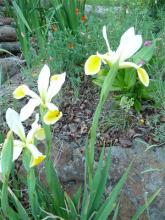
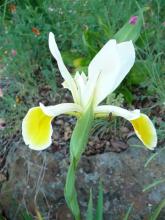
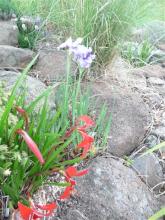
This spuria iris arrived as a volunteer seedling in a bed of summer dormant bulbs - how it got there I don't know, though it does grow in our neighbour's frontyard, about 200 yds away! It appears to be Iris orientalis
This white siberian iris has done well,
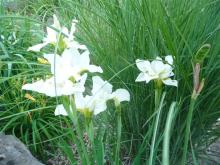
While a mauve-blue one is less floriferous this year, though the Sprekelia formosissima next to it has been brilliant!
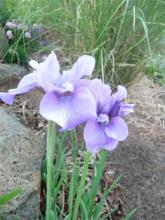
In the "bog garden" a couple of Louisiana iris have opened,
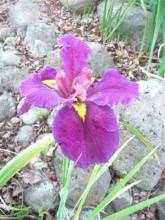
possibly "John's Lucifer'
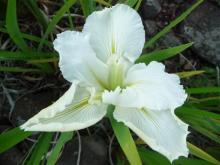
possibly "Koorawatha"
cheers
fermi
Anne Spiegel
Re: What do you see on your garden walks?
Wed, 11/02/2011 - 2:35pmOctober 30th in the garden.
Anne Spiegel
Re: What do you see on your garden walks?
Wed, 11/02/2011 - 2:40pmThanks to some of the leaves still on the trees, the damage was extensive. Magnolia soulangeana, not a relaible bloomer every yeare due to frequent late frosts, but very beautiful when it did bloom.
Tim Ingram (not verified)
Re: What do you see on your garden walks?
Thu, 11/03/2011 - 1:43amAnne - really sad to see such damage to the magnolia. It is the most extraordinary tree in flower. I remember a large tree in Canterbury near us which was savagely pruned one year with no thought for its shape. Now though after some years it has grown out and made quite a shapely specimen again. (Not that such pruning is to be recommended!!). I hope we are not in for another severe (relatively) winter here, as I am still clearing up after the last one.
Toole (not verified)
Re: What do you see on your garden walks?
Fri, 11/04/2011 - 2:59amOne of the 'Death Camas' .....Zigadenus fremontii currently is at it's peak.
Cheers Dave.
Anonymous (not verified)
Re: What do you see on your garden walks?
Fri, 11/04/2011 - 8:09pmThese will probably be my last views of 'Fall' in my garden.
I love the color in my Fothergilla major 'blue shadow.'
The Spireas have nice color from Spring to Fall. The ones that were abused at the home improvement store have the deepest color. This is the opposite of what I would expect.
The 'Front Path Garden' has Coreopsis auriculata, Geranium sanguineum, and Armeria maritima. The Geranium sanguineum is particularly beautiful because some of the leaves are red while others are green. This gives the plant a Christmas look.
I included the Alberta Spruce surrounded by Snapdragons because I like the echo of shape between the pavers and the Spruce. I cannot take credit for this design. It was here when I purchased my home. I only planted the Snapdragons.
The Red Maples are one of my favorite trees for Fall color.
The last picture is of Pineapple Sage. I planted this for my hummingbirds. It did not begin blooming until after all the hummingbirds had migrated South. Since it did not accomplish its purpose, I will not be planting Pineapple Sage in the future.
James
Trond Hoy
Re: What do you see on your garden walks?
Sat, 11/05/2011 - 3:43pmA sad sight of damaged trees and shrubs :(
The Magnolia soulangiana I grow at our summerhouse lost the top of its main stem and some limbs due to heavy late snow a couple of years ago but now it is completely regrown. I removed the broken limbs and doctored the wounds with a sharp knife but did nothing else.
Now snow or frost here, in fact it is extraordinary mild for the season. The last days have reached 15C in daytime and not less than 11C at night. However, two nights with 0-2C a couple of weeks ago transformed the colours of the leaves and heavy rain later defoliated almost all the deciduous trees and shrubs so not much fall colour to show. In stead some plants still flower and Viburnum farrerii is in full bloom with fragrant flowers.
Lori S. (not verified)
Re: What do you see on your garden walks?
Sat, 11/05/2011 - 5:31pmWow, unimaginable, Trond!
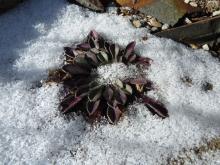
I am scraping the bottom of the barrel here... and winter usually comes much sooner than this.
Here is a bit of fall colour on Townsendia parryi:
The sun is very low in the sky now but if it shines on these autumn crocus, they might manage to open again:
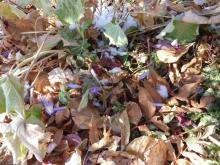
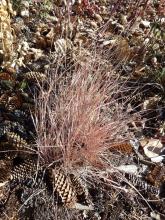
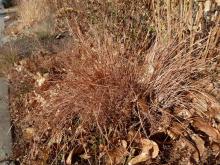
I always enjoy the pinky tones of little bluestem, Schizachyrium scoparium. I've lost the name of this other grass, but it's looking nice now.
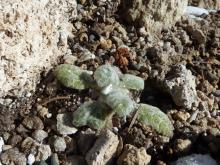
This Stachys inflata seedling looks like it's put on a wool sweater for the cold weather:
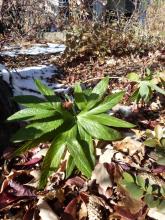
Helleborus caucasicus is still defiantly green and looking incongruous against all the yellows and browns:
Anonymous (not verified)
Re: What do you see on your garden walks?
Sun, 11/06/2011 - 5:36pmThe 'Front Path Garden' has Coreopsis auriculata, Geranium sanguineum, and Armeria maritima. The Geranium sanguineum is particularly beautiful because some of the leaves are red while others are green. This gives the plant a Christmas look.
- I just had to post a closer picture of Geranium sanguineum to show you what I was talking about above.
Amy Olmsted
Re: What do you see on your garden walks?
Sun, 11/06/2011 - 6:10pmWhile cleaning up the gardens today I took a few pics of what was still or reblooming!
Cyclamen hederifolium
Primula auricula
Spiranthes odorata
Tricyrtis sp.
Primula auricula
(Edited to add species names to allow search capability. :) )
Lori S. (not verified)
Re: What do you see on your garden walks?
Sun, 11/06/2011 - 6:17pmVery nice, James. Geranium sanguineum is probably my favourite geranium species for its very long bloom and terrific fall colour.
Amy, you have a lot going on there. I wonder if anyone grows Spiranthes odorata here? Seems like it should not be such a stretch. It's very surprising to me to see an orchid still in bloom!
Anonymous (not verified)
Re: What do you see on your garden walks?
Sun, 11/06/2011 - 8:34pmAmy, What is the species shown in the upper right corner of the photo whose subject is Primula auricula?
Anonymous (not verified)
Re: What do you see on your garden walks?
Sun, 11/06/2011 - 9:33pmLori, I think Spiranthes odorata is actually rather a stretch for Amy. In her more interior Northern climate it does not appear to be very strong. I think Goodyeara would be much better for Amy's garden.
In contrast, I think Spiranthes odorata would be a greenhouse plant in Alberta.
You have two native Ladies'-tress Orchids. They are Spiranthes lacera var. lacera and Spiranthes romanzoffiana.
The range of Spiranthes lacera var. lacera just makes it into Northeastern Alberta. It is found in or near Jack Pine Forests. This means it likes nutrient poor sandy, gravelly, or rocky areas that experience periodic fire. However, it may also occur in rock outcrops where enough fuel is never present to carry fire.
Spiranthes romanzoffiana lives in wetlands.
It likely be best to observe these plants in the wild, rather than attempting cultivation. Spiranthes lacera var. lacera is listed as being rare in your province.
Amy Olmsted
Re: What do you see on your garden walks?
Mon, 11/07/2011 - 4:41amJames the other plant with the P. auricula is another unamed and unflowered auricula from seed. The Spiranthes are actually quite hardy here in the garden coming through pretty tough winters.
Anonymous (not verified)
Re: What do you see on your garden walks?
Mon, 11/07/2011 - 8:22amAmy, That slightly out of focus unflowered Primula auricula had me imagining one of my Mexican Pinguliculas. Of course, Mexican Pinguliculas are a house plant in my climate.
I am surprised you are finding Spiranthes odorata to be hardy in Vermont. The USDA lists the range of Spiranthes odorata as only extending as far North as New Jersey. Is it possible the plant you are growing is actually Spiranthes cernua? Here is the key for these two species from the flora of North America.
26 (25) Plants to 50 cm; leaves comparatively slender, ascending to spreading (flaccidly so because of membranaceous blades with thickened midrib); petioles of basal leaves less than 6 mm wide; leaves wholly basal or lower sheaths with ascending-spreading blades; perianth usually 8–11 mm; lip membranaceous to fleshy, less than 7 mm wide. 14 Spiranthes cernua
+ Plants to 100 cm or more; leaves broad, ascending to spreading (rigidly so because of aerenchymatous thickening of blade); petioles of basal leaves 7 mm or more wide; blades spreading-recurved on proximal cauline sheaths, frequently also on distal, leaves then extending to inflorescence; perianth (4–)10–18 mm (shorter in young or depauperate plants); lip fleshy, (4–)7–9.5 mm. 13 Spiranthes odorata
http://www.efloras.org/florataxon.aspx?flora_id=1&taxon_id=131021
Mark McDonough
Re: What do you see on your garden walks?
Mon, 11/07/2011 - 5:20pmLots of flora found in southeastern USA is perfectly hardy in northern New England; haven't met a southeastern Trillium species that isn't hardy and happy here in Massachusetts, like deep south Trillium decumbens or Trillium lancifolium:
http://plants.usda.gov/java/nameSearch?keywordquery=Trillium+decumbens&m...
http://plants.usda.gov/java/profile?symbol=TRLA15
Even less of a climatic stretch comparing mid-Atlantic States to places like Massachussets, Vermont, and New Hampshire.
Amy Olmsted
Re: What do you see on your garden walks?
Mon, 11/07/2011 - 5:56pmNot sure if this clears things up...but I just peeked at the label again and it says Spiranthes cernua var. odorata. So we're both right? ;)
Pages