Rick, a most impressive Vernonia! Makes my V. noveboracensis at a mere 8' look puny ;)
The remnants of Hurricane Irene that passed through 2 weeks ago made all the stems, which normally stand perfectly erect, bend over in weather submission and splay outwards, at least putting the flowers at closer view :D. Here's a few photos before the storm.
At an impromptu garden nursery visit I came across one I've been looking for, the baby of Ironweeds, Vernonia lettermannii from Arkansas and Oklahoma. I first saw it at Garden In The Woods in Framingham, Massachusetts, an excellent natives-only garden of the New England Wildflower Society. I wondered where such a beauty has been all my life, and at just two feet tall! The nursery had two forms, one a slight bit taller and lighter green in foliage than the other (and actually listed as form #2), I bought the smaller form with darker green foliage. In the first photo, I'm holding the pot up to Amsonia hubrectii in the background, to show just how similar the foliage is, fairly unique for Vernonia to have such narrow willow-like leaves. I'm still waiting for the buds to open.
Vernonia lettermannii has been on my watch list since I first heard of it about a year ago, I think maybe from you, Mark, here on the Forum.
Very nice!
Everything looks so fresh this late in the year, Lori, and you still have so much blooming! Since my oak leaf mulch source dried up a couple years ago, I've had to resort to what I can get - mostly maple and assorted wimpy leaved trees. Really inferior stuff. I use twice the amount of leaf mulch now, and it is still gone by this time of the season. It's really hard on the perennials because I am a very reluctant waterer.
I've always had a soft spot for sedums and they give a long period of colour in our relatively dry garden. We have one small bed packed with spring bulbs and to give interest later on I have planted sedums and other small late growing perennials. Two of the best were raised by Graham Gough (Marchant's Plants), who used to work with Elizabeth Strangman at the famed Washfield Nursery near Hawkhurst in Kent; these are S. 'Purple Emperor' (a really superb plant) and the stronger coloured 'Red Cauli'. In the same bed are paler coloured selections which have crossed and self-sown to produce quite an enjoyable mix. The great plantsman and nurseryman Bob Brown has coined the name 'Stewed Rhubarb Mountain' for one of his raising, and it is one of those completely perfect names!
Also flowering now and very different are a trio of rather special plants. Fascicularia bicolor has proved very hardy over many years, even through our last winter. For most of the year it is not particularly notable but now the inner rosette leaves have coloured red and the beautiful soft-blue flowers cluster deep within. This plant is now so big to be impossible to divide. I have heard of smaller species but don't know how they compare in hardiness or how available they might be.
Hedychium 'Tara' is a remarkably exotic 'ginger' that is fully hardy with us but generally doesn't get enough summer moisture to do well. This year it has been very striking. It was introduced by Tony Schilling along with a robust form of densiflorum called 'Stephen'.
The third was a kind gift from a friend who has found it hardy in his garden, growing away strongly from the deep roots. This is Bomarea hirtella. I have tried several of these climbing 'alstroemerias' but they are usually very late to come into growth in the spring and therefore very late flowering - this one looks as though it may be more reliable. A very subtle and fascinating combination of colours!
Wow, stunning plants, Tim! The Fasicularia is so unusual!
RickR wrote:
Everything looks so fresh this late in the year, Lori, and you still have so much blooming!
Well, just due to our very compressed season, I think.
McDonough wrote:
I particularly like the white Serratula coronata! How long have you grown it? Reliably hardy?
It seems to be reliably hardy; my records claim I grew it from seed in 2008. I think, from a search I did the other day, that perhaps it is a white form of Serratula coronata var. insularis... at least that variety seems, from a record I found, to be a dwarf form, as opposed to the very large, purple-flowered plants that seem to represent the species (according to a cursory Google search, at any rate).
I'm very impressed by Vernonia! I did actually buy a couple this summer... I think the main thing might be whether our season is long enough for them to bloom.
I transplanted Aralia cordata var. sachalinensis out of the garden three years ago because it was getting too large for the space. It's new home is in the yard, at the northwest edge of the neighbor's Sugar maple canopy. Not nearly as inviting as the former environment, the plant now deals with poor, dry soil and the competition of voracious maple roots. Now in the third year, it is just over half its original height in the garden.
As you can see, the maple is dropping leaves prematurely this year, and the fallen leaf color is off. That's because the tree is losing a battle with verticillium wilt, a soil born disease common in the region. The disease is common in native Sugar maple woods here, but trees usually are able to compartmentalize the spread within the vascular system, as evidenced by the disfiguring of otherwise healthy wild trees. However this neighbor's tree, with a trunk of 1.5ft in diameter, seems to have very little resistance. Symptoms began only a month ago, and now almost the entire tree is wilted.
It took a few tries to get Chasmanthium latifolia (Northern Sea Oats) to live in the garden for more than a season. But now, volunteer seedlings seem to have good staying power.
Symphotrichum sericeum (Aster sericea) (Silky Aster) is a native prairie plant here. It has very wiry dark stems and small silvery green leaves. In the prairie, it tends to "hide" in the grasses until it flowers. This poor specimen in the garden almost seems to have no leaves due to the sudden late summer drought. With more than ample rainfall all season, plants have put on a lot of "extra" growth, and now find themselves paying dearly. Even the trees in yards that don't water (like mine) show wilting.
As if often the case, flower color does change with maturity.
Tim, I agree with Rick on Fascicularia , it is fabulously weird and wonderful. I googled it, some really good photos on the web. Looking at the blue flowers I thought to myself they look rather like Puya blooms; come to find out they're both in the family Bromeliaceae.
Rick, I got seed of Aster sericea from Panayoti several years back, and one plant managed to survive the rabbit attacks. It's in full flower now, rather leafless too... it drops most of the lower leaves on the stem. It's crowding out some other plants, it was my intention to move it to a new spot this year but that never happened. The spring growth is eye-catching with fuzzy looking growth.
In my garden, Silky aster always looses a significant number of its leaves by bloom time, but never as much as this season. In the wild here in Minnesota, it doesn't seem to have this problem, but it's still almost as much of a see-through plant as my garden plant. I never would have imagined it could crowd out anything!
Silky aster is a favorite of rabbits in the spring here, too. I've learned that it is one of the plants I must protect with a wire cage for the first 3-4 weeks.
Rick, glad you posted a photo of the emerging foliage, I spent 1/2 hr searching through my generic alphanumeric default-named images and couldn't find any, although I know I took some. In addition to rabbits eating my Asters, the last two years I have had woodchucks living under my garden shed (reminder to myself: a project - dig all around the base of my shed and install wire mesh), and these much larger beasts adore Asters, even the tall ones, and pull them down and basically decimate them to mere stubs. This year my A. sericea was miraculously spared from their munching. I spread ground pepper as a deterrent although it gets expensive and can wash away and lose effectness with rain.
Ptilostemon afer, from a late seeding this year. Acer miyabei (Miyabe maple) root sprouts.
Syneilesis intermedia, in a pot and shutting down a bit early, presumably because of the frequent wilting I imposed on it through my neglectful watering. In the background is Carex nigra (Black sedge). This is only my second year for S. intermedia, but foliage seems to be more substantive than S. aconitifolia. Eryngium amethystina has been blooming for quite a while, and still looks good.
Still a ways to go for Allium thunbergii 'Ozawas'. Not to many Euonymus nanus var. turkestanicus flower buds escaped the bunnies last winter, so I don't have too many showy capsules this season.
The discussion of Asters and spring growth reminded me to post my favourite fall edimental, Aster scaber from Korea. At least, I assume that the identification is correct as the seed came from Berkutenko's seed list in 2007. Two pictures of the plant in flower and one of the spring leaves ready for the pot. This is one of the originally wild foraged species in Korea that there is such a demand for in the cities that it is now cultivated for market. Just imagine a field of this - a field of vegetables doesn't get better... Tasty too...
I stir-fried those and they had a mild taste and the stems were also tender.
In Korea, I understand most wild vegetables are more or less treated the same. The vegetables are stir fried in sesame oil with various seasonings such as salt, vinegar and gochujang (red pepper paste) and are served over rice. Fried egg is also often added. The dried leaves are often just soaked in water and seasoned with soy sauce and sesame oil (so that is essentially raw!).
Not to many Euonymus nanus var. turkestanicus flower buds escaped the bunnies last winter, so I don't have too many showy capsules this season.
Rick, being a maple fan myself, your photo of Acer miyabei really caught my attention, beautiful leaf form. You mention that these are the leaves of root sprouts, do the mature leaves look very different?
The Euonymus nanus v. turkestanicus is one I used to grow, it was grafted on top of a standard; rather silly looking as some of these artificial grafts can be, but it kept the flowers and fruits well above bunny level. Checking my photos, the last pics were in 2006, so it succumbed that winter after about 3 years in the garden. I know it is a low species, how tall does it grow for you. I dug up a few pics from 2004 & 2005. As Euonymus species go, I found the ultra-long-tubed red flowers to be much showier than the usual minute yellowish-green flowers of most species, and the fruits are certainly ornamental as in many Euonymus. I have a photo or two of the fruit pods opening up, but can't lay my hands on them now.
How tall does Euonymus nanus var. turkestanicus grow for me? Honestly, I don't know. It's been sprawling around for 10 years, but I've never had more than two season's growth with rabbit damage. It's been up to four feet, though. Yes, the flowers are more showy than most euonymus, but taking into consideration the "cute" factor, I still like E. verrucosus best. A washed out pic of it:
I mentioned the Mayabi maple pic was root sprouts because you would never see such a combination of growth unless maybe if you were looking down from above the tree. This one is the last of my Asian maples extant, because they are so susceptible to the verticillium that is natively in the ground here, coupled with the not so good clay soil. The tree's canopy (about 15ft high) was half killed last season, and finished this season. The stump (and sprouts) are slated for removal. Leaves are usually almost twice that size, but still have the same crinkly quality. But the overall density in the canopy is less compact. Of course there is always variation, and this had a nice corky bark feature similar to winged euonymus, except with six wings instead of four.
Tim, I tried Fascicularia and Bomarea in my garden but none could stand the last two cold winters :'( I'll try again ;)
Stephen, I do grow some Asters but I don't eat them ;D They are among the few plants slugs dislike!
Rik, do the Miyabe maple set seed? The leaves are very attractive!
Here are a nice clematis flowering now: Clematis x jouiniana 'Praecox', trailing to 3m.
Weeds but not the most difficult: Impatiens glandulifera. Some are white flowered and others are dark purple(?) And another species, sturdier and with branches.
Not much still in bloom here. We have been having some amazingly great weather though (30 deg C yesterday!), but much in my garden has dried up in the last while.
In the rock garden... I'm trying Scutellaria Salviaresinosa again. It didn't winter over in regular soil so I'll see if drainage was the problem (vs. overall hardiness).
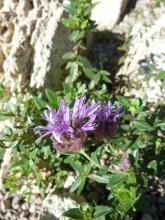
Monardella odoratissima v. odoratissima, planted this season:
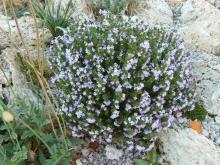
Satureja montana ssp. illyrica is still blooming nicely:
Well, thanks - I guess I just wish that summer would last, though I certainly can't complain with the weather. There has not even been frost on the ground yet in our yard - only on the roofs a couple of mornings. (We've often had the first snow before this calendar date.)
Lespedeza bicolor (the one that didn't get eaten by rabbits last winter) is super floriferous this year. Also in the first pic: Thujopsis dolabrata var. hondai(hiding on the left), Picea omorika 'Treblitzch', needles of Pinus ponderosa.
Corydalis ochroleuca still pumps out the blooms, and a close relative will be ready to shoot up its vine next season.
Impatiens namchabarwensis is shy this year. In fact only a few sprouted this season. Sedum cauticola 'Lidakense' is a most vibrant color.
It's been almost two weeks since Colchicum agrppinum began blooming, and of course they are still glorious. Five days ago, I plucked two flowers off for a better photo composition, and just set them on a nearby rock and forgot about them. Here they are three and five days later! They seem like such a dainty flower. Who would have thought they would have such staying power without water?
Warm, sunny weather the last two days has brought out several kind of insects which I haven't seen for a while. Bees, flies and hoverflies seek nectar and pollen on the green but rich flowers of the Hedera helix.
Trond, did you get a new camera? The clarity of your photos is tremendous! What plant is shown in these shots?
Thank you Mark. No new camera but a sunny and warm day 8) The plant is Hedera hibernicahelix, Irish or Atlantic Common Ivy. It is a dangerous plant as it grows tremendously and swamp all small neighbours and climb every vantage point and tree it can find. However, it blooms in fall and the flowers are much appreciated by both humans and insects and visited by many kind of the last category. It has a pleasent but faint smell too.
Here's a part of the flowering shrub. (The flower-bearing stems are very different from the trailing and climbing ones.)
Hedera helix is such an interesting plant to me because I knew it for so long as only a houseplant with juvenile foliage. I knew it had an adult stage and foliage, but I hadn't realized the flowering stems were different, too.
At work yesterday, a man from central America (or was it South America?) was looking at the houseplants, and he mentioned that the common Heartleaf Philodendron (Philodendron scandens) was thought of as "evil" in his country. This, because of how the vine often makes abrupt turns at the nodes, causing it to tangle and look unruly.
My other Podophyllums are still green, too (well actually turning autumn yellow now). But this one is in a very dry part of the garden, and went dormant in July. While I have had ample rain all summer, I received just over one tenth of an inch in all of September, when we normally get 3 inches of rain. About a week before the pic was taken, I watered heavily for the first time. I guess that was a mistake...
My other Podophyllums are still green, too (well actually turning autumn yellow now). But this one is in a very dry part of the garden, and went dormant in July. While I have had ample rain all summer, I received just over one tenth of an inch in all of September, when we normally get 3 inches of rain. About a week before the pic was taken, I watered heavily for the first time. I guess that was a mistake...
I hope it will survive! Normally 3 inches of rain in September? It is about what I get every other day nowadays :o
I found another plant in flower today: Impatiens omeiana. It is always blooming very late.
So much of interest still happening even in the most northerly areas! And it's spring in the southern hemisphere - how wonderful! We're going to be counting on you to brighten our winter doldrums, Fermi! :)
Well, Lori, there'll be plenty for awhile, but we hit our "doldrums" in summer when it's too hot for much to flower! ;D Here are some Pacific Coast Iris - the first lot are seedlings raised from seed from Diane W. in Canada!
The next two show the variation in colour in some seedlings of PCI "Big Money"
Clematis marmorariais gorgeous! :o I'm glad your are brightening our days too with spring flowers, Jandals! Drizzling rain here the last couple of days really brings a feeling of finality to the season.
Those Pacific coast iris are sure beautiful and varied. They say the Pacific coast native iris species are still speciating. Would be nice if I could grow them here. ----------------------------------- A nondescript pic of the garden today. If you look hard you can see what is left of the Colchicum agrippinum that began bloom about 14 Sept.
I am moving bulbs around in the gardens, and I thought this was interesting. Look at how (where) the roots emerge from the bulb!
Seems the fall has arrived at your place too, Rick! The Hyacinthoides bulb has to have a (short) stem inside where the roots grow from. Have you ever made a longitudinal cut through the bulb?
Thanks Lori . If I could steal your drizzle I would . Even in september I could walk anywhere on the property in my jandals and not get stuck . Spring was the same last year but as soon as everyone went on their summer holidays at Christmas it started raining .
Rick - The Clematis marmoraria do sucker around and they can be propagated from these . One of my plants has about 100 flowerbuds on it . If I can get a good picture when it flowers I will post it
The Clematis marmoraria do sucker around and they can be propagated from these . One of my plants has about 100 flowerbuds on it . If I can get a good picture when it flowers I will post it.
Now THAT is one-upmanship!!!! I, for one, can't wait to see that Steve!
No lovely irises, no pretty lewisias, no gorgeous clematis but snow. Saturday was sunny as the Sun's day should be. However we are struck by an untimely snowstorm here in the mountains. It is a bit early in the season even here in 1000m ASL.
A few plants try to keep up their and our spirit. A goldenrod (Solidago virgaurea) and a dandelion (Taraxacum sp), especially the last one is either very late or very early(!). Also a knapweed (Centaurea scabiosa) and a Jacob's ladder (Polemonium caeruleum) strive to show their flowers.
We are having quite an Indian summer in southern England with unseasonably warm days reaching nearly 30°C Good for extending the flowering of some plants. One of the loveliest autumn shrubs is Ceratostigma willmottianum, which is reliably hardy with us, though sometimes cut to the ground in winter. It really is a gentian-blue; quite exquisite. Crocusspeciosus is making a good display for the first time in several years owing to the absence of any rabbits! And Cyclamenhederifolium, one of the finest and longest lived plants in the garden is flowering all over. I have grown this from many seed sources and have a great variety of leaf forms. These here are in a bed by the greenhouse that has recently been cleared and we are replanting with more choice woodland species such as Mukdenia rossii, Patrinia triloba, Cheloniopsis moschata and the yellow catmint Nepeta govaniana. Should be good to see what it looks like next year. This is one of the few places in the garden that stays quite moist due to run off from the greenhouse.
The Hyacinthoides bulb has to have a (short) stem inside where the roots grow from. Have you ever made a longitudinal cut through the bulb?
Your wish is my command...at least sometimes ;D
It seems roots emerge from a particular part of the stem within the bulb (and not the basal plate), regardless of where they emerge on the bulb surface.
No lovely irises, no pretty lewisias, no gorgeous clematis but snow. Saturday was sunny as the Sun's day should be. However we are struck by an untimely snowstorm here in the mountains. It is a bit early in the season even here in 1000m ASL.
Sounds like you may have to put the flip-flops in storage , Trond . They tend to flick the snow up your back and could give you a back chill when out walking in the snow . Especially that soft powdery stuff .



Comments
Lori S. (not verified)
Re: What do you see on your garden walks?
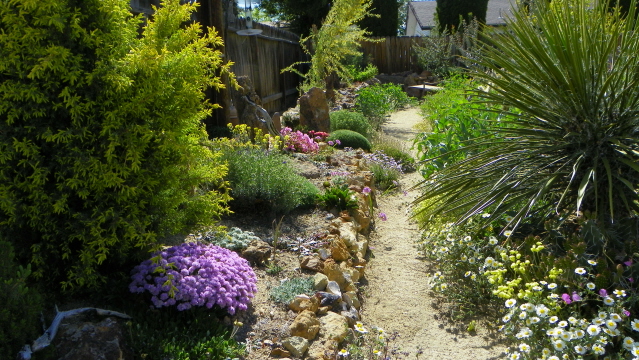
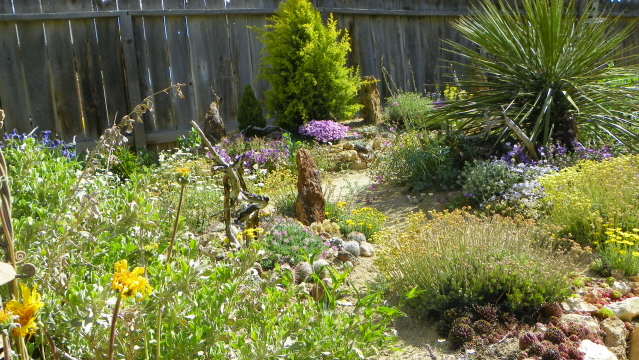
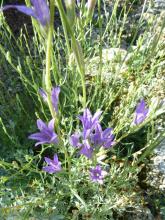
Thu, 09/08/2011 - 4:41pmCampanula stricta ssp. alidagensis has been very nice (and very long-blooming) too...
Mark McDonough
Re: What do you see on your garden walks?
Thu, 09/08/2011 - 5:44pmRick, a most impressive Vernonia! Makes my V. noveboracensis at a mere 8' look puny ;)
The remnants of Hurricane Irene that passed through 2 weeks ago made all the stems, which normally stand perfectly erect, bend over in weather submission and splay outwards, at least putting the flowers at closer view :D. Here's a few photos before the storm.
At an impromptu garden nursery visit I came across one I've been looking for, the baby of Ironweeds, Vernonia lettermannii from Arkansas and Oklahoma. I first saw it at Garden In The Woods in Framingham, Massachusetts, an excellent natives-only garden of the New England Wildflower Society. I wondered where such a beauty has been all my life, and at just two feet tall! The nursery had two forms, one a slight bit taller and lighter green in foliage than the other (and actually listed as form #2), I bought the smaller form with darker green foliage. In the first photo, I'm holding the pot up to Amsonia hubrectii in the background, to show just how similar the foliage is, fairly unique for Vernonia to have such narrow willow-like leaves. I'm still waiting for the buds to open.
Mark McDonough
Re: What do you see on your garden walks?
Thu, 09/08/2011 - 5:46pmLori, many tasty treats for the eye as usual, but I particularly like the white Serratula coronata! How long have you grown it? Reliably hardy?
Richard T. Rodich
Re: What do you see on your garden walks?
Thu, 09/08/2011 - 8:02pmVernonia lettermannii has been on my watch list since I first heard of it about a year ago, I think maybe from you, Mark, here on the Forum.
Very nice!
Everything looks so fresh this late in the year, Lori, and you still have so much blooming! Since my oak leaf mulch source dried up a couple years ago, I've had to resort to what I can get - mostly maple and assorted wimpy leaved trees. Really inferior stuff. I use twice the amount of leaf mulch now, and it is still gone by this time of the season. It's really hard on the perennials because I am a very reluctant waterer.
Tim Ingram (not verified)
Re: What do you see on your garden walks?
Fri, 09/09/2011 - 6:46amI've always had a soft spot for sedums and they give a long period of colour in our relatively dry garden. We have one small bed packed with spring bulbs and to give interest later on I have planted sedums and other small late growing perennials. Two of the best were raised by Graham Gough (Marchant's Plants), who used to work with Elizabeth Strangman at the famed Washfield Nursery near Hawkhurst in Kent; these are S. 'Purple Emperor' (a really superb plant) and the stronger coloured 'Red Cauli'. In the same bed are paler coloured selections which have crossed and self-sown to produce quite an enjoyable mix. The great plantsman and nurseryman Bob Brown has coined the name 'Stewed Rhubarb Mountain' for one of his raising, and it is one of those completely perfect names!
Tim Ingram (not verified)
Re: What do you see on your garden walks?
Fri, 09/09/2011 - 7:00amAlso flowering now and very different are a trio of rather special plants. Fascicularia bicolor has proved very hardy over many years, even through our last winter. For most of the year it is not particularly notable but now the inner rosette leaves have coloured red and the beautiful soft-blue flowers cluster deep within. This plant is now so big to be impossible to divide. I have heard of smaller species but don't know how they compare in hardiness or how available they might be.
Hedychium 'Tara' is a remarkably exotic 'ginger' that is fully hardy with us but generally doesn't get enough summer moisture to do well. This year it has been very striking. It was introduced by Tony Schilling along with a robust form of densiflorum called 'Stephen'.
The third was a kind gift from a friend who has found it hardy in his garden, growing away strongly from the deep roots. This is Bomarea hirtella. I have tried several of these climbing 'alstroemerias' but they are usually very late to come into growth in the spring and therefore very late flowering - this one looks as though it may be more reliable. A very subtle and fascinating combination of colours!
Lori S. (not verified)
Re: What do you see on your garden walks?
Fri, 09/09/2011 - 8:10pmWow, stunning plants, Tim! The Fasicularia is so unusual!
Well, just due to our very compressed season, I think.
It seems to be reliably hardy; my records claim I grew it from seed in 2008. I think, from a search I did the other day, that perhaps it is a white form of Serratula coronata var. insularis... at least that variety seems, from a record I found, to be a dwarf form, as opposed to the very large, purple-flowered plants that seem to represent the species (according to a cursory Google search, at any rate).
I'm very impressed by Vernonia! I did actually buy a couple this summer... I think the main thing might be whether our season is long enough for them to bloom.
Richard T. Rodich
Re: What do you see on your garden walks?
Wed, 09/21/2011 - 8:52pmI transplanted Aralia cordata var. sachalinensis out of the garden three years ago because it was getting too large for the space. It's new home is in the yard, at the northwest edge of the neighbor's Sugar maple canopy. Not nearly as inviting as the former environment, the plant now deals with poor, dry soil and the competition of voracious maple roots. Now in the third year, it is just over half its original height in the garden.
As you can see, the maple is dropping leaves prematurely this year, and the fallen leaf color is off. That's because the tree is losing a battle with verticillium wilt, a soil born disease common in the region. The disease is common in native Sugar maple woods here, but trees usually are able to compartmentalize the spread within the vascular system, as evidenced by the disfiguring of otherwise healthy wild trees. However this neighbor's tree, with a trunk of 1.5ft in diameter, seems to have very little resistance. Symptoms began only a month ago, and now almost the entire tree is wilted.
Richard T. Rodich
Re: What do you see on your garden walks?
Thu, 09/22/2011 - 8:37amIt took a few tries to get Chasmanthium latifolia (Northern Sea Oats) to live in the garden for more than a season. But now, volunteer seedlings seem to have good staying power.
Symphotrichum sericeum (Aster sericea) (Silky Aster) is a native prairie plant here. It has very wiry dark stems and small silvery green leaves. In the prairie, it tends to "hide" in the grasses until it flowers. This poor specimen in the garden almost seems to have no leaves due to the sudden late summer drought. With more than ample rainfall all season, plants have put on a lot of "extra" growth, and now find themselves paying dearly. Even the trees in yards that don't water (like mine) show wilting.
As if often the case, flower color does change with maturity.
Mark McDonough
Re: What do you see on your garden walks?
Thu, 09/22/2011 - 5:30pmTim, I agree with Rick on Fascicularia , it is fabulously weird and wonderful. I googled it, some really good photos on the web. Looking at the blue flowers I thought to myself they look rather like Puya blooms; come to find out they're both in the family Bromeliaceae.
Rick, I got seed of Aster sericea from Panayoti several years back, and one plant managed to survive the rabbit attacks. It's in full flower now, rather leafless too... it drops most of the lower leaves on the stem. It's crowding out some other plants, it was my intention to move it to a new spot this year but that never happened. The spring growth is eye-catching with fuzzy looking growth.
Richard T. Rodich
Re: What do you see on your garden walks?
Thu, 09/22/2011 - 7:00pmIn my garden, Silky aster always looses a significant number of its leaves by bloom time, but never as much as this season. In the wild here in Minnesota, it doesn't seem to have this problem, but it's still almost as much of a see-through plant as my garden plant. I never would have imagined it could crowd out anything!
Silky aster is a favorite of rabbits in the spring here, too. I've learned that it is one of the plants I must protect with a wire cage for the first 3-4 weeks.
Mark McDonough
Re: What do you see on your garden walks?
Thu, 09/22/2011 - 7:10pmRick, glad you posted a photo of the emerging foliage, I spent 1/2 hr searching through my generic alphanumeric default-named images and couldn't find any, although I know I took some. In addition to rabbits eating my Asters, the last two years I have had woodchucks living under my garden shed (reminder to myself: a project - dig all around the base of my shed and install wire mesh), and these much larger beasts adore Asters, even the tall ones, and pull them down and basically decimate them to mere stubs. This year my A. sericea was miraculously spared from their munching. I spread ground pepper as a deterrent although it gets expensive and can wash away and lose effectness with rain.
Richard T. Rodich
Re: What do you see on your garden walks?
Thu, 09/22/2011 - 8:25pmSome more photos from today:
Ptilostemon afer, from a late seeding this year. Acer miyabei (Miyabe maple) root sprouts.
Syneilesis intermedia, in a pot and shutting down a bit early, presumably because of the frequent wilting I imposed on it through my neglectful watering. In the background is Carex nigra (Black sedge). This is only my second year for S. intermedia, but foliage seems to be more substantive than S. aconitifolia. Eryngium amethystina has been blooming for quite a while, and still looks good.
Still a ways to go for Allium thunbergii 'Ozawas'. Not to many Euonymus nanus var. turkestanicus flower buds escaped the bunnies last winter, so I don't have too many showy capsules this season.
Stephen Barstow
Re: What do you see on your garden walks?
Fri, 09/23/2011 - 12:17amThe discussion of Asters and spring growth reminded me to post my favourite fall edimental, Aster scaber from Korea. At least, I assume that the identification is correct as the seed came from Berkutenko's seed list in 2007. Two pictures of the plant in flower and one of the spring leaves ready for the pot. This is one of the originally wild foraged species in Korea that there is such a demand for in the cities that it is now cultivated for market. Just imagine a field of this - a field of vegetables doesn't get better... Tasty too...
Richard T. Rodich
Re: What do you see on your garden walks?
Fri, 09/23/2011 - 8:05amIt looks as though you collected some of the young stems, too. Are they tender to eat also? And the aster is cooked?
Stephen Barstow
Re: What do you see on your garden walks?
Fri, 09/23/2011 - 8:48amI stir-fried those and they had a mild taste and the stems were also tender.
In Korea, I understand most wild vegetables are more or less treated the same. The vegetables are stir fried in sesame oil with various seasonings such as salt, vinegar and gochujang (red pepper paste) and are served over rice. Fried egg is also often added. The dried leaves are often just soaked in water and seasoned with soy sauce and sesame oil (so that is essentially raw!).
Stephen Barstow
Re: What do you see on your garden walks?
Fri, 09/23/2011 - 8:50amI'm also looking for two others, both used in the same way: Aster glehni and A. yomena (syn. Kalimeris yomena)..
Mark McDonough
Re: What do you see on your garden walks?
Sat, 09/24/2011 - 5:11pmRick, being a maple fan myself, your photo of Acer miyabei really caught my attention, beautiful leaf form. You mention that these are the leaves of root sprouts, do the mature leaves look very different?
The Euonymus nanus v. turkestanicus is one I used to grow, it was grafted on top of a standard; rather silly looking as some of these artificial grafts can be, but it kept the flowers and fruits well above bunny level. Checking my photos, the last pics were in 2006, so it succumbed that winter after about 3 years in the garden. I know it is a low species, how tall does it grow for you. I dug up a few pics from 2004 & 2005. As Euonymus species go, I found the ultra-long-tubed red flowers to be much showier than the usual minute yellowish-green flowers of most species, and the fruits are certainly ornamental as in many Euonymus. I have a photo or two of the fruit pods opening up, but can't lay my hands on them now.
Richard T. Rodich
Re: What do you see on your garden walks?
Sat, 09/24/2011 - 9:30pmHow tall does Euonymus nanus var. turkestanicus grow for me? Honestly, I don't know. It's been sprawling around for 10 years, but I've never had more than two season's growth with rabbit damage. It's been up to four feet, though. Yes, the flowers are more showy than most euonymus, but taking into consideration the "cute" factor, I still like E. verrucosus best.
A washed out pic of it:
I mentioned the Mayabi maple pic was root sprouts because you would never see such a combination of growth unless maybe if you were looking down from above the tree. This one is the last of my Asian maples extant, because they are so susceptible to the verticillium that is natively in the ground here, coupled with the not so good clay soil. The tree's canopy (about 15ft high) was half killed last season, and finished this season. The stump (and sprouts) are slated for removal. Leaves are usually almost twice that size, but still have the same crinkly quality. But the overall density in the canopy is less compact. Of course there is always variation, and this had a nice corky bark feature similar to winged euonymus, except with six wings instead of four.
Trond Hoy
Re: What do you see on your garden walks?
Sun, 09/25/2011 - 11:29amTim, I tried Fascicularia and Bomarea in my garden but none could stand the last two cold winters :'( I'll try again ;)
Stephen, I do grow some Asters but I don't eat them ;D They are among the few plants slugs dislike!
Rik, do the Miyabe maple set seed? The leaves are very attractive!
Here are a nice clematis flowering now: Clematis x jouiniana 'Praecox', trailing to 3m.
Weeds but not the most difficult: Impatiens glandulifera. Some are white flowered and others are dark purple(?) And another species, sturdier and with branches.
Lori S. (not verified)
Re: What do you see on your garden walks?
Sun, 09/25/2011 - 12:02pmNot much still in bloom here. We have been having some amazingly great weather though (30 deg C yesterday!), but much in my garden has dried up in the last while.
In the rock garden...
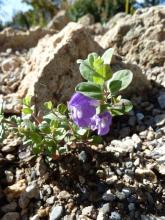
I'm trying Scutellaria
Salviaresinosa again. It didn't winter over in regular soil so I'll see if drainage was the problem (vs. overall hardiness).Monardella odoratissima v. odoratissima, planted this season:
Satureja montana ssp. illyrica is still blooming nicely:
Elsewhere:
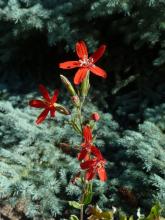
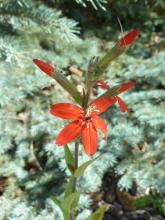
Silene regia:
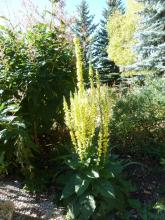
A late Verbascum nigrum:
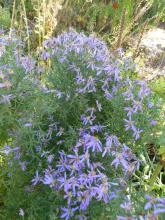
Aster sedifolius:
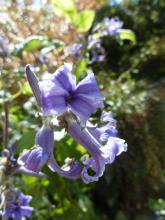
Clematis stans:
Richard T. Rodich
Re: What do you see on your garden walks?
Sun, 09/25/2011 - 3:52pmI'd hardly call that "not much", Lori... ;D
Amy Olmsted
Re: What do you see on your garden walks?
Sun, 09/25/2011 - 4:07pmI agree! :) What a pretty salvia...how large is it? The flower looks big but it's hard to tell.
Lori S. (not verified)
Re: What do you see on your garden walks?
Sun, 09/25/2011 - 6:25pmWell, thanks - I guess I just wish that summer would last, though I certainly can't complain with the weather. There has not even been frost on the ground yet in our yard - only on the roofs a couple of mornings. (We've often had the first snow before this calendar date.)
Oops, sorry. I wrote "Salvia" when I should have written Scutellaria resinosa; I've corrected it in the photo post. It looks like the consensus is that it should get to ~8-10 inches, and the flower is not large, only about 1cm but quite showy.
Here's some info on it:
http://www.highcountrygardens.com/catalog/product/88540/
http://www.highplainsgardening.com/?q=plants/scutellaria-resinosa-syn-s-...
Richard T. Rodich
Re: What do you see on your garden walks?
Tue, 09/27/2011 - 10:51pmLespedeza bicolor (the one that didn't get eaten by rabbits last winter) is super floriferous this year. Also in the first pic: Thujopsis dolabrata var. hondai(hiding on the left), Picea omorika 'Treblitzch', needles of Pinus ponderosa.
Corydalis ochroleuca still pumps out the blooms, and a close relative will be ready to shoot up its vine next season.
Impatiens namchabarwensis is shy this year. In fact only a few sprouted this season. Sedum cauticola 'Lidakense' is a most vibrant color.
It's been almost two weeks since Colchicum agrppinum began blooming, and of course they are still glorious. Five days ago, I plucked two flowers off for a better photo composition, and just set them on a nearby rock and forgot about them. Here they are three and five days later! They seem like such a dainty flower. Who would have thought they would have such staying power without water?
Lori S. (not verified)
Re: What do you see on your garden walks?
Wed, 09/28/2011 - 6:30pmWow, very colourful! Looks like there is still quite a bit going on there, Rick.
Trond Hoy
Re: What do you see on your garden walks?
Thu, 09/29/2011 - 12:37pmRick, here the Colchium flowers hadn't lasted a day - slug-bait >:(
Trond Hoy
Re: What do you see on your garden walks?
Fri, 09/30/2011 - 10:47amWarm, sunny weather the last two days has brought out several kind of insects which I haven't seen for a while. Bees, flies and hoverflies seek nectar and pollen on the green but rich flowers of the Hedera helix.
Mark McDonough
Re: What do you see on your garden walks?
Fri, 09/30/2011 - 5:18pmTrond, did you get a new camera? The clarity of your photos is tremendous! What plant is shown in these shots?
Trond Hoy
Re: What do you see on your garden walks?
Sat, 10/01/2011 - 12:55amThank you Mark.
No new camera but a sunny and warm day 8)
The plant is Hedera
hibernicahelix,Irish or AtlanticCommon Ivy. It is a dangerous plant as it grows tremendously and swamp all small neighbours and climb every vantage point and tree it can find.However, it blooms in fall and the flowers are much appreciated by both humans and insects and visited by many kind of the last category. It has a pleasent but faint smell too.
Here's a part of the flowering shrub. (The flower-bearing stems are very different from the trailing and climbing ones.)
Richard T. Rodich
Re: What do you see on your garden walks?
Tue, 10/04/2011 - 8:58pmHedera helix is such an interesting plant to me because I knew it for so long as only a houseplant with juvenile foliage. I knew it had an adult stage and foliage, but I hadn't realized the flowering stems were different, too.
At work yesterday, a man from central America (or was it South America?) was looking at the houseplants, and he mentioned that the common Heartleaf Philodendron (Philodendron scandens) was thought of as "evil" in his country.
This, because of how the vine often makes abrupt turns at the nodes, causing it to tangle and look unruly.
---------------------------------
And what do I see in my garden today?
Uh Oh.......
A confused Podophyllum hexandrum.
Trond Hoy
Re: What do you see on your garden walks?
Thu, 10/06/2011 - 6:53amAll my Podophyllums are still in green leaf.
A single rose (can it be 'Chinatown'?) by the garage wall:
Richard T. Rodich
Re: What do you see on your garden walks?
Thu, 10/06/2011 - 8:23amMy other Podophyllums are still green, too (well actually turning autumn yellow now). But this one is in a very dry part of the garden, and went dormant in July. While I have had ample rain all summer, I received just over one tenth of an inch in all of September, when we normally get 3 inches of rain. About a week before the pic was taken, I watered heavily for the first time. I guess that was a mistake...
Trond Hoy
Re: What do you see on your garden walks?
Thu, 10/06/2011 - 8:45amI hope it will survive! Normally 3 inches of rain in September? It is about what I get every other day nowadays :o
I found another plant in flower today: Impatiens omeiana. It is always blooming very late.
Fermi de Sousa
Re: What do you see on your garden walks?
Thu, 10/06/2011 - 4:48pmRight now in these parts it's Iris Time - by which I mean the Pogons or Beardies! ;D
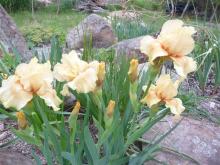
This is a MBI called "Arianna"
DBI "Buster
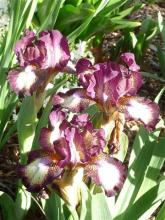
DBI "Kiwi Slices"
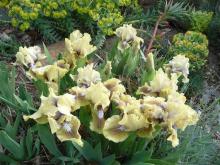
A dwarf species one which came form the SRGC Seedex as I. schachtii but it may be I. pumila ???
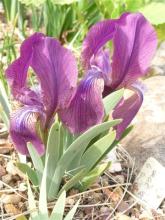
cheers
fermi
Fermi de Sousa
Re: What do you see on your garden walks?
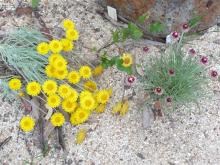
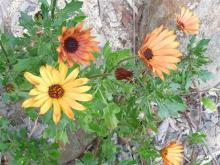
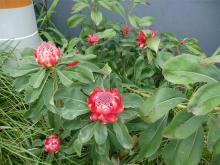
Thu, 10/06/2011 - 4:57pmOther plants in flower include:
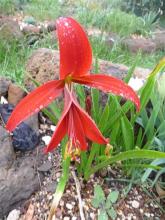
Sprekelia formosissima
A couple of our native paper daisies
And a coppery African Daisy
The next was outside where I work where the landscaper planted a New South Wales Waratah
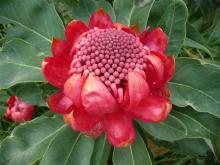
cheers
fermi
Lori S. (not verified)
Re: What do you see on your garden walks?
Thu, 10/06/2011 - 7:00pmSo much of interest still happening even in the most northerly areas!
And it's spring in the southern hemisphere - how wonderful! We're going to be counting on you to brighten our winter doldrums, Fermi! :)
Fermi de Sousa
Re: What do you see on your garden walks?
Thu, 10/06/2011 - 8:18pmWell, Lori, there'll be plenty for awhile, but we hit our "doldrums" in summer when it's too hot for much to flower! ;D
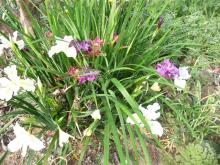
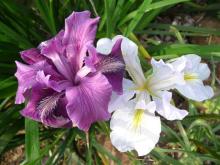
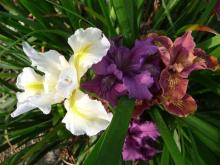
Here are some Pacific Coast Iris - the first lot are seedlings raised from seed from Diane W. in Canada!
The next two show the variation in colour in some seedlings of PCI "Big Money"
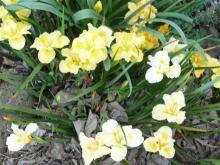
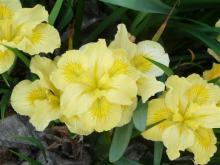
cheers
fermi
Steve Newall (not verified)
Re: What do you see on your garden walks?
Fri, 10/07/2011 - 2:34amHi . Pictures from my place today and yesterday
Clematis marmoraria
Dicentra spectabilis alba
Lewisia tweedyi alba
Paeonia lutea
Lori S. (not verified)
Re: What do you see on your garden walks?
Fri, 10/07/2011 - 7:56amClematis marmoraria is gorgeous! :o I'm glad your are brightening our days too with spring flowers, Jandals! Drizzling rain here the last couple of days really brings a feeling of finality to the season.
Richard T. Rodich
Re: What do you see on your garden walks?
Fri, 10/07/2011 - 2:43pmYessiree, that Clematis marmoraria is something to behold!
It supposedly has a suckering habit?
Richard T. Rodich
Re: What do you see on your garden walks?
Fri, 10/07/2011 - 6:35pmThose Pacific coast iris are sure beautiful and varied. They say the Pacific coast native iris species are still speciating. Would be nice if I could grow them here.
-----------------------------------
A nondescript pic of the garden today. If you look hard you can see what is left of the Colchicum agrippinum that began bloom about 14 Sept.
I am moving bulbs around in the gardens, and I thought this was interesting. Look at how (where) the roots emerge from the bulb!
Hyacinthoides sp.
Trond Hoy
Re: What do you see on your garden walks?
Fri, 10/07/2011 - 11:01pmSeems the fall has arrived at your place too, Rick!
The Hyacinthoides bulb has to have a (short) stem inside where the roots grow from. Have you ever made a longitudinal cut through the bulb?
Steve Newall (not verified)
Re: What do you see on your garden walks?
Sat, 10/08/2011 - 12:44amThanks Lori . If I could steal your drizzle I would . Even in september I could walk anywhere on the property in my jandals and not get stuck . Spring was the same last year but as soon as everyone went on their summer holidays at Christmas it started raining .
Rick - The Clematis marmoraria do sucker around and they can be propagated from these . One of my plants has about 100 flowerbuds on it . If I can get a good picture when it flowers I will post it
Cliff Booker
Re: What do you see on your garden walks?
Sat, 10/08/2011 - 3:28amNow THAT is one-upmanship!!!! I, for one, can't wait to see that Steve!
Trond Hoy
Re: What do you see on your garden walks?
Sun, 10/09/2011 - 5:26amNo lovely irises, no pretty lewisias, no gorgeous clematis but snow. Saturday was sunny as the Sun's day should be. However we are struck by an untimely snowstorm here in the mountains. It is a bit early in the season even here in 1000m ASL.
A few plants try to keep up their and our spirit. A goldenrod (Solidago virgaurea) and a dandelion (Taraxacum sp), especially the last one is either very late or very early(!). Also a knapweed (Centaurea scabiosa) and a Jacob's ladder (Polemonium caeruleum) strive to show their flowers.
Tim Ingram (not verified)
Re: What do you see on your garden walks?
Sun, 10/09/2011 - 2:48pmWe are having quite an Indian summer in southern England with unseasonably warm days reaching nearly 30°C Good for extending the flowering of some plants. One of the loveliest autumn shrubs is Ceratostigma willmottianum, which is reliably hardy with us, though sometimes cut to the ground in winter. It really is a gentian-blue; quite exquisite. Crocus speciosus is making a good display for the first time in several years owing to the absence of any rabbits! And Cyclamen hederifolium, one of the finest and longest lived plants in the garden is flowering all over. I have grown this from many seed sources and have a great variety of leaf forms. These here are in a bed by the greenhouse that has recently been cleared and we are replanting with more choice woodland species such as Mukdenia rossii, Patrinia triloba, Cheloniopsis moschata and the yellow catmint Nepeta govaniana. Should be good to see what it looks like next year. This is one of the few places in the garden that stays quite moist due to run off from the greenhouse.
Richard T. Rodich
Re: What do you see on your garden walks?
Sun, 10/09/2011 - 6:47pmAnd what a nice underplanting for the crocus, too!
Richard T. Rodich
Re: What do you see on your garden walks?
Mon, 10/10/2011 - 9:30amYour wish is my command...at least sometimes ;D
It seems roots emerge from a particular part of the stem within the bulb (and not the basal plate), regardless of where they emerge on the bulb surface.
Steve Newall (not verified)
Re: What do you see on your garden walks?
Mon, 10/10/2011 - 11:41amSounds like you may have to put the flip-flops in storage , Trond . They tend to flick the snow up your back and could give you a back chill when out walking in the snow . Especially that soft powdery stuff .
Pages