I am definitely with Trond! That Dalea is something else. I have always loved legumes and have had seed of Dalea species but never managed to grow them on. I will certainly try again! Do you get seed on it Lori?
Rick, Silene uniflora is a very common shore plant here but I have never seen that colour! (and the flowers are never that perfect either)
I know! It's been blooming off and on all season with very white petals and rather unpleasing form - unworthy of photographing, I thought, because I assumed they were abnormal. Thanks for straitening out this dilemma of mine! I wonder what will happen next year?
Lori, that's a bummer about the orostachys... but I wonder if that is really a flower stalk? Could it just be that species normal production of winter leaves? I question because internet photos of flowering O. iwarenge show a gradation of leaf size as the stem progresses, and not such an abrupt change.
This is what a non-blooming Orostachys spinosa does in mid summer for me:
And this is how a blooming one begins. The growth pattern is unmistakable, even at this stage, as it is clear that the stem has begun. Compare the vegetative counterpart in the second photo.
I realize this is a whole different species, so my hypothesis may or may not be right. I guess time will tell...
I grow the white species of Prairie clover - Dalea candida, from Minnesota native seed. It produces copious seed. I much prefer the purple one though, since the white flowers tend to look dirty as the overall color grays against the darker, nondescript stamens and pistils.
This summer I got hold of 3 different Orostachys species by swapping ;D
Out in the garden today and some of the showier things were these:
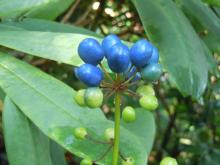
The Clintonia andrewsiana produces nice blue berries!
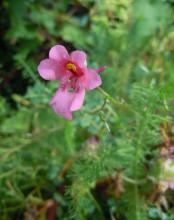
This Diascia is from seed of Silverhill, South Africa. The plant is quite hardy (has withstood all the shifting winters for several years) but not showy with very lax stems. However it flowers through the whole summer and the flowers are nice.
To continue the nonflowering part of animals without backbones: The showiest though is this Red Admiral Vanessa atalanta. It is a common guest in spring, summer and autumn. They say it does not overwinter neither does it breed but i am not so sure as I often see newly hatched specimens.
Yes, Tim, the Dalea purpurea produces lots of seed... let me know if you would like some. I managed to get Dalea candida seeds once but was not able to germinate them, oddly enough... would like to grow that one too, though.
Rick, thanks - I never thought of that possibility. That's what my Orostachys spinosa do as well (particularly those in less sun). I should look more closely at the other seedlings and see what they are doing. As you say, time will tell is that is the case too with Orostachys iwarenge. Surely it is not so unhappy with the conditions here as to be suicidal! ;)
I find that pinkish tones in the flowers of Silene uniflora are not uncommon, for example: (Definitely not the perfectly-formed flowers that you captured, Rick!)
Nice photos, Trond. Beautiful Clintonia! Well done on the Orostachys trades. Which ones did you get?
As you say, time will tell is that is the case too with Orostachys iwarenge. Surely it is not so unhappy with the conditions here as to be suicidal! ;)
Well I did have a suididal Orostachys spinosa once...
Hoy! You have Delosperma cooperi there: if it is from the Oxbow Collection (at nearly 9000') at a ski area in Lesotho, I am sure you will do fine with it. The lower elevation forms (more commonly sold) are not as hardy...
I've had a very hectic summer with quite a few trips to the hills and more than a few house guests: I have been terribly remiss about the Forum, although I just had a wonderful half hour or so strolling around touching bases. You more faithful forumists seem to be having a good summer too. We had 8" of rain in July, and my gardens grew out of proportion and I have spent spare minutes cutting down the masses of herbage in the perennial and xeric beds, but it only took an hour or so to clean up my rock garden: definitely the best and most sensible form of gardening! I don't think I have posted any of the following pix--they are mostly from earlier this year when the garden was freshest...but I wanted to share them because this garden in particular, but really all rock gardens are enormously gratifying...
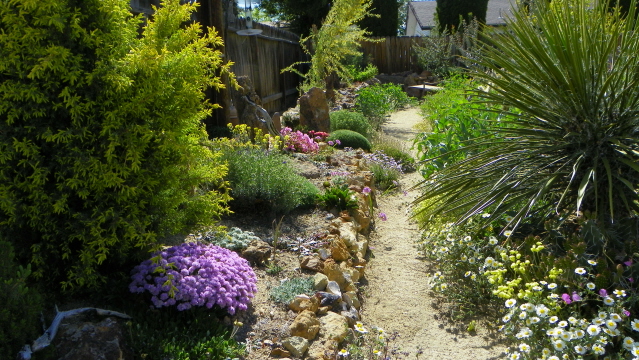
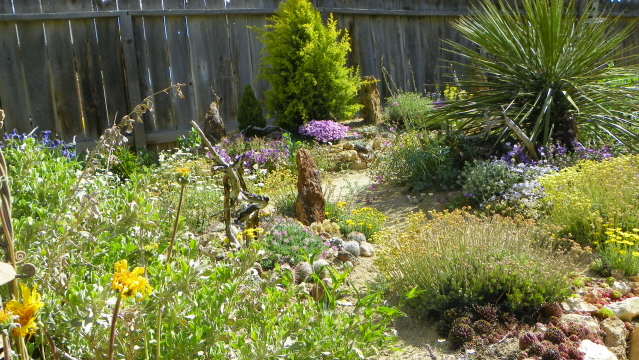
1 The first picture shows the path rising up through the garden: the white grass is Melica ciliata 2 The main slope of the garden in June with poppies and various crucifers (Aethionema, Iberis etc.) 3) The north (back) slope of the rock garden with my beloved yellow Pulsatilla and Aubrieta pinardii 5) There is no 4, but 5 is Iris pumla (supposedly from the Altai, probably a mistake) and a novel view 6) Campanula 'Dickson's Gold', one of my favorites in a shady corner with Adiantum venustum 7) Delosperma "deleuwiae" (which it is not) from Halda, and a distant orange patch of Anagalis monellii from Morocco. I have been so inspired, I blogged about my rock garden on my blog if you are a sucker for punishment and want to have more pictures inflicted upon you! Check out: http://www.prairiebreak.blogspot.com/
Time to go back and cut back more herbage in the acursed perennial gardens!
What you have there is an Argiope aurantia...the yellow garden spider. It's a very valuable addition to your garden! They weave beautiful webs and at this time of the year are producing large egg sacs that are brown and tear-drop shaped and you should find them hanging from plants stems near her web.
Hoy! You have Delosperma cooperi there: if it is from the Oxbow Collection (at nearly 9000') at a ski area in Lesotho, I am sure you will do fine with it. The lower elevation forms (more commonly sold) are not as hardy...
Thank you. Kelaidis! However I don't know what collection it is but I can try to find out ;D I should wish my garden looked anything like yours (tidy and with lot of interesting rock garden plants!
I thought I had a name of this plant but I can't find it!
Out in the garden today and some of the showier things were these:
The Clintonia andrewsiana produces nice blue berries!
To continue the nonflowering part of animals without backbones: The showiest though is this Red Admiral Vanessa atalanta. It is a common guest in spring, summer and autumn. They say it does not overwinter neither does it breed but i am not so sure as I often see newly hatched specimens.
Nice to see the berries on your Clintonia! Never seen that before over here...
Red Admirals do breed here and the fresh looking butterflies appearing at the moment are the offspring of the migrants that arrived here in the spring.
Like the Monarch in North America it is also now known that some also migrate south again as documented in this Finnish article with an estimated 1/2 million butterflies migrating over a 100km front!http://www.eje.cz/pdfarticles/253/eje_100_4_625_Mikkola.pdf solving the evolutionary puzzle as to why they come here in the first place!
Here's a picure of one of the 4 specimens frequenting my garden at the weekend, posing on this Aster scaber from Korea, one of my favourite Edimentals...
Edimental - My invention/baby - not found on Google when I first used it (apart from as a Spanish name).... and next month a book will be published by a BBC gardening personality and this word is used.... :) I got fed up with writing edible and ornamental....
It's the spring shoots which are used. Originally wild collected in Korea in country areas, people moved into towns and missed their traditional food. Now the demand is so high that the Koreans are cultivating it commercially....
Edimental - My invention/baby - not found on Google when I first used it (apart from as a Spanish name).... and next month a book will be published by a BBC gardening personality and this word is used.... :) I got fed up with writing edible and ornamental....
It's the spring shoots which are used. Originally wild collected in Korea in country areas, people moved into towns and missed their traditional food. Now the demand is so high that the Koreans are cultivating it commercially....
Stephen, if you start growing mushrooms as ornamental additions to your garden, you have my permission to call them Fungimentals ;D
Lori that Satureja is lovely! And such nice color for this time of year. Do you know if it's hardy to zone 4-5? And was it easy from seed?
Hi, Amy. That plant has come through one winter so far here in zone 3 (and is nicely evergreen, by the way), and I recall now that I was speaking to someone at the local rock garden society plant sale this spring who considered it to be hardy, so that bodes well. (EDIT: Ooops, nix that thought... I have since remembered that it was actually Teucrium, not Satureja, that we were talking about.) The seeds germinated for me in 13 days at room temperature.
And super duper floriferous! Is it a super duper seed producer as well? (That's a hint ;D.) Makes me wonder if it is going to be a short lived perennial...
And super duper floriferous! Is it a super duper seed producer as well? (That's a hint ;D.) Makes me wonder if it is going to be a short lived perennial...
I'll certainly collect seeds and send some, Rick, if it's inclined to produce any, i.e. doesn't get frozen off first! Re. longevity, I think certain Lamiaceae just tend to flower extravagantly, e.g. Thymus, and that it being considered a subshrub should bode well for longevity... at least that's what I'm hoping! ;)
Edimental - My invention/baby - not found on Google when I first used it (apart from as a Spanish name).... and next month a book will be published by a BBC gardening personality and this word is used.... :) I got fed up with writing edible and ornamental....
It's the spring shoots which are used. Originally wild collected in Korea in country areas, people moved into towns and missed their traditional food. Now the demand is so high that the Koreans are cultivating it commercially....
Stephen, if you start growing mushrooms as ornamental additions to your garden, you have my permission to call them Fungimentals ;D
Thanks, Mark, that is very generous of you. Had to google "fungimental" and it seems to be a state induced at rave parties induced by excessive intake of psychotropic mushrooms... :)
I don't need to "grow" mushrooms, there are loads all over the garden at the moment including the one in the first picture which has infiltrated one of my edimental beds. It is incidentally edible at a young stage while still a white ball so it fits in well.... I do show it off to visitors in my garden as you can expect.... Unfortunately it stinks to high heaven so I start by apologising for the smell.... An erotimental perhaps? (another new word for Google). Sorry for lowering the tone of the forum, I do now expect to be excluded... :)
Speaking of "edimentals"... I picked the big, beautiful fruits of Prunus cerastus 'Evans' the other day - sour cherries - gorgeous on the tree, and excellent for pies and jam!
I have no cherries in my garden any longer - the blackbirds and the seagulls ate the fruit before I could pick them!
But this one, rowan/mountain ash (Sorbus aucuparia), is very common around here together with its relatives, a swarm of different Sorbus species. The berries are used in jam and jelly (by some).
Oddly enough, none of the birds around here seem to eat the cherries.
Evans would be top selling if that were true in the U.S. Now that I think about it, when I was in Slovenia we ate Bing cherries right of the tree...and birds didn't seem to go after them either.
It is strange... The Amur cherry fruit seems to get eaten, and some of the chokecherries from our huge Schubert chokecherry get eaten by waxwings and migrant robins (but I seem to weed out most!), and the mountain ash berries are popular through the winter, but the cherries don't seem to be too attractive to the birds, including the earlier-ripening bird cherries (go figure!) and the 'Carmine Jewel'.
Here's one I've been enjoying, particularly since it was brought out of the greenhouse (where it escaped the hail damage) to add some interest to the corner of the house... Rosa 'Amsterdam':
Not sure it will be kept, as it isn't what it was supposed to be (a fragrant floribunda) due to a mail order goof-up*. It is a beauty though, and we noticed today that new flowers have a faint cinnamon scent... It has managed to squeak through 2 seasons now on its merits, so we'll see.
Wow, is this just a Midwest thing where the birds ravenously eat cherries? It just seems so unbelievable! you'll never get to taste a ripe cherry here unless you net the tree.
I've never heard of gulls stealing fruit either! Here, we see them hawking for insects, and also scavenging, but they avoid coming into yards. I wonder what Sorbus jam/jelly tastes like? I've never heard of anyone around here using the berries. I'll have to go out and sample ours... bearing in mind, of course, that adding a ton of sugar will make almost anything palatable! ;)
Anne, I'll have to look up Cyclamen fatrense, if it is considered very hardy. So far, I've only found C. purpurascens to be hardy here (after expending the lives of many innocent C. coum and C. hederifolium in my sad experiments :-\).
Lori, Dick Redfield (from whom my original plant came), told me that some people were insisting that C. fatrense was a variation of C. purpurascens, but he didn't believe this to be true. In my limited experience (after killing numerous cyclamens under the guise of trying to grow them), they are different. It has lasted many years and now I have a number from the original plant. They flower late August and into September. Usually, the leaves have some marbling, but it seems less so this season for some unknown reason.
I've never heard of gulls stealing fruit either! Here, we see them hawking for insects, and also scavenging, but they avoid coming into yards. I wonder what Sorbus jam/jelly tastes like? I've never heard of anyone around here using the berries. I'll have to go out and sample ours... bearing in mind, of course, that adding a ton of sugar will make almost anything palatable! ;)
Lori, seagulls are eating everything here including fruit. They are especially fond of cherries and swarming ants.
If you want to make something of Sorbus fruits they taste best after a night of freezing - or you can put them in the fridge for some days.
Here is two recipes (jelly):
1 kg rensede rognebær 1 kg berries 2 dl vann 2dl water 3/4 kg sukker pr. liter saft . 3/4 kg sugar to 1liter juice
or
2 1/2 kg rognebær 1,2 l vann 1 kg sukker
Bærene kokes i vannet til de sprekker i ca 20 minutter. Boil the berries to they crack(?), about 20 min. Moses lett Mash lightly Siles gjennom silklede Strain through a cloth 1 liter sukker til 1 liter saft. 1 liter sugar to 1 liter juice
Mint or lemon can be used as flavoring.
To make jam you can add apples and do as when you make applejam.
I just checked the Cyclamen society website for info on C. fatrense and they have this specie as a form of C. purpurascens, which is very hardy for me here in Vermont as well as coum & hederifolium. I planted out 1 corm each of cilicium & pseudoibericum this year to check on the hardiness of those. I will be keeping my fingers crossed this winter :-\. Here's the link to the Cyclamen societies' page http://www.cyclamen.org/purp_set.html
I have seen C fatrense mentioned both as a species and as a subspecies of purpurascens. The name means nothing, it is artificial anyway but may tell about its origin (and potential hardiness).
My experience is that my own seedlings almost always are hardier than bulbs/corms i buy especially if I grow them in a lean medium.
Seems a repeat of what Dick Redfield told me about Cyclamen fatrense. It is the only cyclamen that has been reliably hardy here. I tried all the "hardy" ones and they never even made it through a winter. That includes C. purpurascens which I tried more than once. With apologies to the Cyclamen Society, if C. fatrense is only a "form" of C. purpurascens, it is one that has managed to be hardier.
A month or two ago Tim Ingram showd a picture of Salvia "cyanescens" which must surely have been Salvia CANESCENS: the latter is in the same complex as S. daghestanica and S. hypargeia, whereas the first has cordate leaves and a very different habit: I have a blog post on the former:
Panayoti - of course you are right, the Salvia I have is canescens. I took the name from the label. The plant I have is very like daghestanica. Thanks for the correction.
Rick - The Vernonia is a tremendous plant! I wish we had the summer moisture to succeed better with these bold late perennials.
When I stumbled on the similarity of names between Salvia cyanescens/canescens, I wondered if what I was growing was correct too. Panayoti, from your description of cordate leaves, is this plant S. cyanescens then?
Here are a few things from the rock garden... Campanula hawkinsiana is still in bloom, along with C. topaliana - what fabulous plants!! Even if they prove to be monocarpic, they have certainly shown their worth in the garden! (I'll collect seeds and start more next year, to be on the safe side.)
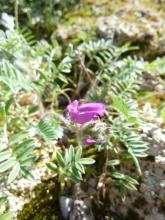
A couple of late blooms on Oxytropis megalantha:
Colourful bracts (and a last couple of flowers) on Acantholimon kotschyi ssp. laxispicatum:



Comments
Trond Hoy
Re: What do you see on your garden walks?
Mon, 08/15/2011 - 12:48amFermi, I know you have winter down there but it is strange to see the flowers at this time of the year anyway ;)
Rick, Silene uniflora is a very common shore plant here but I have never seen that colour! (and the flowers are never that perfect either)
Lori, Dalea purpurea really is something :o Hope you don't loose the Orostachys.
Tim Ingram (not verified)
Re: What do you see on your garden walks?
Mon, 08/15/2011 - 1:19amI am definitely with Trond! That Dalea is something else. I have always loved legumes and have had seed of Dalea species but never managed to grow them on. I will certainly try again! Do you get seed on it Lori?
Richard T. Rodich
Re: What do you see on your garden walks?
Mon, 08/15/2011 - 1:24amI know! It's been blooming off and on all season with very white petals and rather unpleasing form - unworthy of photographing, I thought, because I assumed they were abnormal. Thanks for straitening out this dilemma of mine! I wonder what will happen next year?
Lori, that's a bummer about the orostachys... but I wonder if that is really a flower stalk? Could it just be that species normal production of winter leaves? I question because internet photos of flowering O. iwarenge show a gradation of leaf size as the stem progresses, and not such an abrupt change.
This is what a non-blooming Orostachys spinosa does in mid summer for me:
And this is how a blooming one begins. The growth pattern is unmistakable, even at this stage, as it is clear that the stem has begun. Compare the vegetative counterpart in the second photo.
I realize this is a whole different species, so my hypothesis may or may not be right. I guess time will tell...
Richard T. Rodich
Re: What do you see on your garden walks?
Mon, 08/15/2011 - 1:42amI grow the white species of Prairie clover - Dalea candida, from Minnesota native seed. It produces copious seed. I much prefer the purple one though, since the white flowers tend to look dirty as the overall color grays against the darker, nondescript stamens and pistils.
Trond Hoy
Re: What do you see on your garden walks?
Mon, 08/15/2011 - 3:35amThis summer I got hold of 3 different Orostachys species by swapping ;D
Out in the garden today and some of the showier things were these:
The Clintonia andrewsiana produces nice blue berries!
This Diascia is from seed of Silverhill, South Africa. The plant is quite hardy (has withstood all the shifting winters for several years) but not showy with very lax stems. However it flowers through the whole summer and the flowers are nice.
To continue the nonflowering part of animals without backbones:
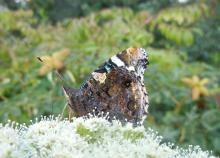
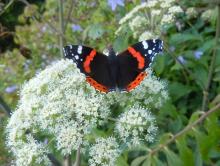
The showiest though is this Red Admiral Vanessa atalanta. It is a common guest in spring, summer and autumn. They say it does not overwinter neither does it breed but i am not so sure as I often see newly hatched specimens.
Richard T. Rodich
Re: What do you see on your garden walks?
Mon, 08/15/2011 - 5:36amRed Admirals are common here in Minnesota, too.
Lori S. (not verified)
Re: What do you see on your garden walks?
Mon, 08/15/2011 - 9:06amYes, Tim, the Dalea purpurea produces lots of seed... let me know if you would like some. I managed to get Dalea candida seeds once but was not able to germinate them, oddly enough... would like to grow that one too, though.
Rick, thanks - I never thought of that possibility. That's what my Orostachys spinosa do as well (particularly those in less sun). I should look more closely at the other seedlings and see what they are doing. As you say, time will tell is that is the case too with Orostachys iwarenge. Surely it is not so unhappy with the conditions here as to be suicidal! ;)
I find that pinkish tones in the flowers of Silene uniflora are not uncommon, for example:
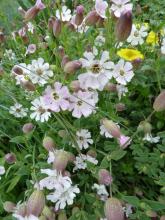
(Definitely not the perfectly-formed flowers that you captured, Rick!)
Nice photos, Trond. Beautiful Clintonia! Well done on the Orostachys trades. Which ones did you get?
Richard T. Rodich
Re: What do you see on your garden walks?
Mon, 08/15/2011 - 9:16pmI'll save seed of Dalea candida, Lori.
Well I did have a suididal Orostachys spinosa once...
Trond Hoy
Re: What do you see on your garden walks?
Sat, 08/20/2011 - 1:08pmThis Delosperma cultivar is supposed to be hardy. I hope so!
Panayoti Kelaidis
Re: What do you see on your garden walks?
Sat, 08/20/2011 - 3:50pmHoy!
You have Delosperma cooperi there: if it is from the Oxbow Collection (at nearly 9000') at a ski area in Lesotho, I am sure you will do fine with it. The lower elevation forms (more commonly sold) are not as hardy...
Panayoti Kelaidis
Re: What do you see on your garden walks?
Sat, 08/20/2011 - 4:18pmI've had a very hectic summer with quite a few trips to the hills and more than a few house guests: I have been terribly remiss about the Forum, although I just had a wonderful half hour or so strolling around touching bases. You more faithful forumists seem to be having a good summer too. We had 8" of rain in July, and my gardens grew out of proportion and I have spent spare minutes cutting down the masses of herbage in the perennial and xeric beds, but it only took an hour or so to clean up my rock garden: definitely the best and most sensible form of gardening! I don't think I have posted any of the following pix--they are mostly from earlier this year when the garden was freshest...but I wanted to share them because this garden in particular, but really all rock gardens are enormously gratifying...
1 The first picture shows the path rising up through the garden: the white grass is Melica ciliata
2 The main slope of the garden in June with poppies and various crucifers (Aethionema, Iberis etc.)
3) The north (back) slope of the rock garden with my beloved yellow Pulsatilla and Aubrieta pinardii
5) There is no 4, but 5 is Iris pumla (supposedly from the Altai, probably a mistake) and a novel view
6) Campanula 'Dickson's Gold', one of my favorites in a shady corner with Adiantum venustum
7) Delosperma "deleuwiae" (which it is not) from Halda, and a distant orange patch of
Anagalis monellii from Morocco. I have been so inspired, I blogged about my rock garden on my blog if you are a sucker for punishment and want to have more pictures inflicted upon you! Check out: http://www.prairiebreak.blogspot.com/
Time to go back and cut back more herbage in the acursed perennial gardens!
Amy Olmsted
Re: What do you see on your garden walks?
Sat, 08/20/2011 - 5:13pmWhat you have there is an Argiope aurantia...the yellow garden spider. It's a very valuable addition to your garden! They weave beautiful webs and at this time of the year are producing large egg sacs that are brown and tear-drop shaped and you should find them hanging from plants stems near her web.
Trond Hoy
Re: What do you see on your garden walks?
Sun, 08/21/2011 - 12:54pmThank you. Kelaidis! However I don't know what collection it is but I can try to find out ;D
I should wish my garden looked anything like yours (tidy and with lot of interesting rock garden plants!
I thought I had a name of this plant but I can't find it!
Richard T. Rodich
Re: What do you see on your garden walks?
Sun, 08/21/2011 - 1:53pmTrond, could that be a Sempervivella sp.?
I am only familiar with Sempervivella alba, but your plant looks a lot like it to me...
Trond Hoy
Re: What do you see on your garden walks?
Mon, 08/22/2011 - 1:50amI think you are right, Rick. It ha to be a Sempervivella but I can't tell the difference between alba and sedoides.
Mark McDonough
Re: What do you see on your garden walks?
Mon, 08/22/2011 - 4:41amBoth Sempervivella alba and sedoides are considered = Rosularia sedoides
http://www.efloras.org/florataxon.aspx?flora_id=5&taxon_id=242426835
http://www.theplantlist.org/tpl/record/tro-8903077
http://www.theplantlist.org/tpl/record/tro-8903074
So, it appears there is no longer a recognized genus of Sempervivella, all became Rosularia.
Trond Hoy
Re: What do you see on your garden walks?
Mon, 08/22/2011 - 5:01amMark, now I remember the name ;D Thank you Mark.
Stephen Barstow
Re: What do you see on your garden walks?
Tue, 08/23/2011 - 12:30amNice to see the berries on your Clintonia! Never seen that before over here...
Red Admirals do breed here and the fresh looking butterflies appearing at the moment are the offspring of the migrants that arrived here in the spring.
Like the Monarch in North America it is also now known that some also migrate south again as documented in this Finnish article with an estimated 1/2 million butterflies migrating over a 100km front!http://www.eje.cz/pdfarticles/253/eje_100_4_625_Mikkola.pdf solving the evolutionary puzzle as to why they come here in the first place!
Here's a picure of one of the 4 specimens frequenting my garden at the weekend, posing on this Aster scaber from Korea, one of my favourite Edimentals...
Richard T. Rodich
Re: What do you see on your garden walks?
Tue, 08/23/2011 - 6:43amLove the word "edimental".
What part(s) is edible on the aster?
Stephen Barstow
Re: What do you see on your garden walks?
Tue, 08/23/2011 - 12:47pmEdimental - My invention/baby - not found on Google when I first used it (apart from as a Spanish name).... and next month a book will be published by a BBC gardening personality and this word is used.... :) I got fed up with writing edible and ornamental....
It's the spring shoots which are used. Originally wild collected in Korea in country areas, people moved into towns and missed their traditional food. Now the demand is so high that the Koreans are cultivating it commercially....
Trond Hoy
Re: What do you see on your garden walks?
Wed, 08/24/2011 - 12:52pmYou are building up stock to export to Korea then, Stephen ;)
Mark McDonough
Re: What do you see on your garden walks?
Sat, 08/27/2011 - 11:46amStephen, if you start growing mushrooms as ornamental additions to your garden, you have my permission to call them Fungimentals ;D
Richard T. Rodich
Re: What do you see on your garden walks?
Sat, 08/27/2011 - 8:54pmYou're great wit that one, Mark.
Lori S. (not verified)
Re: What do you see on your garden walks?
Thu, 09/01/2011 - 3:45pmSatureja montana ssp. illyrica, from seed last year:
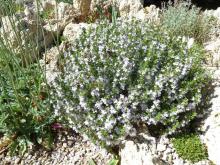
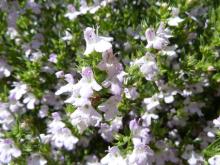
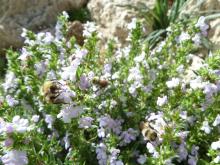
As you can see, it is much loved by the bees, rivalling even Thymus serpyllum in popularity!
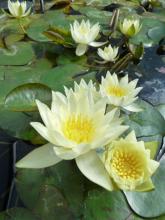
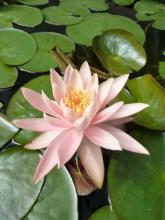
Nymphaea 'Helvola' and 'Colorado':
Amy Olmsted
Re: What do you see on your garden walks?
Thu, 09/01/2011 - 6:30pmLori that Satureja is lovely! And such nice color for this time of year. Do you know if it's hardy to zone 4-5? And was it easy from seed?
Lori S. (not verified)
Re: What do you see on your garden walks?
Thu, 09/01/2011 - 6:51pmHi, Amy. That plant has come through one winter so far here in zone 3 (and is nicely evergreen, by the way),
and I recall now that I was speaking to someone at the local rock garden society plant sale this spring who considered it to be hardy, so that bodes well.(EDIT: Ooops, nix that thought... I have since remembered that it was actually Teucrium, not Satureja, that we were talking about.)The seeds germinated for me in 13 days at room temperature.
Richard T. Rodich
Re: What do you see on your garden walks?
Thu, 09/01/2011 - 6:53pmLovely, indeed!
And super duper floriferous!
Is it a super duper seed producer as well? (That's a hint ;D.)
Makes me wonder if it is going to be a short lived perennial...
Lori S. (not verified)
Re: What do you see on your garden walks?
Thu, 09/01/2011 - 7:03pmI'll certainly collect seeds and send some, Rick, if it's inclined to produce any, i.e. doesn't get frozen off first!
Re. longevity, I think certain Lamiaceae just tend to flower extravagantly, e.g. Thymus, and that it being considered a subshrub should bode well for longevity... at least that's what I'm hoping! ;)
Stephen Barstow
Re: What do you see on your garden walks?
Fri, 09/02/2011 - 12:48amThanks, Mark, that is very generous of you. Had to google "fungimental" and it seems to be a state induced at rave parties induced by excessive intake of psychotropic mushrooms... :)
I don't need to "grow" mushrooms, there are loads all over the garden at the moment including the one in the first picture which has infiltrated one of my edimental beds. It is incidentally edible at a young stage while still a white ball so it fits in well.... I do show it off to visitors in my garden as you can expect.... Unfortunately it stinks to high heaven so I start by apologising for the smell.... An erotimental perhaps? (another new word for Google). Sorry for lowering the tone of the forum, I do now expect to be excluded... :)
1.Phallus impudicus (Common Stinkhorn)
2.Agaricus sylvicola (Wood Mushroom)
Lori S. (not verified)
Re: What do you see on your garden walks?
Sat, 09/03/2011 - 9:36pmSpeaking of "edimentals"...
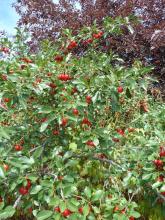
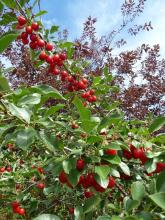
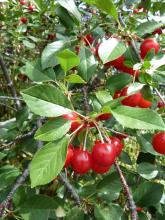
I picked the big, beautiful fruits of Prunus cerastus 'Evans' the other day - sour cherries - gorgeous on the tree, and excellent for pies and jam!
Trond Hoy
Re: What do you see on your garden walks?
Mon, 09/05/2011 - 2:30pmI have no cherries in my garden any longer - the blackbirds and the seagulls ate the fruit before I could pick them!
But this one, rowan/mountain ash (Sorbus aucuparia), is very common around here together with its relatives, a swarm of different Sorbus species. The berries are used in jam and jelly (by some).
Lori S. (not verified)
Re: What do you see on your garden walks?
Mon, 09/05/2011 - 4:27pmOddly enough, none of the birds around here seem to eat the cherries.
Richard T. Rodich
Re: What do you see on your garden walks?
Mon, 09/05/2011 - 4:44pmEvans would be top selling if that were true in the U.S. Now that I think about it, when I was in Slovenia we ate Bing cherries right of the tree...and birds didn't seem to go after them either.
Lori S. (not verified)
Re: What do you see on your garden walks?
Mon, 09/05/2011 - 5:05pmIt is strange... The Amur cherry fruit seems to get eaten, and some of the chokecherries from our huge Schubert chokecherry get eaten by waxwings and migrant robins (but I seem to weed out most!), and the mountain ash berries are popular through the winter, but the cherries don't seem to be too attractive to the birds, including the earlier-ripening bird cherries (go figure!) and the 'Carmine Jewel'.
Here's one I've been enjoying, particularly since it was brought out of the greenhouse (where it escaped the hail damage) to add some interest to the corner of the house...
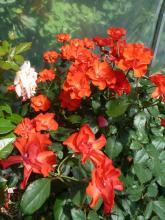
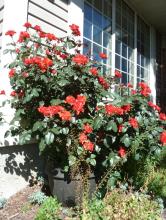
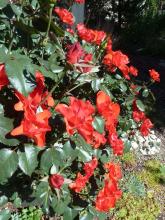
Rosa 'Amsterdam':
Not sure it will be kept, as it isn't what it was supposed to be (a fragrant floribunda) due to a mail order goof-up*. It is a beauty though, and we noticed today that new flowers have a faint cinnamon scent... It has managed to squeak through 2 seasons now on its merits, so we'll see.
*Hortico... need I say more?
Richard T. Rodich
Re: What do you see on your garden walks?
Mon, 09/05/2011 - 7:55pmWow, is this just a Midwest thing where the birds ravenously eat cherries? It just seems so unbelievable! you'll never get to taste a ripe cherry here unless you net the tree.
Trond Hoy
Re: What do you see on your garden walks?
Tue, 09/06/2011 - 4:55amLori, I think 'Amsterdam' is a good-looking rose. Roses are difficult here due to the moist climate. They're often infested with all kind of diseases.
Rick, I've never seen ravens stealing fruit ;)
Anne Spiegel
Re: What do you see on your garden walks?
Tue, 09/06/2011 - 6:08amNot much happening in the garden - some daphne rebloom etc, but now Cyclamen fatrense comes into its own. A lovely plant that is reliably hardy here.
Lori S. (not verified)
Re: What do you see on your garden walks?
Tue, 09/06/2011 - 10:00amI've never heard of gulls stealing fruit either! Here, we see them hawking for insects, and also scavenging, but they avoid coming into yards.
I wonder what Sorbus jam/jelly tastes like? I've never heard of anyone around here using the berries. I'll have to go out and sample ours... bearing in mind, of course, that adding a ton of sugar will make almost anything palatable! ;)
Anne, I'll have to look up Cyclamen fatrense, if it is considered very hardy. So far, I've only found C. purpurascens to be hardy here (after expending the lives of many innocent C. coum and C. hederifolium in my sad experiments :-\).
Anne Spiegel
Re: What do you see on your garden walks?
Tue, 09/06/2011 - 10:21amLori, Dick Redfield (from whom my original plant came), told me that some people were insisting that C. fatrense was a variation of C. purpurascens, but he didn't believe this to be true. In my limited experience (after killing numerous cyclamens under the guise of trying to grow them), they are different. It has lasted many years and now I have a number from the original plant. They flower late August and into September. Usually, the leaves have some marbling, but it seems less so this season for some unknown reason.
Trond Hoy
Re: What do you see on your garden walks?
Tue, 09/06/2011 - 11:34amLori, seagulls are eating everything here including fruit. They are especially fond of cherries and swarming ants.
If you want to make something of Sorbus fruits they taste best after a night of freezing - or you can put them in the fridge for some days.
Here is two recipes (jelly):
1 kg rensede rognebær 1 kg berries
2 dl vann 2dl water
3/4 kg sukker pr. liter saft . 3/4 kg sugar to 1liter juice
or
2 1/2 kg rognebær
1,2 l vann
1 kg sukker
Bærene kokes i vannet til de sprekker i ca 20 minutter. Boil the berries to they crack(?), about 20 min.
Moses lett Mash lightly
Siles gjennom silklede Strain through a cloth
1 liter sukker til 1 liter saft. 1 liter sugar to 1 liter juice
Mint or lemon can be used as flavoring.
To make jam you can add apples and do as when you make applejam.
I am sure Stephen can say something about this ;D
Lori S. (not verified)
Re: What do you see on your garden walks?
Tue, 09/06/2011 - 12:11pmThanks, Trond! Now I'm pretty well obligated to make some Sorbus jam! ;D
Richard T. Rodich
Re: What do you see on your garden walks?
Tue, 09/06/2011 - 8:20pmOur native Sorbus americana and S. decora berries have always looked more scrumptious than the European counterpart (S. aucuparia)...
Richard T. Rodich
Re: What do you see on your garden walks?
Tue, 09/06/2011 - 8:44pmVernonia gigantea is 9.5ft this season...
Amy Olmsted
Re: What do you see on your garden walks?
Wed, 09/07/2011 - 4:56amI just checked the Cyclamen society website for info on C. fatrense and they have this specie as a form of C. purpurascens, which is very hardy for me here in Vermont as well as coum & hederifolium. I planted out 1 corm each of cilicium & pseudoibericum this year to check on the hardiness of those. I will be keeping my fingers crossed this winter :-\.
Here's the link to the Cyclamen societies' page http://www.cyclamen.org/purp_set.html
Trond Hoy
Re: What do you see on your garden walks?
Wed, 09/07/2011 - 6:50amI have seen C fatrense mentioned both as a species and as a subspecies of purpurascens. The name means nothing, it is artificial anyway but may tell about its origin (and potential hardiness).
My experience is that my own seedlings almost always are hardier than bulbs/corms i buy especially if I grow them in a lean medium.
Anne Spiegel
Re: What do you see on your garden walks?
Wed, 09/07/2011 - 12:02pmSeems a repeat of what Dick Redfield told me about Cyclamen fatrense. It is the only cyclamen that has been reliably hardy here. I tried all the "hardy" ones and they never even made it through a winter. That includes C. purpurascens which I tried more than once. With apologies to the Cyclamen Society, if C. fatrense is only a "form" of C. purpurascens, it is one that has managed to be hardier.
Panayoti Kelaidis
Re: What do you see on your garden walks?
Wed, 09/07/2011 - 8:24pmA month or two ago Tim Ingram showd a picture of Salvia "cyanescens" which must surely have been Salvia CANESCENS: the latter is in the same complex as S. daghestanica and S. hypargeia, whereas the first has cordate leaves and a very different habit: I have a blog post on the former:
http://prairiebreak.blogspot.com/2011/08/lavender-cloudburst.html
Tim Ingram (not verified)
Re: What do you see on your garden walks?
Thu, 09/08/2011 - 11:18amPanayoti - of course you are right, the Salvia I have is canescens. I took the name from the label. The plant I have is very like daghestanica. Thanks for the correction.
Rick - The Vernonia is a tremendous plant! I wish we had the summer moisture to succeed better with these bold late perennials.
Trond Hoy
Re: What do you see on your garden walks?
Thu, 09/08/2011 - 12:15pmHi Rick, I had somehow missed your picture :o That Vernonia do not drown among its neighbours!
Lori S. (not verified)
Re: What do you see on your garden walks?
Thu, 09/08/2011 - 3:15pmRick, the Vernonia is spectacular!
When I stumbled on the similarity of names between Salvia cyanescens/canescens, I wondered if what I was growing was correct too. Panayoti, from your description of cordate leaves, is this plant S. cyanescens then?
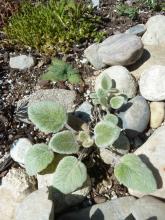
I assume then that this plant in the following link is not S. cyanescens... is it S. canescens?
http://davesgarden.com/guides/pf/showimage/111183/#b
Here are a few things from the rock garden...
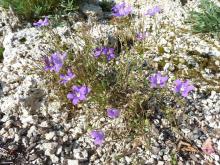
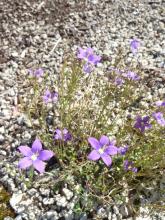
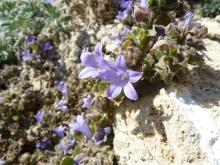
Campanula hawkinsiana is still in bloom, along with C. topaliana - what fabulous plants!! Even if they prove to be monocarpic, they have certainly shown their worth in the garden! (I'll collect seeds and start more next year, to be on the safe side.)
A couple of late blooms on Oxytropis megalantha:
Colourful bracts (and a last couple of flowers) on Acantholimon kotschyi ssp. laxispicatum:
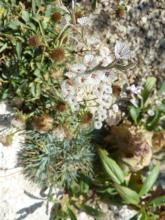
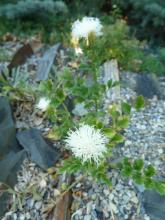
Serratula coronata:
Pages