Beautiful, Fermi - how nice to be reminded of summer turning to fall! I've been intrigued for some time by Wahlenbergia (being kind of a campanula nut) but I suspect they'd only act as annuals here.
I like the Linum tenuifolium too. I have found growing Linum from seed surprisingly difficult (well, surprising especially given that one sees entire blue fields of flax in these parts!)
Trond, I live in the land of fog and it can get darn depressing day after day. having said that, I could use some now as fog is great at melting snow...and we still have scads of that! It has been sunny and 8 C this past 2 days so the snow is settling but there is just so much on the ground...still about 3-4 feet over most of my back yard. I actually dug out my crevice garden as I am desperate to see some soil!
Trond, I live in the land of fog and it can get darn depressing day after day. having said that, I could use some now as fog is great at melting snow...and we still have scads of that! It has been sunny and 8 C this past 2 days so the snow is settling but there is just so much on the ground...still about 3-4 feet over most of my back yard. I actually dug out my crevice garden as I am desperate to see some soil!
Daytime fog is not at all common here, its usually a nighttime (or at least morning.evening) phenomenon, though at this elevation we are sometimes in the bottom of the clouds ;)
3-4 feet is a lot of snow--we have that much around paths and drives where its been piled up from shovelling, otherwise probably more like 13-18inches in most places, tending to less around spruce and in mixed woods (except north side of woods in the low areas where willows grow, which always has the most snow).. no doubt it will stay here much longer than in Newfoundland, though anything can happen this time of year--Wed +2C, Fri -8C with possible snow (they downgraded periods of snow to 60%chance of flurries, yay!)
A random image from warmer days, an Achillea millefolium growing just up the road--the first time I have seen pink in the wild populations! The close-up may or may not make it look pinker than in real life--it was pale but noticeable as I rode past on my bike.... And one of its basically white cousins with a pollinator...
Trond, I live in the land of fog and it can get darn depressing day after day. having said that, I could use some now as fog is great at melting snow...and we still have scads of that! It has been sunny and 8 C this past 2 days so the snow is settling but there is just so much on the ground...still about 3-4 feet over most of my back yard. I actually dug out my crevice garden as I am desperate to see some soil!
Todd, fog is not uncommon in spring when the air warms and the sea still is cold but fortunately we are spared the worst as it tends to be more foggy at the other side of the fjord and nearer the coast (the fjord runs south - north here and I live at the east side).
Cohan, is yarrow a native plant at your place? Here pink (light pink, not dark) yarrows are not uncommon, especially at our cabin in the mountain where I am now. Not much snow here - 3/4m I think. Haven't had time skiing though, the sewage is frozen further down the valley and all the neighbors "spent food" has found it's way up through our toilet - the floors of the bathroom, toilet and entrance flooded with..... Have done the worst cleaning job ever!
And I can't comment on Fermi's pictures, I can't see them! (Trond, Fermi's photos have been fixed - Mark McD.)
I know the snowdrops I show here are very common, but they are the harbinger of spring in my garden, followed closely by Crocus vitellinus, and this year Colchicum kesselringii that a friend sent last fall, is blooming now too. The yard and gardens are still covered with an 18" glacial layer of hard-pack ice, but in a couple spots, such as the warm sunny south side of the house, snow receded and a few bare bits of ground can be seen, and much to my surprise, there were snowdrops! Nice :D
Trond, I live in the land of fog and it can get darn depressing day after day. having said that, I could use some now as fog is great at melting snow...and we still have scads of that! It has been sunny and 8 C this past 2 days so the snow is settling but there is just so much on the ground...still about 3-4 feet over most of my back yard. I actually dug out my crevice garden as I am desperate to see some soil!
Todd, fog is not uncommon in spring when the air warms and the sea still is cold but fortunately we are spared the worst as it tends to be more foggy at the other side of the fjord and nearer the coast (the fjord runs south - north here and I live at the east side).
Cohan, is yarrow a native plant at your place? Here pink (light pink, not dark) yarrows are not uncommon, especially at our cabin in the mountain where I am now. Not much snow here - 3/4m I think. Haven't had time skiing though, the sewage is frozen further down the valley and all the neighbors "spent food" has found it's way up through our toilet - the floors of the bathroom, toilet and entrance flooded with..... Have done the worst cleaning job ever!
And I can't comment on Fermi's pictures, I can't see them! (Trond, Fermi's photos have been fixed - Mark McD.)
I have to apologise for my brain apparently not functioning this morning, I somehow thought I was posting to image of the day, earlier...lol Oh well, I suppose it was only somewhat off topic :rolleyes: Trond: yes yarrow- Achillea millefolium - is a very very common native here, but nearly all white--till now! I was also pleased to find A sibirica the last two summers--just an occasional plant--maybe only in one spot, and last year I got some seed, I really like the form/foliage of sibirica: taller, straighter and neater.. I'd be interested in seeing your pink yarrows; I may yet break down and get some seed of hybrids, I really do like some of the colours, and want some other species--rock garden and larger--I want one of the 'white' leafed yellow flowered tall ones..; I have seedlings from last year (hopefully alive under the snow) from Gardens North of ACHILLEA sibirica var. camtschatica--which has pink flowers, very different foliage from the regular form too, it seems, but haven't seen mature foliage yet..
Cohan, I'll show you pictures of the yarrows - but you have to wait some months ;D I haven't pictured yarrows, they are ubiquitous!
Nice to see snowdrop, Mark. I'll take a look at mine when I've time and it is sun!
I know what you mean, Trond; I try to photograph every flowering species, especially when they first start.. after they are going for a long time, I tend to taper off..lol--stilll, the summer is so short, there are very few flowers I get tired of (apart from the cursed foreign buttercup, and slightly less, clover and dandelions!)
A little walk in the garden between the showers - rain - hail - sleet! Got an inch of white stuff last night and early morning but it thawed during the day.
The snowdrops dropped a little by the weight of the white stuff and a Helleborus thibetanus takes it time to flower.
The Hellebores in the wood fared better and the snow receded quickly. Some Crocuses struggle, not with snow but with old leaves.
Congratulations, Trond--spring finally arrived for you! It'll be a while yet here, so its good to see some photos from elsewhere ..
Thanks Cohan! But spring comes and goes here and is slow in progress. The spring does last to May :o We can still get snow and sleet :(
Spring comes and goes here too, but we wont have any wildflowers until end of April or early May, I don't yet have much planted for spring to make it earlier, my one spring bulb bed turned out to be a cold spot, so its not early..lol This week we will have days well above freezing, but there will be snow again, we aren't safe until late May/June....
We've just been through a toasty week and lots is coming into bloom: there are a bank of daffodils out on the parking lot of the gardens in full bloom, and the first Magnolia stellata opened by the Botanic Gardens house and the first corydalis are out (of course I forgot to photograph all these!)...but there are enough things to give a taste of the blustery steppe spring on the Colorado piedmont...I start with Bulbocodium vernum, which seems to do well in a variety of sites around Denver Botanic Gardens: I neglected to photograph the little dark pink forms of Colchicum szovitsii that have just opened at my house (much daintier). Two shots of my best Cyclamen coum--one with back lighting and the other not. These have finally found a shady site they like. Then there is the ever charming Eranthis hyemalis: can one ever have enough of this? The Fritillaria raddeana alarms me by its early bloom: I don't think we have as attractive a form as I've seen in pictures: it is rather greenish. Our F. imperialis are just breaking ground and this is in full bloom: makes me nervous since we are sure to have some more very cold weather. And Christmas roses have been blooming for months and they are now turning deep reds as they set seed....I've barely scratched the surface! I will have to do another post!
I have just posted ten pix, and they were not enough! Way too much is already blooming. I have over 30 different kinds of things in bloom at home, and the Gardens are exploding! The Galanthus are starting to go over in more exposed spots (although there are still a few patches of snow in the darker corners where they'll be coming up for some weeks to come!) The first picture is of a giant form of Galanthus elwesii I got from Don Hackenberry 30 years ago! The next is a more typical form that has naturalized at the gardens...and the nivalis 'Viridapice' which I find to be quite vigorous. I have a special spot in my heart for reticulate irises, and this seems to be a banner year for them. I have two shots of Iris danfordiae, which seems to perenniate if you can keep it dry in summer (we grow it in groundcovers or grass to achieve that). I have 'Katharine Hodgekin' all over my garden (I blogged about it recently as well: there's quite a story about it:http://prairiebreak.blogspot.com/2011/03/whats-in-name.html). And I include closeups of 'Harmony' and 'Pixie' two of my favorite dark blues. We have drifts of 'Harmony' on a steep slope with blue gramma grass where they are quite happy. I guess you will miss my pix of early Muscari, townsendias, hellebores galore, a bevy of early drabas, and so on and so forth: the new year is rushing headlong and dragging me with it. There's nothing like early spring! (Or is it late winter?)
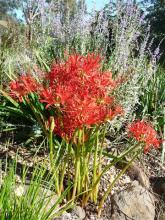
And here it is starting to feel like autumn with the "late bulbs" like Lycoris coming into bloom, Lycoris elsae cheers fermi
Fermi, great fall color, as we're just starting to emerge from under a mantle of snow and ice in the northern hemisphere. I love the white Lycoris, a genus I have not succeeded with yet, in spite of getting some bulbs from Mr. Lycoris himself, James Waddick. The name Lycoris elsae is probably referring to Lycoris elsiae Traub, Pl. Life xiv. 43 (1958).
It is a perplexing entity, this elsiae, and here are some links I found that help provide clues to the mystery:
Panayoti, your spring season seems so much more advanced than New England, I'm so jealous. Today it suddenly warmed up and reached 60 F (15.5 C), but it seemed semi-stupid as most of the yard and garden are still covered with a 12" thick (or thicker in places) mantle of snow, the ground still frozen beneath.
Of your floral spectacle, I really liked Galanthus nivalis 'Viridapice', such drooping elegance (and it actually looks different than many snowdrops). ;)
Now I've seen plenty of photos of Iris danfordiae, that elfin golden yellow reticulate Iris, but interplanted with glowing orange Sedum rupestre 'Angelina', sheer brilliance!
And the shot of blue pools of Iris reticulata 'Harmony' amidst the pale amber of dried grasses, who would have thought of such a combination, double brilliance!
Today it was suddenly very warm, almost summer like, after such a long spell of cold and freezing weather. The snow has receded from a few areas where spring bulbs are plants. Yesterday, a patch of ground where Crocus biflorus ssp. isauricus was planted, the receding snow-pack revealed flattened buds of this crocus squashed and lying miserably under the weight of the snow, but today with the warmth, they all popped open.
Stepping away a little bit is a reminder that winter snow is still predominant; we'll need a number of such warm days to melt the snow-pack layer.
Panayoti--what a wealth of spring glory! I can only second some of Marks specifics, esp for the irises, Love the wild form of reticulata..
Mark, congrats on blooms! Everything here still looks like your last pic.... nothing here can bloom out of the snow, unless its a late spring snow after the pack has melted and ground thawed! The ground will still be solidly frozen in most places until some time after snowmelt...
Yesterday, St. Patrick's Day, was the first day it was possible to see signs of life in the garden - Daphne mezereum, which was prostrate under the snow, has straightened up and the flower buds are swelling - lots of yellow Winter Aconite, Iris reticulata shoots and snowdrops. Tulip and Hyacinths under the house eaves are up 3 inches now and Belladonna lilies which I transplanted into the University Courtyard (home of FOGS) last year, have survived and are coming up in good health. Over in the tiny bog that one of our members created last year, the Lobelia cardinalis "placemats" look full of health. In my own garden Lobelia cardinalis alba, Arum maculatum and that wonderful Polygala appear not to have been hurt at all by our really terrible winter. Calycanthus floridus is just a mass of disjointed twigs - it did suffer. However, some of those twigs, which I brought indoors and put into a vase with Cornus mas branches, have begun to leaf out, as has a small pot of Begonia sutherlandii. No pictures yet but perhaps soon? Fran
Here it is back to square one - 10cm of wet snow this morning! But as the ground no longer is frozen I hope it will thaw during the day. This is quite normal for March weather though.
Fermi, wether it is Lycoris radiata or not don't matter to me! It is a nice plant anyway.
Kelaidis, you do not lack plants! I believe you have a lot of sun in daytime but that you experience freezing temps during nighttime?
Hoy, We get over 300 days of sun a year (more than Cairo and Athens! They have more clouds in winter than we do)...but we get frost until May. We often have Magnolias crisped...although the coming week is supposed to stay mild. I would be surprised if we don't get some very cold days still this winter.
Beautiful shows, Panayoti, Mark and Trond! Wonderful fall flowers from the other side of the world too, Fermi!
The big melt is on here, and as this year's heavy snow rapidly disappears, it's encouraging to see signs of life... Some native and exotic plants in juxtaposition - bristlecone pine, Astragalus angustifolius and kinnikinnick (Arctostaphylos uva-ursi)
The following few are new from last year: A teensy rosette of Dionysia involucrata, looking reasonably lifelike...
Papaver kluanense
Physaria alpina
Anacyclus marrocanus
Eriogonum saxatile
Elsewhere in the garden: New growth on Caltha leptosepala
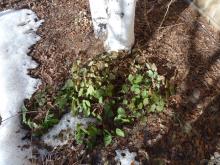
Evergreen foliage on Epimedium x versicolor 'Sulphureum' and a hellebore:
Lori, you are way ahead of me! I we get more weather like last week (+5C and higher) the snow will go fast, but we are back to barely above 0 days, or below; plus, much of my place is shaded, esp until the sun is higher, so we keep snow longer, except for a few spots..
hoping we will dodge the forecast 15-30cm of snow forecast for parts of the province the next couple of days; now looks like it may be farther south/west...
Lori is way ahead of me too, here near Minneapolis, Minnesota. No gardens' soil is showing yet, although there are spots of grass showing in the yard. But the big melt is on here too, and the three bridges over the Minnesota River closest to me are expected to closed by mid to end of this coming week due to flooding! Makes me feel very fortunate that I live on the same side of the river as where I work. Many fellow employees will be driving an extra 20-25 miles each way to get to work.
Rivers' flooding is expected to be very bad here this spring. The city of Grand Forks, MN on the Red River (flowing north) has stock piled 1.5 million filled sand bags.
Oh, Rick, you are in one of those areas! I talk to lots of Manitoba folks in another forum, they are watching the rivers too.... Luckily, there is really nothing much around here that could flood--we get water standing in fields and roadsides, that's about it..even if the rivers in Rocky Mtn House or Red Deer did flood, it would be very local...
Ryvarden lighthouse. It has been a beacon here for more than 1000 years. You are not allowed to drive but have to walk a few miles along the road. It is popular by all kind of people particularly in the summer.
View north and east across the open sea "Sletta" and the "Bømlafjorden" fjord. Here the weather and the sea can be very bad. You can see the snow covered mountains in the east.
it is mostly heather and grass growing here. No early springflowers! The kinnikinnick is very common here Lori ;)
Oh, Rick, you are in one of those areas! I talk to lots of Manitoba folks in another forum, they are watching the rivers too.... Luckily, there is really nothing much around here that could flood--we get water standing in fields and roadsides, that's about it..even if the rivers in Rocky Mtn House or Red Deer did flood, it would be very local...
The Red River flowing from Minnesota and into Manitoba is especially prone to flooding because the drop in elevation per mile is so little. It takes a long time for such flat areas to drain. The Minnesota river is not as bad, but historically is a river with large natural fluctuations in volume. It's really quite a spectacle to view the river at spring flooding from atop a river bluff, when you know what a "trickle" of water it becomes in late summer.
My little piece of land is at the top of the highest hill for for miles around. (But you would never realize it just be looking at it.)
Beautiful sights, Trond. It's nice to see blue water and blue sky. Yes, kinnikinick is very common here too, though maybe not so common in people's yards.
Hope you did not get all the forecasted snow, Cohan. We've only gotten a couple of centimeters so far here.
My higher elevation really doesn't matter as I am 15 miles from the river: the last half of the Minnesota River (maybe 100 miles?), the river bottom is pretty much flanked by low bluffs, and that general elevation is then maintained throughout my area. Many towns are situated in the river bottoms, however.
Good to know you are not right in the flood path, Rick, that would be awful....
Lori, we got something like 3-4 inches last night through early this afternoon (sat night/sunday) not bad considering they were talking about 15-30 cm for some areas, and we weren't clear if we'd be in that zone or not! Still merited an hour and half or more of 2 man intensive shovelling..
Happily, they have removed snow from Monday's forecast, though its still there for Tues and Wed--looks like another big system, this one should be farther south, mostly, looks like Calgary might be right in the middle of that one? Looked at the mounds of snow beside the driveway today, chest high in places and a few metres wide....
Spring is springing a bit too quickly: our star magnolia is nearly in full bloom at the gardens (pix in my camera still)...but I have a enough pix from the last week to share: sunny and bright every day. The skies have forgotten how to rain! Oh well...at least we have lots of snowpack so we can water to our heart's content for a while...
Snowdrops and Helleborus niger going over, as are the earlier crocuses. Lots of daffodils are out as are the first tulips. I love this time of year! Fritillaria raddeana is a new one for me: what a beauty! Looks a lot like F. imperialis, only a month earlier, and a cool chartreuse. I am curious to see how it will fare with our inevitable cold snaps we shall get for the next few months eventually! I am not positive about Crocus versicolor: it may be C. veluchensis: can anyone weigh in? I've missed several of the spring colchicums already: they are a variable lot. I finally found a spot Trillium nivale seems to like: now I need to get some more! Aaah Spring...from here on out it's a roller coaster.
Panayoti...Aahhh Spring indeed! An awesome start to the season. I'm fixated on your Fritillaria raddeana in its ethereal chartreusiness and brooding black tree-trunk-like stems :o :o :o :o Nice going with Iris nicolai outside too! As I'm writing this, had to dash outside to see if there's any sign of Trillium nivale in my garden, but the snow only just receded from the east-facing slope it is planted on, and no signs of life yet, the ground still frozen.
Aside from crocus and other early spring bulbs on the sunny and warm south side of my house, there isn't much else brewing significantly just yet... the ground needs to warm up a bit, a couple cold days with some snow causing some delay. As the snow recedes, I inspect the extent of tunneling and mice/mole/vole/shrew damage to the yard and garden areas. Activity is greatest in the fall, and I generously "fed" the tunnels last fall, but still see remnants of activity. All has been tromped down and raked over; any new signs of activity will be dealt with.
Where snow has melted away from troughs, there are signs of growth, a couple Draba ready to pop blooms. I am struck by the winter foliage color on Globularia repens 'nana', a plant I bought from Harvey Wrightman, with micro-tiny leaves that are about as black as any black-leaved plant that I know of. It gives me an idea, a planting of this Globularia, with the blazing orange wide-spread goblets of Crocus gargaricus piercing the flat mats of Globularia goodness. Is this the same as G. nana (a valid name), or is it truly a microform of G. repens? http://www.wrightmanalpines.com/details.asp?PRODUCT_ID=G072 PS: the labels in my troughs are scheduled to disappear, after I document maps of each trough. :)
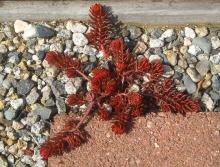
I spied a seedling of Sedum rupestre 'Angelina' that seeded into the pure gravel of my deck stair landing, looking mighty coral red. :o
Wow! That sedum is mighty red: wonder if you have an even redder form (if it came from seed): it might be worth growing alongside typical Angelina to see if it is a redder form...
Iam posting a link: I'm starting to do a short TV segment on a local TV program. You can at least see what I look like in it@
Panayoti... I'm fixated on your Fritillaria raddeana in its ethereal chartreusiness and brooding black tree-trunk-like stems
Reginald Farrer is alive and well and living in Massachusetts!!! ;D Beautifully descriptive phrase, Mark ... I didn't even need to look at the image! :D
Panayoti ... your multifarious talents are wasted on such basic material ... please convince the television company to reach out to a more educated and appreciative audience (i.e. the alpine fraternity). :D
Things are slowly but surely plumping up and showing hints of lively color. In a trough, Penstemon breviculus leaves remain evergreen all winter, typically with a winter burnish of red, but the color seems more pronounced now. Buds on a misnamed Draba (of the D. hispanica type) await a warmer day to pop their first blooms. The Penstemon in flower can be seen here: http://nargs.org/smf/index.php?topic=300.0
Townsendia rothrockii buds are swelling with promise:
I've shown Crocus gargaricus with blooms wide open, but I do find the unopened golden dumplings visually amusing, popping straight out of the ground without leaves, anchored to the ground by whitish cataphyllls (basal bracts); not sure why but they conjure up an image of woman's lipstick and make me smile.
I can't say that I miss the snow anymore! The snowdrops have flowered for a while but when I came home today after finishing work the sun still shone and I could picture the flowers open!
In the woodland Rhododendron moupinense has opened it's flowers too.
I had six inches of wet snow a few days ago, and the Iris suaveolens is again covered. But the sun is more intense now, and things are melting even though it hasn't gone above freezing.
Fargesia rufa popped out of the snow two weeks ago, and I am surprised how good it still looks. Usually, as soon as it is exposed to the elements in late winter/early spring the foliage begins to dry. I believe it is because the ground is already at or near the thaw point. Most winters, our soils freeze at least 2-3ft deeper.
Thuja koraiensis (Korean Arborvitae) with last season's cones, and showing the white lower surface of its green foliage.
Thujopsis dolabrata var. hondai, the most cold hardy form, seems to be doing well here in zone 4a. It is interesting to note that this one's foliage turns darker in winter, while Thuja koraiensis foliage turns slightly lighter.
A little rabbit damage on Lespedeza bicolor. This is an area where the wind whips through, and blows a good portion of the snow away. In the photo is a yardstick for comparison. This is the first time anything has eaten the Lespedeza. Usually the rabbits go after the shrubby willows (untouched this year!) and the Leitneria. It took several years before that Lespedeza bicolor decided it wasn't going to be a herbaceous plant any more. Mama is a 9ft. shrubby tree in Chicago.
I have to say, Lori, that your Dracocephalum looks way better than mine ever does after the snow melts. Bravo! (and very cute)
Trond, Rhododendron moupinense is one of the few rhododendron species that can do well here. My place is too dry for any rhododendrons, and I am a terrible waterer during the summer to boot.
It's lovely to see such greenery and bloom, Maggi! Among all the glorious sights in your photos, the size of the Eranthis is especially incredible! (The poor little wretches only manage to get to about an inch and a half for me here.)
Rick, I'd love to see that Lespedeza again later on when it's in bloom. It's curious that it can even take on tree form! The Fargesia looks terrific. So it's not usually so pristine-looking, come spring? Sounds like it is usually mostly evergreen, if not completely, for you?
Lori, I guess the Eranthis are about six or so inches high now... they always get much taller as the flowers fade.....making a really nice green patch for a while... before the next batch of plants get going.



Comments
Fermi de Sousa
Re: What do you see on your garden walks?
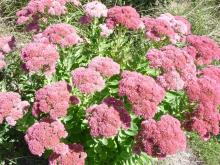
Sun, 03/06/2011 - 11:17pmThe "sedums" are doing really well this year after all that summer rain we got! This is one of the Hylotelephiums, possibly "Autumn Joy"
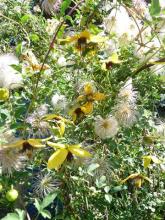
Clematis "Golden Tiara" is also still looking good with new flowers adorning the silky seed heads,
A native "Bluebell", Wahlenbergia stricta is liking conditions in a sand-bed
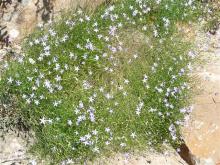
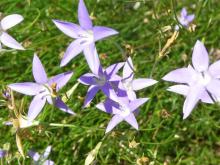
A rather pale cutie is this Linum tenuifolium grown from Seedex 2010(?)
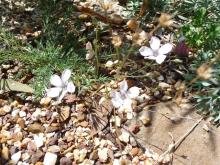
which I'm hoping will re-seed.
cheers
fermi
Lori S. (not verified)
Re: What do you see on your garden walks?
Mon, 03/07/2011 - 8:22pmBeautiful, Fermi - how nice to be reminded of summer turning to fall! I've been intrigued for some time by Wahlenbergia (being kind of a campanula nut) but I suspect they'd only act as annuals here.
I like the Linum tenuifolium too. I have found growing Linum from seed surprisingly difficult (well, surprising especially given that one sees entire blue fields of flax in these parts!)
Todd Boland
Re: What do you see on your garden walks?
Tue, 03/08/2011 - 11:09amTrond, I live in the land of fog and it can get darn depressing day after day. having said that, I could use some now as fog is great at melting snow...and we still have scads of that! It has been sunny and 8 C this past 2 days so the snow is settling but there is just so much on the ground...still about 3-4 feet over most of my back yard. I actually dug out my crevice garden as I am desperate to see some soil!
cohan (not verified)
Re: What do you see on your garden walks?
Tue, 03/08/2011 - 11:53amDaytime fog is not at all common here, its usually a nighttime (or at least morning.evening) phenomenon, though at this elevation we are sometimes in the bottom of the clouds ;)
3-4 feet is a lot of snow--we have that much around paths and drives where its been piled up from shovelling, otherwise probably more like 13-18inches in most places, tending to less around spruce and in mixed woods (except north side of woods in the low areas where willows grow, which always has the most snow).. no doubt it will stay here much longer than in Newfoundland, though anything can happen this time of year--Wed +2C, Fri -8C with possible snow (they downgraded periods of snow to 60%chance of flurries, yay!)
A random image from warmer days, an Achillea millefolium growing just up the road--the first time I have seen pink in the wild populations! The close-up may or may not make it look pinker than in real life--it was pale but noticeable as I rode past on my bike....
And one of its basically white cousins with a pollinator...
Trond Hoy
Re: What do you see on your garden walks?
Tue, 03/08/2011 - 12:28pmTodd, fog is not uncommon in spring when the air warms and the sea still is cold but fortunately we are spared the worst as it tends to be more foggy at the other side of the fjord and nearer the coast (the fjord runs south - north here and I live at the east side).
Cohan, is yarrow a native plant at your place? Here pink (light pink, not dark) yarrows are not uncommon, especially at our cabin in the mountain where I am now. Not much snow here - 3/4m I think. Haven't had time skiing though, the sewage is frozen further down the valley and all the neighbors "spent food" has found it's way up through our toilet - the floors of the bathroom, toilet and entrance flooded with..... Have done the worst cleaning job ever!
And I can't comment on Fermi's pictures, I can't see them!
(Trond, Fermi's photos have been fixed - Mark McD.)
Mark McDonough
Re: What do you see on your garden walks?
Tue, 03/08/2011 - 3:59pmI know the snowdrops I show here are very common, but they are the harbinger of spring in my garden, followed closely by Crocus vitellinus, and this year Colchicum kesselringii that a friend sent last fall, is blooming now too. The yard and gardens are still covered with an 18" glacial layer of hard-pack ice, but in a couple spots, such as the warm sunny south side of the house, snow receded and a few bare bits of ground can be seen, and much to my surprise, there were snowdrops! Nice :D
cohan (not verified)
Re: What do you see on your garden walks?
Tue, 03/08/2011 - 11:55pmI have to apologise for my brain apparently not functioning this morning, I somehow thought I was posting to image of the day, earlier...lol Oh well, I suppose it was only somewhat off topic :rolleyes:
Trond: yes yarrow- Achillea millefolium - is a very very common native here, but nearly all white--till now! I was also pleased to find A sibirica the last two summers--just an occasional plant--maybe only in one spot, and last year I got some seed, I really like the form/foliage of sibirica: taller, straighter and neater..
I'd be interested in seeing your pink yarrows; I may yet break down and get some seed of hybrids, I really do like some of the colours, and want some other species--rock garden and larger--I want one of the 'white' leafed yellow flowered tall ones..; I have seedlings from last year (hopefully alive under the snow) from Gardens North of ACHILLEA sibirica var. camtschatica--which has pink flowers, very different foliage from the regular form too, it seems, but haven't seen mature foliage yet..
Trond Hoy
Re: What do you see on your garden walks?
Wed, 03/09/2011 - 11:36amCohan, I'll show you pictures of the yarrows - but you have to wait some months ;D I haven't pictured yarrows, they are ubiquitous!
Nice to see snowdrop, Mark. I'll take a look at mine when I've time and it is sun!
cohan (not verified)
Re: What do you see on your garden walks?
Wed, 03/09/2011 - 11:52amI know what you mean, Trond; I try to photograph every flowering species, especially when they first start.. after they are going for a long time, I tend to taper off..lol--stilll, the summer is so short, there are very few flowers I get tired of (apart from the cursed foreign buttercup, and slightly less, clover and dandelions!)
Trond Hoy
Re: What do you see on your garden walks?
Fri, 03/11/2011 - 9:18amA little walk in the garden between the showers - rain - hail - sleet! Got an inch of white stuff last night and early morning but it thawed during the day.
The snowdrops dropped a little by the weight of the white stuff and a Helleborus thibetanus takes it time to flower.
The Hellebores in the wood fared better and the snow receded quickly. Some Crocuses struggle, not with snow but with old leaves.
cohan (not verified)
Re: What do you see on your garden walks?
Sat, 03/12/2011 - 12:01amCongratulations, Trond--spring finally arrived for you! It'll be a while yet here, so its good to see some photos from elsewhere ..
Trond Hoy
Re: What do you see on your garden walks?
Sat, 03/12/2011 - 11:43pmThanks Cohan! But spring comes and goes here and is slow in progress. The spring does last to May :o We can still get snow and sleet :(
cohan (not verified)
Re: What do you see on your garden walks?
Sun, 03/13/2011 - 10:11amSpring comes and goes here too, but we wont have any wildflowers until end of April or early May, I don't yet have much planted for spring to make it earlier, my one spring bulb bed turned out to be a cold spot, so its not early..lol
This week we will have days well above freezing, but there will be snow again, we aren't safe until late May/June....
Fermi de Sousa
Re: What do you see on your garden walks?
Mon, 03/14/2011 - 11:58pmAnd here it is starting to feel like autumn with the "late bulbs" like Lycoris coming into bloom,
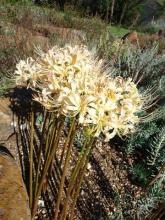
Lycoris elsae
and the red one we grow as L. radiata but which I'm told isn't!
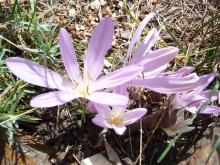
The colchicums are also doing their stuff: Colchicum cilicium (pale form) is slowly clumping up
cheers
fermi
Panayoti Kelaidis
Re: What do you see on your garden walks?
Thu, 03/17/2011 - 5:18pmWe've just been through a toasty week and lots is coming into bloom: there are a bank of daffodils out on the parking lot of the gardens in full bloom, and the first Magnolia stellata opened by the Botanic Gardens house and the first corydalis are out (of course I forgot to photograph all these!)...but there are enough things to give a taste of the blustery steppe spring on the Colorado piedmont...I start with Bulbocodium vernum, which seems to do well in a variety of sites around Denver Botanic Gardens: I neglected to photograph the little dark pink forms of Colchicum szovitsii that have just opened at my house (much daintier). Two shots of my best Cyclamen coum--one with back lighting and the other not. These have finally found a shady site they like. Then there is the ever charming Eranthis hyemalis: can one ever have enough of this? The Fritillaria raddeana alarms me by its early bloom: I don't think we have as attractive a form as I've seen in pictures: it is rather greenish. Our F. imperialis are just breaking ground and this is in full bloom: makes me nervous since we are sure to have some more very cold weather. And Christmas roses have been blooming for months and they are now turning deep reds as they set seed....I've barely scratched the surface! I will have to do another post!
Panayoti Kelaidis
Re: What do you see on your garden walks?
Thu, 03/17/2011 - 5:32pmI have just posted ten pix, and they were not enough! Way too much is already blooming. I have over 30 different kinds of things in bloom at home, and the Gardens are exploding! The Galanthus are starting to go over in more exposed spots (although there are still a few patches of snow in the darker corners where they'll be coming up for some weeks to come!) The first picture is of a giant form of Galanthus elwesii I got from Don Hackenberry 30 years ago! The next is a more typical form that has naturalized at the gardens...and the nivalis 'Viridapice' which I find to be quite vigorous. I have a special spot in my heart for reticulate irises, and this seems to be a banner year for them. I have two shots of Iris danfordiae, which seems to perenniate if you can keep it dry in summer (we grow it in groundcovers or grass to achieve that). I have 'Katharine Hodgekin' all over my garden (I blogged about it recently as well: there's quite a story about it:http://prairiebreak.blogspot.com/2011/03/whats-in-name.html). And I include closeups of 'Harmony' and 'Pixie' two of my favorite dark blues. We have drifts of 'Harmony' on a steep slope with blue gramma grass where they are quite happy. I guess you will miss my pix of early Muscari, townsendias, hellebores galore, a bevy of early drabas, and so on and so forth: the new year is rushing headlong and dragging me with it. There's nothing like early spring! (Or is it late winter?)
Mark McDonough
Re: What do you see on your garden walks?
Thu, 03/17/2011 - 8:11pmFermi, great fall color, as we're just starting to emerge from under a mantle of snow and ice in the northern hemisphere. I love the white Lycoris, a genus I have not succeeded with yet, in spite of getting some bulbs from Mr. Lycoris himself, James Waddick. The name Lycoris elsae is probably referring to Lycoris elsiae Traub, Pl. Life xiv. 43 (1958).
It is a perplexing entity, this elsiae, and here are some links I found that help provide clues to the mystery:
[pbs] Lycoris straminea, houdyshellii, and L. elsiae:
http://lists.ibiblio.org/pipermail/pbs/2010-September/038606.html
"Some authors describe that Lycoris albiflora Koidzumi is a natural hybrid of Lycoris radiata (L’Héritier) Herbert and Lycoris traubii Hayward"
Found a link for Lycoris albiflora, a species from Korea and China, with the synonym of Lycoris elsiae Traub
http://flowers.la.coocan.jp/Amaryllidaceae/Lycoris%20albiflora.htm
http://www.efloras.org/florataxon.aspx?flora_id=2&taxon_id=200028053
All I could do here is raise questions, sorry, I don't have any answers, just not very experienced with the beautiful genus Lycoris.
Mark McDonough
Re: What do you see on your garden walks?
Thu, 03/17/2011 - 8:23pmPanayoti, your spring season seems so much more advanced than New England, I'm so jealous. Today it suddenly warmed up and reached 60 F (15.5 C), but it seemed semi-stupid as most of the yard and garden are still covered with a 12" thick (or thicker in places) mantle of snow, the ground still frozen beneath.
Of your floral spectacle, I really liked Galanthus nivalis 'Viridapice', such drooping elegance (and it actually looks different than many snowdrops). ;)
Now I've seen plenty of photos of Iris danfordiae, that elfin golden yellow reticulate Iris, but interplanted with glowing orange Sedum rupestre 'Angelina', sheer brilliance!
And the shot of blue pools of Iris reticulata 'Harmony' amidst the pale amber of dried grasses, who would have thought of such a combination, double brilliance!
Mark McDonough
Re: What do you see on your garden walks?
Thu, 03/17/2011 - 8:51pmToday it was suddenly very warm, almost summer like, after such a long spell of cold and freezing weather. The snow has receded from a few areas where spring bulbs are plants. Yesterday, a patch of ground where Crocus biflorus ssp. isauricus was planted, the receding snow-pack revealed flattened buds of this crocus squashed and lying miserably under the weight of the snow, but today with the warmth, they all popped open.
Stepping away a little bit is a reminder that winter snow is still predominant; we'll need a number of such warm days to melt the snow-pack layer.
cohan (not verified)
Re: What do you see on your garden walks?
Fri, 03/18/2011 - 12:11amPanayoti--what a wealth of spring glory! I can only second some of Marks specifics, esp for the irises, Love the wild form of reticulata..
Mark, congrats on blooms! Everything here still looks like your last pic.... nothing here can bloom out of the snow, unless its a late spring snow after the pack has melted and ground thawed! The ground will still be solidly frozen in most places until some time after snowmelt...
Howey (not verified)
Re: What do you see on your garden walks?
Fri, 03/18/2011 - 4:22amYesterday, St. Patrick's Day, was the first day it was possible to see signs of life in the garden - Daphne mezereum, which was prostrate under the snow, has straightened up and the flower buds are swelling - lots of yellow Winter Aconite, Iris reticulata shoots and snowdrops. Tulip and Hyacinths under the house eaves are up 3 inches now and Belladonna lilies which I transplanted into the University Courtyard (home of FOGS) last year, have survived and are coming up in good health. Over in the tiny bog that one of our members created last year, the Lobelia cardinalis "placemats" look full of health. In my own garden Lobelia cardinalis alba, Arum maculatum and that wonderful Polygala appear not to have been hurt at all by our really terrible winter. Calycanthus floridus is just a mass of disjointed twigs - it did suffer. However, some of those twigs, which I brought indoors and put into a vase with Cornus mas branches, have begun to leaf out, as has a small pot of Begonia sutherlandii. No pictures yet but perhaps soon? Fran
Frances Howey
London, Ontario, Canada
Zone 5b
Trond Hoy
Re: What do you see on your garden walks?
Fri, 03/18/2011 - 5:01amHere it is back to square one - 10cm of wet snow this morning! But as the ground no longer is frozen I hope it will thaw during the day. This is quite normal for March weather though.
Fermi, wether it is Lycoris radiata or not don't matter to me! It is a nice plant anyway.
Kelaidis, you do not lack plants! I believe you have a lot of sun in daytime but that you experience freezing temps during nighttime?
Panayoti Kelaidis
Re: What do you see on your garden walks?
Fri, 03/18/2011 - 7:00pmHoy,
We get over 300 days of sun a year (more than Cairo and Athens! They have more clouds in winter than we do)...but we get frost until May. We often have Magnolias crisped...although the coming week is supposed to stay mild. I would be surprised if we don't get some very cold days still this winter.
Lori S. (not verified)
Re: What do you see on your garden walks?
Fri, 03/18/2011 - 7:34pmBeautiful shows, Panayoti, Mark and Trond! Wonderful fall flowers from the other side of the world too, Fermi!
The big melt is on here, and as this year's heavy snow rapidly disappears, it's encouraging to see signs of life...
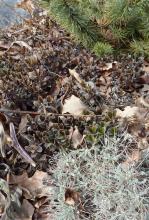
Some native and exotic plants in juxtaposition - bristlecone pine, Astragalus angustifolius and kinnikinnick (Arctostaphylos uva-ursi)
The following few are new from last year:
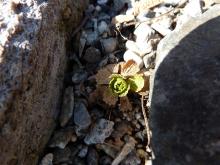
A teensy rosette of Dionysia involucrata, looking reasonably lifelike...
Papaver kluanense
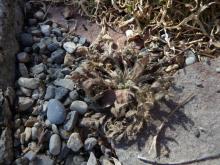
Physaria alpina
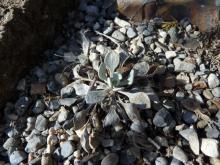
Anacyclus marrocanus
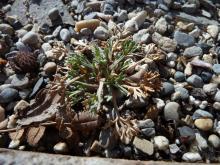
Eriogonum saxatile
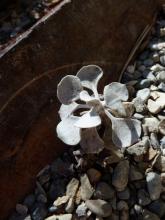
Elsewhere in the garden:
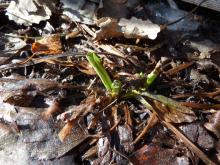
New growth on Caltha leptosepala
Evergreen foliage on Epimedium x versicolor 'Sulphureum' and a hellebore:
cohan (not verified)
Re: What do you see on your garden walks?
Fri, 03/18/2011 - 9:21pmLori, you are way ahead of me! I we get more weather like last week (+5C and higher) the snow will go fast, but we are back to barely above 0 days, or below; plus, much of my place is shaded, esp until the sun is higher, so we keep snow longer, except for a few spots..
hoping we will dodge the forecast 15-30cm of snow forecast for parts of the province the next couple of days; now looks like it may be farther south/west...
Richard T. Rodich
Re: What do you see on your garden walks?
Sat, 03/19/2011 - 8:35pmLori is way ahead of me too, here near Minneapolis, Minnesota. No gardens' soil is showing yet, although there are spots of grass showing in the yard. But the big melt is on here too, and the three bridges over the Minnesota River closest to me are expected to closed by mid to end of this coming week due to flooding! Makes me feel very fortunate that I live on the same side of the river as where I work. Many fellow employees will be driving an extra 20-25 miles each way to get to work.
Rivers' flooding is expected to be very bad here this spring. The city of Grand Forks, MN on the Red River (flowing north) has stock piled 1.5 million filled sand bags.
cohan (not verified)
Re: What do you see on your garden walks?
Sat, 03/19/2011 - 9:05pmOh, Rick, you are in one of those areas! I talk to lots of Manitoba folks in another forum, they are watching the rivers too....
Luckily, there is really nothing much around here that could flood--we get water standing in fields and roadsides, that's about it..even if the rivers in Rocky Mtn House or Red Deer did flood, it would be very local...
Trond Hoy
Re: What do you see on your garden walks?
Sun, 03/20/2011 - 2:10amRyvarden lighthouse. It has been a beacon here for more than 1000 years. You are not allowed to drive but have to walk a few miles along the road. It is popular by all kind of people particularly in the summer.
View north and east across the open sea "Sletta" and the "Bømlafjorden" fjord. Here the weather and the sea can be very bad. You can see the snow covered mountains in the east.
it is mostly heather and grass growing here. No early springflowers! The kinnikinnick is very common here Lori ;)
Richard T. Rodich
Re: What do you see on your garden walks?
Sun, 03/20/2011 - 10:00pmThe Red River flowing from Minnesota and into Manitoba is especially prone to flooding because the drop in elevation per mile is so little. It takes a long time for such flat areas to drain. The Minnesota river is not as bad, but historically is a river with large natural fluctuations in volume. It's really quite a spectacle to view the river at spring flooding from atop a river bluff, when you know what a "trickle" of water it becomes in late summer.
My little piece of land is at the top of the highest hill for for miles around. (But you would never realize it just be looking at it.)
Lori S. (not verified)
Re: What do you see on your garden walks?
Sun, 03/20/2011 - 10:23pmI'll bet you're glad for that hill, Rick!
Beautiful sights, Trond. It's nice to see blue water and blue sky. Yes, kinnikinick is very common here too, though maybe not so common in people's yards.
Hope you did not get all the forecasted snow, Cohan. We've only gotten a couple of centimeters so far here.
Richard T. Rodich
Re: What do you see on your garden walks?
Sun, 03/20/2011 - 11:03pmMy higher elevation really doesn't matter as I am 15 miles from the river: the last half of the Minnesota River (maybe 100 miles?), the river bottom is pretty much flanked by low bluffs, and that general elevation is then maintained throughout my area. Many towns are situated in the river bottoms, however.
cohan (not verified)
Re: What do you see on your garden walks?
Mon, 03/21/2011 - 1:41amGood to know you are not right in the flood path, Rick, that would be awful....
Lori, we got something like 3-4 inches last night through early this afternoon (sat night/sunday) not bad considering they were talking about 15-30 cm for some areas, and we weren't clear if we'd be in that zone or not! Still merited an hour and half or more of 2 man intensive shovelling..
Happily, they have removed snow from Monday's forecast, though its still there for Tues and Wed--looks like another big system, this one should be farther south, mostly, looks like Calgary might be right in the middle of that one?
Looked at the mounds of snow beside the driveway today, chest high in places and a few metres wide....
Panayoti Kelaidis
Re: What do you see on your garden walks?
Tue, 03/22/2011 - 10:36amSpring is springing a bit too quickly: our star magnolia is nearly in full bloom at the gardens (pix in my camera still)...but I have a enough pix from the last week to share: sunny and bright every day. The skies have forgotten how to rain! Oh well...at least we have lots of snowpack so we can water to our heart's content for a while...
Snowdrops and Helleborus niger going over, as are the earlier crocuses. Lots of daffodils are out as are the first tulips. I love this time of year! Fritillaria raddeana is a new one for me: what a beauty! Looks a lot like F. imperialis, only a month earlier, and a cool chartreuse. I am curious to see how it will fare with our inevitable cold snaps we shall get for the next few months eventually! I am not positive about Crocus versicolor: it may be C. veluchensis: can anyone weigh in? I've missed several of the spring colchicums already: they are a variable lot. I finally found a spot Trillium nivale seems to like: now I need to get some more! Aaah Spring...from here on out it's a roller coaster.
Mark McDonough
Re: What do you see on your garden walks?
Tue, 03/22/2011 - 3:08pmPanayoti...Aahhh Spring indeed! An awesome start to the season. I'm fixated on your Fritillaria raddeana in its ethereal chartreusiness and brooding black tree-trunk-like stems :o :o :o :o Nice going with Iris nicolai outside too! As I'm writing this, had to dash outside to see if there's any sign of Trillium nivale in my garden, but the snow only just receded from the east-facing slope it is planted on, and no signs of life yet, the ground still frozen.
Mark McDonough
Re: What do you see on your garden walks?
Tue, 03/22/2011 - 3:27pmAside from crocus and other early spring bulbs on the sunny and warm south side of my house, there isn't much else brewing significantly just yet... the ground needs to warm up a bit, a couple cold days with some snow causing some delay. As the snow recedes, I inspect the extent of tunneling and mice/mole/vole/shrew damage to the yard and garden areas. Activity is greatest in the fall, and I generously "fed" the tunnels last fall, but still see remnants of activity. All has been tromped down and raked over; any new signs of activity will be dealt with.
Where snow has melted away from troughs, there are signs of growth, a couple Draba ready to pop blooms. I am struck by the winter foliage color on Globularia repens 'nana', a plant I bought from Harvey Wrightman, with micro-tiny leaves that are about as black as any black-leaved plant that I know of. It gives me an idea, a planting of this Globularia, with the blazing orange wide-spread goblets of Crocus gargaricus piercing the flat mats of Globularia goodness. Is this the same as G. nana (a valid name), or is it truly a microform of G. repens?
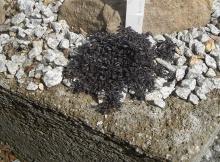
http://www.wrightmanalpines.com/details.asp?PRODUCT_ID=G072
PS: the labels in my troughs are scheduled to disappear, after I document maps of each trough. :)
I spied a seedling of Sedum rupestre 'Angelina' that seeded into the pure gravel of my deck stair landing, looking mighty coral red. :o
Panayoti Kelaidis
Re: What do you see on your garden walks?
Tue, 03/22/2011 - 7:34pmWow! That sedum is mighty red: wonder if you have an even redder form (if it came from seed): it might be worth growing alongside typical Angelina to see if it is a redder form...
Iam posting a link: I'm starting to do a short TV segment on a local TV program. You can at least see what I look like in it@
http://www.kwgn.com/lifestyle/green/
I must have taken over 100 pictures today at the Gardens and at my home. Tomorrow I visit Sandy Snyder and her fabulous grass garden.
Cliff Booker
Re: What do you see on your garden walks?
Tue, 03/22/2011 - 11:34pmReginald Farrer is alive and well and living in Massachusetts!!! ;D Beautifully descriptive phrase, Mark ... I didn't even need to look at the image! :D
Panayoti ... your multifarious talents are wasted on such basic material ... please convince the television company to reach out to a more educated and appreciative audience (i.e. the alpine fraternity). :D
Panayoti Kelaidis
Re: What do you see on your garden walks?
Wed, 03/23/2011 - 7:51amDon't worry, Cliff: I will be slipping lots of alpines into the mix!
Mark McDonough
Re: What do you see on your garden walks?
Wed, 03/23/2011 - 9:39amalpine peas... astragalus and such ;D
Mark McDonough
Re: What do you see on your garden walks?
Wed, 03/23/2011 - 12:44pmThings are slowly but surely plumping up and showing hints of lively color. In a trough, Penstemon breviculus leaves remain evergreen all winter, typically with a winter burnish of red, but the color seems more pronounced now. Buds on a misnamed Draba (of the D. hispanica type) await a warmer day to pop their first blooms. The Penstemon in flower can be seen here: http://nargs.org/smf/index.php?topic=300.0
Townsendia rothrockii buds are swelling with promise:
I've shown Crocus gargaricus with blooms wide open, but I do find the unopened golden dumplings visually amusing, popping straight out of the ground without leaves, anchored to the ground by whitish cataphyllls (basal bracts); not sure why but they conjure up an image of woman's lipstick and make me smile.
Trond Hoy
Re: What do you see on your garden walks?
Wed, 03/23/2011 - 1:15pmMark, I think your spring is doing fine! Here it is almost standstill but that is quite normal.
Lori S. (not verified)
Re: What do you see on your garden walks?
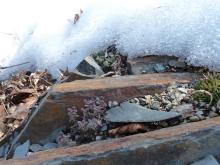
Thu, 03/24/2011 - 7:13pmNothing but snow all week here, but here's a snippet from before the snow... hope to see some of the rock garden again sometime soon. :rolleyes:
Dracocephalum palmatum, Androsace carnea and Aethionema glaucescens, as the glacier recedes...
Trond Hoy
Re: What do you see on your garden walks?
Fri, 03/25/2011 - 11:03amI can't say that I miss the snow anymore!
The snowdrops have flowered for a while but when I came home today after finishing work the sun still shone and I could picture the flowers open!
In the woodland Rhododendron moupinense has opened it's flowers too.
Richard T. Rodich
Re: What do you see on your garden walks?
Fri, 03/25/2011 - 8:41pmI had six inches of wet snow a few days ago, and the Iris suaveolens is again covered. But the sun is more intense now, and things are melting even though it hasn't gone above freezing.
Fargesia rufa popped out of the snow two weeks ago, and I am surprised how good it still looks. Usually, as soon as it is exposed to the elements in late winter/early spring the foliage begins to dry. I believe it is because the ground is already at or near the thaw point. Most winters, our soils freeze at least 2-3ft deeper.
Thuja koraiensis (Korean Arborvitae) with last season's cones, and showing the white lower surface of its green foliage.
Thujopsis dolabrata var. hondai, the most cold hardy form, seems to be doing well here in zone 4a. It is interesting to note that this one's foliage turns darker in winter, while Thuja koraiensis foliage turns slightly lighter.
A little rabbit damage on Lespedeza bicolor. This is an area where the wind whips through, and blows a good portion of the snow away. In the photo is a yardstick for comparison. This is the first time anything has eaten the Lespedeza. Usually the rabbits go after the shrubby willows (untouched this year!) and the Leitneria. It took several years before that Lespedeza bicolor decided it wasn't going to be a herbaceous plant any more. Mama is a 9ft. shrubby tree in Chicago.
Richard T. Rodich
Re: What do you see on your garden walks?
Fri, 03/25/2011 - 8:55pmI have to say, Lori, that your Dracocephalum looks way better than mine ever does after the snow melts. Bravo! (and very cute)
Trond, Rhododendron moupinense is one of the few rhododendron species that can do well here. My place is too dry for any rhododendrons, and I am a terrible waterer during the summer to boot.
Margaret Young
Re: What do you see on your garden walks?
Sat, 03/26/2011 - 9:18amThis is what I see this week in Aberdeen, North East Scotland..... too lazy to take my own so I stole the pix from Ian's Bulb Log!
M
Lori S. (not verified)
Re: What do you see on your garden walks?
Sat, 03/26/2011 - 9:59amIt's lovely to see such greenery and bloom, Maggi! Among all the glorious sights in your photos, the size of the Eranthis is especially incredible! (The poor little wretches only manage to get to about an inch and a half for me here.)
Rick, I'd love to see that Lespedeza again later on when it's in bloom. It's curious that it can even take on tree form! The Fargesia looks terrific. So it's not usually so pristine-looking, come spring? Sounds like it is usually mostly evergreen, if not completely, for you?
Margaret Young
Re: What do you see on your garden walks?
Sat, 03/26/2011 - 12:00pmLori, I guess the Eranthis are about six or so inches high now... they always get much taller as the flowers fade.....making a really nice green patch for a while... before the next batch of plants get going.
Trond Hoy
Re: What do you see on your garden walks?
Sat, 03/26/2011 - 1:11pmMaggi, your garden looks terrific!
Here the Eranthis are eaten before it reaches even a centimeter!
Rick, I had a Lespedeza but the summers are too cold so it never hardened off and froze each winter.
Margaret Young
Re: What do you see on your garden walks?
Sat, 03/26/2011 - 1:36pmThank you, Trond. We are fortunate not to have rabbits, voles or deer in the garden. Only some mice and a million slugs, snails and caterpillars . :-\
Pages