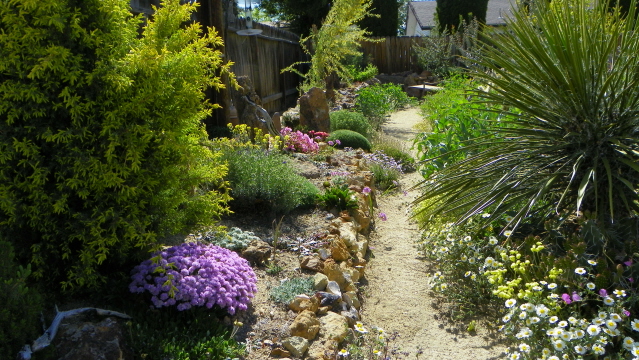
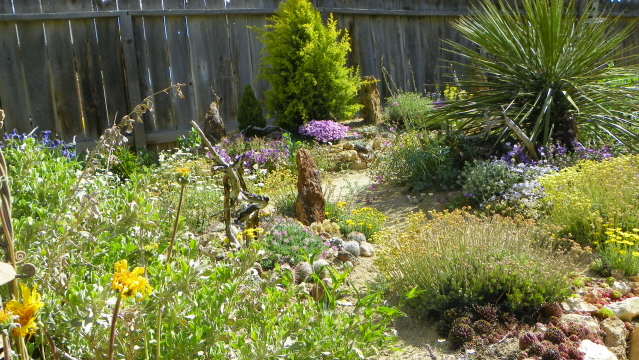
Two plants still going strong are the American Polemonium pauciflorum and the Chinese Stylophorum lasiocarpum. Both are short-lived perennials but selfsow moderately. They flower all summer and continue through the fall.
Very nice - Polemonium pauciflorum is one of my favourites. Not familiar with Stylophorum lasiocarpum... though I seem to recall a Stylophorum out in the yard that, unfortunately, never does much of anything. It's wonderful to have some plants that bloom all summer through!
A few things here, as the season rapidly winds down... 1) Very bizarre flowers of water hawthorn, Aponogeton distachyos, a South African water plant that goes dormant in mid-summer (even here in our short season), then develops leaves and flowers again in fall. 2) Native plant Gutierrezia diversifolia still in bloom, with Carlina acaulis in the back. 3) Lonicera x 'Dropmore Scarlet', against blue skies. 4) Rhododendron mucronulatum 'Crater's Edge' 5) Clematis tubulosa var. davidii, looking very washed out this year. (It's usually distinctly blue.) 6) Aster ericoides ssp. pansus, another native plant. 7) Onosma stellulata - still blooming in this very cool, wet summer! 8 ) Sempervivum and fall leaves
Right now, mid October, the loveliest plant in my garden is this Callicarpa - not sure of species - with it's eye-catching purple berries. Not sure how to get seeds for the Seedex - have squashed a few berries but the seeds inside are very tiny and hard to capture. Hope the attached pic gets through OK. Fran
You can buy food strainers of various weave sizes. I use a very fine weave that works well with my cactus seed that is suspended in a slimy gel. The seed is smaller than edible poppy seeds. Gently swirl and rub the seed against the strainer under running water.
I processed seed from Aralia elata once. I took a good amount of time. Later, when I saw what the seed is supposed to look like (larger and heftier), I realized the seeds I extracted were not viable and never really developed, even though the berries looked normal. Hopefully, this is not the case with your Callicarpa.
Below is my maiden bloom of Aconitum incisifidum. One slender, 4 ft. stalk that is amazingly sturdy, with still unblemished foliage of heavy substance.
Fran, your Callicarpa looks like dichotoma, but I must admit, some Callicarpa species look fairly similar, so don't hold me to that identification. I get seedlings under my main shrub from the berries dropping, so it might be possible to gather them up and sow them without cleaning... I do that with Arisaema seed all the time and still get good germination.
Rick, I've not heard of that Aconitum, but there are some grand fall blooming ones such as the one you show. A neighbor gave me a clump that I've been admiring next to their mailbox, growing 5-6 feet, just coming into bloom now, but the plant from a friendly local garden-club lady, latin names are largely optional, so I don't know which one it is.
Right now, mid October, the loveliest plant in my garden is this Callicarpa - not sure of species - with it's eye-catching purple berries. Not sure how to get seeds for the Seedex - have squashed a few berries but the seeds inside are very tiny and hard to capture. Hope the attached pic gets through OK. Fran
I once learnt from a gardener to let soft berries rot before you try to rinse the seeds. Then the (remains of the) pulp is easy to wash away. (He also said it improves germination by breaking down germination inhibiting chemicals.) If the seeds are very fine you have to use a special sieve, though!
The birches have lost almost all their leaves but other plants in the garden still linger. 1) Remnants from the kitchen garden, a battered artichoke we forgot to eat. 2 and 3) Clematis orientalis (probably 'Bill McKenzie') never gives up till devastated by frost and storm. The plant produces more and more flowers in the fall. 4) The fuchsias are stayers too. 5) The Kiwi plant on the wall grows enormously every year and I have to cut it down so that it don't completely swamp the house. The longest shoots are 4-5 meters.
Right now, mid October, the loveliest plant in my garden is this Callicarpa - not sure of species - with it's eye-catching purple berries. Not sure how to get seeds for the Seedex - have squashed a few berries but the seeds inside are very tiny and hard to capture. Hope the attached pic gets through OK. Fran
I once learnt from a gardener to let soft berries rot before you try to rinse the seeds. Then the (remains of the) pulp is easy to wash away. (He also said it improves germination by breaking down germination inhibiting chemicals.) If the seeds are very fine you have to use a special sieve, though!
On some genera, such as with Magnolia, I do exactly that... put the fleshy red "berries" in a container of water and soak for up to a week, changing the grungy water every other day. Then when they're totally soft and mushy (and a bit stinky/slimy) it is easy to squeeze out the fairly large black seed. The seed is dried and stored in plastic bags with peat moss (only ever-so-slightly moistened), kept in the vegetable crisper in the refrigerator, and in spring when the weather warms up, sow the seed, and you get about 100% germination in a week or two. But for some seed, I don't bother removing the pulp, and I still get good germination with Arisaema, and self-sown germination with Callicarpa.
Now I'm wondering how to handle my Ophiopogon umbraticola, the beautiful blue berries are starting to fall off, so time to harvest them... maybe I'll experiment, 1/2 soaked and pulp removed, the other half sown as is. Addenda: just harvested two dozen Ophiopogon seeds, and will try my experiment. Last year I only had 5 seeds produced, and I scratched them all in around the parent plant, but received no germination... that is, until just now when I harvested the seed, there was a single spiralling leaf seedling! Took a full year to germinate, cool.
2 and 3) Clematis orientalis (probably 'Bill McKenzie') never gives up till devastated by frost and storm. The plant produce more and more flowers in the fall.
Awesome Clematis, just look at all those flowers, so late in the season.
My plants look not too unlike the last photo above... though I'd prefer them to look like the furry little trolls in the first two photos!! I've come to realize the conditions in the new tufa bed are much too rich, and assuming these plants survive the winter, I'll have to starve them into character next year. (I assure you that next spring's tufa bed addition will be lean and mean! ;D)
2) Nepeta phyllochlamys has been hardy for a few years nowcorrection: through 1 winter so far... the foliage is pleasantly furry. Flowers are almost insignificant... though mildly interesting in extreme close-up!
3) Tanacetum tibeticum from Pavelka seed this year (Description: "5000m, Tanglang La Pass, Zanskar, India; dwarf suffruticose silvery-grey cushions 5-15cm; erect scapes with 2-5 yellow flowers; 2005 seed").
Lori, all three are really nice... I particularly like Marmoritis complanatum (Phyllophyton complanatum), never heard the name Marmoritis, but I'm vaguely familiar with Phyllophyton. I'll have to check back on the efloras pages, they're timing out so must be busy.
In your threesome, I see an old friend. Nepeta phyllochlamys I grew from the Turkish MacPhail & Watson expedition back in the latter 1970s, and it proved hardy outside for a number of years, making a most satisfactory fuzzy tumbling mound, great for a rock wall situation. While the flowers are small, they were so numerous to create a haze of color, so was actually effective in flower.
Not the most exciting time of year for walking in my garden. However, the first frost came two nights ago leaving in its wake the usual deep green drooping leaves of the Dahlias and the tiny yellow and weedy Coyote tomatoes. The ground is now covered with leaves ready for raking. Random bits of color - one mauve cluster on the lilac bush, only one pink flower on Erodium richardii, a single wee stalk of that beautiful blue Eritrichium canum, and those hard to kill California poppies running through it all. The last red rosebud of summer is on the New Dawn Rose and Crysanthemums still in flower. Those maculate leaves of Arum maculatum are up now and restarting their cycle. Christmas Cactus and a Bottlebrush have only benefited from a shot of frost and are now indoors for the winter. Just cut the top off a Juniper which was small but grew without my noticing. The Smilax vine looks like it will be evergreen. So now it is just a matter of having faith that the nice things will survive the oncoming cold and snow, the chicken wire around small trees and shrubs will hold out the rabbits and concentrating on feeding the birds. Time to assess 2010's high and low lights and start to sow more seeds for 2011. Frances Howey London, Ontario, Canada Zone 5b
Frances, it is certainly time to "put the garden to bed"; been doing the same here. I was curious about your comment on "weedy Coyote tomatoes", as I have not heard of them before, so I googled to learn more about them. Are the "tomatoes" in the following link look like yours? Do you cultivate these and enjoy their fruit, or are they a garden escape (ref: weedy)? Interesting about the lycopene levels. http://www.aravaipa.com/Coyote-Tomato-Co.htm "Not a cherry tomato as some claim, but another nightshade species called Solanum pimpinellifolium, the Currant Tomato. Currant tomatoes contain about 40 times more lycopene than common tomatoes!"
We've had a couple nights down to the lower-mid 20s F (hard freeze), but a few things are still flowerings, among them the Asters or Symphyotrichum species. One of my favorites is Aster laevis or Symphyotrichum laeve var. laeve, which is utterly unfazed by the frost and continues flowering; they have been in flower for 2 months... one of the very best native asters.
Mark, very interesting what you wrote about the Currant Tomato, as that is what it appears to be. I do not deliberately cultivate it - it just pops up everywhere and is still producing edible fruit in the Friends of the Gardens Courtyard at the University. Was also interesting to note about the lycopene component which sounds pretty positive to me. I'd be happy to send you seed if you like? Surprising what turns up at the Local Horticulture Group meetings...that's where we got it. It is one of the few tomato volunteers that produces fruit before the killing frost comes here. Nice pictures of the fall asters. Among the mauve ones in my garden is one that is pink - plan to try to propagate it from seed over winter. A friend sent me pics of a deep pink one in her garden at Iron Bridge (North Shore of Lake Huron) which could be some type of cultivar - nice. Fran
A last few late-blooming alpines... My plants look not too unlike the last photo above... though I'd prefer them to look like the furry little trolls in the first two photos!! I've come to realize the conditions in the new tufa bed are much too rich, and assuming these plants survive the winter, I'll have to starve them into character next year. (I assure you that next spring's tufa bed addition will be lean and mean! ;D)
Lori, Your plants look much more like "furry little trolls" than mine ever shall ( I don't have these plants either). The moist climate and low angle of the sun here make many of the rock plants lax.
Frances, I never "put the garden to bed" if you mean covering plants or cutting down stems and leaves. I think the plants overwinter better if left to themselves. I also let the leaves lie except in the paths.
Very interesting indeed about the "coyote tomato" - one can't help but be intrigued by the description of "earthy, fruity, outrageous flavor"! :D
We don't usually do much of any "putting the garden to bed" here either - nothing gets covered, or cut off, normally. The exception this year was to appease my husband by cutting off the taller perennials right along the sidewalks, while things were still dry and the weather was good, in order to make snow shoveling easier later on. Even that I find strangely depressing to do - I really prefer to leave things standing 'til spring! :( We don't do any fussing around with leaves either... they just stay where they collect. (Not having any lawn makes it easier to follow a laissez faire policy on leaves, too, of course!)
In this amazingly warm fall, there are still a few things in active bloom, and some nice colour here and there: 1) Senecio polyodon, one of those amazingly hardy South Africans 2) Geranium x magnificum 3) A sparse few blooms on Androsace septentrionalis, self-seeded from NARGS seed... a much different and looser form than what I see in the mountains here 4) Jovibarba fall colour 5) Hylotelephium 'Autumn Joy' (or similar) 6) Veronica spicata ssp. incana 'Silbersee' 7) Arabis procurrens 'Variegata' 8 ) The ever-reliable and long-blooming Campanula rotundifolia 9) Geranium sanguineum
Lori, you're getting some great fall color there, and some nice late blooms... very colorful.
Hmmm, it seems that people don't like cutting back plants and perennials in the fall. Every year it's the same story for me, in spring stuff starts growing so fast that I work feverishly to do spring cleanup, cut back old foliage, twigs and stems, before new plant growth gets in the way and makes the task much harder to do. So, I now try and get as much pruning, cleanup, shearing, and debris removal done in late fall, so in spring I can concentrate on less mundane activities and enjoy the spring show.
So, today I went ahead and started shearing back Epimedium foliage. With a pair of sharp shears, it took me about 15 minutes to trim back about 25 epimedium plants near my deck... if I wait until spring and have to do micro-surgery to clear out the unsightly twigs and battered winter persistent foliage, being careful not to cut off spring shoots and flower buds, it might take me a couple hours. Yes, I'll miss some of the colorful foliar interest, but next spring I can just watch my "eppies" come to life without worry about cleanup. I did leave the leaves on a couple evergreen species, and depending on their condition next spring will either leave them on or cut them back if beaten up. Here are before, during, and after shots of this particular epimedium planting.
I need to do the same thing with Allium beds, tons more epimediums, and with other perennials; I hope the season holds out before the first big snow.
Mark, I wait until I see bare ground sometime during the winter and cut all the epimediums at that time. We always seem to have a snow-free period now. It's too early then to have to worry about spring shoots or buds. I used to wait until the snow melted but always lost a few small shoots no matter how careful I tried to be. We just don't seem to get the kind of continuous snow cover we once did. All of "my" snow seems to be dumped well south.
Some pictures taken about 10 days ago in this long, extended fall. Most of the garden has sensibly retired for the winter. Here are the last holdouts. 1. One flower on Petrocallis pyrenaica 2. Heterotheca jonesii scattered blooms 3. The last Salvia 4. Snake in trough - still hasn't moved There was a picture of epimediums in their fall color, but lost it when I was resizing pictures, oops.
How clever of you to identify it. You're exactly right. Actually, I bought this at a roadside cafe in Utah years ago as a replacement for a wonderful snake that we lost to a pair of red-tailed hawks. It was made from a willow branch and painted by the artist Jack Lambert. He did too good a job. We saw the hawks, who live here, dive down to the back patio. When we investigated we found the snake in pieces where one had grabbed it with its talons and released it in disgust. They've left the replacement strictly alone.
Dave, that is a plant to grow! I have started collecting Arisaema but I plant all in my garden hoping the best! I have none with such fine markings though.
Dave, that is a plant to grow! I have started collecting Arisaema but I plant all in my garden hoping the best! I have none with such fine markings though.
Thanks Trond
I've just about finished the remodelling of another woodland plot so eventually all the potted Arisaemas will be planted out.....
Finally started seriously using my new SLR camera which i purchased 3 months ago. Close up pic of a Geranium sps .
oooh Dave, that photo is worth clicking on (quick everyone, click that photo to see the enlarged view), just look at the tracery of blue veins against the pink petals... wonderful detail. Any idea about what Geranium species or hybrid it might be? There have been some posts on SRGC lately with some really good links to Erodium and Geraniacaea that capture the imagination during these winter days (well, at least winter days for us northern hemisphere folks ;))
Yes i do know the name Mark --it's just that i can't remember for the moment .... :-[ sigh! As soon as it comes to me i'll post it's name .
I'll go out and obtain a picture of the clump once this welcome rain stops. . i've had this plant for at least 20 years--a real 'go doer' in the garden here --easy to divide. Not sure if it sets seed as i tend to cut the stems and sometimes the foliage later in the season when the growth gets a bit floppy.
I'm glad that Dave has started off the new year on this thread - I can now post a few pics of our garden in "high summer" - the rains so far haven't let us feel it's really summer yet! At least it's a change from the usual heat and drought! The first is a calochortus which has just opened the last flower for the season Calochortus fimbriatus.
Fermi, from what I've seen on postings on SRGC by folks from Australia, it seems that the genus Calochortus do well in Australia. I bet there are few here in the US that can boast growing C. fimbriatus, a fantastic species and VERY NEW to the taxonomic scene described just 10 years ago in 2001. What is your source for this species? How many Calochortus do you grow and what is your basic cultivation regimen?
PS. You get a Gold Star, you wasted no time in reading my FAQ on how to use the syntax for "inline" image attachments on the forum, this was just added today! Of course, you've been using that technique on SRGC already, so maybe I should just award a Silver Star ;D. The FAQ and others are found here: http://nargs.org/smf/index.php?board=1.0
This is Lewisia brachycalyx emerging in the rock garden today.
I always find it exciting to see new growth on plants that estivate, given the uncertainty of whether they made it through the summer and fall. Lewisia rediviva emerges in October in our garden but Lewisia brachycalyx and Lewisia nevadensis don't show up until January or February, eventually flowering in spring before disappearing again.
W.H.N. Preece writing in 1937 said this about Lewisia brachycalyx:
It is no easy matter to find suitable words, nor to coin adeqaute phrases to portray such ethereal beauty, ineffable purity and gleaming loveliness in blossoms at once transluscent, ice-white and crystalline".
Fine words indeed for a very lovely plant. I hope it grows faster than whatever is nibbling on the leaves.
Fermi, from what I've seen on postings on SRGC by folks from Australia, it seems that the genus Calochortus do well in Australia. I bet there are few here in the US that can boast growing C. fimbriatus, a fantastic species and VERY NEW to the taxonomic scene described just 10 years ago in 2001. What is your source for this species? How many Calochortus do you grow and what is your basic cultivation regimen?
PS. You get a Gold Star, you wasted no time in reading my FAQ on how to use the syntax for "inline" image attachments on the forum, this was just added today! Of course, you've been using that technique on SRGC already, so maybe I should just award a Silver Star ;D. The FAQ and others are found here: http://nargs.org/smf/index.php?board=1.0
Hi Mark, We got this Calochortus under its synonym C. weeddii ssp vestus from a local bulb supplier, Marcus Harvey in Tasmania. Other Calochortus which we grow include C. superbus (the first one I grew to flowering size from seed from the NARGS Seedex I think), C. splendens, C. albus, C. macrocarpus (only in a pot at present), C.argillosus, C. amabile, C. luteus, C. uniflorus, C. catalina and C. clavatus. Most were grown from seed but we have bought bulbs of the last 4 as well. C. superbus and C. splendens have produced the most impressive displays so far in terms of numbers. Apart from those that never make it out of the seed-pot, I plant the bulbs out in late summer/early atutumn into raised beds which are basically our local "adobe" clay ameliorated with plenty of grit/sand and sometimes a bit of compost and gypsum. We try not to water the bulb areas during the summer but this year that has been futile; it remains to be seen how many have survived the wet weather! cheers fermi PS yes, I've had some practice on the SRGC Forum at posting pics ;D but I needed your FAQ to let me know we could do the same here now (it didn't work a while back when I tried!)
PS yes, I've had some practice on the SRGC Forum at posting pics ;D but I needed your FAQ to let me know we could do the same here now (it didn't work a while back when I tried!)
Fermi, that's quite a good representation of Calochortus species! I hope the recent rains In Australia that were so prominent in the news recently have no ill effect on your Calochortus bulbs, or other plants for that matter.
Yes, the "inplace" loading of photos here previously showed a bug whereby images were repeated (doubled), but we got that fixed and the FAQ tells how to do it now.
Aaah Fermi, you know how to rub salt in wounds! We just had -20F in parts of this area a few days ago, and there is snow everywhere. America is in the thralls of winter, and you show us lilies and calochorti! You are a sadist, my man!
Aaah Fermi, you know how to rub salt in wounds! We just had -20F in parts of this area a few days ago, and there is snow everywhere. America is in the thralls of winter, and you show us lilies and calochorti! You are a sadist, my man!
Panayoti! You should know that Indians don't waste salt onwounds - we use chilli powder! ;D Besides the pics of plants flowering here is only to remind you that spring and summer are not far away. Of course this side of the world is suffering floods and fires while you are under snow - it's a crazy world! The alternation between heatwave and downpour is playing havoc with some plants in the Rock Garden; Genista pilosa which was a lovely cascading mat is now seriously burned off and 2 Daphne alpina shrubs look like they have succumbed. But I'm sure my losses will be nothing compare to what the extreme cold is doing to some of your gardens over there. cheers fermi
Beautiful "lilies"! I am looking forward to see mine when they hopefully reach flowering size. I have sowed different monocots from Chilean seed, among them some Rhodophiala spp and have potfulls of seedlings. ;D
Today I didn't walk in the garden but chopped a yew to firewood. A foggy but not cold day +7C now. Rick, did you say you were fan of brown? Here are some browny colors ;D
Today I didn't walk in the garden but chopped a yew to firewood. A foggy but not cold day +7C now. Rick, did you say you were fan of brown? Here are some browny colors ;D
Nice views! I don't like overcast days, usually, but I do like fog! What is the large broadleaf evergreen?
Today I didn't walk in the garden but chopped a yew to firewood. A foggy but not cold day +7C now. Rick, did you say you were fan of brown? Here are some browny colors ;D
Nice views! I don't like overcast days, usually, but I do like fog! What is the large broadleaf evergreen?
Thanks! Fog has it's charm but not if it is foggy too often >:( The broadleaf evergreen is a Hedera, probably H hibernica, climbing in a common birch.
Is that a Pinus parviflora in the first pic? I sure wish I could grow true cedars, ANY true cedars. And what is the broadleaf evergreen tree?
Right on spot! Pinus parviflora. The other pine there to the right is an American species, P contorta. Between them is a Thuja, maybe T plicata. When you say true cedars, do you mean Cedrus? -I grow three species: C deodara, libanotica and atlantica. They are nice trees. You can get a glimpse of C atlantica 'Glauca' in the top left corner of the 3rd picture, the other green stuff in the left is Sciadopitus verticillata.
The broadleaf evergreen tree is not a tree but Hedera hibernica climbing in a common birch.
Right on spot! Pinus parviflora. The other pine there to the right is an American species, P contorta. Between them is a Thuja, maybe T plicata. When you say true cedars, do you mean Cedrus? -I grow three species: C deodara, libanotica and atlantica. They are nice trees. You can get a glimpse of C atlantica 'Glauca' in the top left corner of the 3rd picture, the other green stuff in the left is Sciadopitus verticillata.
The broadleaf evergreen tree is not a tree but Hedera hibernica climbing in a common birch.
Yes, I was alluding to the Cedrus atlantica (which has had a name change, I believe). I did guess the Pinus contorta, but I never would have thought that tree (below) was a Sciadopitys. I would have thought it would have much longer pseudo-needles in your climate. Unless, is it growing in clay based soil?
The Hedera hiberica is impressive, at least to me. We are very lucky to even get Hedera helix (or closely related) to even survive on the ground, let alone climb.
The Sciadopitys really has very large needles, the picture lies :-X When I come home next week I'll show you! No clay here - all soil is peat-based (naturally) except some sandy soil at the lowest-lying part.



Comments
Trond Hoy
Re: What do you see on your garden walks?
Wed, 09/29/2010 - 12:07pmTwo plants still going strong are the American Polemonium pauciflorum and the Chinese Stylophorum lasiocarpum. Both are short-lived perennials but selfsow moderately. They flower all summer and continue through the fall.
Lori S. (not verified)
Re: What do you see on your garden walks?
Mon, 10/11/2010 - 3:54pmVery nice - Polemonium pauciflorum is one of my favourites. Not familiar with Stylophorum lasiocarpum... though I seem to recall a Stylophorum out in the yard that, unfortunately, never does much of anything. It's wonderful to have some plants that bloom all summer through!
A few things here, as the season rapidly winds down...
1) Very bizarre flowers of water hawthorn, Aponogeton distachyos, a South African water plant that goes dormant in mid-summer (even here in our short season), then develops leaves and flowers again in fall.
2) Native plant Gutierrezia diversifolia still in bloom, with Carlina acaulis in the back.
3) Lonicera x 'Dropmore Scarlet', against blue skies.
4) Rhododendron mucronulatum 'Crater's Edge'
5) Clematis tubulosa var. davidii, looking very washed out this year. (It's usually distinctly blue.)
6) Aster ericoides ssp. pansus, another native plant.
7) Onosma stellulata - still blooming in this very cool, wet summer!
8 ) Sempervivum and fall leaves
Howey (not verified)
Re: What do you see on your garden walks?
Sat, 10/16/2010 - 3:35amRight now, mid October, the loveliest plant in my garden is this Callicarpa - not sure of species - with it's eye-catching purple berries. Not sure how to get seeds for the Seedex - have squashed a few berries but the seeds inside are very tiny and hard to capture. Hope the attached pic gets through OK. Fran
Richard T. Rodich
Re: What do you see on your garden walks?
Sat, 10/16/2010 - 10:19amYou can buy food strainers of various weave sizes. I use a very fine weave that works well with my cactus seed that is suspended in a slimy gel. The seed is smaller than edible poppy seeds. Gently swirl and rub the seed against the strainer under running water.
I processed seed from Aralia elata once. I took a good amount of time. Later, when I saw what the seed is supposed to look like (larger and heftier), I realized the seeds I extracted were not viable and never really developed, even though the berries looked normal. Hopefully, this is not the case with your Callicarpa.
Below is my maiden bloom of Aconitum incisifidum. One slender, 4 ft. stalk that is amazingly sturdy, with still unblemished foliage of heavy substance.
Mark McDonough
Re: What do you see on your garden walks?
Sat, 10/16/2010 - 11:00amFran, your Callicarpa looks like dichotoma, but I must admit, some Callicarpa species look fairly similar, so don't hold me to that identification. I get seedlings under my main shrub from the berries dropping, so it might be possible to gather them up and sow them without cleaning... I do that with Arisaema seed all the time and still get good germination.
Rick, I've not heard of that Aconitum, but there are some grand fall blooming ones such as the one you show. A neighbor gave me a clump that I've been admiring next to their mailbox, growing 5-6 feet, just coming into bloom now, but the plant from a friendly local garden-club lady, latin names are largely optional, so I don't know which one it is.
Trond Hoy
Re: What do you see on your garden walks?
Sat, 10/16/2010 - 2:40pmI once learnt from a gardener to let soft berries rot before you try to rinse the seeds. Then the (remains of the) pulp is easy to wash away. (He also said it improves germination by breaking down germination inhibiting chemicals.) If the seeds are very fine you have to use a special sieve, though!
Trond Hoy
Re: What do you see on your garden walks?
Tue, 10/19/2010 - 10:18amThe birches have lost almost all their leaves but other plants in the garden still linger.
1) Remnants from the kitchen garden, a battered artichoke we forgot to eat.
2 and 3) Clematis orientalis (probably 'Bill McKenzie') never gives up till devastated by frost and storm. The plant produces more and more flowers in the fall.
4) The fuchsias are stayers too.
5) The Kiwi plant on the wall grows enormously every year and I have to cut it down so that it don't completely swamp the house. The longest shoots are 4-5 meters.
Mark McDonough
Re: What do you see on your garden walks?
Tue, 10/19/2010 - 11:15amOn some genera, such as with Magnolia, I do exactly that... put the fleshy red "berries" in a container of water and soak for up to a week, changing the grungy water every other day. Then when they're totally soft and mushy (and a bit stinky/slimy) it is easy to squeeze out the fairly large black seed. The seed is dried and stored in plastic bags with peat moss (only ever-so-slightly moistened), kept in the vegetable crisper in the refrigerator, and in spring when the weather warms up, sow the seed, and you get about 100% germination in a week or two. But for some seed, I don't bother removing the pulp, and I still get good germination with Arisaema, and self-sown germination with Callicarpa.
Now I'm wondering how to handle my Ophiopogon umbraticola, the beautiful blue berries are starting to fall off, so time to harvest them... maybe I'll experiment, 1/2 soaked and pulp removed, the other half sown as is.
Addenda: just harvested two dozen Ophiopogon seeds, and will try my experiment. Last year I only had 5 seeds produced, and I scratched them all in around the parent plant, but received no germination... that is, until just now when I harvested the seed, there was a single spiralling leaf seedling! Took a full year to germinate, cool.
Mark McDonough
Re: What do you see on your garden walks?
Tue, 10/19/2010 - 11:17amAwesome Clematis, just look at all those flowers, so late in the season.
Lori S. (not verified)
Re: What do you see on your garden walks?
Sun, 10/24/2010 - 9:23pmA last few late-blooming alpines...
1) Marmoritis complanatum (was Phyllophyton complanatum), from Holubec seed this year. (Description: "China: Beima Shan, Yunnan, 4500m, limestone scree; beautiful hairy Lamium, 5-12 cm high, imbricate reddish green leaves, long blue axillar flowers, 2008 seeds").
For comparison:
http://www.efloras.org/object_page.aspx?object_id=88857&flora_id=800
http://www.efloras.org/object_page.aspx?object_id=88858&flora_id=800
http://www.efloras.org/object_page.aspx?object_id=88860&flora_id=800
My plants look not too unlike the last photo above... though I'd prefer them to look like the furry little trolls in the first two photos!! I've come to realize the conditions in the new tufa bed are much too rich, and assuming these plants survive the winter, I'll have to starve them into character next year. (I assure you that next spring's tufa bed addition will be lean and mean! ;D)
Here's a plant description, and the source of the photo above, and others:
http://www.efloras.org/florataxon.aspx?flora_id=2&taxon_id=210001232
2) Nepeta phyllochlamys has been hardy for
a few years nowcorrection: through 1 winter so far... the foliage is pleasantly furry. Flowers are almost insignificant... though mildly interesting in extreme close-up!3) Tanacetum tibeticum from Pavelka seed this year (Description: "5000m, Tanglang La Pass, Zanskar, India; dwarf suffruticose silvery-grey cushions 5-15cm; erect scapes with 2-5 yellow flowers; 2005 seed").
Mark McDonough
Re: What do you see on your garden walks?
Mon, 10/25/2010 - 7:56amLori, all three are really nice... I particularly like Marmoritis complanatum (Phyllophyton complanatum), never heard the name Marmoritis, but I'm vaguely familiar with Phyllophyton. I'll have to check back on the efloras pages, they're timing out so must be busy.
In your threesome, I see an old friend. Nepeta phyllochlamys I grew from the Turkish MacPhail & Watson expedition back in the latter 1970s, and it proved hardy outside for a number of years, making a most satisfactory fuzzy tumbling mound, great for a rock wall situation. While the flowers are small, they were so numerous to create a haze of color, so was actually effective in flower.
Howey (not verified)
Re: What do you see on your garden walks?
Tue, 11/02/2010 - 6:31amNot the most exciting time of year for walking in my garden. However, the first frost came two nights ago leaving in its wake the usual deep green drooping leaves of the Dahlias and the tiny yellow and weedy Coyote tomatoes. The ground is now covered with leaves ready for raking. Random bits of color - one mauve cluster on the lilac bush, only one pink flower on Erodium richardii, a single wee stalk of that beautiful blue Eritrichium canum, and those hard to kill California poppies running through it all. The last red rosebud of summer is on the New Dawn Rose and Crysanthemums still in flower. Those maculate leaves of Arum maculatum are up now and restarting their cycle. Christmas Cactus and a Bottlebrush have only benefited from a shot of frost and are now indoors for the winter. Just cut the top off a Juniper which was small but grew without my noticing. The Smilax vine looks like it will be evergreen. So now it is just a matter of having faith that the nice things will survive the oncoming cold and snow, the chicken wire around small trees and shrubs will hold out the rabbits and concentrating on feeding the birds. Time to assess 2010's high and low lights and start to sow more seeds for 2011.
Frances Howey
London, Ontario, Canada
Zone 5b
Mark McDonough
Re: What do you see on your garden walks?
Thu, 11/04/2010 - 5:00amFrances, it is certainly time to "put the garden to bed"; been doing the same here. I was curious about your comment on "weedy Coyote tomatoes", as I have not heard of them before, so I googled to learn more about them. Are the "tomatoes" in the following link look like yours? Do you cultivate these and enjoy their fruit, or are they a garden escape (ref: weedy)? Interesting about the lycopene levels.
http://www.aravaipa.com/Coyote-Tomato-Co.htm
"Not a cherry tomato as some claim, but another nightshade species called Solanum pimpinellifolium, the Currant Tomato. Currant tomatoes contain about 40 times more lycopene than common tomatoes!"
We've had a couple nights down to the lower-mid 20s F (hard freeze), but a few things are still flowerings, among them the Asters or Symphyotrichum species. One of my favorites is Aster laevis or Symphyotrichum laeve var. laeve, which is utterly unfazed by the frost and continues flowering; they have been in flower for 2 months... one of the very best native asters.
Howey (not verified)
Re: What do you see on your garden walks?
Fri, 11/05/2010 - 4:11amMark, very interesting what you wrote about the Currant Tomato, as that is what it appears to be. I do not deliberately cultivate it - it just pops up everywhere and is still producing edible fruit in the Friends of the Gardens Courtyard at the University. Was also interesting to note about the lycopene component which sounds pretty positive to me. I'd be happy to send you seed if you like? Surprising what turns up at the Local Horticulture Group meetings...that's where we got it. It is one of the few tomato volunteers that produces fruit before the killing frost comes here. Nice pictures of the fall asters. Among the mauve ones in my garden is one that is pink - plan to try to propagate it from seed over winter. A friend sent me pics of a deep pink one in her garden at Iron Bridge (North Shore of Lake Huron) which could be some type of cultivar - nice. Fran
Trond Hoy
Re: What do you see on your garden walks?
Sat, 11/06/2010 - 12:48amLori, Your plants look much more like "furry little trolls" than mine ever shall ( I don't have these plants either). The moist climate and low angle of the sun here make many of the rock plants lax.
Frances, I never "put the garden to bed" if you mean covering plants or cutting down stems and leaves. I think the plants overwinter better if left to themselves. I also let the leaves lie except in the paths.
Lori S. (not verified)
Re: What do you see on your garden walks?
Sat, 11/06/2010 - 10:06amVery interesting indeed about the "coyote tomato" - one can't help but be intrigued by the description of "earthy, fruity, outrageous flavor"! :D
We don't usually do much of any "putting the garden to bed" here either - nothing gets covered, or cut off, normally. The exception this year was to appease my husband by cutting off the taller perennials right along the sidewalks, while things were still dry and the weather was good, in order to make snow shoveling easier later on. Even that I find strangely depressing to do - I really prefer to leave things standing 'til spring! :( We don't do any fussing around with leaves either... they just stay where they collect. (Not having any lawn makes it easier to follow a laissez faire policy on leaves, too, of course!)
In this amazingly warm fall, there are still a few things in active bloom, and some nice colour here and there:
1) Senecio polyodon, one of those amazingly hardy South Africans
2) Geranium x magnificum
3) A sparse few blooms on Androsace septentrionalis, self-seeded from NARGS seed... a much different and looser form than what I see in the mountains here
4) Jovibarba fall colour
5) Hylotelephium 'Autumn Joy' (or similar)
6) Veronica spicata ssp. incana 'Silbersee'
7) Arabis procurrens 'Variegata'
8 ) The ever-reliable and long-blooming Campanula rotundifolia
9) Geranium sanguineum
Mark McDonough
Re: What do you see on your garden walks?
Sat, 11/06/2010 - 5:46pmLori, you're getting some great fall color there, and some nice late blooms... very colorful.
Hmmm, it seems that people don't like cutting back plants and perennials in the fall. Every year it's the same story for me, in spring stuff starts growing so fast that I work feverishly to do spring cleanup, cut back old foliage, twigs and stems, before new plant growth gets in the way and makes the task much harder to do. So, I now try and get as much pruning, cleanup, shearing, and debris removal done in late fall, so in spring I can concentrate on less mundane activities and enjoy the spring show.
So, today I went ahead and started shearing back Epimedium foliage. With a pair of sharp shears, it took me about 15 minutes to trim back about 25 epimedium plants near my deck... if I wait until spring and have to do micro-surgery to clear out the unsightly twigs and battered winter persistent foliage, being careful not to cut off spring shoots and flower buds, it might take me a couple hours. Yes, I'll miss some of the colorful foliar interest, but next spring I can just watch my "eppies" come to life without worry about cleanup. I did leave the leaves on a couple evergreen species, and depending on their condition next spring will either leave them on or cut them back if beaten up. Here are before, during, and after shots of this particular epimedium planting.
I need to do the same thing with Allium beds, tons more epimediums, and with other perennials; I hope the season holds out before the first big snow.
Anne Spiegel
Re: What do you see on your garden walks?
Sun, 11/07/2010 - 1:27pmMark, I wait until I see bare ground sometime during the winter and cut all the epimediums at that time. We always seem to have a snow-free period now. It's too early then to have to worry about spring shoots or buds. I used to wait until the snow melted but always lost a few small shoots no matter how careful I tried to be. We just don't seem to get the kind of continuous snow cover we once did. All of "my" snow seems to be dumped well south.
Trond Hoy
Re: What do you see on your garden walks?
Mon, 11/08/2010 - 3:42amIt would "tear" my heart to shear the Epimidiums now! Anyway, I don't do it in spring either.
Anne Spiegel
Re: What do you see on your garden walks?
Sun, 11/14/2010 - 7:02amSome pictures taken about 10 days ago in this long, extended fall. Most of the garden has sensibly retired for the winter. Here are the last holdouts.
1. One flower on Petrocallis pyrenaica
2. Heterotheca jonesii scattered blooms
3. The last Salvia
4. Snake in trough - still hasn't moved
There was a picture of epimediums in their fall color, but lost it when I was resizing pictures, oops.
Anne Spiegel
Re: What do you see on your garden walks?
Sun, 11/14/2010 - 7:05amAnd here's the salvia I forgot
John P. Weiser
Re: What do you see on your garden walks?
Sun, 11/14/2010 - 7:40amLove the snake!! What is it an Eastern Rustyback Rock Viper? ::)
Anne Spiegel
Re: What do you see on your garden walks?
Sun, 11/14/2010 - 8:05amHow clever of you to identify it. You're exactly right. Actually, I bought this at a roadside cafe in Utah years ago as a replacement for a wonderful snake that we lost to a pair of red-tailed hawks. It was made from a willow branch and painted by the artist Jack Lambert. He did too good a job. We saw the hawks, who live here, dive down to the back patio. When we investigated we found the snake in pieces where one had grabbed it with its talons and released it in disgust. They've left the replacement strictly alone.
Toole (not verified)
Re: What do you see on your garden walks?
Sat, 01/15/2011 - 11:52pmA couple of shots of Arisaema fargesii taken today --Currently grown in a large pot.
Cheers Dave
Trond Hoy
Re: What do you see on your garden walks?
Mon, 01/17/2011 - 3:14amDave, that is a plant to grow! I have started collecting Arisaema but I plant all in my garden hoping the best!
I have none with such fine markings though.
Toole (not verified)
Re: What do you see on your garden walks?
Tue, 01/25/2011 - 7:15pmThanks Trond
I've just about finished the remodelling of another woodland plot so eventually all the potted Arisaemas will be planted out.....
Finally started seriously using my new SLR camera which i purchased 3 months ago.
Close up pic of a Geranium sps .
Cheers Dave
Mark McDonough
Re: What do you see on your garden walks?
Tue, 01/25/2011 - 7:40pmoooh Dave, that photo is worth clicking on (quick everyone, click that photo to see the enlarged view), just look at the tracery of blue veins against the pink petals... wonderful detail. Any idea about what Geranium species or hybrid it might be? There have been some posts on SRGC lately with some really good links to Erodium and Geraniacaea that capture the imagination during these winter days (well, at least winter days for us northern hemisphere folks ;))
Toole (not verified)
Re: What do you see on your garden walks?
Tue, 01/25/2011 - 8:22pmYes i do know the name Mark --it's just that i can't remember for the moment .... :-[ sigh!
As soon as it comes to me i'll post it's name .
I'll go out and obtain a picture of the clump once this welcome rain stops. . i've had this plant for at least 20 years--a real 'go doer' in the garden here --easy to divide.
Not sure if it sets seed as i tend to cut the stems and sometimes the foliage later in the season when the growth gets a bit floppy.
Cheers Dave.
Fermi de Sousa
Re: What do you see on your garden walks?
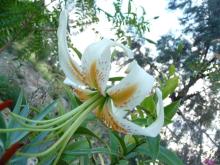
Wed, 01/26/2011 - 4:46pmI'm glad that Dave has started off the new year on this thread - I can now post a few pics of our garden in "high summer" - the rains so far haven't let us feel it's really summer yet! At least it's a change from the usual heat and drought!
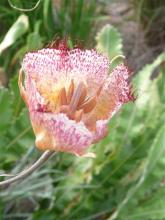
The first is a calochortus which has just opened the last flower for the season Calochortus fimbriatus.
The next is a hybrid Lilium "Pappo's Beauty"
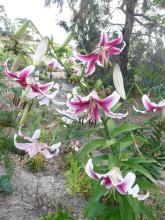
and then "Lady Alice"
cheers
fermi
Mark McDonough
Re: What do you see on your garden walks?
Wed, 01/26/2011 - 7:53pmFermi, from what I've seen on postings on SRGC by folks from Australia, it seems that the genus Calochortus do well in Australia. I bet there are few here in the US that can boast growing C. fimbriatus, a fantastic species and VERY NEW to the taxonomic scene described just 10 years ago in 2001. What is your source for this species? How many Calochortus do you grow and what is your basic cultivation regimen?
PS. You get a Gold Star, you wasted no time in reading my FAQ on how to use the syntax for "inline" image attachments on the forum, this was just added today! Of course, you've been using that technique on SRGC already, so maybe I should just award a Silver Star ;D. The FAQ and others are found here: http://nargs.org/smf/index.php?board=1.0
Lori S. (not verified)
Re: What do you see on your garden walks?
Wed, 01/26/2011 - 9:18pmGeranium 'Wargrave Pink'?
Cliff Booker
Re: What do you see on your garden walks?
Thu, 01/27/2011 - 11:09amMany thanks to Mark for explaining how to inset images into a posting ... this is simply a test to see how easy or difficult this might be.
All the images were captured during a brief visit to Ness Gardens on the Wirral in north-west England.
None of the images will be titled.
This is purely a test.
Images for enjoyment only.
May post more later.
Few more to post.
Not as easy to negotiate as posting all at the end.
Only a few more ...
Simply a test ...
Finally reached the end!
Cliff Booker
Re: What do you see on your garden walks?
Thu, 01/27/2011 - 12:01pmWell, the test certainly worked and could prove indispensable in the future.
All the images were captured in late August 2010.
Mark McDonough
Re: What do you see on your garden walks?
Thu, 01/27/2011 - 3:12pmHi Cliff, glad the inline image attachments syntax is working out for you. What's the blue-fruited beauty above?
Cliff Booker
Re: What do you see on your garden walks?
Thu, 01/27/2011 - 6:50pmHi Mark,
I didn't collect names along with the images, but I believe (from memory) that this was Dianella tasmanica.
Sellars (not verified)
Re: What do you see on your garden walks?
Thu, 01/27/2011 - 8:31pmThe Northern Hemisphere is starting to wake up.
This is Lewisia brachycalyx emerging in the rock garden today.
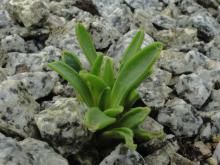
I always find it exciting to see new growth on plants that estivate, given the uncertainty of whether they made it through the summer and fall. Lewisia rediviva emerges in October in our garden but Lewisia brachycalyx and Lewisia nevadensis don't show up until January or February, eventually flowering in spring before disappearing again.
W.H.N. Preece writing in 1937 said this about Lewisia brachycalyx:
It is no easy matter to find suitable words, nor to coin adeqaute phrases to portray such ethereal beauty, ineffable purity and gleaming loveliness in blossoms at once transluscent, ice-white and crystalline".
Fine words indeed for a very lovely plant. I hope it grows faster than whatever is nibbling on the leaves.
Fermi de Sousa
Re: What do you see on your garden walks?
Mon, 01/31/2011 - 10:57pmHi Mark,
We got this Calochortus under its synonym C. weeddii ssp vestus from a local bulb supplier, Marcus Harvey in Tasmania.
Other Calochortus which we grow include C. superbus (the first one I grew to flowering size from seed from the NARGS Seedex I think), C. splendens, C. albus, C. macrocarpus (only in a pot at present), C.argillosus, C. amabile, C. luteus, C. uniflorus, C. catalina and C. clavatus. Most were grown from seed but we have bought bulbs of the last 4 as well. C. superbus and C. splendens have produced the most impressive displays so far in terms of numbers.
Apart from those that never make it out of the seed-pot, I plant the bulbs out in late summer/early atutumn into raised beds which are basically our local "adobe" clay ameliorated with plenty of grit/sand and sometimes a bit of compost and gypsum.
We try not to water the bulb areas during the summer but this year that has been futile; it remains to be seen how many have survived the wet weather!
cheers
fermi
PS yes, I've had some practice on the SRGC Forum at posting pics ;D but I needed your FAQ to let me know we could do the same here now (it didn't work a while back when I tried!)
Mark McDonough
Re: What do you see on your garden walks?
Tue, 02/01/2011 - 8:30pmFermi, that's quite a good representation of Calochortus species! I hope the recent rains In Australia that were so prominent in the news recently have no ill effect on your Calochortus bulbs, or other plants for that matter.
Yes, the "inplace" loading of photos here previously showed a bug whereby images were repeated (doubled), but we got that fixed and the FAQ tells how to do it now.
Panayoti Kelaidis
Re: What do you see on your garden walks?
Fri, 02/04/2011 - 5:42pmAaah Fermi, you know how to rub salt in wounds! We just had -20F in parts of this area a few days ago, and there is snow everywhere. America is in the thralls of winter, and you show us lilies and calochorti! You are a sadist, my man!
Fermi de Sousa
Re: What do you see on your garden walks?
Mon, 02/07/2011 - 3:28pmPanayoti! You should know that Indians don't waste salt onwounds - we use chilli powder! ;D Besides the pics of plants flowering here is only to remind you that spring and summer are not far away.
Of course this side of the world is suffering floods and fires while you are under snow - it's a crazy world! The alternation between heatwave and downpour is playing havoc with some plants in the Rock Garden; Genista pilosa which was a lovely cascading mat is now seriously burned off and 2 Daphne alpina shrubs look like they have succumbed. But I'm sure my losses will be nothing compare to what the extreme cold is doing to some of your gardens over there.
cheers
fermi
Fermi de Sousa
Re: What do you see on your garden walks?
Thu, 02/24/2011 - 10:54pmSome new flowers this week,
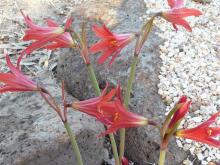
Rhodophiala bifida
Lycoris sprengeri
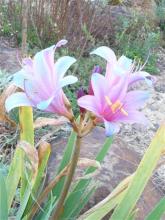
And some belladonna Lilies, Amaryllis belladonna hybrids
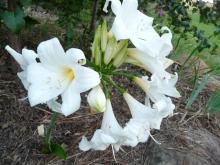
cheers
fermi
Richard T. Rodich
Re: What do you see on your garden walks?
Fri, 02/25/2011 - 8:52pmVery nice, Fermi.
I didn't know there were any Lycoris with such wide petals. And such a symmetrical flower, too!
Trond Hoy
Re: What do you see on your garden walks?
Sat, 02/26/2011 - 2:46amBeautiful "lilies"!
I am looking forward to see mine when they hopefully reach flowering size. I have sowed different monocots from Chilean seed, among them some Rhodophiala spp and have potfulls of seedlings. ;D
Trond Hoy
Re: What do you see on your garden walks?
Fri, 03/04/2011 - 8:15amToday I didn't walk in the garden but chopped a yew to firewood. A foggy but not cold day +7C now.
Rick, did you say you were fan of brown?
Here are some browny colors ;D
cohan (not verified)
Re: What do you see on your garden walks?
Fri, 03/04/2011 - 10:42amNice views! I don't like overcast days, usually, but I do like fog! What is the large broadleaf evergreen?
Trond Hoy
Re: What do you see on your garden walks?
Fri, 03/04/2011 - 12:17pmThanks! Fog has it's charm but not if it is foggy too often >:(
The broadleaf evergreen is a Hedera, probably H hibernica, climbing in a common birch.
Richard T. Rodich
Re: What do you see on your garden walks?
Fri, 03/04/2011 - 6:00pmYou got it!
Is that a Pinus parviflora in the first pic?
I sure wish I could grow true cedars, ANY true cedars.
And what is the broadleaf evergreen tree?
Trond Hoy
Re: What do you see on your garden walks?
Fri, 03/04/2011 - 11:06pmRight on spot! Pinus parviflora. The other pine there to the right is an American species, P contorta. Between them is a Thuja, maybe T plicata.
When you say true cedars, do you mean Cedrus? -I grow three species: C deodara, libanotica and atlantica. They are nice trees. You can get a glimpse of C atlantica 'Glauca' in the top left corner of the 3rd picture, the other green stuff in the left is Sciadopitus verticillata.
The broadleaf evergreen tree is not a tree but Hedera hibernica climbing in a common birch.
Richard T. Rodich
Re: What do you see on your garden walks?
Sat, 03/05/2011 - 2:45pmYes, I was alluding to the Cedrus atlantica (which has had a name change, I believe). I did guess the Pinus contorta, but I never would have thought that tree (below) was a Sciadopitys. I would have thought it would have much longer pseudo-needles in your climate. Unless, is it growing in clay based soil?
The Hedera hiberica is impressive, at least to me. We are very lucky to even get Hedera helix (or closely related) to even survive on the ground, let alone climb.
Trond Hoy
Re: What do you see on your garden walks?
Sat, 03/05/2011 - 11:25pmThe Sciadopitys really has very large needles, the picture lies :-X When I come home next week I'll show you! No clay here - all soil is peat-based (naturally) except some sandy soil at the lowest-lying part.
Pages