Forums:
I've been watching for these, and here is the first hairy little troll emerging!
Syneilesis aconitifolia, from seed in 2008:
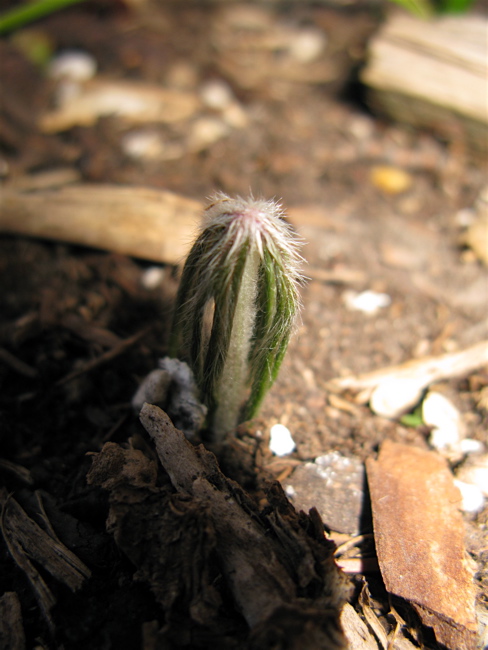

I've been watching for these, and here is the first hairy little troll emerging!
Syneilesis aconitifolia, from seed in 2008:
Comments
Richard T. Rodich
Re: Syneilesis
Mon, 04/09/2012 - 7:41amIt only takes finding one mutation to be propagated and spread around the world, Cohan. I don't think your observations are abnormal. Of course, some species seem to be more prone to variegation or other mutations than others. Even certain populations or areas of the same species can be discovered to mutated more "commonly" than others. For instance, a disproportionate amount of dwarf and otherwise interesting forms of Canada hemlock (tree) are found in the northeast U.S.
Mark McDonough
Re: Syneilesis
Mon, 04/16/2012 - 10:40amWith the current heat wave, plants are jumping out of the ground. Syneilesis aconitifolia appeared a couple days ago, with the umbrellas leaves opening up today... they're so cute.
Trond Hoy
Re: Syneilesis
Mon, 04/16/2012 - 12:58pmMark, that's why you wouldn't have slug problems even with lots of slugs. The plants grow too quickly.
Very cute, I agree!
Mark McDonough
Re: Syneilesis
Mon, 04/16/2012 - 1:03pmTrond, too dry for slugs here in this garden, I only ever see them when we have long bouts of rainy weather. There's a place down the street that has small wetlands on one side, and sometimes in the mornings slugs will attempt to cross the street, but since they're so slow, by the time the sun rises and starts baking the pavement, there is a mass slug-drying ;D I see this when I run around the neighborhood, and I have to gingerly step to avoid treading on drying slugs. It's a fine sight indeed.
Mark McDonough
Re: Syneilesis
Mon, 04/16/2012 - 7:47pmA late afternoon view of emerging S. acanthifolia, in afternoon light:
Richard T. Rodich
Re: Syneilesis
Mon, 04/16/2012 - 9:47pmMark, yours are at about the same stage as mine in pots. Mine in the garden on the north side of the house have not emerged yet. S. intermedia in pots are only an inch high.
Syneilesis aconitifolia
Mark McDonough
Re: Syneilesis
Sat, 04/28/2012 - 9:20pmToday I attended our NARGS New England Chapter annual meeting and rare plant auction, and on this chilly start of a sunny new day, the event was well attended (about 40 people) and there were some very desirable one-of-a-kind plant offerings for auction. I set my eyes on Syneilesis palmata 'Kikko'. It was mentioned that the local nurseryman who imported this plant from Japan spent $200 for it. Bidding was spirited but I prevailed with the Syneilesis, which as it turns out, cost me the same as the Plant Delights Nursery price:
http://www.plantdelights.com/Syneilesis-palmata-Kikko-Kikko-Shredded-Umb...
I donated a nice looking plant of S. aconitifolia, which went for around $30. Rick, a few of your S. intermedia plants would have raised a handsome sum and increased the chapter's coffers.
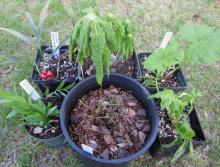
Syneilesis palmata 'Kikko', the net-variegated plant in the top-center:
Richard T. Rodich
Re: Syneilesis
Sat, 04/28/2012 - 9:44pmThat must be one of those plants that become more variegated as the leaves mature. I grew a variegated forsythia (Forsythia 'Kumson') that did that. I planted seed from Syneilesis palmata 'Kikko' from the NARGS seed ex. The first one emerged a few days ago. ;D It's hardly done anything since it has been so cold this last week.
My Syneilesis aconitifolia are just coming up in the garden now (among our native Thalictrum thalictroides), but ones in pots have been growing for a while already.
Mark McDonough
Re: Syneilesis
Sat, 04/28/2012 - 9:52pmI must have missed Syneilesis palmata 'Kikko' from the NARGS seed ex. I was talking with NARGS members about S. aconitifolia and they mentioned that they never get viable seed. Last year, I collected lots of seed, but never donated nor sowed the seed :rolleyes:, so it's hard for me to comment, so now I wonder about seed viability of this species.
Please show us see your results with the very-variegated 'Kikko' seedlings once they develop. Does Syneilesis have some attraction at your local NARGS meeting plant sales, I would think they must be popular.
Richard T. Rodich
Re: Syneilesis
Sat, 04/28/2012 - 10:08pmFrom my first plantings, which were also from the NARGS seed ex, the donated seed was extremely viable - near 100% germination. I winter sowed them in pots in late January. I had so many that I probably threw out half of them!
Since Syneilesis only puts up one non-true leaf the first year, I wonder if variegation would show on any of the Kikko seedlings the first year. We'll have to see....
Mark McDonough
Re: Syneilesis
Sun, 04/29/2012 - 6:29amSyneilesis palmata 'Kikko' (foreground) is feeling right at home planted close to its neighbor, A. aconitifolia (background). :D
Richard T. Rodich
Re: Syneilesis
Mon, 07/02/2012 - 8:26pmThe pink flowering form of Syneilesis aconitifolia (Shredded umbrella Plant) is maturing in the garden now, and I never thought the leaves would get this large! I refuse to be slave to my gardens, so they wilt down a little every day in this heat to the point that they now look permanently wilted, even though they can be fully turgid. (Unfortunately, I don't have any constantly moist garden areas.) The photo is deceiving, but laid flat, the largest leaf measures 19.5 inches across!
Mark McDonough
Re: Syneilesis
Mon, 07/02/2012 - 8:46pmAn impressive beauty there Rick. Looks great given enough room to breathe. I planted my Syneilesis palmata 'Kikko' much too close to other plants, and it is totally hidden by Kirengeshoma palmata right now, but I plan to move it to a more generous spot. The pink flowers on your Syneilesis aconitifolia look rather showy, and the reflexed leaf form is most appealing.
Tim Ingram (not verified)
Re: Syneilesis
Tue, 07/03/2012 - 12:41amWhat a fascinating plant Rick - those 'shaving brush' like flowerheads are intriguing, and the close up of the flowers rather striking. Like all the ligularias I think we would struggle with this in our summer dry garden.
cohan (not verified)
Re: Syneilesis
Tue, 07/03/2012 - 10:05pmReally great looking plant, Rick! this is something I'd love to try for sure :)
On the wilting, I have a planting of one of the native tall Antennaria species (I've keyed it, but forget now, need to do it again now that I have photos of this year's involucres which hold the important characters) which usually grows in moist areas and while the soil where it is does not ever dry out, it does tend to droop a bit in the leaf, which I think cannot be about moisture- the place I collected it from originally is no wetter than where it is now.. so I'm not sure if this is just normal ( I don't see the wild plants consistently enough to see if they droop) or if it has anything to do with the fact that in nature the plant is much less concentrated- the plant spreads by stolons, but they are mixed with other plants in nature, in my garden it's a tight clump, and or maybe more shading from those plants they are mixed with in nature, though they are in locations as open as mine or often more so... anyway, doesn't seem to hurt it- no leaf browning, and it's flowering and growing..
Trond Hoy
Re: Syneilesis
Tue, 07/03/2012 - 11:04pmA great Syneilesis, Rick! All my attempts to grow that genus have failed (slugs of course) but I am tempted to try at my summerhouse where the slug problem is less (but drought is more frequent :-\).
Richard T. Rodich
Re: Syneilesis
Thu, 06/06/2013 - 6:44pmThis is the fifth season planted in the garden for Syneilesis aconitifolia. I am certainly not complaining, but had expected it to wander more and take up more real estate. To my delight, it is staying quite compact! Does it just need more time?
Margaret Young
Re: Syneilesis
Fri, 06/07/2013 - 9:00amI'm finding it quite slow here, Rick - but perhaps, long-term, that's a good thing.
It is slow to emerge, to enlarge and also to spread - obviously not in any hurry at all!
Maggi
Mark McDonough
Re: Syneilesis
Sat, 06/08/2013 - 8:48amRick, do you have two forms of S. aconitifolia, one that is the typical whitish form, and the pink flowered form you showed us last year? I'd like to get hold of a second clone sometime, particularly one with pink flowers, maybe a seed swap in the future?
Trond Hoy
Re: Syneilesis
Sat, 06/08/2013 - 11:35amLovely Syneilesis, Rick! My problem is that no plant even last a single season :( (Slugs, if you didn't guess)
Lori S. (not verified)
Re: Syneilesis
Sat, 06/08/2013 - 6:18pmLooks wonderful, Rick. Plant Delights says "spreading slowly", "2 feet wide in 5-7 years".
Richard T. Rodich
Re: Syneilesis
Sat, 06/08/2013 - 8:40pmOh gee.... I just assumed it spread like Mark's from the get go:
http://nargs.org/smf/index.php?topic=252.msg16721#msg16721
Mark, yes I have the white and pink flowering forms of S. aconitifolia. Last year, the seed heads looked so promising (I only let the pink ones form), but every "seed" was empty. I know I had saved some anyway to plant, but darned if I can find them. ??? Now that I know (maybe) that they seem to be self infertile, I'll make a point to cross pollinate the seedlings I have. Flower stems are already forming on the one pictured above (a pink flowering one).
I finally planted Syneilesis intermedia in the garden last week.
Mark McDonough
Rick, are your Syneilesis
Sat, 06/29/2013 - 7:41amRick, are your Syneilesis plants getting ready to flower? Mine are, and I just noticed that the buds are indeed tipped pink on the outside, although the flowers will be white.
Richard T. Rodich
Mine aren't quite that far
Sat, 06/29/2013 - 11:00pmMine aren't quite that far along, althiugh it is really surprising how close in development they are to yours, considering they are on the the north side of my house and only a foot (approx) outside the roof eve. Initially, our spring here in zone 4 Minnesota was a full month late, but we have almost caught up to a normal season already. This is another weird season for us, and many species are blooming out of their normal comparative sequence. This is the pink form of Syneilesis aconitifolia, pic taken tonight.
Pages