Forums:
I've been watching for these, and here is the first hairy little troll emerging!
Syneilesis aconitifolia, from seed in 2008:
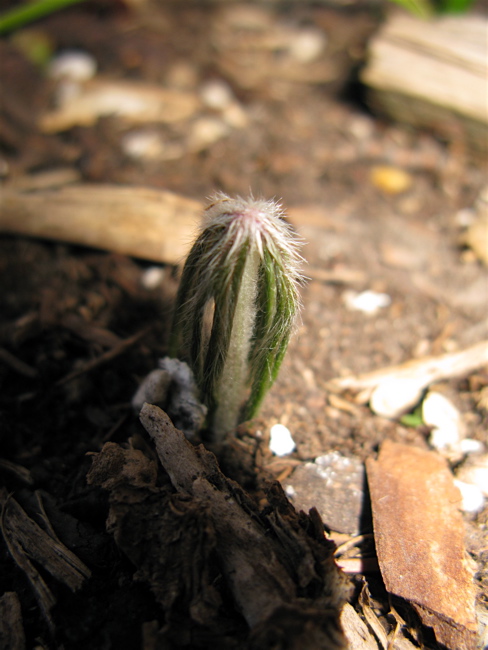

I've been watching for these, and here is the first hairy little troll emerging!
Syneilesis aconitifolia, from seed in 2008:
Comments
Todd Boland
Re: Syneilesis
Fri, 05/14/2010 - 5:37amFunky! I've never tried them.
BalistrieriCarlo (not verified)
Re: Syneilesis
Fri, 05/14/2010 - 6:12amWonderful plant...I've had it around for years (going from garden to garden with me). My clump here is now 18 or so stalks. It is much further along than Lori's--already putting up buds. While the flowers are beautiful (at least when you get close), it is the early, felty growth pushing through the ground like some kind of green mushroom that is really the star.
Mark McDonough
Re: Syneilesis
Fri, 05/14/2010 - 6:42amCarlo, mine sounds like it's at a similar state as your plants, already showing flower stalks and the plants getting big. The best part of this plant is the spring foliage emergence. The plant gets fairly large, 18" (45 cm) tall or so, and spreading to 2' (60 cm) in 5-6 years.
For those who are curious, this is a small genus of Asian plants in the Asteraceae, related to Ligularia. It is available from a number of nurseries, here's the Plant Delights Nursery listing:
http://www.plantdelights.com/Catalog/Current/Detail/03400.html
Trond Hoy
Re: Syneilesis
Fri, 05/14/2010 - 12:52pmI have tried this plant several times but you know, do I have to repeat? (The slugs of course.)
I haven't stopped trying so 6 seedlings wait to be big enough to be planted out!
Richard T. Rodich
Re: Syneilesis
Fri, 05/14/2010 - 2:58pmI grew Syneilesis aconitifolia from seed in 2008 also. That summer, circumstances caused an overflow of my roof rain gutters, splashing water down on the seedlings. When I came home from work that evening, I found half of the soil washed out of all the pots, and the leaves supported by the convergence of root "stilts" at the crown. Yet almost every one survived.
Picture #2 is in 2009. Only a few plants produce more than one leaf that season. The single blue pot filled with round leaves is first year seedlings of Syneilesis intermedia.
Richard T. Rodich
Re: Syneilesis
Fri, 05/14/2010 - 3:07pm1. Syneilesis aconitifolia on left (third season), Syneilesis intermedia on the right (second season). I am not sure if the upturned leaves of S. intermedia is indicative of the species or not. This is only their second season, and I have yet to have another year to compare. All is fine now, but at the time this pic was taken, they seemed a little peaked, like they are in pots to large for their size.
2. Another "treat" for buyers at our Society plant sale coming up.
Mark McDonough
Re: Syneilesis
Fri, 05/14/2010 - 4:53pmRick, you're like a one-man nursery :o :o :o Awesome seeing all those potted seedlings, once again I think all of us want to come to your NARGS chapter meetings! Not familiar with S. intermedia, but even in the young plants, I love the upswept pagoda arrangement of the leaves.
Richard T. Rodich
Re: Syneilesis
Fri, 05/14/2010 - 9:23pmWell I wasn't kidding when I said I was a mad propagator. Anyone here is welcome at my house. I like to see the variation in species, so I like to grow many plants. I have both white flowering and pink flowering S. aconitifolia. Currently, I have Anemone rivularis growing from seed from several sources. (I just hope those sources didn't all get theirs from the same place.)
It's a lot of fun having a forest of miniature "palm trees" outside my kitchen window.
Syneilesis aconitifolia, still immature foliage.
Mark McDonough
Re: Syneilesis
Fri, 07/02/2010 - 4:08pmShow me your Syneilesis aconitifolia flowers (or other Syneilesis species)! Actually, there isn't much to them, I usually cut off the stems, but left them on this year to remind myself why I cut them off.
A magnificent dry summer day here, 80 F (22 C), hypnotic strong breezes and occasional northwest gusts made getting photos difficult to focus. The flowering stems lean, they would be 3-1/2' (105 cm) tall if they stood straight, and the flowers.... eesh, just whitish things along the lines of a Prenanthes :P, the involucre stained dull lavender. I'll try to get a better photo if it's not so windy tomorrow. Rick, you mentioned your plants having "pink" flowers... let's see them.
Trond Hoy
Re: Syneilesis
Sat, 07/03/2010 - 1:26amI agree! The flowers are not much to beheld but without flower no seed!
I have planted out some of my seedlings and wonder if they are still alive when I get back home.
Todd Boland
Re: Syneilesis
Sat, 07/03/2010 - 5:11amRick, if you ever get seed......what a great sale you must have. Wish I could be there!
Mark McDonough
Re: Syneilesis
Sat, 07/03/2010 - 7:05amI should add, as negligible as the flowers are, they do have a sweet scent.
Richard T. Rodich
Re: Syneilesis
Sat, 07/03/2010 - 5:55pmMine haven't opened yet. Withholding a final judgment, but so far it looks like prenanthus is the better flower. Actually, we have a very nice wild pendant species that grows in the moist areas here.
Will see about seed, Todd. Although in the garden, one I planted did not flower, and the other, the flower stem broke off. Seed would be from woefully underpotted plants, and therefore may not be in the best of health. It is surprising, however, to observe the tenacity of the species under these adverse conditions.
Lori S. (not verified)
Re: Syneilesis
Sun, 07/04/2010 - 10:10amNothing to offer here re. flowering... I still have only single-leaf plants, but I'm pleased that both S. aconitifolia and S. palmata have made it through 2 winters now!
Trond Hoy
Re: Syneilesis
Sun, 07/04/2010 - 11:01amWinters - no problem! Slugs are!!
Mark McDonough
Re: Syneilesis
Sun, 07/04/2010 - 1:00pmI have grown a couple "not too bad" Prenanthes species in the past, the nodding flowers on some are kind of "interesting". So, here's two much better photos of Syneilesis aconitifolia flowers today. The flowers opened more, and when adorned with "protruding bits" it is an amusing site at close hand, the sweet scent of the flowers wafting on this hot day (90 F, +32 C).
Howey (not verified)
Re: Syneilesis
Sat, 09/04/2010 - 2:51amWhat a lovely plant! One to covet. Ordered seed from the Seedex last year but got something quite different that I'm still trying to identify. Will try again this year and hope I get the right seed this time. Did someone mention the flowers are pendant? One of the photos shows them on long stems that poke out (extrude?) beyond the leaf - unlike the Podophyllum peltatum it is often likened to. Fran
Frances Howey
London, Ontario, Canada
Zone 5b
Richard T. Rodich
Re: Syneilesis
Sat, 09/04/2010 - 7:05pmMy talk of pendant flowers was about Prenanthus spp. Syneilesis flowers are upright and do extend way above the foliage, as the previous pics show.
My plants are from the NARGS seed ex with seed collected in 2007. Every single seed germinated. They were winter sowed on February 3rd and left outside here in Minnesota. Most emerged April 18-25. Seedlings are curious things, as they produce only one leaf the entire first season, that is very different from the mature leaf form.
You can see in a previous pic here: http://nargs.org/smf/index.php?action=dlattach;topic=252.0;attach=4043;i... first year seedlings of Syneilesis intermedia in the lower left quadrant. S. aconitifolia seedlings look exactly the same.
Howey (not verified)
Re: Syneilesis
Sun, 09/05/2010 - 4:24amRick - if you are able to get such results from sowing seed outside in "winter" in your zone 4a, then it should work for my zone 5b too. Can hardly wait to try it that way. Guess the only way Syneilesis resembles Podophyllum peltatum is the way it emerges from the ground and then the umbrella leaves. Will check to see if they are the same family. Fran
Lori S. (not verified)
Re: Syneilesis
Sun, 09/05/2010 - 9:45amFran, rest assured that it, "winter sowing", (which seems to be the name currently applied to an age-old method, as though it's something new ;)) works in much colder zones than yours. The only real difference from "random" seed germination in nature is that one would usually control things somewhat by planting the seeds up in a pot, which may or may not be kept covered.
Richard T. Rodich
Re: Syneilesis
Sun, 09/05/2010 - 9:42pmWhen I winter sow, I plant up the pots inside, water from the bottom, and then they drain uncovered for a day (or two if I don't get to the them) still inside. Then I enclose the pots in a clear plastic bag and put them out side. If temps are below zero F, I might put them in the garage for a few days first, before putting the outside.
Howey (not verified)
Re: Syneilesis
Mon, 09/06/2010 - 5:04amLori and Rick - Thanks so much for the info re sowing Syneilesis outside. Interesting to note that S. is a member of the Asteraceae family while Podophyllum is Berberidaceae.
Frances Howey
London, Ontario, Canada
Zone 5b
Gene Mirro (not verified)
Re: Syneilesis
Wed, 12/01/2010 - 9:45pmI have some seeds of S. aconitifolia to give away. Let me know if you're interested.
cohan (not verified)
Re: Syneilesis
Fri, 02/18/2011 - 11:58amInteresting-- sort of Petasites meets Antennaria... Lori, where did you get seed? probably a seed-ex?
Lori S. (not verified)
Re: Syneilesis
Fri, 02/18/2011 - 12:06pmHi, Cohan
Here are my records below... both are "easy, warm germinators":
Syneilesis aconitifolia NARGS 2008; #2905; garden - Started indoors Feb. 13/08; sprouted Feb. 18.
Syneilesis palmata Gardens North - Started indoors Feb. 9/08; sprouted Feb. 18.
cohan (not verified)
Re: Syneilesis
Sat, 02/19/2011 - 11:29amThanks, Lori. I didn't recall the name from Gardens North, but then, there is a lot to know on that list!
Mark McDonough
Re: Syneilesis
Sat, 05/07/2011 - 9:32pmThese plants are really showy upon leaf emergence. Here are two views taken the same morning recently, one before the sun was fully up, the second taken in morning sunshine, thus a different look. Syneilesis aconitifolia:
Richard T. Rodich
Re: Syneilesis
Sat, 05/07/2011 - 11:51pmMy Syneilesis spp. haven't even poked out of the ground yet!
Lori S. (not verified)
Re: Syneilesis
Mon, 05/16/2011 - 7:54pmThe first furry little troll is finally emerging...
Mark McDonough
Re: Syneilesis
Mon, 05/16/2011 - 8:08pmThat's the cute stage... too bad they don't stay like that longer. ;)
Mine are jumping out of the ground; a photo from a few days ago:
Trond Hoy
Re: Syneilesis
Mon, 05/16/2011 - 11:39pmThen we are two, Rick! But of different reasons I assume. Here the slugs are the culprits :(
Richard T. Rodich
Re: Syneilesis
Tue, 05/17/2011 - 10:32amAhhh, but they are up now, Trond. after giving some away and donating eight at the local Chapter sale (they sold for $6 and $7 for the white or pink flower forms), I still have many left. The one in the ground emerged a few days later, but is now farther along.
cohan (not verified)
Re: Syneilesis
Tue, 05/17/2011 - 3:03pmcute things ;D
Trond Hoy
Re: Syneilesis
Tue, 05/17/2011 - 11:42pmI planted many seedlings last year and they grew well but I haven't seen anything to them this year :'( Two plants I had in pots were fine though and I have planted them out but I don't know how long they'll survive!
Geo F-W (not verified)
Re: Syneilesis
Wed, 02/29/2012 - 2:37pmI do not know if anyone here grown it, but there is a beautiful form close to S.palmata
but, in my opinion, prettier and strong growing, S. aff. tagawae BSWJ11191 (it's a Crug Farm collected form).
She is quite tall, close to a meter, a very good plant.
Mark McDonough
Re: Syneilesis
Wed, 02/29/2012 - 7:55pmGeoffrey, great seeing this one, even as an "aff." species, thanks for showing us this rarely seen species. Checking it out on The Plant List, S. tagawae is one of 6 accepted species, never heard of it before, I see that a synonym is Syneilesis aconitifolia var. tagawae, so perhaps it is closer to S. aconitifolia.
I have never visited the Crug Farm nursery list, oh my! Truly unique and intriguing plants, you're so lucky to have access to their offerings. I enjoy the small genus of Syneilesis, wonderful additions to the woodland garden; I have an eye out for seed of other species.
Richard T. Rodich
Re: Syneilesis
Wed, 02/29/2012 - 9:15pmI have not grown S. palmata, but I was under the impression that it was the real beauty of the bunch. Your selection, Geoffrey, looks like a giant aconitifoilia, superficially at least. I didn't know such a species existed either. Would that be near meter high foliage or flower stalks?
Do you grow any of the other Syneilesis species? Is the culture any different for S. aff. tagawae?
I thought that accession designation looked familiar. Crûg Farm is the only place I have ever seen that has the real Lilium hansonii. (Everyone thinks hansonii is yellow, but it's not.) What a couple of very interesting (and learned) owners they must be!
Trond Hoy
Re: Syneilesis
Thu, 03/01/2012 - 4:07amI managed to buy some plants from Crûg Farm last month but I didn't dare to buy Syneilesis as all my beautiful plants were destroyed by slugs last year :'(
Geo F-W (not verified)
Re: Syneilesis
Thu, 03/01/2012 - 4:43amMaybe it's closer to aconitifolia yes. In fact, it's like a compromise between aconitifolia and palmata : when it emerge from the ground, the leaves are well divided as an aconitifolia but the division becomes larger as a palmata...
I grow Syneilesis aconitifolia, Syneilesis palmata and its selection 'Kikko', and this one, Syneilesis tagawae.
Syneilesis aconitifolia grows well here, but I have some difficulty with palmata, which is annualy attacked by slug which are legions in the garden, despite of my vigilance...And I think that they grow in an inappropriate place, too damp, almost wet. Because they enjoy high air humidity, but grow in soil just damp. So I have to move them this spring.
I love such "umbrella" plants as Dysosma and Podophyllum, and the slugs too...
So Syneilesis tagawae grow in light shade, damp soil, humiferous, with Podophyllum, Saruma, Epimedium etc.
Crug Farm is a mecca! Sue and Bleddyn are extremely friendly. I am fortunate to have a neighbor (Thierry Delabroye, always ^^), who is friends with them and multiplies some of their plants. I wish I could go at Crug as much as I want, but Wales is not so close! And a bit isolated...There are many other British nurseries, which are small wonders for me, like Nick Macer's one, Pan Global Plants in the Gloucestershire.
Mark McDonough
Re: Syneilesis
Sat, 03/10/2012 - 5:58amYes Geoffrey, there is something about "umbrella" leaved plants that adds intrique to the garden, I too like such plants. Do you grow Diphylleia cymosa? It's one of my favorites, great in the shady garden with adequate moisture; since I grow mine in average to at times dryish soil, it stays much smaller and manageable in such conditions, growing massive in a wet boggy situation. The mottled brownish color of the spring leaves is a definite attraction, as are the expanding leaves, flowers, and berries.
http://nargs.org/smf/index.php?topic=253.0
I noticed Saruma henryi in some of your Epimedium photos, another of my favorite woodland plants, it is starting to seed around quite a bit too.
Geo F-W (not verified)
Re: Syneilesis
Sun, 03/11/2012 - 7:20amI must admit that I have great difficulties with Diphylleia cymosa...
I do not know exactly why...
It didn't seem to enjoy the garden soil, can be too clayey...And slugs do great damages also.
In the garden of a friend in Belgium, the Diphylleia are monstrous, wealthy, it is a magnificent spectacle.
I'd have to try it somewhere else, but usually, after a failure, I'm a bit "chilly" (I don't know if this expression exists in English ^^) to try again...
Saruma henryi is one of my favorite plants in the woodland yes. A very easy plant which has the merit of naturalizing and whose flower color is the one I prefer at this time.
There's a scene in the garden that takes me to heaven every year, the Epimedium 'Flowers of Sulphur' surrounded by Saruma henryi with Paris quadrifolia and polyphylla and Polygonatum yunnanense, lined with and Selaginella sanguinolenta and kraussiana.
I love the Aristolochiaceae, I try to cultivate some Aristolochia here, as A.tomentosa, A.macrophylla, A.debilis, or A.clematitis A.mandschurica. My friend Mark Brown has a small collection.
Mark McDonough
Re: Syneilesis
Sun, 03/11/2012 - 7:40amParis is a genus that I would love to try, fascinating plants, but seldom ever offered here. Trying to get a few more Polygonatums introduced in the garden, I have failed with some that I've tried. You mentioned in a previous message the genus Chloranthus, one that I first encountered at Darrell Probst's nursery, utterly unique and charming plants; I must beg a piece from Darrell sometime.
Geo F-W (not verified)
Re: Syneilesis
Sun, 03/11/2012 - 8:50amParis are amazing plants, some are really impressive. I do grow a few here, Paris quadrifolia, which is common in parts of France, Paris polyphylla, Paris polyphylla yunnanensis alba, Paris japonica and Paris vietnamensis, but there are many other equally ornamental. (look at these pictures : http://www.greenmilenursery.be/photo_paris.html at Robin Callens's nursery in Belgium)
For Chloranthus, I was especially interested in them through Mark Brown (whose garden is based on an demential project retracing the evolution of flowering plants), because the Chloranthaceae are a very old family, phylogenetically speaking, almost fossils.
By cons, they are very slow to expand, their only fault! ^ ^
kalle-k.dk (not verified)
Re: Syneilesis
Thu, 04/05/2012 - 11:58pmI mean Syneilesis palmata is one of the best woodland plants and there are several Japanese forms. They come up early and still where we can get frost at night, but it seem that they not get any damaged.
Trond Hoy
Re: Syneilesis
Fri, 04/06/2012 - 12:14amI would love to grow them but the slugs have damaged them every time I have tried :'( Maybe they tolerate frost but not slugs >:(
Geo F-W (not verified)
Re: Syneilesis
Fri, 04/06/2012 - 4:09amIndeed, here too slus are public enemy number one, a constant struggle...
Karl, your selections are superb, I grow 'Kikko here, but in pots, precisely because of the slugs ...
I love your site, since a long time, bravo!
Mark McDonough
Re: Syneilesis
Sat, 04/07/2012 - 8:17pmKarl, those Syneilesis are the epitome of horticultural whimsy, just fantastic, and I'm totally smitten with what you show. Are these generally available in Europe? I assume these all come out of Japan, did you import them or obtain them from a European nursery?
Slugs are no problem here in my dryish New England garden, so I suspect if these whimsical Syneilesis were to become available here, they should grow just fine in our climate. Thanks for showing these wonders.
Karl, in your experience, do these varieties come true from seed, or do seed-grown plants offer lots of variability?
cohan (not verified)
Re: Syneilesis
Sat, 04/07/2012 - 8:38pmVery interesting, Karl! I will be happy to hear the answers to Mark's questions....
Does anyone know what the Japanese growers are doing to get so many variegates and other forms? Is it simply sowing thousands to find the one sport? Or do they have some techniques to speed mutations?
kalle-k.dk (not verified)
Re: Syneilesis
Sun, 04/08/2012 - 12:58amNo they are very rare in Europe and I got them from a Japanese friend. About the varieties forms of Japanese plants I think it is because they are very good plants man and they got lot of material in the nature, as you also see in Trillium in US and we see in our nature plants.
Syneilesis belongs to Asteraceae family and my wife and I have sown several plants from that family before and with luck, but we have any luck with Syneilesis I don’t know why. I have divided a few of them and then I also know they are right.
cohan (not verified)
Re: Syneilesis
Sun, 04/08/2012 - 11:25pmI ask because I look at a lot of plants in nature, and we have many species here that are very very common, so I see thousands of them in a season- and never any variegates! I've seen one small willow/Salix in nature, that seemed to be variegated, and that is the only thing! The Syneilesis makes me think of our native Petasites palmatum -very nice leaves, woodland plant, and very very common, the leaves are everywhere in our woodland- I have never seen a variegated leaf......
Pages