Forums:
Figured there weren't enough Chionodoxa species to warrant their own thread so this one can include the miscellaneous spring bulbs. This is my first Chionodoxa forbesii (luciliae) of the season.
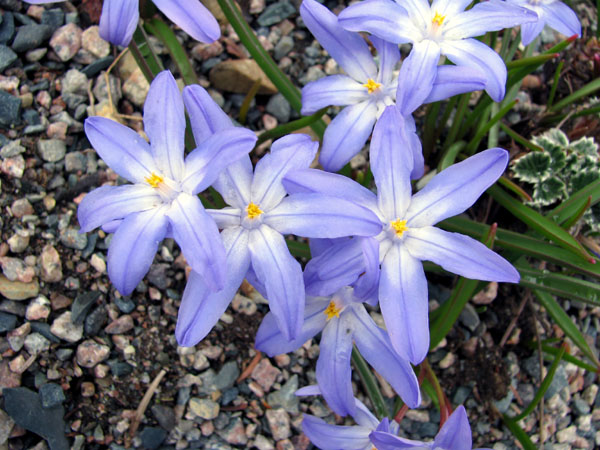

Figured there weren't enough Chionodoxa species to warrant their own thread so this one can include the miscellaneous spring bulbs. This is my first Chionodoxa forbesii (luciliae) of the season.
Comments
Trond Hoy
Re: Miscellaneous spring bulbs
Fri, 04/16/2010 - 1:51pmNice plants! Here Chionodoxa, Scilla (incl. former Scillas), Muscari, tulips, daffodils, Corydalis and different early dicots have replaced Crocus.
Lori S. (not verified)
Re: Miscellaneous spring bulbs
Sat, 04/17/2010 - 12:51pmThe chionodoxa are starting to bloom here too, seemingly very early.
Puschkinia libanotica, seeding freely all over the yard, and a white version of same.
Todd Boland
Re: Miscellaneous spring bulbs
Sat, 04/17/2010 - 4:27pmLike that white version!
Trond Hoy
Re: Miscellaneous spring bulbs
Sun, 04/25/2010 - 3:25amHyacinthella libanotica (or is it something else?) Anyway it is a sure bloomer every year.
Mark McDonough
Re: Miscellaneous spring bulbs
Sun, 04/25/2010 - 4:44amTrond, beautiful azure color on that one.
As you'll probably hear over and over from me, I'm drawn to blue flowers, azure to pale blue; hope to post a photo in a day or two (although rain is predicted for the next couple days, after a LONG stretch of sunny weather) of a baby blue one; actually more of an ice blue one, Triteleia grandiflora var. howellii.
Todd Boland
Re: Miscellaneous spring bulbs
Sun, 04/25/2010 - 3:09pmTrond, I think your Muscari is M. azureum (good call on the 'azure blooms' Mark!)
Trond Hoy
Re: Miscellaneous spring bulbs
Mon, 04/26/2010 - 7:22amIs Muscari azureum synonymus with Hyacinthella libanotica?
Todd Boland
Re: Miscellaneous spring bulbs
Tue, 04/27/2010 - 10:56amFrom my googling, seems like it might well be...I'll have to investigate this further.
Todd Boland
Re: Miscellaneous spring bulbs
Tue, 04/27/2010 - 4:14pmTrond, Muscari azureum is indeed now Hyacinthella azurea...I found no reference to it being H. libanotica.
Here is Chionodoxa forbesii 'Pink Giant' I planted in a rock nook at the BG. Its been here 10 years now!
Trond Hoy
Re: Miscellaneous spring bulbs
Wed, 04/28/2010 - 12:20amOK, thanks.
This is nice! I have always placed those bulbs in the turf but they seem to flourish in crevices too!
Richard T. Rodich
Re: Miscellaneous spring bulbs
Wed, 04/28/2010 - 10:28amSpring Beauties (Claytonia virginica).
And a nice, heavily colored form.
Trond Hoy
Re: Miscellaneous spring bulbs
Wed, 04/28/2010 - 12:01pmC. virginica seems to be a tidier plant than the coarse C. sibirica I have! (not blooming yet)
Todd Boland
Re: Miscellaneous spring bulbs
Wed, 04/28/2010 - 3:25pmMuch tidier than siberica indeed! My siberica have now moved into the lawn!
Richard T. Rodich
Re: Miscellaneous spring bulbs
Wed, 04/28/2010 - 7:34pmClaytonia virginica disappears rather quickly as the season progresses, and is truly ephemeral. Of the two sources of C. sibirica I grew from seed last year, yours, Todd, were the only ones that survived the winter. Although, a few of those croaked too. Even of the ones I held over in pots, Todd's were the only survivors. I do see volunteer seedlings in the garden (and in pots) already.
My original Spring Beauties came accidentally with the root ball of a tulip tree I brought from a friend's place in Chicago. Over the years, Claytonia virginica has jumped over a lawn section in favor of another bare piece of ground under a Sambucus nigra 'Laciniata', and has established there.
Trond Hoy
Re: Miscellaneous spring bulbs
Thu, 04/29/2010 - 3:39amC. virginica seems to tolerate much drier habitat than sibirica?
Richard T. Rodich
Re: Miscellaneous spring bulbs
Thu, 04/29/2010 - 7:05pmI would say so, since it disappears underground as a "dormant" bulb over the heat of the summer. The Tulip tree is very tall and narrow, and lends little shade the the ground directly beneath. The soil gets very dry and warm.
Mark McDonough
Re: Miscellaneous spring bulbs
Mon, 05/03/2010 - 10:41amThis Trit has been in bloom for a week or so, Triteleia grandiflora var. howellii, found in British Columbia and Washington State, Oregon, and California. I tried in vain to get some goods pics, but finally got a few decent ones yesterday... I think it liked the 92 F heat (33 C), and there were still air moments, where these 24" (60 cm) wands could stand still for a few seconds. The flowers are large and soft powder blue, never failing to bloom each year.
http://plants.usda.gov/java/profile?symbol=TRGRH
Trond Hoy
Re: Miscellaneous spring bulbs
Wed, 05/05/2010 - 1:43pmNice plants!
I have tried Triteleias here but they too soon disappear. Don't know why but maybe slugs. What else?
Mark McDonough
Re: Miscellaneous spring bulbs
Thu, 05/06/2010 - 7:27amI haven't noticed slugs ever attacking mine, but then again, I don't have much of a problem with slugs, particularly in the open dry sunny areas. I took a cue from how I'd see these plants growing in nature, often in heavy clay soil that gets sunbacked in summer. My game plan, was to use our heavy rocky clay soil as a base, the soil (if you can call it that) broken up a bit from it's rock hard state, bulbs planted on top of that layer, then light sandy mix covering the bulbs. Grow in full sun; one exception is T. grandiflora howelllii that is growing under a Fringetree (Chionanthus virginicus), although it might as well be in full sun, the Chionanthus is among the latest trees to leaf out and is only breaking bud now. I've had good luck with Trits over the past 10 years or so, using this technique, although it is very unlikely that they'll ever take over the garden.
Trond Hoy
Re: Miscellaneous spring bulbs
Thu, 05/06/2010 - 1:19pmThanks for advice. I will try'em again and find clay and sand! And should they take over the garden I will not complain.
Mark McDonough
Re: Miscellaneous spring bulbs
Mon, 05/17/2010 - 5:20amAnother Trit has been in bloom for nearly two weeks, still looking great today (very long bloomers they are), Triteleia lemmoniae. This is a rare species with a restricted geographical distribution in Arizona. My favorite aspect of this species, is how the spent flowers turn a rich red-brown color, adding to the effect. It is also a very small species, just a few inches, whereas many Trits are much taller growers. It has been hardy here for the last 6-7 years I've grown it, increasing very slowly.
USDA map and data page:
http://www.plants.usda.gov/java/profile?symbol=TRLE4
Flora of North America
http://www.efloras.org/florataxon.aspx?flora_id=1&taxon_id=242102033
More info and pics:
http://www.delange.org/LemmonsStar/LemmonsStar.htm
Trond Hoy
Re: Miscellaneous spring bulbs
Mon, 05/17/2010 - 1:30pmNever heard of (and never seen before)! Now it is on my list of plants to try to get hold of!
Mark McDonough
Re: Miscellaneous spring bulbs
Tue, 05/18/2010 - 6:39amYet another Trit flowering, one of Jim Robinett's selections, Triteleia laxa 'Sierra Giant'. The flower stem is about 14" tall (35 cm) with a very large umbel of large silvery lilac funnels, shiny and rose-tinged at the outside base of the florets. These large-flowered Trits always surprise me, in that their foliage is a mere pair of minimal basal leaves, little indication at how much they do up in the air above. The waxy flowers last for weeks.
Trond Hoy
Re: Miscellaneous spring bulbs
Tue, 05/18/2010 - 1:17pmI have at least heard about Triteleia laxa! But this selection is better than any I have seen (pictures of).
My picture is not of any plant taking first price in color display but the fragrance is better!
The plant in front to the left is a perennial Tropaeolum from seed, it has not flowered yet.
Trond Hoy
Re: Miscellaneous spring bulbs
Tue, 06/08/2010 - 7:11amNot the most flamboyant of bulbs but Ornithogalum has charm. This particular species, O. umbellatum, I collected in Morocco a couple of years ago. No problem growing it outdoors.
Todd Boland
Re: Miscellaneous spring bulbs
Tue, 06/08/2010 - 7:40amI'm not sure if my O. umbellatum are even showing buds yet....Triteleia don't bloom until late July here! My goodness, I never realized just how far behind we are in Newfoundland...especially this year!
Trond Hoy
Re: Miscellaneous spring bulbs
Wed, 06/09/2010 - 10:37amThen you have the opportunity to enjoy the blooming when it is finished elsewhere!
Mark McDonough
Re: Miscellaneous spring bulbs
Sat, 06/12/2010 - 8:16pmMore Trits; there are always more Trits ;D
Three species blooming more or less at the same time. Triteleia hyacinthina is an easy species that'll seed around when happy, with lots of full heads of white blooms. Each floret is typically nerved with a green, blue-green, to blue midvein. It is adaptable, and seems to do best in heavy soils that are moist in spring but allowed to dry out in summer.
T. laxa is amazingly variable, and at least a few distinct forms have been selected and named. Previously I showed the silvery lilac 'Sierra Giant' which flowered weeks ago, now the deep blue T. laxa 'Humbolt Star' is in bloom, both being Jim Robinett selections. This is a large and showy feast for the senses.
The last is T. bridgesii (formerly Brodiaea bridgesii), which seems to be diminishing in size and I worry about it's demise after a near decade of splendid bloom. I show one photo from this year, a bit late because some of the flowers have gone by, but it is a mere ghost of itself compared to previous years. Also, I had two color forms, one with a more prominent white eye, but have since lost that distinctive form... I include a poor quality photo that shows these two color forms back in early 2000s. I include two older lesser quality photos that show these two color forms back in early 2000s, the last photo giving an idea of scale of the flower head, which is huge!
Lastly, for those who want to know more, I supply links to additional photos, distribution maps, and info.
Triteleia hyacinthina
Flora of North America
http://www.efloras.org/florataxon.aspx?flora_id=1&taxon_id=242102030
USDA Plants Database, distribution shades in all of British Columbia, although the species just edges into British Columbia over the USA border:
http://plants.usda.gov/java/profile?symbol=TRHY3
CalPhotos:
http://calphotos.berkeley.edu/cgi/img_query?query_src=photos_index&where...
Triteleia bridgesii
Flora of North America
http://www.efloras.org/florataxon.aspx?flora_id=1&taxon_id=242102025
USDA
USDA Plants Database
http://plants.usda.gov/java/profile?symbol=TRBR7
CalPhotos:
http://calphotos.berkeley.edu/cgi/img_query?query_src=photos_index&where...
Triteleia laxa
Flora of North America
http://www.efloras.org/florataxon.aspx?flora_id=1&taxon_id=242102032
(note: shows the distribution to be California only)
USDA Plants Database
http://plants.usda.gov/java/profile?symbol=TRLA16
(note: shows the distribution to be California & southern Oregon)
CalPhotos:
http://calphotos.berkeley.edu/cgi/img_query?query_src=photos_index&where...
Trond Hoy
Re: Miscellaneous spring bulbs
Mon, 06/14/2010 - 11:24amAt last a Triteleia I grow! I believe it is the same species, T. laxa. I have grown them for some years but they do not flower before July here.
Mark McDonough
Re: Miscellaneous spring bulbs
Mon, 06/14/2010 - 4:43pmEverything here is blooming a full 2-3 weeks earlier than normal, one of the earliest spring seasons on record.
WimB (not verified)
Re: Miscellaneous spring bulbs
Thu, 02/17/2011 - 10:06amA few bulbs in flower here today:
Eranthis x tubergenii
en Ranunculus kochii
Trond Hoy
Re: Miscellaneous spring bulbs
Fri, 02/18/2011 - 12:26amWim, do you grow R kochii outside in the ground or in pots? I am considering trying some in my garden ;)
WimB (not verified)
Re: Miscellaneous spring bulbs
Fri, 02/18/2011 - 2:11amTrond,
it grows outside in the ground. In a sunny place, the soil gets rather dry in summer (since we get a lot of rain in summer too, the soil never gets bonedry, though).
Matt Mattus
Re: Miscellaneous spring bulbs
Tue, 02/22/2011 - 7:04pmWhile on the subject of lesser Hyacinthella and the like, I have this very fragrant Hyacinthoides aristides in bloom right now ( a first for me). Not sure of the name, perhaps it is a Scilla, but this what it was sold as. I wish I bought more bulbs, but even this pan of 3 bulbs is very fragrant, and long lasting - this pot has been in bloom for over a month.
Richard T. Rodich
Re: Miscellaneous spring bulbs
Tue, 02/22/2011 - 7:40pmIt's darling!
And the blue shades, captivating.
Paul T (not verified)
Re: Miscellaneous spring bulbs
Tue, 02/22/2011 - 9:25pmNice, Mattus!
I love the little Scillas and their relatives, but haven't come across that one before.
LucS (not verified)
Re: Miscellaneous spring bulbs
Wed, 02/23/2011 - 9:00amI have this plant with the same name.
LucS (not verified)
Re: Miscellaneous spring bulbs
Wed, 02/23/2011 - 9:04amTwo more that are in flower now:
Scilla libanotica from Lebanon
Scilla mischtschenkoana
Paul T (not verified)
Re: Miscellaneous spring bulbs
Wed, 02/23/2011 - 3:26pmBoth very nice, Luc. I must check and see whether the latter still exists in my collection. I don't think I've seen it in a couple of years. :rolleyes: Excellent pics.
Matt Mattus
Re: Miscellaneous spring bulbs
Wed, 02/23/2011 - 7:19pmNice, Luc. Now I think I could easily collect this genus!
Trond Hoy
Re: Miscellaneous spring bulbs
Thu, 02/24/2011 - 8:38amVery nice all those small springflowering bulbs! More species to try inthe garden ;)
Todd Boland
Re: Miscellaneous spring bulbs
Thu, 02/24/2011 - 11:00amI have been growing S. mischtschenkoana (I didn't know it was spelled this way) for years. It is the first bulbs to bloom in the garden, even earlier than snowdrops! Mine normally bloom in early-mid April. Delightful species that puts on a great show.
WimB (not verified)
Re: Miscellaneous spring bulbs
Wed, 03/02/2011 - 5:47amCharming species indeed, and not very hard to grow and to multiply in the garden. I've heard it's been renamed to Scilla tubergiana (not sure if that's correct though).
Here are two small bulbs which are flowering now:
Corydalis wendelboi and the very small Fritillaria pudica.
Mark McDonough
Re: Miscellaneous spring bulbs
Wed, 03/02/2011 - 8:03amWim, interesting that you show Eranthis and Ranunculus kochii together, as indeed the flowers on the Ranunculus are somewhat reminiscent of Eranthis. I only recently learned that this "tuberous" Ranunculus has become popularly grown by Dutch bulb growers, being that the tubers can be stored like regular bulbs and tubers.
Matt, really like your Hyacinthoides aristides, I wonder if it hardy enough for our Massachusetts climate outdoors.
Luc, both species you show are attractive, although Scilla libanotica with the flat wide-open stars really catches my attention.
Wim again, my goodness your spring is early to already have Corydalis and frits in bloom. If I were only allowed to grow one Fritillaria species, it would be F. pudica, a slow by easy grower outside, and a long-lived reliable bloomer here. Although it is a lily beetle magnet and I must pick the beetles daily.
WimB (not verified)
Re: Miscellaneous spring bulbs
Wed, 03/02/2011 - 8:14amMark, they're both in the Ranunculaceae family after all. ;) I didn't buy my Ranunculus kochii from our northern neighbours, but I've seen it offered more and more by Dutch bulb-sellers indeed.
It seems spring has started for real now. They predict dry and sunny weather until next Tuesday at least (with frost during the night) so I guess there will be a lot more flowering plants in a couple of days. No lily beetles here yet (too early in the year I guess).
Trond Hoy
Re: Miscellaneous spring bulbs
Wed, 03/02/2011 - 1:18pmNo Corydalis has started blooming here yet, but some have advance shoots now!
Wim, Do you grow C wendelboi in the garden or in pots? I have thought of acquiring that species in memory of Per Wendelbo whom the plant is named for. He died in a car accident in Bergen 30 years ago.
I would like to grow F pudica too but slugs can't resist such plants either :'(
WimB (not verified)
Re: Miscellaneous spring bulbs
Wed, 03/02/2011 - 11:32pmTrond,
I grow C. wendelboi in a trough together with some rock plants and small plants.
Trond Hoy
Re: Miscellaneous spring bulbs
Wed, 03/02/2011 - 11:47pmThanks, Wim. If a find a niche I'll give it a try :D
LucS (not verified)
Re: Miscellaneous spring bulbs
Tue, 03/08/2011 - 4:47amTwo of the many corydalis that are coming in flower now:
Corydalis angustifolius "Talysh dawn"
Corydalis tauricola x caucasica alba
Mark McDonough
Re: Miscellaneous spring bulbs
Tue, 03/08/2011 - 4:56amVery nice Luc, all are nice but being partial to soft pink, 'Talysh Dream' catches my fancy. Is the last one a natural hybrid or something that occurred in your garden or in cultivation someplace?
Pages