
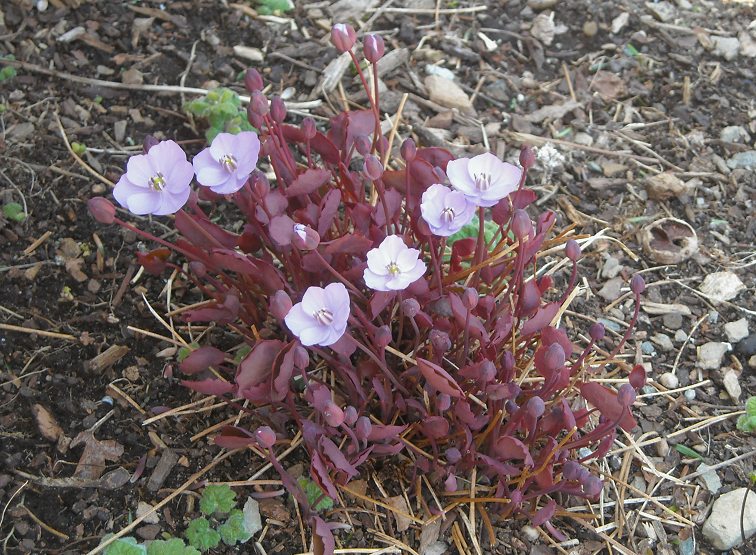
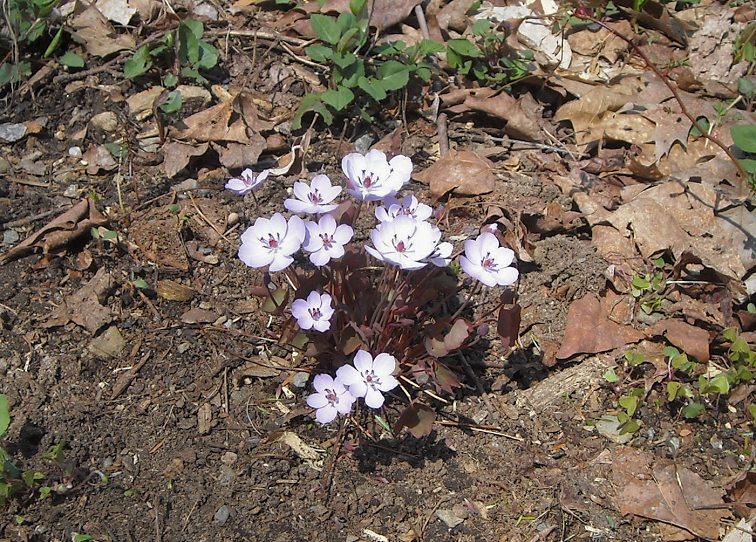
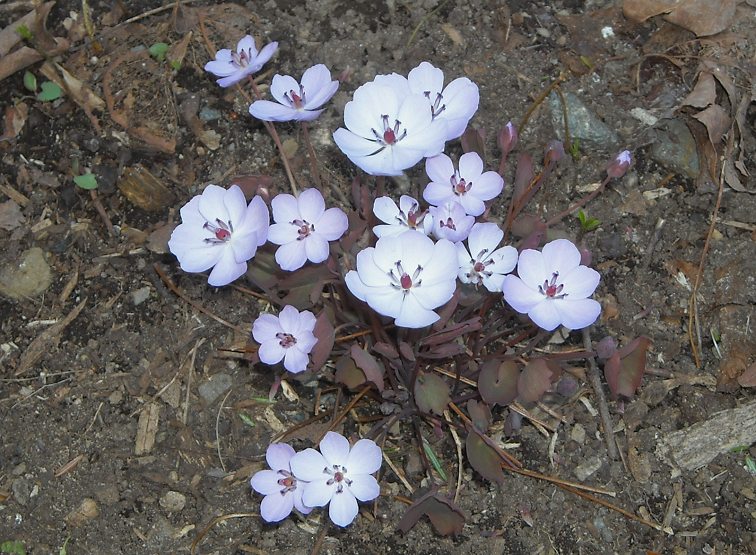
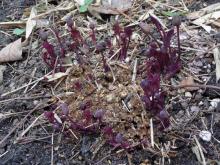
Just starting to flower is Jeffersonia dubia, fun to watch as they emerge, the foliage is beet red and rubbery looking (Photo 1). My plants are from a good dark color form, just opening their first couple blooms... flower color is deeper than what the photo captured. However, I wanted to showcase a form that Darrell Probst collected, CPC 3.10.97 (Cobblewood Plant Collection), selected on account of it's dark flowers (although my normal form are darker) and the red seed pods. In full flower on 04-04-2010, I note some other differences: the ovary is red (green in other dubia forms) and the stamens dark tipped (light color in other dubia forms).
Sun is very strong today, and my daughter's cheap entry-level Nikon Coolpix does a terrible job with white or light-colored flowers, and after several tries, settled on these washed out looking photos, but it is the best I can do. In the last photo, I used a sun baffle to tone down the bright light.
Comments
Trond Hoy
Re: Jeffersonia
Mon, 05/28/2012 - 1:12pmLike Rick, I wouldn't worry much! BTW, are the seedlings easy to plant out or do they sulk afterwards?
Mark McDonough
Re: Jeffersonia
Mon, 05/28/2012 - 1:32pmThey're easy as dirt ;D All kidding aside, they seem indifferent to being handled and transplanted.
By the way, an interesting thing about both Jeffersonia and Epimedium seed, I kept some flats where I received no germination, and in the 2nd year, a few additional seedlings showed up. I was most disappointed last year when seed of white Jeffersonia dubia (kindly sent to me by a SRGC correspondant) showed zero germination. I held on to the flat, and this year, a single seedling appeared!
Tim Ingram (not verified)
Re: Jeffersonia
Tue, 05/29/2012 - 3:17amThose flats of Jeffersonia seedlings are pretty exciting to a nurseryman's eyes! Jeffersonia dubia was one of the first plants that hooked me on 'alpines' (from a picture in a book by Anna Griffiths), but we have never managed to grow it well - too dry I suppose. Those full flowered forms of Rick's and on the SRGC Forum are even more delectable, and also the striking variety Mark showed from Korea. There must be somewhere in the garden we could do better with them!
WimB (not verified)
Re: Jeffersonia
Tue, 05/29/2012 - 11:09amI can really see how that would be a problem, Mark. :P If I didn't live on the other side of the ocean....I would have gladly helped you...A flat more or less for my garden wouldn't be a problem, still have a lot of lawn to convert to woodland beds ;D ;D :P
Richard T. Rodich
Re: Jeffersonia
Sun, 04/21/2013 - 7:47pmPropagation non-results:
You may remember that I wanted to divide a particularly wonderful J. dubia specimen. Being apparently sterile, it's stems multiply vigorously, so I can easily afford loosing some.
When the leaves matured, I tried to cut six growing points off the side while leaving the plant undisturbed in the ground. I cut vertically into the soil hoping I would get some roots along with the stems. No dice. This outer group of stems seemed to curl in, just under the soil surface, toward the center of the plant. I think if I were to dig the the whole plant in the early spring (no, not going to do that!), the shape of the top of the plant would look like a mushroom, with a constriction below the crown, but "exploding" at the top with a multitude of pips. This is unlike the growth of a regular J. dubia nearby.
So I had four usable short stems, and stripped all but two leaves per stem. Then "planted" them in a vermiculite/peat mix, and enclosed them in a clear plastic bag in Nearing frame conditions. The extra leaves were so stiff and non-wilting, that just for kicks, I tried to see if they might root. I treated them as one might when rooting a tropical begonia leaf, with perhaps a centimeter stem, and the leaf laid flat on the vermiculite/peat surface, with the main veins cut with a razor blade. All other rooting parameters were the same.
Neither method was successful. But what was interesting to note was that the individual severed leaves actually lasted longer before withering than the stems!
Trond Hoy
Re: Jeffersonia
Mon, 04/22/2013 - 10:53amA pity it didn't work! Did you try rooting hormone?
Richard T. Rodich
Re: Jeffersonia
Mon, 04/22/2013 - 12:26pmNo I didn't, Trond. That is yet another avenue to explore. That and different times of the season.
Any thoughts on timing from anyone out there?
I forgot to mention on the pic of the cuttings you can see the withered flower stems if you you magnify the image.
Tim Ingram (not verified)
Re: Jeffersonia
Mon, 04/22/2013 - 1:20pmWhen I first got the white form of Jeffersonia dubia and it had bulked up quite well, I tried dividing it. It was a great mistake; the divisions sat still for ever. Perhaps I should have caught it just at the point the plant was beginning to grow. It sounds to me like a ripe plant for tissue culture if hormonal treatment is likely to stimulate proliferation of callus-like growth that can then be stimulated to produce shoots. It does sound as though it might be triploid. Maybe if it keeps growing strongly it would eventually be possible to get large divisions that are not checked too much, to allow a bit more experimentation.
Mark McDonough
Re: Jeffersonia
Mon, 04/22/2013 - 4:20pmRick, maybe best not to tempt fate, and leave your glorious plant alone and just enjoy it, and take lots of pictures for all to enjoy. I'm getting superstitious with some plants, worried that attempts to propagate will kill them.
I took a photo of the Korean Form today, to show a couple blooms that had dropped their petals and red pods are developing. I later noticed the pod and remnant stamens and anthers form an amusing face. Took another close-up shot, they look like little gesturing Jeffersonia monkeys ;)
Going back to yesterday's late afternoon photo, I didn't notice the "little guys", but they can be seen here too. I thought the lighting dramatic, showing up the Pulmonaria and red Corydalis solida in the background.
Mark McDonough
Re: Jeffersonia
Mon, 04/22/2013 - 5:48pmI just came across this, a Japanese nursery selling seed of a variegated leaf Jeffersonia dubia, photo is very small (scroll down), but it looks quite remarkable.
http://www.yuzawa-engei.net/08English/02SeedsCategories/02Seeds.html
Sometimes I should look closer to home, here's a photo of Jeffersonia dubia color forms right here on NARGS wiki, in the garden of nearby Jan Sacks and Marty Schaefer:
http://nargs.org/nargswiki/tiki-browse_image.php?&imageId=4248
Trond Hoy
Re: Jeffersonia
Mon, 04/22/2013 - 11:50pmI can recommend the nursery Yusawa-engei. I have ordered both plants and seeds from them. The plants travel all the way from Japan to Norway in very good condition!
Although the flowers of Jeffersonia are ephemeral they (both species) are indeed worth a place in a garden! The leaves are decorative too.
I have a small batch of seedlings now waiting for planting out later ;D
Tim Ingram (not verified)
Re: Jeffersonia
Tue, 04/23/2013 - 12:52amThose developing seed pods bring a whole new personality to the plant! Very nice pictures on the Wiki - I'm not so sure about the 'variegated' plant, but interesting that this is transmitted via the seed. It be good to try and multiply Rick's plant because if it is completely sterile I imagine the flowers last much longer than normal Jeffersonia; normally they are so beautiful, but so fleeting.
Tim Ingram (not verified)
Re: Jeffersonia
Tue, 04/23/2013 - 1:06amThe long cold spring, and sudden change to warmer weather, has brought out plants all over the garden, and this white Jeffersonia is definitely one of the loveliest...
Margaret Young
Re: Jeffersonia
Tue, 04/23/2013 - 6:52amThanks for the update Rick- I've posted a link to here from your
thread on the SRGC Forum from last year. :)
Mark McDonough
Re: Jeffersonia
Tue, 04/23/2013 - 7:28amTim, I'm envious of your beautiful white Jeffersonia dubia. Seeing this I ran outside to check the spot where I planted the single seedling last summer, nothing showing yet. Not sure if I kept it moist enough after planting it out under the canopy of hemlock trees, the hemlocks tend to block rain from reaching the ground.
cohan (not verified)
Re: Jeffersonia
Tue, 04/23/2013 - 10:30amAll the colours are great :)
Interesting nursery too! Wondering about timing- Jeffersonia and Dicentra are warm/cold/warm germination, right? So the time to buy/sow would summer?
Tony Willis (not verified)
Re: Jeffersonia
Tue, 04/23/2013 - 11:34amI find jeffersonia seeds are very short lived and always sow straight from the pod the day it ripens. It then germinates the next spring.
As to dividing plants the only one I tried by cutting in two died at once,on the other hand I have a plant of the white form which was propagated by division for me, so it could just be my lack of skill.
Mark McDonough
Re: Jeffersonia
Tue, 04/23/2013 - 5:32pmWhen I collect seed of Jeffersonia, Epimedium, and woodland Iris species, I collect directly into plastic baggies. They can stay in the seed for up to 2-3 weeks without problem, and then sown, to germinate next spring; just gives a bit of leeway as to when the seed is sown.
Tim Ingram (not verified)
Re: Jeffersonia
Wed, 04/24/2013 - 12:43amOver the years people have toyed with the idea of a short viability seed exchange because there are so many woodland plants in particular like this: seed could be kept in slightly damp vermiculite for a long time if necessary. A few growers do supply seed like this in the UK, and occasionally Society seed exchanges institute the idea, but there are probably not enough knowledgeable gardeners to really make it viable (excuse the pun). Similar, but different, is supplying seed that has been pretreated (eg: by cold stratification) to improve germination, and the German seedsmen Jelitto must be pre-eminent in this. Years ago I remember getting some rosulate viola seed that had been stored moist in the cold and it gave very good germination - growing them on was another problem!
cohan (not verified)
Re: Jeffersonia
Wed, 04/24/2013 - 3:28pmIf I read correctly, the Japanese nursery noted above is selling seed of this sort moist packed, as Kristl does, which seems to preserve them for some time- until sown if the same season, or if it's a bit later, the moist packing seems to take the place of the warm period in warm/cold/warm, so they can go straight to cold.
Just curious about how well these (and Dicentras I was especially looking at on that list ;D ) respond to moist packing..
Mark McDonough
Re: Jeffersonia
Wed, 04/24/2013 - 6:52pmI'm not too familiar with how long you can moist pack seed before they'll start germinating on their own, or rotting... Kristl Walek would know.
I neglected to post this season's best photos of Jeffersonia dubia Korean Form, so here they are. Still in bloom now, after 9 days, but the photo shown on the left was taken on about day 4 (in the sun) and the photo on the right taken on day 6 (cloudy).
Richard T. Rodich
Re: Jeffersonia
Wed, 04/24/2013 - 9:18pmYes, best photos indeed, Mark!
I get almost as much enjoyment with my failures as with successes, especially when it comes to seeds. When you said,
I'm not too familiar with how long you can moist pack [Jeffersonia dubia] seed before they'll start germinating on their own, or rotting
I may be able to provide some tangential experience. Through more happenstance than planned and methodical regiment, this is my unofficial, non-scientific, and inconclusive experience so far with a particulaar batch of dubia seeds. Take from it what you will. Edit: I thought these were Jeffersonia, but they are actually Allium triccocum
June 2011: collected
J. dubiaAllium triccocum seeds from my own plant.Immediately placed between moist paper towels at 65-80F. (I don't have air conditioning).
They plumped even more into very dark, round balls.
August: the moist towels dried somewhat, to the point that a visible shrinking could be seen with the seeds.
After re-wetting, they returned to there previous size.
October: still no germination. Placed in fridge.
February 2012: Brought 65f.
May: Still no germination. Placed back in fridge.
September: After forgetting about them, I took half the seed and planted them. These are now spending the winter (and spring, if it ever comes) outside. The other half is still in the fridge. They look unchanged, still plump and still very firm. This is a photo of them now:
April 2013
Trond Hoy
Re: Jeffersonia
Thu, 04/25/2013 - 12:39amIt's like Schrödinger's cat - they are either dead or alive; and you can't know before something happens ;D
Tim Ingram (not verified)
Re: Jeffersonia
Thu, 04/25/2013 - 12:52amRick, I'm really surprised those didn't germinate in the spring. I've always sown Jeffersonia seed (the few times I've got much) in pots as soon as I collect it, but with other such plants I have put moist-packed seed in an airing cupboard and then sown outside for the normal winter cold. It could be they really need constant percolation of moisture throughout the winter to allow germination to proceed. I think the ideal must be to sow fresh in pots in a cool place so they experience as close to natural conditions as possible. I like Mark's idea of sowing directly in the garden, except this isn't so effective for the nurseryman.
Mark McDonough
Re: Jeffersonia
Thu, 04/25/2013 - 4:25amTim, I'm not sure why you didn't get germination. On Jeffersonia, this is one that typically don't do my scratch-and-sow-in-place technique (although one year I experimented with that too), I typically collect the seed and then within a week or two, all gets sown in peat flats and covered with wire to keep chipmunks from eating the seed (they love em). The flats sit on the ground in contact with the earth, and get sprinkled regularly. In spring, they germinate with such vigor that they tend to left the crust of soil up as a layer. I've done this with both species the last three years, and have gotten consistently strong germination, and always with diphylla being the slightly slower germinator.
One year as a test, I prepped an area approximately 4' x 5', and sowed the seed in place (immediately after seed was ready). Also had tremendous germination, but after 4 years, with animal trampling (an occassional deer passing through), mole tunneling, and other invading plants, it's not a sheet of Jeffersonia. But the area still has LOTS of Jeffersonia seedling plants there, growing in clusters or small colonies, this year small plants flowering in significant number.
Richard T. Rodich
Re: Jeffersonia
Wed, 05/08/2013 - 7:55pmOh the HORROR !!!!!
My most excellent J.dubia has been eaten. Eaten alive!
Dang varmints! This part of the garden is the last to thaw, and when I did my initial garden cleaning, all the old petioles had been severed, just as mice do with lawn grass over winter, and all the buds gone. :'(
27 April 2013
You can see a few buds left at the outer edges, where they would have been a little under and hidden.
Thankfully, a few more have emerged also, and all is not lost.
8 May 2013
PHEW !
Mark McDonough
Re: Jeffersonia
Wed, 05/08/2013 - 8:10pmOMG Rick, that's terrible! :'( I shed Jeffersonian tears for this sad development.
It seems that when there's just one of something, that's when something happens to it. At least there's new shoots coming up at the periphery, and hopefully it'll rejuvenate to some level. Depending on it's level of renewed growth, maybe it would be prudent to attempt a division, just so that you have more than one plant in the garden.
Dang varmints!!!
cohan (not verified)
Re: Jeffersonia
Mon, 05/13/2013 - 10:55amSorry to hear, Rick, hopefully there is enough left underground to regenerate..
CScott (not verified)
This is a very long thread on
Sat, 01/25/2014 - 7:55pmThis is a very long thread on Jeffersonia!
Having just set the moist packed seeds out for a winter sowing.
Thanks for all the information of this thread.
Richard T. Rodich
Fri, 02/07/2014 - 2:23pm[quote=Hoy]
It's like Schrödinger's cat - they are either dead or alive; and you can't know before something happens ;D
[/quote]
Something happened !!!
So to catch up on what had previously been going on with the
JeffersoniaAllium triccocum seed I harvested in 2011, you can look at an earlier post in this thread here: https://www.nargs.org/comment/4409#comment-4409Since then (April 2013), I just left them alone, kinda as a lost cause, and they stayed in their moist paper towel in a closed container and on a table next to the outside wall of the house. They endured temps of 80 plus degrees F in summer, and temps as low as 45F nights this winter. In early December there was still no activity. But now...
The cool temps finally triggered germination, as normal. I suppose that after the seeds' initial hydration, the drying up in 2011 must have put it into a very deep dormancy.
Incidentally, there are still three dormant seeds.
So now more investigation and questions....
I had assumed that with this kind of germination mode,
--- first a root would grow
--- a crown would establish
--- then the first true leaf would emerged from the crown
This is not right then, if I assume that the dark green part is a developing leaf. Does anyone have any insight?
It appears there is a secondary root growing here, possibly indicating where the crown is....
Lori S. (not verified)
Wow, well done, Rick! Right
Fri, 02/07/2014 - 3:37pmWow, well done, Rick! Right there is a demonstration of the wisdom of hanging onto planted seeds that haven't germinated... a lesson I need to follow.
Trond Hoy
Rick, those seedlings do not
Thu, 02/13/2014 - 12:10amRick, those seedlings do not look anything like dicotyledons?
How are they now?
Richard T. Rodich
I planted most of them, but
Thu, 02/13/2014 - 10:02pmI planted most of them, but kept a few for further examination. Not really much change yet, but I have a little better pics. It’s the limit of my pocket camera. Every seedling has grown a secondary root. I cut one of the ungerminated seeds as shown in the second pic. The seed was still surprisingly hard. Vertical marks are millimeters.
Mark McDonough
Cool pics Rick, thanks for
Sat, 02/15/2014 - 3:08pmCool pics Rick, thanks for sharing those.
Trond Hoy
Rick, seems the one you cut
Sun, 02/16/2014 - 8:53amRick, seems the one you cut still was alive with a small embryo. But it doesn't look like a dicot though!
Richard T. Rodich
I had no doubt the seed was
Sun, 02/16/2014 - 4:26pmI had no doubt the seed was still alive. I cut it because I thought I would easily see the two cotyledons. But that's certainly not the case!
I suppose only time will tell. It was all so long ago, I won't even venture a guess of what else the might be.....
Richard T. Rodich
Yow, it came back to me, and
Tue, 02/18/2014 - 9:08pmYow, it came back to me, and am I red in the face! I try hard to keep the best records, but as many will attest, things still manage to fall through the cracks.
I am almost positive that they are wild Allium triccocum seeds I collected near here that same year. At least the mystery is solved.
I had wondered what happened to them....
Now I am wondering what happened to the real Jeffersonia dubia seeds!
Trond Hoy
Have you looked in the fridge
Wed, 02/19/2014 - 1:31pmHave you looked in the fridge, Rick?
Richard T. Rodich
Look what I found this spring
Mon, 06/23/2014 - 1:09pmLook what I found this spring! Beneath my special multi-petaled Jefersonia dubia are two seedlings! My other seed producing J. dubia is 25ft away. Ants carry the seeds even that far away, but always to warmer, drier areas. This more moist area gets no direct sun, except late in the day, so I am very hopeful! Still have never found any seed capsules on the "mother" plant yet, though. I wonder about the seedlings' true origin with fingers crossed!
Richard T. Rodich
Isn't this interesting....
Mon, 06/23/2014 - 1:10pmIsn't this interesting.... from http://english.knps.or.kr/flash/resources2/Model/knpsPicture_XML.xml
Jeffersonia dubia
RANUNCULALES Berberidaceae
Status : No data / No data
It is perennial. The unit stem does not exist and several leaves come from the root stem. The leaf is a rounded heart shape, the length and width are 9cm and the boundary is wave-shaped. The flower is red-purple. It hangs on the stem of the flower from April to May. The fruit is widely oval-shaped as a follicle. It propagates by seeds, but plant multiplication by separating the roots is done as well. It grows on the bottom half of mountains. It grows in nationwide in Gyeonggi-do, Gangwon-do, Chungbuk, jeonnam, Gyeongnam and Gyeongbuk and is also distributed in Amur and Usuri, Russia and northeastern china.
※References
Korean red data book(MOE, UNDP/GEF Korea Wetland Project, NIER)
Mark McDonough
Good find Rick (on both
Tue, 06/24/2014 - 8:04amGood find Rick (on both accounts; the appearance of a couple seedlings on your fine form, and the information on this species in Korea). For me the link doesn't work (in Firefox), it displays as a raw XML page, but I went to the root web page, and after bumbling around for a while, found a beautiful picture of Korean form of Jeffersonia dubia with the classic red ovaries; here's the direct photo link:
http://english.knps.or.kr/down/chi-Jeffersoniadubia.jpg
Richard T. Rodich
Mark McD wrote:
Tue, 06/24/2014 - 7:53pm[quote=Mark McD] For me the link doesn't work (in Firefox), it displays as a raw XML page[/quote]
Me too (on FF), but when I copied it to the forum, it processed the code, and voila!
That's a wonderful Korean Jeffersonia pic. Are they really that small, or the brown forest floor leaves that big?? What about yours, Mark?
Lori S. (not verified)
NIce find, Rick. I've been
Mon, 06/30/2014 - 6:01pmNIce find, Rick. I've been amazed to find seedlings all around my Jeffersonia dubia this spring - never noticed any before except directly under it; must be the crazy winds blowing them around - and have been busily moving the seedlings around!
Claire Cockcroft
I had a surprise this year
Tue, 07/01/2014 - 8:37amI had a surprise this year with Jeffersonia diphylla seeds. Usually there are so many that I have trouble with too many seedlings, even after harvesting as many seeds as possible. I won't be bothered with seeds this year -- a very industrious rat picked off almost all the seed pods, heaped them in neat piles, and chowed down! Thankfully my two terriers helped put an end to his gourmet snacking.
I was able to share only a few J. diphylla seeds. J. dubia bloomed and set seed earlier, so its seed harvest was not affected.
Richard T. Rodich
Some of the seedlings grown
Thu, 04/16/2015 - 6:17pmSome of the seedlings grown from seed you sent me, Mark. Most of them are going to flower for the first time this year.
Jeffersonia diphylla
Toole (not verified)
RickR wrote:
Thu, 04/16/2015 - 9:01pm[quote=RickR]
Some of the seedlings grown from seed you sent me, Mark. Most of them are going to flower for the first time this year.
Jeffersonia diphylla
[/quote]
Lovely clear detailed photos Rick.
Mark McDonough
That's good new Rick. I'm
Fri, 04/17/2015 - 6:34pmThat's good news Rick. I'm amazed that with our 9' of snow, which finally cleared out of the yard about 1 week ago (April 10, 2015), that my J. diphylla plants are at the same stage of emergence as yours! It's such a great plant, rather fleshy and distinctive when emerging from the cataphylls. I agree with Dave, good photos.
Toole (not verified)
I have some 2nd youngsters
Fri, 04/17/2015 - 9:16pmI have some 2nd year youngsters coming along ,courtesy of seed from a Forum member however to my shame I've lost the donor's details ...I'd like to blame it on ' too many species not enough time '
  .........
Richard T. Rodich
>>>Lovely clear photos
Sat, 04/18/2015 - 7:49pm>>>Lovely clear photos
Thanks. I actually chose to show the ones with better bokeh over full detail!
More pics, two days later:
Lori S. (not verified)
Here's a photo from the peak
Mon, 05/11/2015 - 12:30pmHere's a photo from the peak of bloom back on April 22. Now, the seed pods are visible and the plants are beautiful mounds of foliage (although snow-covered today, ahem). I'm glad to see that the seedlings I distributed around last year are coming up.
Here's what they look like today, with just foliage (except for the odd flower hidden deep in there) and seedpods;
Pages