
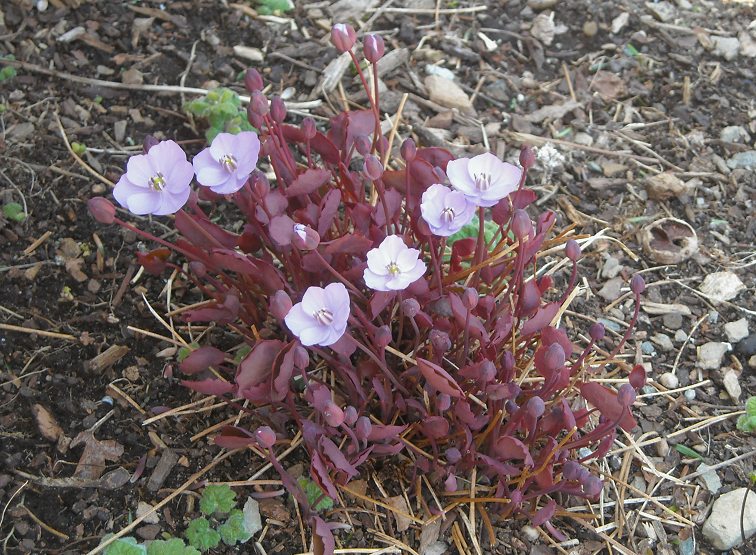
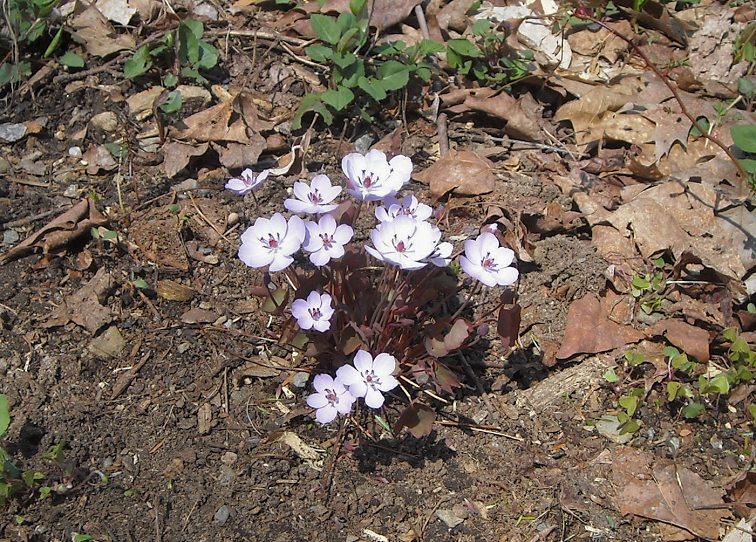
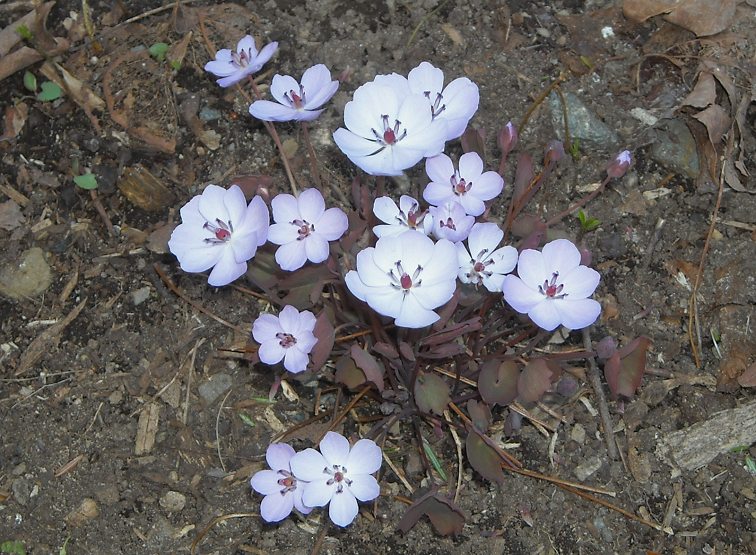
Just starting to flower is Jeffersonia dubia, fun to watch as they emerge, the foliage is beet red and rubbery looking (Photo 1). My plants are from a good dark color form, just opening their first couple blooms... flower color is deeper than what the photo captured. However, I wanted to showcase a form that Darrell Probst collected, CPC 3.10.97 (Cobblewood Plant Collection), selected on account of it's dark flowers (although my normal form are darker) and the red seed pods. In full flower on 04-04-2010, I note some other differences: the ovary is red (green in other dubia forms) and the stamens dark tipped (light color in other dubia forms).
Sun is very strong today, and my daughter's cheap entry-level Nikon Coolpix does a terrible job with white or light-colored flowers, and after several tries, settled on these washed out looking photos, but it is the best I can do. In the last photo, I used a sun baffle to tone down the bright light.
Comments
Mark McDonough
Re: Jeffersonia
Sat, 11/05/2011 - 5:48pmCleaning up around a clump of Jeffersonia dyphylla, I thought I'd clear around the plump resting buds to reveal them, normally just barely visible unless the top layer of leaf mold and soil is scratched away. Also seen, is a fine network of roots. After the photo, the buds were recovered for a safe winter rest. Trond, maybe these types of leaf buds would not last in your area if they're attractive to slugs.
Toole (not verified)
Re: Jeffersonia
Sat, 11/05/2011 - 7:35pmRick and Mark
Just seen your postings above and it's solved a mystery for me .
I grow Jeffersonia dubia ,(it is currently forming about 6 good sized seed pods--if you are still after fresh seed Gene just PM me ),however i have raised seed of something a bit different...
Seeing your pics it's obviously J.diphylla , a newy for moi ;D .Unfortunately i have no idea where the seed came from. :rolleyes:
Cheers Dave.
Mark McDonough
Re: Jeffersonia
Sat, 11/05/2011 - 7:45pmI would agree Dave, looks like Jeffersonia diphylla to me too. It will fit in nicely with your trillium collection. When it does flower (will take several years from seed), be sure to watch the buds closely, the flowers are fleeting and may only last but 1 day (in warm temperature) or up to 3-4 days with cool weather. Even so, this is an excellent plant.
Trond Hoy
Re: Jeffersonia
Sun, 11/06/2011 - 1:40amMark, fortunately I haven't seen slug damage of the only specimen I have of a Jeffersonia. But who knows - sometime a precocious slug find it irresistible.
Mark McDonough
Re: Jeffersonia
Sun, 03/25/2012 - 1:47pmAbnormally warm weather has brought about particularly early bloom in the garden, and in just a few days Jeffersonia have gone from no visible signs of sprouting to being in flower. Today however is cold and dreary, so the first flowers are closed tightly. I hope the predicted deep freezing nights for the next several nights doesn't do too much damage.
Jeffersonia diphylla was way behind J. dubia in emerging, but it caught up, to flower at the same time.
Left: from a previous year's in-situ seed sowing of Jeffersonia dubia in a large patch of ground, are seedlings entering their second year of growth just emerging.
Right: from 2011 seed sowing of 5 flats of Jeffersonia dubia, they're all coming up thickly, as are 2 flats of J. diphylla. In the photo, the first seedlings showing, many many more are just breaking surface (can't see that in the photo) and others still germinating and pushing the soil surface upward. Taking no risk, I'm bringing the flats inside for 3-4 days until the temperatures moderate.
Lori S. (not verified)
Re: Jeffersonia
Sun, 03/25/2012 - 2:29pmGreat to see your Jeffersonia so advanced, Mark. Can't wait to see those pristine buds open. (And look at that beautiful trillium in the background too.)
You'll need to watch it, though - they're practically getting to be weeds. ;D ;D
cohan (not verified)
Re: Jeffersonia
Sun, 03/25/2012 - 4:05pmWow-- looking great! Hope the they weather the freeze okay..
Richard T. Rodich
Re: Jeffersonia
Sun, 03/25/2012 - 6:27pmMy Jeffersonia diphylla buds with leaves, but Jeffersonia dubia does not. Is that normal for you, Mark, or is it the weird weather?
J. diphylla is just emerging...
Mark McDonough
Re: Jeffersonia
Sun, 03/25/2012 - 6:40pmHmmm, interesting. My J. dubia tend to show buds first but quickly by the time buds are ready to open there are young leaves, so I have always thought it as having simultaneous bud/leaf growth. Could be that the extra warmth this spring is causing aberrant behavior, shooting buds up before leaves have had a chance. But my goodness, look at all them buds, going to be quite a sight soon.
Rick, do you get germination with the seed? I'm always surprised that this plant is so expensive to purchase, when they make so much seed and seem very easy to germinate and grow on.
Mark McDonough
Re: Jeffersonia
Sun, 03/25/2012 - 6:44pmWell, I'm hoping to replace much of my lawn with Jeffersonia ;D The trillium in the background is T. foetidissimum; I have several different ones, they are among the earliest to bud up.
Cohan and others, I hope to report back next weekend after the freezing weather, to see what transpires.
Richard T. Rodich
Re: Jeffersonia
Sun, 03/25/2012 - 8:24pmI do have plants from the seed you sent me, Mark. I have not tried otherwise. The ants seem to do a fairly good job. I find a couple J. dubia seedlings each year way away from the plant. The J. dubia in the first pic with all the buds seems to be sterile. It has never set seed. Last season I even tried hand pollinating it with pollen from a different dubia, but to no avail. It is also the one that consistently has more than the normal six of petals.
Lots of naturally planted baby J. diphylla babies beneath mom, though:
Mark McDonough
Re: Jeffersonia
Sun, 03/25/2012 - 8:37pmInteresting that you have a J. dubia that is sterile, and one that produces extra petals! All of mine are fertile and are normal in terms of petal count. Lots of little diphylla "jeffs" in your photo. Do you pot any of these up for your NARGS chapter sales, or is J. diphylla considered too common thus not a big "mover" in the local plant sales. I used to be down on this plant because flowers only last a 2-3 days, but over time I've grown very fond of it for the unique foliage, intriguing seed pods, and the untapped variability; an all around great native plant.
Richard T. Rodich
Re: Jeffersonia
Sun, 03/25/2012 - 9:28pmIn fact, the native J. diphylla is more well known among gardeners here, and since our spring sale is open to the public, we always sell out of the diphylla's. (And I am not the only one who donates them.) It's the dubia's that don't always sell!
Last year one of our Chapter members moved south, and donated an old J. dubia she had. It was 2.5ft across!!! :o :o :o
Howey (not verified)
Re: Jeffersonia
Mon, 03/26/2012 - 3:45amYes Mark, I too delight in the whole development process of Jeffersonia diphylla even though the flowers are so short lived as are the native Bloodroot - Sanguinaria canadensis. J. diphylla has been in my garden for many years and has spread itself around nicely, producing copious seeds. I acquired J. dubia as a plant last year and am happy to see the tiny purple leaves emerging - quite behind J.diphylla. Didn't think either would succumb to the frost, which we had last night and is due to go on for a few more days. Am almost afraid to look at it later on this morning when it gets light. Will keep my fingers crossed. Fran
Frances Howey
London, Ontario, Canad
Zone 5b
Trond Hoy
Re: Jeffersonia
Mon, 03/26/2012 - 1:15pmMy sole Jeffersonia doesn't set any seed! I tried to get some new plants last year but they don't travel well even inland. Jeffersonia is never for sale in any common nurseries here. So if any of you guys get more seed than you need yourself I can gladly help you off with some ;) Regardless which species it is ;D
Tony Willis (not verified)
Re: Jeffersonia
Fri, 03/30/2012 - 9:00amAt the moment I have a single plant of both species and last year they set seed. This is just germinating.
Both lots were sown the day the pods ripened which seems essential.
Mark McDonough
Re: Jeffersonia
Sat, 03/31/2012 - 11:23amRick, good to learn that J. diphylla is actually appreciated at your plant society sales; though, hard to believe that the dubia plants don't always sell out!
Francis, hope your Jeffersonias are ok after the frost, they were unfazed by the freezing cold snap here. Good that you now have both species, as J. dubia is such a delight too.
Trond, will have to send you some seed this year. :)
Tony, having just one plant of each species, you are fortunate to get seed and good germination on both, congratulations.
Mark McDonough
Re: Jeffersonia
Sat, 03/31/2012 - 11:25amTo compare seedlings of bothy species.
I have multiple flats of Jeffersonia dubia germinating thickly. I use decomposed pine bark mulch as seed cover, the flats left out to weather all winter. They germinate so profusely that germination tends to lift the whole bark mulch "crust" up; I try to gingerly tamp it back down and poke to break the crust up, I should probably use something else for seed cover. When I jest that I want to replace parts of my lawn with Jeffersonia, I do so with a degree of seriousness, I want a Jeffersonian lawn :D
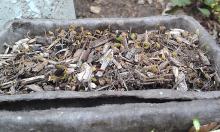
Two years ago after posting photos of my seed harvest and sowing of Jeffersonia diphylla on SRGC, I received some feedback that I harvested seed too early which lessens viability of the seed, eg. harvested before peak viability. Last summer I harvested seed as I do normally, just before pods split wide open, when the "lid" on the pipe-shaped pod will easily "pop" with the slightest squeeze, or the lid seam visibly starting to separate. Because pods ripen and pop open so fast, a half day delay can be too late and all seeds spills out (when that happens, I've been known to rout around the base of mother Jeffersonia hand picking seeds found among the leaf litter ::) ). Seed is sown immediately in flats, covered thinly with soil and then a layer of pine barch mulch, kept cool and shaded and just moist through summer, left out all winter. Flats are covered with wire cloth to keep chipmunks and squirrels from digging and eating the seed. As with easy-germinator J. dubia, my 3 flats of J. diphylla are coming up so thickly as to raise the bark mulch "crust". Below is a photo of both species; a bit hard to see with J. diphylla, the seedlings are smaller and come up a little bit later than J. dubia, and are an earthy camouflage beige color.
Jeffersonia dubia germination:
Jeffersonia diphylla germination:
Richard T. Rodich
Re: Jeffersonia
Tue, 04/03/2012 - 6:37pmLast season was a let down for me and the jeffersonias. It rained every day of the bloom season, so flowers were never picture worthy.
This season, however, is pretty glorious!
The regular form of Jefersonia dubia:
And the multiple petaled plant that seems to be sterile:
Mark McDonough
Re: Jeffersonia
Tue, 04/03/2012 - 7:01pmOMG, your multiple-petaled form is very choice, such full rounded flowers; maybe make some divisions of that one ;) 8)
You're having a better flowering season for them than I am. Today I was home because my car broke down (hurrah), which as it turns out, gave me a day to look at plants in bloom on a sunny day at long last, and the Jeffersonias, which have been in closed bloom for weeks, finally partially opened their flowers today. Jeffersonia diphylla is ready to bloom too, but with the next 3 workdays predicted to be sunny, I'll probably miss seeing them, let alone attempt a second time to cross the two species.
Mark McDonough
Re: Jeffersonia
Tue, 04/03/2012 - 8:57pmA few views of Jeffersonia today.
Left, J. dubia (above the main plant, are dozens of seedlings).
Right, J. dubia Korean Form, with red versus green ovaries.
J. diphylla ready to pop open, I think I might miss the bloom during the work week.
Two close-ups of J. diphylla seedlings.
Trond Hoy
Re: Jeffersonia
Wed, 04/04/2012 - 12:20amThey really are beauties both species but Rick's double take the first prize!
I'm looking forward to my woodland "filled with" these plants ;D Hope is still living!
.. so thanks, Mark!
cohan (not verified)
Re: Jeffersonia
Wed, 04/04/2012 - 4:28pmStunning, Rick! I'm usually not a fan of double flowers, but this still looks natural enough ;D
I would like to beg seed this year again if anyone has some spare (of either species)- I got some from two generous people last year, but I'm not sure about them- one batch got mouldy in transit and the other I may have accidentally let dry out :( I'm still hopeful, but not expectant....
Richard T. Rodich
Re: Jeffersonia
Wed, 04/04/2012 - 6:08pmI am going to divide my double dubia this season. As it produces more and more buds each year, the individual flowers seem to be a bit smaller. I am thinking now the best time is after the leaves fully open, or would you say right after flowering? Anyone with good or bad experiences? Do tell...
The first division goes back to a fellow Chapter member (Nancy), who gave me the plant as a small seedling in 2006. Hers (the parent) is a normal form, but with better color and more blue.
Trond Hoy
Re: Jeffersonia
Thu, 04/05/2012 - 12:04amI can't advise you regarding dividing but maybe you should name this form? It is worth propagating!
And I am sorry I don't live close to you ;)
Tony Willis (not verified)
Re: Jeffersonia
Thu, 04/05/2012 - 1:43amRick
my only experience with a large plant was a fairly quick death to both parts.
On the other hand I have just received a small division of the white form and it is looking fine and is I believe a year old.
Diane Clements on the Scottish Rock would be a very good person to ask as I know she has experience of it.
Mark McDonough
Re: Jeffersonia
Thu, 04/05/2012 - 4:00amI only divided Jeffersonia dubia once before. I received my plants from nearby friend and fellow rock gardener Marsha Russell, she was clearing out much of her garden in preparation for eventually moving (ultimately she decided not to move afterall), we dug a couple large clumps late in the season (late summer or fall, can't remember exactly when). They have a massive root system, and I pulled apart the large clumps into smaller pieces, and fortunately all acclimated just fine. The time of year was by chosen by necessity of the intended house move situation, not by any insightful experience with moving and dividing Jeffersonia. Not sure if we were just luckly or if late summer is actually a good time for such an operation.
Mark McDonough
Re: Jeffersonia
Thu, 04/05/2012 - 4:05pmHome again on a sunny but cold day, too cold for Jeffersonia flowers to open much, with J. diphylla's buds still tightly clenched. One good thing about the coolness, the flowers last longer.
Left: J. dubia trying it's best to open flowers. I spied some pods just starting to form on some plants.
Right: J. dubia Korean Form, a better overhead view to show the red ovaries and dark stamens.
Left: Jeffersonia dubia, 2-year old sown-in-place seedlings starting to grow.
Right: These dang weeds are popping up everywhere! ;)
Left: Jeffersonia diphylla - a clump looking pretty good, with lots of flower buds. If they open soon, I might get a chance to attempt dabbing J. dubia pollen on the flowers for another try at crossing the two species.
Right: Another view in afternoon light today, the flowers stems leaning towards the sun.
Trond Hoy
Re: Jeffersonia
Thu, 04/05/2012 - 10:45pmMark it is easy to see that you have a drier climate than I have! Here the soil had been covered in moss in no time (do I spot a piece of moss in one of the middle pictures, Mark? ;D) and not your kind of weed! Wouldn't mind some of them :) Do the Koren form and the other cross? - or I mean, can you discern the hybrids?
Mark McDonough
Re: Jeffersonia
Sat, 04/07/2012 - 8:38pmHaven't tried. The Korean form is only noticeably different from the regular form of J. dubia by virtue of the red ovary and dark stamens, versus green ovary and light color stamens in regular J. dubia. Much rather try crossing the two species, instead of figuring subtle differences between the same species.
Trond Hoy
Re: Jeffersonia
Mon, 04/09/2012 - 12:16amYes of course - I just wondered whether some stray seedlings showed intermediary characters. Maybe the offspring of such a cross were showed extra vigour - heterosis effect, you know.
Mark McDonough
Re: Jeffersonia
Mon, 04/09/2012 - 4:52pmI only have a few sown-in-place 2 year seedlings of the Korean form coming a long, then a potful of fresh seedlings from last summer sowing. This Korean form was a relatively new (going on 3 years) acquisition from Darrell Probst.
Trond Hoy
Re: Jeffersonia
Tue, 04/10/2012 - 10:12amA few and a potful ;) Any one of them would be nice to grow ;)
Mark McDonough
Re: Jeffersonia
Thu, 04/12/2012 - 6:32pmWith cool weather, Jeffersonia diphylla has been in bud for 1-1/2 weeks, but not warm enough to open its flowers. Of course, with warmer temperatures during the work week, the flowers certainly did open, but I missed seeing them open for 2012 :(. Inspecting the plants tonight at dusk after I got home, the petals had fallen and small developing seed pods have begun to form.
Last summer (2011) I rowed out lots of seedlings of my attempted cross of J. dubia x diphyllum. The area where I planted them was subject to continued disturbance by mole tunneling, and despite attempts to bait, the tunneling continued. The photo I show below was taken a few days ago, it is not staged, it is what I actually came upon, I think the varmints are mocking me, not only did they tunnel, but they actually tunneled such that the labels fell into a mole hole! So far I don't see a single young Jeffersonia seedling leafing out (all the other Jeffersonia seedlings have been up for a couple weeks or more), so I'm beginning to think this bed is a total failure.
While I have missed opportunity to try crossing the two species again in 2012, thank goodness I have many pink-stemmed baby J. diphylla (just the regular species) to plant around the garden this year. They are the cutest little seedlings.
Richard T. Rodich
Re: Jeffersonia
Thu, 04/12/2012 - 8:17pmThe pods as lidded scepters above the foliage is quite attractive, Mark. I've never noticed that on mine...
I'll have to take better note this spring. They'll be blooming any day now.
Mark McDonough
Re: Jeffersonia
Sat, 04/14/2012 - 9:10pmSoon after flowering and the production of "lidded sceptars" (good description Rick) the foliage will overtake them where they will be shaded and concealed by the ornamental foliage.
Today I noticed something I have not noticed before. In a different part of my property (the wild wooded part, not the garden area), where Jeffersonia diphylla is several days behind the flowering schedule of the same species in my garden in a more open and warmer spot, they were still in bud. I went to photograph them, then witnessed a remarkable thing, the bud sheath, which becomes detached from the base and was at a stage where it partially constricts the opening of the flowers, suddenly pops off from the pressure of the expanding buds and the tightly closed white flower sprung open in real-time, in a couple seconds, just like the way some "evening primroses" (Oenothera species) will pop open at dusk so fast that its fun to watch such miraculous "plant movement". I had no idea that Jeffersonia diphylla flowers are "spring loaded" and open with such speed.
In the first photo, you can see the translucent green bud sheath at the top of the white bud. At some point the sheath will just pop off and the flowers spring open in a couple of seconds.
In this photo, I noticed further down on my dry wooded hillside, two white flowers with looked like Sanguinaria from afar. When I got up close, I can see it is J. diphylla with the 8-petaled flowers fully open mimicking a bloodroot, In the photo, you'll notice lots of foliage of Garlic Mustard or Alliaria petiolata which is invading New England, and only showed up in my property a couple years ago, but already it has spread with explosive abandon.
Trond Hoy
Re: Jeffersonia
Sun, 04/15/2012 - 11:29amThe only one I have more than I need of is Alliaria petiolata (it's called løkurt "onion wort" here) although it is not a pest ;)
Mark McDonough
Re: Jeffersonia
Sun, 04/15/2012 - 7:12pmToday I went and gathered some self-sown J. diphylla plants down in my dry woods area. They have a fine mass of roots and are easily moved and replanted. Shown are 2 - 3 year seedling plants.
Mark McDonough
Re: Jeffersonia
Thu, 04/19/2012 - 7:57pmThe Jeffersonia seedlings are growing fast, but to my surprise, the later germinating J. diphylla has caught up and overtaken J. dubia in growth. Now I'm wondering if I will manage to get all of these planted, I have 5 flats of dubia (1 flat seen in the upper left) and 3 flats of diphylla (2 seen in the photo, lower left and upper right). To ease my Jeffersonia burdon, I think I'll donate one flat of J. dubia seedlings to a NARGS New England Chapter meeting plant sale on Saturday. :D
Richard T. Rodich
Re: Jeffersonia
Fri, 04/20/2012 - 5:29amSame here: J. diphylla is later, but once it decides to grow, it really takes off. How old are those seedlings, Mark?
I am pleased to see a lot of what looks to be 5(?) year old blooming seedlings in our MN arboretums wildflower garden now. Obviously individually planted, someone must have grown them from seed. 8)
Mark McDonough
Re: Jeffersonia
Fri, 04/20/2012 - 5:24pmNot very old, I posted a photo earlier in this topic that shows the seedling just breaking ground, that was March 25th! So these seedlings are not quite a month old. I think the unusually warm weather and lots of sunny days is bringing them on speadily. Plus I try to remember to water them adequately while actively growing.
http://nargs.org/smf/index.php?topic=181.msg16064#msg16064
Lori S. (not verified)
Re: Jeffersonia
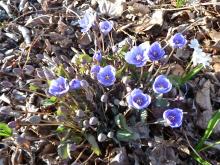
Mon, 04/23/2012 - 7:48pmAfter a beautiful weekend and 26 deg C today, everything has suddenly popped! Jeffersonia dubia was tightly closed yesterday:
Mark McDonough
Re: Jeffersonia
Mon, 04/23/2012 - 7:55pmSince our Jeffersonia are just lovely foliage now, good to again see the beautiful blooms. Wow, 26 C (77 F) is a warm day, you'll have plants and flowers popping all over the place. I'm amazed at just how fast plants can open flowers when they receive full days of warmth.
Trond Hoy
Re: Jeffersonia
Wed, 04/25/2012 - 2:57amThat never happens here!
The warmest so far was yesterday evening - had to use the garden parasol when we had dinner outside in the evening ;D ;D
Still, my sole Jeffersonia hasn't opened the flowers yet.
Mark McDonough
Re: Jeffersonia
Fri, 05/04/2012 - 7:12pmI saw this link on an SRGC post that shows a very full-flowered form of J. dubia similar to Rick's fine form:
http://www.srgc.net/forum/index.php?topic=9018.msg245568#msg245568
http://www.srgc.net/forum/index.php?action=dlattach;topic=9018.0;attach=...
Richard T. Rodich
Re: Jeffersonia
Fri, 05/04/2012 - 8:42pmYes, a very nice one. It seems to have almost exactly the same form, except that I don't see any of his flowers with more than six petals.
But unlike mine, I'll bet his is fertile...
Trond Hoy
Re: Jeffersonia
Fri, 05/04/2012 - 11:17pmRick, are you sure yours is completely sterile? Sometimes "sterile" plants can produce some good pollen. But you probably have to try several times . . . . . .
And you can try colchicine treatment!
Richard T. Rodich
Re: Jeffersonia
Sat, 05/05/2012 - 7:49amActually, I haven't had too much opportunity to try using pollen from the double plant on a normal type. It is in a part of the garden where it blooms much later than the other. Bloom times often don't overlap. Saving pollen from a normal one is easy to try to pollinate the double, but vice versa is is more difficult. I've only tried it once without success. What I ought to do is grow some seedlings next to the double one...
Mark McDonough
Re: Jeffersonia
Sun, 05/27/2012 - 6:51amSeedlings of J. diphylla are growing lustily, now I'm worried about being able to make a new woodland bed large enough to hold them all, the start of my "Jeffersonian woodland lawn". In the overhead view (photo 1), you can see equally full flats of J. dubia in the back (center and to the left).
Richard T. Rodich
Re: Jeffersonia
Sun, 05/27/2012 - 8:27pmto have such a worry is the dream of many a gardener...
Good show! ;D
Pages