
I'm pleased to kick off this "Epimedium 2010" thread. For many North American gardeners that must deal with shady wooded conditions, often rather dry too, I can think of no better candidate to grace such conditions as the many members of the genus Epimedium. They are tough, drought tolerant when established, have beautiful graceful flowers and gorgeous foliage often strikingly colored in spring and in a second-flush of color post-flowering, many with excellent fall color as well.
For me, the "Onion Man", there is life beyond the genus Allium, and I'm a serious admirer and collector of Epimedium as well as many other plants. I call my beloved Epimedium plants "eppies" for short. I am most fortunate being located just a mere 40 minutes drive from the "epicenter of Epimedium", the epimedium extravaganza that is Garden Vision Epimediums founded by epi-jedi master Darrell Probst, in Hubbardston, Massachusetts. The nursery is now run by Darrell's ex, Karen Perkins, a lovely person and trained horticulturalist herself, still with a mutual association with Darrell Probst and his important Epimedium breeding work.
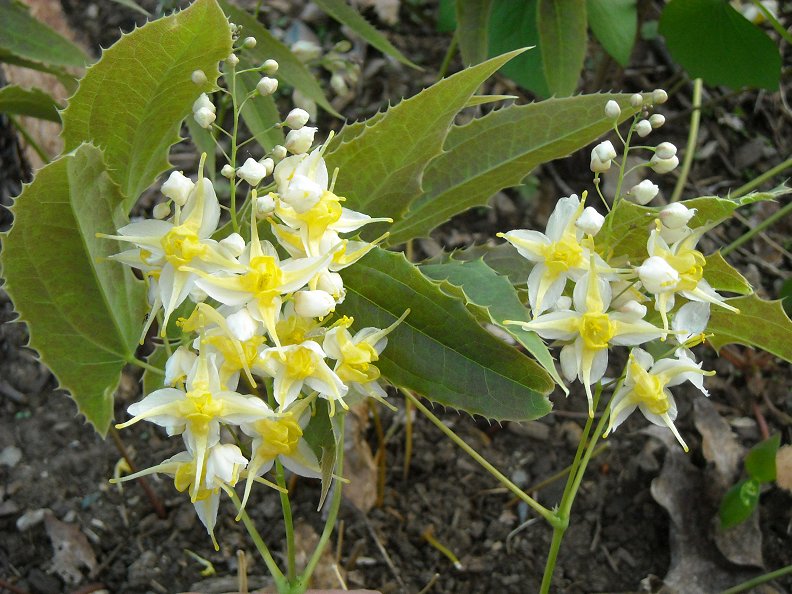
Let me start with a single recent species, E. wushanense, a species of only recent and rare obtainability, an imposing tall species with large creamy white flowers. Epimedium wushanense "Spiny-leaved Forms" is a selection from several clones grown by Darrell, growing much lower and leafier, with shorter condensed panicles of large bloom. I got my plant at a local NARGS auction 3 years back, where Darrell as usual generously donated a wonderful selection of "choicest of choice" epimedium to benefit our chapter.
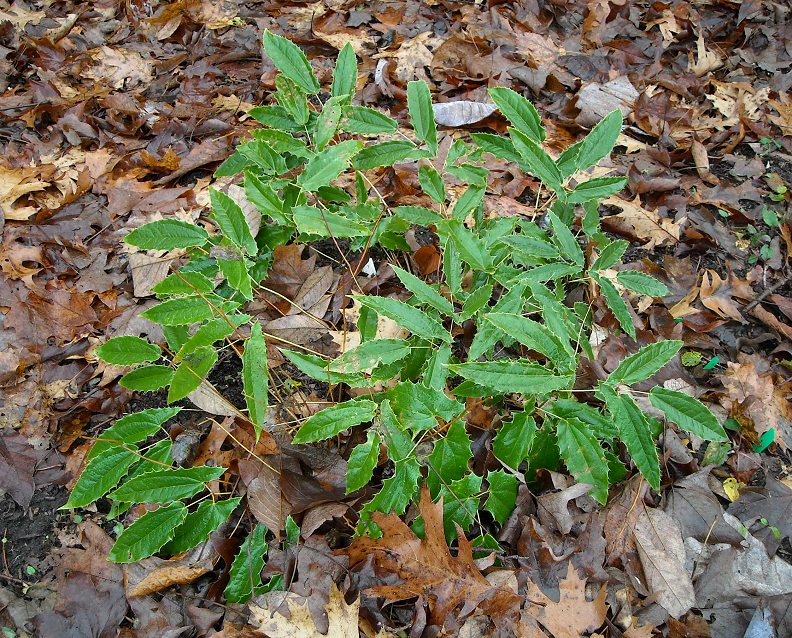
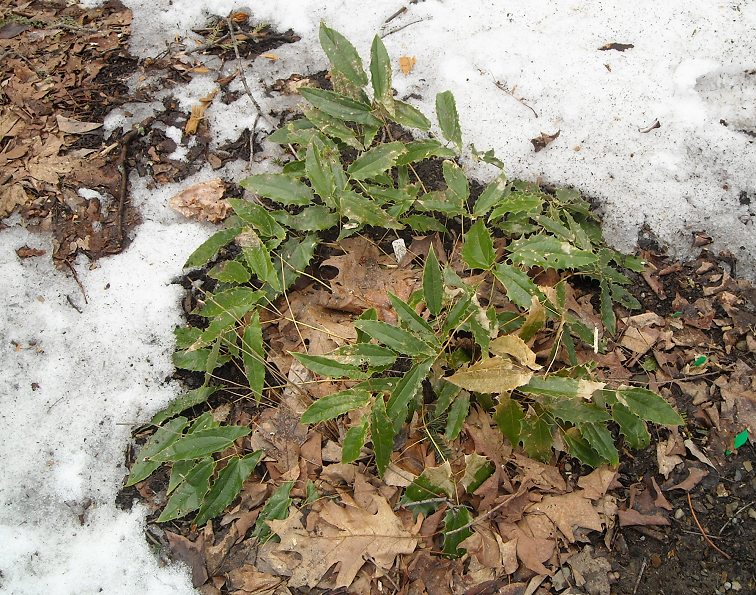
This species has proved hardy (most epimediums are bone hardy) and completely evergreen in my harsh Zone 5 garden (a number of eppies are indeed evergreen here), with bold, glossy, spiny-edged foliage, and dense spikes of substantially large white and yolk-yellow flowers in May. The only problem with the flowers is that they droop downwards towards the ground and get dirt-splashed. In the photo, I am lifting up two flower spikes. I think this species has incredible potential for breeding. More to come.
Garden Vision Epimediums publishes an extensive list of eppies for sale, all completely identification validated, with inumerable rare species, special variant forms, and many of Darrel's latest gorgeous hybrids. Send an email to Karen Perkins requesting a catalog to: [email protected]. The catalog is due out soon, and includes 10 or more color pages of photographs, truly worth having as an Epimedium reference alone! In addition to Epimedium, there are choice woodland Iris species, many Iris cristata cultivars, some novel Primula sieboldii cultivars, and other choice woodlanders. For those who live within driving range, the nursery is open each year on two consecutive May weekends (includes Fridays before each weekend). I typically place an order and elect to pick it up at the nursery, where I get to see swathes of fantastic eppies, many new to science, swathes of new hybrids, discuss these with Darrell, and buy even more plants that are for sale at the nursery. Ahhh, to satiate ones plant desires.
Comments
Mark McDonough
Re: Epimedium 2010
Wed, 12/01/2010 - 5:30amPart 3,
21 E. x versicolor 'Versicolor' - rich red semi-evergreen foliage, and the ever-widening mat of E. pinnatum ssp. colchicum 'Thunderbolt' with superb evergreen foliage, deepening to near black in winter, highlighted by green venation.
22 E. x youngianum 'Otome'- one of the very best youngianum types, this one surely with some sempervirens in its genetic makeup. Beautiful rounded, deeply veined evergreen leaves that take on various leaf colors throughout the year, build into a superb upright clump. Epimedium x sasakii 'Melody' just behind it, another evergreen one.
23 E. x youngianum 'Grape Fizz' - a 2004 introduction by Darrell Probst, a terrific small plant with sprightly flowers that can appear all summer, taking on russet red leaf colors in fall.
24 E. fangii - not a particularly showy plant in flower, nor fall color, but an interesting species nonetheless, with stout, leathery, 3-part leaves. Spreads by long rhizomes, so needs to be placed carefully. Possibly useful for hybridization for the plant habit, leaf disposition, and yellow flower color.
25 E. grandiflorum f. flavescens - No.2 - Darrell Probst numbers his various collections of forma flavescens, this one show some dessicated leaves on top from our summer drought, but was more tolerant of drought than most other flavescens forms. Also unique in growth; very large, with bold textured leaves, yellow in autumn.
26 Epimedium hybrid seedling - 2 year, showing some interesting fall color and venation.
27 Epimedium hybrid seedling - 3 year, unflowered so far, keeping an eye on this one as it is among the most dwarf of my eppies so far, evergreen, with red leaves in spring, and deep bronze foliar color in autumn.
28 Epimedium hybrid seedling - 3 year, probably a seedling from youngianum 'Otome', with shiny veined leaves, great clumping habit, and attractive autumn color.
29 E. grandiflorum 'Bicolor Giant' - relatively new to my garden, has good red fall foliage.
30 E. pubescens "Shaanxi Forms" - introduced by Darrell Probst, a hardy selection of this slightly more tender species. Very low, wide clump of neat foliage, much smaller than E. stellulatum that can be seen just above. perky white flowers above the foliage.
Woodard (not verified)
Re: Epimedium 2010
Wed, 12/01/2010 - 9:20amVer nice. That's an impressive clump of 'Thunderbolt'. I look forward to seeing more of your seedlings as they mature; as you've implied before, Mark, we've only seen the tip of the iceberg with these wonderful and variable plants!
Woodard (not verified)
Re: Epimedium 2010
Wed, 12/01/2010 - 11:48amA few photos from spring '09, mostly of 'no-name' seedlings.
Seedlings from 'Caramel'. The best of them are extremely floriferous (500+ on still-maturing plants) with upright flower stalks. Some flower stalks are lax and bend though, which is personally not my preference.
Some variation. Notice that one has green anthers, which is fairly uncommon (e.g. E. chlorandrum and a couple of others).
An exciting and seemingly vigorous seedling from E. davidii.
Some seedlings from E. dolichostemon.
E. x youngianum 'Yenomoto' and an open-pollinated seedling from it (notice the blush of pink that is not present in the seed-parent).
Some self-sown seedlings that will likely bloom in '11 (if they haven't already; I missed the spring '10 season being abroad)
Trond Hoy
Re: Epimedium 2010
Wed, 12/01/2010 - 11:58amWhen I look at your photos, Mark and Joseph, I am very sorry that I haven't yet been able to increase my collection! As I have told before, it is likely slugs to blame for that. They devour the shoots in spring. And, of course, the difficulty in obtaining other species than the common ones here.
Mark McDonough
Re: Epimedium 2010
Wed, 12/01/2010 - 2:07pmSome tantalizing stuff there Joseph! I don't yet have 'Caramel', but must get a piece sometime, along with 'Amber Queen' which is a real beauty: http://www.plantdelights.com/Catalog/Plants/Epimedium-Amber-Queen-PP-171...
Walking the rows upon rows at Garden Vision Epimediums nursery, there are entire rows of plants with these giant spider blooms in all sorts of caramel, tan, pink, and rose colors, simply wonderful. Wow, 500 bloom on one plant! You second hybrid plant from dolichostemon looks similar to the named hybrid 'Amanogawa' (acuminatum x dolichostemon), white flowers with yellowish-brown spurs and cup, which I showed earlier in this thread:
http://nargs.org/smf/index.php?topic=178.msg1973#msg1973
After spending so much on these plants over the years, now that I have a couple hundred varieties, I'm thinking to myself, why keep buying them, why not start hybridizing my own plants and grow them from seed. They're all charming, even those that don't get named, they are still beautiful plants in the garden.
This year I planted out about 250 self-sown seedlings, labeling them as to what plant and area they were found under, fun to see what one gets. I have many parallel cases like your pink-blushed youngianum 'Yenomoto' seedling, where the hybrid seedling closely resembles the parent, but with a subtle twist. So, it pays to surround your desirable epimediums with "good neighbors". I have floriferous grandiflorum forms 'Larchmont' and 'Pseudo-Larchmont' growing near E. grandi. f. flavescens 'La Rocaille', and one gets plants perfectly intermediate, grandiflorum-like plants with light pink and pale yellow flowers. It was pure serendipity that I planted the tiny youngianum 'Liliputian' near a number of desirable epimedium species & cultivars, getting very dwarf and distinctive plants that are fully evergreen imparted from either E. sempervirens 'Candy Hearts', E. pubigerum, and E. x sasakii (natural hybrid of sempervirens and setosum).
Self-sown epimedium seedlings are the cutest little things, I don't have the heart to toss them out until I see what they produce in 2-3 years. This spring I had a batch of about 150 3-year old seedlings bloom, I selected those I wanted to keep, and gave the rest away to our local Garden Club in town, the ladies were thrilled with these donations. Also this past year, I potted up, then planted out about 200 more self-sown seedlings. Spring of 2011, if I get even fair germination on my 50 flats of manually made crosses, I should have more epimediums than I know what to do with.
Trond: I have never seen a slug munching on any "eppies" here, although we don't have much of a problem with them here, but they do exist, particularly in the more woodsy areas where the epimediums are planted. I have friends in Seattle Washington area, Pacific Northwest USA, wher giant slugs reign supreme, but they do grow epimediums there too. You might need some regime of slug bait application to mitigate their damage.
Woodard (not verified)
Re: Epimedium 2010
Wed, 12/01/2010 - 6:25pmMark, I'm sure a visit to Garden Vision would blow my mind. I'd like to visit, and I'm very glad it's still around. I didn't receive a catalogue this year that I recall. Do they still publish one? In the past they have generally sent it out automatically.
I don't have 'Amber Queen' either, but it's what I think of every time I see my seedlings bloom. I did see a whole bed of them at a botanical garden in Korea, though. They looked smaller and weaker than mine, but I can't judge based on that because, though blooming size, they were obviously recent additions. Incidently, there was also a bed of E x 'Pink Champagne', so I was able to see that one in the flesh before taking the plunge. Do you have it (I assume so)? I like plants like it and 'Domino', which hold the flowers high above the foliage. I have noticed that the color of the flowers are not as intense as I had expected. That goes with the territory though . . .
It sounds like your "eppy" program is off and running. It's all still quite new to me.
Mark McDonough
Re: Epimedium 2010
Wed, 12/01/2010 - 7:48pmYes, Garden Vision Epimediums still publishes a catalog, I did get one for 2010, but it was the first one in a decade where I did not order because of being unemployed :-\. I was however graced by the generous gift of 'Pink Champagne' and sp. nova "The Giant". Since Garden Vision Epimediums is now run by Darrell's ex, Karen Perkins, try emailing her to be sure you get the list this year: [email protected].
Mark McDonough
Re: Epimedium 2010
Wed, 12/01/2010 - 8:16pmI was googling Epimedium wushanense 'Caramel' tonight, and came across a somewhat unsettling nursery-offering from Heronswood. They are selling seedling-grown plants from E. wushanense 'Caramel', which will obviously be 100% hybrids and not the true Caramel; fair game I suppose, but the plant offering is listed simply as Epimedium [Caramel], an odd cryptic way to list the offering. What does it mean? To be sure, almost every customer who would purchase such an offering will label their plant Epimedium 'Caramel' or Epimedium Caramel, and it'll totally create confusion with the true E. wushanense 'Caramel'; they should know better than such a carelessly labeled offering... how disappointing. If anyone currently grows the true 'Caramel', start calling it as such; E. wushanense 'Caramel' (true vegetatively propagated plant). Tsk tsk Heronswood.
Heronswood - Epimedium [Caramel]
http://www.heronswood.com/shop/03464
Trond Hoy
Re: Epimedium 2010
Thu, 12/02/2010 - 8:41amWith bigger plants it is no problem but small, newly planted ones are vulnerable in the spring when the new shoots emerge especially if the spring is slow and the slugs are numerous. The very cold winter last year decimated the slug population a lot and the extreme cold this November with no snow-cover may kill off some of the greedyguts. (I hope the few Epimediums I have survive.)
When I acquire new plants either by buying or seeding I will be very careful where to plant them and use slug bait.
The look of all your different plants makes me wish for growing more!
Woodard (not verified)
Re: Epimedium 2010
Thu, 12/02/2010 - 10:59amMark, that is an unfortunate reality, and one that is all too common in the trade. And that is an old listing too; they no longer offer those seedlings, which is also unfortunate, and I think they should remove the page (the link has been removed from the catalogue, but you can obviously still reach the page 'through the back door' as you have). The 'former Heronswood' was one of the only sources of seedlings, though, and I wish others would offer them. Perhaps they don't because people like names, and even if you did make it clear (e.g. 'These are seedlings FROM H. wushansense Ogisu 92009, NOT the real thing!'), many consumers would take the liberty of retaining the name anyway, presumably to avoid the complexity of the explanation to fellow friends and gardeners. Either way it's not ideal, and it is certainly unacceptable for anyone who distributes plants, whether commercially or as a hobby. I'm afraid it's probably inevitable though. The upside is that even though this practice can lead to disappointment, it can also lead to pleasant surprises. Given the option, I would always prefer a seedling to a named clone, assuming the two are of equal horticultural merit. To me, plants are no different from pets; it's nice knowing that you have something unique with which to develop a relationship. On the other hand, if you paid $140,000 for a clone of the 9/11 rescue dog, you might want it to be the real thing! ;D
Trond Hoy
Re: Epimedium 2010
Thu, 12/02/2010 - 12:55pmThis Heronswood isn't the same as the old Heronswood. I don't think they would do anything like this with Dan Hinkley at the wheel. I did buy plants from them in the old days.
Richard T. Rodich
Re: Epimedium 2010
Thu, 12/02/2010 - 5:03pmExactly. Once it change hands, the integrity is gone.
Mark McDonough
Re: Epimedium 2010
Fri, 12/03/2010 - 7:59pmIt's an interesting point, or concept... offering seedling grown plants, maybe at a much cheaper price. The way this should be handled is to isolate a few different selected epimediums and plant them close together, then grow on seedlings from this "blend", and sell any resulting OP (Open Pollinated) hybrid progeny under a new and distinct "umbrella" name, like Epimedium "Sunset Color Blend", or E. "Spring Fantasy Blend", or other nursery name that clearly indicates a variable group of hybrids. Even this concept can go astray, Washfield Nursery in England sold various mixed Epimedium seedlings of Asian parentage under the "catch-all" name of "Asiatic Hybrid". Years later, various nurseries get one plant named as 'Asiatic Hybrid', propagate it and offer it for sale. Everyone is confused, because this nursery's 'Asiatic Hybrid' doesn't at all match that nursery's 'Asiatic Hybrid', everyone is growing completely different plants under one name, a singular name (would have been better to name it 'Asiatic Hybrids', or better yet, something like "Selected Asiatic Hybrids", something short and more description, that people would probably still mimic exactly, but is self explanatory). Now forever and ever, people will wonder why their 'Asiatic Hybrid' has pink flowers, while someone else's has yellow flowers. Mitigating the confusion would not be that hard if some thought and consideration went into a proper name for such entities.
Mark McDonough
Re: Epimedium 2010
Fri, 12/03/2010 - 8:05pmColder temperatures have arrived, yet still no snow, with garden interest provided by evergreen Epimediums and a few late-deciduous types.
1 E. pubigerum Cc950215 - In my opinion, one of the very best all-around clumping species, although a largely overlooked one. The neat crimped foliage looks great year round, is the most reliable evergreen of all species, and drought-resistant too. The small flowers are produced in open sprays on tallish stems that clear the foliage, not bowl-me-over beautiful but refined and attractive. Flowers are basically white, but depending on the form grown, can be flushed with pink or red. The number indicates a Darrell Probst collection number; with four forms offered in the past, I have three of them. From Turkey, in areas near the Black Sea.
2 E. x sasakii - another evergreen "species", a name used by Japanese botanists to describe natural hybrids between E. sempervirens and E. x setosum, but the name not generally recognized. Since E. x setosum is itself a natural hybrid between E. diphyllum and E. sempervirens, E. x sasakii can be thought of as:
E. sempervirens x (diphyllum x sempervirens). The sempervirens genes certainly show through, with small rounded evergreen leaves, but with an upright habit more like diphyllum. Very slow growing clumper. I grow a couple forms.
3 E. x sasaki 'Melody' - introduced by Darrell Probst in 2001, this is a hybrid that occurred in Harold Epstein's garden, between E. sempervirens (violet form) and E. x setosum. It is a very good plant, slowly building into a mound of shiny semi-evergreen leaves, taking on dark leather red colors in fall. The spring foliage is flecked with red, and the violet flowers are a bit larger and more showy than other x sasakii types.
4 E. sempervirens 'Candy Hearts' - a fantasic plant, the spring foliage is unbelievable, looking like shiny plastic with bold red edges. New leaves after flowering also show bold coloration. Large, heavy foliage tends to flatten out in summer making beautiful low mounds, worth growing for the foliage alone. Absolutely winter evergreen and drought resistant. Palest lavender flowers are okay but not very exciting. Excellent plant for hybridization efforts.
5 E. pinnatum ssp. colchicum - this evergreen species hardly needs any introduction, a familiar garden plant that slowly spreads into a dense wide mat. Reliably evergreen here, and drought resistant. The yellow verbascum-like flowers are best appreciated however if the foliage is cut off in spring. Late autumn and winter foliage takes on dark charcoal shades.
6 E. x youngianum 'Otome' - I keep showing this Japanese variety, but it is so fantastic, useful too for hybridization, and colorful so late into the season, that it's hard not to be fixated on it. Semi-evergreen, and drought-resistant.
7 Not all grandiflorums are created equal, even with flowers of the same color scheme. The small plant on the left, showing some red fall color, is E. grandiflorum 'Silver Queen'. The much larger E. grandiflorum 'White Queen' is on the right, taking on some dull brownish-red fall color.
8 E. x youngianum 'Royal Flush'- fantastic copper-red spring foliage, some good foliar color in late spring and summer too, and subtle burnished copper tones in autumn; semi-evergreen. Attractive lavender flowers. Somewhat similar to the next one, #9.
9 E. grandiflorum var. violaceum 'Bronze Maiden' - in spring this goes through an incredible metamorphosis of leaf color, from chocolate to carneous red and flesh tones. This plant had a rough time with our summer drought, so it looks a bit tatty, but still showing some burnished leaf color.
10 Two E. x versicolor selections (garden bred E. grandiflorum x pinnatum ssp. colchicum), the cultivar 'Versicolor' in the lower right with deep leather-red foliage, and Darrell Probst's 2004 'Cherry Tart' above it with leather-brown leaves. Foliage is semi-evergreen, these being a couple of the very best eppies ever.
Woodard (not verified)
Re: Epimedium 2010
Sun, 12/05/2010 - 12:26pmMark, more nice foliage shots!
I can see the value of acquiring named forms for botanical gardens, who want to display them, and commercial horticulturalists, who want to profit from them, and scientists, who want to study them. But for my purposes as a hobbyist the names are trivial, so there's little practical value in being too concerned or rigorous about it.
And it makes sense to me that some open-pollinated seedlings would command lower prices, but I don't think that's always the case (I would take any open-pollinated E. wushanense seedling over a division of a plant like E. Sagittatum 'Warlord', for instance). Heronswood used to sell 'Wushanense hybrids' for a very fair price; a rare bargain. Also, careful hand-pollinations of choice parents in which the pollen parent and seed parent are completely protected from natural pollinators would seem to be much more valuable than either open-pollinated plants, plants that are hand-pollinated in the open garden, or vegetatively-propagated plants. I say that for several reasons: 1) it is more labor intensive; 2) pollinators fly, so proximity of plants in the garden is not a strong limiting factor; 3) hand-pollination in the open garden where there are many interfertile plants is not strong proof that a cross was successful, regardless of the phenotype of the offspring; 4) the breeder is releasing unique genetic material to the public. I suspect, but don't know, that among the reasons seedlings are not generally offered to the public is in part due to protectionist concerns of breeders.
SO . . . if you were to come up with a list of seedlings for distribution, you would have at least one avid customer and would be saving me some time! ;)
On a side note, some people might be surprised that my hellebore collection does not contain a single named clone (in part because many happen to be sterile and thus are a breeding dead end). I find little satisfaction in owning a plant that hundreds or thousands of other people own. My goal is progress, so phenotype and parents that routinely produce high-quality offspring are all I care about. If that plant happens to have a cultivar name, then that's OK, but it's irrelevant to me. I think one of the great things about having a variety of enthusiasts with different goals and perspectives is that we will inevitably have different collections and thus contribute to the diversity of plants in cultivation. It would also possibly make it more interesting for visitors, who might be pleased to see plants that can't be seen anywhere else.
Mark McDonough
Re: Epimedium 2010
Sun, 12/05/2010 - 8:45pmJoseph, I have much I want to respond to, but it's late, so I simply post the following URL, to a new post on the Epimedium 2010 thread on SRGC, where a new forumist posted approximately 50 photos of Epimedium hybrids, some are truly delicious.
http://www.srgc.org.uk/smf/index.php?topic=4769.msg175090#msg175090
A proper response later :D
Woodard (not verified)
Re: Epimedium 2010
Mon, 12/06/2010 - 11:47amNow, that's my idea of fun! :D
Mark McDonough
Re: Epimedium 2010
Fri, 12/24/2010 - 9:01pmWarm Christmas colors on Epimedium lishihchenii and stellulatum on this sunny Christmas Eve, they look hot enough to melt snow :D
Merry Christmas Epimedium fans :)
Trond Hoy
Re: Epimedium 2010
Sat, 12/25/2010 - 1:41amThanks Mark! Nice to see when I sit here in a very cold and snow covered Oslo! The sun is just rising but nobody is up except me yet.
Happy gardening the years to come!
Paul T (not verified)
Re: Epimedium 2010
Mon, 01/31/2011 - 8:29pmMark,
Absolutely brilliant topic. I can barely believe the range of Epimediums, I had no idea there were so many until reading this topic and seeing all your wonderful pictures. I grow a few of them here as well (amybe 20 or so?), and wish I had more space to be able to grow more (don't we all! ;D), but they aren't easy to find here in Australia, or at least in my part of Australia anyway. I've also never seen any sort of seed set on any of mine, despite some of them being grown in pots in close proximity to each other. Next spring I must get out and do some paintbrush work I think.
Thanks so much for such an inspiring topic. 8)
WimB (not verified)
Re: Epimedium 2010
Mon, 02/07/2011 - 11:55amHello everyone,
my first post and it's a question to start with.
Maybe I should introduce myself first.
In short ;) I'm Wim Boens, I live in Belgium (a small country between the Netherlands, Germany and France) and I'm an archaeologist.
I've been gardening since I was 9 years old and in the last five years I became more interested in woodlanders and bulbs.
Today I received a form of Epimedium grandiflorum called E. grfl. f. flavescens #1. The person who gave it to me said she bought it some years ago from Heronswood.
I was wondering if anyone here might know if this plant has been given a cultivar name and what makes this clone (number 1) so special?
Thanks
Wim
Mark McDonough
Re: Epimedium 2010
Mon, 02/07/2011 - 8:35pmHello Wim, we meet again ;) Welcome to the NARGS Forum!
I suspect your E. grandiflorum f. flavescens #1 is a Darrel Probst designation. In the Garden Vision Epimediums catalog he writes "We grow many distinct forms of f. flavescens, (probably differing from one another due to their origins in segregated wild populations). We give each "type" a number (unless we have location information), but not a cultivar name as there are probably thousands of similar clones in the original wild populations". The Garden Vision Epimediums catalog has sold E. grandiflorum f. flavescens numbered forms 1 - 6 for a number of years, although form #1 was last offered in 2005 (maybe 2006, but I can't verify as I've seem to have lost my 2006 catalog).
E. grandiflorum f. flavescens #1 is described as: Side leaflets of this clone have at least one of the basal lobes squared with an extended point. When well grown there can be as many as 3 points on some, producing several different types of medium-sized leaflets on the same plant. Handsomely bronzed in spring. Large, pale yellow flowers bloom below the leaves. !2".
I have all 6 forms, as well as a few other named forms, but can't find a photo of #1 tonight. I will try to find the plant this spring and post some photos.
WimB (not verified)
Re: Epimedium 2010
Mon, 02/07/2011 - 10:00pmThank you very much, Mark.
Pages