
I'm pleased to kick off this "Epimedium 2010" thread. For many North American gardeners that must deal with shady wooded conditions, often rather dry too, I can think of no better candidate to grace such conditions as the many members of the genus Epimedium. They are tough, drought tolerant when established, have beautiful graceful flowers and gorgeous foliage often strikingly colored in spring and in a second-flush of color post-flowering, many with excellent fall color as well.
For me, the "Onion Man", there is life beyond the genus Allium, and I'm a serious admirer and collector of Epimedium as well as many other plants. I call my beloved Epimedium plants "eppies" for short. I am most fortunate being located just a mere 40 minutes drive from the "epicenter of Epimedium", the epimedium extravaganza that is Garden Vision Epimediums founded by epi-jedi master Darrell Probst, in Hubbardston, Massachusetts. The nursery is now run by Darrell's ex, Karen Perkins, a lovely person and trained horticulturalist herself, still with a mutual association with Darrell Probst and his important Epimedium breeding work.
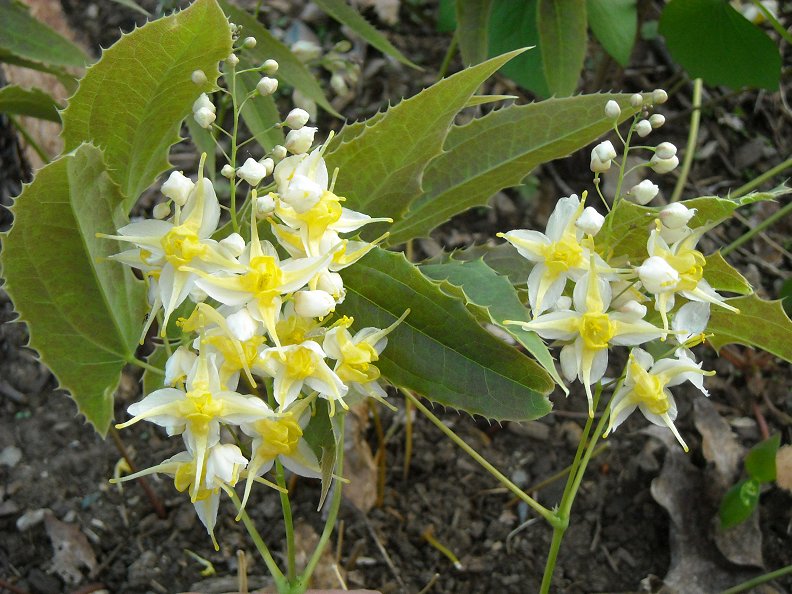
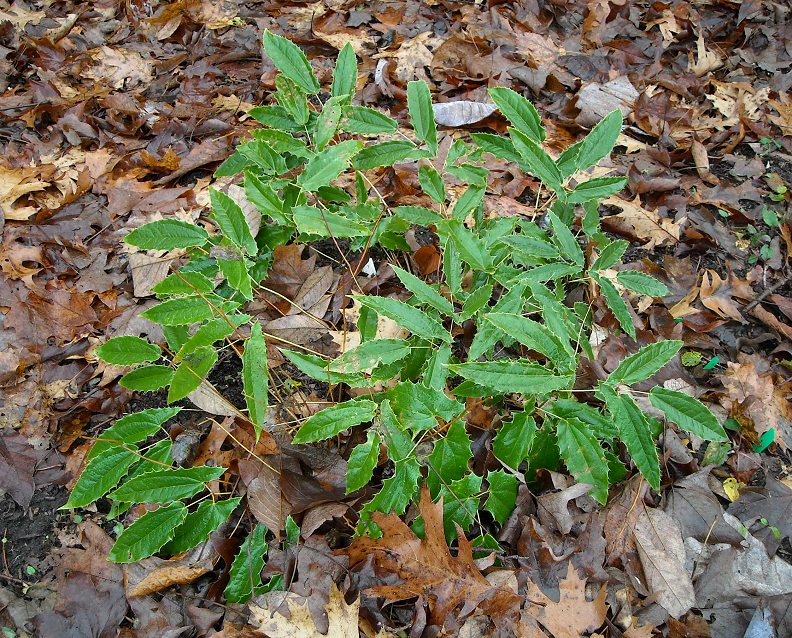
Let me start with a single recent species, E. wushanense, a species of only recent and rare obtainability, an imposing tall species with large creamy white flowers. Epimedium wushanense "Spiny-leaved Forms" is a selection from several clones grown by Darrell, growing much lower and leafier, with shorter condensed panicles of large bloom. I got my plant at a local NARGS auction 3 years back, where Darrell as usual generously donated a wonderful selection of "choicest of choice" epimedium to benefit our chapter.
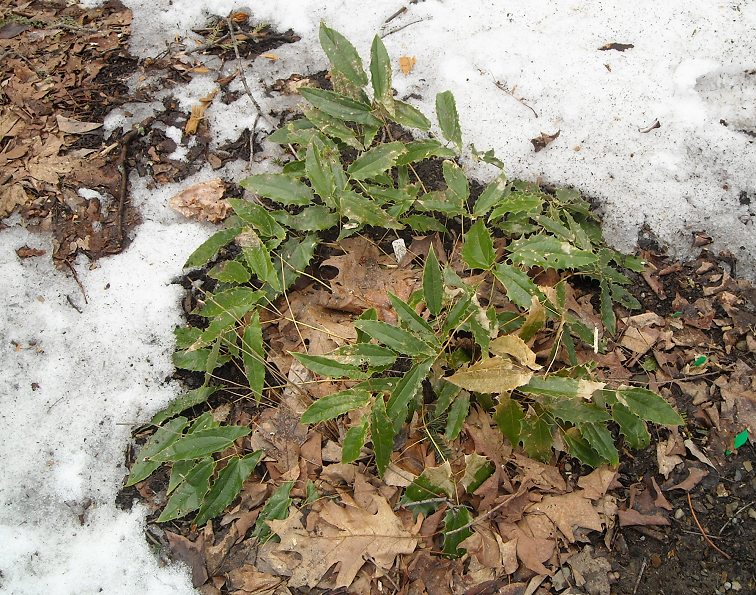
This species has proved hardy (most epimediums are bone hardy) and completely evergreen in my harsh Zone 5 garden (a number of eppies are indeed evergreen here), with bold, glossy, spiny-edged foliage, and dense spikes of substantially large white and yolk-yellow flowers in May. The only problem with the flowers is that they droop downwards towards the ground and get dirt-splashed. In the photo, I am lifting up two flower spikes. I think this species has incredible potential for breeding. More to come.
Garden Vision Epimediums publishes an extensive list of eppies for sale, all completely identification validated, with inumerable rare species, special variant forms, and many of Darrel's latest gorgeous hybrids. Send an email to Karen Perkins requesting a catalog to: [email protected]. The catalog is due out soon, and includes 10 or more color pages of photographs, truly worth having as an Epimedium reference alone! In addition to Epimedium, there are choice woodland Iris species, many Iris cristata cultivars, some novel Primula sieboldii cultivars, and other choice woodlanders. For those who live within driving range, the nursery is open each year on two consecutive May weekends (includes Fridays before each weekend). I typically place an order and elect to pick it up at the nursery, where I get to see swathes of fantastic eppies, many new to science, swathes of new hybrids, discuss these with Darrell, and buy even more plants that are for sale at the nursery. Ahhh, to satiate ones plant desires.
Comments
Mark McDonough
Re: Epimedium 2010
Sat, 04/24/2010 - 5:25amThe Epimediums just keep on coming...
1 - 3 E. x 'Domino' - one one the finest new (2004) intoductions by Darrell Probst. Of Asiatic parentage, the plant is elegantly clothed in slender pointed leaves, finely soft-spined and tinged with purplish-red as the foliage emerges. The slender panicles of flowers are well presented above the foliage. Spidery ivory white flowers shading to a deep brooding pink center, set off by dark stems and pedicels, and dark purple outer sepals giving the buds the appearance of shiny black grapes. The flowers remind me of birds in flight.
4 - 6 E. x 'Sunshowers' - introduced by Darrell Probst in 2008, a cultivar created by a friend of Darrell's. A cute small growing plant with red-speckled foliage, and spires of plump soft yellow flowers. Viewed from above gives a slightly different effect, showing the white, finely pink-spotted sepals.
7 - E. sempervirens 'Violet Queen' - sheer flower power in this one, a fantastic plant for the masses of large violet flowers and brilliant spring foliage that appears after the flowers.
8 - 10 E. grandiflorum 'Purple Prince' - without doubt one of the darkest purple flowered forms of grandiforum. Depending on the light, the flowers can look nearly black-purple. Flowers are well interspersed and visible among the well formed canopy of foliage.
Mark McDonough
Re: Epimedium 2010
Sun, 04/25/2010 - 7:09pmEpimedium foliar color is playing a major role in the garden this spring:
1-5 Epimedium garden seedling with brilliant red and yellow mottled spring foliage.. Yowsa! This is a hybrid between E. brevicornu with...? ... maybe E. membranaceum or E. stellulatum, probably the former. Starry white flowers with larger yellow cup... flowering has just started.
6. E. x sasaki - natural hybrids in Japan between E. sempervirens and x setosum. Several variants are offered by Garden Vision Nursery, this one (Cc.950183) is my favorite, with blunt, rounded sheild like leaves that are pinkish-red tinged in spring.
7. E. sempervirens 'Violet Queen' - this cultivar has about the most intensely colored new foliage appearing as the flowers go over, than any other epimedium cultivar... brilliant red with green veining.
8. E. x youngianum 'Little Shield' - a 2004 introduction by Darrell Probst. This has quicken risen to one of my top 20 epimedium, making a mat much wider than tall, densley clothed in purplish-brown textured shield-shaped leaves; the perky pure white flowers just clearly the foliage. A refined beauty.
9. E. wushanense "Spiny-leaved Forms" - another Darrell Probst introduction from Japan. While the foliage is evergreen, I cut the foliage off this year to see the fresh young foliage better and to work with the flowers (hybridization) more easily. The new leaves are long and narrow and spiny-edged, of a unique burnished brownish green color, and remarkably glossy.
10. E. stellulatum - a wonderful Chinese species, one of several that create clouds of small white flowers with tiny yellow centers. But is is the new cauline leaves that are spine-edged and heavily mottled with red, that gradually expand in size, to become the true show of this species.
Trond Hoy
Re: Epimedium 2010
Mon, 04/26/2010 - 7:09amWhy not "the Epimedium man"?
Mark McDonough
Re: Epimedium 2010
Mon, 04/26/2010 - 7:19amWell, I've been dubbed the Onion man decades ago, it has been more recent that I have gone wild with epimediums. Besides, the horticultural world correctly considers Darrell Probst the defacto Epimedium man, I just dabble with "eppies". :D
Mark McDonough
Re: Epimedium 2010
Wed, 04/28/2010 - 9:26amThinking about hybridizing epimediums, I pulled some images together. There is so much potential in certain species and cultivars, that it fires the imagination. Seeing what some of the hybrids look like compared to theior parents, gives clues and ideas about what to strive for. Here are a few that I'm working with.
1-4 E. grandiflorum 'Red Queen' - the granddaddy of grandiflorums, a giant plant that grows much larger than reported. Just went out and measured it, currently 30" tall x 44" wide (75 x 110 cm), yowsa! The dense foliar sheath lifts its skirt high enough to see the bounty of rosy-red flowers which last for weeks.
5 E. davidii "Wolong Selections" - variable forms found and introduced by Darrell Probst, from Wolong, China. Mine is a young plant; has attractive small spiny-edged foliage, and good-sized bright flowers, much pollen dabbing going on here.
6 E. x 'Domino' - another view of this fantastic introduction by Darrell Probst, with the previous mentioned E. davidii off to the left. Gorgeous plant form and flowers, with significant flower power, flowers produced *above* the foliage, seems like an excellent starting point.
7-8 E. brevicornu - has already revealed itself to be a willing parent, imparting boldly colored foliage and good form. While the flowers are tiny, they are so abundant and clearly presented *above* the foliage, that it makes a grand show in the garden, among the earliest to flower and continuing for up to 2 months! Established plants make large bold clumps. Also shown here is a young plant with a smaller bounty of flowers... again, lots of pollen dabbing going on.
9-10 View of Epimedium bed full of hybrid seedlings flowers (3 year old bed). In the center of the photo 9 is a small yellow and white flowered hybrid between E. brevicornu x E. membranaceum. In photo 10, there's a E. davidii hybrid, with rather small hot pink and yellow flowers. This year, many of these hybrids are being planted out to see what they look like as established clumps.
Mark McDonough
Re: Epimedium 2010
Thu, 04/29/2010 - 6:31amMany will be familiar with the tried and true E. x versicolor 'Sulphureum', or the somewhat less common 'Neosulphureum', both indispensible for the woodland garden. But there are a couple more recent versicolor cultivars, 'Strawberry Blush' introduced by Darrell Probst in 2004, and 'Cherry Tart', a hybrid seedling found a garden in Virginia and introduced by Darrell in 1999. Also featured in this post is a recent E. x youngianum cultivar named 'Royal Flush', yet another Darrell Probst introduction (2004).
1. E. x versicolor 'Strawberry Blush' - The first photo shows how the flowers are displayed in a nodding disposition, which is too bad because it is the front face of the flowers that reveal their charm. The sepal color is described as "antique pink", and appear pinkish in a color photograph in the Garden Vision Epimediums catalog. However, as I've grown it, the back of the ample sepals are a pale bisque yellow color with only a faint pink tinge.
2. Lifting up the flowers shows the sepals to be veined pink on the inside, sporting a large yellow cup and pink spurs, delightful, if only the flowers would hold themselves up.
3-4 Two low-angle views where the bright yellow cups can be seen. In both photos, the lilac flowers are E. x youngianum 'Royal Flush'.
5 Another view of both epimediums from above, showing the late-to-expand leaves on 'Strawberry Blush' which are bronze-toned. This cultivar is a strong grower.
6-7 E. x versicolor 'Cherry Tart' - the better of the two versicolor cultivars, with more upright panicles of striking pink flowers, individual flowers held in tilted semi-nodding disposition, revealing hot pink spurs and a cup that shades to a bright yellow rim. The inside of the sepals are finely veined with deeper pink. So far, seems to be a slower grower than 'Strawberry Blush'.
8 E. x youngianum 'Royal Flush' - sizzling HOT spring foliage color!
9 E. x youngianum 'Royal Flush' (top) showing the dark copper foliage and classic form lilac bloom, with E. grandiflorum 'White Queen' in front.
10 E. x youngianum 'Royal Flush' - profile file. I consider this to be among the finest of youngianum types, making a large full mound of beautiful heart-shaped leaves, with elegant flowers well presented just above the foliage. It is reminscent of E. grandiforum var. violaceum 'Bronze Maiden', which can be seen in the upper left corner.
Mark McDonough
Re: Epimedium 2010
Fri, 04/30/2010 - 8:41amA miscellany of epimediums today:
1. E. fangii - hardy form. A rhizomatous spreading species, so I will be moving this one to a place where it can spread. Bronzy spring foliage, yellow flowers with sepals shading to white.
2. E. fargesii - evergreen basal foliage and tan-bronze new foliage, reflexed white start flowers with small purple petals.
3. Epimedium hybrid with 'Dark Beauty', showing gold spring leaf coloring.
4. E. sempervirens 'Mars'- erect red stems and dense clusters of rose-red flowers, which (unfortunately) quickly become concealed under a "shield" of shiny green red-edged leaves. Makes a tall bold clump.
5. E. sempervirens 'Mars'- looking "under the skirt :o" to see the flowers, and lots of cute eppie babies below.
6-7. E. x 'Amanogawa'- hybrid of E. acuminatum x dolichostemon, spring mottled foliage, and lovely upright panicles of reflexed white flowers accented with a dark center, brownish-orange cup shading to yellow spurs.
8. E. grandiflorum var. higoense 'Bandit' - deservedly popular, having small leaflets edged in brown-purple, and abundant white flowers.
9. E. grandiflorum 'Sirius' (originally offered as 'Epstein's Salmon') - a pretty plant with soft foliage and pastel pink flowers shading to a salmon pink at the base of the sepals, a fairly unique color.
10. E. sempervirens 'Candy Hearts' - WOW for the foliage display, almost looks like waxed plastic. Even in summer after the leaves turn shiny green, there is always new foliage sprouting forth in hot pink and red candy colors. Fairly good flowers of palest lilac, but this one is grown for the foliage. Fantastic.
Lori S. (not verified)
Re: Epimedium 2010
Fri, 04/30/2010 - 7:01pmAbsolutely amazing, Mark! What a pleasure it would be to tour your garden!
Just for contrast, here's the most advanced of my epimediums... E. x versicolor 'Sulphureum'. ;D
Trond Hoy
Re: Epimedium 2010
Sun, 05/02/2010 - 11:26amThis is about the size mine have too!
Mark McDonough
Re: Epimedium 2010
Sun, 05/02/2010 - 4:16pmWell Lori and Trond, you get to enjoy these plants well after they're done here. Yesterday it was 82 F (28 C) and today it was a ridiculous 95 F (35 C), way hotter than normal, and everything is going over so quickly. By the way, I have taken some close-up photos of E. x versicolor 'Sulphureum' that help distinguish it from the paler yellow 'Neosulphureum', I will post these soon.
Richard T. Rodich
Re: Epimedium 2010
Sun, 05/02/2010 - 5:18pmWow, my Epimedium pubigerum 'Orangekönigin' is already nearly done! A very short lived bloom for an epimedium, and it was not even close to the first to bloom in my garden. I have ones that started weeks before Orangekönigan, and are still going strong.
By the way, is Orangekönigin really just a pubigerum selection?
Epimedium 'Orangekönigin'
Mark McDonough
Re: Epimedium 2010
Sun, 05/02/2010 - 6:17pmHeya Rick, glad you posted this, as it is one I've been using for some hybridization efforts, as there are only a couple orange-flowered Epimedium cultivars. I'm afraid this is not E. pubigerum... I grow 5 forms of pubigerum and it is a very different thing, typically with tiny creamy white flowers, but a couple forms have pink-flushed flowers.
Your plant is E. x warleyense 'Orangekönigin'. Epimedium x warleyense is a cross between E. alpinum x pinnatum ssp. colchicum. E. x warleyense is reputedly sterile, and that certainly seems to be true, but as with many plants reported as sterile, there are times or conditions under which pollen is produced, and I've been attempting to use it when I find it. While E. x warleyense 'Orangekönigan' is from the same cross, the pollen seems much more abundant and possibly fertile, so I have my hopes in using this to start exploring more orange-color Epimediums.
E. x warleyense is one of the first to start for me, and is still going strong 6 weeks later, possibly because the flowers are mostly sterile thus no rush to create seed pods. It can make quite an orange splash in the garden. E. x warleyense 'Orangekönigan' has never made much of an impact here, a couple spikes of bloom each year... that's it. However, I do like the flower color... so unique, so using it for hybridization.
I post a photo showing the hybrid E. x warleyense growing in full sun, with a haze of orange flowers visible if the winter-battered evergreen foliage is cut off in late winter. The foliage appearing after the flowers takes on deep burnished orange colors (will be green in shade) and is visually stunning, a reason to consider giving Epimedium much more sun that one typically considers.
Trond Hoy
Re: Epimedium 2010
Mon, 05/03/2010 - 12:05amBy the way - shouldn't it be 'Orangekönigin' = - queen, not -königan?
Mark McDonough
Re: Epimedium 2010
Mon, 05/03/2010 - 4:19amThanks Trond, you are correct, I made the corrections.
Mark McDonough
Re: Epimedium 2010
Tue, 05/04/2010 - 8:09pmMany Epimedium are now finishing up their floral show, while a smaller number of later flowering species and cultivars continue. I have a large backlog of photos, which I'll share in batches as time permits.
1-2 Two photos of my woodland/epimedium garden expansion... bye-bye sod.
3-4 Two more photos of E. x 'Amanogawa'; better closeup showing the flowers with unique color cups and spurs.
5-6 Epimedium ilicifolium - this is a particularly hardy form, a low growing species with narrow spiny holly-like leaves, intersting brown mottled in earlier spring, and just coming now are large spidery yellow and green flowers in horizontally spreading sprays. A neat growing species.
7-10 Epimedium hybrid with davidii, one of my own seedlings that is really cute, with small but chunky bright yellow flowers and deep pink sepals. The plant shown is 3 years old, it'll be interesting to see how it looks when bulked up. Very fertile, I shall be using it as breeding material.
Richard T. Rodich
Re: Epimedium 2010
Tue, 05/04/2010 - 9:37pmThanks for the corrections and editing. Especially since these threads are potentially seen all over the world, it is important that we are as exacting as we can be.
Mark McDonough
Re: Epimedium 2010
Fri, 05/07/2010 - 8:10pmToday I visited Garden Vision Nursery in charming Hubbardston, Massachusetts, USA, on one of their six "open nursery days" over two long weekends in May, an annual event. If you live close enough for a drive out to central Massachusetts to visit, there are still 5 days left in 2010 to visit (and buy plants if you'd like), May 8-9, and May 14-16, 10am-4pm each of those days. This one-of-a-kind nursery has the most comprehensive offering of Epimedium species and cultivars in the world, with numerous introductions by Epi-Jedi Master Darrell Probst. If interested in more information or a catalog with 8 full color pages, contact Karen Perkins, Owner/Proprietor of the nursery, at [email protected].
It was a perfect dry, sunny, mild (not hot) day, and the epimediums were in full force. It's getting late, and I'll be posting more photos, but let me leave you with this teaser photo showing one of numerous hybrid seedlings under trial at Garden Vision Epimediums... yum yum eat em up.
Trond Hoy
Re: Epimedium 2010
Sun, 05/09/2010 - 10:32amI am sorry, it is not close enough for me!
Mark McDonough
Re: Epimedium 2010
Sun, 05/09/2010 - 8:10pmContinuing series - Part 1: Garden Vision Epimediums nursery in Hubbardston, Massachusetts, USA - Darrell Probst Epi-Jedi Master, Karen Perkins Owner/Proprietor/Horticulturalist.
Garden Vision Epimediums is not a retail nursery in the typical sense, it is a private naturalistic horticultural laboratory carved out of acres of rough and tumble forested hillside in Central Massachusetts, with areas cleared for sunlight and nursery beds. Walking down from a small shaded gravel parking lot to the nursery beds, one gets a sense of traversing frontier logging roads leading deep into the woods. On the roadside cuts with high and steep enbankments, there can be found occasional choice woodland plants and Epimediums, improbably poked into the bare-earth enbankment walls. Eventually one reaches a gently sloped area, with rows upon rows of high mounded plantings with masses of Epimediums.
The day I visited was during one of two annual Open Nursery Weekends, where visitors can pick up their orders, browse tables of Epimediums and other woodlanders for sale, and the best part, meander through the nursery beds packed full of Epimedium species and cultivars, and hybrid trial beds.
A bit about my photographs. I took several hundred photos, but had to cope with brilliant sunlight, not my preferred lighting condition to capture the delicate beauty of epimediums, as well as strong winds challenging my efforts to get focused images. I was travelling with a friend, and was scheduled to visit another garden in central Massachusetts that day, time was limited, so I just shot photos using my daughter's entry-level Nikon Coolpix camera as best I could under the conditions. I may go back on an overcast or partly cloudy day and do another photoshoot.
1-3 Of the most frequent epimediums in the nursery is Epimedium sp. nov. On a 6' (2 meter) high nearly vertical bare-earth enbankment approaching the nursery beds, I spotted an Epimedium with enormous flowers. Another E. sp. nov! Comparing the flowers to the size of my fingers, I put the width of a single flower at 5-6 cm across! It is an evergreen species, with finely spine-edged heart-shaped leaves, the new foliage bright red mottled, and gorgeous big spider flowers of pastel pinkish white sepals, and purple petals shading to an orange-rimmed cup. Wow!
4-5 The other most commonly found epimediums among the nursery rows, is "Epimedium hybrid under trial". Shown is a nice one with lightly mottled brown-tinged foliage and sprays of plump sugar pink flowers. The strong light was not conducive to good photos, but you will get the idea.
6-9 E. sp. nov 'Simple Beauty' - this is an unnamed new species (awaiting publication) that Darrell discovered in China, a simple leaved form of a new undescribed species that normally has three leaflets. The most striking aspect of this species is the high sheen on the leaves, the leaves so glossy they look like they're wet, or have been oiled and polished. Apparently it is a very good parent in hybridization efforts to pass along the shiny leaf characteristic. The flowers are large chartreuse yellow spiders with incurved spurs. A 2010 introduction, it is available for sale under the category of "Rarities for Breeders and Collectors" for $200. According to Darrell the simple-leaved form was very rare, with only a few plants found.
10 Walking among rows upon rows of epimedium cultivars, many of which I grow, it is not uncommon to come across something new... my eye caught a patch of beautiful coppery-red leaves delicately suspended and glowing in the sunshine, labelled E. sempervirens 'Japonica Magnifica'.
To be continued...
Mark McDonough
Re: Epimedium 2010
Mon, 05/10/2010 - 7:02amOne of the harder to find Epimedium varieties is E. grandiflorum f. flavescens 'Nanum'. It is slower to emerge than other flavescens types, with the initial flush of foliage showing very small leaflets of an unusual and attractive tan-coffee color, red stems and dropping clusters of light yellow buds (photo 1). It is growing beside the much larger E. grandiflorum v. flavescens 'La Rocaille' on the right.
In a weeks time, the leaves more fully expand, yet still much smaller than other flavescens forms, turning a lively bright green, and showing delicate light yellow flowers at the periphery of the leaf canopy (photo 2). Beside it you can see the much larger 'La Rocaille' which maintains the burnished coppery red tones on the leaves.
Photo 3 is a close-up of the flowers and fine leaflets.
Mark McDonough
Re: Epimedium 2010
Sat, 05/15/2010 - 5:12amContinuing series - Part 2: Garden Vision Epimediums nursery in Hubbardston, Massachusetts, USA - Darrell Probst Epi-Jedi Master, Karen Perkins Owner/Proprietor/Horticulturalist.
1-2 Many beds of epimedium at the nursery are labelled "Epimedium hybrids under trial". One that caught my attention, although evidently one not considered as good enough (because it hasn't been "flagged") was this one with frilled pink and white sepals, and broad and chunky yellow cup and spurs.
3-8 More "Epimedium hybrids under trial", this grouping all looked akin to Darrell's newest hybrids 'Domino' and 'Pink Champagne'... the colors were delicious. Unfortunately, many of the photos came out poorly (blurred) due to gusty winds, so I cannot show the complete range of colors seen. Some of the paler cream and yellow ones were exquisite, but you'll get an idea about the color possibilities.
9-10 Among the more dramatic Epimedium hybrids are those where Darrell's E. sp. nov 'Spine Tingler' is the parent, forming amazing compact mounds of extra narrow spine-edged, wavy-margined, glossy leaves, burnished and shaded with copper and red tones. It would be worth growing for the foliage alone, but the large yellow spiderflowers are good too.
To be continued.
Trond Hoy
Re: Epimedium 2010
Sun, 05/16/2010 - 6:17amFantastic leaves on the 'Spine Tingler' hybrids!
Reed (not verified)
Re: Epimedium 2010
Tue, 10/12/2010 - 7:36pmHere is my Epimedium simplicifolium a bit rugged after having my Maple tree removed. I am always on the lookout for the other two known species with single leaflets. I was finally able to get this one to cross with my Species E. wushanense and set seed. I cant wait to see if it worked out to be a good cross.
Mark McDonough
Re: Epimedium 2010
Tue, 10/12/2010 - 8:15pmA nice one, E. simplicifolium is relatively new and rare in cultivation. It was listed in the Garden Vision Epimediums 2009 catalog for $125, but not listed in 2010. A bit pricey for me. Good luck with your hybrid seed... as you know most Epimedium are self sterile so if you get seed, they will be hybrids, that's the exciting part. I know E. elachyphyllum is another of the simple-leaf species, what is the second one?
Reed (not verified)
Re: Epimedium 2010
Tue, 10/12/2010 - 8:35pmWell I can tell you that I didn't pay $125.00 (I have good friends and we share). I got mine two years ago as a 1 gal plant but it is slow to establish. as of the other species of Epi. with one leaflet I dindnt know of E. elachyphyllum so that means 4 have only one the other three are E. baojinense, E. glandulosopilosum, E. zhushanese.
Richard T. Rodich
Re: Epimedium 2010
Tue, 10/12/2010 - 9:46pmI didn't know epimediums are self infertile. Do you know if this is true for all species of the genus? (That is, at least what is known so far.) For instance, Lilium spp. are generally self infertile, but there are several exceptions.
Reed (not verified)
Re: Epimedium 2010
Tue, 10/12/2010 - 10:00pmYes it is as is known thus far; however, sometimes there are several seedling in a single clump that could lead people to believe this not to be true. I am sure that there are some exceptions. Podophyllum are the exact same you need two plants to get seeds.
Mark McDonough
Re: Epimedium 2010
Wed, 10/13/2010 - 4:28amIn the 2010 Garden Vision Nursery, there was a a new offering named Epimedium sp. nov. 'Smidgeon' described as "the tiniest of all Epimedium in our collections at only 4-5" in height. And as yet, unnamed species. It starts its flowering when only 2" tall. The only self-fertile species of Epimedium that we have come across to date, it is related to E, platypetalum, but is clump forming."
I've had my doubts too, as I will get seed set on species, like E. rhizomatosum, with scattered flowers in July for example, but the only other Epimedium blooming (membranaceum, hybrids of it, and occasional few out-of-season flowers) would be about 300' away on the other side of the house. However, I do think the bees are just doing their job, cross-pollinating flowers even if relatively far away.
Richard T. Rodich
Re: Epimedium 2010
Thu, 10/14/2010 - 8:42amThanks, Mark, and
Hah! That explains it: I had two nice plump Podophyllum hexandrum fruits, both with only one seed each, and one was non-viable. I have a few widely dispersed plants in the garden, and I am not even sure they bloomed simultaneously.
Mark McDonough
Re: Epimedium 2010
Thu, 10/14/2010 - 9:21amObserving a large batch of 3 year old Epimedium seedlings, I'm having some interesting results. The most important realization came this summer with prolonged heat and drought that devastated the foliage on many (most) Epimedium grandiflorum and youngianum cultivars, with almost all foliage toasted to a crisp, those hybrid plants that had evergreen species in their lineage, such as sempervirens and pubigerum, laughed at the drought and looked as deep green and fresh as they did in spring.
I'm particularly excited by a batch of seedlings from E. youngianum 'Liliputian', one of the smallest varieties with white flowers, which crossed with some nearby evergreen species; either pubigerum, sempervirens 'Candy Hearts', or x sasakii (itself, a natural dyphyllum x sempervirens cross). The resulting plants are all very dark green, evergreen, compact, and drought-tolerant. One plant is particularly small, a real dwarf with concise leaves and tiny evergreen leaflets smaller than a fingernail.
1 Epimedium - evergreen 'Liliputian' hybrids in front row
2 E. selected dwarf evergreen 'Liliputian' hybrid, showing the brace of tiny evergreen leaves at the base, basal leaves only about 1" tall
(it is my belief that the evergreen parent is E. pubigerum)
3 E. membranaceum x rhizomatosum cross, not great, but flowered all summer long, even in the drought. Here, flowering in September.
4 E. membranaceum - 2 year old hybrid seedling, can't wait until spring!
Mark McDonough
Re: Epimedium 2010
Tue, 10/26/2010 - 8:40pmFollowing the spring display of Epimedium flowers, and the few summer-blooming types, I've been carefully reviewing the foliage on Epimedium species and cultivars, after all, much of the year it is their foliage that's the main attraction. Also, I review them with a new eye as I launch into an ambitious Epimedium hybridization program, looking for best characteristics, paying special attention to those that are truly drought-resistant (many get stressed under prolonged drought). Most interesting this time of year, is the fall color "signature" of many epimedium. Studying the autumn color (as well as the remarkable spring foliar colors), gives clues about various traits and species lineages, the signature fall colors often showing in hybrid progeny. What follows are some random thoughts of Epimedium that I like:
1. E. ilicifolium - the narrowish spiny-edged leaves make a concise dwarf clumping plant. No fall color per se, but evergreen and small, with yellow flowers, this is a plant I shall be working with based on its growth habit.
2. E. brachyrrhizum - I'm showing a young plant here, I have some gorgeous large clumps, one of the VERY BEST species in every aspect. Evergreen leaves, it sometimes throws new growth of plum red; a great clumper, not a runner. Excellent potential for hybridization.
3. E. sempervirens 'Secret Arrow' - sempervirens is a key species in a hybridization program, absolutely drought-tolerant, not blinking an eye during this summer's record-breaking drought. Hybrids involving sempervirens are equally drought-tolerant. This particular selection introduced in 2000 by Garden Vision Epimediums is fantastic during all seasons, a low-growing clumper, but the fall color is outstanding.
4. Darrell Probst introduced 9-10 different forms of E. grandiflorum f. flavescens, which he numbered to keep them separate; all are nice, all are distinct. This is E. grandiflorum f. flavescens #5, which takes on a unique caramel color in fall, highlighted by brown veins.
5. E. grandiflorum 'Tancho' - fall color reminds me of Lays Potato Chips, heart-shaped leaves are a very pale yellow with thin brown edging and veins.
6. E. x youngianum 'Hagoromo' - hot pink fall color on this small one, and the delicate white and lavender flowers are slender and utterly unique.
7. E. x youngianum 'Tamabotan' - a kaleidascope of dark purple foliage colors in spring and into summer, but the fall color is a diaphanous light pink color. A number of other Epimedium take on such autumn colors.
8. E. lishihchenii - one of the best species, heavy textured evergreen foliage is low and spreading, and very long season (into summer) of large spidery yellow flowers. In autumn, the shiny rugose red-flushed leathery leaves are outstanding.
9. E. x 'Black Sea'- a truly unique cultivar in every respect, in autumn and winter the evergreen foliage turns an unusual red-black shiny foliage. In this photo, the color is just starting, by December it is near black.
10. Epimedium x setosum - evergreen hybrids between E. diphyllum and E. sempervirens, this is by far one of my favorites. Clump forming plants covered with minute pure white flowers in spring, in fall taking on orange red foliage colors with green veining.
Trond Hoy
Re: Epimedium 2010
Wed, 10/27/2010 - 9:56amI have not thought of
Epiphyllumsas fall color plants but I look at your picture with envy! I would plantEpiphyllumsall over if I had access to other than the common plants. Have to try seeds I presume.Edit:
I have been busy bringing my Epiphyllums and other cacti indoors! I know the difference between Epiphyllum and Epimedium! (Even if you don't believe it!)
Mark McDonough
Re: Epimedium 2010
Fri, 10/29/2010 - 9:03amWe believe you Trond, it's fun to see how our minds work and play tricks, particularly as we get older ;D
I had a large batch of self-sown seedlings on E. sempervirens 'Mars', most I potted up, but left a few (3) where they sprouted. It's hard to resist those perky little self-sown Epimedium seedlings. You can catch a bit of the rust-orange fall foliage color on Mars to the right. Each seedling has taken on different fall colors, little hearts of promise.
Trond Hoy
Re: Epimedium 2010
Fri, 10/29/2010 - 9:16amPromising dainties!
Your soil still looks dry, Mark. Here it is so soggy I can almost not walk on the lawn. It's like a bog.
Mark McDonough
Re: Epimedium 2010
Fri, 10/29/2010 - 9:30amWhat you're seeing is the well-decayed bark mulch that I top dress with. The soil itself is actually fairly heavy rocky clay soil; no need to amend the soil much for Epimedium, they're not overly particular about soil.
Richard T. Rodich
Re: Epimedium 2010
Fri, 10/29/2010 - 6:37pmWell I don't know about how "fun" it is, but it happens to us all. I am embarrassed to say that I sent Coryphantha vivipara seed to the NARGS seed ex labeled Cryptantha! Fortunately, our super duper intake manager, Laura S., knew better. We are so lucky to have her!
Mark McDonough
Re: Epimedium 2010
Thu, 11/04/2010 - 11:05amEvery autumn I struggle with the same dilemma, whether to shear back Epimedium foliage in the autumn or wait until spring.
The mounds of foliage have such presence this time of year, some still dark green while many plants are already dormant, other epimediums lasting well into autumn and early winter with persistent and brightly colored foliage. It typically goes like this; I plan on shearing the foliage after most leaves are killed off with the onset the really cold weather, but as it so often works out, a heavy snow arrives and the weather turns frigid, burying the plants in snowy ice-pack, so now I have to wait until spring. But in spring, the "eppies" can start sprouting so early, it becomes *very labor intensive* to careful snip off all of the dead or battered foliage and twiggy remains of stems, without damaging new growth and inadvertently cutting off flower stems. With several hundred maturing eppies in the garden, the spring cleanup can be a nightmare if the old foliage isn't removed in time.
It's November, and foliage mounds of Epimedium still make a visual impact... what should I do, what should I do? If I were smart about it, I would shear off all foliage very soon!
1-2 Colorful Epimedium foliage in the autumn garden.
3 Epimedium brevicornu with yellow foliage.
4 Epimedirum sempervirens 'White Purity' with leathery red fall leaves. I leave the foliage on
most sempervirens forms, some overwinter quite well.
5 Epimedium x versisolor 'Versicolor' - one that is "semi-evergreen", I usuall leave the foliage on
and snip off old foliage in late winter.
6 Epimedium grandiflorum var. coelestre 'Alpine Beauty' - colorful!
7 Epimedium planting near my deck stairs.
Richard T. Rodich
Re: Epimedium 2010
Thu, 11/04/2010 - 6:08pmMighty fine assortment, Mark. Especially the multicolored ones. Not many people would think of planting perennials for fall color.
Trond Hoy
Re: Epimedium 2010
Sat, 11/06/2010 - 12:51amVery decorative, Mark. My few Epimediums are far more anonymous.
Mark McDonough
Re: Epimedium 2010
Wed, 11/10/2010 - 7:58pmApproaching mid November, some epimediums are still showing colorful fall foliage.
1. E. lishihchenii is coloring up fantastic this year. I showed this earlier, where the leathery veined leaves are red-hued, but the color now is most impressive. I see this as a species to play a primary role in hybridization efforts. I used many of the spidery yellow flowers to cross with other pollen parents, but next year I need to focus in on hybrids with this plant. The full sheath of highly colored evergreen leaves are about 6" tall by about 24" across, never dropping a leaf during our intense drought this past summer.
2. Two E. grandiflorum cultivars, 'Purple Prince' on the left, 'Princess Susan' on the right.
3. The common E. x rubrum turns burnished leather brown-red colors in the fall and early winter.
4. E. grandiflorum cultivar, dark chocolate colored leaves, distinctive.
5. Two evergreen E. sempervirens cultivars, 'Aurora' on the left is still green, 'Vega' on the right.
6. E. x 'Enchantress', a hybrid between E. dolichostemon and E. leptorrhizum. It is a large clump but shed about 90% of its leaves during this summer's record drought, so only a few evergreen leaves remain. Too bad, because they are a deep blackish-purple color in fall. Today I moved the plant to a more moisture-retentive spot.
7. A view of three 3-year old Epimedium hybrid seedlings, the one in the center is taking on a unique blackish color to the leaves, don't know from what parent this comes from.
8. One of 9-10 E. x youngianum 'Liliputian' hybrids (which crossed with one of several possible evergreen species), with small evergreen leaflets and diverse leaf petioles. The previous black-leaf hybrid seedling can be seen in the upper right.
I have decided in some parts of the garden this year, I will finally be proactive and shear some of my Epimediums in the fall (now) rather than in spring, which if I wait too long in the spring, means tons more cleanup work than doing it in the fall, see this separate posting:
http://nargs.org/smf/index.php?topic=274.msg4809#msg4809
Mark McDonough
Re: Epimedium 2010
Fri, 11/12/2010 - 8:15pmI'm a sucker for Epimedium seedlings, they're so cute. The initial leaf is not necessarily indicative of what the plant will look like, even spiny narrow-leaf types will have a roughly heart shaped first leaf. The photo shows a flat of E. sempervirens 'Mars' seedlings, about 20 of them or so, but just a few in this view. On the left, we're seeing a seedling with second or third leaflets, also showing some fall color, but I'm intrigued by the lobes on the upper-most leaflet. This is the fun part, imagining what the hybrid plants will look like, will they be anything new and special. Some seedlings flower the second year from seed, but it requires a minimum of 3 years to know what the plant character will be like.
Mark McDonough
Re: Epimedium 2010
Tue, 11/23/2010 - 8:18pmSome recent nights well below freezing mark the end of "Epimedium fall color fantasy" for many eppie varieties, but not all, some of the more evergreen sorts go into what I call the "slow burn", with rich foliar color lasting well into winter.
1. E. grandiflorum 'Nanum' has the most unusual autumn foliage scheme, an inner center of yellow but outer leaves a deep dark chocolate brown color.
2-3. E. lishihchenii, an evergreen species, is a candidate for "best fall color on an evergreen species"; a rich burnished red color on shiny evergreen leaves, with deep red veining. Looks great all winter and into spring, this is probably the most dependable winter-evergreen species for New England.
4. E. x 'Domino' - you'll see a hit of color on a few leaves, but basically one of many Chinese species and hybrids involving Chinese species that tend to be winter evergreen, thus still having a strong presence in the late autumn and early winter garden.
5. E. diphyllum 'Variegatum' - a great all around plant, colorful red/honey/coffee spring color foliage, foliage stippled with white in later spring and summer, and a slow burn of mahogany leather red in autumn.
6. E. x versicolor 'Versicolor' - tries to be fully evergreen but best regarded as semi-evergreen, rich red coloring starts early in fall and lasts well into winter. A beauty.
7. E. x youngianum 'Otome'- one of the very best youngianum types for all seasons, beloved for the very rounded deeply netted leaves that have an evergreen substance to them year round; I'm convinced that this "youngianum" has sempervirens blood in it, accounting for the shiny nearly evergreen leaves. Beautiful leather leaf colors.
Trond Hoy
Re: Epimedium 2010
Wed, 11/24/2010 - 8:20amI have no Epimediums with such colors. All (that's 4-5) mine are still green despite cold and sunny weather the last days.
Mark McDonough
Re: Epimedium 2010
Mon, 11/29/2010 - 7:33amAfter viewing some photo galleries showing Epimedium sutchuenense (of possibly questionable identity) I thought I'd post a couple photos taken this spring. My plant came from Darrell Probst, who writes about this species in the Garden Vision Epimediums nursery catalog "Finally the REAL E. sutchuenense, from the mountains of Shaanxi and northwest Hubei Provinces", and "superficially resembling E. leptorrhizum, with large, lavender mauve flowers and long, thin 8-12" rhizomes", "two leaves on every flower stem, each with three medium-sized leaflets".
Taking a cue from Darrell's description of the long annual rhizomes, this is not a plant for close company but more suitable to a large woodland area where it can spread, I have planted it in a wilder portion of my woodland accordingly.
Trond Hoy
Re: Epimedium 2010
Mon, 11/29/2010 - 11:23amThis is a plant for me! But I am afraid of slugs. Twice have I tried E. leptorrhizum and both times it ended its spring life as a slug delicacy.
Woodard (not verified)
Re: Epimedium 2010
Tue, 11/30/2010 - 5:46pmMark, your collection is excellent. Though I grow many of the same plants from the same source, the extent of coloration in the autumn foliage is not as pronounced here.
Mark McDonough
Re: Epimedium 2010
Tue, 11/30/2010 - 9:51pmThe fall color thing is, I think, rather dependent on microclimates and conditions. I have some varieties that I divided and planted in several spots around the yard, but in some spots the fall color is much more pronounced than in other spots. Also, the "forgiving" autumn seasons that we've been having in recent years, the right balance between cold nights, even some freezing, and warmer daytime temps, can greatly impact the color. This year, after an terrible drought, the worst I have seen in decades, the fall color on Epimediums has been outstanding. It is purely coincidental with this message that today, the last day of November, after lots of freezing nights to the low 20s F, I went around and took lots of photos; many Epimediums I have cut back the foliage, but for many others the color is still excellent and prominent. What follows may be an overdose of such photos showing Epimedium color.
Mark McDonough
Re: Epimedium 2010
Tue, 11/30/2010 - 10:29pmOn this last day of November 30th, 2010, there are still many Epimedium varieties showing color. This year I have cut many of the more overtly deciduous species back, easing the spring cleanup, but I leave the many semi-evergreen and full evergreen types, as their presence is so colorful and prominent. The following 3-part series is not only an exhibition of the fall colors on these fine plants, but also serves as a photographic record of what these plants look like in their fall garb. So often Epimedium photos are just mere closeups of a few flowers, I believe it is far more important to impart an impression of the whole plant as it may inhabit one's garden.
1. E. sempervirens 'Vega' - one of the very best sempervirens types with glossy foliage and clumping habit, this photo shows recently divided plants showing strong red coloration to the foliage. This one will play a role in my hybridization efforts.
2. A view of various sempervirens hybrids, the one in the foreground having blackish fall foliage.
3. E. sempervirens 'Secret Arrow', perhaps the best and longest last fall color of sempervirens types.
4. E. sempervirens "Variegated No.1" - I posted on the amazing hot red, pink and white spring color of this eppie; the fall foliage is more somber, a dark brownish purple color.
5. E. sempervirens 'White Purity' on the left (strong red oliage color) and 'Asiatic Hybrid' above and on the right, taking on more muted purplish-red foliage tones.
6. Three E. sempervirens forms, a violet-flowered form with red fall color on the left, 'Aurora' in the center staying green, and what Garden Vision a "typical form" of E. sempervirens", with red fall color, in the lower right.
7-8 A patch of E. pauciflorum on a steep woodland slope.
9. My selected hybrid seedling of E. x youngianum 'Liliputian' crossed with an evergreen species (likely E. pubigerum or E. sempervirens 'Candy Hearts'). This is the smallest Epimedium of all, so I have a careful watch on this little gem, only recently at this late point in the season is it showing some dark foliage.
10. E. diphyllum 'Variegatum', with lustrous leathery coppery red foliage, with a pinkish-flowered form of evergreen E. pubigerum behind it.
Trond Hoy
Re: Epimedium 2010
Wed, 12/01/2010 - 12:00amMine are still green but frozen hard as crystal. I don't dare touch them. I am afraid they will shatter!
Mark McDonough
Re: Epimedium 2010
Wed, 12/01/2010 - 4:54amPart 2,
11 E. membranaceum x brevicornu No.2 - fine golden fall color, good clumping habit akin to E. brevicornu
12 E. membranaceum x brevicornu No.3 - wider more open growth than No.2 similar to membranaceum
13-15 E. membranaceum hybrid seedlings, various 2-year hybrid seedlings
16 E. brachyrrhizum - beautiful dense mounds of shiny, rugose dark evergreen leaves, sometimes colored. There's hardly a better clumping species than this one, and totally drought-resistant too.
17 E. stellulatum - makes a wide, low clump of spine-edged evergreen leaves. The late fall and winter foliage continues to deepen in russet color, highlighting strong venation. Superb drought-resistant species.
18 E. fargesii - 2-year hybrid seedling - the parent plant grows near some choice eppie species and cultivars, this is the part of gardening that I love, the prolonged anticipation of a plant's first flowering.
19 E. grandiflorum 'Orion' - very late to color, but worth the wait, a beautiful orange color.
20 E. x 'Black Sea' - reported as a hybrid between E. pinnatum ssp. colchicum and pubigerum, this is one the finest eppies ever. The foliage is always excellent, but thee fall & winter color almost doesn't look real, like shiny leather in coffee-red tones that will deepen over time to near black. Drought-resistant plant.
Pages