
I'm pleased to kick off this "Epimedium 2010" thread. For many North American gardeners that must deal with shady wooded conditions, often rather dry too, I can think of no better candidate to grace such conditions as the many members of the genus Epimedium. They are tough, drought tolerant when established, have beautiful graceful flowers and gorgeous foliage often strikingly colored in spring and in a second-flush of color post-flowering, many with excellent fall color as well.
For me, the "Onion Man", there is life beyond the genus Allium, and I'm a serious admirer and collector of Epimedium as well as many other plants. I call my beloved Epimedium plants "eppies" for short. I am most fortunate being located just a mere 40 minutes drive from the "epicenter of Epimedium", the epimedium extravaganza that is Garden Vision Epimediums founded by epi-jedi master Darrell Probst, in Hubbardston, Massachusetts. The nursery is now run by Darrell's ex, Karen Perkins, a lovely person and trained horticulturalist herself, still with a mutual association with Darrell Probst and his important Epimedium breeding work.
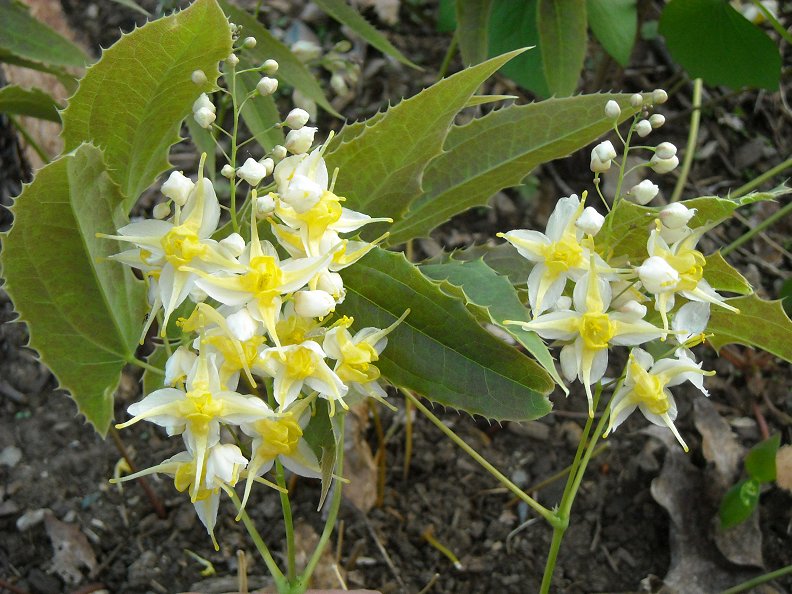
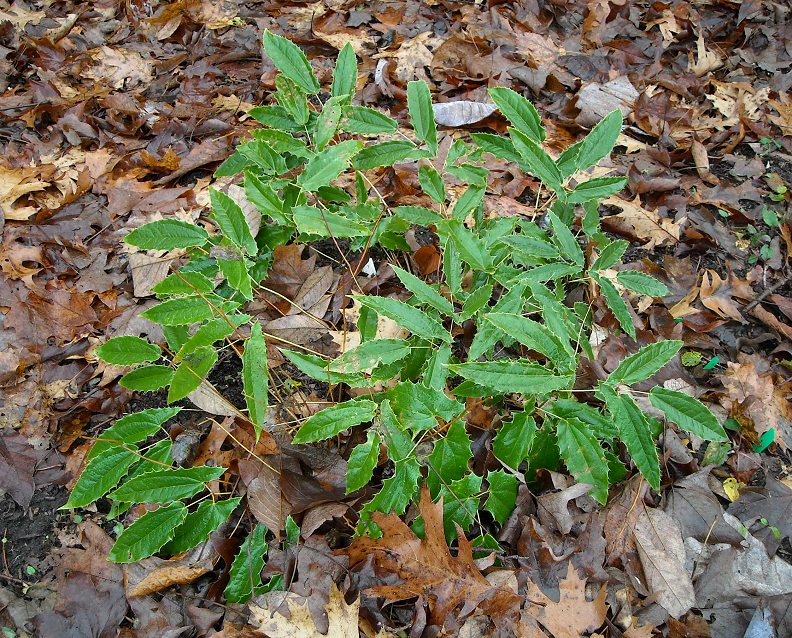
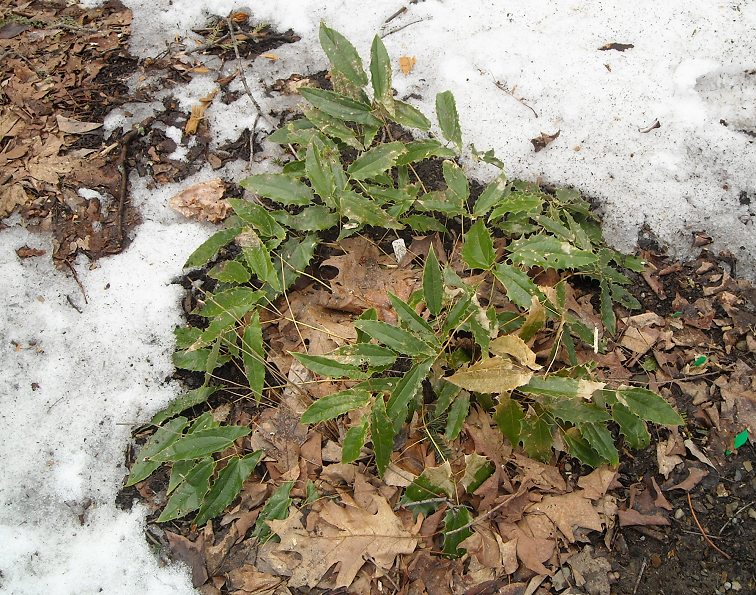
Let me start with a single recent species, E. wushanense, a species of only recent and rare obtainability, an imposing tall species with large creamy white flowers. Epimedium wushanense "Spiny-leaved Forms" is a selection from several clones grown by Darrell, growing much lower and leafier, with shorter condensed panicles of large bloom. I got my plant at a local NARGS auction 3 years back, where Darrell as usual generously donated a wonderful selection of "choicest of choice" epimedium to benefit our chapter.
This species has proved hardy (most epimediums are bone hardy) and completely evergreen in my harsh Zone 5 garden (a number of eppies are indeed evergreen here), with bold, glossy, spiny-edged foliage, and dense spikes of substantially large white and yolk-yellow flowers in May. The only problem with the flowers is that they droop downwards towards the ground and get dirt-splashed. In the photo, I am lifting up two flower spikes. I think this species has incredible potential for breeding. More to come.
Garden Vision Epimediums publishes an extensive list of eppies for sale, all completely identification validated, with inumerable rare species, special variant forms, and many of Darrel's latest gorgeous hybrids. Send an email to Karen Perkins requesting a catalog to: [email protected]. The catalog is due out soon, and includes 10 or more color pages of photographs, truly worth having as an Epimedium reference alone! In addition to Epimedium, there are choice woodland Iris species, many Iris cristata cultivars, some novel Primula sieboldii cultivars, and other choice woodlanders. For those who live within driving range, the nursery is open each year on two consecutive May weekends (includes Fridays before each weekend). I typically place an order and elect to pick it up at the nursery, where I get to see swathes of fantastic eppies, many new to science, swathes of new hybrids, discuss these with Darrell, and buy even more plants that are for sale at the nursery. Ahhh, to satiate ones plant desires.
Comments
Trond Hoy
Re: Epimedium 2010
Wed, 03/31/2010 - 11:04pmA wonderfull plant! Epimedium is one of my favorite genuses too! But the ubiquitous slugs take their toll. I have lost several fine specimens particularly when the plants are young. At least I believe it is the slugs to blame. They devour the young shoots early in spring. Gingers too are affected badly.
You are lucky to live near a specialist nursery. Except a few common hybrids, "eppies" are almost impossible to get here in Norway. Have to buy from foreign nurseries which can provide phytosanitary certificates.
Mark McDonough
Re: Epimedium 2010
Fri, 04/02/2010 - 7:40amEpimedium grandiflorum forma flavescens - William T. Stearn recognized E. koreanum as a separate species distinct from E. grandiflorum as recently as 2002 (e.g., a yellow-flowered entity akin to grandiflorum yet distinct), and Darrell Probst has supported and enriched our gardens with both species and numerous collected forms of E. grandiflorum f. flavescens. The key difference is that E. koreanum spreads aggressively, whereas all E. grandiflorum f. flavescens forms are tight clumpers. I grow 9 selections of E. grandiflorum f. flavescens, they are roughly similar, yet each with their own distinct characteristics and charm. I am only exploring a couple of these forms here. All are available from Garden Vision Epimediums, contact Karen Perkins at [email protected]
One of the very first Epimediums I purchased was "Epimedium grandiflorum flavescens" from George Schenk in 1977. This plant is now identified as a cultivar; E. grandiflorum f. flavescens 'La Rocaille', honoring the name of Harold Epstein's garden where this particular form was found. Back then, it cost $14 in George Schenk's catalog when most of his nursery offerings were between a mere $1 - $2 American dollars. While expensive, it was a worthwhile investment because I still have the original plant, now 33 years old, and it has provided considerable pleasure in all those years. It is what I call an "epimedium island', this curious effect among clumping epimediums where after a great number of years, a sizeable 2' (60 cm) clump never seems to spread any more... it just sits there content on being a happy large clump.
A few years ago in spring, I chopped off a piece (with great difficulty) and replanted it. The offset grew surprisingly quickly to fill the void and assume the same tight-clump proportion in only a few years. In this series of photos, I show both the original 30+ year old clump, and a new clump. In all forms, the elegant pale yellow flowers appear below a canopy of fresh foliage. Perhaps not as showy as other epimediums because the pale flowers are partially hidden, this variety is elegant and refined and certainly worth a choice spot in the garden.
Photos:
1 & 2 - View of young 3-year old clump of E. grandiflorum f. flavescens 'La Rocaille'. Notice the beautiful dark color stems.
3,4,5 - views of an old clump of E. grandiflorum f. flavescens 'La Rocaille'. Pointed spring foliage is strongly tinged red, lasting into early summer.
6 - E. grandiflorum f. flavescens 'Nanum' - most "flavescens" forms grow 14" - 22" (35 - 55 cm), but this one is much shorter (6 - 8", or 15-20 cm in flower), with the flowers extending out to the periphery.
7 & 8 - views of E. grandiflorum f. flavescens #4 (Darrell Probst numbers his forms), this is a tall one, almost 2' (60 cm) with thin, wiry bright red stems, airy sprays of narrow foliage, and nice light yellow flowers. The first photo is a flower closeup, the second shows E. x rubrum in flower, with the tall expanding red stems of "flavescens 4" in the upper right.
Plant any of these "flavescens" forms up on an embankment, to effectively show off their shy flowers and deep color stems.
Mark McDonough
Re: Epimedium 2010
Fri, 04/02/2010 - 7:44amFound two more old photos of E. grandiflorum f. flavescens 'La Rocaille' as the leaves and buds emerge, showing off the trademark cinnamon red stems, a subtle yet exquisite form.
Mark McDonough
Re: Epimedium 2010
Fri, 04/02/2010 - 7:50amWhile all the new exotic Chinese Epimediums entice us with different plant habits, uniquely beautiful flowers, and bold spectacular evergreen mottled foliage, many other Epimedium species and cultivars are more quiet and subtle, yet fundamentally beautiful and essential to the garden.
I grow 39 Epimedium x youngianum forms, and love them all. This group represents hybrids between E. grandiflorum and diphyllum, but one can also assume some of the lines have been blurred in the hybridization process. They're all charming small clump-forming plants, equally nice for the flowers as the foliage, all suitable to smaller gardens where space is a premium. Here's a classic example: E. x youngianum 'Jenny Wren' taken on May 11, 2007, low and floriferous in bloom with showy bloom above the foliage, and with nice speckled foliage season round.
Mark McDonough
Re: Epimedium 2010
Fri, 04/02/2010 - 7:56amA few Young ones ;D (E. x youngianum cultivars)
All of the "youngianums" (hybrids between grandiflorum and diphyllum) are dainty little clump-forming plants. Young spring foliage is often flushed or speckled with color, and a second leaf flush after flowering also shows some foliar interest. While generally rather small plants, the second leaf flush in June can give the clumps significantly more height and width. Here's a sampling:
1. E. x youngianum 'Fairy Dust' - Darrell Probst 2004 introduction. Pale but perky flowers, coffee tinged foliage.
2 & 3. E. x youngianum 'Tamabotan' - originally from We-Du nursery, known under 3 other names. Has the effect of double flowers because the petals and sepals are similarly sized.
4 & 5. E. x youngianum 'Marchacos Sprite' - D.Probst 2003 introduction, good bright pink cutie.
6 & 7. E. x youngianum 'Azusa' - a personal favorite with largish white flowers, red sepals and stems. Fall color is rich mottled red.
8. E. x youngianum 'Azusa' - fall color. Also fall color on E. diphyllum 'Variegatum' and E. grandiflorum var. violaceum.
9 E. x youngianum 'Hanagaruma' - floriferous light pink
Mark McDonough
Re: Epimedium 2010
Fri, 04/02/2010 - 8:26amEpimedium x versicolor represents a group of semi-evergreen hybrids between E. grandiflorum and E. pinnatum ssp. colchicum. All of the half dozen or so cultivars are first class plants, valued for their beautiful foliage, often highly colored in spring and with good fall color too, and their bounty of uniquely hued blooms. The plants clump up and spread slowly, making fine foliage mounds, and showing remarkable durability, prospering even under very dry wooded shady conditions.
I thought I'd put together some photos that help show the differences in two Epimedium cultivars, E. x versicolor 'Cupreum' and E. x versicolor 'Versicolor', which are sometimes confused. They have the same seed parents are are indeed similar, but when observing both in the garden, they are distinctive enough to easily spot which is which.
Compared to E. x versicolor 'Versicolor', the salmon pink and yellow flowers in 'Cupreum' have a deeper color, especially noticeable in the dark color red buds, and foliage of 'Cupreum' tends to be more intensely bronzy-red giving greater emphasis to the green venation. Overall, I find find E. x versicolor 'Versicolor' a faster growing plant, more floriferous, with masses of softer pastel salmon flowers. It is gorgeous! In late autumn and early winter, the fall foliage color is different, a bright orangish-red (with yellow underlay) in 'Cupreum', a lustrous mahogany brown-red in 'Versicolor'. In the last photo, E. x versicolor 'Versicolor' is on the left, E. pinnatum colchicum 'Thunderbolt' on the right, showing intense fall color.
I hope to capture photographs of two more recent of Darrell Probst's versicolor hybrids, 'Cherry Tart' and 'Strawberry Blush'; both were too small in previous years to warrant photos, but should be good this year.
Mark McDonough
Re: Epimedium 2010
Fri, 04/02/2010 - 8:34amThere is frequent confusion between E. x versicolor 'Sulphureum' and E. x versicolor 'Neosulphureum'.
'Sulphureum' has flowers a deeper yellow color than 'Neosulphureum'. The spurs of 'Sulphureum' equal the length of the inner sepals, whereas the spurs on 'Neosulphureum' are short, only about half as long as the inner sepals. I am uploading several photos of E. x versicolor 'Neosulphureum', one looking up at the flowers clearly showing the short spurs. Also, 'Neosulphureum' is much lower growing, has denser growth, and burnished bronze spring foliage, altogether a better plant than 'Sulphureum'. The latter has much more open growth (shown in Photo 7), taller stems, and slightly red-tinged foliage in spring, and the aforementioned flower differences.
In Photo 6, we also see a recent evergreen species, E. lishihchenii, with bold corrugated leaves and large light yellow flowers, the fresh new leaf growth is vibrant light green compared to the darker burnished evergreen leaves below.
Mark McDonough
Re: Epimedium 2010
Fri, 04/02/2010 - 7:58pmEpimedium timeline: E. sempervirens 'Violet Queen'
Here are a series of photos documenting this partcular epimedium from April - December. I draw from photos over several years, so the size of the plant may look different depending on the photo, but the goal here is to show early flowering and foliage emerging, the bountiful floral display on this selection (on a mature plant, such as the photo taken on 4-29-2009), the brilliant color of spring foliage, sprinking of bright new foliage in the start of a "second foliar flush", and ending up with the smoldering fall color that lasts well into winter.
The transition from photo 5 & 6 beautifully illustrate the transformation from a flowering plant, to s foliar plant, where the brilliantly color foliage rises above the fading flowers.
Mark McDonough
Re: Epimedium 2010
Fri, 04/02/2010 - 8:04pmEpimedium profile: E. sempervirens 'Candy Hearts'
With E. sempervirens, the best aspect of the species is the foliage, spectacular in some cultivars such as this 2001 introduction from Darrell Probst. I include a number of photographs, as it presents itself differently day to day, week after week, and under different lighting conditions. In late spring and early summer, there are flushes of colorful new leaves. The flowers, while large, are a pale washed-out color (described as silvery lavender pink), but it is definitely worth growing for the foliage alone. This is a very slow grower, and a clumper not a spreader.
Seedlings show interesting variation.
Mark McDonough
Re: Epimedium 2010
Fri, 04/02/2010 - 8:18pmMore Epimedium sempervirens.
Epimedium sempervirens are unsurpassed as foliage plants. One of the best is E. sempervirens 'Aurora'. It has pale lavender blooms, but it is the shiny foliage that really stands out, which can be beautifully edged in red. In the second photo, there is E. x setosum in the upper right with tiny white flowers (x setosum is a hybrid between E. diphyllum and E. sempervirens). In the 3rd photo, a more general view of an enbankment with several E. sempervirens cultivars, the cultivar 'Aurora' in the center, E. sempervirens 'Vega' in the lower right with very shiny pointed leaflets. The 4th photo shows E. sempervirens "Aurora' again, but later on when the colorful second flush of foliage appears.
Mark McDonough
Re: Epimedium 2010
Fri, 04/02/2010 - 8:33pmEpimedium grandiflorum 'Dark Beauty' - partial spring to summer timeline.
This is among my very favorite eppies, a chameleon to be sure, almost a different color and aspect every other day. It emerges with foliage that is near black-red, but quickly assumes more muted tones of red and green, eventually giving over to green but strongly tinged red on the older foliage, the new leaflets still black-red. The flowers are large spidery two-toned lavender and purple, showy and worthwhile in their own right. The famed "second flush" of foliage after initial flowering is almost as spectacular as the initial foliage, young leaflets blood red, shading to paler suffused red tones on slightly older leaflets. Eventually new leaflets are luminous light green against the darker green of older leaflets, yet still sporting red juvenile foliage through the season. Fall color is an unremarkable yellowish.
Mark McDonough
Re: Epimedium 2010
Fri, 04/02/2010 - 8:35pmAnother dark-leaf beauty, colorful aspects of Epimedium grandiflorum var. violaceum 'Bronze Maiden'.
This is a 1999 introduction by Darrell Probst, another of those dark-leaf selections that goes through a dramatic cameleon-like transformation of foliage color. The mahogany brown-red foliage is so shiny that it can look like polished leather. It is a solid clumper with showy sprays of lavender flowers above the neat foliage. By June the leaves turn green, but new foliage in the second flush of foliage and sporadic new leaves all summer, are richly red-tinged. Outstanding!
Mark McDonough
Re: Epimedium 2010
Fri, 04/02/2010 - 8:38pmThree miscellaneous grandiflorums, E. grandiflorum 'Saxton's Purple', a fairly unique color, E. grandiflorum 'Princess Susan', a 1999 Darrell Probst introduction with showy bi-colored flowers of clean white and bright rose, and E. grandiflorum var. violaceum with lively flowers and contrasting dark color spring foliage.
Mark McDonough
Re: Epimedium 2010
Fri, 04/02/2010 - 8:43pmEpimedium x sasakii (hybrids between E. sempervirens and E. x setosum)
A modest species to be sure, but still attractive in a demure way. Slow growing, attractive colored foliage in spring, sprays of small pale flowers. This one is now a bittersweet memory for me, as Sasaki Associates is the name of the company I was recently laid off from after 20+ years service.
I grow two forms offered by Garden Vision Epimediums, and his 2001 introduction E. x sasakii 'Melody', a more robust showy hybrid. These have evergreen foliage, which can be seen in the last photo.
Mark McDonough
Re: Epimedium 2010
Fri, 04/02/2010 - 8:48pmA portrait of Epimedium x 'Black Sea'
Sometimes listed as a cultivar of E. pinnatum ssp. colchicum, I found the hybrid parentage listed as E. pinnatum ssp. colchicum x E.pubigerum on the JEARRARD'S HERBAL web site: http://www.johnjearrard.co.uk/index.html
It's a super web site, scroll down to the list of genera and select Epimedium.
This hybrid is something special, with little else quite like it, a good candidate for hybridization efforts. In photos 1-2 taken spring 2009, the evergreen foliage had been cut off early, to get a clean floral display, not that it is necessary in this hybrid because the flower stems soar past the old foliage for an aerial display. Without the support of the old evergreen foliage at the base, the flower stems did not grow as tall, and rise with angular ascent, rather pretty I think. The clouds of pastel yellow orange-veined flowers put on a good show.
In photos 3-6 taken the previous year in 2008, I left the evergreen foliage on, and one sees a different effect in spring, looking more substantial, the dark red shiny basal evergreen foliage "grounding" the airiness of the new growth. Photo 7 is a closeup view of the flowers. Photo 8 shows the special feature of this hybrid; the beautiful red-black burnished autumn-winter foliage. Photo 9 shows the same (younger) plant taken on New Year's Day 2007.
Mark McDonough
Re: Epimedium 2010
Fri, 04/02/2010 - 8:51pmEpimedium x 'Black Sea' emerging shoots on 3-25-2010.
Mark McDonough
Re: Epimedium 2010
Fri, 04/02/2010 - 8:56pmA couple more eppies.
Epimedium x youngianum 'Capella' - a spritely little thing with bright rose flowers (leaves of E. sempervirens 'Candy Hearts' in the background).
Epimedium grandiflorum 'Lavender Lady' - Darrell Probst introduced this in 2000, reportedly a spontaneous cross between E. sempervirens 'Violet Queen' and E. grandiflorum 'Silver Queen' found in Harold Epstein's garden. Gorgeous spring foliage and showy flowers.
Trond Hoy
Re: Epimedium 2010
Fri, 04/02/2010 - 11:13pmI am impressed, Mark! You have some collection! Many colors have I never seen before either. Takes time to view all the pictures too. Good to have something to do when I am tired of looking at the snow here (has snowed all week - seen no sun (not at home, but in the mountain, that is)).
Do you know Mark if any of your suppliers dispatch abroad?
Mark McDonough
Re: Epimedium 2010
Sat, 04/03/2010 - 6:37amSo often, photos of epimediums only show close-ups of a few flowers, failing to depict the chararcter and charm of the whole plant. As a result, it is difficult to get an idea about what an Epimedium species or cultivar will look like after a few years growth, So this photographic essay is to demonstrate what these marvellous plants look like in the garden thoughout the seasons, to display the unique character of each.
Garden Vision Epimediums can dispatch internationally, although it is very expensive to do so. There are European-based nurseries with good collections of Epimedium that might be able to ship at less cost.
Mark McDonough
Re: Epimedium 2010
Sat, 04/03/2010 - 7:02pmEpimedium timeline threesome - Photos 1-10: E. x versicolor 'Versicolor', E. pinnatum ssp. colchicum 'Thunderbolt', E. grandiflorum f. flavescens 'Chocolate Lace'.
These three species are planted side by side along a garden path. The metamorphosis of each plant's appearance through an extended season is rather dramatic and visually captivating. I will start out New Year's Day 2007 (and a couple days before), where the ground is completely frozen, there's a bit of snow, the grandiflorum cultivar has gone to bed, but evergreen E. pinnatum ssp. colchicum 'Thunderbolt' has shiny rounded leaves drenched blackish-purple revealing a network of green veins on each leaf, and semi-evergreen E. x versicolor 'Versicolor' turns a rich burnished red-leather color.
From here, the photos will progress through spring, into summer, and then back into fall and winter again. A couple other eppies will be seen along the journey. This timeline series will be in 3 installments.
We start with a few winter photos, then move on to the early Epimedium season at the end of March. Epimedium x versicolor 'Versicolor' is particularly floriferous and beautiful, thus featured.
Mark McDonough
Re: Epimedium 2010
Sat, 04/03/2010 - 7:05pmEpimedium timeline threesome - Photos 11-20: E. x versicolor 'Versicolor', E. pinnatum ssp. colchicum 'Thunderbolt', E. grandiflorum f. flavescens 'Chocolate Lace'.
These three species are planted side by side along a garden path. The metamorphosis of each plant's appearance through an extended season is rather dramatic and visually captivating. The star is E. x versicolor 'Versicolor' with soft pink and yellow blooms atop a shield of intensely colored red spring foliage highlighting a network of luminous green veins. The glorious foliage starts to overtake the flowers.
The evergreen foliage of E. pinnatum ssp. colchicum 'Thunderbolt' had been cut off, as it must to better appreciate the spikes of bright yellow verbascum-like flowers. The soft juvenile spring foliage quickly surpasses and semi-conceals the blooms.
E. grandiflorum f. flavescens 'Chocolate Lace' is a study of understatement, with fine chocolate suffused leaves accentuating green veins, and pale yellow flowers partly hidden below the canopy of emerging leaves.
By early to mid May, these Epimediums transform into beautiful foliar accents, most of the flowers gone or hidden by the foliage, and starting to set seed, yet indispensable for their season-long foliar value.
Mark McDonough
Re: Epimedium 2010
Sat, 04/03/2010 - 7:09pmEpimedium timeline threesome - Photos 21-30: E. x versicolor 'Versicolor', E. pinnatum ssp. colchicum 'Thunderbolt', E. grandiflorum f. flavescens 'Chocolate Lace'.
These three species are planted side by side along a garden path. The metamorphosis of each plant's appearance through an extended season is rather dramatic and visually captivating.
By June, the famous "second flush" of foliar growth is happening on many epimediums. With E. pinnatum ssp. colchicim 'Thunderbolt', the spring foliage has settled in to a shiny deep green color, and new leaves are much lighter green, for a nice effect. With E. x versicolor 'Versicolor', the second leaf flush is a medley of intensely variegated red-tinged green-veined foliage to fresh light green foliage against shiny darker green foliage, very special!
In photo #24, we see the fall foliar patch of E. koreanum in yellow, an aggressive spreader. In the upper right is E. grandiflorum f. flavescens 'Chocolate Lace' still green in leaf on October 22, 2009. Just below it is E. x versicolor 'Versicolor' with foliage appearing near black, and evergreen E. pinnatum ssp. colchicum 'Thunderbolt' below it.
In photo #25, we see the same eppie threesome, but further back, showing a large clump of E. x rubrum in fall foliar color, a pale reddish-tan color. Also, notice that E. grandiflorum f. flavescens 'Chocolate Lace' has foliage turned yellow just a week later.
In photos #26-28, we see all three "eppies", but it is E. grandiflorum f. flavescens 'Chocolate Lace' that turns a really bright yellow by mid November.
The last two photos, #29-30 show the initial two evergreen epimediums in their December color. These are truly plants of full seasonal interest.
Mark McDonough
Re: Epimedium 2010
Sat, 04/03/2010 - 7:21pmNo one thinks of Epimediums as suitable for sunny locations, but they can be superb in the sun as well. Perhaps part of the issue, there are much fewer number of plants willing to grow in dry shade where Epimedium excels, who needs yet another plant willing to grow in the sun. I want to explore this more in the next few years because some species and cultivars have richly colored foliage that would otherwise just show up as green when grown in shade. I've never had seedlings appear in the drier sunny locations, only in more moist sahded locales.
My favorite example is with E. x warleyense, which not only excels unfazed in a full sun position, it grows happily in full sun (although spreading somewhat exuberantly), and shows a long season on a rich red to orangish leaf coloring and venation lasting well into the summer. When this eppie is grown in shade, apart from the short season of orange flowers, the foliage is green and unremarkable.
Here are some photos:
Mark McDonough
Re: Epimedium 2010
Sat, 04/03/2010 - 7:32pmThe question gets asked to suggest low Epimediums for the rock garden, sort of depends on the scale of the garden I suppose, but even though some species and cultivars are rather low, many have a second flush of foliage after flowering that can more than double the apparent size of the plant. But here are some suggestions:
E. x setosum - delicate clumping sort, several clones, adorable leaves & delicate white flowers.
(photo uploaded)
E. x setosum 'Nanum'- 5" tall, second flush to 10" tall.
E. grandiflorum 'Nanum' - 3-5" in bloom, 10" after second flush (choice)
E. grandiflorum var. coelestre - Japanese, from "high alpine heights", 9", greenish yellow flowers
E. grandiflorum var. coelestre 'Alpine Beauty'- 6" tall "tight bun", light yellow
E. grandiflorum var. higoense (including cultivars 'Bandit', 'Saturn', 'Saturn'), all low growing
E. grandiflorum f. flavescens 'Nanum'- 6" light yellow, 12-16" second foliar flush
E. elachyphyllum - 6" tall, 2" rhizomes, simple single leaflets, evergreen.
...also various smaller cultivars such as E. x youngianum 'Liliputian'. (photo uploaded)
Watch out for some of the other low growers that romp around and spread aggressively, including E. alpinum 'Shrimp Girl', pauciflorum, rhizomatosum, unless they get introduced to wilder parts of the garden, or placed in a planting specifically designed to account for their spread.
Mark McDonough
Re: Epimedium 2010
Sat, 04/03/2010 - 7:40pmRegarding naming hybrids in any hybridization effort, I hope not to do this:
http://www.plantsnouveau.com/2009/05/18/epimedium-purple-pixie/
(scroll down to the overall plant view)
...that is, introduce a plant as something special and unique, when in fact it looks like many other grandiflorums that already exist. To my eyes, this 'Purple Pixie' doesn't look very different than the type form of E. grandiflorum (photo 1) or "var. violaceum" (photo 2) which has showy brownish-reddish-purple spring foliage. I'm sure 'Purple Pixie' is a nice enough plant (almost all eppies are), but how many more very similar cultivars do we need, when there is potential for so much more.
Mark McDonough
Re: Epimedium 2010
Sat, 04/03/2010 - 7:47pmEpimedium pubigerum is an excellent species, and quite distinct. What I like about it is the foliage is completely evergreen here in New England (USDA Zone 5), which says a lot in this tough climate. And the small white flowers (pinkish in some forms) held aloft above the foliage, have a definite charm. A quick search on photos for this species in my library yields some less-than-satisfactory shots, but you'll get the general impression.
In the first photo, on the left is E. pubigerum with modest displays of white flowers. Looking closely, some of the previous year's evergreen foliage is still present in the lower right (I'm not always as timely as I should be in cutting out the previous year's growth). In the upper left is Epimedium grandiflorum f. flavescens 'La Rocaille', the original plant bought in 1973 or 1974!
In the second photo, we see the "epimediumesque" second flush of foliage, which lends a second season to Epimedium viewing, where the newer foliage takes on dramatically different leaf coloration than the maturing spring foliage. This is basically a June phenomenon in my area.
The third photo shows a classic situation, with the previous year's evergreen growth at the base (darker green) yet still in good condition after a harsh winter, a fresh flush of lively light green slightly red-flushed new season's growth, and the lovely modest sprays of white flowers. There are winters here and there (the relatively snowless types) where the evergreen leaves suffer badly, but in most years they survive just fine.
The forth and final photo shows the same plant back in 2006, where I did indeed cut off the old foliage in late winter/early spring, so no dark green old foliage is present. I actually think it looks best when there is contrast between the new foliage and older foliage.
In summary, this is a rock-solid species, slowly spreading, extremely hardy, quietly beautiful, and recommended. It is also quite drought resistant, as I find most eppies are.
Trond Hoy
Re: Epimedium 2010
Sat, 04/03/2010 - 11:28pmToday we go down from the mountains were we have been the last week. At home I can take a closer look at your excellent pictures. At the cabin I have to use my cellphone to get access to Internet and that is a bit slow. You have edited a book, Mark!
I have lots of trees on my property so I don't get too much sun. My eppies normally have not that rich leaf color as yours. And I have not all those cultivars either! So now I have a problem, do I cut more trees? Or have I to plant in shade. But for sure I have to try and get more of those fabulous cultivars!
Mark McDonough
Re: Epimedium 2010
Sun, 04/04/2010 - 7:15pmThis is basically a "transfer" from information I posted to SRGC, but wanted to post here with a North American context, and then add to it all, now that NARGS Forum is up and running. Epimediums are a fantastic solution to the often bemoaned problem of having to much shade to grow "normal" garden plants and perennials. Regarding leaf coloring, many will color as richly in sun or shade, but there are a few cases, such as E. x warleyense that I highlighted, that will grow and flower just fine in shade, but will only show strong leaf coloration when grown in brighter light and sunny conditions.
Mark McDonough
Re: Epimedium 2010
Sun, 04/04/2010 - 7:17pmEpimedium Hybrid - Posting 1a
Hello Epimedium lovers, I thought I would put together a couple posts to illustrate a hybrid that occured between Epimedium brevicornu and E. membranaceum. This part of my post will primarily show E. brevicornu, one of the very best eppies in my opinion. What I like about this species, is the perky upright growth, with sprays of small white and yellow flowers clearly displayed above the foliage. It also blooms for an exceptionally long time, being among the first to bloom, but also one of the last. It is a clumper, so no spreading habit to worry about. And it has lovely red-mottled foliage in spring.
I start with a photo in 2007 showing the upright profile, followed by a series of views taken in 2008 & 2009 as it pushed into bloom. The next to last photo is an overhead shot, showing Saruma henryi in bloom, just getting a glimpse of E. brevicornu to the right of a boulder, and in the lower right, the foliage and emerging buds of E. membranaceum.
E. membranaceum is on my personal top 10 list; it starts flowering late, has enormous spidery bright yellow flowers with white-pink-spotted sepals. A low grower (and another clumper), the species is remarkable because it is an ever-bloomer, with low ascending branched stems and sprays of golden spiders, blooms all summer long and into the fall. As such, it is an excellent candidate for hybridization. While E. brevicornu started blooming long before E. membranaceum, there is a brief overlap of bloom time; a photo depicts this overlap. Notice the hirsute stems and seed pods on E. brevicornu in the last photo.
I will follow up later with Posting 1b, with photos of E. membranaceum and the resulting hybrid that flowered for the first time in 2009.
Mark McDonough
Re: Epimedium 2010
Sun, 04/04/2010 - 7:21pmEpimedium Hybrid - Posting 1b
Installment 2 of a 3-part message:
Here are some views of E. membranaceum. See my previous post where I talk about the attributes of this ever-blooming species.
In the first view there is Saruma henryi again (yellow flowers) on the left, Trillium catesbaei, Epimedium membranaceum at centerstage, and just behind it is E. brevicornu mostly finished but still some small white flowers coming and those fuzzy flower stems. A worm's-eye view of Trillium catesbaei and E. membranaceum in the second photo. Photo 3 shows a typical inflorescence of E. membranaceum (notice one inflorescence of E. brevicornu in the upper right), and the 4th photo is a detail view showing the sepals... white, lightly spotted with red or pink dots. In the 5th photo, nothing very different about this photo, but take a look at the date in the photo title, this eppie is still blooming on October 26th!
In the final installment, I will show photos of one selected hybrid, and compare the hybrid's flowers photographically with E. brevicornu.
Mark McDonough
Re: Epimedium 2010
Sun, 04/04/2010 - 7:27pmEpimedium Hybrid - Posting 1c
Installment 3 of a 3-part message:
In the following series of photos, I'm holding a couple individual flowers of my E. brevicornu x membranaceum hybrid in each photo up against an inflorescence of E. brevicornu, for comparison. As you'll see, the hybrid has larger flowers overall, the yellow cup is about 5x as big, the yellow spurs are vestigial in E. brevicornu but long and prominent in the hybrid. In the hybrid, the general shape of the flower and other characteristics, more closely resemble E. brevicornu, thus my belief this cross represents E. brevicornu x membranaceum, not the other way around.
In the 5th photo, we see flowers of both the hybrid and E. brevicornu from the back, to reveal the sepals. Notice the hybrid has picked up the red spotting from E. membranaceum (two flowers on the left are the hybrid). Also to note, the hybrid has hirsute flower stems, but not quite as fuzzy as E. brevicornu. In photo 6, again we see the back of the flowers and the spotted sepals, but we also see some of the foliage which is rounded, minutely spinulose, red-spotted when emerging, thus mimicking E. brevicornu.
In photos 7 & 8, we see views of the young inflorescence of this hybrid in May 2009. Proving to me that E. membranaceum is involved, is that the flower stems are semi-indeterminate and keep spouting new flowers way past normal Epimedium flowering season; this young seedling flowered non-stop from May to August. The everblooming tendencies of E. membranaceum can be passed along to offspring!!! WooHOO!
I had a few other seedlings of the same cross, not nearly as good. Many more seedlings are cropping up, but will be a year or more before I see what they look like. What fun! I hope this detailed summary of Epimedium hybridization (even if the bees did it in this case) sparks the imagination of what is possible in this fantastic genus, now that the gene pool has been so enriched by numerous new species and hybrids becoming available.
Mark McDonough
Re: Epimedium 2010
Sun, 04/04/2010 - 7:29pmHere are a 3 more hybrid seedling views taken spring 2009. The first is a nice white with yellow center, I shall be watching this one too. The last two photos show very nice epimediums, but they're not much different or special. No matter, I plan an entire enbankment of growing unnamed eppie seedlings, it'll be beautiful regardless whether they're named cultivars or anonymous seedlings... it's all part of the fun.
Mark McDonough
Re: Epimedium 2010
Sun, 04/04/2010 - 7:33pmEpimediums are literally jumping out of the ground, after nearly a week of rain followed by warm sunshine, and temperatures up to 25 C. This morning I took these photos of the hairy, muscular, frond-like uncoiling shoots of E. grandiflorum f. flavescens 'La Rocaille'. And from 2 days ago, on 04-02-2010, fuzzy mass of shoots and buds on E. x versicolor 'Versicolor', and red-tinted shoots on E. grandiflorum 'Red Queen'.
Trond Hoy
Re: Epimedium 2010
Sun, 04/04/2010 - 11:32pmAt home! Here's one of my Epimediums taken today. As usual I have forgotten the name of the cultivar, it is yellow-flowered though.
Mark McDonough
Re: Epimedium 2010
Mon, 04/05/2010 - 4:50amLooks like E. pinnatum ssp. colchicum. The other possibility is E. x perralchicum (E. perralderianum x pinnatum ssp. colchicum), a widely available plant. If the new spring foliage is reddish bronze with green veining, then it could be another popularly grown selection, E. x perralchicum 'Frohnleiten'. All have spikes of yellow flowers.
Trond Hoy
Re: Epimedium 2010
Mon, 04/05/2010 - 10:59amThanks. When you mention the names I recognize E x perralchium, think I have different selections of that cross.
I have tried Saruma too, but that plant was the slug's favorite.
Mark McDonough
Re: Epimedium 2010
Tue, 04/06/2010 - 7:23amMore Epimedium spring foliage and stems emerging:
1. E. grandiflorum f. flavescens 'Chocolate Lace' - dark emerging shoots
2. E. grandiflorum f. flavescens 'La Rocaille' - forrest of shoots
3. E. x versicolor 'Versicolor' - budding, a few first flowers open, the very first "eppie" to bloom.
4. E. grandiflorum var. violaceum - emerging growth catching afternoon sun.
Trond Hoy
Re: Epimedium 2010
Tue, 04/06/2010 - 10:37amOK, thanks.
Shipping from USA is not necessarily more expensive than from the Continent or GB. I bought from Heronswood Nursery in Washington a couple of times when owned by Dan Hinkley.
I'll be at the lookout!
Mark McDonough
Re: Epimedium 2010
Thu, 04/15/2010 - 6:49amFlowering now and putting on a display more impressive than imagined, is a rare variegated form of Epimedium sempervirens. It doesn't have a cultivar name yet, it is just referenced as E. sempervirens "Variegated #1". This form was purchased in Japan by Darrell Probst in 1997, who says it "cost a small fortune".
What a stunner it is, even more compelling than my photos which fail to adequately capture the intensity and nuance of color of the brilliant new foliage embracing creamy white flowers, all hovering above dark leathery winter-evergreen leaves. To quote Darrell, the variegation of new foliage is supposed to turn "a swirling collage of white, pink, and light green" which last well into summer.
Photos 3-4 show the plant at younger emergence, with deep red leaf tones. In Photo 5, just two days later, the leaves are starting to expand, they are infused with mottled red and pink coloration :o :o In photos 1-3 notice how the aerial flower and new foliage effect is set off by a low brace of shiny evergreen foliage; looks great in the garden.
I wonder what it'll look like today :D
Trond Hoy
Re: Epimedium 2010
Thu, 04/15/2010 - 11:37amWhat a sight! I am jealous.
The other plants there, are they Corydalis nobilis and Dicentra cucullaria?
I have also seen some kind of groundcover wood sorrel (Oxalis) in some of your pictures. (Or is it weed ;).) I grow pink and white Oxalis acetosella and O. oregana in my woodland.
Mark McDonough
Re: Epimedium 2010
Thu, 04/15/2010 - 11:58amYes on both the Corydalis and Dicentra. The Oxalis is a lovely little weedy thing, but since it only roots in 1-2 cm of soil, it is really no risk to anything, the green trifoliate leaves always look fresh, but the long season of perky little flowers make it special for me. Now, what species is it... I'm not sure. It might be O. acetosella or montana :P I spent a lot of time on this one, as I've had plants in the past under both species names, but if you look them up (particularly montana) they are typically whitish to light pink and with deeper pink veins. Mine are solid color, bright rosy pink. Oxalis montana, which describes the North American plant, used to be considered a subspecies of acetosella.
Soon I'll start a new thread elsewhere on this forum, with some diagnostic detail photos and links, and maybe we can pinpoint an identity.
Richard T. Rodich
Re: Epimedium 2010
Thu, 04/15/2010 - 7:23pmWhile I am pretty much content with how my Epimediums perform, the eye candy you display, Mark, is no match. What a glorious garden!
Mark McDonough
Re: Epimedium 2010
Thu, 04/15/2010 - 7:34pmTo be honest, lot of it is "trompe l'oeil", where a camera lens and selective shots and careful cropping make things look bigger and better than they are. But it helps to have lots of Epimediums, with so many varieties, and a great spring season as this has been, and the Epimediums are leaping out of the ground... they can't help looking so beautiful. Been having a great time the last couple days studing Epimedium hybrid seedlings into their 3rd year, and there are some GOOD ONES. I've taken a load of photos the last few days but haven't had time to cull through them and start posting some varieties I haven't covered yet... was hoping to do that tonight, but got a last minute IT consultation gig in Boston tomorrow morning, my first work in 6 months since unemployed, so it'll have to wait for the weekend. Hope I'm not too rusty on IT/CAD stuff, I've been fooling around for 6 months on plant forums instead of keeping my IT skills honed, but one needs to have priorites ;D
Mark McDonough
Re: Epimedium 2010
Sun, 04/18/2010 - 6:26pmThe Epimedium season is suddenly upon us with wild abandon here in Northeastern USA, fully 3 weeks ahead of normal due to a series of weather contitions; an unusually mild spring, a few periods of record rainfall (with flooding), fueled by extended periods of warm and mild dry sunshine, including a couple days of record heat. The Epimediums are jumping out of the ground!
1 - 3 E. epsteinii, an evergreen species named as recently as 1994, It is slow to become established, but once happy it makes a striking specimen, with leathery dark green evergreen foliage mixed with orange-bronze new foliage, and discreet panicles of substantial flowers of exceptionally broad white sepals, contrasting with the dark purple cup and petals. This is a plant that needs to be planted high on an enbankment to best appreciate the beautiful down-faced blooms.
4. E. fangii - this photo shows a bit of dark green oval evergreen foliage mixed with a small emerging leaflet of rich mottled red... more to come. This plant is one that Darrell Probst introduced as a hardy growable form from Mt. Emei China, of an otherwise tempermental not-so-hardy species from previous introductions. This one is a "spreader" with long annual rhizomes, so site it accordingly. It has large yellow flowers. Quickly becoming one of my favorites.
5 - 7 E. fargesii, a Chinese species that is hard to capture photographically. Long slender spine-edged evergreen leaflets and slender tallish panicles with down-turned delicate white flowers, like little slender white "shooting stars" with reflexed sepals and small grape purple centers. Enchanting.
8 - 9 E. stellulatum, another Chinese evergreen species. Photo 8 shows the basal evergreen spine-edged foliage, a nice base to light filmy panicles of starry white flowers with yellow centers, with a haze of spring cauline leaves that are variably marbled red, bronze and green. In my photos, the flowers are just starting to open. A good one to be sure!
10. E. leptorrhizum, a Chinese species that is very low and spreading up to 8" annually on long stolons. As it is, I have not sited it well, must replant it where it is free to create a spreading groundcover without invading neighbors. The spidery light pink blooms are extra large held close to the textured olive bronze-tinged foliage.
Mark McDonough
Re: Epimedium 2010
Wed, 04/21/2010 - 6:41amIt is Epimedium madness time here, all busting into bloom. I share a miscellany of Epimedium images that caught my fancy in the bright sunlight yesterday (and sunny and warm again today... more epimedium photo shoots!).
1 - colorful epimedium leaves catching afternoon sunlight in the garden
2 - E. grandiflorum 'Lavender Lady' overlooking maidenhair fern fronds and pulmonaria.
3 - view of young epimedium foliage, top center is the giant E. grandiflorum 'Red Queen'
4 - epimedium foliage, E. x versicolor 'Versicolor' at centerstage with red, green-veined leaves, and
E. grandiforum f. flavescens 'Chocolate Lace' on the left.
5 - splash of orange in my Allium garden, Epimedium x warleyense flowering prolifically.
6-9 - E. pinnatum ssp. colchicum flowering. Evergreen foliage cut off to see the floral show.
The young leaves are inrolled showing off their fuzzy backsides.
10 - Bed of mixed hybrid seedlings, those with wonderful coffee and caramel toned leaves are hybrids between
E. grandiforum f. flavescens 'La Rocaille' x E. grandiforum 'Dark Beauty'
Trond Hoy
Re: Epimedium 2010
Wed, 04/21/2010 - 12:55pmMark, I recently read an article of Tony Avent, Plant Delight Nursery, in The Plantsman. He mention 54 species named and lots of cultivars, do you know how many you have? It's a pity that it seems to be difficult to obtain many of the cultivars in Europe, though.
Mark McDonough
Re: Epimedium 2010
Thu, 04/22/2010 - 8:06amTrond, many more species in China have been discovered, and await publication. Darrell Probst, of Epimedium fame, spoke at the NARGS Eastern Winter Study Weekend at Devens, Massachusetts in March 2010, and gave a riveting presentation on his efforts and travels in China, in search of Epimedium. There are dozens of new epimediums that need to be published, but apparently Chinese botanists are slow to do so, their efforts more governed by medicinal properties in plants than for the science of taxonomy itself, so Darrell is pushing for botanical institutions in other countries to "pick up the slack" and continue publishing. There may be closer to 100 species, and they're finding new ones all the time. Then, there are numerous "forms" of certain species, and of course, numerous hybrids.
I grow approximately 180 different species and cultivars. But now I'm wondering why there aren't a million hybrids, as they are all so willing to hybridize. I had heard that most epimedium are self sterile, and need other plants/species around, and then they freely hybridize. In 2005, I started getting many seedlings around parent plants; they're such cute seedlings I couldn't throw them away, so I decided to pot them up and eventually plant them out, labeling the seedlings as to what parent plant they were found near. Well, I am just dazzled by the results. So I include a photo of Epimedium grandiflorum 'Dark Beauty', one of the most dramatic cultivars with foliage that emerges near black-red, then goes through a gorgeous transformation through all shades of reddish brown, coffee, and caramel leaf colors. I follow with 4 photos of mixed hybrid seedlings, many being hybrids with 'Dark Beauty', inheriting the same dramatic spring foliage color.
Today the flowers started opening on 'Dark Beauty', so I spent a couple hours this morning hand pollinating and making intentional crosses... such fun! I'm selecting specific parents that possess desirable qualities, then dabbing pollen. While epimedium flowers are small, they're actually fairly easy to work with to make crosses, some species/cultivars having more abundant easy-to-access pollen than others.
Trond Hoy
Re: Epimedium 2010
Thu, 04/22/2010 - 1:54pmAmazing! I am dumb. (And I know what to do in the future...)
Richard T. Rodich
Re: Epimedium 2010
Thu, 04/22/2010 - 4:08pmDo you use tin foil to protect your crosses?
I tried a few attempts at J. dubia x J. diphylla, and was afraid the foil might be too heavy, see how the rain beats the flowers down so easily. Fortunately, there were no problems. For as big as the anthers were on J. diphylla, I expected a lot more available pollen. Grains were quite scant.
Mark McDonough
Re: Epimedium 2010
Thu, 04/22/2010 - 7:08pmNo, I didn't use foil or any protection :o :o :o This was the first time I actually tried hand-to-hand Epimedium hybridization, and they're actually easy... some species have the stigma way ahead of the stamens and anthers, so brushing them with abundant pollen of another species/cultivar is quite evident. Same was true of Jeffersonia. The crosses I'm attempting are not so rigorously executed, I just want to try and "mix it up a bit". What I'm seeing from bee-polinated hybrids, they look rather intermediate from the nearby species/cultivars. Darrell Probst suggests planting one species you are interested in, with another species or cultivar, and the bees will do the crossing for you. Of course, he does lots of controlled manual crosses, but I hope to do the something similar, on a smaller scale.
Pages