
I always suggest that is important to retry growing the same species from multiple sources. Too often our knowledge of any plant species is from a single mass-produced source, certainly true with bulbs, depriving our knowledge of the true breadth of variability of a plant species. Even something as common as nodding onion, Allium cernuum, can be had in amazingly diverse and beautiful forms (and nondescript ugly forms) from such efforts.
So it is true with Allium caeruleum, widely cultivated and surely mass-produced from a single clone for many decades. The problem is, the plant widely available in fall bulb bins at local nursery centers is an inferior form; flowers are indeed a good dark blue, but there's a tendency to produce an odd bulbil or two or three in the inflorescence, the flower heads often with amusingly weird aberrant florets.... multi-petaled ones, fused florets, or situations where a stamen morphs into a pedicel and sprouts one or more flowers from within a flower . Invariably the widely cultivated type is short-lived, only flowering well the first year after planting, dying out quickly in subsequent years. They're cheap enough to buy, but I was tired of these bad habits and replanting bulbs every couple of years.
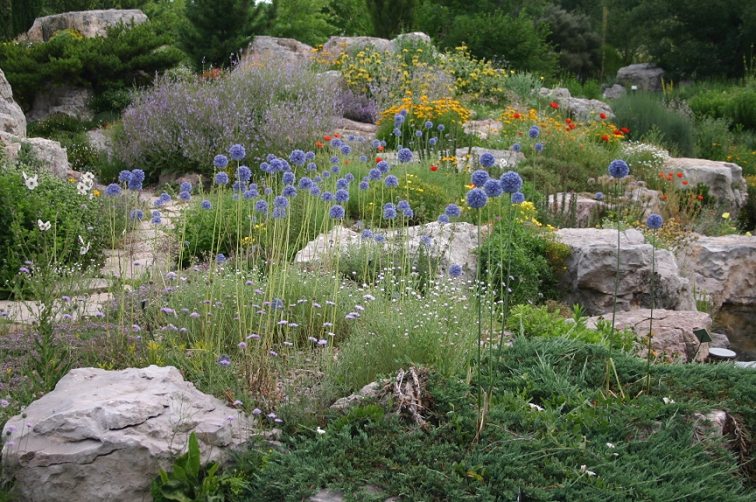
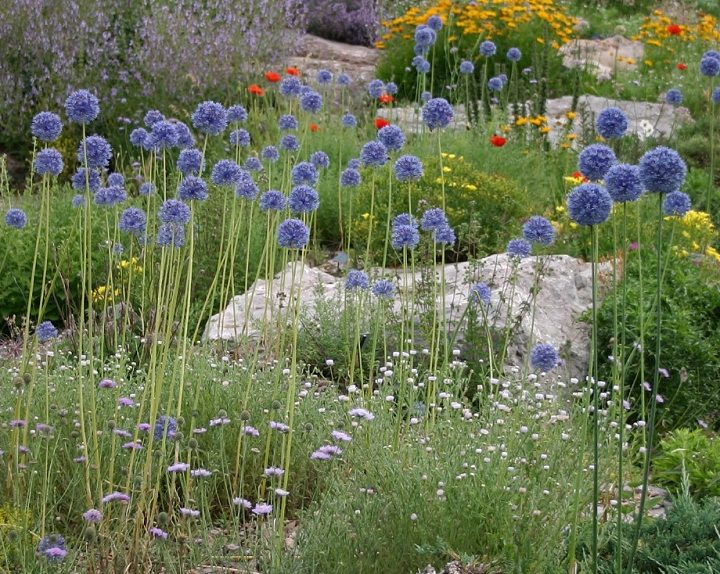
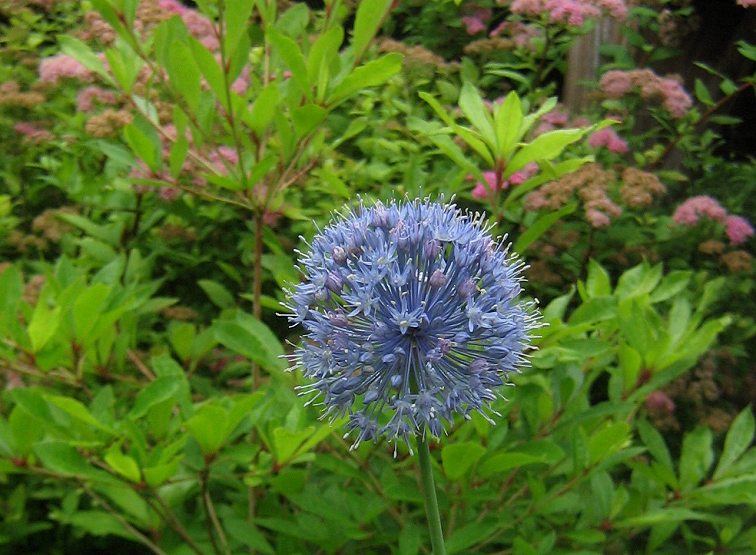
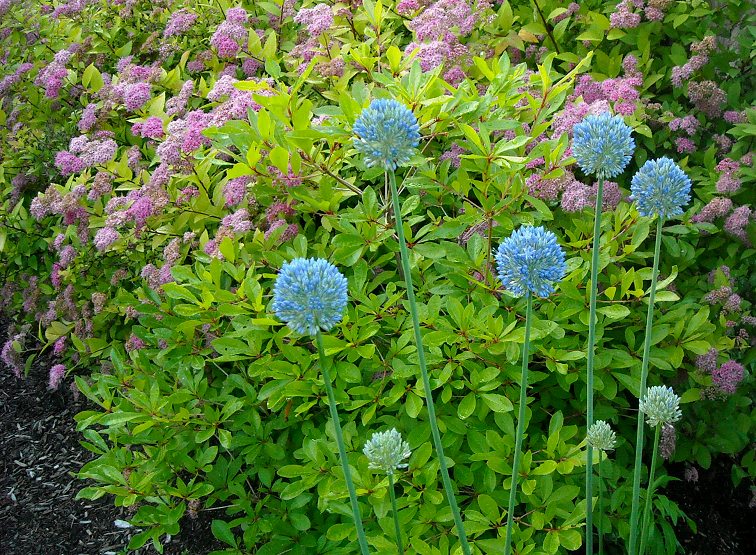
Then one day, Panayoti Kelaidis sent me a photo of this blue allium growing at Denver Botanic Garden (DBG), and I couldn't believe my eyes... a gorgeous form with brilliant azure blue flowers in heads larger than normal, and taller too. Afterwards, he sent me a good crop of bulbs (thanks Panayoti!). Determined to get a good form established, I planted bulbs out in 7-8 spots around the garden, hoping to find just the right spot to the plant's liking. And sure enough, the bulbs only really prospered in one location, the successful one now forming basal offsets and bulblets to try again in other locations. Here are some photos of what I have dubbed the 'DBG Form'.
1. Allium caeruleum in a mixed planting at Denver Botanic Garden, beautiful!
2. close-up of the same planting
3. In my garden, a close-up of a single flower head in 2008, 3" (7.5 cm) in diameter.
4. In my garden, several azure flower heads in 2009, at early anthesis with intense color of young buds.
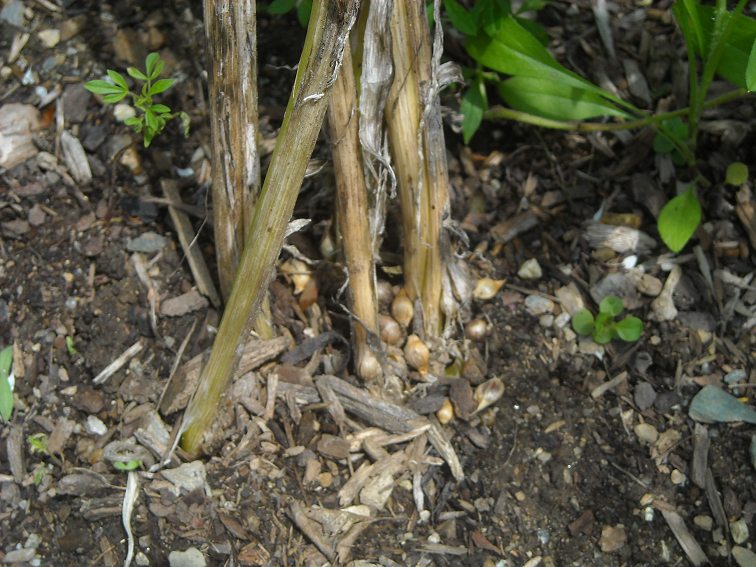
5. In late summer, bulblets can be found at the stem bases bulging friom the basal leaf sheaths, harvest and replant.
6. Spring growth 2010 shows much dividing and increasing, some of the bulblets replanted near mother plant are sprouting.
(Aster pilosus growing nearby, see: http://nargs.org/smf/index.php?topic=159.0 )

Comments
Mark McDonough
Re: Allium 2010
Sun, 10/24/2010 - 12:36pmVery nice Harold, that's one of the finest clumps of white thunbergii I've seen. It also has those older leaves that age an orange color as seen on the purple 'Ozawa' selection. What is the source of your plant, it seems more compact than normal.
Harold Peachey
Re: Allium 2010
Mon, 10/25/2010 - 6:03amMark-bought this plant at a nursery in Ithaca, NY a couple of years ago at an end of season sale along with a few alpines that seemed out of place at this particular nursery, has not made seed in the past, hoping for some this year, but as it is late in the season I am not overly optimistic, but if successful, will send you some.
Mark McDonough
Re: Allium 2010
Tue, 10/26/2010 - 7:31pmA view of my Allium thunbergii 'Ozawa' planting, and a lone never-increasing white form of A. thunbergii, taken today on this unseasonably warm day. The temperature at 74 F, the Allium planting was covered with an impossible number of bees; I tried making a video to show, and to capture the the droning buzz of frenzied bees, on what might be their last stand for the year. Note: photo taken in morning before it warmed up and before the masses of bees arrived.
externmed (not verified)
Re: Allium 2010 Summer Drummer
Wed, 10/27/2010 - 4:57pmAllium 'Summer Drummer'
Guess this new cv may not qualify as rock garden, as it's reported to reach 6 feet. Bought it fall of 2009. Came up spring 2010 and grew about 14 inches and disappeared. Quite surprised to find it now at 16 to 18 inches and growing strong -- with winter lows expected at -5 to 5F.
Clearly this new variety is not suitable in USDA zone 6, but rather should be classsed as a zone 7 or 8 -- to be determined.
Charles Swanson NE Massachusetts USA
Lori S. (not verified)
Re: Allium 2010
Wed, 10/27/2010 - 6:48pmLots of vendors suggest zone 4 as the low end for 'Summer Drummer', and such zone ratings are usually very conservative (giving the general impression that it must be an nonvegetated wasteland north of zone 6 ;) ), rather than the other way around.
Having said that, I'm not familiar with that particular cultivar among the big alliums. Is it a hybrid of some particularly tender species?
Mark McDonough
Re: Allium 2010
Wed, 10/27/2010 - 8:18pmCharles, I read your message a couple times and just didn't notice that you appended to the name of the message subject to indicate the Allium cultivar name of 'Summer Drummer', normally that remains to match the topic. So that it doesn't trick others as it did me, I added the name of the cultivar to the body of your message :)
I can't find out much about this, other than it is Dutch origin and was introduced in 2006. One thing I find very frustrating about the Dutch bulb trade, they'll name plants without any indication of the underlying species, which would be helpful to know how to cultivate the selection. It is unclear whether 'Summer Drummer' is a hybrid, or just a selection of a species. The one thing I do know, the name Summer Drummer is clever and will probably sell lots of bulbs.
My guess is the species represented in 'Summer Drummer', whether a pure species or a part of a hybrid situation, looks like either Allium ampeloprasum, A. porrum (the Leek; A. porrum is only known in cultivation, probably a centuries old derivation from Allium ampeloprasum, often listed as Allium ampeloprasum var. porrum), or less likely A. commutatum (closely related to A. ampeloprasum). Allium ampeloprasum and porrum have stems that can reach 200 cm and 180 cm respectively (6'+ or up to 6' respectively), but the flower heads are listed as 8-9 cm in A. ampeloprasum, to 20 cm in A. porrum, the larger size flower heads of A. porrum more closely matching the stated size of 'Summer Drummer'.
Here's a link to an Italian site that shows Allium porrum:
http://luirig.altervista.org/schedeeu/ae/allium_porrum.htm
Compare the A. porrum photo in the link above, to any of the 3 photo links below, I think we have a match. Notice the cute marketing on the 3rd image link. Also notice the flower head size relative to a person's hand, looks like the heads are smaller than reported, maybe 5" (12.5 cm) across.
http://suttons.hostserver1.co.uk/im/pd/BUALL22613_3.jpg
http://gardenimport.com/spblvl3.php?lvl=Allium&nm=SUMMER_DRUMMER&ref=AL1670
http://img.visionspictures.sodatech.com/VISI/wprev/visi70351.jpg
Aha! Found a picture showing the bud spathe, this is a clincher because the bud spathe on the three species I mention look like little pointed caps, and they slide off sideways as if hinged on the side of the inflorescence. Don't you love a good mystery!
http://www.meeuwissenvoorhout.nl/shop/artikel.asp?aid=205 <---link overwritten and no longer pointing to the right photo :-(
Charles, what is the foliage like, do you have a picture? The web descriptions say the foliage is corn like, which sounds like the broad, clasping leaves of A. ampeloprasum/porrum.
externmed (not verified)
Re: Allium 2010
Thu, 10/28/2010 - 7:17amHi Mark and all,
Sorry about the confusion. Right now A. Summer Drummer looks very much like Hemerocallis; but ascending a bit, like corn. Will try to get a photo next AM. (Will also try to dig before a hard frost)
Charles Swanson Masachusetts
Mark McDonough
Re: Allium 2010
Thu, 10/28/2010 - 7:59amFrom what I read, Allium porrum and A. ampeloprasum should be hardy perennials, and like many perenniating alliums they can have persistent fall/winter foliage. I have no first hand experience with either species, so use your best judgement on how to overwinter... it might be worth leaving one bulb out over winter to see how it fairs. Looking forward to seeing a photo of the growth... thanks Charles.
I did receive bulbils (very small) from a friend of A. ampeloprasum var. babingtonii, which is a bulbilliferous version of ampeloprasum, which I planted out... we'll see what happens.
Mark McDonough
Re: Allium 2010
Wed, 11/17/2010 - 5:43amHey Allium fans, I received an announcement today from Dr. Reinhard Fritsch that "some data and images of definitively determined accessions of our IPK Taxonomic Allium reference collection are now available via IPK Homepage (Institute of Plant Genetics in Gatersleben, Germany). Keep this first link handy, because if you choose to look at any other database link, you can't get back to this home page. :-\
http://www.ipk-gatersleben.de/Internet/Infrastruktur/Datenbanken/Genetis...
I've been checking it out, and there is excellent information and photos available, showing many species that are otherwise difficult or impossible to find photos of. The typus information, indicating where each accession was made, is also most useful. There is much that can be accessed here, although some of the web linking and functionality can be tricky to figure out, but let me highlight the most useful items I've found so far.
Taxonomic Allium Reference Collection - currently 3784 records of Allium accessions, many with photographs. Some steps on how best to use the resource:
a. Go to: http://pgrc-35.ipk-gatersleben.de/pls/htmldb_pgrc/f?p=265:1:267669476324...
b. Click on "Search allium data" at the top of the page, a huge list will appear.
1. Since the list is not sorted alphabetically, use the drop-down list labeled - Select scientific name - (photo 1)
2. I selected Allium akaka, a list of 4 accessions shows. Click on the left-hand document icon to display the first record. (photo 2)
3. The first record is displayed, if there are photos, thumbnail images show in the record. Use the left and right arrows in the record
to cycle through the records, finding photos you want to look at. (photo 3)
4. Cycling through the records, it is interesting to see from the thumbnails the variations in the species. (photo 4)
5. From the drop-down list I moved on to Allium eriocoleum, a beautiful (and rare) yellow-flowered species. (photo 5)
6. Click on a thumbnail for an enlarged view, here showing Allium eriocoleum. (photo 6)
There is also a List of Allium images from the Allium Database (this is separate from the photos available through the Taxonomic Allium Ref Collection)
http://mansfeld.ipk-gatersleben.de/pls/htmldb_pgrc/f?p=185:83:4399216669...
Have fun :D
Mark McDonough
Re: Allium 2010
Wed, 11/17/2010 - 9:12pmHello onion mavens, here is an intriguing little onion photographed by Panayoti Kelaidis on is 2009 expedition to Mongolia, sadly this one was not among the collections made. I'm parsing through the 1995 publication in Feddes Repertorium 106 (1995) 1-2, pp 59-81, The Genus Allium L. in the Flora of Mongolia by Nicolai Friesen, to see if I can match up an ID. Since this short publication is basically an enumeration of species and their distribution, I'll have to resort to species descriptions elsewhere, such as Flora of the USSR, and possibly Flora of China, depending on where in Mongolia the photo was taken. A really cute onion, whatever it is.
Mark McDonough
Re: Allium 2010
Sat, 11/20/2010 - 7:06pmHere are a series of links showing 4 species (all related) that were under consideration for Panayoti's Mongolian Allium ID. At first I thought it was A. mongolicum, but I'm quite certain it is A. vodopjanovae, a species described by Nikolai Friesen in 1995 splitting off this few-flowered form with semi-nutant flowers from A. mongolicum. Do check out the Allium mongolicum links, why isn't this species in cultivation... it is the most common onion found growing over most of Mongolia, and really adorable in every way.
Allium bellulum
http://www.bioaltai-sayan.ru/regnum/pict-p/photo/Allium_bellulum_fot.jpg
http://www.plantarium.ru/page/image/id/69601.html
Allium mongolicum
species desc: http://greif.uni-greifswald.de/floragreif/?flora_search=Taxon&taxon_id=15
photo record: http://greif.uni-greifswald.de/floragreif/?flora_search=Image&record_id=...
large image: http://greif.uni-greifswald.de/floragreif/floragreif-content/Kr03/25-08-...
large image2: http://greif.uni-greifswald.de/floragreif/floragreif-content/Kr03/17-08-...
roots & bulb coats: http://greif.uni-greifswald.de/floragreif/?flora_search=Image&record_id=...
http://www.bioaltai-sayan.ru/regnum/pict-p/photo/Allium_mongolicum_fot.jpg
http://www.bjkp.gov.cn/bjkpzc/tszr/zwdg/lsmy/211454.shtml
Allium vodopjanovae
http://www.bioaltai-sayan.ru/regnum/pict-p/photo/Allium_vodopjanovae_fot...
Allium vodopjanovae - zoomable herbarium specimen identified by N. Friesen 2008
http://greif.uni-greifswald.de/floragreif/wp-content/uploads/scan_B12-09...
Allium tenuissimum
http://houmingfei.blogspot.com/2009/04/5_01.html
Update: I have heard back from Dr. Nicolai Friesen, an expert in the genus Allium in such regions as Siberia and Mongolia, and he confirmed my ID of Panayoti's dwarf pink-flowered Mongolian Allium as A. vodopjanovae.
Mark McDonough
Re: Allium 2010
Mon, 11/22/2010 - 6:57amHere is another allium species photographed in Mongolia by Panayoti Kelaidis in 2009.
This allium is surely A. amblyophyllum (platyspathum ssp. amblyophyllum), a species very close to A. carolinianum (among its synonyms are varieties of A. platyspathum, such as A. platyspathum Schrenk var. falcatum Regel), and also close to A. hymenorrhizum.
Allium carolinianum is not recorded for Mongolia, although A. hymenorrhizum is.
Allium amblyophyllum
http://www.plantarium.ru/page/image/id/27709.html
http://www.plantarium.ru/page/image/id/17930.html
http://www.plantarium.ru/page/image/id/24368.html
...photo showing whole plant, and tapered leaf petioles
http://www.plantarium.ru/page/image/id/3178.html
Update: I have heard back from Dr. Nicolai Friesen, an expert in the genus Allium in such regions as Siberia and Mongolia, and he has identified Panayoti's Mongolian Allium as A. platyspathum.
Trond Hoy
Re: Allium 2010
Mon, 11/22/2010 - 10:19amA cross between chives and leek! I like it.
Mark McDonough
Re: Allium 2010
Tue, 11/30/2010 - 12:14pmI often sow Allium seed in late fall or early winter, but I was surprised to see very quick germination on two species, A. obliquum and A. pseudoflavum. I didn't expect germination this early, nor do I want germination now, as surely many or most of the seedlings will not persist once the real winter temperatures arrive. I don't have a greenhouse nor coldframe, so I'm debating whether to bring these two flats to my basement windowsill for the winter. Thanks to the NARGS & SRGC forumists who shared this seed with me.
Trond Hoy
Re: Allium 2010
Tue, 11/30/2010 - 12:39pmMark, is it not possible to keep the trays outside and cover with dry leaves or another insulation material and a sheet of plastic?
Mark McDonough
Re: Allium 2010
Tue, 11/30/2010 - 12:49pmSure, if I decide to leave them out, I would certainly do something to protect them, but given that they germinated just very recently, the seedlings will not have had time to develop any true bulbs, and seedlings will be subject to out right winter kill. One can sow seed of species like A. flavum and other Codonoprasum section alliums when the seed ripens in July, and they germinate quickly in summer but seedlings will still have at least 3 months to develop and get settled in, then overwinter fine. From previous experience, I find that late-showing seedlings like these have a very low chance of surviving the full brunt of winter, even with some protection. I should've sown the seed later in the season :-\
Richard T. Rodich
Re: Allium 2010
Tue, 11/30/2010 - 4:54pmBummer. I had the same thing happen to me with Allium wallichii last season. But being single, I can use my house (and my refrigerator) any way I like. I grew them inside, along with Corydalis wilsonii and Delosperma bosseranum.
I brought my Ranunculus gramineus seeded pot inside before fall temps arrived for exactly that reason, too. Last season, they germinated in the fall, just as they are supposed to (I discovered), but it was too late to survive the winter, and they didn't make it. This time, I will start wtheir cool down in February.
Mark McDonough
Re: Allium 2010
Thu, 12/02/2010 - 8:31pmSo Rick, did the Ranunculus gramineus fail because you waited too long with the seedlings outdoors, exposed to too much freezing; or because once indoors the warmer temps were not to their liking? Tonight, I brought my flats of seedlings of both Alliums inside, as it is supposed to go down to 20 F tonight. I made room for them on my single basement window (I have two basement windows, but only one of them is "mine" ;)) The problem is, this is a heated space... it's my fully finished basement office that my wife and I share, so the warm temps can be a problem for overwintering plants and seedlings.
Richard T. Rodich
Re: Allium 2010
Thu, 12/02/2010 - 8:55pmI waited to long with the seedlings outdoors...
A thought...if it is amenable with your wife, you could box in the window, taking advantage of the cold that seeps through the window, and making it a "cold greenhouse."
Mark McDonough
Re: Allium 2010
Thu, 12/02/2010 - 9:33pmGood one Rick ;D Not even going to "go there"; some battles are worth fighting for, others aren't.
Mark McDonough
Re: Allium 2010
Fri, 12/17/2010 - 7:43pmUpdate: I have heard back from Dr. Nicolai Friesen, an expert in the genus Allium in such regions as Siberia and Mongolia, and he has identified Panayoti's Mongolian Allium as A. platyspathum... I was close, but very happy to have Dr. Friesen's expert ID.
http://nargs.org/smf/index.php?topic=177.msg5043#msg5043
Dr. Friesen has confirmed as correct my ID of A. vodopjanovae on Panayoti's small pink-flowered Mongolian allium
http://nargs.org/smf/index.php?topic=177.msg4963#msg4963
externmed (not verified)
Summer Drummer
Thu, 05/05/2011 - 12:19pmAllium Summer Drummer
Made it through the Z6a winter at 14 inches high, with 20% die-back on some leaves. Deep fairly constant snow this winter. (had been dormant going into its first winter)
Now continuing to ascend it's leafy stalk.
Will photograph when it has finished growing.
Charles Swanson
Z6a Massachusetts USA
Mark McDonough
Re: Allium 2010 - Summer Drummer
Sun, 05/08/2011 - 2:56pmThanks for the update Charles, can't wait to see what this thing looks like. We can finish out this 'Summer Drummer' mystery here in the Allium 2010 topic, and new Allium additions should go into the Allium 2011 topic. :D
externmed (not verified)
Re: Allium 2010
Sun, 07/31/2011 - 7:49pmAllium "Summer Drummer" was a total waste. Made it to 5.5 ft, looking like a pathetic corn plant, flower cluster smaller and less attractive than the readily available globe hybrids-but flowering in July. Might have some limited value in some climates for cut flowers. Mine is going to compost pile.
Mark McDonough
Re: Allium 2010
Sun, 07/31/2011 - 8:53pmThanks for the feedback Charles. The hybridizer/namer for a number of Alliums (including Summer Drummer) grown in the Netherlands has posted on SRGC about this Allium... it is basically a selected form of Allium ampeloprasum.
Links pertinent to Allium 'Summer Drummer'
http://www.srgc.org.uk/smf/index.php?topic=6685.msg203513#msg203513
http://www.srgc.org.uk/smf/index.php?topic=6685.msg204932#msg204932
http://www.srgc.org.uk/smf/index.php?topic=6685.msg204985#msg204985
...Allium 'Summer Drummer' is a selected seedling of allium ampeloprasum:
http://www.srgc.org.uk/smf/index.php?topic=6685.msg204999#msg204999
Allium 'Summer Drummer' in late July:
http://www.srgc.org.uk/smf/index.php?topic=6685.msg209426#msg209426
Anne Spiegel
Re: Allium 2010
Mon, 08/01/2011 - 5:59amMark, I've been drooling over the alliums in part 2 of your article in the Quarterly. Naturally, they're the ones not so readily available, right?
Mark McDonough
Re: Allium Question
Mon, 08/01/2011 - 3:16pmLis, that is Allium carinatum ssp. pulchellum. In your last photo, I see the white ones, a lavender color one just peeking from behind a white one, and a darker purplish one... one of my favorite alliums, a good doer, loves the sun and doesn't mind heat and a degree of drought. An excellent species for the mid summer garden. As alliums go, for me it doesn't seed around so easily as A. flavum, to which it is related and has the same general look except for flower color and somewhat earlier bloom in July.
Mark McDonough
Re: Allium 2010
Mon, 08/01/2011 - 3:18pmThanks Anne. Yes indeed, the whole point of part 2 was to feature some of those rare types that we can dream about, in compliment to Part 1 that covered more accessible species.
Pages