
While it is also the earliest spring ever here for crocus to start blooming, it is nowhere near as advanced as the much more southerly and/or warmer areas we've been seeing here... but things are progressing!
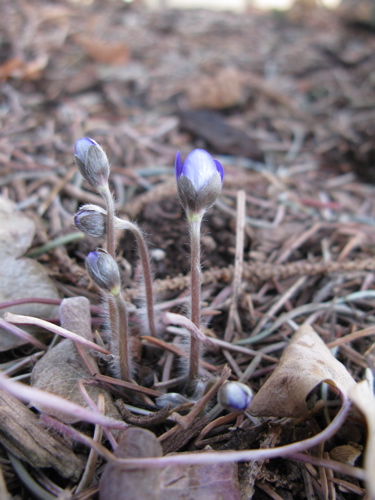
1) There will be flowers open today on the most precocious of various self-seeded Hepatica nobilis; the leaves on hepatica take quite a beating over the winter here, so it seems it is only much warmer areas that can produce those photos showing spectacular flowers and beautiful leaves at the same time!
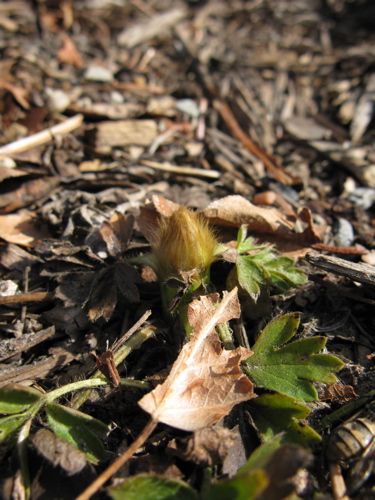
2) Pulsatilla vernalis
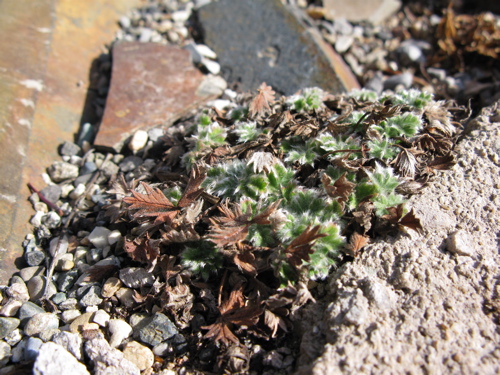
3) Potentilla nivea
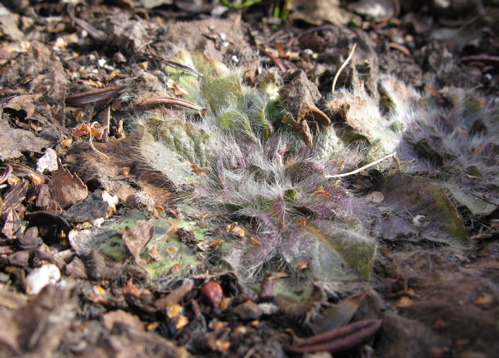
4) Potentilla porphyrantha
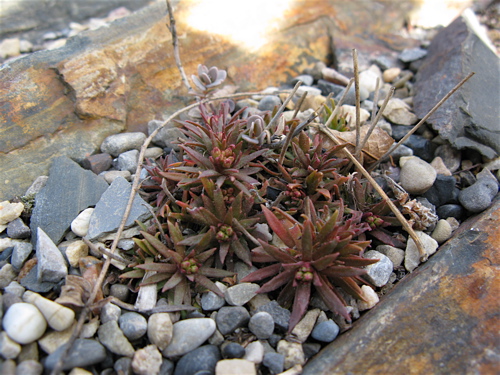
5) Calyptridium umbellatum (evergreen)
6) Inula rhizocephalum
7)Caltha leptosepala
8 ) Flower buds on Androsace carnea alba; Aethionema saxatile in the background; both are evergreen
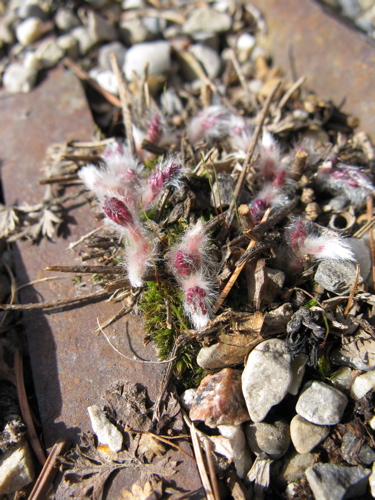
9) Furry little nubbins on Pulsatilla campanella
10) Gentiana verna is evergreen




Comments
Trond Hoy
Re: Signs of life
Sat, 03/27/2010 - 2:55pmLori, where I am heading now the Pulsatilla vernalis is still covered by feet of snow! It is a common plant some places in the interior of Norway. Hepatica nobilis is also common but along the coast. The latter is difficult to grow well in my garden, some beetles devour the leaves in summer . The leaves are however never damaged in winter.
Lori S. (not verified)
Re: Signs of life
Sat, 03/27/2010 - 4:05pmNow open, it's modest but it is the first! This seedling Hepatica nobilis shows the sort of ratty old leaves that are typical here... the new leaves get to be in good form pretty well after the bloom is done. I love the colour of these (not quite captured by my camera) - the standard, rich royal purple on an ordinary flower form suits me much better than any of the exorbitantly expensive hybrids!
Mark McDonough
Re: Signs of life
Sat, 03/27/2010 - 5:44pmLori, seems like spring is springing into action for you. Love the golden-haired bud on Pulsatilla vernalis. What is Potentilla porphyrantha like... where is it from? An old friend, Calyptridium umbellatum... I used to grow these by the dozens, they can be quite variable, fun little urchins to grow.
After unseasonably mild weather early on, last night went down to 18 degrees F (-9 C), slowing things down a bit :(
Lori S. (not verified)
Re: Signs of life
Sat, 03/27/2010 - 7:18pmYes, spring is slow in coming here, but a very exciting time!
I'm not personally familiar with Calyptridium - it doesn't occur this far north. I grew some from seed last year, planted them in various places and am hoping I get to see blooms this year!
Potentilla porphyrantha is one of the pink-flowered potentillas, this one from the Caucasus. In The Caucasus and It's Flowers, Holubec and Krivka describe it as endemic to Armenia and Nakhichevan (http://en.wikipedia.org/wiki/Nakhchivan). There are a couple of nice pictures in the book, of course. I bought the plant from Beaver Creek (http://www.rockgardenplants.com/plantcatmain.htm) a couple of years ago.
Here's a close-up of the flowers, from last year:
Mark McDonough
Re: Signs of life
Sat, 03/27/2010 - 7:26pmOoohhh, one of those pink-flowered Potentilla beauties... nice! The Calyptridium is a "hoot", a funny little prostrate plant... the succulent foliage is most variable, often wrinkled and delightfully dimpled, and tinged with color, and the fluffy "catkin-like" flowers on prostrate stem "spokes" are quite amusing and attractive. It is not long lived, but so easy to raise from seed. Great for troughs.
Trond Hoy
Re: Signs of life
Sun, 03/28/2010 - 9:00amHope you continue posting picture of spring flowers! Where I am now all is covered by 3' of snow. We are going to stay here for a week (must be crazy seeking out the snow when the spring is unfolding at home and a lot of tidying up need to be done back home!).
Todd Boland
Re: Signs of life
Fri, 04/02/2010 - 12:35pmI posted my Crocus and Scilla in their respective threads but here is my Galanthus nivalis 'Flore Pleno' and regular form.
Todd Boland
Re: Signs of life
Fri, 04/02/2010 - 12:37pmAnd here is my Eranthis hyemalis...no Hepatica or Pulsatilla yet so Lori you are well ahead of me!
Mark McDonough
Re: Signs of life
Fri, 04/02/2010 - 6:55pmSeems like spring has finally arrived for you. When I posted a photo of what was eventually identified as Galanthus nivalis 'Flore Pleno' on the Scottish Rock Garden Club forum, in a thread about snowdrop identification, I was told by a galanthophile supplying the ID that it was an ugly plant and he wouldn't have such a thing :o >:( :o,
I think it is pretty nonetheless, in spite of disparaging comments, my clump is not nearly as large as yours.
Mark McDonough
Re: Signs of life
Fri, 04/02/2010 - 7:11pmAfter 5 days of rain and cloudiness, the sun shone today and it became very warm; everything is ready to grow:
1. Epimedium x versicolor 'Versicolor' - fuzzy shoots emerge
2. Epimdeium grandiflorum 'Red Queen' - red shoots emerging
3. Aster sericeus - fuzzy rosettes emerging, a dryland Aster... thanks Panayoti!
4. Allium crenulatum 'Olympic Sunset' - shoots emerging
5. Trillium decumbens
6. Jeffersonia dubia & Primula kisoana - emerging shoots
7. Pulmonaria - named forms don't last, self-sown seedlings from them do.
8. Corydalis nobilis - a powerful species with beautiful foliage.
9. Corydalis solida - colorful seedlings, lots of good reds... joyful ephemeral weeds
Trond Hoy
Re: Signs of life
Fri, 04/02/2010 - 11:36pmI have a clump of G. 'Flore Pleno' myself but I have to admit that I like the ordinary form better! I have 8-10 different selections of Galanthus I think. I am very excited by the thought of how far the spring has come when I finally arrive home (only one week away but still...). That's the worst - and best - by travelling!
Pulmonaria and Corydalis I have in swarms. They self-sow but not true to type! Corydalis nobilis is short lived here but I know it is very popular and easy in the northern part of Norway.
I try to gather a population of Jeffersonia in my woodland but have had limited success, not that easy from seed?
And Eranthis! Have tried many times but something nasty eat all the plants and the seedlings every time!
Lori S. (not verified)
Re: Signs of life
Sat, 04/03/2010 - 12:02amMore signs of life...
1) Adonis amurensis 'Fukujukai'
2) Balsamorhiza hookeri var. lagocephala
3) Besseya alpina from seed last year, emerging.
4) Corydalis nobilis, going into action here too.
5) Corydalis magadanica, still tiny, from a planting in 2008.
6) Pulmonaria altaica
7) Dracocephalum palmatum - actually, this one is evergreen, and always winters over very well. Perhaps it will finally bloom this year! (I grew some of these from seed a few years ago.)
Todd Boland
Re: Signs of life
Sat, 04/03/2010 - 2:18pmMy signs of life: Pulmonaria angustifolia, Pulmonaria montana, Saxifraga 'Marianne', Viburnum X bodnantense
Todd Boland
Re: Signs of life
Sat, 04/03/2010 - 2:20pmOmphaloides verna and Corydalis solida
Richard T. Rodich
Re: Signs of life
Sat, 04/03/2010 - 7:41pmI have to agree, the double forms of galanthus are a little weird, but this clone is a most reliable bloomer.
Lori S. (not verified)
Re: Signs of life
Sun, 04/04/2010 - 11:13amWow, you are way ahead of us now, Todd!
Mark McDonough
Re: Signs of life
Sun, 04/04/2010 - 6:40pmI love this thread! There is nothing as tantalizing as the shape, color and form of new shoots emerging. Lori, tell me more about Pulmonaria altaica. Last year, at a late summer NARGS plant sale I bought 6 plants of Corydalis magadanica, which flowered even as young plants with yellow and brown marked flowers, none are up and all look dead >:(
A few items that caught my attention today:
1. Dicentra cucullaria surging out of the ground, have these beauties everywhere.
2. Paeonia wittmanniana leaf buds - taken in low late afternoon light. Love the look of these muscular buds.
3. Paeonia wittmanniana leaf buds - taken in brigh morning light, red and lively.
4. A very tiny Viola species with pointed (not rounded) variegated leaves.. V. selkirkii?
Trond Hoy
Re: Signs of life
Sun, 04/04/2010 - 11:39pmThings don't evolve fast here even without freezing temperatures. Been away for a week and the snowdrops and many crocuses are finito but new plants slowly emerge. It is still early morning and I have not taken many pictures yet! Here are two:
I like cardamines and one of the first to bloom is C. enneaphylla.
The other is my only palm, still alive seemingly after a harsh winter.
Lori S. (not verified)
Re: Signs of life
Mon, 04/05/2010 - 9:12amMark, Pulmonaria altaica is an introduction from Siberia by Josef Halda, according to Wrightman's, source of my plant in 2008:
http://www.wrightmanalpines.com/details.asp?PRODUCT_ID=P077
It is quite lovely - the leaves are finely felted and soft as a black lab's ears, and the flowers are quite large:
Trond Hoy
Re: Signs of life
Mon, 04/05/2010 - 10:25amI have several pulmonarias but not altaica. Nice color.
Here are some more plants from the deep woods.
Lori S. (not verified)
Re: Signs of life
Mon, 04/05/2010 - 1:07pmYou will make many of us jealous with that meconopsis, Trond!
1)
Helleborus cyclophyllusAcck! It's actually Cardamine enneaphylla... which will likely get snowed on again before winter is over - won't look so perky then.2) Polemonium confertum, spreading around a bit in the trough
3) Salvia pachyphylla, from seed last year, seems to have come through the winter, though it is in a very exposed spot.
4) Aquilegia laramiensis... very long-lived, and apparently, not inclined to promiscuous hybridizing, unlike its fellow species.
5) Erythronium dens-canis
6) Phlox multiflora, coming back to life
7) Draba acaulis, with buds forming - oops, guess I forgot the picture!
8, 9) Leptodactylon pungens ssp. pulchrifolium, gnarly but alive!
Todd Boland
Re: Signs of life
Mon, 04/05/2010 - 4:33pmI don't know Lori...I still think you are ahead of me! Here is Helleborus orientalis hybrid and niger
Todd Boland
Re: Signs of life
Mon, 04/05/2010 - 4:35pmPrimula marginata, Draba polytricha and Salix cordata
Richard T. Rodich
Re: Signs of life
Mon, 04/05/2010 - 11:43pmThe maiden bloom of Helleborus purpurescens in the oh so dry garden today. I hadn't expected the flowers to be very spectacular. It's the foliage that is cool.
Trond Hoy
Re: Signs of life
Tue, 04/06/2010 - 1:50amYes, Rick, I have come to appreciate the leaves of the different plants more and more and take the flowers as an extra bonus of course.
To Lori: You all have plants that make me jealous! Often I see (pictures of) plants I know I can't grow well and that makes me, well, jealous! But then I think if everybody grew all kind of plants to perfection, where were the excitement? Often I try plants that by the books doesn't grow here, and that is right, but then some do grow well and I am happy!
Todd Boland
Re: Signs of life
Tue, 04/06/2010 - 4:25pmCentaurea epirota, another Helleborus orientalis and Erica carnea 'Heathwood'
Mark McDonough
Re: Signs of life
Tue, 04/06/2010 - 5:03pmI agree that this is a lovely species, one I've not heard of before... looks almost Mertensia-like in habit. Lori, could you add this species with pics to the Pulmonaria thread I started, it would be useful to help complete the Pulmonaria picture by adding the info there. Thanks.
PS. I'm wondering the if the finely felted leaves are as soft as a golden lab's ears? ;D
Todd, similarly, if you have any more photos of Pulmonaria montana, maybe add them to the Pulmonaria thread... looks like that species is another reddish-flowered one like P. rubra? I'm not familiar with P. montana either.
Mark McDonough
Re: Signs of life
Tue, 04/06/2010 - 6:35pmTodd, how large does Salix cordata grow? I like the large catkins. Also cool is the foliage on Centaurea empirota... can I assume it is Turkish? The Erica carnea 'Heathwood' is a stunner, flowers contrast nicely with black-green foliage.... adding to my list :)
Lori, a bought about 6 plants of Corydalis magadanica at a NARGS chapter plant sale last September (for about 25 cents each), although small they flowered with yellow brown-marked flowers after being planted out. None has resurfaced this spring! I do like the leaves of Polemonium confertum; in the just-emerging stage they look like baby fern fronds... must try some of these again. I have also always wanted to grow Leptodactylon species, including pungens... maybe I should give it a try if it is hardy for you.
Trond, you can grow Meconopsis? It is much too dry and hot here in summer. Can you grow a number of species, or just the ones with spines like M. horridula, where the slugs get impaled trying to eat the plant ;D I like the look of Cardamine enneaphylla, with fleshy rubber-like leaves when they first emerge... if they make any seed, please spare me a bit (and I'll save some Jeffersonia dubia for you) :)
Trond Hoy
Re: Signs of life
Wed, 04/07/2010 - 12:48pmI can grow several Meconopsis. The molluscs seem not to like them. I have had many, but often they are monocarpic In fact one of the pest species I have is M. cambrica. I am not sure how many I have this year, have to see what comes up. Except M. cambrica they seldom self seed.
That's a deal!
I have other Cardamines too: pentaphyllos, heptaphylla, trifoliata, bulbifera etc. C. pratensis is very common in the wet fields around here.
Lori S. (not verified)
Re: Signs of life
Wed, 04/07/2010 - 12:59pmNice cardamines... I only have a couple, C. trifoliata and ?? (have to refer to records)
Yes, Meconopsis cambrica is one that would probably allow most of us to make the claim that we "successfully grow meconopsis". ;D ;D It self-seeds but is not pestilent in my dry conditions.
Mark McDonough
Re: Signs of life
Wed, 04/07/2010 - 6:15pmNot mentioned in your list, but shown as one of your photos is C. waldsteinii... that one looks awesome... such large flowers. Yes please to seed on that one, if you get seed... and the only other one I grow currently is pentaphylla, but I'm always looking to increase my Cardamine representation. :D
Regards,
Mark
Trond Hoy
Re: Signs of life
Thu, 04/08/2010 - 12:08amwaldsteinii is the etc part of the list!
I shall collect all the seeds I can! Heptaphylla is almost as nice as waldsteinii.
Trond
Todd Boland
Re: Signs of life
Thu, 04/08/2010 - 7:45amMy mistake Mark....P. montana is the old name for P. rubra...time I got up to speed with the new (or not so new) names.
Trond I'm jealous of your Cardamine...I've never had any luck with the couple I tried (probably too much overcrowding) and access to them is difficult in Canada. Save some seed for me too! I'd like to give them a try again.
The worse plant in my garden is probably M. cambrica...hard to get rid of the little blighters. If the plant didn't have such a long blooming season I'd irradicate it altogether.
Richard T. Rodich
Re: Signs of life
Thu, 04/08/2010 - 10:12amIn our Big Woods ecosystem, the wild garlic (Allium tricoccum) and Dicentra cucullaria have been up for a while now.
Richard T. Rodich
Re: Signs of life
Thu, 04/08/2010 - 10:27amCardamine laciniata just beginning.
Trond Hoy
Re: Signs of life
Fri, 04/09/2010 - 4:10amLori,
Pulmonaria altaica is a species I not have seen before. Looks great with huge blue flowers! I have not tried Helleborus cyclophyllus assuming it wouldn't tolerate wet winters. And this Leptodactylon of yours looks spiny! Haven't seen that either.
Rick,
I have seen Cardamine laciniata pictured but not live, looks nice.
Richard T. Rodich
Re: Signs of life
Fri, 04/09/2010 - 7:26amApparently, Cardamine laciniata is quite variable. The pic I took is of our wild phenotype in the Minneapolis, Minnesota area. It blooms very sparsely and the flowers don't open very wide at all. Like all (or most?) variations of this species, flowers open only when it is warm and sunny.
I have seen photos of much better forms from other parts of the country. So if you look for plants or seed, I would try to stay away from a Minnesota source.
Mark McDonough
Re: Signs of life
Fri, 04/09/2010 - 9:07pmSome more signs of life 2010:
1. Allium altyncolicum - allied to chives (A. scheoneoprasum) but with spikey erect blue leaves. Love it!
2. Allium hymenorrhizum - robust form, beautiful Christmas red stem bases with falcate green leaves. To 30" tall.
3. Clematis fremontii - a weird relic, reliable but impossibly slow growing. Fuzzy urn flower(s).
4. Anemomopsis macrophylla - just sprouted today, in one day, a remarkably beautiful plant in flower.
5. Aster (now Ionactis) linariifolius - tiny dense shoots; ouch, watch out for the tough old stems. Rock garden gem. Variable.
6. Paeonia wittmanniana - shoots, a muscular species with single cream-yellow flowers, a large beauty.
7. Paeonia 'Buckeye Belle' - wow, can you say RED... red shoots but the amazing flowers are glossy deep blood red.
8. Saxifraga fortunei - pink form, flowers in October with beautiful delicate pale pink flowers, a woodland gem.
9. Thalictrum minus 'Adiantifolium' - a treasured plant here, filiform masses of tiny yellowish flowers.
10. Saruma henryi - an anagram of the related Asarum, furry foliage and showy yellow flowers, love this plant!
Mark McDonough
Re: Signs of life
Fri, 04/09/2010 - 9:10pmSome more signs of life 2010 continued - those with asparagus shoots ;-)
11. Amsonia rigida - one of the most consise Amsonia species from southeastern USA, a great perennial.
12. Baptisia sphaerocarpa - bold spires of yellow against blue-green foliage.
13. Cynanchum ascyrifolium - my absolute favotite asclepid perennial, long season of white flowers, concise.
14. Kirengoshoma palmatum - wonderful late summer show of large yellow bells, great foliage too... needs WATER!
15. Uvularia_grandiflora - an essential woodland garden plant, fab foliage, erect then drooping habit, large yellow flowers.
Trond Hoy
Re: Signs of life
Fri, 04/09/2010 - 11:37pmAccording to the TV-news here New York has beaten all time high for April temperature? Is this true for your place too, Mark? No wonder why your plants grow fast. Here we will have sun the coming week but the air is a little colder (from the Arctic) so we probably get frosty nights. I'll take some pictures later today.
Mark McDonough
Re: Signs of life
Sat, 04/10/2010 - 5:15amWell, we always get a few of what I call "stupid days" in early spring, where suddenly it gets hot as if the middle of the summer, but it only lasts a couple days at most, then back to more normal temperature. But yes, last week we matched the record for the hottest day in April on that particular day, 86 F (30 C). But this spring it has been mild overall, some record breaking rainstorms of several days each that caused lots of flooding, but the deep rains, followed by periods of mild sunny days and no frosty nights, caused a compressed spring explosion of growth, 2-3 weeks earlier than normal, and many things blooming at the same time that don't normally bloom at the same time. As long as we don't get whacked with a freezing cold snap, I'm not complaining. :)
We even have Magnolias and Bradford Pear trees in bloom, unheard of! Here's my seed-grown M. stellata - pink form.
Mark McDonough
Re: Signs of life
Sat, 04/10/2010 - 5:38amRick, do you ever see any pink Dicentra out in the Big Woods? Regarding Allium tricoccum, it is a species that interests me... so common, yet actually scarce horticulturally. I notice your Big Woods plants have red leaf petioles. Do you grow it in the garden... ever eaten the leaves, they're supposed to be good.
In 1979 a minor variant of A. tricoccum was separated out as it's own species, A. burdickii ::), which was rather silly I think. The USDA still maintains it as a species, but checking the online Flora of North America at http://www.efloras.org/florataxon.aspx?flora_id=1&taxon_id=242101410 shows that at best, it is merely a variety of tricoccum. However, even with that, if you look at what separates the so-called variety burdickii, there is much overlap with var. tricoccum, and in the end of their treatment, it says "with its overlapping characteristics and distribution, Allium tricoccum var. burdickii is doubtfully separate from var. tricoccum".
Trond Hoy
Re: Signs of life
Sat, 04/10/2010 - 12:33pmWhat a splendid Magnolia stallata Mark! I have a white one myself (and not flowering yet - waiting for warmer weather).
Here are some plants, pictures taken today.
1) Gagea lutea is a wild spring flowering plant in Norway.
2) I have lots of hellebores, all from seed. This is H. orientalis.
3) The common wild Hepatica nobilis (blåveis) is certainly the spring flower here, but common only in south and east. of Norway.
4) Hepatica transsylvanica is better than nobilis here on the west coast.
5) I have lots of Paeonia too, from seed.
PS. 3) The front leaves are ivy, the upper right is Hepatica leaf.
Lori S. (not verified)
Re: Signs of life
Sat, 04/10/2010 - 1:36pmSome things are looking a little depressed here, after about 1" of wet snow on Thursday afternoon/evening and -10 deg C overnight... supposed to be snow flurries Sunday through Wednesday. Oh well, it's still been an early spring.
1) Burly shoots of Allium obliquum. There are lots of little two-pronged seedlings around it, too.
2, 3) First butterfly I've seen this year - Milbert's Tortoise Shell.
4) Lathyrus vernus gracilis
5) Helianthemum oelandicum ssp. alpestre is evergreen, but the stems and leaves redden rather nicely in spring.
6) The current state of Corydalis solida (actually this photo was pre-snow; a little droopy now).
7) Paeonia anomala
Trond Hoy
Re: Signs of life
Sat, 04/10/2010 - 3:04pmSnow is not the worst, I would be very anxious if the thermometer dropped that much, fortunately it is very uncommon here (-1 oC last night).
Lori S. (not verified)
Re: Signs of life
Sat, 04/10/2010 - 6:15pmWell, it happens every year for at least a week in April... things are so less advanced here than where you are, that it really usually has little effect.
Mark McDonough
Re: Signs of life
Sat, 04/10/2010 - 7:11pmLori - tell me about Lathyrus vernus gracilis, I don't know the "gracilis" subspecies or variety; are the leaves extra narrow? What color are the flowers. On your Allium obliquum, that looks like an amazing robust form, beautiful shoots... do you have a pic when in flower. Please remember me for seed on this one, I used to grow it but no longer have it.
Trond - Your Hepatica nobilis is a nice clear blue; I need more forms of Hepatica, and blue ones too, all I currently grow is a pink-flowered form of acutiloba, which I moved to a moister spot and it is flowering and growing better than under drier conditions. And both you and Lori showed Paeonia shoots... aren't they amazing! :D
Lori S. (not verified)
Re: Signs of life
Sat, 04/10/2010 - 7:33pm1, 2) Yes, Lathyrus vernus 'Gracilis' does have very narrow leaves.
3, 4) Here, too, is my Allium obliquum ... no problem saving seeds for you, if you want some. It is very tall - about 3' or more.
Mark, your Baptisia sphaerocarpa and Cynanchum ascyrifolium look and sound very interesting, and completely unfamiliar to me. Can you show us more pix of them?
Richard T. Rodich
Re: Signs of life
Sat, 04/10/2010 - 7:46pmMark, native flora books say there are pink forms of D. cucullaria in MN/WI (not rare, but I don't know how common), but I have never seen any myself.
Not that I have seen a lot of Allium tricoccum, but I do know them from an area a mile from me and a couple areas 100 miles to the south. All have the red leaf stems. I've never tasted the leaves. Never thought about it, actually. I only discovered the ones right under my nose a couple years ago, and my aim is to gather some fresh seed to propagate. They are not that common in this area for me to feel okay about digging bulbs, and although they proliferate to the south, my moral judgment precludes me there also.
Last summer when I checked on the flowering of the ones close to me, they were attacked by some insect producing a mealy bug effect. I didn't have time to closely inspect them then, and never returned to follow up. Could it be woolly aphids? They are known here, and I get them on my Alnus glutinosa and Alnus x spaethii.
A search this past week revealed a second small colony and few more scattered individuals near me. Maybe I'll have better luck collecting seed this year.
The supposed differences between var. tricoccum and var. burdickii certainly seem trivial for a varietal designation. It would seem the rank of forma is more appropriate (he says, posing as a taxonomist wannabe.)
Lori S. (not verified)
Re: Signs of life
Sun, 04/11/2010 - 12:11pm1) Anemone ranunculoides
2) Aconitum anthoroideum, a new one, planted in 2009.
Pages