
... for kicking off this discussion, anyway. Due to its circumpolar distribution, Silene acaulis is one that I'm sure will be familar to forumists worldwide. It seems to me to be omnipresent in the alpine zone in this area, challenged in abundance perhaps only by Dryas octopetala... ? (NB. These are only my biased observations from limited exposure to the area. Please feel free to question, challenge, or vehemently deny! :))
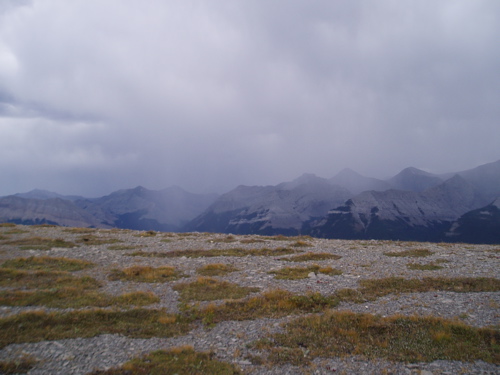
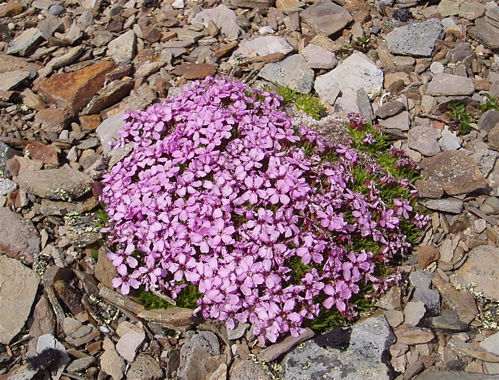
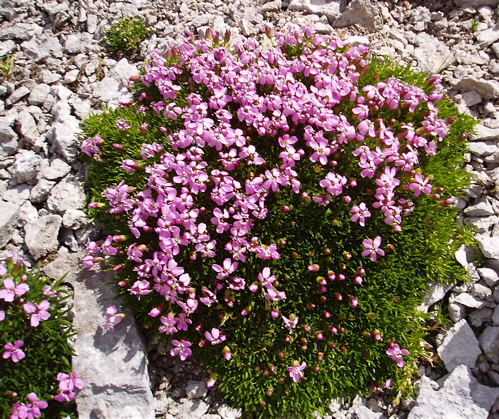
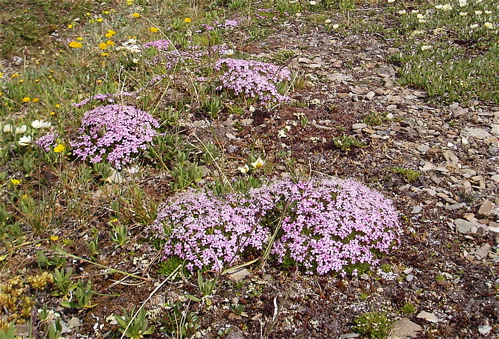
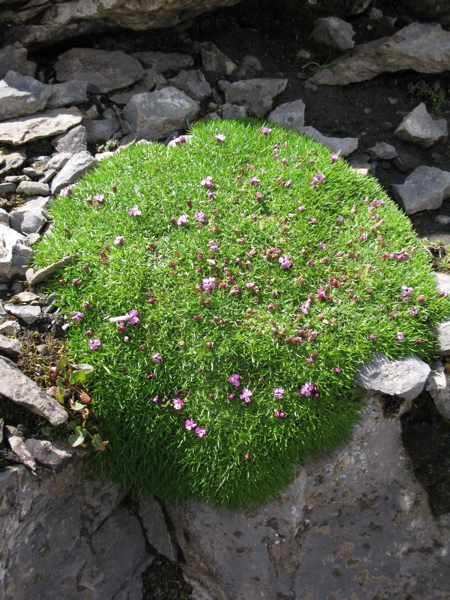
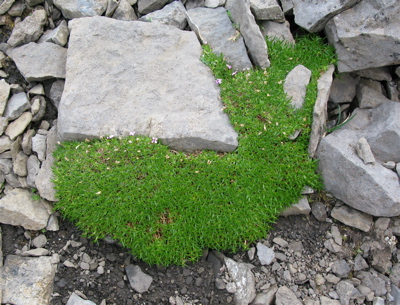
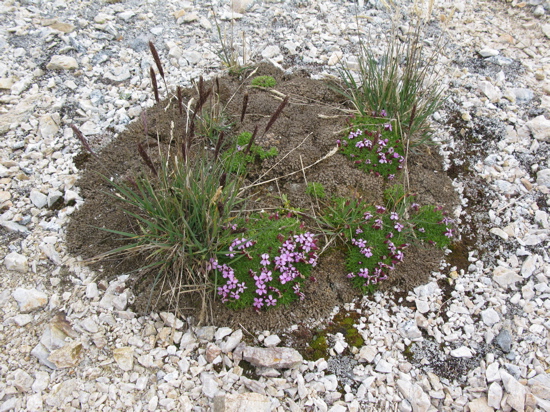
It occurs in a variety of settings, seemingly tolerant of the range of moisture conditions, from high snowfall areas to dry, windy ridges (#1-4).
Such a common plant and yet so beautiful... could one wish for greater flower density? (#5-7)
The flexibility of S. acaulis in seeming to bend over and down and around the angular edges of rocks, makes it sort of the Gumby of local flora. (Ouch, I think I tore something in that painful stretch for a metaphor! ;D) (#8, 9)
And, if it was possible to have a favourite from the thousands of individuals, this would be it (#10). This mat of S. acaulis has had an interesting history in its elegantly-barren, high alpine location... "an island in a sea of scree". (Thanks, Maggi - that expresses it wonderfully!) I'm tempted to try to find it again next summer, just to see how it's doing.
Comments
Lori S. (not verified)
Re: The perfect silene?
Sun, 02/21/2010 - 10:20amAnd.... it is possible to grow reasonably easily (at least in this dry, cold, relatively high elevation area). This plant is in a trough, and after a couple of years, is starting to pay its rent with some bloom.
And a parting close-up of an intensely-coloured wild plant...
Richard T. Rodich
Re: The perfect silene?
Sun, 02/21/2010 - 7:06pmSilene acaulis seemed to be very precocious from seed for me.
Richard T. Rodich
Re: The perfect silene?
Sun, 02/21/2010 - 7:10pmAnd watch what you say about Gumbies . . . .
Lori S. (not verified)
Re: The perfect silene?
Sun, 02/21/2010 - 7:26pmIndeed! A terrific flower-to-plant ratio at this stage, too, hey?
Wow - I had no idea you held the National Collection! :o ;D
Todd Boland
Re: The perfect silene?
Mon, 02/22/2010 - 7:04amPanayoti is the Gumbie king! :o
Silene acaulis does pretty good for us in Newfoundland as well..in cultivation they certainly grow faster than in the wild.
I got the alba form from Maria Galetti.....not sure her source on this one....she may have found it in Newfoundland as she has done a lot of collecting here.
Cliff Booker
Re: The perfect silene?
Mon, 02/22/2010 - 10:48amThis beautiful Silene acaulis was growing within fifty feet of a cable car station in the Dolomites and was (amazingly) totally ignored by the vast proportion of those passing by.
Richard T. Rodich
Re: The perfect silene?
Mon, 02/22/2010 - 5:28pmOh my, is this a closet gene attached to the "I love plants" gene that we all have here? Are there any other bendy fetishers out there?
Okay Panayoti, show us your stuff.
----------------------------
Todd, do you find the alba form flowers more or less than the type?
Lori S. (not verified)
Re: The perfect silene?
Mon, 02/22/2010 - 7:46pmBeautiful, Cliff! It's always a surprise what people notice... or, more often, don't. When people start birdwatching, for example, they are always absolutely astounded to see brilliantly-coloured birds (e.g. yellow warblers, goldfinches, orioles, etc.)... yet they don't realize that the birds were always there, they just didn't notice them before! Hmmm, I'm sure there's a very relevant analogy in there somewhere... ;D
The photos I posted show some colour variations, but I have yet to see a white one here... will be on the lookout, though.
ClifflineGardens (not verified)
Re: The perfect silene? Silene acaulis
Fri, 01/25/2013 - 10:52amFor those of you that have grown Silene acaulis, does it brown out in the Winter?
Lori S. (not verified)
Re: The perfect silene? Silene acaulis
Fri, 01/25/2013 - 7:41pmOddly enough, I don't have any photos I could refer to in answering your question (probably because my little plants have not been exciting enough to take lots of pictures of!) I just went out in the dark with a flashlight to look but they are snow covered... will excavate them and take a look tomorrow though, unless someone else answers first. I'm tempted to guess it would be evergreen but then I think of other deciduous mat-forming Silene.... hmmm...??
Trond Hoy
Re: The perfect silene? Silene acaulis
Fri, 01/25/2013 - 11:42pmI have not grown Silene aculis but it is fairly common in the mountains here and I have often seen it just when the snow melts. It is not green but not brown either, more gray-yellow and the new growth is green between the old yellow leaves.
Strange- I have no pictures of it without flowers either!?
Midsummer:
Lori S. (not verified)
Re: The perfect silene? Silene acaulis
Sat, 01/26/2013 - 1:25pmWell, looks like checking on my Silene acaulis will have to wait until a natural thaw... the trough out front has a layer of very crusty, icy snow on it (a blowtorch would be a better choice of tool than the scoop I used!) and the tufa bed out back would take a lot of excavation; a few random holes in the snow didn't do it. I'll try to remember to look when the snow melts off... I assume it will be as Trond says though.
Richard T. Rodich
Re: The perfect silene? Silene acaulis
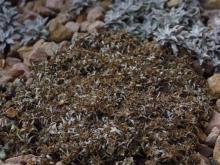
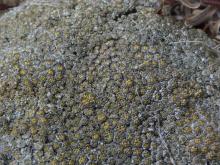
Sat, 01/26/2013 - 2:36pmI have a Silene acaulis in a trough that is overwintering in the unheated garage for the first time, rather than outside. It is consistently 10-15F warmer than outside, although the garage door is opened almost twice daily for my going to work. Judging from the Draba rigida var. bryoides that usually shows more green, plants are not as happy as they should be. The no snow cover and even lower relative humidity is taking their toll. So I think Trond's description is right on the money.
26 January 2013
Silene acaulis (& Antennaria) Draba rigida var. bryoides
Lori S. (not verified)
Re: The perfect silene? Silene acaulis
Sat, 01/26/2013 - 3:23pmYes, that does ring a bell now about Silene acaulis...
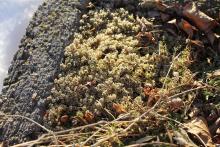
I don't think I'd worry about the Draba rigida "not showing as much green as it should, hence not happy"....
Here's what it looks like here in winter and there has never, ever been any die-back, even through winters when it's been exposed most of the time: