Do you see a difference in growth between male and female plants? We are supposed to have Shepherdia canadensis and S. argentea here, but I think I have only seen S. argentea.
Here S canadensis grows every few feet...lol, but S argentea is supposely only in the south of the province... Elaeagnus commutata (silverberry) does occur in isolated spots here, and more commonly in the foothills .. hoping to get some cuttings this year from a spot about 10 miles from here..
I know too well the damge from compacted snow as it melts...I used to have plenty of rhododendrons but have replaced most with deciduous azaleas as the latter are not so prone to the pancake effect.
I am rather fond of our native prostrate form of Shepherdia canadensis...it is a truly prostrate form and comes true from seed (as they don't root for beans from cuttings)
Wow Todd, a superb dwarf form of Shepherdia :o... I hesitate to join in lest you be overburdened with requests, although I'd like to join the club! Thanks for showing that beauty and making us aware of its existence.
Elaeagnus commutata (silverberry) does occur in isolated spots here, and more commonly in the foothills .. hoping to get some cuttings this year from a spot about 10 miles from here..
As much as I like wolf willow (E. commutata) in the wild (especially for the fragrant flowers), it's worth mentioning that it has a very strong suckering habit... something to consider when deciding where (or whether) to plant it.
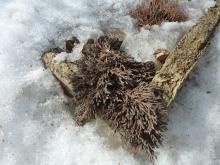
Nothing too exotic here... Juniperus horizontalis 'Pancake', coming out of its rusty winter colour and remaining small and completely prostrate after 4 years:
Cute little juniper.. I can see that habit of Elaeagnus commutata in the wild, I definitely would not plant it near any garden beds (though nothing could outsucker the native poplars here, and they can reach every inch of the 6 acres with their suckers, my main reason for mowing....)..I could give it space to do its thing, likely with mowing on at least one side, such as along the side of our property along the road, already a line (not single line, a few metres deep) of trees, but I'd like denser screening......
Nothing too exotic here... Juniperus horizontalis 'Pancake', coming out of its rusty winter colour and remaining small and completely prostrate after 4 years:
With that name it has to stay flat for lot more than 4 years;)
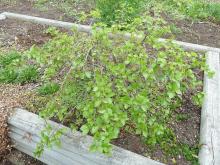
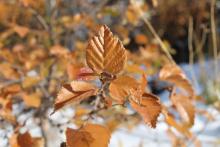
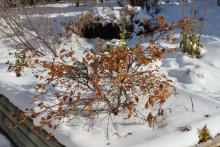
It's not exactly ground-hugging but Betula apoiensis is a nice little tree, suitable for the larger rock garden. It's shown here just after leafing out at the end of May, and in fall colour at the end of October this year:
Nice birch, seems to have similar leaf texture to the native dwarf birches (which I only see in grazed contexts, so I don't know how small they stay- I see Kristl got some seed of B glandulosa in the Rockies, and she mentions 1-3 metres.. don't know if its the same as those I see around here) but your birch has a very different habit- more pendulous and graceful...
I have this Salix sp. hugging the ground very well and creeping around, to be honest, somewhat thuggishly! It grows incredibly easily from cuttings also. I was told when given the original plant that it was a Californian sp. but I haven't been able to find anything like it there. I think the people who gave me it were mistaken ( although they grew many USA plants ). Can anyone help ID it please? I can take more pics if necessary. TIA :)
We like having these truly ground hugging Salix sp. growing throughout what are primarily the 'bulb growing' beds. The very open soil is kept on the dry side in summer through the root action and leaf cover, maintaining a good soil moisture and temperature. The bulbs flower through the branches before the leaves appear on the Salix ( in the main ).
Salix reticulata - in full seed !
We were given this one as Salix nivalis ( we still think it is, but many pictures on the web look more like S. reticulata !? ). It is very easily propagated and now covers many areas. The fallen leaves are of a Prunus sp. tree which overhangs part of this bed, ( left in for scale !)
Not a ground hugging species, but a lovely tiny plant is Salix x boydii. Dotted around to add different colour and texture.
Those are beauties, Ron! I wonder what it takes to get Salix to bloom in captivity?? Blooming is rare to nonexistent on mine!
My Salix x boydii has been doing poorly the last two years - died back by about half after the winter of 2011-2012. I think I discovered why. It's planted in a two-tier wood-frame acid bed, in the upper tier. Ants and wasps (I assume) had excavated out a cavity beneath it which I refilled this spring (the wasps had abandoned it) - it took a gallon and a half of soil to refill the cavity, so I imagine the roots of plants growing above it were pretty much suspended in the air! No wonder it died back.
Ron, I have never really tried to grow Salix reticulata although I like it very much. It is always a pleasure to find it.
Here are two small, decorative shrubs probably useful in a garden: Salix polaris and Betula nana ssp tundarum. The latter is much more prostrate than the usual B. nana.
We like having these truly ground hugging Salix sp. growing throughout what are primarily the 'bulb growing' beds. The very open soil is kept on the dry side in summer through the root action and leaf cover, maintaining a good soil moisture and temperature. The bulbs flower through the branches before the leaves appear on the Salix ( in the main ).
Salix reticulata - in full seed !
[/quote]
Your Salix reticulata above looks a lot like a plant I have- Salix nakamurana var yezoalpina. Not sure if this helps or just muddies the waters for identification!
[quote=Longma]
We were given this one as Salix nivalis ( we still think it is, but many pictures on the web look more like S. reticulata !? ). It is very easily propagated and now covers many areas. The fallen leaves are of a Prunus sp. tree which overhangs part of this bed, ( left in for scale !)
Not a ground hugging species, but a lovely tiny plant is Salix x boydii. Dotted around to add different colour and texture.
You may well be correct Gordon. Thanks for the suggestion. Over the years friends have given us numerous of these low growing shrubs and generally we just go with the name they were carrying when given to us. We love to employ them in the garden beds to hold / protect the bulbous flowers that, when in the open, are at the mercy of the vagaries of our Fall weather. Here Crocus speciosus growing through a species of Salix from Asia. Not accurate, but that's gardening???
All nice willows! I like them with the bulbs too. something I will keep in mind when I manage to get hold of some... I've been thinking of using the much more available (for me) Arctostaphylos uva-ursi and Dryas and Linnaea for that as well...
Genista lydia is looking fantastic, Fermi. Hmm, that sparks a memory of my long gone Genista pilosa 'Vancouver Gold'... not that it ever looked that good! May have to try it again one day.
Fermi, any problem with cats and the Teucrium? I tried a couple times growing this Teucrium and cats would decimate it, as the aromatic foliage is as intoxicating as regular catnip (Nepeta cataria).
Very nice on both Teucrium species, now including T. marum. Both species never had a chance in my garden, many many years ago when I was still gardening at my parents home, the plants would be become decimated by cats (we didn't have cats, nor do I remember seeing any roaming cats), the small broken shrublets entangled with cat hair, apparently far more pungent and potent than normal catnip. If I were to try growing them again, would have to cover with protective wire mesh; there are at least 3 cats in the area that routinely come through the yard and hunt.
Here is one of my favourite ground-hugging shrubs, Teucrium subspinosum. Growing in a hot dry position in a raised bed in the rock garden and now covering a few bulbs such as Retic iris 'Harmony' and Narcissus viridiflorus.
Trond- Cassiope is nice- I've seen a couple sp in this clan at one spot in the mountains (not saying they are rare, just the one right spot I've visited) and thought it was a habitat I could duplicate: the north edge and moderate slope of a rocky ridge, under open conifers. Haven't tried yet though.. I tend to assume these Ericaceae will be painfully slow from seed?
Fermi-looks good- are trhe bulbs able to push through it?
Cohan, I have never tried Cassiope but I have grown both some Ericas and Calluna from seed and they are rather quick. Often they are flowering in their 2nd year.
Good to know, Trond- my only effort in the family was with some Rhodos (I forget what it was, something small and zone 3 from Kristl), and they never really got any size to them after a couple of years, and just disappeared everntually, but that may have been entirely my fault.. oh, and Arctostaphylos rubra I sowed last winter, and it just didn't come up :(
Fermi-my bulb growing is still in early stages, so I'm still thinking about what to plant them with.. I have some on a berm with mid-sized meadow plants, that seems good, but need some solutions still for Crocus at the base of a rock garden.. I have an Acaena and Azorella there, but those are so tiny they really wont help.. probably need to move them and put something more robust- maybe Arctostaphylos uva-ursi would be a good sub-shrub for me to use for that--I've seen Anemones coming up through it in the wild...
Lori- not sure I'd even be able to find the native Valerian in the fall..lol- they are not very conspicuous plants at the best of times, and here grow amongst grasses, sedges, other forbs etc Still mean to get them into my garden, but hasn't happened yet...
Really interesting plants Fermi - we are growing many teucriums, along with other Mediterranean shrublets and I'm aiming to write about them for The Plantsman in the UK. Fortunately our dog should prevent any problems with cats! The Relhania is completely new to me - I wonder if it has any chance of being hardy in the UK? This is one of my favourite small shrubs - Lithodora oleifolia - one of a particularly lovely family of plants, and at last growing a lot better than it has done before now it is planted out in the sand bed.
Tim, How does Lithodora oleifolia compare in hardiness to Lithodora diffusa? We have L. diffusa 'Grace Ward' growing here, though it doesn't exactly appreciate our extra cold and wet winters. With a bit of shelter, a raised bed with excellent drainage, and plenty of sun seems to help it through the worst winter offers here.
I think Lithodora oleifolia is probably hardier than L. diffusa; it has a limited distribution and at a higher altitude. We are roughly zone 8 and have never had winter lows below -15°C - but we do tend to specialise in more Mediterranean-type plants! There are some smaller ecotypes of L. diffusa from higher altitude (like 'Picos') which is lime tolerant and I imagine a good bit hardier than 'Grace Ward'.
It could be. It is rated as hardy in USDA hardiness zone 8-11 so with winters like the last one the winters shouldn't be a problem but if it needs very warm summers that would be more difficult! Could be interesting to try.
This one is not exactly ground-hugging - it's more mound-like - but it's certainly small... Buxus microphyllus 'Kingsville'; planted in 2008 and is 3" or less:

Comments
Richard T. Rodich
Re: Groundhugging shrubs.
Mon, 03/14/2011 - 9:21amYes, I hadn't thought about crowberry. Probably more likely...
cohan (not verified)
Re: Groundhugging shrubs.
Mon, 03/14/2011 - 10:34amHere S canadensis grows every few feet...lol, but S argentea is supposely only in the south of the province... Elaeagnus commutata (silverberry) does occur in isolated spots here, and more commonly in the foothills .. hoping to get some cuttings this year from a spot about 10 miles from here..
Mark McDonough
Re: Groundhugging shrubs.
Mon, 03/14/2011 - 7:27pmWow Todd, a superb dwarf form of Shepherdia :o... I hesitate to join in lest you be overburdened with requests, although I'd like to join the club! Thanks for showing that beauty and making us aware of its existence.
Lori S. (not verified)
Re: Groundhugging shrubs.
Sat, 03/19/2011 - 11:20pmAs much as I like wolf willow (E. commutata) in the wild (especially for the fragrant flowers), it's worth mentioning that it has a very strong suckering habit... something to consider when deciding where (or whether) to plant it.
Nothing too exotic here... Juniperus horizontalis 'Pancake', coming out of its rusty winter colour and remaining small and completely prostrate after 4 years:
cohan (not verified)
Re: Groundhugging shrubs.
Sat, 03/19/2011 - 11:56pmCute little juniper..
I can see that habit of Elaeagnus commutata in the wild, I definitely would not plant it near any garden beds (though nothing could outsucker the native poplars here, and they can reach every inch of the 6 acres with their suckers, my main reason for mowing....)..I could give it space to do its thing, likely with mowing on at least one side, such as along the side of our property along the road, already a line (not single line, a few metres deep) of trees, but I'd like denser screening......
Trond Hoy
Re: Groundhugging shrubs.
Sun, 03/20/2011 - 2:31amWith that name it has to stay flat for lot more than 4 years;)
Trond Hoy
Re: Groundhugging shrubs.
Tue, 03/22/2011 - 2:08pmHere's a natural form of Juniperus communis.
Lori S. (not verified)
Re: Groundhugging shrubs.
Mon, 11/12/2012 - 1:05pmIt's not exactly ground-hugging but Betula apoiensis is a nice little tree, suitable for the larger rock garden.
It's shown here just after leafing out at the end of May, and in fall colour at the end of October this year:
http://www.theplantlist.org/tpl/record/kew-21161
http://translate.google.ca/translate?hl=en&sl=fr&u=http://talent.paperbl...
http://www.apoi-geopark.jp/file/pdf/apodake_leaf_e.pdf
cohan (not verified)
Re: Groundhugging shrubs.
Mon, 11/12/2012 - 11:16pmNice birch, seems to have similar leaf texture to the native dwarf birches (which I only see in grazed contexts, so I don't know how small they stay- I see Kristl got some seed of B glandulosa in the Rockies, and she mentions 1-3 metres.. don't know if its the same as those I see around here) but your birch has a very different habit- more pendulous and graceful...
Longma (not verified)
Re: Groundhugging shrubs.
Sat, 05/04/2013 - 9:22amI have this Salix sp. hugging the ground very well and creeping around, to be honest, somewhat thuggishly! It grows incredibly easily from cuttings also. I was told when given the original plant that it was a Californian sp. but I haven't been able to find anything like it there. I think the people who gave me it were mistaken ( although they grew many USA plants ). Can anyone help ID it please? I can take more pics if necessary. TIA :)
Longma (not verified)
We like having these truly
Sun, 07/21/2013 - 6:55amWe like having these truly ground hugging Salix sp. growing throughout what are primarily the 'bulb growing' beds. The very open soil is kept on the dry side in summer through the root action and leaf cover, maintaining a good soil moisture and temperature. The bulbs flower through the branches before the leaves appear on the Salix ( in the main ).
Salix reticulata - in full seed !
We were given this one as Salix nivalis ( we still think it is, but many pictures on the web look more like S. reticulata !? ). It is very easily propagated and now covers many areas. The fallen leaves are of a Prunus sp. tree which overhangs part of this bed, ( left in for scale !)
Not a ground hugging species, but a lovely tiny plant is Salix x boydii. Dotted around to add different colour and texture.
Lori S. (not verified)
Those are beauties, Ron! I
Tue, 07/23/2013 - 9:05amThose are beauties, Ron! I wonder what it takes to get Salix to bloom in captivity?? Blooming is rare to nonexistent on mine!
My Salix x boydii has been doing poorly the last two years - died back by about half after the winter of 2011-2012. I think I discovered why. It's planted in a two-tier wood-frame acid bed, in the upper tier. Ants and wasps (I assume) had excavated out a cavity beneath it which I refilled this spring (the wasps had abandoned it) - it took a gallon and a half of soil to refill the cavity, so I imagine the roots of plants growing above it were pretty much suspended in the air! No wonder it died back.
Trond Hoy
Ron, I have never really
Fri, 07/26/2013 - 11:24pmRon, I have never really tried to grow Salix reticulata although I like it very much. It is always a pleasure to find it.
Here are two small, decorative shrubs probably useful in a garden: Salix polaris and Betula nana ssp tundarum. The latter is much more prostrate than the usual B. nana.
Salix polaris
Betula nana ssp tundrarum
Gordon Tingley
Longma wrote:
Wed, 10/30/2013 - 5:04am[quote=Longma]
We like having these truly ground hugging Salix sp. growing throughout what are primarily the 'bulb growing' beds. The very open soil is kept on the dry side in summer through the root action and leaf cover, maintaining a good soil moisture and temperature. The bulbs flower through the branches before the leaves appear on the Salix ( in the main ).
Salix reticulata - in full seed !
[/quote]
Your Salix reticulata above looks a lot like a plant I have- Salix nakamurana var yezoalpina. Not sure if this helps or just muddies the waters for identification!
[quote=Longma]
We were given this one as Salix nivalis ( we still think it is, but many pictures on the web look more like S. reticulata !? ). It is very easily propagated and now covers many areas. The fallen leaves are of a Prunus sp. tree which overhangs part of this bed, ( left in for scale !)
Not a ground hugging species, but a lovely tiny plant is Salix x boydii. Dotted around to add different colour and texture.
[/quote]
[Edited to correct the "quoted" parts... Lori ]
]
Longma (not verified)
You may well be correct
Wed, 10/30/2013 - 1:14pmYou may well be correct Gordon. Thanks for the suggestion. Over the years friends have given us numerous of these low growing shrubs and generally we just go with the name they were carrying when given to us. We love to employ them in the garden beds to hold / protect the bulbous flowers that, when in the open, are at the mercy of the vagaries of our Fall weather. Here Crocus speciosus growing through a species of Salix from Asia. Not accurate, but that's gardening???
cohan (not verified)
All nice willows! I like them
Fri, 11/01/2013 - 11:56pmAll nice willows! I like them with the bulbs too. something I will keep in mind when I manage to get hold of some... I've been thinking of using the much more available (for me) Arctostaphylos uva-ursi and Dryas and Linnaea for that as well...
Lori S. (not verified)
Genista lydia is looking
Sun, 11/03/2013 - 11:02amGenista lydia is looking fantastic, Fermi. Hmm, that sparks a memory of my long gone Genista pilosa 'Vancouver Gold'... not that it ever looked that good! May have to try it again one day.
Fermi de Sousa
Hi Lori,
Tue, 12/17/2013 - 5:47amHi Lori,
I think one of the genistas we grew was a form of G. pilosa - must try it again from seed!
One of my favorite dwarf shrubs, Teucrium subspinosum, is now in flower,
cheers
fermi
Mark McDonough
Fermi, any problem with cats
Wed, 12/25/2013 - 3:20pmFermi, any problem with cats and the Teucrium? I tried a couple times growing this Teucrium and cats would decimate it, as the aromatic foliage is as intoxicating as regular catnip (Nepeta cataria).
Fermi de Sousa
Hi Mark,
Thu, 12/26/2013 - 4:48amHi Mark,
not with this one; they like Teucrium marum more, but they don't decimate it either,
cheers
fermi
Fermi de Sousa
Here are some pics of
Fri, 12/27/2013 - 8:20pmHere are some pics of Teucrium marum which is now in flower,
cheers
fermi
Mark McDonough
Very nice on both Teucrium
Wed, 01/01/2014 - 5:19pmVery nice on both Teucrium species, now including T. marum. Both species never had a chance in my garden, many many years ago when I was still gardening at my parents home, the plants would be become decimated by cats (we didn't have cats, nor do I remember seeing any roaming cats), the small broken shrublets entangled with cat hair, apparently far more pungent and potent than normal catnip. If I were to try growing them again, would have to cover with protective wire mesh; there are at least 3 cats in the area that routinely come through the yard and hunt.
Fermi de Sousa
Another ground-hugging shrub
Wed, 01/01/2014 - 11:08pmAnother ground-hugging shrub in our rock garden is the South African Relhania pungens
It looks great at this time of year but can be a bit tatty when the seed heads are left to go brown!
cheers
fermi
Fermi de Sousa
It was an article by
Wed, 01/01/2014 - 11:12pmIt was an article by Panayoti in an ARGS journal way back in the 1980s which got me interested in rock garden Oreganoes.
This is a "swarm" of hybrids involving Origanum rotundifolium and another one whose name I've lost!
cheers
fermi
cohan (not verified)
Love all those dwarf willows
Tue, 07/30/2013 - 11:26pmLove all those dwarf willows and birches! Still haven't got any, but I will someday!..lol
Trond Hoy
I'll try to remember 1)
Wed, 07/31/2013 - 12:09pmI'll try to remember 1) collecting some seeds 2) posting the collection!
Here's another one, Cassiope tetragona, that covered huge areas on Svalbard.
Fermi de Sousa
Here is one of my favourite
Thu, 08/08/2013 - 4:17pmHere is one of my favourite ground-hugging shrubs, Teucrium subspinosum. Growing in a hot dry position in a raised bed in the rock garden and now covering a few bulbs such as Retic iris 'Harmony' and Narcissus viridiflorus.
cheers
fermi
Lori S. (not verified)
Wow, love it, Fermi! Prickly
Thu, 08/08/2013 - 6:50pmWow, love it, Fermi! Looks prickly and wonderful!!
A couple of subshrubs in the yard here...
Linnaea borealis, which is done blooming here, though it was in full splendour through the montane forest on our hike earlier this week:
Salix retusa:
cohan (not verified)
Trond- Cassiope is nice- I've
Sat, 08/17/2013 - 11:14amTrond- Cassiope is nice- I've seen a couple sp in this clan at one spot in the mountains (not saying they are rare, just the one right spot I've visited) and thought it was a habitat I could duplicate: the north edge and moderate slope of a rocky ridge, under open conifers. Haven't tried yet though.. I tend to assume these Ericaceae will be painfully slow from seed?
Fermi-looks good- are trhe bulbs able to push through it?
Lori- is that a native willow?
Trond Hoy
Cohan, I have never tried
Sat, 08/17/2013 - 11:41amCohan, I have never tried Cassiope but I have grown both some Ericas and Calluna from seed and they are rather quick. Often they are flowering in their 2nd year.
Lori S. (not verified)
cohan wrote:
Sat, 08/17/2013 - 4:02pm[quote=cohan]
Lori- is that a native willow?
[/quote]
No, apparently, it's a European species:
http://encyclopaedia.alpinegardensociety.net/plants/Salix/retusa
I'll have to watch for the scent of valerian in the fall - not something I've noticed.
Fermi de Sousa
Hi Cohan,
Sat, 08/17/2013 - 11:08pmHi Cohan,
the iris and the Narcissus both spear through the Teucrium without a problem! It has meant that I haven't dug them up recently! <grin>
Trond,
it seems to be a widespread genus, but you can grow many things (like cassiopes!) which I have no hope of getting let alone keeping!
cheers
fermi
Trond Hoy
Fermi, it is the other way:
Tue, 08/20/2013 - 9:09amFermi, it is the other way: you can grow many things which i have no hope of ever keep alive!
cohan (not verified)
Good to know, Trond- my only
Wed, 09/11/2013 - 11:07pmGood to know, Trond- my only effort in the family was with some Rhodos (I forget what it was, something small and zone 3 from Kristl), and they never really got any size to them after a couple of years, and just disappeared everntually, but that may have been entirely my fault.. oh, and Arctostaphylos rubra I sowed last winter, and it just didn't come up :(
Fermi-my bulb growing is still in early stages, so I'm still thinking about what to plant them with.. I have some on a berm with mid-sized meadow plants, that seems good, but need some solutions still for Crocus at the base of a rock garden.. I have an Acaena and Azorella there, but those are so tiny they really wont help.. probably need to move them and put something more robust- maybe Arctostaphylos uva-ursi would be a good sub-shrub for me to use for that--I've seen Anemones coming up through it in the wild...
Lori- not sure I'd even be able to find the native Valerian in the fall..lol- they are not very conspicuous plants at the best of times, and here grow amongst grasses, sedges, other forbs etc Still mean to get them into my garden, but hasn't happened yet...
Fermi de Sousa
This Genista lydia has molded
Sun, 10/27/2013 - 8:12pmThis Genista lydia has molded itself to the rocks over which it grows and it a solid yellow at this time each year,
cheers
fermi
Fermi de Sousa
cohan wrote:
Sat, 04/19/2014 - 4:39am[quote=cohan]
Fermi [Teucrium subspinosum] -looks good- are the bulbs able to push through it?
[/quote]
Cohan,
this colchicum is a bit too small to get through
cheers
fermi
Tim Ingram (not verified)
Really interesting plants
Sat, 04/19/2014 - 12:02pmReally interesting plants Fermi - we are growing many teucriums, along with other Mediterranean shrublets and I'm aiming to write about them for The Plantsman in the UK. Fortunately our dog should prevent any problems with cats! The Relhania is completely new to me - I wonder if it has any chance of being hardy in the UK? This is one of my favourite small shrubs - Lithodora oleifolia - one of a particularly lovely family of plants, and at last growing a lot better than it has done before now it is planted out in the sand bed.
Gordon Tingley
Tim, How does Lithodora
Sun, 04/20/2014 - 3:22pmTim, How does Lithodora oleifolia compare in hardiness to Lithodora diffusa? We have L. diffusa 'Grace Ward' growing here, though it doesn't exactly appreciate our extra cold and wet winters. With a bit of shelter, a raised bed with excellent drainage, and plenty of sun seems to help it through the worst winter offers here.
Tim Ingram (not verified)
I think Lithodora oleifolia
Wed, 04/23/2014 - 5:17amI think Lithodora oleifolia is probably hardier than L. diffusa; it has a limited distribution and at a higher altitude. We are roughly zone 8 and have never had winter lows below -15°C - but we do tend to specialise in more Mediterranean-type plants! There are some smaller ecotypes of L. diffusa from higher altitude (like 'Picos') which is lime tolerant and I imagine a good bit hardier than 'Grace Ward'.
Fermi de Sousa
Tim,
Thu, 04/24/2014 - 5:36amTim,
I'll have to look out for seeds of that Lithodora - L. "Grace Ward" is the only one seen locally!
Here's another ground-hugger which Crocus pulchellus is able to penetrate when it's time to flower: Haplopappus coronipifolius (syn glutinosus)
cheers
fermi
Fermi de Sousa
This is a local, native "rice
Thu, 10/09/2014 - 10:49pmThis is a local, native "rice-flower", Pimelea glauca (I think) which suckers lightly and can provide a not-too-dense ground cover,
cheers
fermi
Trond Hoy
Nice plant, Fermi!
Sun, 10/12/2014 - 10:53amNice plant, Fermi!
It seems that the Pimelea likes the same conditions as the Armeria? Could be possible to grow it here then!
Robert Nold
Autumn color on Rhamnus
Tue, 10/21/2014 - 4:26pmAutumn color on Rhamnus microcarpa. The shrub grows about 1mm every two years.
Bob
Fermi de Sousa
Hoy wrote:
Tue, 11/25/2014 - 10:39pm[quote=Hoy]
Nice plant, Fermi!
It seems that the Pimelea likes the same conditions as the Armeria? Could be possible to grow it here then!
[/quote]
I'll have to see if there is any seed set on it!
Here's a ground-hugging shrub that gets a bit too huggy - it swamps anything in its path!
Margyricarpus pinnatus, "Pearl-berry" growing with Geranium harveyi
and a pic of the Haplopappus coronopifilus in flower
cheers
fermi
Trond Hoy
Fermi wrote:
Mon, 12/08/2014 - 5:55am[quote=Fermi]
I'll have to see if there is any seed set on it!
Here's a ground-hugging shrub that gets a bit too huggy - it swamps anything in its path!
Margyricarpus pinnatus, "Pearl-berry" growing with Geranium harveyi
and a pic of the Haplopappus coronopifilus in flower
cheers
fermi
[/quote]
Hi Fermi, you certainly have some nice shrubs! Never heard of the Pearlfruit before.
Fermi de Sousa
Hi Trond,
Sun, 12/14/2014 - 2:39pmHi Trond,
I wonder if it would be hardy for you?
cheers
fermi
Trond Hoy
Fermi wrote:
Sun, 12/14/2014 - 11:31pm[quote=Fermi]
Hi Trond,
I wonder if it would be hardy for you?
cheers
fermi
[/quote]
Fermi,
It could be. It is rated as hardy in USDA hardiness zone 8-11 so with winters like the last one the winters shouldn't be a problem but if it needs very warm summers that would be more difficult! Could be interesting to try.
Fermi de Sousa
Fermi wrote:
Mon, 01/12/2015 - 5:18pm[quote=Fermi]
[/quote]
And a couple of weeks ago it was in full seed mode
cheers
fermi
Trond Hoy
Nice, are they viable?
Wed, 01/14/2015 - 4:04amNice, are they viable?
Lori S. (not verified)
This one is not exactly
Fri, 02/06/2015 - 6:25pmThis one is not exactly ground-hugging - it's more mound-like - but it's certainly small... Buxus microphyllus 'Kingsville'; planted in 2008 and is 3" or less:
Pages