
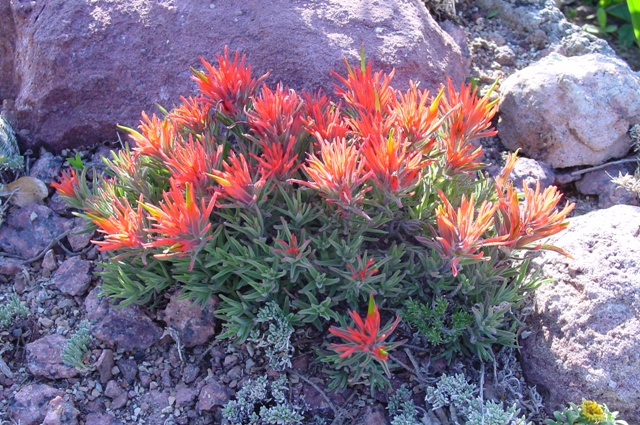
I know it looks like the wild, but if you look carefully at the upper right you can see a corner of the veggie garden and the edge of the trough this grew in.
For ten years or so this astonishing Castilleja scabrida graced this trough, invariably coming into full bloom at exactly the time of the Rock Garden Club spring plant sale: year after year we had to lug the damn trough down to the Gardens for the sale, and always some one would sidle over and offer to buy it. Who would sell the only trough in the world brimming with this tiny, brilliant and actually quite abundant Castilleja from the slick rock of the Colorado plateau and especially the San Rafael swell. The mystery is that no one has bothered to go out there and gather lots and seed and replicate our feat.
Except David Joyner--the long time president of the Wasatch Chapter of NARGS--who grows dozens of species of Castilleja like weeds: don't you just hate people like that?
You don't have to be annoyed with me, however, since this little gem is long gone. Although the delight it brought me for most of April and May year after year still lingers: thank heavens we have cameras and pictures to prove things. As Geoffrey Charlesworth observed, it really doesn't matter if you've grown a plant so much as it does that you have photographed it to PROVE you've grown it!
Comments
Lori S. (not verified)
Re: In remembrance of paintbrush lost and those still with us
Sat, 02/20/2010 - 7:42amCastilleja miniata, while I suppose not one of most sought-after species, has been a good performer here out in the front yard. The plants have chosen to hang around for 8 years now, and every year in the last while, I find a small number of self-seeded additions.
I must branch out to other species, though.
Any one else with Castilleja-growing stories to share out there?
Panayoti Kelaidis
Wow!
Sat, 02/20/2010 - 9:29amI would be thrilled to have those C. miniata in my garden: kudos!
HughGmail (not verified)
Re: In remembrance of paintbrush lost
Sat, 02/20/2010 - 9:46amHere's C. scabrida from May, 2009, taken during a camping trip to the Bucklhorn Draw area of the San Rafael Swell. Our campground was about half way between Buckhorn Draw and the Black Box canyon of San Rafael River. It was a particularly dry Spring last year, but these beauties put on quite a display!
Lori S. (not verified)
Re: In remembrance of paintbrush lost
Sat, 02/20/2010 - 9:49amWow, that species is stunning, especially against the harsh backdrops of its habitat!
Lori S. (not verified)
Re: In remembrance of paintbrush lost
Sat, 02/20/2010 - 9:58amHa, ha! I'll remember that, next time I'm tempted to have the whole darned thing paved over!
Mueller (not verified)
Re: In remembrance of paintbrush lost
Sat, 02/20/2010 - 3:09pmKelaidis,
Starting a trough full of scabrida, from seed, has been my plan for this year. I'm glad to know that it could work.
What did you use as a host plant? Nold, in "High and Dry", recommends artemesia frigida or blue grama grass for Castilleja. I wasn't sure what to do since I think both can be taller than the target plant.
Scott
Lori S. (not verified)
Re: In remembrance of paintbrush lost
Tue, 02/23/2010 - 7:15pmScott,
I just thought I would mention that there have been some very good articles on germination and cultivation of Castilleja in the NARGS Rock Garden Quarterly, that might be of interest, if you have access to them.
I can suggest the following (and there are very likely others):
Volume 63, #2 (Spring, 2005): Growing Castilleja for Restoration and the Garden, Lawrence & Kaye
Volume 65, #3 (Summer, 2007): Techniques for Growing Castilleja in the Garden, Nelson & Joyner
Panayoti Kelaidis
Re: In remembrance of paintbrush lost
Tue, 02/23/2010 - 8:57pmScott,
I don't think Castillejas are so very fussy: I remember we did have some stunted Artemisia frigida in that trough, as well as various dwarf crucifers (like Lesquerella alpina) and dwarf penstemons (Penstemon caespitosus and P. acaulis) and various tiny erigerons and other composites.
Giving the seed some scarification (lightly!) and a good long freeze thaw cycle is important. Also fresh seed on some Castillejas seems to germinate better,
That's my recipe! Now I need to reapply it...
Trond Hoy
Re: In remembrance of paintbrush lost
Sun, 02/28/2010 - 9:46amI have not lost any but have for long thought of trying to grow some paintbrushes in my garden. What do you think of sowing in situ? Is it better to do so in fall with as fresh seed as possible?
Barbara L. Weintraub
Re: In remembrance of paintbrush lost
Thu, 03/18/2010 - 3:40pmCastilleja integra should be growing on my land, as it is common in similar habitats nearby. My plan has been to collect fresh seed and scatter it about. With such a wet winter, this may be the year to find a prolific stand and collect seed for that purpose. It may take a couple of years for it to germinate and bloom, but if I'm successful, a report will be forthcoming!
In your case, you may have to have a host ready before scattering seed. Let me know if you need seed to get host plants going. I have access to blue gramma and several other native grasses. I'd have to wander around a bit to find the right species of Artemisia if that's your preference.
Trond Hoy
Re: In remembrance of paintbrush lost
Fri, 03/19/2010 - 2:17amBarbara,
I looked up this blue gramma grass as I didn't know it. It looks nice and worth growing by itself. So if you bother collecting some seeds of this and other species I would appreciate that!
Richard T. Rodich
Re: In remembrance of paintbrush lost
Fri, 03/19/2010 - 10:26amTrond, I grow Bouteloua gracilis grown from seed from Bad River, Minnesota. I think it would be more tolerant to your weather than the plants from New Mexico. I already have seed collected in 2009. If you would like to click on my user name and send me a message with you address, I can send some to you.
Lori S. (not verified)
Re: In remembrance of paintbrush lost
Fri, 03/19/2010 - 11:41amCastilleja miniata (for which I sent seeds from my plants, Trond), grows in company with an assortment of other perennials in my front yard... some North American natives, mostly not - no native grasses nearby, no artemisia anywhere near. Just from that observation, I tend to imagine it does not require specific species as host plants (if it in fact it requires hosts at all?) It's said to be among the easiest to grow, possibly for that reason.
From the NARGS articles I referenced, it seems whether certain species require hosts or not is unclear - I recall reading that some grow better in captivity when started with hosts. Very interesting...
Trond Hoy
Re: In remembrance of paintbrush lost
Fri, 03/19/2010 - 12:04pmLori, I think you mentioned it, but I will try different procedures and maybe I get hold of other paintbrushes as well (remember seeing some in Ecuador by the way). Besides the grass look fine! Am I right in that the C. miniata do best in a not too dry place?
Lori S. (not verified)
Re: In remembrance of paintbrush lost
Fri, 07/09/2010 - 8:14pmSorry, Trond, I didn't see your question. Well, we get only 40 cm of precipitation a year here, and a lot of that runs off in the spring melt while the ground is still frozen. In the wild, they grow with a huge amount of competition, as well, so I would say they don't really need a great deal of moisture.
Toole (not verified)
Re: In remembrance of paintbrush lost
Fri, 07/09/2010 - 10:23pmSome old pics --feb 2005 of Castilleja miniata i raised from seed --host plant was a NZ native Arthropodium candidum.
Placed under cover during winter to cope with our wet conditions it flowered for a total of 3 seasons .Its demise :'( came about when i attempted to increase it by dividing the caudex ? which had become quite wide.
Have tried a number of different sps since then--some false starts but nothing reached flowering :(
Cheers dave.
Lori S. (not verified)
Re: In remembrance of paintbrush lost
Fri, 07/09/2010 - 10:37pmVery nice, Dave, and from googling just now, Arthropodium candidum looks quite nice too!
Here's a particularly vividly-coloured C. miniata from the front yard.
Toole (not verified)
Re: In remembrance of paintbrush lost
Sat, 07/10/2010 - 2:44amLovely colouring Lori.
If you ever want seed of the Arthropodium just let me know --i have the purple /bronze form.
Cheers dave.