
Forums:
Seems it is a dull season, not much activity at this forum at the moment! Are you covered by snow, blown away by wind or damaged by wildfires?
The season has started here although it is not much to boast about. February has been very mild so far (not a single degree of frost till now!) but the rain has poured down in stead. Not like in GB but more than enough. When the rain stops for a moment it is still not enough light for the flowers to open and barely enough to take pictures!
Snowdrops, snowflakes and crocuses are all up and showing colour but don't open properly!


Comments
Lori S. (not verified)
Well done with Castilleja
Fri, 07/18/2014 - 5:04pmWell done with Castilleja miniata, Trond! They produce copious seed, so I hope they persist and spread for you.
Beautiful bulbs, Ron! I wonder how hardy Tritelia laxa would be? A quick search suggests zone 6... hmm, maybe I'll just stick with Ixiolirion tataricum, if I can get a good stand of it going.
Here's one of those "nature red in tooth and claw" things... a crab spider, not very well camouflaged in this Veronicastrum sibiricum, yet well enough, evidently, to capture an unwary(?) bumble bee:
Trond Hoy
Lori S. wrote:
Sat, 07/19/2014 - 3:01pm[quote=Lori S.]
Well done with Castilleja miniata, Trond! They produce copious seed, so I hope they persist and spread for you.
[/quote]
Thanks Lori - I also hope that they spread, but not too well! I think you are the seed source, BTW!
Are they self fertile so one plant is enough?
deesen (not verified)
Do you find Castillejas easy
Sun, 07/20/2014 - 11:19amDo you find Castillejas easy Trond, I wonder if I might get away with them here in Devon? Lovely by the way.
Toole (not verified)
Back in May I cleared a small
Mon, 07/21/2014 - 1:36amBack in May I cleared a small area, 1.5 mtrs width x 4 mtrs length , near the aviary to accommodate an increasing number of pots of seedling Hellebores and Trilliums and one or two other genera.It had previously been home to a couple of shrubs , Forsythia and Rhodo), which had outgrown their space ,requiring regular pruning to stop them encroaching onto the lawn.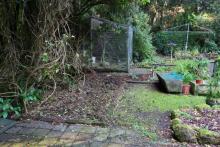
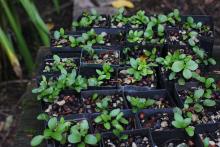
Unfortunately I had forgotten that the edge of the garden was infested with Ranunculus ficaria which are currently in leaf.Rather than applying a herbicide such as Amitrole by paint brush, I've decided that as it dies back by early summer it can stay.Hopefully the Hellebore seedlings can cope with the competition this season ,after that they will be okay .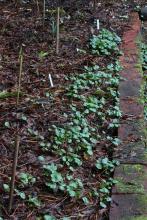
Trond Hoy
Dave, I have too much of
Mon, 07/21/2014 - 1:23pmDave, I have too much of Ranunculus ficaria in my garden and I think they are able to suffocate small seedlings. Where I have planted more delicate plants I let the Ranunculus flower a little before I remove all parts above ground. I have two kinds of of it, one type set seeds and the other type increase by bulbils in the leaf axils. The latter one is the worst to spread.
Trond Hoy
deesen wrote:
Mon, 07/21/2014 - 1:12pm[quote=deesen]
Do you find Castillejas easy Trond, I wonder if I might get away with them here in Devon? Lovely by the way.
[/quote]
Well David, the one in flower is/was easy enough! I just sprinkled seeds where I wanted them to grow and where I thought the habitat was right. I got at least two plants and has grown quickly as you see.
I've also tried Castilleja in pots both with and without companion plants and the seed germinate easily enough and the seedlings grow OK in pots but when I plant them out they disappear. Maybe they'll put their heads up later.
Can't see any reason why you shouldn't be able to grow them in Devon, David!
Trond Hoy
Lori S. wrote:
Mon, 06/16/2014 - 12:54pm[quote=Lori S.]
A nice rose. Is it fragrant? Once-blooming?
[/quote]
I suppose it is once-blooming and I have not yet detected any fragrance, neither during the day nor in the evening.
Trond Hoy
Regarding Anemone canadensis
Mon, 06/16/2014 - 1:08pmRegarding Anemone canadensis I once tried it in my woodland. Had a lot of it in a bed here at home and moved it in spring. It lasted but one season. Slugfood.
Fortunately I planted a piece of it at my summerhouse where it behaves very well and spreads a little where it is allowed to do.
Crab spiders like to hide in the flower:
Lori S. (not verified)
Hoy wrote:
Sun, 06/15/2014 - 6:46pm[quote=Hoy]
Here is a picture (out of flower at the moment) but you can see the leaves. I got an email telling me it could be Viola lanceolata, which seems plausible.
[/quote]
Very interesting foliage. Definitely not Viola canadensis.
Richard T. Rodich
There are advantages to being
Thu, 06/19/2014 - 6:25pmThere are advantages to being a lazy weeder
I was weeding yesterday and found two Saruma henryi seedlings: the only two I've ever seen. I don't know that I would have noticed them, had I not let them grow to a recognizable age. They aren't anywhere near the parent plant. They have an interesting growth pattern.
There are two glabrous cotyledons, then two hair oval leaves (juvenile leaves?) that at least appear to be arranged opposite. And then growth explodes with the true leaves and form.
Iris graminea and friends, Thalictrum aquilegifolium, Pulmonaria 'Silver Streams', Gentiana tibetica, Lilium michiganense, Impatiens glandulifera, lots of weeds.
Abelia mosanensis is hardy here with a most wonderful fragrance.
Back on June 5, I found this caterpillar on Antennaria rosea subsp. pulvinata (formerly Antennaria neglecta var. gaspensis according to Flora of North America). It was 3 mm long and produced a strong web "roof" for protection as it lived in the growing points.
It has turned out to be a Vanessa sp. June 19, it is now 4 cm. Surprisingly, they have not done much damage at all to the plants. It makes me wonder what they are eating!
Richard T. Rodich
One of the winners from the
Sat, 08/09/2014 - 10:40pmOne of the winners from the enormous amount of extra rainfall I've had this season: Gentiana tibetica and Gentiana septemfida
Oops! Almost missed seed collecting - Iris reichenbachii and Draba rigida var. bryoides
Anthericum racemosum and Ruellia humilis
Deinanthe 'Blue Wonder' and Deinanthe caerulea
Accidentally pulled up some Thalictrum thalictroides tubers. Aconitum lamarkii
Hakonechloa macra 'Albo Striata' and Jovibaarba heuffelii
Manfreda virginica. Flowers are quite out of the ordinary. The stamen filaments always seem to have these uniform bends initially, that straighten as they age.
Richard T. Rodich
Trond, the Impatiens species
Thu, 09/25/2014 - 6:29pmTrond, the Impatiens species seed you sent me in early 2013 didn't come up until this year. Well worth the wait.
One of our native asters, Symphiotrichum sericeum, and Rudbeckia subtomentosa 'Henry Eilers'. Colchicum x agrippinum
Hystrix patula, Aconitum lamarkii. Thalictrum coreanum produced seed this year for the first time in nine years. It is a dioecious species and I only have one clone, but this year it must have produce some perfect flowers, according to Aaron Floden (his best guess). It interesting that the same thing happened in his garden this year, too.
Lori S. (not verified)
Looking fantastic there, Rick
Thu, 09/25/2014 - 6:49pmLooking fantastic there, Rick!
Trond Hoy
Seems you have some nice
Sat, 09/27/2014 - 12:00pmSeems you have some nice flowering going on Rick!
Glad at least some of the seeds I have sent you germinated!
How tall are the Impatiens plants?
I also have some white/pink ones.
Richard T. Rodich
Hoy wrote:
Sat, 09/27/2014 - 5:43pm[quote=Hoy]
How tall are the Impatiens plants?
[/quote]
They had emerged in the 4 inch pot quite late for impatiens, at the end of May. (I. namchabarwensis is late, too.) And I am embarrassed to say that I didn't get them planted in the ground until mid July, when they were only 5-6 inches, languishing, due to the pot size constraints. They are almost 3 feet now, and from the looks of it, they would have grown to 6 feet, had I cared for them correctly!
How tall do they grow for you, and how is that in relation to I. glandulifera?
Jan Jeddeloh
So, Rick and Trond,
Sat, 09/27/2014 - 8:35pmSo, Rick and Trond,
What species are those impatiens? I have namcharbarwensis but it's an annual for me. I just let it seed into pots, put them in my greenhouse and the seed germinates at about 40 degrees (4. 5 C). It then sits there at the cotyledon stage for months until it warms up.
Trond Hoy
Jan, I think I have the
Sun, 09/28/2014 - 12:00pmJan, I think I have the common annual "weed" Impatiens glandulifera which is the one which grows biggest (3m/9ft in good moist soil). It is several colour forms of that one.
I also have another annual which is much shorter and with a different kind of inflorescence and which branches more freely. It is only one but a deeper colour though. The seed pods are also a bit different, slimmer and longer. I don't know whether the last one is another species or just a form of glandulifera. I am not sure but I think they hybridize.
Both seed freely in the garden and pop up everywhere. Fortunately they are easy to pull when young.
I also have a perennial, Impatiens arguta which is well behaved. It is about 1ft tall and starts flowering in summer.
Another perennial, Impatiens omeiana, which is very pretty but very late in flower.
Richard T. Rodich
All impatiens are annual for
Mon, 09/29/2014 - 5:35pmAll impatiens are annual for me. I don't know the species of the lavender one I just showed. Trond sent me seeds labeled as Impatiens sp. when I asked for them. They are certainly not closely related to glandulifera, which have whorled leaves and fat pods. The lavender sp. has alternate leaves and and long, narrow pods, like I. balfourii, which I also grow. I only had namchabarwensis for a few years. While the others reseed massively, namchabarwensis was quite sparse, and I just didn't keep it going. Loved it when I had it, though. I did have a problem now and then, with a "sudden death" symptom, like a wilt. I've never seen it on any other impatiens, except namchabarwensis. It does seem to need the warmth more than balfourii and glandulifera. In the nine years I have had these two species growing amongst one another, they have never produced any hybrids. I use to have the pink form of glandulifera (from a different source), but I kept weeding it out in favor of the white that I like far better. Glandulifera grows 5-7ft in my not so moist garden.
Fermi de Sousa
This time of year is when the
Sat, 10/04/2014 - 6:06amThis time of year is when the South African bulbs are stunning.
Here are mixed ixias
Babiana stricta
cheers
fermi
Lori S. (not verified)
Stunning, indeed, Fermi.
Sat, 10/18/2014 - 9:52amStunning, indeed, Fermi.
Only the final dribs and drabs of bloom left here, as is normal for middling October.
Here's a little fall colour... mostly on the ground, though!
'Schubert' chokecherry leaves; birch, pear and apple leaves, against Ajuga reptans 'Mahogany'; wayfaring tree, Viburnum lantana:
Rosa spinossima (red) and Rosa rugosa cv.'s; dried flowers on Carlina acaulis:
Seedling of Artemisia filifolius - hoping it winters over; a little fall colour on Draba ventosa and unknown Draba sp.:
Winter resting rosettes of Androsace spinulifera; Arabis androsacea with a couple of flowers; Androsace chamaejasme:
Rhododendron mucronulatum 'Crater's Edge':
Guess it's a foregone conclusion that winter is around the corner when the jackrabbits start to turn white... starting with the backs of the ears on this fellow:
Richard T. Rodich
Saruma henryi, one week after
Thu, 11/06/2014 - 7:57pmSaruma henryi, one week after several freezing nights and one at 24F.
And Allium sacculiferum (past its prime - second pic 10 October) and A. thunbergii 'Ozawas' and alba, still blooming nicely.
Hamamelis virginiana blooms in late fall and produces its seed the following fall. Liriodendron tulipifera had the best fall color ever in 2014, but has now dropped its leaves. Cotinus obovatus usually has spectacular fall color, first turning maroon, then red, then red-orange. This year it was only red-orange, and only for a week instead of the usual 2-3 weeks.
Lori S. (not verified)
Amazing colour for so late in
Tue, 11/11/2014 - 10:11amAmazing colour for so late in the season. Quite a difference from here, even in what was a mild, extended fall (except for the freak dump of snow in early September).
Richard T. Rodich
These abnormal seasons that
Tue, 11/11/2014 - 4:04pmThese abnormal seasons that we all seem to get now can really change the comparative growth chronology of species. My Kentucky Coffee trees (Gymnocladus dioicus) seen behind the American Smoke tree (Cotinus obovatus) normally drop their leaves long before the Cotinus, but not this year. For the first time in 24 years, my Tetradium(Euodia ) danielii actually had some fall color. Leaves always froze green on the tree in the past. Who knows, maybe this spring I'll get some normal looking flowers for the first time. Yet, the haskaps (Lonicera caerulea) had poor fall color, and the lilacs that usually hint of color in these long falls showed nothing this year. Perhaps 5% of the leaves on my bamboos ( Fargesia rufa ) were deciduous this year. That's never happened either, in their six years with me. "Normal" for me is to have most of them dry up in early spring.
Claire Cockcroft
Here is a funny little fungus
Sun, 01/11/2015 - 3:02pmHere is a funny little fungus related to a puff ball -- an earth star that showed up under a big rhododendron. It's the first time I've noticed one at home, though I have seen them in Greece on occasion.
Pages