
We are 11 days late on this topic!
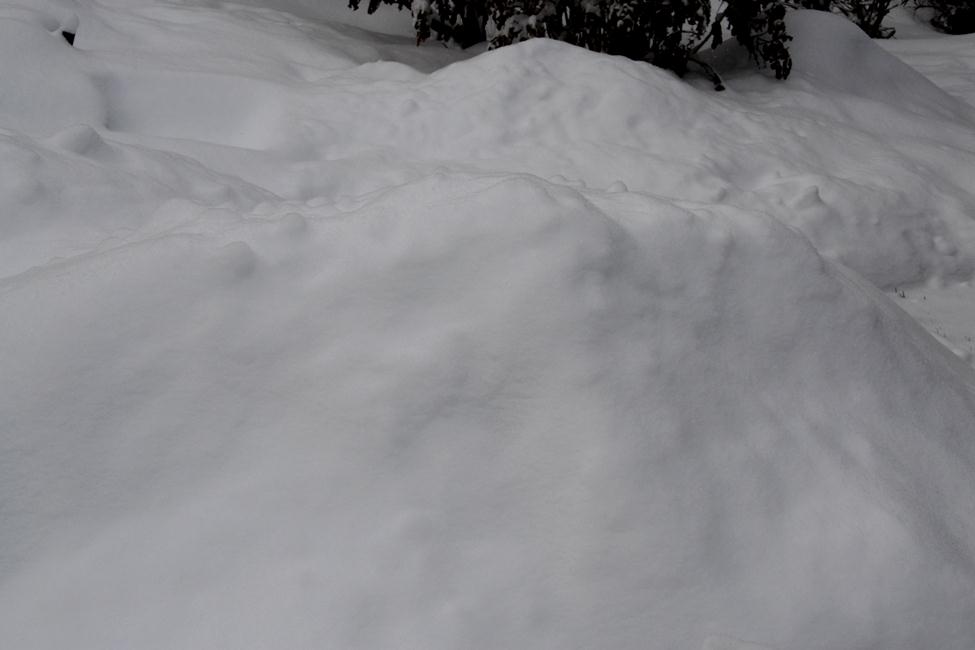
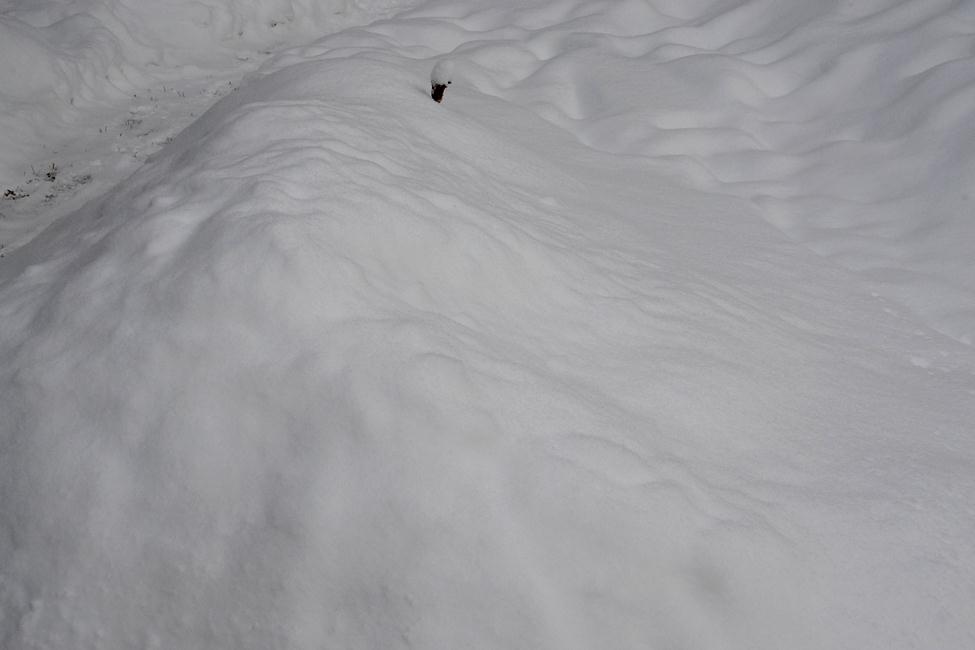
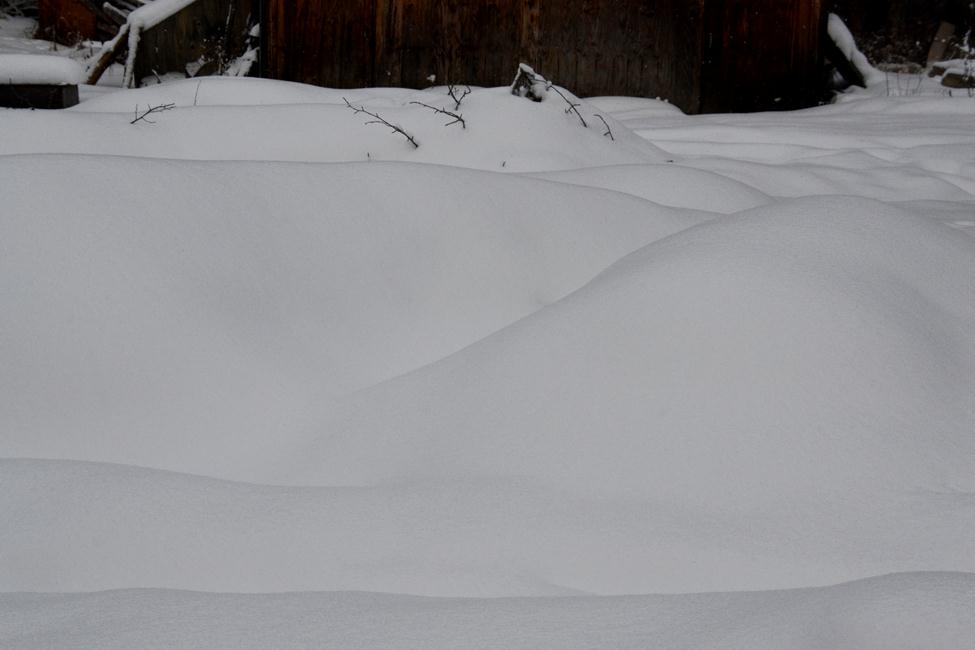
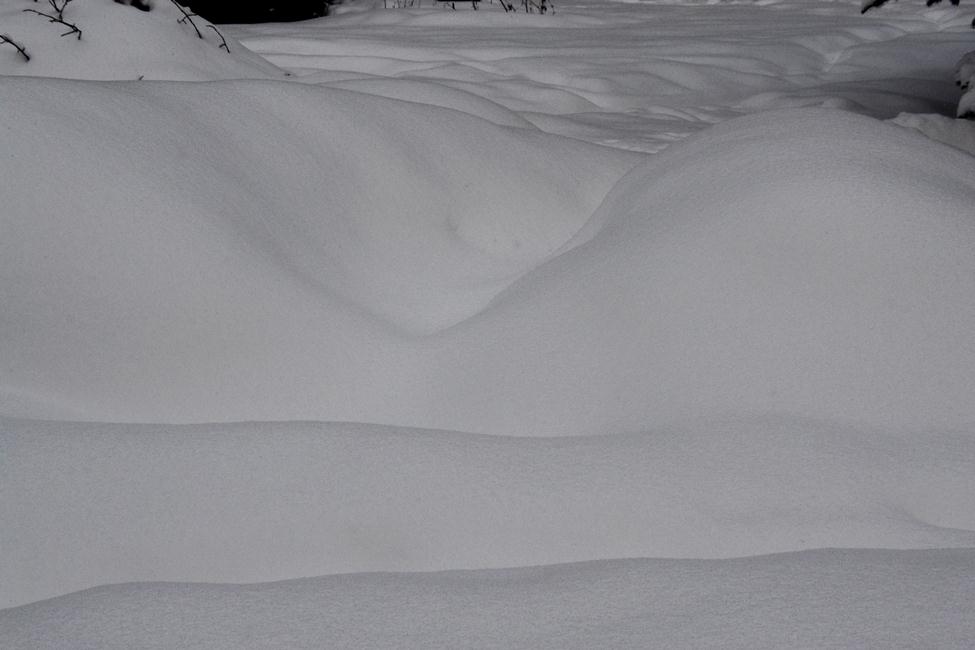
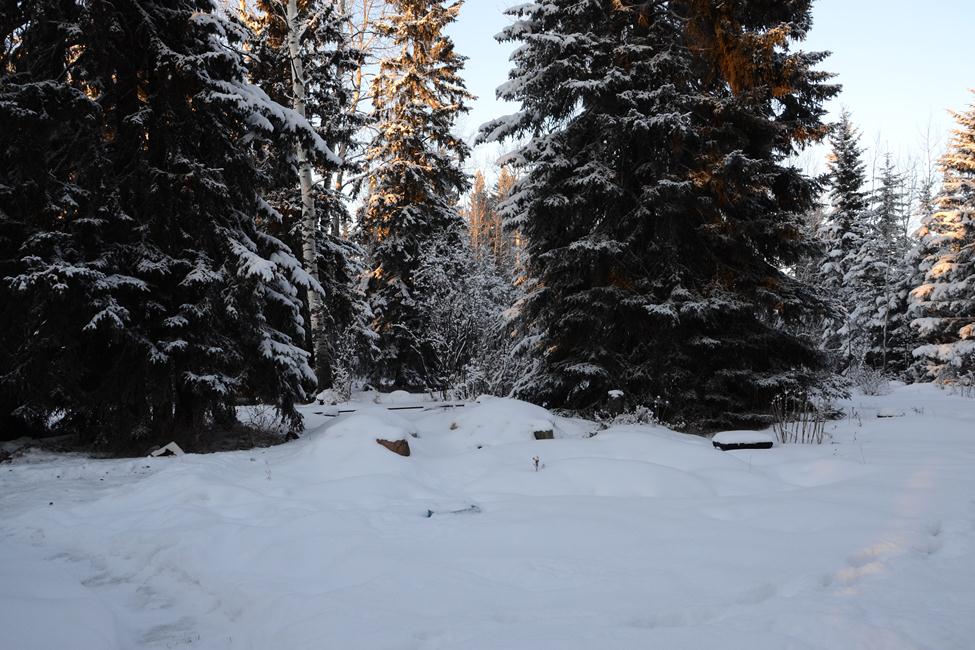
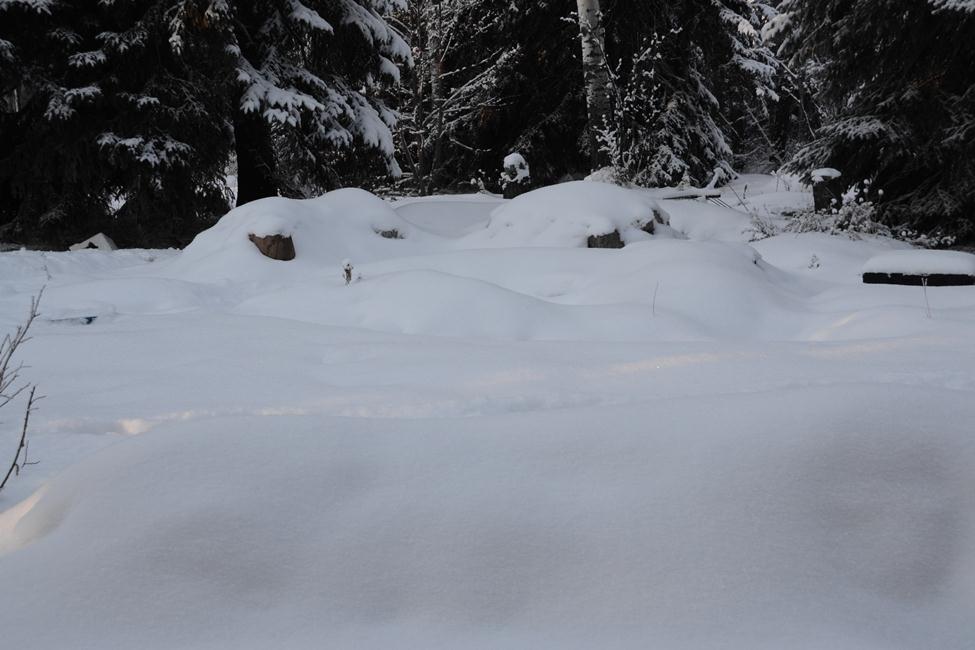
A couple views of some of my garden beds in the last couple of days-- not a whole lot to see! but you see some of the 'ridges' of the rock gardens and berms I've been developing, and looking at them this winter under snow, I've realised that these winter shapes should be taken into account at the design phase, since this is what I see for months at a time!
1-3 the rock beds in front of the house which get extra snow, being surrounded by shovelled paths; in #3 you can see a bit of the tallest Sempervivum flower stalk sticking through the snow still..
4,5 a couple of rock beds and berms in a different part of the acreage- these are in the moister part of the property, and (not counting the shovelling mentioned above) get the deepest snow
6,7 the third rock garden area, this is on the drier end of the property, and drier yet between the two large spruce trees- the two taller ridges have had the least snow cover of any of my plantings, so time will tell what plants that will favour (naturally, I am planting things that generally want to be drier in this area)

Comments
Trond Hoy
Mark, the pea is a Lathyrus,
Tue, 08/20/2013 - 10:03amMark, the pea is a Lathyrus, possibly L latifolius.
Richard T. Rodich
You still have lots of stuff
Mon, 08/19/2013 - 6:53pmYou still have lots of stuff going on in your garden, Lori. (No surprise.) I think you have a harder time with Synelesis because you are so much drier. Mine wilt even before the species impatiens do.
[quote=Lori S.]
Good grief, Rick! Shades of "Alien"!
[/quote]
That's kinda funny, 'cause I got to wondering... in the first close up photo, you can see the stolon had been severed quite a while ago, and I imagined the bulb keeping the stolon alive(!). But no: I broke the bulb open, and the stolon practically fell out, so I don't think there was any nutrient transfers.
Lori, your not going to convince me that you really think that is a hellebore seedling you photographed.... what is it?
Hellebore seedlings
Not to be confused with Angelica gigas
______________________________
edited for spelling
Lori S. (not verified)
RickR wrote:
Mon, 08/19/2013 - 8:33pm[quote=RickR]
Lori, you're not going to convince me that you really think that is a hellebore seedling you photographed.... what is it?
[/quote]
I'll post some better pictures when I get a chance. I'm pretty familiar with what's out there and with seedlings of same, but this one looks odd, which put me in mind of the Helleborus multifidus and H. caucasicus that are on the other side of the roses about 10 feet away.... beats me.
I haven't gotten the impression that Syneilesis has suffered for lack of water here (no wilting observed). Maybe both the lack of wilting and the late bloom are due to the fact that my plants are all in part shade, rather than full sun?
Lori S. (not verified)
Lori S. wrote:
Sun, 09/01/2013 - 7:01pm[quote=Lori S.]
I'll post some better pictures when I get a chance. I'm pretty familiar with what's out there and with seedlings of same, but this one looks odd, which put me in mind of the Helleborus multifidus and H. caucasicus that are on the other side of the roses about 10 feet away.... beats me.
I haven't gotten the impression that Syneilesis has suffered for lack of water here (no wilting observed). Maybe both the lack of wilting and the late bloom are due to the fact that my plants are all in part shade, rather than full sun?
[/quote]
Yeah, you're right, it's not a hellebore... probably a shoot of a nearby aster coming up and a case of wishful thinking.
Nice, Fermi!
Lori S. (not verified)
Rain, wonderful rain!
Sat, 09/07/2013 - 7:39pmRain, wonderful rain!
After a slow start, it's been a hot, dry summer with no significant rain since mid-July, so it's been a pleasant respite to have rain and drizzle since Friday. Only an inch so far, but better than nothing. After clear skies for so long, the cloud cover made it seem like 5pm when it was only noon - a bit disorienting, but then, I'm always wishing for more time, so it made for a long, luxurious day.
With the end of the season drawing near, almost everything that's going to bloom, already has... only late Telephium, Zauschneria and a couple others are still to come.
I forgot about these and was pleased to see them in bloom today - Monarda punctata
Clematis 'Blue Boy', needing a trellis now that the nannyberry (Viburnum lentago) has been removed for the sake of keeping the path open; California poppies; Gentiana clausa; Allium senescens var. glaucum (x2); Silene regia; Sedum/Hylotelephium maximum:
A bur oak acorn that the squirrels and jays missed...
What's happening in your neck of the woods?
Trond Hoy
Seems you still have high
Mon, 09/09/2013 - 2:07pmSeems you still have high summer, Lori!
Haven't been out in my garden lately but last weekend we were at our mountain cabin. There it is already fall but a few plants still stand up against the weather. However, we had warm summery weather in the weekend.
Although Centaurea scabiosa looks a bit tatty it is extremely cold hardy and flowers until it is covered by snow. Unbelievable it is a lowland plant!
Galium verum is usually yellow but a white flowered specimen has showed up amongst the yellow ones.
Also Tanacetum vulgare is a lowland plant which tolerates the climate here.
Gentanella campestris is very variable in size - the tiniest plants have only one or two flowers but the biggest have many!
Castilleja miniata flowers for the first time! Sowed in situ (seed from Lori - thanks!).
Trond Hoy
Saturday we went for a trip
Mon, 09/09/2013 - 2:31pmSaturday we went for a trip to look for the colours of fall.
The dwarf birch (Betula nana) often gets brown or yellow but some plants achieve a reddish tint in fall. The common birch (Betula pubescens) never gets red but yellow or orange.
The blueberry (Vaccinium myrtillus) leaves often have a nice red colour. The red leaves of cowberry (Vaccinium vitis-idaea) is coloured by a fungus.
The winner in the colour competition is as always alpine bearberry (Arctostaphylos alpinus).
cohan (not verified)
Rick- re: bulb pics- I took
Wed, 09/11/2013 - 10:45amRick- re: bulb pics- I took pics of various bulbs and roots when I was doing some planting last week, thinking of you, will try to post them...
Lori- still a wealth! We were dry mostly for August, but not as long as you, by the sounds of it.. and I definitely wouldn't call our summer hot..lol
That Artemisia really does look like a lichen!
Trond- your weedy garden pic definitely looks familiar...lol Actually the veg beds I planted this year, with the polyculture approach have had a similar chaotic overgrown look- more or less by design...lol
We were in the mountains last week- also looking like fall here at the highest points (fall seems to be starting early here too-maybe all the dry weather in August? and/or some chilly nights, but we had those even in July), and Arctostaphylos rubra was the most extreme colour there..
cohan (not verified)
Several years ago, I received
Mon, 09/16/2013 - 11:32amSeveral years ago, I received garden seed of several Pulsatillas from an SRGC member. There were supposed to be white, a couple of reds, etc- but of course with garden seed, you never know. They languished in pots for a couple of years before I finally got them planted out late last summer. Still small, several of them flowered this spring, just a few flowers; but alas, all pretty much standard vulgaris colours- albeit some a bit redder, and others lighter or darker- with varying foliage. Oh well, I like regular vulgaris too :)
Well, they've been flowering again since mid august or so- not sure if it's something about the weather, or just the fact that they weren't fully ready to go in spring, so had another go for fall. I was very pleased to notice the other day that I did finally get a white in the bunch :) Now I just need a real red, then on to some of the yellow species! (I've had seed, but no results :( And an average colour, these are from Sept 14.
And from Sept 05, a paler, more open flower.. and Aug 26, a darker one..
And a couple from Aug 21
I think there was a redder one yet, but no more time to dig for photos now!
Mark McDonough
Hi Cohan, getting some nice
Mon, 09/16/2013 - 12:28pmHi Cohan, getting some nice Pulsatilla plants there. I only have one, that I grew from seed from a SRGC Forumist in Germany, it is P. vulgaris 'Red Cloak" or in German 'Rote Gloche', as it was sent to me I have it as 'Red Gloche', a bit of English and German combined . It's a really good strong red color. I believe I still have lots of seed (I should check before I make the offer), but I'll try and find where I put it. Interestingly enough, the fellow from Germany since lost his red Pulsatilla, and I was able to send him some fresh seed.
Pulsatilla vulgaris 'Red Cloak' taken mid April 2013.
cohan (not verified)
Thanks, Mark- the subtle
Mon, 09/16/2013 - 11:53pmThanks, Mark- the subtle variations in my lot are better appreciated in a post like this, since those flowers appeared mostly singly over several weeks- not that I'm complaining for late summer/fall bloom. I'm hoping they will put on a nice show in spring.
That is a great red! The best I had was a slightly redder violet (I think maybe the dark flower in the post above was my reddest- at least I haven't found any other redder photos)- in spite of seed labelled both rubra and rosea. Interestingly, there was slightly different foliage on each batch, but the flower colours didn't come true. I may yet be surprised- I think they've all flowered, but I thought that before the white popped up.
If you do still have seed, it would be appreciated, thanks.
Mark McDonough
Cohan, I found my seed, send
Tue, 09/17/2013 - 7:07amCohan, I found my seed, send me a PM with your mail address and I'll send it along. If any others want some, I'm happy to share. And, since it's the only Pulsatilla in my garden, the seedlings should come true to color.
Richard T. Rodich
And those were only blue
Mon, 08/19/2013 - 6:55pmAnd those were only blue grass stolons, not the real vigorous ones of Quack grass or other "wild" grasses!
Trond Hoy
I can't match the flower
Tue, 08/20/2013 - 12:15pmI can't match the flower power of Lori but I can compete with Mark in weeds! Here is my former kitchen garden after 2 years of neglect. I had planned to do a renovation but hasn't started yet.
Most rockery subjets have finished their season and larger "cottage garden" plants have taken over like these.
Hydrangea aspera x2 The Hydrangea is about 3x3x3m in size now.
An unknown lily Rhododendron bureavii brightens the shady woodland even without flowers
Anemone hupehensis is almost a weed but I like it!
Trond Hoy
Another weedy genus is
Tue, 08/20/2013 - 12:30pmAnother weedy genus is Impatiens. I balsamifera spreads everywhere and the tallest plants are about 3m. I have another species or form, very similar to balsamifera but earlier and shorter. The unknown yellow one (neither noli-tangere nor pallida I believe) is more modest both in flower and size. They are all annuals - and I like them!
I have several colour forms of I balsamifera
The smaller form has only one colour
The yellow one
Lori S. (not verified)
Very nice, Trond. The rhodo
Wed, 08/21/2013 - 9:33pmVery nice, Trond. The rhodo is especially intriguing, given that any rhodo is a rarity here.
Lori S. (not verified)
Adenophora sp.; Solidago ex.
Sun, 08/25/2013 - 7:26pmAdenophora sp.; Solidago ex. 'Goldkind'; Salvia glutinosa, a massive plant; Echinops ritro:
Late dayliliy 'Cherry Cheeks'; Sedum 'Frosty Morn'; Eryngium planum:
Seedheads of Clematis occidentalis v. grosseserrata, looking like they should be hanging from a rear-view mirror; Aconitum lamarckii; Aconitum albo-violaceus, a twining monkshood; Artemisia versicolor 'Sea Foam', looking to me like caribou moss(lichen):
Solidago 'Crown of Rays'; Ratibida pinnata; Carlina acaulis, now open; clouds of flowers on Gypsophila oldhamiana; Clematis 'Pamiat Serdtsa' with Telekia speciosa in the foreground;
Richard T. Rodich
Deinanthe caerulea. Seeds
Sat, 09/28/2013 - 10:07amDeinanthe caerulea flowers in early and mid July. Seeds aren't ripe yet. The dried capsules photo is from a previous year.
First bloom from a seedling Gladiolus flanaganii. Not like it should be, but it's a start.
I was weeding a few weeks ago, and found that Convallaria majalis 'Aureo-striatum' had set seed. Wondering if it was even worth growing the seed, I decided to let it develop, even though it is a probable chimera. I reasoned that since the cultivar is so prone to reversions and varying stripe color intensity from year to year and also (apparently) due to microclimate, that maybe such diversity might show in seedlings anyway. Thoughts, anyone?
And who knew (at least not me) that the berry turns a decorative orange color?
cohan (not verified)
Interesting, Rick- the
Sun, 09/29/2013 - 11:43amInteresting, Rick- the Deinanthe would probably have trouble setting seed here, unless it didn't mind cold- while still having some nice-if cool- days, we've had some good frosts- Rocky Mountain House - my nearest weather reports- have already had a couple of nights of -6 to -8C, we are presumbably a couple of degrees warmer, but the really tender stuff is mostly done. Always fascinating to see natives/alpines etc still growing and flowering after those nights that turned the tomatoes, squash, beans, potatoes etc to mush.
The Convallaria berry reminds me of Maianthemum- their berries are green then very nicely speckled with dark , going sort of golden before finally hitting red when they are really ripe- and they ripen late in spite of early flowers.
externmed (not verified)
RickR wrote:
Tue, 10/01/2013 - 8:33pm[quote=RickR]
found that Convallaria majalis 'Aureo-striatum' had set seed. Wondering if it was even worth growing the seed, I decided to let it develop, even though it is a probable chimera. I reasoned that since the cultivar is so prone to reversions and varying stripe color intensity from year to year and also (apparently) due to microclimate, that maybe such diversity might show in seedlings anyway.
[/quote]
A lot of variegated Clivia are grown from seed. Non-variegated fruit usually yields non-variegated plants. Variegated fruit will yield a percent of variegated plants. Some may be 100% albino and die. Since Convallaria from seed is likely a more daunting process, you'll have to decide if it might be worth the effort.
Lori S. (not verified)
Nothing much happening here..
Sun, 10/06/2013 - 9:15amNothing much happening here... a prolonged frost Friday morning made for the following photos of, well, frost on stuff, I guess.
Hops; cliff green, Paxistima canbyi; fern, Dryopteris filix-mas 'Undulata Robusta'; this snowberry, Symphoricarpos x doorenbosii 'Marleen', has the most berries ever this year, which is still very few - sort of a pointless bush, really:
Ajuga reptans and a self-seeded Hacquetia epipactis; bog birch; twinberry, Linnaea borealis and a blueberry that has survived from an optimistic, long-ago planting; Betula apoiensis:
Salvia tchihatcheffii; Arenaria pseudoacantholimon; Hypericum aviculariifolium ssp. uniflorum; Marrubium lutescens, looking like a terry-cloth towel;
Geum 'Beech House Apricot'; Onosma euboica and thyme; Echinops ritro; mountain ash,Sorbus sp. or hybrid(?):
More terry toweling - Stachys byzantina; poplars in the park, against the autumn sky; colours in the front yard:
cohan (not verified)
Nice shots, Lori- frost is
Sun, 10/06/2013 - 11:27amNice shots, Lori- frost is always pretty, if you don't think about it too much...lol no point worrying about cold weather here anyway, there will be plenty... I'm not usually outside in early morning, but was out the other day a bit earlier, and saw some heavy frost on things that have been fine so far, though all tenders have frozen. Amazingly things that looked limp and (I thought) black and covered in frost were fine later- like the sub/alpine Violas that have been blooming for months, Plantago major rubra etc.
A couple of things managing flowers in spite of repeated frosts:
Campanula Get Mee (portenschlagiana) boy do I hate florist names! This was just planted out this fall, and the foliage loss I think is still from transplant rather than frost.. Still making a few flowers...
Received as seed of Polemonium boreale - it does look like some cultivars I've seen, but not, unfortunately, like the dwarf arctic forms I was hoping for. It's probably around 30-40 cm tall. I moved one from this rock garden (where they are way out of scale) to a berm where it will be more appropriate, and left this one for this year to make sure I got ripe seed in case they didn't like being moved. they've been blooming non-stop since spring. I also had a couple of plants in a more xeric rock bed, and those plants are maybe a tenth the size, but still generally tall and skinny, not low-growing like the beautiful plants you see in photos from Svalbard. Still, a great flowering plant for a different kind of bed.
cohan (not verified)
Tomatoes, squash, potatoes
Sun, 10/06/2013 - 11:52amTomatoes, squash, potatoes etc are long frozen (though I still have more potatoes to dig), but some things in the veg plantings are still looking good, like lettuce, kale, gobo, etc. Quinoa is somewhere between, not sure if I will get a harvest or not- need to get them in earlier next year! I've been very impressed with many of the lettuces, which have been beautiful all summer, and still looking great!
An Artemisia, probably Artemisia frigida, this one from Southern Alberta. It hung on in a pot for several years till I finally got it planted in a dry berm last fall. vegetative growth is quite low-maybe 10-15cm at a guess, but flowering stems are much longer and sprawling. Tends to be more compact in habitat, but flower stems are still longish there.
Wild plants on the acreage, Rubus idaeus and a Ribes sp
Mark McDonough
Lori, fine frosty photos
Sun, 10/06/2013 - 3:48pmLori, fine frosty photos there, particularly stunning impression of Echinops ritro. No frost here yet, the coldest it has been is 39 F (4 C), still sleeping with windows open most nights. Frosted Salvia tchihatcheffii and Marrubium lutescens look compelling as well.
Cohan, your Artimisia photo is a reminder to me, to grow some artemisia, love the silver or gray foliage on them. I like the informal look when the shower of stems flop about. I have but one very tall one, that I got at a New England NARGS seedling sale, raised from NARGS seed as Youngia yoshinoi, a Japanese relative to Prenanthes, but it turned out to be an Artemisia sp, tall stems to 3-4', and many danging "brushes" of a rusty red color and autumn foliage that turning orangish, debating whether to discard it, or plant someplace where it'll make a big perennial accent.
Lori S. (not verified)
Lovely subtle colours there,
Sun, 10/06/2013 - 3:54pmLovely subtle colours there, Cohan. I'll have to look up what "gobo" is and what you do with it!
That Artemisia sounds intriguing, Mark. Could you post a photo of it sometime, please?
Mark McDonough
Okay, here goes, four photos
Sun, 10/06/2013 - 4:25pmOkay, here goes, four photos of Artemisia - tall species (received as Youngia yoshinoi), photos are not very good, I know I have better pics someplace, but probably didn't rename them for searchability.
Artemisia species:
Also found in my images search, is Artemisia caucasica in Peter George's garden in May 2010, pure silver mound
cohan (not verified)
That does look like a nice
Sun, 10/06/2013 - 4:39pmThat does look like a nice Artemisia, Mark, just in need of the right spot and/or companions.. If you are interested in frigida, I presume my plant should be producing piles of seed..
A. caucasica is nice too- is that the full extension of the flowering stems, or are they just budding?
Lori- if you haven't looked it up already, Gobo is the Japanese vegetable for (the root of) burdock, Arctium lappa. This is my first time growing it, and I have never eaten it...lol I have to remember to look up whether I am supposed to harvest this first year, or wait till next fall.. I don't think the roots are very big yet, though, from the bit i saw of them while digging other stuff..
I'll eventually post a series of the new veg gardens this year- they were fun to look at, but harvests varied-- I was trying the polyculture approach, and definitely wins and losses from that- just too much shade for some plants, esp since few spots on my property are really full sun morning to night. I'll need to do more studying and rethink some things for next year. Also, because I was building beds so long, many things were planted a bit late, and this climate doesn't leave much room to manouever ...
Lori S. (not verified)
The photo of Artemisia
Sun, 10/06/2013 - 5:48pmThe photo of Artemisia caucasica seems quite different from what I am growing under the same name. Different forms of the same species? Perhaps, although the inflorescences look quite different too. Who knows?
Here's what I grew in 2012 from M. Pavelka seed (description: "1700m, Ala Dag, Turkey; dwarf silver cushions, 10-15 cm, mountain steppe, 2008 seed"). The plant is 2.5cm tall, and the flowering stems are up to 23 cm tall. I wonder if the "10-15cm" in the description was meant to be the plant or the flowering stems?
It seems lately that every time I look at one of my plant photos, I start to wonder if it's identified correctly.
Mark McDonough
Lori, your Artemisia
Sun, 10/06/2013 - 5:59pmLori, your Artemisia caucasica does seem quite different (and I'm loving it, what a great looking species), even the yellow discoid flowers are attractive. I would err on the side of your seed source being of known M.Pavelka collected provenance; not sure what the source is on Peter George's plant is, whether collected seed of garden original, but I like both. Maybe Peter will comment on his plant source. Cohan, since my photograph of Peter's plant was taken in May, the flowers are just starting to form, it might look rather different by the time the stems and flowers fully expand.
Lori S. (not verified)
That's a handsome mystery
Sun, 10/06/2013 - 6:09pmThat's a handsome mystery Artemisia, Mark. The stems look very graceful, and nice fall colour to boot!
I appreciate the info on "gobo", Cohan. I had not yet looked it up.
Fermi de Sousa
Hi Lori,
Mon, 10/07/2013 - 4:54amHi Lori,
that looks what I think is Artemesia caucasica as does Mark's pic of Peter's plant. However it's been grown in Australia as A.schmidtiana nana for decades! The true A.schmidtiana nana is apparently fully herbaceous while the imposter is shrubby with seasonal, non-perennial growth. Personally I find the flowering a pain in the a**! Because after it flowers the mat looks extremely dreary till it gets sheared down. I still love it because it looks great for the rest of the year and makes a great ground-cover for bulbs to grow through.
Cheers
fermi
cohan (not verified)
Nice Artemisia, Lori!
Mon, 10/07/2013 - 11:36amNice Artemisia, Lori!
Rick, I have tended not to pay a lot of attention to flowering of A frigida in habitat- I guess partly because the flowering is often spotty in the dry places I usually see it, the flowering stalks can blend in with surrounding grasses etc.
Here are a few views from the Kootenay Plains in Western Alberta, Sept 04, this year.
1) Artemisia frigida, Arctostaphylos uva-ursi, Juniperus 2) A frigida with Juniperus 3) A frigida on a river bank
4)A frigida again, in an extra dry spot 5) A different Artemisa.. I haven't looked at names, but I think this one also occurs over quite a range, occurring in one spot I've seen in my area. If I recall correctly it is a fair size in flower, and not mat forming like frigida..
Richard T. Rodich
Well, "gobo" was on my list
Sun, 10/06/2013 - 7:24pmWell, "gobo" was on my list to ask about, too. Glad you cleared that up, Cohan. "Gobo" doesn't sound very Japanese to me, though.
Frost photos always accentuate detail, but sometimes you never know what details might be the outcome until it happens!
Lots of great pics, everyone! I think I have always missed the actual flowering of Artemisia frigida here. It doesn't grow anywhere nearby that I know of.
Richard T. Rodich
We have the same or similar
Mon, 10/07/2013 - 6:34pmIn the wild, we have the same or similar to your last pic, too, Cohan.
No idea what it really is, either.
cohan (not verified)
I find the leaves very
Mon, 10/07/2013 - 10:17pmI find the leaves very attractive, almost succulent.. in the Kootenay plains, it probably tends to disappear among a lot of silver plants, and the one place I've seen it nearer home they seemed a bit sparse if I remember them right.. should dig for a pic..
Hmm, so much for memory- this, I'm pretty sure, is the Artemisia closer to home, and in this pic it doesn't look anything like the one above...lol.. So either I was mistaken that I'd seen it before, or it was somewhere else (other than in the same area as the pic above).
This site is about 10-12 miles from home, but a spot with some atypical sandy soil and plants usually seen a bit farther west.. near Alhambra, Alberta
Fermi de Sousa
A colorful combo in the rock
Mon, 10/14/2013 - 12:07amA colorful combo in the rock garden - a late flowering tulip (labelled Tulipa aff sprengeri but not close!) a Californian Poppy and a Dichelostemma (possibly D. multiflorum?)
cheers
fermi
cohan (not verified)
That's a cheerful grouping :)
Mon, 10/14/2013 - 11:50pmThat's a cheerful grouping :)
On T sprengeri- any idea how large bulbs need to be to flower? I just planted some out this fall from seed maybe 2009ish, but having been left in pots and probably not fed enough, the bulbs were still very tiny!
Longma (not verified)
What do you see on your
Tue, 10/15/2013 - 6:05amWhat do you see on your garden walks?
Not what I wanted to see today I'm afraid . We've had some heavy rain and strong winds over the past few days, and one of our great old Willow trees had partially succumbed.
cohan (not verified)
Sorry to hear! Will the rest
Tue, 10/15/2013 - 10:34pmSorry to hear! Will the rest be safe/stable?
Longma (not verified)
I'm hoping so Cohan, but
Wed, 10/16/2013 - 5:35amI'm hoping so Cohan, but since I took the picture the wild weather has returned and I haven't been able to climb in to check it all out. The good thing is that there are no buildings in that area of the garden so no chance of damage of that kind.
cohan (not verified)
We're having some fall wind
Thu, 10/17/2013 - 11:46amWe're having some fall wind too, but nothing drastic..trees will be pretty much bare after this though..
Lori S. (not verified)
More fall colour - what else
Fri, 10/18/2013 - 8:19pmMore fall colour in some photos from last week and today - what else at this time of year here? ..... though its days are numbered! Can't complain, as fall has been very mild and extended this year.
Rosa spinosissima and Rosa rugosa hybrid/cultivar (one in the 'Pavement' series):
Orostachys iwarenge; Rheum delavayi, chewed by something - there seemed to be a lot more plant-munching insects around than usual in this warm summer; Eriogonum umbellatum; Anemone trullifolia v. linearis:
Primula scotica; Androsace sp.; Colchicum autumnale; Carlina acaulis (x2):
Gillenia trifoliata; Rhododendron mucronulatum 'Crater's Edge'; Sempervivum in 'Schubert' chokecherry leaves; Arabis procurrens 'Variegata':
cohan (not verified)
Looking good, Lori, lots of
Fri, 10/18/2013 - 11:27pmLooking good, Lori, lots of colour. The native trees here are mostly bare now (except tamaracks, which are the latest of the natives to turn colour and drop leaves), though shrubs etc still have leaves/colour.
Richard T. Rodich
Oh my, Lori, how come we
Sat, 10/19/2013 - 6:49pmOh my, Lori, how come we haven't seen that first pic vista before! It looks as though you planned it for fall colors!
The three lobes at the end of the leaves in Anemone trullifolia v. linearis is pleasingly different.
Lori S. (not verified)
RickR wrote:
Sun, 10/20/2013 - 5:16pm[quote=RickR]
Oh my, Lori, how come we haven't seen that first pic vista before!
[/quote]
Well, you have... not that I would expect anyone to remember from year to year, though!
Looks like the seed-starting has really paid off, Cohan! There is still a little (very little) scattered bloom here - Phlox paniculata 'David', Geranium 'Patricia' and G. sanguineum, various campanula, Monarda punctata, etc.. Campanula persicifolia is one of the most vigorously blooming... I was actually actively weeding these out up until last year (sorry, Mark!) but they've grown on me again since then and I've appreciated them all summer and now well into late fall.
Here's another oddly late-blooming penstemon, P. whippleanus:
Another Arabis photo... just because I liked it. The plain-foliaged one was bought as Arabis x sturii; however, I now see that this is an invalid name. The leaves are similar to, though not quite like, Arabis procurrens 'Variegata' on the right in the photo - wonder what it is?
Geranium sanguineum... well-named... and Veronicastrum virginicum; some colour on Saxifraga cotyledon; Euonymus alatus; Colchicum 'Waterlily'... an old plant, but down to one flower again after a couple of hard winters:
cohan (not verified)
Some shots from Oct 09..
Sun, 10/20/2013 - 12:46pmSome shots from Oct 09.. nothing has changed too drastically, except for most trees having dropped leaves... same things still flowering, mostly, though gradually declining with repeated frosts-- there had already been many frosts when these shots were taken...
I've mentioned this Polemonium, and think I've shown it? Received as seed of Polemonium boreale, sown spring 2012,- which it could be, looks like some forms, but not the nice flat Svalbard type, for example :( Plants are 30-40cm tall, and by the end of the season as wide, in this mesic planting, maybe only 15-20cm in a dry bed, and only a couple of flowering stems, but still too vertical there. I'm moving them from rock gardens proper to berm plantings (and may try naturalising in a semi-dry spot) but left this plant to be sure I got seed (tons). the first photo I can find of it flowering is mid June, so that is over 4 months flowering, with no stop.. Too big for the rock garden spots I gave them, but well worth growing... Hummingbirds were visiting this plant in view of my front window, this summer. If there are volunteer seedlings at the base of the rock garden, might leave a couple...
Viola elegantula; grown from seed spring 2012. Wow- these have been flowering since mid May, I think, and while not quite in their prime now, still flowering after numerous frosts and temps down to around -6/-8C. Hard to get the exact colour, it is a very red-violet shade. From a few small seedlings planted out last summer, they have grown to cover maybe a meter squared or close... In fact a little too vigorous for the rock garden proper (notice a theme here?) but I didn't have anything else planted in that area for it to overwhelm, so no problem. It will get shifted to a berm or base of the rock garden.. Not sure how perennial the plants will be, but there will be millions of seedlings for sure, even though I've collected quite a bit of seed. I didn't take any shots on that day (though V lutea is part of the mass in the overview shot), but V lutea and V aetolica are also still going- aetolica started earliest, in early May.
cohan (not verified)
Still on pics from Oct 09.
Sun, 10/20/2013 - 1:14pmStill on pics from Oct 09. Another one that has been flowering since June, though the main flush was early, and a bit of another stronger burst in fall, Penstemon procerus. Not putting on a strong show now, but still nice to see a few flowers.. The overview shot is after I cut off old flower stems to collect seed.
Definitely looking raggedy here, but this self sown wild Erigeron philadelphicus ( I think) has definitely impressed this year- funnily, it sprouted on the edge of what is supposed to be a xeric bed, but from this plant's success (prefers mesic-moist habitats in nature), maybe not xeric enough! In the wild here, these plants have a short bloom period in early summer, but this plant has been flowering for months, proving to be one of those that do much more in the garden than in the wild. Rather floppy, but I think among other plants of its height it would be better. Classified as biennial to short-lived perennial, we'll see what it does, though in any case, I'm sure I will have its progeny coming up by the dozens, even though I tried to collect as much seed as I could remember to.. I'll have to plant some in a more suitable spot...
cohan (not verified)
Thanks, Lori- I do have some
Sun, 10/20/2013 - 11:17pmThanks, Lori- I do have some nice things from seed, and those that have germinated have done so mostly in good numbers, though I have to say the percentage of species that have germinated compared to those I've sown is not so high as I'd like.. oh well, room for improvement!
I thought P whippleanus sounded familiar as a dark flowered species I'd looked at on Alplains list, but not got yet. He mentions the seed is from an extra dark flowered population, dark purple to black- check out his photo:
http://www.alplains.com/images/PentWhipple.jpg
That G sanguineum really is red! I have a G sanguineum album, which so far is only turning yellow...
cohan (not verified)
Now a few just for foliage
Sun, 10/20/2013 - 11:48pmNow a few just for foliage colour..
Here's an irony- native Alberta Monarda fistulosa, but I don't see it in my area, got the seed (wild collected in Alberta) from Kristl in Nova Scotia...lol. The seedlings were planted out late summer, we'd already had some cool nights near freezing (but then, we did all summer) and they had great colour already, and still do many weeks later.. I built an area specifically for these (with some other natives), connected to other dryish berms and rock gardens for mostly native/nativish plants, where I hope they will establish a nice little colony..
Sibbaldiopsis (Potentilla) tridentata; also from Gardens North seed, but I actually sowed this last year at least, but there was no germination till this year, rather late, when I wasn't even paying attention to that pot anymore!.. Just a few, but that should be enough to get a patch started.. also planted in the dryish native berm area..
This native does grow nearby- in fact my plant comes from a rescue on a bit of land between my driveway and the neighbour's access to a pasture- land that technically belongs to a road allowance, with no indications that road will be built (hope not). During roadwork nearby last year, a backhoe driver stopped in to ask if it was okay for him to park his machine there overnight- of course I have no legal right to say yes or no, he was just being nice, and I said yes, of course, I immediately went for my shovel when he left, since I'd been watching this Potentilla in that spot for a couple of seasons, meaning to get seeds and/or transplants from it- it is very occasional in my area, I just see single plants here and there, miles apart. Knowing he'd like destroy it driving over it, I dug up a good chunk of it and transplanted it to a semi-cultivated spot near the native rock garden. I think it is Potentilla gracilis.. this just shows a couple of leaves with nice, if subtle, fall colour. (the red leaf behind is a wild strawberry which came with the transplant, and grows all over my property anyway..)
Another Rosaceae- Sorbus reducta; these are from seed a couple of years ago, I'd have to check, but they've been planted out I think 2 winters already, looking healthy, but not fast! I have them in a couple of different spots (at the drier and moister ends of the property) and not much difference...I'd estimate the tallest plants are maybe 15cm, 20 at the most..... It is a small species, but still has a way to go... Pretty fall colour, we'll see if that carries on as they get bigger... I'll have to show a pic from the other planting when I find it- those ones may be even a slightly darker burgundy/plum.
David L (not verified)
A quick change of hemispheres
Mon, 10/21/2013 - 2:26amA quick change of hemispheres and seasons. Very much a contrast with Alberta.
Here are a few things I photographed in my garden yesterday. First a selection of Celmisias that are flowering at the moment; a hybrid Celmisia semicordata x C. gracilenta from Hokonui Alpines, Celmisia walkeri, a second hybrid possibly Celmisia brevifolia x C. hectori from Hokonui alpines and Celmisia brevifolia .
Next, Anisotome haastii also now in flower
A specimen of Melicytus growing in a pot (not Melicytus alpinus but something else - it is a specialised form found in screes) It is also in flower but I doubt whether anyone will be able to see them.
Myosotidium hortensia the Chatham Island forget-me-not.
Clematis paniculata, a New Zealand native growing through Coprosma virescens. It is quite common in the forests around Dunedin and is grown widely on gardens as well
Last perhaps a more familiar plant to many of you Rhododendron 'Lem's Cameo' just beginning to flower.
Pages