
We are 11 days late on this topic!
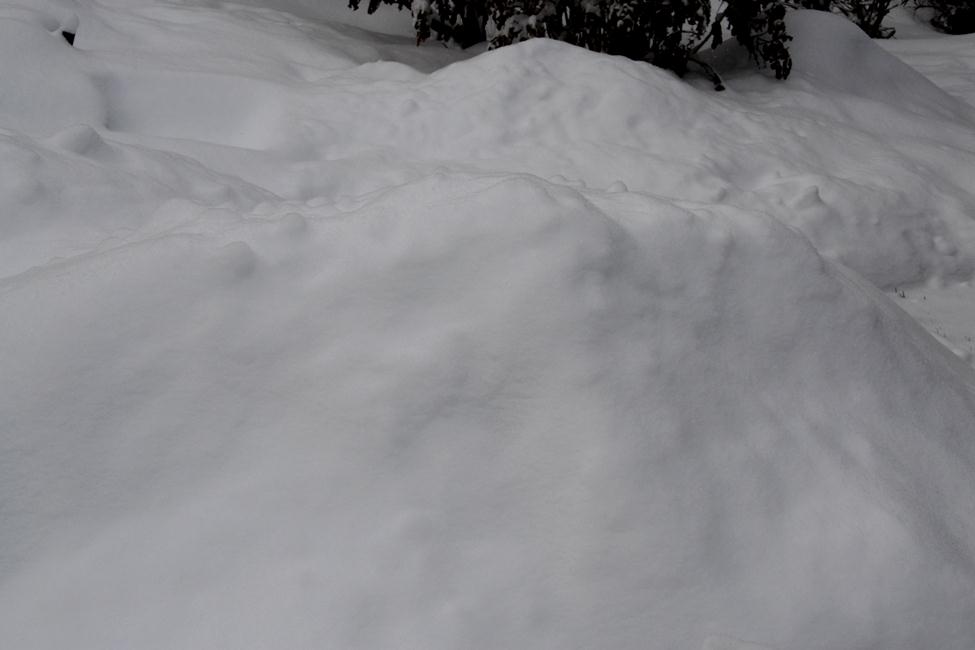
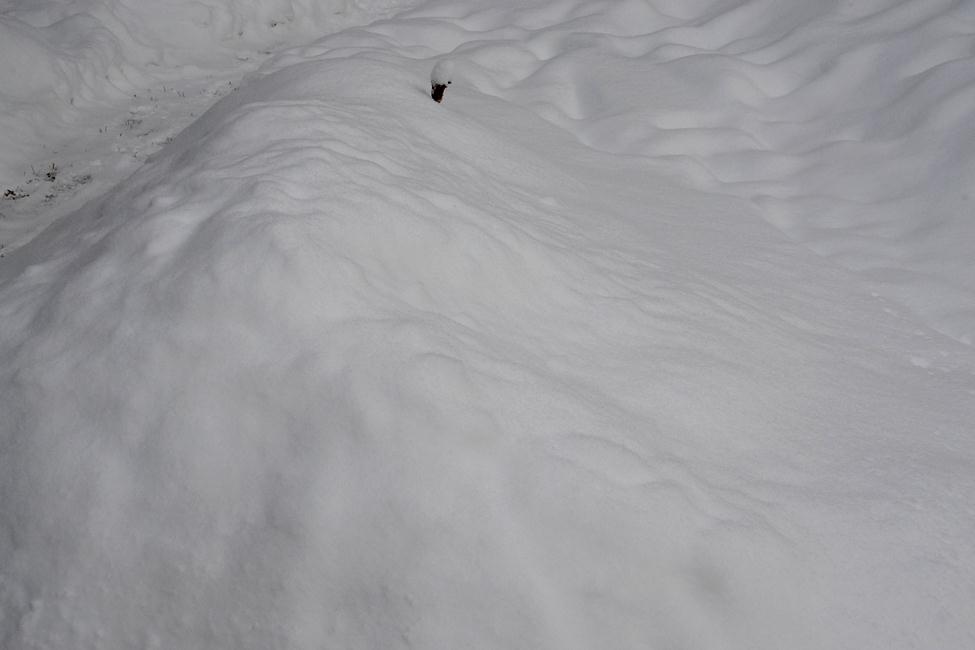
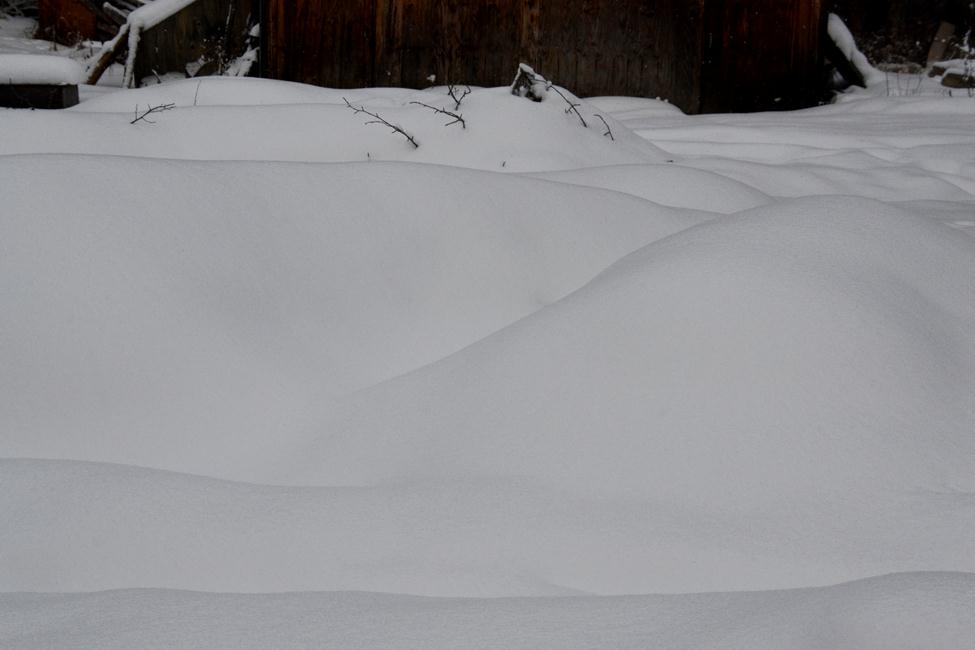
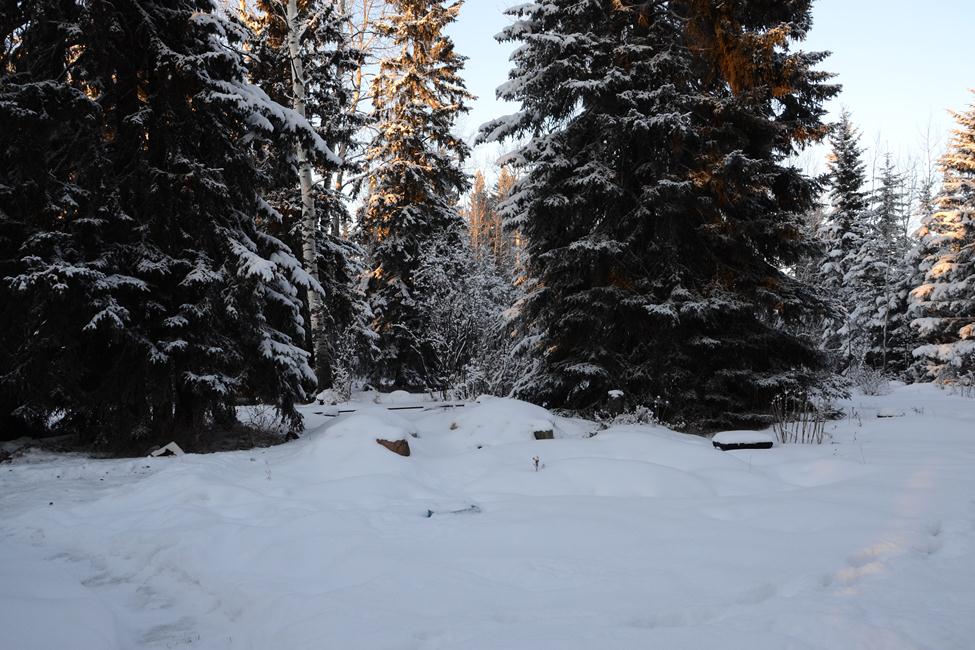
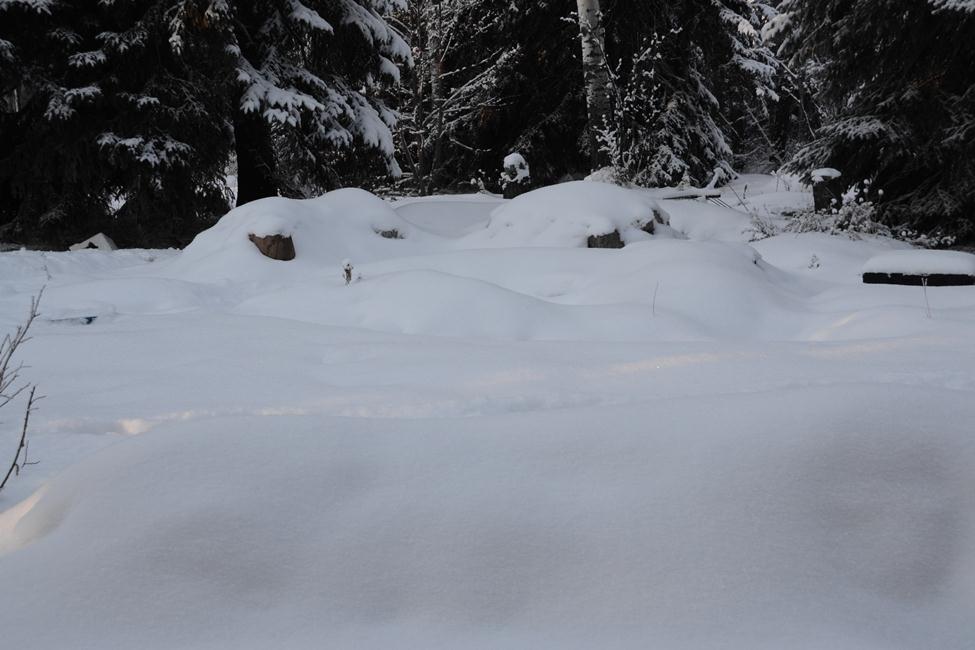
A couple views of some of my garden beds in the last couple of days-- not a whole lot to see! but you see some of the 'ridges' of the rock gardens and berms I've been developing, and looking at them this winter under snow, I've realised that these winter shapes should be taken into account at the design phase, since this is what I see for months at a time!
1-3 the rock beds in front of the house which get extra snow, being surrounded by shovelled paths; in #3 you can see a bit of the tallest Sempervivum flower stalk sticking through the snow still..
4,5 a couple of rock beds and berms in a different part of the acreage- these are in the moister part of the property, and (not counting the shovelling mentioned above) get the deepest snow
6,7 the third rock garden area, this is on the drier end of the property, and drier yet between the two large spruce trees- the two taller ridges have had the least snow cover of any of my plantings, so time will tell what plants that will favour (naturally, I am planting things that generally want to be drier in this area)


Comments
Anne Spiegel
A fairly quiet time in the
Sun, 08/11/2013 - 11:05amAnne Spiegel
When the NARGS Forum got
Sun, 08/11/2013 - 11:15amWhen the NARGS Forum got changed my saved password disappeared and it took a while to get a new passsword only to discover that the method for putting pictures on had changed as well. I couldn't seem to attach pictures to the text. I hope someone can talk me through it. The pictures above are of Collomia debilis (just finishing a long bloom season) and Zauschneria californica 'etteri', a very splashy deep red-orange and just starting to flower. It's the earliest of the Zauschnerias and the hardiness is still a question since last two winters were non-events. Pictured below is the lovely Daphne velenovskyi 'Balkan Rose', starting to rebloom.
Lori S. (not verified)
Mmmmm, Collomia - another
Sun, 08/11/2013 - 11:51amMmmmm, Collomia - another genus to add to the wish list!
Things are looking great there, Anne. Thank you for persisting with the photo posting - looks like you succeeded!
I can give you a brief tutorial here if you like:
Embedded Images
If you want to place photos amongst the text, click on Embedded Images, below the text box.
Then choose the photo from your hard drive (Choose File), and click Upload. You will see that a thumbnail of the photo appears.
Then the next step is to return to the Message box, and place the cursor where you want the picture to be. Then go back down to the photo, and click on Insert. The photo will appear in the Message box where you had placed it via your cursor.
If it is not in the right place, you can click on the photo and move it. Or you can highlight the mis-placed photo in the Message box and delete it by pressing "Delete" on your keyboard. Then, you can place it in the correct position by moving your cursor there and clicking Insert again.
If you decide you don't want to post that picture at all, click Remove (otherwise the photo will show up at the bottom of your posting.)
You can see that once you upload a picture, an area below it opens up that allows you to "Add a new file". So, this allows you to add your next photo.
When you are done, click Save to publish your posting. Or you can click Preview, to look at it again first, prior to clicking Save to publish it. In any case, you can go back and Edit your post afterwards (so Preview is not really necessary).
Image Attachments
This feature works about the same, however does not give you the ability to place the photos where you may want them among the text lines. Instead, the photos are all just posted at the bottom of your posting.
Again, Choose File to select the photo you want to post, then click Upload.
Note that you will not see the photos in the Message box until you actually click Save to publish your posting. Then, if you go back to look at your posting, you'll see the photos there.
Again, if you decide you don't want to post that photo after all, click Remove.
Hope this helps.
Lori S. (not verified)
RickR wrote:
Mon, 07/22/2013 - 8:51am[quote=RickR]
Asclepias tuberosa and Amorpha canescens seedlings
[/quote]
Only one of the many Amorpha canescens seedlings I planted in 2011 has survived. Now in its third year, it's only about 3" tall! It's probably just as well, since I planted this one next to the tufa garden (with the idea of dotting them around to try out a range of conditions) - not the proper place for it if/when it decides to put on a burst of growth. I'd best move it soon.
Love the Verbascum, Ron! Is it a perennial or a biennial?
I weeded out what I think is a peach seedling... of course, I wouldn't know a peach from a palm tree ;-) ... can any of you from peachier areas confirm its ID?
After an extremely heavy first flush, DH's roses in the greenhouse are setting up again. 'Dolly Parton':
Adenophora remotiflora f. album, a rather spready and floppy thing, even amongst the competition in the border; Lallemantia canescens; Symphyandra zanzegur; the first of Delphinium grandiflorum, which will be blooming en masse soon; a white-flowered Verbascum, possibly Verbascum chaixii 'Album' but not sure what sorts of cross-pollination have gone on over the years!
Campanula persicifolia 'Moerheimii'; Potentilla fruticosa Abbotswood':
Lori S. (not verified)
Please feel free to post
Tue, 07/23/2013 - 6:30pmPlease feel free to post photos of your garden or other sites here! (In fact, I beg of you to do so... I'm getting tired of only seeing my own postings on this forum!! ;-) )
Cyclamen purpurascens, starting to bloom:
And its arch-enemy (well, competitor for space and sunlight, anyway), Codonopsis clematidea, which would like to take over the area and whose seedlings I pull out by the score (I still like it though):
Richard T. Rodich
Asian Arisaema are always
Thu, 07/25/2013 - 12:26amAsian Arisaema are always late emerging for me, but this is a new record -
Arisaema consanguineum (I think), July 18th!
I had my suspicions when I found this unusual thistle growing in the garden last season. Care to make a guess at the identity?
It is Onopordum acanthium. Scotch thistle is a European invasive that has made it to Minnesota. This is the first time I've seen it.
One would expect the seed heads to be spreading the seed by now, but everything was still very tight.
But I'm taking no chances, and it's all cut down and disposed of now.
Ruellia humilis, Stachys monieri 'Hummelo' and Penstemon pinifolius. In the background you can see the Onopordum stem.
I allow two bristly annuals in the garden: a variegated Humilis sp., and Borage (Borago officinalis).
It's nice to be able to nibble in the garden. Borage flowers are edible and make a colorful addition to salads.
Deinanthe caerulea and a new qcquisition from our Chapter plant sale auction: bought as Deinanthe 'Blue Wonder', I think it is just Deinanthe caerulea (a different form). When I planted it, I pinched off the flowers, and it produced more! They must have been so tiny that I didn't notice.
Mark McDonough
Lori, I'm taken by your white
Thu, 07/25/2013 - 6:02amLori, I'm taken by your white Vebascum, love the fuzzy purple stamen filaments. Wow, you have Codonopsis gone weedy, hard to imagine as they don't persist in my garden, nor previous gardens. I did grow the beautiful tall climber C. lanceolata for about 5-6 years, it never set seed in spite of fine flowering, then perished one winter.
PK, I'm envious of your Campanula incurva, but more so of having a waterfall feature as the setting. Had impromptu waterfalls here a couple days ago, where torrential downpours washed away mulch and bedding edges with scouring rivulets, oh brother.
Rick, doing some Allium research recently, I was using the key in Flora of China, and they use the term "decurrent" in reference to leaves on one species (when the base of a leaf continues down onto the stem), and I was trying to think of a good example; seeing your photo of Onopordum reminds me there's no better example, if I understand the term correctly.
Is the photo of Deinanthe caerulea on the right the 'Blue Wonder' variety? The one of the left is a lovely strong blue too. This spring at a local NARGS chapter plant auction, I got what is supposed to be a very pale blue D. caerulea. In bud and even when looking at the downturned flowers from above they looked plain white, but lifting the flowers and looking inside, they were a pleasant pale lavender-blue, wonder if it's actually a hybrid with bifida, the latter species I have plenty of.
The borage flowers have a delightful form and color.
Richard T. Rodich
'Mark McD wrote:
Thu, 07/25/2013 - 8:41am[quote='Mark McD]
Rick, doing some Allium research recently, I was using the key in Flora of China, and they use the term "decurrent" in reference to leaves on one species (when the base of a leaf continues down onto the stem)...
[/quote]
In the case of Allium, "decurrent" would be like this (?)
Allium zebdanensis
[quote=Mark McD]
Is the photo of Deinanthe caerulea on the right the 'Blue Wonder' variety?
[/quote]
The original owner told me he thought it is a hybrid (caerulea/bifida), so I thought it was a cultivar. But he also said he got it from Plant Delights many years ago, and on their web site, they use Blue Wonder as a common name for the species Deinanthe caerulea. It's a bit ambiguous, though. So, it must be a different form than my other Deinanthe (from Chen Yi). Both have single hairs on both sides of the leaves, and corymbose (rather than umbellate) cymes. both of these characteristics distinguish it from D. bifida. Whether or not the leaf is bifid seems to not be important.
Lori S. (not verified)
Deeply envious of the
Thu, 07/25/2013 - 10:01amDeeply envious of the Arisaema, Rick... and the Deinanthe (it's just too darn dry in my garden for them, it seems). I had no idea hops came in a variegated version - would be nice to magically exchange our plain green one for that!
Mark McDonough
Lori S. wrote:
Thu, 07/25/2013 - 12:43pm[quote=Lori S.]
Deeply envious of the Arisaema, Rick... and the Deinanthe (it's just too darn dry in my garden for them, it seems). I had no idea hops came in a variegated version - would be nice to magically exchange our plain green one for that!
[/quote]
I forgot to comment on the Arisaema, as the late emergence reminds me of A. fargesii that I've had for about 10 years, the darn thing never shows above ground until late July or early August, then it's just one great big shiny simple leaf, never has flowered.
Regarding hops, just meandered down google path. I thought I had "wild hops" here on my property, they climb up into some hemlock trees, an aggressive perennial vine, but I do like the drooping hops bract-clusters later in the summer. I include a link to a PDF entitled "Are there really wild hops?".
http://www.gorstvalleyhops.com/pdfs/July_09.pdf
Yes there are wild hops, most of what is seen is Humulus lupulus (how many plant binomials can one name with 6 "u" letters?). There is the European H. lupulus var. lupulus (found throughout N.America as an introduction / invasive), then the eastern North American Humulus lupulus var. lupuloides and var. pubescens, and var. neomexicanus in western North America. Now I don't know if the hops in my yard are native or not.
Haven't heard of annual hops, the variegated plants sold as ornamental annual hops are varieties of Humulus japonicus, another introduction / non-native, found throughout eastern N.America. I just learned a lot about hops. Maybe I'll go have a beer now.
cohan (not verified)
Lots of great stuff, as
Thu, 07/25/2013 - 1:04pmLots of great stuff, as always! Lori- your range of Verbascums is very nice!
I'm so far behind on posting I guess it doesn't really matter where I start... here are a few random things from the last few weeks, if my connection holds out long enough to post any....
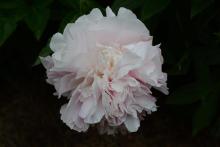
A couple of no-name (to me, at least!) peonies.. nothing special, and I doubt I'd plant these, but they are here and have some photogenic moments.
.
Dianthus barbatus; I think I've mentioned these before- I believe my sister sowed these in semi wild grassy areas on the property years ago as part of a 'wildflower' mix. There are probably hundreds of plants, many of them in very large patches, but almost all in areas that are mowed, so not that many flowers, unless a spot is not mowed for some reason, such as near where I built new veg beds etc this year, and have some leftover piles of soil, sod, lenghts of young poplars that were cut down, etc, so in hard to mow spots there are some flowers. There are many different colours and patterns of flowers, most of them nearly impossible for me to get accurate colour reproductions of. Most of these should be pinker, and the darker ones should be much more intense. This isn't all of the variations, but gives you some idea.. I still intend to do a deliberate planting of these somewhere..
Trond Hoy
Dianthus barbatus was one of
Mon, 07/29/2013 - 3:36amDianthus barbatus was one of my dad's favorite plants. He always collected seed of the best forms and sowed around everywhere at our summerhouse. They're still there.
Mark McDonough
Among the very first plants I
Mon, 07/29/2013 - 6:48amAmong the very first plants I grew from seed (besides zinnias and snapdragons) when I was about 8 or 9 years old, were "pinks", each plant would be a different color and pattern, really loved growing them. Cohan, your assemblage of pretty flower forms with variable zones of color brings back childhood memories vividly.
cohan (not verified)
Trond- seeing the toughness
Mon, 07/29/2013 - 11:29amTrond- seeing the toughness of these plants: many have been mowed over for years, which just expands the clumps, and as soon as given a chance they rush to flower. There is even one perched on top of a pile of sod removed while digging a new bed, a couple of feet off the ground and must be dry at times, flowering! So I'm not surprised they have persisted from your father's sowings..lol
Mark- the variability in them is quite impressive, my favourites are the flower heads with 3 or 4 colours at once, sent seed to a couple of people last year from one of those...
Another old garden flower, but this one I planted on purpose- Achillea millefolium; the white version grows wild all over the property, but I've long been charmed by the coloured garden forms, and started collecting a few over the last couple of years, Now I have several shades from a corally pink through pale pinks to a near/red. This year I got one that was missing from the bunch- in the more autumny range of yellow/orangey shades.. hasn't flowered yet.
And a different Achillea- A sibirica var camtschatica; very different leaves from millefolium, a pretty clear pale pink, taller than millefolium generally is, also. The colourful background is thanks to the very colourful leaves (this year, on this plant at least) of Diervilla lonicera and a couple of species Violas. Still thinking about the best spots for this, I have it in a few spots- a dry area it does okay, but smaller and less vigorous, this damp spot it is a bit floppy and too close to the rock garden: have one kind of in the middle, it's just getting going there..
Mark McDonough
RickR wrote:
Thu, 07/25/2013 - 12:25pm[quote=RickR]
In the case of Allium, "decurrent" would be like this (?)
Allium zebdanensis
[/quote]
No, I don't think so, just clasping or sheathing leaf bases. Not sure what Flora of China had in mind applying the rem to one Allium species, saying that the leaves in Allium victorialis are decurrent, I just went out and checked three forms of Allium victorialis, there is no leaf feature that I would call decurrent. To show a plant with decurrent foliage attachments to the stems, here is a good example, Boltonia decurrans (aptly named):
http://www.plantsystematics.org/imgs/robbin/r/Asteraceae_Boltonia_decurrens_35062.html
cohan (not verified)
I seem to have a bit of an
Sun, 08/11/2013 - 11:35amI seem to have a bit of an obsession with dandelionesque plants- I grew a couple of Hieracium (actually 3, but sadly, realised that H aurantiaca is considered a noxious weed in Alberta, so no orange Hieracium for me :( ) and Hypochoeris from seed last year.
Hieracium intybaceum is quite a nice plant with somewhat hairy, nicely wavy narrow leaves. Tons of buds, but not many opening at once, or really all that fully- likely our often cool, cloudy, rainy summer is at least partly responsible for that.. 1-closer shot of flower stems. 2-shows one of the plants on the berm with Pulsatilla vulgaris forms, H villosum and Hypochoeris maculata. 3,4 -partial views of the berm, also visible are Geum coccineum, Portulaca oleracea sativa Golden Leaf, etc.
Hieracium villosum is more familiar to many, but first time I'm growing it also. Fuzziness is great, and it has lots of buds, we'll see how many open at once..
1- buds, with Portulaca oleracea sativa Golden Leaf- seed bought as an edible plant, I also threw some seeds onto this ornamental berm, and glad I did- awesome colour and texture, really nice beside the Hieraciums etc.. 2- another shot of H. intybaceum, with H villosum behind. 3-full view of Hieracium villosum plants. 4- H. villosum buds with a visitor.
cohan (not verified)
On to Hypochoeris (looking
Wed, 07/31/2013 - 11:55amOn to Hypochoeris (looking now, I see it is more commonly spelled Hypochaeris, I got my seed from France, so perhaps the 'o' is more common in French spelling?). Trond mentioned last year that he hadn't thought of this as a rockery plant- and mine isn't really in the rockery but rather a berm that I think of as more for sub-alpine and meadowy plants (though some of them do grow to higher altitudes)- so it's not really in the rock garden ;) Seriously though, probably not cultivated all that much, but I really like the leaves, a nice addition to this planting which should have a nice flowering at times (esp spring with Pulsatillas and bulbs) but will probably be nicer for foliage texture and colour than anything else ..
David L (not verified)
Hypochaeris radicata is a
Fri, 08/02/2013 - 2:23amHypochaeris radicata is a common weed here. It is reputed to be toxic to horses causing a problem called stringhalt. It is also meant to be edible( for humans) if you wish to eat plants containing neurotoxins No doubt someone will enlighten me
ClifflineGardens (not verified)
new forum is confusing...
Fri, 08/02/2013 - 2:28pmnew forum is confusing...
Here's a view of my garden 'walk' in Chicago in early August...
Richard T. Rodich
Nice pics and plants,
Fri, 08/02/2013 - 7:27pmNice pics and plants, GreenRoofer! You've rebounded quite well. And thanks for taking the time to learn the new forum format.
Phemeranthus calycinus flowers dot my potted menagerie here and there, too. Yours seem very happy!
Lori S. (not verified)
Ah, of course, that's what
Fri, 08/02/2013 - 8:39pmIt looks like some of your pictures have disappeared, Cohan. (I've noticed this in a couple of my recent posts too.) It would be nice to see Hieracium intybaceum (I'm curious what it looks like)... if you wouldn't mind reposting the photos? (Sorry for the problems with the site!!)
Phemeranthus calycinum... Ah, of course, that's what that attractive plant is! Looking good, GreenRoofer! I tried Phemeranthus (Talinum) calycinum last year(?) and planted them in various places in the vain hope that a plant might possibly winter over in the right spot... nope.
It's Eryngium season here (among the many other things in bloom)... I seem to recall scattering some seeds of Eryngium giganteum outside some time ago, after much frustration at not being able to germinate the darn things despite many tries! Well, lo and behold... I had assumed they were just some self-sown E. alpinum until now. (Looking more carefully, the leaves are a little different too.)
And speaking of Eryngium alpinum:
And what I've now decided is Eryngium zabellii. (I've also called it E. bourgattii at times in the past, so please do tell me what it is, if you know.)
cohan (not verified)
Lori I'll repost those later
Sat, 08/03/2013 - 2:33pmLori I'll repost those later-in this case it could be a combination of my often poor internet connection (time outs and slow uploads etc) combining with the vagaries of the new site to make posting especially tricky at times.. Until then, the first pic that remains showing does show H intybaceum in front of H villosum.
The Eryngiums look great, extra nice to see several together, the descriptions would sound similar but the variations are very nice. I haven't tried any yet, but have had similar poor results germinating some other Apiaceae :( That's something I didn't think of when looking at a seed list last winter- I was debating between 2 rather similar plants- one from Apiaceae and one Brassicaceae- I foolishly chose the Apiaceae and it has done nothing from seed..
GreenRoofer- that is a garden walk you will want to take very carefully! ;) The plants are coming along nicely, great to be able to introduce some plant life to those urban barren spots... In most places I lived in the city, all my gardens were indoors..
Lori S. (not verified)
I love watching the dozens of
Sat, 08/03/2013 - 7:32pmI love watching the dozens of bees that are in this patch of Thymus serpyllum at any one time:
I'm pleased and amazed to realize, unexpectedly, that Ligularia flowers are quite fragrant!
Digitalis lutea:
Calamintha grandiflora is a lovely thing:
Lysimachia nummularia... a colourful groundcover here;
Richard T. Rodich
Phemeranthus calycinus has
Sat, 08/03/2013 - 8:42pmPhemeranthus calycinus has never been more than an annual for me. But I'll have it forever (or as long as I want it). It seems to be a nice companion plant, at least for now, with my Eranthus hyemalis seedlings. The P. calycinus seed begins germinating right about the time that the Eranthis wains, although they continue to sprout throughout the season. I do have an unidentified species that overwinters sometimes for me. These pics taken in September:
P. calycinus and Phemeranthus sp.
Eryngium bourgatii won't overwinter for me. Tried three times. But I have gotten it to bloom in a pot. Exquisite foliage....
My Eryngium amethystinum kicked the bucket this winter, along with several other surprises. But it did have a long life - six years.
Lori S. (not verified)
Allium nutans; Stachys
Sun, 08/04/2013 - 11:38amAllium nutans; Stachys monieri 'Hummelo'; Verbascum nigrum; Dracocephalum purdonii(??); our native Ratibida columnifera:
Symphyandra hofmannii; Stachys minima; Clematis 'Hagley Hybrid'; Salvia nemorosa ssp. tesquicola;
Mertensia primuloides; Sidalcea malviflora; colour variant of Delphinium grandiflorum; Allium flavum;
Buds on Carlina acaulis; Artemisia longifolia; long flower stems on giant Aconitum sp.:
Trond Hoy
Not exactly garden walks but
Mon, 08/05/2013 - 2:05pmNot exactly garden walks but meadow walks and wider on.
Thanks to a very warm July (mean temp 2C above normal) most of the clovers and the other meadow plants have finished but the is as nice as ever I saw it.
Very dandelionesque but it is possibly two different Hieracium species. They are very frequent in the subalpine birch and spruce woods. The heads can be quite large and showy.
One of the commonest flowering plants up here is Linnaea borealis. Here is a pink form. A dragonfly rests in the grass. Seconds later it lifted off.
This moss (Splachnum luteum) is rather common where we went yesterday looking for (and picking) cloudberries (Rubus chamaemorus). The moss is called umbrella or petticoat moss in English (if you google the last name you wont get this plant!). It always does grow on old elk droppings and the spores are spread by flies. The spore-bearing hats smell the same as the dung.
Trond Hoy
The pine woods here are
Mon, 08/05/2013 - 2:21pmThe pine woods here are extremely nutrient poor and the flora consists of few flowering plants but a lot of mosses and lichens.
An old pine tree - visited by several woodpeckers, and a fallen one. Such dead pine trees are called "furugadd" in Norwegian and are very important for animals, fungi, mosses and lichens.
and ants. The old ant hills can get more than a meter high, A moss and lichen clad tree stump.
Some lichens.
Rocks in the creek.
Richard T. Rodich
I had forgotten how nice
Mon, 08/05/2013 - 10:30pmI had forgotten how nice Allium nutans can be - a nice example, Lori. I still have an Allium nutans growing in a pot from another Chapter member. It's seems quite adaptable since it still does well in the very same super light substrate that she correctly planted Allium daghestanica in. Tomorrow I'll find a place for it in the garden....
The Umbrella moss is something I would expect to see from Dr. Seuss! I'd love to grow that here, but if it grew rampantly, I don't know how I would stop it.
Tthe first flowering of Liatris cylindirica from seed, and when is this Silybum marianum going to stop growing! It's 33 inches wide! And nothing does better than a volunteer seedling - this one Penstemon hirsutus var. pygmaeus.
Gentiana septemfida
Gotta love those curly cues on the pink form of the fragrant Syneilesis aconitifolia. Saruma henryi foliage.
Nigella hispanica and Ratibida pinnata with Melica ciliata in the foreground. The birds have found the Melica seeds tasty, so they've been nibbled on.
Lori S. (not verified)
I love those fungi and lichen
Tue, 08/06/2013 - 7:49amI love those moss and lichen scenes, Trond!
It's looking good there, Rick! I finally have Syneilesis in bud this year and am waiting for them to open... I'll have to appreciate the details you show so well. Saruma henryi is one I've failed with a few times, though they are hardy here, in the keeners' gardens.
Trond Hoy
Lori S. wrote:
Tue, 08/06/2013 - 11:18pm[quote=Lori S.]
I love those moss and lichen scenes, Trond!
[/quote]
Thanks Lori - I suppose you have similar scenes where you do your walkings?
Lori S. (not verified)
Hoy wrote:
Fri, 08/09/2013 - 2:32pm[quote=Hoy]
Thanks Lori - I suppose you have similar scenes where you do your walkings?
[/quote]
Yes, I suppose, so though my photos are never so nice as the ones you've shown! That charming moss, Splachnum luteum does occur here, mostly in fens and bogs across the boreal forest, growing mainly on moose dung (according to Mosses, Lichens and Ferns of Northwest North America by Vitt, Marsh and Bovey - an excellent reference); apparently, there's also a red one, Splachnum rubrum - I would love to see either!
A few more...
Diervilla lonicera, in bloom and starting to turn bronzy; Telekia speciosa, an imposing perennial; Campanula stricta var. alidagensis, a very dry-textured, broad-spreading (in shape, I mean - it's tap-rooted) Campanula:
Yes, I know this is a weed to most of us... but, hey, it's purple!! And I bought it! (In the words long ago of a local plant retailer of the time, "If people will pay money for it, it's not a weed." LOL!) Plantago major 'Purpurea'; it's amazing how seedlings of this always turn up - I let a few grow this year:
Update on Cerinthe major purpurascens, much taller than I recall from when I grew it long ago; Mimulus guttatus along the edge of the greenhouse; Linum flavum compactum:
Time for the later daylilies now - 'Jersey Spider'; and a few of the poor beleaguered Asiatic lilies (damned lily beetles!) that have managed to put on a decent show - 'Honey Pink', a Fred Fellner lily; a nice, clear orange one (name recorded somewhere no doubt), though only one bloom; 'Rosabelle #2':
A couple of new ones... young plants soon to bloom for the first time. Inula cf. kitamurana (seeds from Holubec, collected in Zhdanko, Sakhalin, Russia at 180m from rocky grassland) and Patrinia villosa (seeds from Gardens North):
Lori S. (not verified)
Wow, that Silybum marianum is
Thu, 08/08/2013 - 9:35amWow, that Silybum marianum is a stunning plant, Rick!
Trond Hoy
Rick, the umbrella moss needs
Tue, 08/06/2013 - 11:12pmRick, the umbrella moss needs fresh dung to grow! I don't think you have too much of that in your garden?
Isn't the Silybum an annual? Yours should have flowered!
Nice to see healthy Syneilesis and Saruma. I can't grow neither. They are immediately eaten by slugs and snails.
Richard T. Rodich
Some have difficulty with
Tue, 08/06/2013 - 8:26amSome have difficulty with Saruma henryi here, also. I can't say for sure, but believe it needs a drier soil in winter, although it appreciates the extra moisture in summer. Mine grows in full shade, under a Chamaecyparis pisifera (tree). With all the excessive rain I've had all summer, it's never been so lush or so floriferous as this season.
cohan (not verified)
Nice to see everything that
Tue, 08/06/2013 - 10:57amNice to see everything that everyone is growing or seeing! Now that the long weekend is over, I'm hoping my internet will be a little better, maybe I can get some photos posted! First I'll go back and try to re-add the photos to the previous post where they disappeared- tried unsuccessfully yesterday..
Trond- are these walks from your mountain cabin? Linnaea is long finished blooming here, but our local Hieracium (umbellatum, I think) is flowering now, along with the ones in the garden. I wish the clovers would be done flowering- they will flower here till past frost- all european invaders, and extremely ubiquitous, among my most bothersome garden weeds...
Saruma henryi is looking good, Rick! I might have a couple of small seedlings, not sure- from seed several years ago, took a couple of years for anything to appear, still small but doesn't look like any of the usual seed pot weeds so far....
Lori- always amazing to see all that you are growing, hard to believe that's on a city plot!
Trond Hoy
cohan wrote:
Tue, 08/06/2013 - 11:26pm[quote=cohan]
Trond- are these walks from your mountain cabin? Linnaea is long finished blooming here, but our local Hieracium (umbellatum, I think) is flowering now, along with the ones in the garden. I wish the clovers would be done flowering- they will flower here till past frost- all european invaders, and extremely ubiquitous, among my most bothersome garden weeds...
[/quote]
Yes, it is near our mountain cabin. And although most of the twinflowers are finished, some do flower still in the cool woods.
The white clover is no problem but the red (Trifolium pratense) seems to spread too much now. Hasn't been troublesome before.
Richard T. Rodich
Wed, 08/07/2013 - 10:57am[quote=Hoy]
Isn't Silybum an annual? Yours should have flowered?
[/quote]
That's what I thought. I've never had them do anything different.
Then I googled the species, and found it can be annual or biennial. So, I am hoping.....
More in the garden:
Our native Hystrix patula
Hakonechloa macra 'Albo Striata' sat for 5 years in the garden never increasing at all. Then I planted a pulmonaria next to it, thinking the grass would never amount to anything. As the lungwort grew, the Forest grass was somehow stimulated! Now after a total of 13 years, that dinky little plant looks very nice.
Bouteloua gracilis from Minnesota native seed a few counties to the west, and Ruellia humilis.
Richard T. Rodich
When I grew Cerinthe major
Thu, 08/08/2013 - 3:22pmWhen I grew Cerinthe major purpurascens, the volunteers wouldn't sprout until August! Then they were quite vigorous, but there hardly enough time to flower, let alone go to seed.
I had a really good crop of Patrinia villosa from seed, with lots to share at the plant sale. Then I discovered the genus is the alternate host for daylily rust. It is the propagules produced by patrinia that are cold hardy enough to survive our winters, so I decided to chuck them all. But also, as I was growing them they were enormously vigorous.... so much so that I also wondered about their invasive potential here. I also had seed of Patrinia scabiosifolia which hadn't germinated yet. I understand it is eaten in Korea,. and I now understand how valuable it could be for this purpose.
Lori S. (not verified)
Very interesting, both about
Fri, 08/09/2013 - 2:29pmVery interesting, both about the rust and about hardiness... I've found the Patrinia spp. I've grown here (P. scabiosifolia, S. rupestris and ??) to be marginally hardy and short-lived so far.
An update on Inula cf. kitamurana showing demurely-nodding flowers; Dracocephalum grandiflorum; Campanula x tymsonii; Dalea purpurea x2:
Richard T. Rodich
Every one of those five very
Fri, 08/09/2013 - 1:56pmEvery one of those five very nice photos, Lori, enlarged except the Dracocephalum.
Likewise in post #486, they all enlarge except for Linum flavum compactum.
??????????????????
Lori S. (not verified)
Okay, thanks for letting me
Fri, 08/09/2013 - 2:28pmOkay, thanks for letting me know. I'll try to fix both.
Edit: Done, I hope... ?
Trond Hoy
Lori S. wrote:
Sat, 08/10/2013 - 12:56pm[quote=Lori S.]
Okay, thanks for letting me know. I'll try to fix both.
Edit: Done, I hope... ?
[/quote]
Works for me too!
It is interesting too see what you grow in your gardens, Lori and Rick. Many are the same as I grow (or try to) but the reasons for failures are often not the same.
Richard T. Rodich
Yes, they both work now.
Fri, 08/09/2013 - 5:43pmYes, they both work now. What did you do?
Lori S. (not verified)
I deleted then re-embedded
Fri, 08/09/2013 - 7:27pmI deleted then re-embedded the photos. Nothing different than I thought I'd done the first time.
Anne Spiegel
Many thanks, Lori. I'm going
Sun, 08/11/2013 - 12:37pmMany thanks, Lori. I'm going to go over the instructions again when there's more time. It seems much more complicated than the old system. Maybe that's just because I knew how to use the old system.
Lori S. (not verified)
Yes, it is a few more steps,
Thu, 08/15/2013 - 9:28amYes, it is a few more steps, Anne, but I'm sure you'll get the hang of it after a couple more times.
Hosta 'Blue Mouse Ears'; Cephalaria gigantea; tender rose 'Amsterdam' and clematis; Campanula trachelium;
Tender roses: 'Rio Samba'; 'Sheila's Perfume'; 'Golden Celebration'
Delphinium brunonianum; Agastache pringlei; a native Liatris... must figure out which; Campanula x carpatica 'Thor Pedo':
cohan (not verified)
I did finally get the
Thu, 08/15/2013 - 12:19pmI did finally get the Hieracium photos (a couple pages back) re-embedded, but more recently the Hieracium intybaceum finally opened more flowers at once- and the plants have got quite large and sprawling- probably they'd be a bit smaller in a leaner environment, but I expected them to get too big for the rock garden proper, and not enough gravel to make the berms that lean.. I don't mind them in their sprawling form, but may try some at the dry end of the property out of curiosity.. in the second shot you also see Geum coccineum, and Hieracium villosum behind putting on a nice show..Then, time to get outdoors and back to the digging!
Richard T. Rodich
I am doing a little
Sun, 08/18/2013 - 7:12pmI am doing a little renovation, too, where the Kentucky blue grass had invaded a patch of Barnardia japonica (Scilla scilloides). I know, it's not a good time, just before they are going to flower, but they will survive just fine. So a few pics of bulbs:
And as I was digging around, I found this: a blue grass stolon had grown right through a bulb!
"Ahah" you say, "this photo is staged!". Well, I hadn't realized it when I snapped the picture, but it does seem to look that way.....
But you're wrong. Here is another:
Bulb roots are not the best. The plants grow in dry, amended clay.
Lori S. (not verified)
A pleasant looking plant,
Sun, 08/18/2013 - 8:46pmA pleasant looking plant, Cohan.
Good grief, Rick! Shades of "Alien"!
Still lots of colour around...
Clematis 'Pamiat Serdtsa'; hardy waterlily 'Colorado'; Sanguisorba 'Pink Elephant'; clematis:
Hanabusaya asiatica, a Japanese Campanulaceae (x2); blue grama, Bouteloua gracilis; Veronicastrum virginicum:
Finally, flowers on Syneilesis!; much to my surprise, what appears to be a hellebore seedling in the front yard:
Just for you, Mark... (kidding!!) - Campanula punctata; I know it is a dread weed for you, Mark, but oddly enough, I find it pretty easy to manage here for some reason, and even fairly useful for dry shade:
Campanula sarmatica; Hosta 'Blue Mouse Ears':
Mark McDonough
Rick, the images of Kentucky
Mon, 08/19/2013 - 6:29pmRick, the images of Kentucky blue grass piercing Scilla bulbs is an eye-opener. Now I worry I have much more to content with, on my large Allium garden overhaul (after 2-1/2 years of neglect and no weeding). The primary invasive is from aggressive stoloniferous field grass (don't know what genus and species) that completely envelope plants; I've been trying to loosen soil and pull the horizontal stolons for years, but without success, the only answer is a complete and thorough spading. Now I fear, I shall have to look closely, washing soil off of bulbs and rhizomes, to make sure it's not harboring a penetrating stolon like those that you show. Here's a couple pics showing just how engulfed in grass and goldenrod some of the Alliums have become, looks sort of like a high-grass prairie view... I have the work cut out for me.
Also beware of plants given to you. I've received many delightful Hemerocallis hybrids from a friend who is a daylily hybrizer extraordinaire, but one such daylily gift sprouted with a perennial sweet pea (I don't know which one, let me know if you recognize it). I have pulled the sweet pea sprouts endlessly, but the sweet pea nearly won in the battle, here's a view of the daylily dug up, with 7'-8' of sweet pea vine hanging on. It had spread 7'-8' in all directions, a 16' monster. The Sweet Pea roots were like giant twisting ropes, I'm surprised it didn't strangle the daylily to death, the sweet pea and the many seedlings now removed.
Pages