
We are 11 days late on this topic!
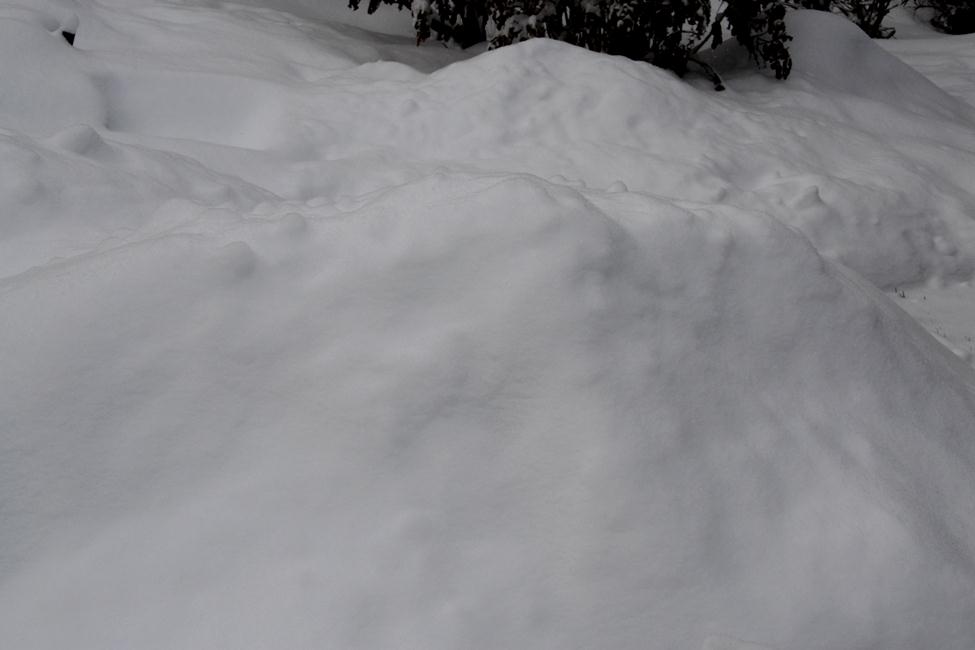
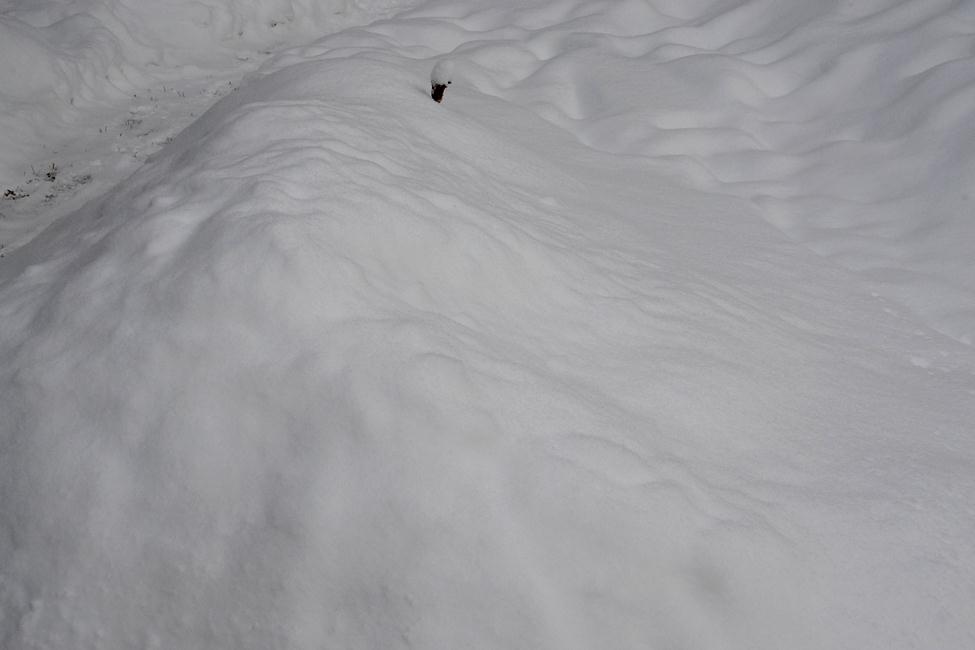
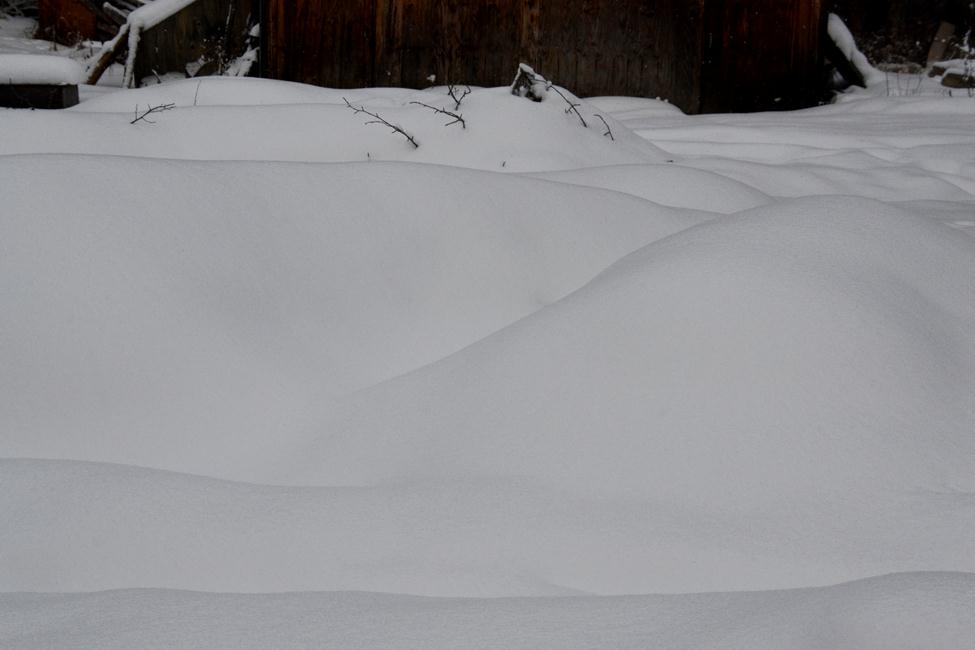
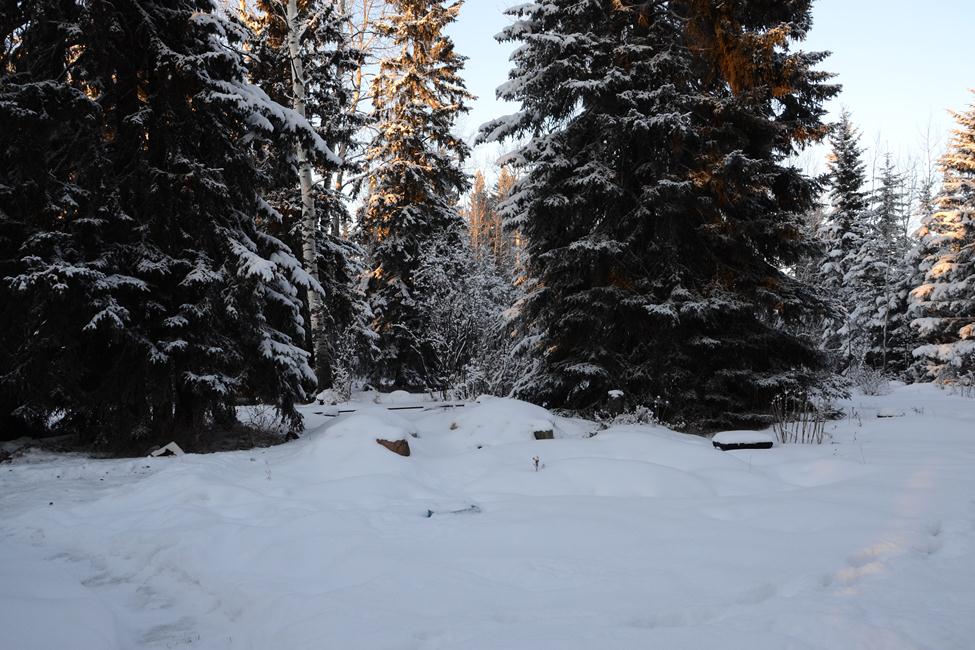
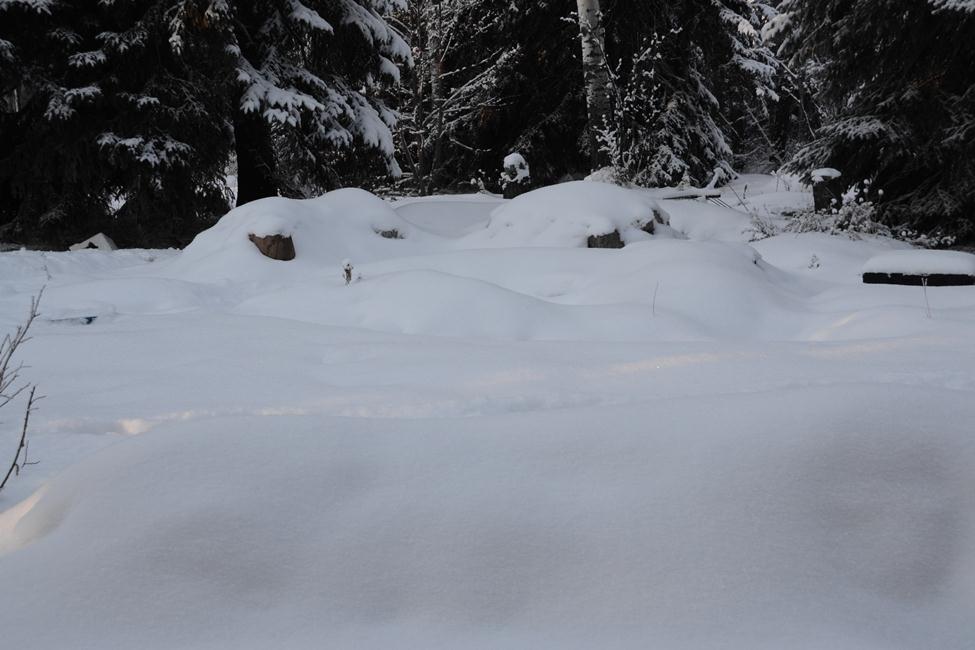
A couple views of some of my garden beds in the last couple of days-- not a whole lot to see! but you see some of the 'ridges' of the rock gardens and berms I've been developing, and looking at them this winter under snow, I've realised that these winter shapes should be taken into account at the design phase, since this is what I see for months at a time!
1-3 the rock beds in front of the house which get extra snow, being surrounded by shovelled paths; in #3 you can see a bit of the tallest Sempervivum flower stalk sticking through the snow still..
4,5 a couple of rock beds and berms in a different part of the acreage- these are in the moister part of the property, and (not counting the shovelling mentioned above) get the deepest snow
6,7 the third rock garden area, this is on the drier end of the property, and drier yet between the two large spruce trees- the two taller ridges have had the least snow cover of any of my plantings, so time will tell what plants that will favour (naturally, I am planting things that generally want to be drier in this area)


Comments
cohan (not verified)
Re: What do you see on your garden walks? 2013
Tue, 06/11/2013 - 10:29amIf you haven't got some seed/cuttings sorted out yet, Maggi, I can offer some - no flowers yet, so seed would be late summer, cuttings anytime, we have tons of it all over the property, including areas I try to avoid while mowing when they are in flower, but don't always succeed..
Michael J Campbell (not verified)
Re: What do you see on your garden walks? 2013
Sat, 06/15/2013 - 8:36amCypripedium californicum.
Sorry posted this earlier in a old thread.
Botanica (not verified)
Re: What do you see on your garden walks? 2013
Tue, 06/11/2013 - 11:22amVery nice Michael J Campbell :)
I've my first flowering of this Cyp this year
If you've other cyp flowering picture . i hope you share with us...because i'm cypripedium addict ;D ;)
Anne Spiegel
Re: What do you see on your garden walks? 2013
Tue, 06/11/2013 - 2:23pmLove the cypripediums. I don't even think of growing them here.
A few pictures of things in bloom now. The area called "the jumble" is right next to the driveway. My snowplower is devoted to his task, so devoted that he removes many plants every year, no matter where I place the markers. I've learned to put the treasures higher up where he can't reach them. In this area you will see arenarias, Iris tectorum, self-sown dianthus, two forms of Anthyllis vulneraria that have produced many inbetween forms and colors, Ononis, coronilla, symphyandras,
phlox douglasia - all have blended together.
(Moderator: added names of 3 plants so they can found in a search)
Lomatium grayi
Moltkia petraea
Centaurea biokevensis
Mark McDonough
Re: What do you see on your garden walks? 2013
Tue, 06/11/2013 - 4:38pmMichael, I had moved/merged you post in the 2011 version of this topic to this 2013 version, but see that you added the posts here once you spotted the issue. A lovely Cyp, I do love these and must try more of them.
Anne, love the foliage mound on Lomatium grayi; really eye-catching. And of course, I'm envious of such a nice clump of Moltkia petraea, not sure why but I invariably lose any Moltkia I have ever tried.
Gene Mirro (not verified)
Re: What do you see on your garden walks? 2013
Tue, 06/11/2013 - 4:48pmHow do you identify and collect the seed? I've watched the capsules as they ripen, and I can't figure it out. Maybe they weren't getting pollinated and weren't setting seed.
cohan (not verified)
Re: What do you see on your garden walks? 2013
Tue, 06/11/2013 - 10:50pmI haven't done it yet, Gene- so I hope I can arrange it...lol if need be I will ask Kristl for advice, as I know she collects it- I think I remember mention of tiny burrs.. I know a casual glance didn't show obvious seed, but I've never really tried as they pretty much occupy all suitable habitat here!
I'll take some pics when the time comes..
Michael J Campbell (not verified)
Pimelea ferruginea
Sat, 06/15/2013 - 6:48amPimelea ferruginea
Mark McDonough
Michael, that's a knock-out
Sat, 06/15/2013 - 7:03amMichael, that's a knock-out beauty. When I saw this posted on facebook, I said "WOW!". I doubt this would be hardy in northern North American gardens, looks like a great subject for growing in a greenhouse, how much cold does it take in Ireland?
Michael J Campbell (not verified)
Frost hardy to -4c but I grow
Sat, 06/15/2013 - 8:33amFrost hardy to -4c but I grow it in the greenhouse because of the wet climate here.
Mark McDonough
Michael J Campbell wrote:
Sat, 06/15/2013 - 6:01pm[quote=Michael J Campbell]
Frost hardy to -4c but I grow it in the greenhouse because of the wet climate here.
[/quote]
Thanks Michael, 25 F is just a smidge below freezing, we get much colder for longer periods of time, so a Pimelia of any sort is only suitable to a greenhouse, but the one you show is certainly worth the effort.
Anne Spiegel
Here we are in the Dolomites
Sun, 06/23/2013 - 11:34pmHere we are in the Dolomites and we woke up this morning to a pea soup fog (I thought). Actually, it's snowing! So far not sticking to the road but sticking to everything else. It will be a change of plans for today.
Lori S. (not verified)
Well, that's the mountains
Tue, 06/25/2013 - 9:12pmWell, that's the mountains for you, Anne! ;-) I hope it clears up soon though so you can enjoy those views. Please do post photos! I would love to see them. I'm not sure how our hiking plans will play out this summer with so many bridges washed out on the highways in to the mountain parks (a minor complaint, needless to say, compared to the situations of those who have suffered flood damage to their homes, though).
A few things from the yard, in the first burst of bloom on the perennials:
Iris versicolor; Echium russicum (soundly perennial here); Silene uniflora (x2) - pinkish and white among the self-seeded multitudes:
Silene zawadskii (x2) - I love this plant! It's tough as nails and takes all conditions.
Anemone canadensis... horribly invasive but tough and beautiful. I thought I'd finally get rid of it this year but now I'm wavering again... as it silently invades under the plastic barrier, past the fence line and into the inner yard...
Update on mountain lily, Ixiolirion tataricum:
Hemerocallis flava - very fragrant:
The start of bloom on Verbascum x phoenicium:
Richard T. Rodich
I don't have any constantly
Wed, 06/26/2013 - 10:02pmI don't have any constantly moist areas in my yard. In the wild, Styrax americanus grows in the flood plains, but it does okay here, too. This exceptionally rainy spring has produced flowers that are 50% larger than usual. This shrubby little American Snowbell is from a disjunct population in Illinois, at the northernmost site of its geographic distribution.
Abelia mosanensis - nice fragrance
A Hemerocallis sp., Coryphantha vivipara. My two Agave parryi from Flagstaff, AZ didn't make it through the winter here. (Photo taken in April.) I'll try again under the rainshadow of the house roof.
Phyteuma orbiculare
Gladiolus atroviolaceus . And this will be a good year for Verbascum nigrum.
Lori S. (not verified)
Every year is a good year for
Sat, 06/29/2013 - 1:14pmEvery year is a good year for Verbascum nigrum in my yard! ;-) (I'm always thinning out the self-seeded hordes... I do love to have it around, nonetheless.) I'm also struck by how much more advanced your season is compard to ours... V. nigrum is weeks from blooming here.
I've not yet had any success at wintering over the hardy gladiolas, unfortunately, so very well done, Rick!
Rosa spinosissima is spectacular right now and very fragrant (funny, I didn't used to notice the fragrance from it) - the bees are having a lovely time in it:
Eremurus himalaicus; Athamanta turbith ssp. haynaldii - does this thing have a common name?
View from below of Caragana arborescens 'Walker' on a high graft (DH likes to refer to this as "the acacia" - yes, he does know better!!!)
Longma (not verified)
May i say you do have some
Sun, 06/30/2013 - 9:44amMay i say you do have some beautiful plants Lori, grown beautifully.
Your Eremurus himalaicus is looking superb. We have a number of Eremurus sp. in the garden and are very keen to add more. Unfortunately, although they grow each year and seem healthy enough, they stubbornly refuse to flower. Any cultivation tips would be very much appreciated. :-)
Lori S. (not verified)
Thank you, Ron!
Sun, 06/30/2013 - 1:10pmThank you, Ron!
I"m sure no expert at growing Eremurus - the one shown is crammed in under the canopy of a sour cherry tree and is leaning out to the light. I had some nice Eremurus stenophyllus that bloomed nicely with multiple flower stalks for many years, until they eventually got too shaded. They didn't like being moved - darned brittle roots. So, I guess all I can recommend from my limited experience is probably full sun. Hmm, now there's a thought.... if we dig out the Diervilla lonicera (that has gotten to be a bit of a bore with its suckering habit), it would create a nice, open, sunny spot for me to grow Eremurus...
Some of the alpines are charming but here's the cutest thing we've ever seen in the garden... a northern saw-whet owl.
.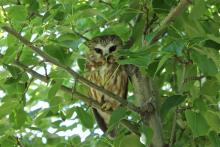
These little guys are 8" from stem to stern, and are amazingly tame. This one is resting in a pear tree after lunching on a mouse... his(her?) digestive ruminations don't seem to be disturbed by the squawk and flutter of the grackles and robins, who occasionally remember he is still there and come back to shout at him.
Longma (not verified)
Thanks for the advice Lori.
Mon, 07/01/2013 - 11:57amThanks for the advice Lori. Our plants are on a slight slope facing South so get whatever sun we get, so I'm not sure that is 100% of the answer for us. Do they flower each year for you? Do you feed them in any way? Good luck with the new plantings! :-)
What a most magical garden guest! She/ he does indeed look very relaxed and 'au fait' with the environment you provide. Do they nest on your land?
Lori S. (not verified)
In my limited experience,
Mon, 07/01/2013 - 12:18pmIn my limited experience, they have flowered each year from the start, up until getting excessively shaded (or at least that was my diagnosis at the time). The only fertilizing that's done here is one or two applications of lawn fertilizer in the spring, timed to be just before the rains, and broadcast over all. No fuss.
No, the saw-whet owl is just a visitor to our yard and we've never seen one here before. I wonder if it was possibly driven to look for new feeding grounds by the flooding along the forested riparian areas?
Richard T. Rodich
The Northern Saw-whet owl is
Mon, 07/01/2013 - 10:47pmThe Northern Saw-whet owl is really precious! I saw my first Snowy owl just in the past year. Very impressive, but I'm not sure which I'd like to see more.
Echium russicum seems to be a short lived perrenial here, lasting 3-5 years. Only one has returned after these big hurrah last season.
More in the garden....
Digitalis lanata and Digitalis lutea? (well, it's not D. ferruginea that I received the seed as).
A better pic of Gladiolus atroviolaceus
Lori S. (not verified)
Very nice, Rick. Your Echium
Wed, 07/03/2013 - 9:28amVery nice, Rick. Your Echium russicum are so nicely upright - mine are always curved.
The result of two different storms (each with about 4 inches of rain) is that my giant perennials are even bigger than usual... Here's Persicaria polymorpha, reaching for the sky:
Oriental poppy, 'Allegro':
A variety of colours on the hybrid tea rose 'Rio Samba':
Geranium x magniflorum and Gillenia trifoliata (that's the old name, I know):
Clematis recta... nicely fragrant; looks like I will need to reef it up again to keep it from flopping over on the peony;
Penstemon x barbatus have self-seeded throughout the yard (which is delightful!) and are starting to bloom:
Trond Hoy
Very nice, Rick and Lori.
Wed, 07/03/2013 - 2:33pmVery nice, Rick and Lori.
Echium is a genus which don't like my humid climate at home.
Your Clematis recta is very showy, Lori, and way earlier than mine!
Lori S. (not verified)
Hoy wrote:
Wed, 07/03/2013 - 6:44pm[quote=Hoy]
Your Clematis recta is very showy, Lori, and way earlier than mine!
[/quote]
Do you have the "plain" species or a cultivar? Clematis recta 'Purpurea' is very attractive... though I don't think I need another. (These rambling clematis force me to do more work than I'm naturally inclined to... ;-) ) Are there other cultivars that are available in Europe.... or here? 'Purpurea' is the only one I'm even aware of.
Trond Hoy
Lori S. wrote:
Thu, 07/04/2013 - 10:47am[quote=Lori S.]
Do you have the "plain" species or a cultivar? Clematis recta 'Purpurea' is very attractive... though I don't think I need another. (These rambling clematis force me to do more work than I'm naturally inclined to... ;-) ) Are there other cultivars that are available in Europe.... or here? 'Purpurea' is the only one I'm even aware of.
[/quote]
I am not aware of any other than 'Purpurea' either but I haven't checked for a while. But I think there exist some seedlings around.
Trond Hoy
A few from my garden today:
Thu, 07/04/2013 - 10:51amA few from my garden today:
An unknown Arisaema, two different Meconopsis horridula from the same seed batch, and n unknown Saxifraga on my roof.
Lori S. (not verified)
Beautiful! I used to try to
Sat, 07/06/2013 - 8:56pmBeautiful! I used to try to grow Meconopsis but have given it up... too dry in my yard and I'm too lazy to provide the conditions needed.
Loads of Aquilegia, which tend to have a wonderfully long bloom period here.... bi-coloured seedlings of every description from a long past planting of 'McKana Hybrids' and various other mutts including some infused with Semiaquilegia ecalcarata genes:
Lori S. (not verified)
Trying to post more Aquilegia
Sat, 07/06/2013 - 9:11pmTrying to post more Aquilegia... it seems I passed the mysterious limit beyond which photos can't be expanded in the above post, so here's continuing on...
Hieracium villosum:
Lori S. (not verified)
Ligularia macrophylla, a
Sat, 07/06/2013 - 9:12pmLigularia macrophylla, a magnificent horseradishy thing:
Campanula rotundifolia:
Mark McDonough
Some really pretty McMutt
Sun, 07/07/2013 - 7:10pmSome really pretty McMutt columbines there Lori, I like them. The one I wanted to see the most, the one with your hand holding a columbine bloom (perhaps to compare) to the other smaller blooms nearby, doesn't enlarge. Your Campanula rotundifolia also seem to be in a range of colors, what a fun garden playground you have!
Lori S. (not verified)
Mark McD wrote:
Sun, 07/07/2013 - 9:37pm[quote=Mark McD]
Some really pretty McMutt columbines there Lori, I like them. The one I wanted to see the most, the one with your hand holding a columbine bloom (perhaps to compare) to the other smaller blooms nearby, doesn't enlarge. [/quote]
That's funny, it does enlarge for me, oddly enough. Here it is again... unfortunately, this is a bad, fuzzy photo but I added a slightly better one from last year of these somewhat unusually-coloured orange "mutt" columbines:
I planted Aquilegia shockleyi in this area in 2006 and I think these plants are showing some influence from it:
http://commons.wikimedia.org/wiki/File:Aquilegia_shockleyi_1.jpg
Trond Hoy
Lori, I think Mark means the
Sun, 07/07/2013 - 11:07pmLori, I think Mark means the fourth picture in your next to last post. It doesn't enlarge for me either!
You certainly have a collection of aquilegias! But they do easily hybridize, don't they?
Richard T. Rodich
Lori S. wrote:
Mon, 07/08/2013 - 8:29pm[quote=Lori S.]
That's funny, it does enlarge for me, oddly enough. Here it is again... unfortunately, this is a bad, fuzzy photo but I added a slightly better one from last year of these somewhat unusually-coloured orange "mutt" columbines:
[/quote]
I am glad you said that, Lori. When Mark mentioned it didn't enlarge for him, I tried, and all of your pics enlarged for me. But I thought maybe you had gone back and fixed it, so I didn't say anything. But now I know you didn't.
I started to grow lots of different columbines, but I soon found that the Columbine leafminer and those tiny caterpillars that devour the leaves were too much to deal with. So I grow very few now. But this past winter (once again) was strange, and though not particularly cold, not a one of those pests has surfaced, anywhere!
Richard T. Rodich
Some columbine hybrids, heavy
Mon, 07/08/2013 - 8:43pmSome columbine hybrids, heavy on the Aquilegia kuhistanica....
Auilegia caerulea hybrid
Tulipa urmiensis bulbs, second year from seed. Yes, they're pretty small, but they were only growing in a 1.5 inch pot!
Lori S. (not verified)
Sorry, Mark... I reposted the
Mon, 07/08/2013 - 10:02pmSorry, Mark... I thought you were referring to the orange columbine photo. In trying to respond to your concern, I reposted the one photo, then added another clearer one, although I see that one of them is not loading now for some reason.
This was different than the first time I exceeded whatever the limit is for embedded photos. That time, the later photos in the list would not enlarge. This time, it was the first photos in the list that would not enlarge.
Anyway, here's the photo you noted does not enlarge (and it doesn't enlarge for me either in the original post... though I thought I had it corrected it earlier). Uggh, it's all very confusing. Spurless flower on the left of Semiaquilegia ecalcarata or hybrid thereof, and spurred ones on the right:
Mark McDonough
Thanks for going to the
Tue, 07/09/2013 - 5:56amThanks for going to the trouble to repost the photo (which does enlarge, the original one still doesn't enlarge for me), lots of curious happenings with photo uploads me-thinks. Both columbines are lovely, even though mutts, they are of fine form and color (I have a soft spot for Aquilegia) :-)
Rick, you dark color Aquilegia kuhistanica types sure are dramatic, very nice indeed.
Trond Hoy
Rick, is this the real A.
Mon, 07/08/2013 - 11:37pmRick, is this the real A. coerulea? I have never seen such long spurs on any supposed-to be-coerulea in my garden.
Without a scale it is impossible to say whether your bulbs are small or big! ;-)
Richard T. Rodich
Oh THAT photo does not
Tue, 07/09/2013 - 7:29amOh THAT photo does not enlarge.... not for me either.
All the others in Lori's following post work for me.
Richard T. Rodich
Ya know, Trond, I though the
Tue, 07/09/2013 - 7:43amYa know, Trond, I though the spurs were extra long, too, although I hadn't noticed when I took the photo. It is volunteer seedling not directly from the wild. The only long spurred columbine that I've ever had was A. chrysantha, which grew on the other side of the house and hundreds of feet away. But, yes I think there must be some infuence, then.
Trond Hoy
Rick, I get a lot of
Tue, 07/09/2013 - 1:14pmRick, I get a lot of volunteers but haven't noticed any like that - yet!
BTW my fav columbine is A. canadensis!
Richard T. Rodich
On the subject of Aquilegia
Tue, 07/09/2013 - 7:47pmOn the subject of Aquilegia canadensis, as kids we called them honeysuckles because of the sweet nectar that could be tasted inside the "bulb" end of the spurs.
Do all aquilegia sp. have enough good tasting nectar for humans to taste?
And do they taste different?
Trond Hoy
I have never tasted columbine
Wed, 07/10/2013 - 1:17pmI have never tasted columbine nectar but we used to suck the nectar of white and red clover (Trifolium repens/pratense) which we called sugar tops.
Harold Peachey
Asclepias tuberosa nice red
Fri, 07/12/2013 - 5:13amAsclepias tuberosa nice red form, Actaea rubra f. neglecta and Mukdenia rossi
Lori S. (not verified)
Wow, stunning, Harold! I've
Thu, 07/18/2013 - 8:36amWow, stunning, Harold! I've just bought one butterflyweed and planted it in the front yard (a very normal orange form) - had a few of the garden variety Asclepias years ago but they seemed fairly short lived in my conditions. Do yours get constant moisture?
Lychnis chalcedonica, pink form; Allium; Astrantia carniolica 'Rubra' and Nepeta nuda; some of our few annuals, honeywort (Cerinthe major 'Purpurascens'); Verbascum x phoenicium and rugosa roses:
Ligularia macrophylla has been brilliant:
Campanula thyrsoides is starting to bloom - in my garden they are 3' tall, which I imagine is 2-3x taller than in mountain meadows?; Stachys macrantha; Anthemis carpatica; another shot of Persicaria polymorpha, Veronicastrum sibiricum and Lychnis chalcedonica; Veronica in the front yard:
Longma (not verified)
Lovely Asclepias Harold. I
Sat, 07/20/2013 - 7:13amLovely Asclepias Harold. I used to grow a few of them in a previous garden, and you've reminded me how much I like them.
More stunning plants Lori. Your garden must be an absolutely beautiful picture. We'll be tracking down Campanula thyrsoides for sure.
In our garden today Gladiolus flanaganii is beginning bloom, and it looks as though it will be a good show this year.
Lori S. (not verified)
I can certainly send you
Sat, 07/20/2013 - 10:54amI can certainly send you seeds of Campanula thyrsoides later on, if you like, Ron. Just PM me with an address if you are interested.
Your Gladiolus flanaganii are gorgeous - what a colour! One I have tried unsuccessfully, but I think Rick is growing it?
Richard T. Rodich
Yes, I have sprouted seeds of
Sat, 07/20/2013 - 4:37pmYes, I have sprouted seeds of G. flanaganii three times. They just might be the easiest Gladiolus seed to germinate of all. The species is not hardy through my winters, and unfortunately, with my first batch I couldn't find the pot when I looked for it to bring in for the winter. So it overwintered with all my other pots, outside. My second batch I just forgot about and the same consequence ensued. The third time (last season) I did bring inside, and planted them rather late in the garden and in pots this spring.
Second year bulb
Richard T. Rodich
Really nice Asclepias
Sat, 07/20/2013 - 4:52pmReally nice Asclepias tuberosa, Harold. I've only seen shades of orange in the wild here. While often brilliantly colored, nothing holds a candle to yours!
I find wild Butterfly weeds grow in dry or moist sand and moist clay based soil prairies. Quite an adaptable species, although not to adaptable to transplanting, even at a young age.
Asclepias tuberosa and Amorpha canescens seedlings
Lori S. (not verified)
RickR wrote:
Sat, 07/20/2013 - 9:13pm[quote=RickR]
I find wild Butterfly weeds grow in dry or moist sand and moist clay based soil prairies. Quite an adaptable species, although not to adaptable to transplanting, even at a young age.
[/quote]
Perhaps it's not the dryness that resulted in them being relatively short-lived in my garden (as I've read that Asclepias tuberosa is supposed to withstand drought) as much as some of the more frequently-cultivated species being somewhat on the edge of hardiness here? Oh well, this genus is certainly worth another try for me, in any case.
Gentiana lutea survived tranplanting from its dry spot next to a big spruce, and has managed to flower, after a few years of barrenness, in these moister, friendlier conditions... flowers are a bit "squinny"-looking this year (not as nice as I remember previously) but maybe it will recover with time:
Osteospermum barberiae var. compactum 'Purple Mountain', planted in 2001 and coming through every winter since (amazing!!), with a little guest seemingly munching on one of its flowers:
Allium cernuum; Scutellaria alpina; Scutellaria pinnatifida (formerly orientalis) ssp. alpina; Allium senescens (thank you for the ID correction, Mark! I received this as Allium roseum years ago and didn't realize the error until now):
Geranium x cantabrigiense 'Cambridge'; Verbascum eriophorum x 2; Verbascum nigrum starting to bloom:
Erigeron glabellus; Linum flavum 'Compactum'; Dianthus deltoides cv.:
Toole (not verified)
Good bit of colour Lori .
Sat, 07/20/2013 - 9:52pmGood bit of colour Lori .
For some reason I've always thought Gentiana lutea was monocarpic , (goodness me where did i get that idea from !!) ,so after seeing your comment above i went and had a look on Wikipedia to read it's a herbaceous perennial.Duh !.Smile.
Cheers Dave.
Longma (not verified)
It really is inspiring to see
Mon, 07/22/2013 - 6:00amIt really is inspiring to see everyone's wonderful plants and garden pictures on this Forum.
Verbascum has performed very well here also this year.
These Achillea millefolium have managed to spread themselves all around the garden, growing in many varying conditions. We are pleased they do, :-)
Digitalis parviflora
The Eryngium are beginning to colour up. Two of the first ones couldn't be more different!
Pages