Bulborum, an new unknown Arisaema for me ! The big red Allium I got from you at St Jean de Beauregard Plant Fair grows well but what is its name please ?
Gene, that's a mighty impressive colony, like a gaggle of geese. Did you grow these from seed? Your climate is more advanced than mine, my plants just broke ground a couple days ago.
Amy: I don't know how long it takes from seed for many Arisaema species, but I have been getting seed from the Arisaema Enthusiast Group, and have been pushing the seedlings along. As soon as they go dormant, I unpot them, and place the tuberlets in a ziplock plastic bag, and they go into the fridge for 2 to 3 months. This lets me start them into growth at least twice per year. With plenty of feeding, it is possible to cut a year or more off the time to first bloom. I am hoping to speed up the growth of several other species this way (ciliatum var liubaense, consanguineum with silvered foliage, fargesii, heterophyllum, jaquemontii, serratum, sikokianum, and tortuosum).Now if only the new seeds would arrive for this season's effort (candidissimum, costatum, and limbatum).
My A. sikokianum are all grown from various seed lots. They are pretty slow. You might get a couple of blooms in three years, but most will bloom in four years. But you have to keep them growing strongly without stressing them. My plants get full sun for several hours around midday, then some shade in the late afternoon, which is the hottest part of the day. If you crowd them, they will survive, but they may not bloom or develop well.
Rick: Wish it were so! I've been growing them in a window if the weather is too cold to use the unheated greenhouse. My first try with pushing them along involved A. consanguineum. The newly sprouted seedlings went dormant quickly, so I had tuberlets about the size of a pea. I re-started them into growth in the house a bit too early and had thin attenuated growth.... but still growth in late winter. They went dormant in spring and I got them going again for the latter part of summer (this time in the greenhouse). All but two of them are already up (southeast window of the house). I started them up a few months ago, as the days were getting longer, and made sure to rotate the pots once they had emerged. The new growth is now complete, totally vertical, and self supporting. I think a few of these nay get to blooming size before this growth cycle is done.
Very early one here they are just above the soil :o
You're so right Roland, this one is early. Strangely this one plant is always earlier than the rest. I have numerous others that are just emerging.
A. triphyllum is absolutely one of my favourites. Extremely variable in form and colour, and an easy plant to grow and propagate. I too have some flowering now, but nothing too different from what you have shown us. You have some lovely examples. Sometimes, I think, these 'common' species get overlooked by those in search of the 'new' and 'rare'.
Ron, both tortuosum and flavum are impressive. I've had seed-grown plants of A. flavum last a couple years but they never flowered and eventually gave up.
I agree about A. triphyllum, extremely variable, so it's fun to find different forms, it remains one of my favorite even if it is common. Roland, the one you show has nice dark purplish stems, I have selected a number of such dark-stemmed ones. This will also hybridize with other species.
A hybrid occured in my garden about 8-9 years ago, between A. amurense and tashiroi. After about 6 years I lost A. tashiroi, but the hybrid lives on; I have several of these, the hybrid inherits the snake-skin mottled stem of A. tashiroi.
When everything goes right I get in a week or two 100 corms from road-works I hope there is some variation in too I lost my amurense It drowned probably last year
Another one that is readily available and very easy to grow well, A. costatum . Produces many tuberlets each year and so multiplies quickly, and is another that is easy from seed.
I was given this form of A. candidissimum last year, by Mr. Davey P, who grew it from seed. It is quite an intense one! He tells me it bulks up quickly and is another of the easier species.
Even in a Genus where 'wierdness' abounds I think this one takes some beating. A. intermedium f. biflagellatum. Not only is the spadix appendage extremely long ( up to 3ft ! ), the spathe limb also ends in a tail which easily reaches the ground and more, twisting along the way!

Comments
Richard T. Rodich
Re: Arisaema 2013
Sun, 01/27/2013 - 6:16pmAnd what a beautiful plant (and photo) to start this thread with.
Does this species tend to produce multiple cormlets?
Mark McDonough
Re: Arisaema 2013
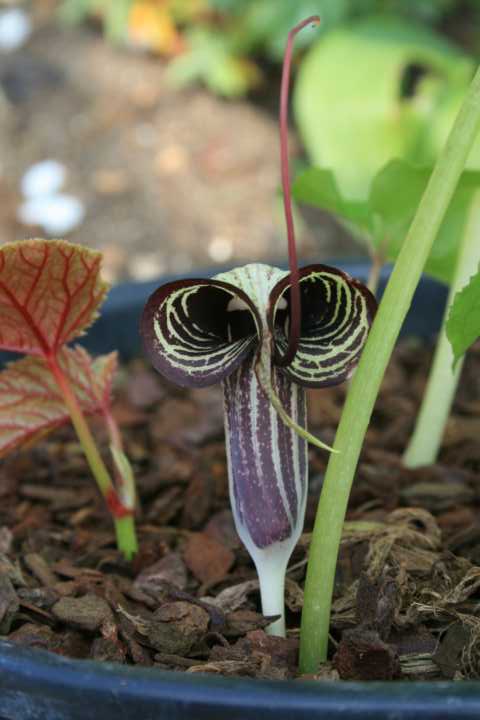
Sun, 01/27/2013 - 6:35pmJust like I said on your Facebook posting of the same image "hoot hoot". ;D The flowers look just like a little owl.
bulborum (not verified)
Re: Arisaema 2013
Mon, 01/28/2013 - 12:30amYes Rick
They produce normally enough cormlets
I can send you some if you like
They will be harvested later on the day
Yes mark a beauty
but I find it difficult to photograph
This is one of the 34 pictures I took
before I was satisfied :o
Roland
Gene Mirro (not verified)
Re: Arisaema 2013
Tue, 04/23/2013 - 7:52pmArisaema sikokianum, grown from seed:
[attachthumb = 1]
bulborum (not verified)
Re: Arisaema 2013
Wed, 04/24/2013 - 12:39amWOW
What a spot
Roland
fleurbleue (not verified)
Re: Arisaema 2013
Wed, 04/24/2013 - 5:07amGene, delighting sight ;)
Bulborum, an new unknown Arisaema for me ! The big red Allium I got from you at St Jean de Beauregard Plant Fair grows well but what is its name please ?
bulborum (not verified)
Re: Arisaema 2013
Wed, 04/24/2013 - 2:14pmI PM you
Mark McDonough
Re: Arisaema 2013
Fri, 04/26/2013 - 6:14amGene, that's a mighty impressive colony, like a gaggle of geese. Did you grow these from seed? Your climate is more advanced than mine, my plants just broke ground a couple days ago.
Amy Olmsted
Re: Arisaema 2013
Sun, 04/28/2013 - 6:15pmWhen growing these from seed how many years to bloom? I have quite a number of seedlings now that were sown 2-3 years ago.
Gordon Tingley
Re: Arisaema 2013
Thu, 05/02/2013 - 5:14amAmy: I don't know how long it takes from seed for many Arisaema species, but I have been getting seed from the Arisaema Enthusiast Group, and have been pushing the seedlings along. As soon as they go dormant, I unpot them, and place the tuberlets in a ziplock plastic bag, and they go into the fridge for 2 to 3 months. This lets me start them into growth at least twice per year. With plenty of feeding, it is possible to cut a year or more off the time to first bloom. I am hoping to speed up the growth of several other species this way (ciliatum var liubaense, consanguineum with silvered foliage, fargesii, heterophyllum, jaquemontii, serratum, sikokianum, and tortuosum).Now if only the new seeds would arrive for this season's effort (candidissimum, costatum, and limbatum).
Richard T. Rodich
Re: Arisaema 2013
Thu, 05/02/2013 - 4:57pmSo Gordon, then some of the growth cycles of your seedlings are completely under artificial lights?
Gene Mirro (not verified)
Re: Arisaema 2013
Thu, 05/02/2013 - 9:14pmMy A. sikokianum are all grown from various seed lots. They are pretty slow. You might get a couple of blooms in three years, but most will bloom in four years. But you have to keep them growing strongly without stressing them. My plants get full sun for several hours around midday, then some shade in the late afternoon, which is the hottest part of the day. If you crowd them, they will survive, but they may not bloom or develop well.
Gordon Tingley
Re: Arisaema 2013
Fri, 05/03/2013 - 4:39amRick: Wish it were so! I've been growing them in a window if the weather is too cold to use the unheated greenhouse. My first try with pushing them along involved A. consanguineum. The newly sprouted seedlings went dormant quickly, so I had tuberlets about the size of a pea. I re-started them into growth in the house a bit too early and had thin attenuated growth.... but still growth in late winter. They went dormant in spring and I got them going again for the latter part of summer (this time in the greenhouse). All but two of them are already up (southeast window of the house). I started them up a few months ago, as the days were getting longer, and made sure to rotate the pots once they had emerged. The new growth is now complete, totally vertical, and self supporting. I think a few of these nay get to blooming size before this growth cycle is done.
Longma (not verified)
Re: Arisaema 2013
Sat, 06/08/2013 - 6:56amA. flavum
An extremely variable species, and one that seems to be very easy to grow from seed.
Longma (not verified)
Re: Arisaema 2013
Sun, 06/09/2013 - 7:11amA. tortuosum
Another easy species, and a very reliable grower from seed. It has been reported as having an unpleasant smell, but I've never experienced this.
bulborum (not verified)
Re: Arisaema 2013
Sun, 06/09/2013 - 7:50amVery early one
here they are just above the soil :o
Arisaema triphyllum starts flowering here
Roland
Longma (not verified)
Re: Arisaema 2013
Sun, 06/09/2013 - 8:34amYou're so right Roland, this one is early. Strangely this one plant is always earlier than the rest. I have numerous others that are just emerging.
A. triphyllum is absolutely one of my favourites. Extremely variable in form and colour, and an easy plant to grow and propagate. I too have some flowering now, but nothing too different from what you have shown us. You have some lovely examples. Sometimes, I think, these 'common' species get overlooked by those in search of the 'new' and 'rare'.
Mark McDonough
Re: Arisaema 2013
Tue, 06/11/2013 - 4:53pmRon, both tortuosum and flavum are impressive. I've had seed-grown plants of A. flavum last a couple years but they never flowered and eventually gave up.
I agree about A. triphyllum, extremely variable, so it's fun to find different forms, it remains one of my favorite even if it is common. Roland, the one you show has nice dark purplish stems, I have selected a number of such dark-stemmed ones. This will also hybridize with other species.
A hybrid occured in my garden about 8-9 years ago, between A. amurense and tashiroi. After about 6 years I lost A. tashiroi, but the hybrid lives on; I have several of these, the hybrid inherits the snake-skin mottled stem of A. tashiroi.
bulborum (not verified)
Re: Arisaema 2013
Wed, 06/12/2013 - 12:35amWhen everything goes right I get in a week or two 100 corms from road-works
I hope there is some variation in too
I lost my amurense
It drowned probably last year
Roland
Longma (not verified)
Re: Arisaema 2013
Wed, 06/12/2013 - 4:35amAnother one that is readily available and very easy to grow well, A. costatum . Produces many tuberlets each year and so multiplies quickly, and is another that is easy from seed.
Longma (not verified)
I was given this form of A.
Mon, 06/24/2013 - 11:44amI was given this form of A. candidissimum last year, by Mr. Davey P, who grew it from seed. It is quite an intense one! He tells me it bulks up quickly and is another of the easier species.
Longma (not verified)
Even in a Genus where
Sat, 06/29/2013 - 3:03amEven in a Genus where 'wierdness' abounds I think this one takes some beating. A. intermedium f. biflagellatum. Not only is the spadix appendage extremely long ( up to 3ft ! ), the spathe limb also ends in a tail which easily reaches the ground and more, twisting along the way!
Lori S. (not verified)
Weird and wonderful, Ron!
Sat, 06/29/2013 - 2:37pmWeird and wonderful, Ron!