
Let me kick off the Epimedium 2013 topic here in January, by highlighting some nursery sources. Choice Epimedium are becoming more available, and prices are starting to come down (although depends on where you shop). I have started the following list, please feel free to add links to additional nursery resources, indicating where the nursery is located.
Epimedium resources
Garden Vision Epimediums - Massachusetts, USA
"The Source" for extensive offering of accurately named Epimedium, including many of their own offerings by Epimedium guru Darrell Probst, now operated by Karen Perkins proprietor. No true interactive website other than an old photo gallery at: http://home.earthlink.net/~darrellpro/
Contact Karen Perkins at [email protected] and request a catalog, instead of using the contact link on the photo gallery page. In May there vare two "open nursery weekends", not to be missed.
Free Spirit Nursery - British Columbia, Canada
Epimedium introductions, 'Atlas', 'Spring Hearts', 'Spring Chocolate'
http://www.freespiritnursery.ca/plantintros.html
Thimble Farms Nursery - British Columbia, Canada, they do ship to the US.
Excellent affordable list of Epimedium, including the new 'Atlas' from Free Spirit Nursury.
http://www.thimblefarms.com/perennials%20a-g.html
Lazy S'S Farm - Virginia, USA
Pretty good listing of Epimedium, some choice items and good pricing
http://www.lazyssfarm.com/Plants/Perennials/E_files/E.htm
Collector's Nursery - Washington, USA
Very good listing of Epimedium, many of their own hybrids, fair prices.
http://www.collectorsnursery.com/cat03/index.php?main_page=index&cPath=2...
Plant Delights Nursery - North Carolina, USA
Very good listing of Epimedium, many of their own hybrids, prices on the high side.
http://www.plantdelights.com/E/products/825/2/0
It should be noted, that on some of the nursery lists I have looked at, there are a few misnomers/mis-IDs, where the photo does not match the species or cultivar. Be sure to research to make sure you're getting the right thing.
Comments
gerrit (not verified)
Re: Epimedium 2013
Sun, 05/12/2013 - 1:26amI made a spelling mistake. It must be Epimedium x 'Yokihi'.
About the spelling of this red and yellow blooming hybrid, It's in the catalogue of Koen van Poucke, written like this 'Yokihi'. The same at PDN. So no 'Yokiho'. The burden of proof lies with others.
Maybe they are confused by the name of the new Epimedium stellulatum 'Yukiko, which I showed in reply 87. (Yokiko, the h and k are close)
About the parentage: There are some guesses about the parentage from photos (you mentioned it before) Well let it be. It's certainly difficult or impossible to determinate a well-known species from a picture. How can you be sure of the parents of a hybrid from a photo. Speculations.
gerrit (not verified)
Re: Epimedium 2013
Mon, 05/13/2013 - 10:38amIn the 2012 catalogue of GVE the red and yellow hybrid is listed as Epimedium x Yohiki Cc 050030, E. daviddi x E. grandiflorum 'Yubae'.
Today I took pictures of Epimedium x omeiense 'Pale Fire Siblings'. Huge flowers under horizontal stems.
Mark McDonough
Re: Epimedium 2013
Mon, 05/13/2013 - 11:08amImpressive flowers on that E. x omeiense 'Pale Fire Siblings', I see that I need all the forms of E. x omeiense (acuminatum x fangii), been enjoying 'Akane' which I added to my garden last year.
I believe the name of Epimedium 'Yokihi' is misspelled "Yohiki" in the Garden Vision catalog, but is spelled correctly on the Garden Vision web site: http://www.epimediums.com/other-e-hybrids/
gerrit (not verified)
Re: Epimedium 2013
Tue, 05/14/2013 - 10:28amAnother one from the intriging x omeiense family. Epimedium x omeiense 'Myriad Years'. Photo 1.
Photo 2,3,4, Epimedium brevicornu var. rotundifolia. Hundreds of diving gulls are flying around.
Mark McDonough
Re: Epimedium 2013
Tue, 05/14/2013 - 6:19pmMmmm, Myriad Year's is wonderful, I keep adding to my list!
I love E. brevicornu, but I've been trying to chase down the name "var. rotundifolia". I don't see that such a name was ever published, although the one synonym that E. brevicornu has, is E. rotundatum (1934). That synonym is confirmed in Stearn's The Genus Epimedium, the online Flora of China, The Plant List, and others. In this species the leaves are described as "acute or rounded", but somehow the name morphed into "var. rotundifolia" or "forma rotundatum" for those plants having more rounded leaves, but it's not a recognized name even though seen in nurseries as such. But don't let that put anyone off, it's a delightful species with clouds of white and yellow flowers.
"http://www.efloras.org/florataxon.aspx?flora_id=2&taxon_id=200008368
http://www.johnjearrard.co.uk/plants/epimedium/epimediumbrevicornurotund...
gerrit (not verified)
Re: Epimedium 2013
Fri, 05/17/2013 - 8:45amThe last of my 4 members of the x omeiense family. With the striking colours of Epimedium x omeiense 'Akane'.
Mark McDonough
Re: Epimedium 2013
Fri, 05/17/2013 - 9:02amThat's what I like, a complete set of something ;)
Gerrit, you did much better that I did photographing 'Akane', I've tried three times now, and each time the photos are blurry. It's a wonderful color, nothing else quite like it, your plants show well raised up a bit, to see the bright flowers. I'm going to move my small plant so that it can be seen and photographed better.
gerrit (not verified)
Re: Epimedium 2013
Fri, 05/17/2013 - 9:07amActually this was my second attempt, from a dozen pictures this one was okay,
Longma (not verified)
Re: Epimedium 2013
Fri, 05/17/2013 - 9:32amYou are showing us some superb Epimedium Gerrit, :o
After seeing some straggly, weedy looking examples at various sales and shows we'd all but given up on this Genus, although the flowers have always attracted us.
After seeing all the lovely posts on this thread by a number of forumists, we think its about time we give them a go, ;D. Hope we can achieve similar results.
Are there any 'trade secrets' to achieving such good results??
Trond Hoy
Re: Epimedium 2013
Fri, 05/17/2013 - 10:47amYou have firstly to get hold of them! That's my biggest problem although I don't suspect I'll ever grow anything competing with Mark's or Gerrit's plants!
Richard T. Rodich
Re: Epimedium 2013
Fri, 05/17/2013 - 6:52pmAnd I have been doing this more and more, too, especially when laying on my stomach isn't an option in the middle of the garden! I hold my camera near the ground and point at the subject and take a bunch of pics.
One (or more) of them is bound to look good. ;D
gerrit (not verified)
Re: Epimedium 2013
Sat, 05/18/2013 - 8:13amI remember the first time, I was in a nursery in order to buy some Epimediums. How I was disappointed by the sight of those poor 'weedy looking' plants. Nevertheless some specimens went over into my garden. From the moment they 'tasted' the new and fertile soil, they started to grow with new leaflets.
And now I am dedicated to this genus.
Another beautiful species is Epimedium wushanense. In this case it is cultivar with no name. Darell Probst gave it a temperarely working-name 'nova'. And as far I know, he's got no properly name. And I am not sad about that.
Epimedium wushanense nova.
Trond Hoy
Re: Epimedium 2013
Sun, 05/19/2013 - 12:50amRick, I am not always that lucky! My new camera has too many options and I don't find the one I want when I need it! And the wind seems always to blow where I am trying to take a picture although it is totally quiet elsewhere :-\
Trond Hoy
Re: Epimedium 2013
Sun, 05/19/2013 - 12:55amGerrit, although wushanense can't compete in flower power with some of the others you have shown, it looks interesting! How does it look from a little greater distance?
Mark McDonough
Re: Epimedium 2013
Sun, 05/19/2013 - 7:18pmTrond - shouldn't be too hard for Ron (Longma) to find choice Epimedium in England, with the many find nurseries in the UK.
Gerrit, I don't remember Darrell Probst ever having a form of E. wushanense given as working name of 'nova', the term 'nova' is usually in conjunction with the syntax "PlantGenus sp. nova", indicating a new as-of-yet unpublished species for a given genus. Darrell did introduce a dwarf extra spiny-leafed for of E. wushanense which was offered as E. wushanense "Spiny leaved forms", in other words, given a plant description versus a cultivar name. Eventually, the plant was given a cultivar name by Tony Avent called E. wushanense 'Sandy Claws', a most regrettable name in opinion.
Ron, you asked for trade secrets on growing Epimedium. Here are a few that come to mind. Given them adequate space. They flourish with more light (sun) than shade in many cases; leaf coloring and flowering is best in a deciduous woodland that gets lots of sun when Epimedium are emerging and flowering. While delicate looking, they do great in sun for at least a portion of the day, with foliage coloring best when there is sufficient sun. While fairly drought resistant, they do best with adequate moisture, the ones I have lost was due primarily to being stressed by drought. They're not overly fussy about soil, but mixing in lots of decomposed bark mulch to a heavy soil works wonders and is much to their liking.
Mark McDonough
Re: Epimedium 2013
Sun, 05/19/2013 - 7:41pmI have missed posting to these pages, will try and catch up. Here's a selection of Epimedium photos taken this past weekend (May 18-19, 2013).
Probably the very best of Darrell Probst's epimedium hybrids is one called 'Pink Champagne'. Mine is a young plant that's just getting going, but the plant form, speckled foliage, and strawberry pink flowers in above-the-foliage sprays make this a real winner.
Epimedium 'Lemon Zest' is yet another of Darrell's excellent hybrids, this one a vigorous hybrid of E. ecalcaratum, with many stems and innumerable yellow bells, with with a hint of vestigial spurs, a delightful long-flowering plant.
I often get colorful seedling-grown plants; here's one that has very bright foliage, worth growing just for the leaves. This is a 3 year old plant from seed.
The next two show a selected hybrid of mine, between E. stellulatum and membranaceum, brilliant mottled foliage when first emerging then turning green, and airy sprays of white and yellow flowers that last until August.
Here's an odd one, E. x youngianum 'Sudama', a Japanese cultivar with curious small balloon-like red flowers that never open, and mostly concealed under the foliage. However, the "foliage build" is excellent, with bronzy leaves amassed into a "table" of bright leaflets.
Epimedium grandiflorum 'Cranberry Sparkle' is a wild selection from high mountain location in Japan; rather late to emerge and late flowering, it has the closest to a true red flower of any Epimedium. Another one introduced by Darrell Probst.
The small thimble-like yellow flowers of E. campanulatum are so cute, lacking any spurs, one of my favorites. In this vignette, we see three color forms of Iris cristata in the background.
Mark McDonough
Re: Epimedium 2013
Sun, 05/19/2013 - 7:55pmIn this view are two angle showing E. grandiflorum var. coelestre 'Alpine Beauty'. This variety represents one of the few truly alpine Epimedium, emerging later and flowering later than most grandiforum types. The flowers are a soft palest cream yellow, but with such substance and extra wide sepals. The foliage is also dense growing and an apply green color; a very fine epimedium. The cultivar named 'Alpine Beauty' is a selected form introduced by Darrell Probst.
These two photos show two hybrids grown from E. davidii EMR (the 3 letters represent a collector's initials). The resulting hybrids are rather different as you can see. The one on the left has clouds of tiny yellow flowers with pink sepals. The one of the right is a prize, extremely floriferous with large elegant bright yellow spider flowers. My original E. davidii EMR is a slow weak grower, I'm lucky to get 20 flowers in a season, but this hybrid from it produces impressive swarms of bright bloom.
gerrit (not verified)
Re: Epimedium 2013
Mon, 05/20/2013 - 2:09amMark. I can't remember where I've got the story of wushanense nova. But true or not, it is plausible or perhaps likely.
About drought resistance: it's good to repeat this. Epimediums can suffer from drought indeed. And even pass away. Altough most of the nurseries regularly claim they are drought resist. In my garden I lost several species under an overhanging conifer. The Epimediums had to compete with the root system of this thirsty conifer. And they lost the unequal battle.
gerrit (not verified)
Re: Epimedium 2013
Mon, 05/20/2013 - 2:33amThanks a lot for the new information. Not a thing for the 'hurry-up' Face book page. We should reflect on this and read again and re-look the photos.
About 'Pink Champagne'. Now you may post pictures of this stunner without making me green of jealousy. At last I've got him. A very generous gift by Ben from 'The Houten Huys'.
You showed here the pictures of campanulatum and a hybrid of ecalcaratum. Two 'rare' growing species because of the shape of the flowers. The first I grow in the garden, the latter I 'forgot' to buy. Must do it as soon as possible.
This hybrid you showed, E. stellulatum x E. membranaceum must be a fantastic new cultivar, when it should get a name. Which such excellent parents.
Longma (not verified)
Re: Epimedium 2013
Mon, 05/20/2013 - 4:11amThat's exactly what I wanted to know. Thanks Mark, and Gerrit 8)
gerrit (not verified)
Re: Epimedium 2013
Mon, 05/20/2013 - 6:46amAfter having seen E. campanulatum and E. x ecalcaratum '...' with very special inflorescence, I show my Epimedium davidii with irregular formed petals. Each flower is different. And I'm fond of it.
Longma (not verified)
Re: Epimedium 2013
Mon, 05/20/2013 - 7:00amThe closest nursery to us has these for sale - Epimedium 'Black Sea' , Epimedium perralderianum and Epimedium x youngianum 'Shikinomai' .
We're thinking we should get one of each. Any comments on these three please?
Mark McDonough
Re: Epimedium 2013
Mon, 05/20/2013 - 8:14amBlack Sea is a good one, a slow spreader, with leaves that turn a ruddy near glossy black color in late autumn (it's evergreen). It has tallish sprays of light yellow-orange flowers, I posted a photo earlier:
http://nargs.org/smf/index.php?topic=1254.msg23277#msg23277
E. perralderianum I've never seen (rare in the US) but is very close to pinnatum ssp. colchicum and the hybrids between both species known as x perralchicum are what most people grow, such as the familiar one names 'Wisley' and 'Frohnleiten', with yellow verbascum-like flowers, handsome evergreen leaves nicely veining, and once again, a slow to moderate spreading habit (not a clumper). Wim Boens was just mentioning E. x youngianum 'Shikinomai', another I'm not familiar with, although it has white flowers, images do come up with Google.
Toole (not verified)
Re: Epimedium 2013
Tue, 05/21/2013 - 1:23amBoy what a treat these postings have been ...I have small number of different unnamed plants ,( divisions from friends) ,however i feel another obsession coming on ..... ;D
I wonder Mark or Gerrit if you like to comment on the viability of seed as I've never managed to successfully raise seed from any of the overseas exchanges.Thanks.
Cheers Dave.
Longma (not verified)
Re: Epimedium 2013
Tue, 05/21/2013 - 10:34amPicked up four plants today.
Anyone have any comments about the accuracy / suitability of the book - 'Epimedium - The Genus by William T Stearn'. ?
Mark McDonough
Re: Epimedium 2013
Tue, 05/21/2013 - 10:57amRon, "The Genus Epimedium" by Stearn is top notch, an essential "bible" on the genus, and other herbaceous Berberidaceae such as Podophyllum, Leontice, Diphylleia, Jeffersonia, Vancouveria, and a couple others. Published in 2002, a year after Stearn's death, it was up to date taxonomically on Epimedium at the time, although new species have been published since then. I bought mine used but in great shape from Amazon.com at $50 (which is the original selling price), many other copies went as high as $200 for a copy, I was lucky to find the one that I did.
Dave, Epimedium seed can't be had successfully from seed exchanges, because the dry seed will be dead. The seed must be sown fresh soon after collecting it in late spring (to early summer, depending on the species). I sow mine immediately after the pods are ripe and starting to spill seed, the seed itself looks like little green lima beans with attached fleshy elaiosomes. I collect seed in plastic sandwich bags, then sow within a week or two, using good compost in peat flats, cover the seed lightly, then top dress with decomposed pine back mulch, cover the flats with wire (prevent squirrels and chipmunks from digging/eating the seed), flats are kept in a shady spot all summer, and sprinkle with water every now and then to prevent dessication, they sit there exposed to weather all winter, then germinate like little beans in spring. Jeffersonia is exactly the same.
Toole (not verified)
Re: Epimedium 2013
Wed, 05/22/2013 - 1:54amThanks a lot for the seed viabilty comments Mark --I had read on the internet that seed needed to be fresh however i thought I'd double check and get your or Gerrit's observations.
As an aside here's a shot i took today of a very small 8 cm rhizome of E.versicolor i took off a small plant last month .........I wasn't too sure whether my timing was a bit late however it seems to have settled and new growth is evident.
Cheers Dave.
Toole (not verified)
Toole wrote:
Thu, 11/14/2013 - 12:11am[quote=Toole]
As an aside here's a shot i took today of a very small 8 cm rhizome of E.versicolor i took off a small plant last month .........I wasn't too sure whether my timing was a bit late however it seems to have settled and new growth is evident.
Cheers Dave.
[/quote]
7 months on after being kept in a cool and moist position,.success ! , the rhizome has come into full leaf .Such yummy leaves.

Mark McDonough
Good news Dave! Yes, the
Thu, 11/14/2013 - 6:18amGood news Dave! Yes, the leaves are irresistible little fringed hearts.
On the other side of the world, here's E. x versicolor 'Cupreum' (photo taken couple days ago) showing it's fall/winter foliage color. The nights are routinely down to -7 C (19-20 F), but the semi-evergreen to true evergreen epimediums continue their presence.
Toole (not verified)
Here's a couple of Epi
Mon, 01/20/2014 - 12:00amHere's a couple of Epi .seedlings, from seed sown July 2013, I've just potted on .
Any info on how long until they will take until flowering?.
Epi 1 .Epimedium davidii dwarf form x grandiforum nanum freya .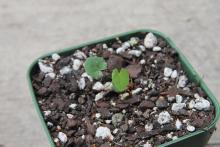
Epi 2. Epimedium akane x acuminatum nightmistress x amanoqawa.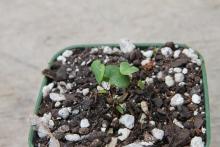
(Hopefully I have the names spelt correctly and in the right order....... ).
).
Cheers Dave.
Mark McDonough
Hi Dave, many epimediums will
Mon, 01/20/2014 - 2:49pmHi Dave, many epimediums will bloom the 2nd year from seed, but its the 3rd year before they really get going. Some of the Chinese species can be slower, such as your second one, E. x omiense 'Akane' x acuminatum 'Night Mistress' x 'Amanogawa', might be 3 years to first flowering, sounds like something exciting should come out of that cross, really good parents :-)
Trond Hoy
I have also some seedlings
Tue, 01/21/2014 - 9:46amI have also some seedlings which germinated during the very mild period we had. I had to bring them inside when the weather got colder.
When is the best time to separate the seedlings?
Mark McDonough
Trond, any time it's warm
Tue, 01/21/2014 - 5:53pmTrond, any time it's warm enough to plant out perennials is fine, including when they still might get frosted a bit if seedlings are hardened off outside, or if protected wait until frost-free conditions.
Toole (not verified)
Mark McD wrote:
Tue, 01/21/2014 - 8:35pm[quote=Mark McD]
Hi Dave, many epimediums will bloom the 2nd year from seed, but its the 3rd year before they really get going. Some of the Chinese species can be slower, such as your second one, E. x omiense 'Akane' x acuminatum 'Night Mistress' x 'Amanogawa', might be 3 years to first flowering, sounds like something exciting should come out of that cross, really good parents :-)
[/quote]
Thanks Mark for the info and name correction --3 years isn't a long wait at all.
Tim Ingram (not verified)
Re: Epimedium 2013
Wed, 05/22/2013 - 5:35amThere is some great information on epis which I've missed while being at the Czech Alpine Conference. We had a much wetter summer last year than normal and I think this has helped a lot with the later flowering woodlanders, and many of the epimediums are looking better than they ever have. I've never tried using such small rhizomes as Dave shows, and generally with dividing epimediums I have found them slow to grow away if they are split up too much. I would like to try many more of these under our apple trees and it is very valuable to hear the experiences of Mark and Gerrit in particular. Will certainly look out for 'Pink Champagne'!
Mark McDonough
Re: Epimedium 2013
Wed, 05/22/2013 - 7:37amGerrit, that's a very fine looking Epi, and amusing too with the indefinitely shaped spurs. And so floriferous! What is your source for that plant? I'm wondering if it might be a hybrid with ecalcaratum, because that feature, of variable vestigial to partly developed spurs, is a strong and unique characteristic of ecalcaratum. It's hybrids, such as 'Lemon Zest' that I showed earlier, and 'Buttered Popcorn', another Darrell Probst hybrid just coming into bloom now, both show that same characteristic.
I have some flowering-size seed-grown plants from 'Lemon Zest', and one in particular has flowers that look just like regular davidii, perhaps revealing parentage in 'Lemon Zest'. I also have some hybrids (2nd generation) from E. stellulatum x membranaceum, and these second generation seedlings are showing forms similar to membranaceum, others following the stellulatum look; interesting to see the genetic tendencies and results in further generations. I will post some photos later.
gerrit (not verified)
Re: Epimedium 2013
Wed, 05/22/2013 - 8:34amYou are definitely right, determining it as a hybrid between E. davidii and E. ecalcaratum. Certainly after seeing E. 'Lemon Zest'.
KVP selled it as a davidii. I asked him about this aberration (defect) but he was not so amused. It could happen was his reply. But I was happy enough. A normal davidii is a common plant. This one is so cute.
Each individual flower is different. Sometimes 4 petals but also 3, 2 or one. Or none with only a sort of shoulder where the spur should be. It's curious and funny.
In attachment, Epimedium 'Egret'. From a Belgian source. And new to me. lovely enough.
gerrit (not verified)
Re: Epimedium 2013
Wed, 05/22/2013 - 9:44amHi Dave.
Am I right, when I say it is difficult to get Epimediums in New Zealand? Due to several restrictions?
In that case, requests fot fresh seeds is the only option.
Gerrit
Trond Hoy
Re: Epimedium 2013
Wed, 05/22/2013 - 11:16amWell, it isn't easy to get Epimediums here either. And it is not about restrictions but knowledge and demand.
So if anybody has some fresh seeds to spare . . . . .
gerrit (not verified)
Re: Epimedium 2013
Wed, 05/22/2013 - 11:42amWell Trond, I like to collect seeds and send it to you. But you know, no guarantee they will be true to the kind.
Mark McDonough
Re: Epimedium 2013
Wed, 05/22/2013 - 8:14pmGerrit, I regret that 'Egret' seems unavailable here in the US (if anyone knows otherwise, please let me know), it's another beauty, love the complimentary color of flowers with striking new foliage.
Dave, I wish you success on that E. x versicolor rhizome piece, I've not had good luck with small divisions of Epimedium, have only had good luck with divisions with enough root mass to support them; maybe we get too dry and hot here in the dog days of summer to keep such tiny pieces alive.
Mark McDonough
Re: Epimedium 2013
Wed, 05/22/2013 - 8:53pmThis will be an all-yellow 10-photo post. When watching plants carefully, and observing hybrid offspring, it's rewarding to pay attention. Working with some of the yellow species, the results have been fun, but I compare them to baby steps; small differences that can be built upon in further hybridization.
For basis, on the left is E. membranaceum. It has very large yellow spider blooms, just starting into bloom recently (late by Epimedium standards). It is a perpetual bloomer, which can continue until frost, if weather conditions are fair (enough moisture, no drought). The flowers characteristic to note, is very long yellow petals (spurs, almost no "cup") and small whitish sepals. On the right is a plant grown from seed of E. davidii "Wolong Select", this particular plant closely resembling the parent. The characteristics to note; down-curved spurs, boxy cup, and red sepals (the sepals not very visible in this photo).
Two view of plants grown from seed collected on E. davidii "Wolong Select", pollinated with various Epis, including larger flowered types such as membranaceum. Both photos show flowers from two hyrbids, the two flowers on the left look very much like E. davidii, except instead of small solid red sepals, here the sepals are larger and with yellow base color, spotted with red. The flower on the right is another hybrid that looks like a miniature E. membranaceum, with whitish to transparent sepals, and almost no central cups.
Two more "overall" views of the same two E. davidii "Wolong Select" hybrids, the first one on the left shows the mini-membranaceum-like plant showing some mottled fresh flush of foliage, and on the right, an earlier view showing the nice basal foliage clumps of both, which look similar.
The next two show a hybrid flowering for the first time; (E. [stellulatum x membranaceum] x various selected), most of these end up looking like stellulatum with clouds of small flowers with broad white sepals and undersized yellow spurs and cup shorter than the sepals. This one surprised me by growing 18" tall with slender stems, and large yellow spider blooms like membranaceum, but with red sepals like davidii instead of white one.
On the left is my ever-blooming Spring-to-October (or November) Epimedium rhizomatosum x membranaceum hybrid, just starting to flower and showing lots of new colorful mottled foliage. On the right is a poor photo of E. flavum, taken in the rain. The flowers were fleeting, so didn't get a better photo. This one seems slow growing, a small plant that did nothing in two years years, this year flowering and showing its distinctive blooms, rather thin-textured but lovely open-cupped blooms of light yellow, no other yellow-flowered species looks quite like it.
Richard T. Rodich
Re: Epimedium 2013
Wed, 05/22/2013 - 9:20pmLike Mark, I find that much larger divisions of epimediums are needed to do well.
Even with such a vigorous one as Orangekönigin, a single or double crown with roots just seems to sit and sulk.
At least in your pic, Mark, E. flavum looks exceptionally nice.
Seems like a lot of hybridizing dreams could be born with that one!
Trond Hoy
Re: Epimedium 2013
Thu, 05/23/2013 - 2:55amThanks Gerrit! It's fine with me - I'm not good at remembering names anyway!
This (a very common one I suppose) is the only one flowering here now! And I have forgotten the name :-\
But Mark's yellows looksmuch better!
Margaret Young
Re: Epimedium 2013
Thu, 05/23/2013 - 4:35amI'm another who has trouble remembering Epi names :-[ .....but that does not prevent my appreciation of these interesting plants.
Here in North East Scotland I think they prefer to be more in the open - we do not get high enough temperatures to bother them and they do best in brighter positions.
Mark McDonough
Re: Epimedium 2013
Thu, 05/23/2013 - 5:07amTrond, your plant is E. x versicolor 'Sulphureum', an old standby that has proven its garden value for a nearly a century. I have this in a couple places, but my biggest patch is down at the lower wooded edge of my property, far out of reach of a hose, growing under dry dry dry Sugar Maples, and after 25 years neglected there, they still persist and grow and flower well.
Maggi, it's an important point you make. Many people here are sold on the idea these are "shade plants" for woodland gardens, when in fact, they revel in bright open light, a half day of sun is best for most compact and vigorous growth, best flowering potential, and more intense leaf coloring. They can be grown in full sun too, as long as they don't get totally parched.
I should show photos side-by-side of Epimedium "Mark's Star" (thanks for the name Wim :D ), where I grew several plants that got 1/2 day sun, and my original plants growing about 40' away in the north-facing constant shade of my house. The plants in shade all day, flowered 3 weeks later than those getting sun, those in sun were compact and amazingly floriferous, whereas those in full shadow grew more open and flowered well enough but modestly by comparison, a real eye-opener.
Mark McDonough
Re: Epimedium 2013
Thu, 05/23/2013 - 5:13amSometimes one will see an aberrant 5-part Epimedium flower. This year, I have noticed many species and cultivars (dozens) with one or more 5-part flowers, I only caught photos on two of them.
E. rhizomatosum is just coming into flower, one of the creeping species, and a long-season bloomer/repeat bloomer. Here's a single anomalous 5-part flower.
Earlier, the giant Epimedium grandiflorum 'Red Queen' had several 5-part flowers, here's one such inflorescence, a single 5-part flower then the rest are normal 4-part flowers.
gerrit (not verified)
Re: Epimedium 2013
Thu, 05/23/2013 - 10:53amMark, I think you underrate the influence of the sun. You are too much focused on your own situation in New England. And Maggi, sorry, but the Scotch are not familiar with the product 'sun'.
Let me explain a common situation in Western Europe, Holland, Belgium, Germany, Northern France, zone 7b, maritime climate. We are in the middle of June. After a Long period of cool weather, the wind is in from Africa, last night I couldn't sleep, Joni Mitchell sings. Temperatures raise suddenly to 30-33 degrees C. The sun shines from 4 am until 10 pm. The inclination is almost vertical. The purple coloured Acer palmatum dissectum burns within a few hours. The other herbaceous plants bow their heads, but will survive. Not the Epimediums. So a spot in the shade is an obligation.
gerrit (not verified)
Re: Epimedium 2013
Thu, 05/23/2013 - 11:19amToday a duet. Two Epimediums are intertwined in a ballet of elfs.
Epimedium acuminatum the purple one and
Epimedium ilicifolium. the yellow.
Mark McDonough
Re: Epimedium 2013
Thu, 05/23/2013 - 5:59pmCollect seeds and sow, hold flats until spring 2014...HYBRIDS!
Pages