
Let me kick off the Epimedium 2013 topic here in January, by highlighting some nursery sources. Choice Epimedium are becoming more available, and prices are starting to come down (although depends on where you shop). I have started the following list, please feel free to add links to additional nursery resources, indicating where the nursery is located.
Epimedium resources
Garden Vision Epimediums - Massachusetts, USA
"The Source" for extensive offering of accurately named Epimedium, including many of their own offerings by Epimedium guru Darrell Probst, now operated by Karen Perkins proprietor. No true interactive website other than an old photo gallery at: http://home.earthlink.net/~darrellpro/
Contact Karen Perkins at [email protected] and request a catalog, instead of using the contact link on the photo gallery page. In May there vare two "open nursery weekends", not to be missed.
Free Spirit Nursery - British Columbia, Canada
Epimedium introductions, 'Atlas', 'Spring Hearts', 'Spring Chocolate'
http://www.freespiritnursery.ca/plantintros.html
Thimble Farms Nursery - British Columbia, Canada, they do ship to the US.
Excellent affordable list of Epimedium, including the new 'Atlas' from Free Spirit Nursury.
http://www.thimblefarms.com/perennials%20a-g.html
Lazy S'S Farm - Virginia, USA
Pretty good listing of Epimedium, some choice items and good pricing
http://www.lazyssfarm.com/Plants/Perennials/E_files/E.htm
Collector's Nursery - Washington, USA
Very good listing of Epimedium, many of their own hybrids, fair prices.
http://www.collectorsnursery.com/cat03/index.php?main_page=index&cPath=2...
Plant Delights Nursery - North Carolina, USA
Very good listing of Epimedium, many of their own hybrids, prices on the high side.
http://www.plantdelights.com/E/products/825/2/0
It should be noted, that on some of the nursery lists I have looked at, there are a few misnomers/mis-IDs, where the photo does not match the species or cultivar. Be sure to research to make sure you're getting the right thing.
Comments
Tim Ingram (not verified)
Re: Epimedium 2013
Tue, 02/19/2013 - 9:36amI'm not sure about shipping plants around North America; how about to the UK too! - that list from Lost Horizon's is some list. I think epimediums may be the plants for our garden this coming year and I will follow that advice about sempervirens.
Mark McDonough
Re: Epimedium 2013
Sun, 03/10/2013 - 11:57amEpimediums on YouTube (includes 'Pink Champagne'), nice music too:
"Most popular Epimedium hybrids cultivars and species for gardens, Elfenblume."
gerrit (not verified)
Re: Epimedium 2013
Mon, 03/11/2013 - 1:45amNice pictures in a colourful garden indeed.
Tim Ingram (not verified)
Re: Epimedium 2013
Mon, 03/11/2013 - 2:26amA very enjoyable way of presenting them! Now if you were in Japan the video would be very long... there must be so many forms they grow there. It is food for thought; a video like that also looking at many other woodlanders and styles of planting would make a wonderful TV programme.
Mark McDonough
Re: Epimedium 2013
Sat, 03/16/2013 - 6:23amI must learn how to make videos like that.
On a separate note, one sometimes wonders how plants get misnamed in the nursery trade. Well, it's not difficult for mistakes to happen, then that mistake gets "propagated" on a major scale, and once the mistake is widespread, it is self-perpetuating. The link below is to a perennials wholesale nursery, with a single Epimedium listed as 'Fire Dragon', however the plant shown and the accompanying description clearly show E. x versicolor 'Versicolor'. I wrote to them telling of their mistake, although if past experience prevails, no corrective action will be taken.
This is NOT 'Fire Dragon', it is E. x versicolor 'Versicolor'
http://www.cliffordsgardens.com/Epimedium/Epimedium-Fire-Dragon-p-242.html
Here is Epimedium 'Fire Dragon':
http://3.bp.blogspot.com/-by21A1W80ts/Te6lZKtyJEI/AAAAAAAACYI/TPJXuapmfP...
copperbeech (not verified)
Re: Epimedium 2013
Sun, 03/17/2013 - 4:56amLis, I am a huge fan of LHorizons. I am somewhat of a nursery 'connoisseur' and there is nothing like it that I have seen in Ontario (especially for perennial selection). I am 50 minutes away by car and I still go several times a season. I do recommend that you go on a weekday to get personalized attention from one of their knowledgeable employees as there are less customers M-F and it is near impossible to find plants on your own!
As well they have a wonderful display garden so overall you need to devote several hours to get the most out of your visit.
I also strongly suggest that you put together a list of plants your want or are interested in and call them in advance so they can tell you if they are available and if you want have them put them aside for you. If you have any more questions just let me know.
Richard T. Rodich
Re: Epimedium 2013
Sun, 03/17/2013 - 6:59amI want to say hello to copperbeech and welcome to the forum!
Lost Horizons looks like really nice place. Here in the Minnesota territories, we are always "behind the times", and pretty much devoid of really good quality nurseries with such far reaching palates. Just little snippets, here and there.
copperbeech (not verified)
Re: Epimedium 2013
Sun, 03/17/2013 - 7:04amI expropriated some lawn late last fall to create "sector" garden shown below. It isn't very large (maybe 150 square feet in total) and it receives almost no direct sunlight from June till September. In this off season I have been planning plant purchases for this space. So far spots are spoken for for these plants:
Now I am very new to this plant (Epimediums) but with a drier shade location I think I need to make use of the interesting qualities of this plant; with a very nearby large tree (basswood) and a cedar hedge there is definite competition for water and light resources.
I think I can squeeze in a (at least) couple of epimediums and I trying to decide which few among all the many varieties.
Right now I have "Amber Queen" and "Pink Champagne" on my "to get" list. Now I have seen neither of these in person so I am just going on what I see on-line. Of course I know it is personal preference but I would love to hear your recommendations given that I am only going to have 2 or 3 in the garden. So it is kind of like the topic..."If you could only have 2 epimediums which would you choose?"
(I take it that given their delicate form that they should be planted near the front of a garden to better see their spring beauty?)
Thanks for your experience.
copperbeech (not verified)
Re: Epimedium 2013
Sun, 03/17/2013 - 7:13amThanks for the welcome RR. This thread is of interest to me as I am now considering the use of epimedium for the first time this season.
Mark McDonough
Re: Epimedium 2013
Sun, 03/17/2013 - 8:18amGreetings copperbeech, welcome to NARGS Forum; the minute I saw the pending registration request as "copperbeach" I thought to myself this is likely to be a valid registration request (we receive hundreds of requests each day, 99% of which are automatically rejected by a anti-forum-spam plugin and lookup procedure).
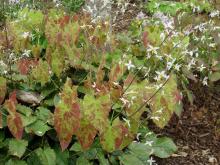
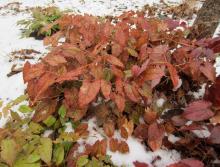
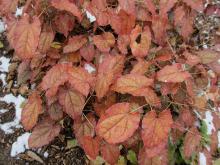
To choose only a couple of epimediums, that will be tough, or at least for me it would be a great challenge to narrow down the selection. You can't do better than with the two you mention, Amber Queen and Pink Champagne, both are excellent. May I also suggest from the Lost Horizons list of 88 Epimedium, E. stellulatum. This one slowly builds into a beautiful mound of evergreen leaves, the freshly unfolding leaves splashed fiery red-orange, changing to mottled green and red, and airy sprays of delicate little white flowers. It has season long beautiful leathery leaves that turn burnished crimson and gold in fall and winter... a year round plant.
Epimedium stellulatum in spring 2012:

Epimedium stellulatum foliage, early December 2012 on the left, January 2013 on the right, still looking vibrant:
I envy your plot of new garden bed ready for planting (oh, to have open ground), keep us posted later in the season on what you plant.
copperbeech (not verified)
Re: Epimedium 2013
Sun, 03/17/2013 - 8:57amI do realize it is a bit of a cheesy question.
I really appreciate the suggestion and the corresponding pictures.
I looked on the LHorizons site and there are two stellulatumm listed i.e. 'Long leaf form' and 'Wudang Star'. Which one am I seeing in the pictures?
It is the last 'open ground' I can get on our small residential property so I want to do it right. And I take it from your comment that your gardens are all well established with no room for expansion? I am not looking forward to this same scenario come 2014.
Mark McDonough
Re: Epimedium 2013
Sun, 03/17/2013 - 10:31amThe available forms of Epimedium stellulatum represent different wild collections of the species. The original species introduction was the one collected by Roy Lancaster in the Wudang Mountains of China, and given the name E. stellulatum 'Wudang Star'. It has leaves that are wider than normal. I have a plant of this selection on order for spring 2013 delivery. Rick has shown some good photos of it earlier in this topic; and if its hardy in Rick's Michigan climate, it should be hardy for you.
http://nargs.org/smf/index.php?topic=1254.msg21745#msg21745
The plants I showed came from Garden Vision Nursery, representing the typical species. Last year I finally purchased the one named "Long Leaf Form" (note: it's not a cultivar name, just a description in quotes). As the description suggests, this selection has longer leaves, that are narrower and more spiny-edged than the type. That said, I think they're all somewhat similar and equally desirable in the garden.
Regarding "open ground", I actually have lots of space left, but digging up new beds in my yard involves a lot of sweat equity, hard digging with a large pry bar and pick-axe to break up terrible rocky clay soil and decomposing ledge; seems that I always have way more plants that need planting than I have open beds for.
Richard T. Rodich
Re: Epimedium 2013
Sun, 03/17/2013 - 8:04pmNot only the pages on this thread, but last year's, too:
http://nargs.org/smf/index.php?topic=943.0
Your Ontario climate is much more amenable than mine in Minnesota. Here, E. stellulatum is evergreen, but I often trim the previous year's old foliage, once fresh leaves are there to replace them. The old leaves can look rather ratty sometimes.
Mark McDonough
Re: Epimedium 2013
Sun, 04/07/2013 - 7:28amJust placed another order, this time with EdelweissPerennials.com in Oregon. They have a really good plant offering, and easy to use & navigate website, purchasing online was simple. Most importantly, their prices are reasonable, bought a couple epimedium at half the cost than other sources. Check out their silver-leaved forms of Cyclamen coum and hederifolium too :o
http://www.edelweissperennials.com/PlantGroup.aspx?plant=Epimedium
Here are the Epimediums I ordered:
Epimedium wushanense 'Caramel' (I realize it's not the true wushanense, but I want E. 'Caramel'
E. chlorandrum
E. 'Starlet'
E. 'Yokihi'
E. x youngianum 'Beni-Goromo'
Cost with shipping was just under $100, once again coming in at that magic mailorder $20 per Epimedium cost.
Mark McDonough
Re: Epimedium 2013
Sun, 04/07/2013 - 8:25amIn the Facebook "Epimedium Group" there was discussion about the proper name of Epimedium 'Yokihi', because sometimes it is found as 'Yohiki' (the "k" and "h" reversed), so which is correct? Apparently it is 'Yokihi'.
When I googled Yokihi, the first thing that comes up is the famous story of Yang Kwei-fei (Yang Guifei). Not knowing the breeder's intent, we don't know the true inspiration behind the name 'Yokihi', but it does seem certain that this is the intended spelling. Its a very beautiful Epimedium, good to learn about its parentage.
NARGS forumist Saori, also on the Facebook Epimedium page, gave some information on this lovely cross, hope it's okay to quote her information "I've heard that Yokihi was bred by a nursery in Niigata and it is a cross between Epimedium membranaceum and Epimedium x rubrum".
When I look at the plant photo link below, the foliage does indeed look very much like E. membranaceum.
couple of good photos of this unique hybrid:
E. 'Yokihi' - whole plant view:
http://www.losthorizons.ca/~losthor/images/Epimedium/e_yokihi2.jpg
...dramatic black-background closeup views:
http://www.asianflora.com/Horticulture/epimedium-yohiki.htm
I've seen this listed as high as $35 for a plant, bought it at EdelweissPerennials.com (see message above) for $15, can't wait! For those in the New England area and you just can't wait, it is available from Garden Vision Epimedium nursery this year, at $30.
gerrit (not verified)
Re: Epimedium 2013
Wed, 04/24/2013 - 12:15pmHi Mark.
What do you know about a cross between Epimedium acuminatum and E. pinnatum. It seems to me a lovely hybrid. Look here.
http://www.visionspictures.com/index.php?module=result&searchKey=Epimedi....
This cross was showed on a German forum. Here you can find it in reply 19.
http://forum.garten-pur.de/index.php?board=24;action=display;threadid=48...
Gerrit
Mark McDonough
Re: Epimedium 2013
Wed, 04/24/2013 - 6:41pmHi Gerrit, I haven't heard of that cross, but it does indeed look beautiful, and distinctive; thanks for bringing it to our attention. It goes to show us, that the world of Epimedium hybridization is wide open, with so many possibilities, our gardens will be all the richer with such diversity.
By the way, my third box of mail-order Epimedium arrived today, all carefully packed; generous size plants, some in full bloom like this E. platypetalum. The order included 9 Epimedium, shipped from Collector's Nursery in Washington State, the plants arrived in awesome condition. I planted some of them tonight after work, the plant size generous enough to divide several of them!
Trond Hoy
Re: Epimedium 2013
Thu, 04/25/2013 - 12:28amMark, I envy your possibility to order Epimediums so easily! I have managed to get hold of two new (for me) ones and hope the slugs let them stay grow. The new growth is apparently irresistible for the gastropods >:(
Mark McDonough
Re: Epimedium 2013
Sun, 04/28/2013 - 7:18pmWe have experienced a slow but perfect spring season, Magnolias are glorious and didn't get whacked by surprise frosts, and Epimedium are surging forward with great speed; can't keep my eyes off of them. Many are breaking into bloom, but tghis post just features two.
Epimedium brachyrrhizum hybrid, from a self-sown seedling, looking very much like E. brachyrrhizum, but with pristine flowers and much better floral presentation.
The next batch of photos are all of an Epimedium hybrid of mine, nicknamed by Wim Boens as 'Mark's Star'. I do plan on introducing this one, but still not settled on what the name will be, although I've grown accustomed to 'Mark's Star' ;)
Trond Hoy
Re: Epimedium 2013
Mon, 04/29/2013 - 2:01amWell, you are lucky, Mark! Here the spring is so slow that nothing seems to change from one week to the next :-\
They are both beautiful, Mark, and the name of the last one is perfect! Do you want me to test-grow it in Norway? ;)
Margaret Young
Re: Epimedium 2013
Mon, 04/29/2013 - 4:51amLovely "baby" you have there, Mark - the name 'Mark's Star' does seem appropriate.
Maggi
gerrit (not verified)
Re: Epimedium 2013
Mon, 04/29/2013 - 9:57amVigorous plant that 'Mark's Star'.
Epimedium season has started here too.
For the first time I have seen Epimedium 'Mandrin Star' in bloom. Well, he is okay I think.
Richard T. Rodich
Re: Epimedium 2013
Mon, 04/29/2013 - 7:10pmMark's Star is really exceptional in so many ways: color blends, floriferousness, flowers lofty above the foliage, etc.
It seems dwarf, too (?)
And Mandrin Star ain't too shabby either. (He says in Minnesota speak.)
Mark McDonough
Re: Epimedium 2013
Mon, 04/29/2013 - 8:38pmThanks Rick. Yes, 'Mark's Star' is dwarf too, truly a rock garden sized thing, thanks for your comments. I do really like how the flowers are well about the foliage, something I'm aiming for in my hybridization.
Gerrit, what can you tell us of 'Mandrin Star'? The name comes up both as 'Mandrin Star', but many more hits on 'Mandarin Star', which makes sense. I can't find hardly any information on it, please tell us where it is from. Only a couple pictures found on google, in those the flowers look like E. stellulatum or E. pubescens, but your photo shows a much more substantial flower with strong outer sepals.
gerrit (not verified)
Re: Epimedium 2013
Tue, 04/30/2013 - 2:10amI contacted Koen van Poucke, where I bought this plant and he confirmed it to be a plant with stellulatum blood. So maybe the right name is Epimedium stellulatum 'Mandrin Star'.
I have 3 E. stellulatum and here are the pictures.
1. Left: Epimedium 'Mandrin Star', right Epimedium stellulatum 'Long Leaf Form'.
2. Flower of E. 'Mandrin Star'
3. Flower of E. 'Long Leaf Form
4. Foliage of Epimedium 'Wudang Star'
5. Flower of E. 'Wudang Star'.
Mark McDonough
Re: Epimedium 2013
Tue, 04/30/2013 - 7:23pmWell, the 'Mandarin Star' form is very nice, looks like it has considerably larger flowers than normal. I do think it should be called 'Mandarin Star' versus 'Mandrin Star', as 'Mandarin' is a Chinese dialect and would make sense for a Chinese species. To re-emphasize the point 'Mandarin Star' is actually a hybrid and not a species selection, notice the size of the yellow petals and cup, way bigger than typical stellulatum. :)
Both 'Wudang Star' and 'Long Leaf Form' are new to my garden, so I shall get a chance to compare them on my own plants, and to the good photos you post showing them.
gerrit (not verified)
Re: Epimedium 2013
Wed, 05/01/2013 - 1:18pmThe person who named it, might have his reason to choose for Mandrin. It sounds better than Ma-da-rin.
I will never change Mark's Star in Marc's Star for instance.
Mark McDonough
Re: Epimedium 2013
Wed, 05/01/2013 - 8:08pmI understand, but then again sometimes there are obvious "typos", naming mistakes. I would bet money that the plant is named 'Mandarin Star', as 'Mandarin' is such a hugely prominent part of Chinese culture, whereas the word "Mandrin" basically comes up odd references. You are correct to be conservative on this matter, but maybe ask Koen van Poucke to verify the "Mandrin" versus "Mandarin" question.
Trond Hoy
Re: Epimedium 2013
Wed, 05/01/2013 - 11:58pmregardless whether it is 'Mandrin' or 'Mandarin' it is a nice plant! And so are the others ;)
gerrit (not verified)
Re: Epimedium 2013
Fri, 05/03/2013 - 12:23pmYesterday I visited Koen van Poucke. I bought a new stellulatum. Epimedium stellulatum 'Yukiko'.
Of course I asked him about the name 'Mandrin' vs 'Mandarin'. He confirmed the possibility the latter is right. So, Mark let's call him 'Mandarin'. The plant might be from Robin White, from Blackthorn Nursery.
Tomorrow more about my new acquisitions.
Edit. Note, the leaves are much bigger than the fragile leaflets of the other cultivars of stellulatum. His performance too. Compare it with the tiny plants, showed before
gerrit (not verified)
Re: Epimedium 2013
Sat, 05/04/2013 - 1:18pmSome new species or cultivars are added to my collection after the visit to KVP
1 Epimedium grandiflorum 'Freya', an outstanding dwarf Epimedium. I lost him in a harsh winter 2 years ago
2 Epimedium koreanum 'Harald Epstein'.
3. Epimedium 'Red Maximum'. This hybrid from the hand of Koen is one of the most red Epimediums. Difficult to catch on a picture. Parents are E. grandiflorum 'Freya' and E. membranaceum. I saw this hybrid years ago for the first time in his 'treasure corner' and I was directly fond of him. A very healthy growth and the flowers above the foliage. And a deep red colour. And now Koen was able to sell him.
More to follow.
Mark McDonough
Re: Epimedium 2013
Sun, 05/05/2013 - 5:21amGerrit, I see what you mean on E. stellulatum 'Yukiko', it is big and bold compared to others, should make an impressive specimen in time. I have not heard of that stellulatum form before.
On your newly added cultivars, Freya looks nice, we're not likely to see it here in the US, although there are others with that general appearance (dwarf grandiflorum type, with the "white star" coloration on the back of the sepals); the one called 'Starlet' from Collector's Nursery has that form.
'Red Maximum' has striking flower form and color. Do you know who selected and named that one?
On E. koreanum 'Harold Epstein', do be careful where you plant it; it is an aggressive runner with long underground stolons. I had an area with mixed epimediums and other plants, eventually decided it would be easier to move all other plants out, and just allow 'Harold Epstein' to fill the area. At Garden Vision nursery (the original one), this epi fills about 20' x 20'. It is beautiful, but just be aware of its spreading tendencies.
It should be noted for NARGS Forum readers, E. koreanum was recognized only recently (2002) by Stearn as a species separate from grandiflorum, although one is likely to see the combination E. grandiflorum ssp. koreanum, but most plants under that name are actually yellow-flowered forms of E. grandiforum, known as E. grandiflorum f. flavescens. Unlike grandiflorum, E. koreanum spreads by rhizomes, 6-12" a year, and has few-flowered inflorescence or relatively huge individual blooms.
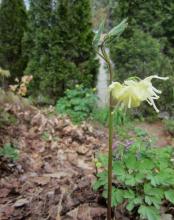
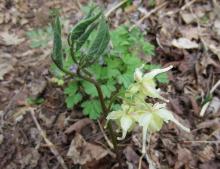
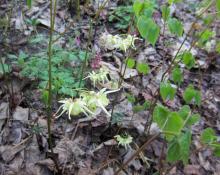
Here are a few photos of E. koreanum 'Harold Epstein' taken over the last week or so. It is distinctive when emerging and flowering, as each growth point is like a sturdy flag pole, or street light, with the big soft yellow flowers popping off from the side of the pole, with a "flag" of young expanding leaves above. The leaves get very large in time.
E. koreanum 'Harold Epstein'
Mark McDonough
Re: Epimedium 2013
Sun, 05/05/2013 - 5:39amA few photos of Epimedium 'Sunshowers', a unique and beautiful epi originating from Far Reaches farm in Washington State; I got mine from Garden Vision a few years back. Compact and floriferous, with specked foliage, and soft yet luminous yellow flowers and broad white sepals. It has a unique appearance on account of the nearly orbicular shape of the central cup on each floret.
E. 'Sunshowers'
gerrit (not verified)
Re: Epimedium 2013
Mon, 05/06/2013 - 12:05amThanks for your words about 'Harold epstein' and the species koreanum. Knowing this, it would be better for me not having bought this plant, but too late. ;D
Do you mean that grandiflorum f. flavescens are all actually koreanum? for example 'La Rocaille?
I've not seen a koreanum before. It's a very rare species here. That's why I bought this 'Harold Epstein' at once.
During my visit to KVP there was in corner a box with hybrids. Huge flowering plants and Koen gave them away for almost nothing. I bought three.
Here are the pictures. First the whole plant and second the close-up.
My first impression is that of a wushanense habitus (is that a right word for performance?)
In photo 1 is maybe influence of E. amber queen.
gerrit (not verified)
Re: Epimedium 2013
Mon, 05/06/2013 - 12:09amThat Epimdium 'Sunshowers' is a real stunner. Everything is okay. Speckled foliage, vigorous, and the attractive colour of the inflorescens.
Mark McDonough
Re: Epimedium 2013
Mon, 05/06/2013 - 6:19amWow Gerrit, you got three stunning epimediums for almost nothing, the first one is exceptional!
Regarding the nomenclature confusion around E. grandiflorum f. flavescens; according to William T. Stearn in his The Genus Epimedium published in 2002, E. grandiflorum f. flavescens is a recognized yellow-flowered phase of E. grandiflorum from Japan. However the name E. grandiflorum ssp. koreanum is also seen a lot, to describe similar yellow-flowered plants from Korea, however that name was retired in 2002 when Stearn published the Korean plants as its own species E. koreanum, putting grandiflorum ssp. koreanum into synonymy.
In horticulture the two species are typically confused, both showing up under the old (now invalid) name of E. "grandiflorum ssp. koreanum". Most plants in cultivation under the name E. grandiflorum ssp. koreanum or even E. koreanum, are in fact E. grandiflorum f. flavescens. So the two correct names are:
E. grandiflorum f. flavescens - a yellow flowered phase of typical grandiflorum, clump-forming non-running growth. Native to Japan.
E. koreanum (syn. grandiflorum ssp. koreanum), also yellow-flowered, but with running rhizomes extending 6-12" annually, native to N. Korea (where the "Type" was described, but also found in China)
In growth, it's not too hard to tell the plant apart, even without checking for the existence of long rhizomes in E. koreanum. Epimedium koreanum doesn't make a tight multi-stemmed clump as is typical for E. grandiflorum, but appears as a colony of spaced-out vertical stems. The photo below shows a form of E. koreanum that Garden Vision sells (their plants of several clones from N. Korea and some from China). The naked stems stand nearly 2' tall, with a few yellow flowers under the canopy of unfurling leaves. I planted mine in a rough woodsy spot where it can run.
Mark McDonough
Re: Epimedium 2013
Mon, 05/06/2013 - 6:28amI should've mentioned for Rick, and others in colder climates, E. koreanum is supposed to be very hardy and rated to as low as Zone 3. Might be one to try, bearing in mind, its running-spreading growth.
gerrit (not verified)
Re: Epimedium 2013
Mon, 05/06/2013 - 11:02amInteresting picture of emerging E.koreanum.
Good to have a place for those interesting Epimediums in a wood. I don't have a woodland garden, but no complains.
Another 3 pictures of my new Epimediums, bought this weekend.
1.Epimedium grandiflorum 'Circe'
2 Epimedium campanulatum (expensive, even here) But a 'must-have'
3.Epimedium lishichenii Og 96024. The one with the registration cc 95007 was already here.
4.Epimedium lishichenii inflorescence
Mark McDonough
Re: Epimedium 2013
Mon, 05/06/2013 - 11:14amI hate it when this happens; while I typically plant out individual Epimedium seedlings, I must have planted two seedlings together by mistake. Half of the clump (left side) has nice heart-shaped leaves and good leaf color, but small, uninteresting partially concealed white flowers, whereas the right side of the clump has bold clusters of pink-sepalled flowers with strong rosy-red cups. I'm going to dig this clump up while in flower, wash off all soil, and attempt to separate them out, the white one to be discarded.
Oh, Gerrit, just noticed your photo additions to the message above. It's good that grandiflorum 'Circe' has "jumped the pond" and made it to Europe, one of the very best deep-color grandiflorums, mine is just coming into bloom too. I agree that Epimedium campanulatum is a "must have", I see buds on my two smallish plants... I had a rather large plant that died back to a smaller size plant a couple years ago, and my second plant is a flowering-size seedling that looks identical. I am now of the opinion that E. lishihchenii is not entirely hardy here, I have lost the plant several times, the replacement I planted out last May is one of the few casualties over this past winter. Even among a flat of E. lishihchenii seedlings, many did not return, which is too bad as its a beautiful species both for flower and foliage.
gerrit (not verified)
Re: Epimedium 2013
Tue, 05/07/2013 - 1:51pmThe beauty of Epimediums.
Epimedium fargesi 'Pink Constellation'
Epimedium pinnatum ssp colchium
Richard T. Rodich
Re: Epimedium 2013
Tue, 05/07/2013 - 7:59pmExquisite photographs, Gerrit, and exquisite subjects, too!
E. lishihchenii has been growing in my garden since 2005. It seems hardy and doesn't get any special winter protection. It increases slowly, and sometimes I wonder if flowers are somewhat deformed due to my cold climate (?).
Mark McDonough
Re: Epimedium 2013
Wed, 05/08/2013 - 5:52amRick, you've done well with E. lishihchenii, I love the heavy textured foliage on this one. I keep losing mine, and was coming to the conclusion it's not reliably hardy here! My replacement plant bought and planted out last spring, died over winter. I wonder if there are different clones, some more hardy than others, or perhaps, mine were in too dry a spot. I have a few seedlings coming along, one is in bloom, but even with the seedlings, about half of them died over winter.
Gerrit, a Rick says, really fine photos, getting the small narrow flowers of E. fargesii in focus is no easy task, such plants are devilishly difficult to photograph well. I don't have Pink Constellation, just the regular species.
I've tried and tried to photograph an allied species, E. qingchengshanense over the last couple of bright sunny days, all photos were poor, so last night I photographed in low light, and finally got photos of the flowers in focus, but I don't like the low-light photos, but it'll have to do.
E. qingchengshanense, from Qing Cheng Shan, China.
Close-up of the flowers, comparing E. qingchengshanense with the similar E. fargesii flowers, the former having a better developed cup and yellow pollen as opposed to green.
gerrit (not verified)
Re: Epimedium 2013
Wed, 05/08/2013 - 10:25amYou did well, getting those difficult tiny flowers in focus. Now I know how the flowers of this Chinese-species-with-his-unpronounceable-name looks like. Something like fargesi or dolichostemon.
Well another difficult-to-get-in-focus-species is Epimedium x omeiense 'Stormcloud'. The first one coming into bloom from the x omeiense family, which I like so very much.
Mark McDonough
Re: Epimedium 2013
Wed, 05/08/2013 - 6:34pmGerrit, do you have a new camera? Your photos are showing some excellent detail. Seeing the E. x omeiense 'Stormcloud', I'm struck by two things, the first being the striking color (the obvious one), and the curious "hump-back" sepals, so distinctive! I have only recently (last year) added E. x omeiense 'Akane' to my garden; the other named forms are on my list. :)
Aaron, I only added E. dolichostemon to my garden a couple weeks ago from a mail order nursery, it would be great to include a flower from that species (next year), to show the differences in these three allied species.
Mark McDonough
Re: Epimedium 2013
Wed, 05/08/2013 - 9:38pmThe season gets ahead of me so quickly, that I miss posting because the images are no longer timely. But, I'm going to try and offer up some Epimedium images for you all.
Epimedium x youngianum-type hybrid that I nicknamed 'Bipolar' because most of the flowers have only 2 sepals like a propeller, although a few flower will have 3 or the normal 4 sepals. Floriferous, light pink, compact, a really nice little hybrid.
Epimedium x 'Black Sea', with light yellowish orange flowers on upright stems, beautiful near black autumn foliage.
Epimedium brevicornu, a younger plant than my big mature clump, airy sprays of white and yellow flowers in abundance.
Epimedium ilicifolium, in a state showing last year's base of evergreen foliage, and then the new orangish foliage and yellow buds forming.
Epimedium hybrid ([stellulatum x membranceum] x open-pollinated), second year seedling already flowering, with flurries of faint pink ascending sepals (they look white in the photo) and light yellow cups.
Epimedium pubigerum hybrid - three views of this lucky find, with very nice textured foliage, and sprays of light yellow flowers on shorter stems than normal, a 3-year seedling plant that I'm keeping an eye on.
E. x versicolor 'Cupreum', the foliage color is outlandish, such a deep orange-rust color with green veining, and coppery yellow & pink flowers.
One of my many hybrid seedlings involving E. grandiflorum 'Dark Beauty', with amazing deep reddish-coffee color foliage, worth growing just for the foliage alone. The average mauve-ish blooms are mostly concealed by foliage (but, oh that foliage), but will probably hold off naming anything until I get one with foliage like this and great flowers too.
gerrit (not verified)
Re: Epimedium 2013
Thu, 05/09/2013 - 11:34amNo Mark, no new camera. I'll try to show in my photos the beauty of the genus. No straight pictures, but a little more impressions, colour and light.
Epimedium ilicifolium, a beautiful species. typical spiny narrow leaves, the best part of the plant. Your plant Mark impressive by it's size. Good to see, the different orange colour.
Mark McDonough
Re: Epimedium 2013
Fri, 05/10/2013 - 5:10amGerrit, fine photo of E. ilicifolium. I have about 4 flats of seedlings coming along, very interested in seeing what the results might be, but first bloom will not be until at least another year.
After two days of much needed rain, I walked the garden briefly this morning before work, and snapped this photo of a hybrid epimedium in the foreground, selected on account of its floriferous habit and large pink and white flowers; not anything to get named, just to be enjoyed in my garden.
gerrit (not verified)
Re: Epimedium 2013
Fri, 05/10/2013 - 10:08amYes Mark, I do the same thing in the morning. A stroll through my garden, looking if everything is going well and enjoy the fresh morning colours. The most happy moments of the day.
1. The reddish colour of Epimedium brachyrrhizum leaves hit my eyes.
2 and 3: And once again, the clear red and yellow Epimedium x Yokiko.
The right name must be: Epimedium x 'Yokihi'
gerrit (not verified)
Re: Epimedium 2013
Fri, 05/10/2013 - 10:20amAnd I discovered a funny thing.
3 years ago I bought a too expensive Epimedium, a very small one, with one flower. A big flower, beautiful violet, Epimedium macrosepalum. The next years no flower(s) appeared and the plant did not increase.
And this morning it appeared to be a spreader without blooming.
The light green leaflets are from E. macrosepalum.
The specled ones, right of it are the leaves from E. wushanense 'Caramel'
Mark McDonough
Re: Epimedium 2013
Sat, 05/11/2013 - 5:46pmEpimedium 'Yokihi; is a real beauty, I received one a few weeks ago from a mail order nursery. Please note the spelling; on the Facebook Epimedium page there was discussion whether it is correctly 'Yokiho' or 'Yohiko', it can be found both ways, although it was verified that it is correctly E. 'Yokiho':
http://www.asianflora.com/Horticulture/epimedium-yohiki.htm
Your comment about E. macrosepalum being a "runner" caught my attention, as I haven't even considered it might be a runner, whenever I saw it at Garden Vision it's always been single plants (probably young plants that hadn't started running). Today I was at Garden Vision and Karen Perkins has it noted right on the sign for this species, that it run. So, that means I will be relocating mine to spot where it can run freely. The flowers are totally hidden under the foliage, bur the sepals are indeed over-sized.
Pages