
We are 11 days late on this topic!
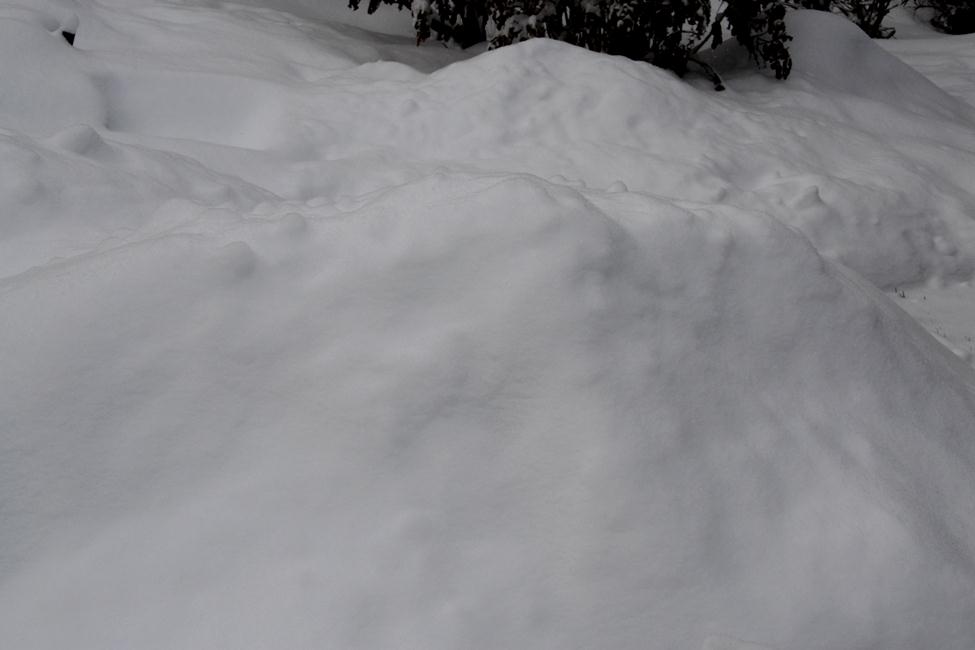
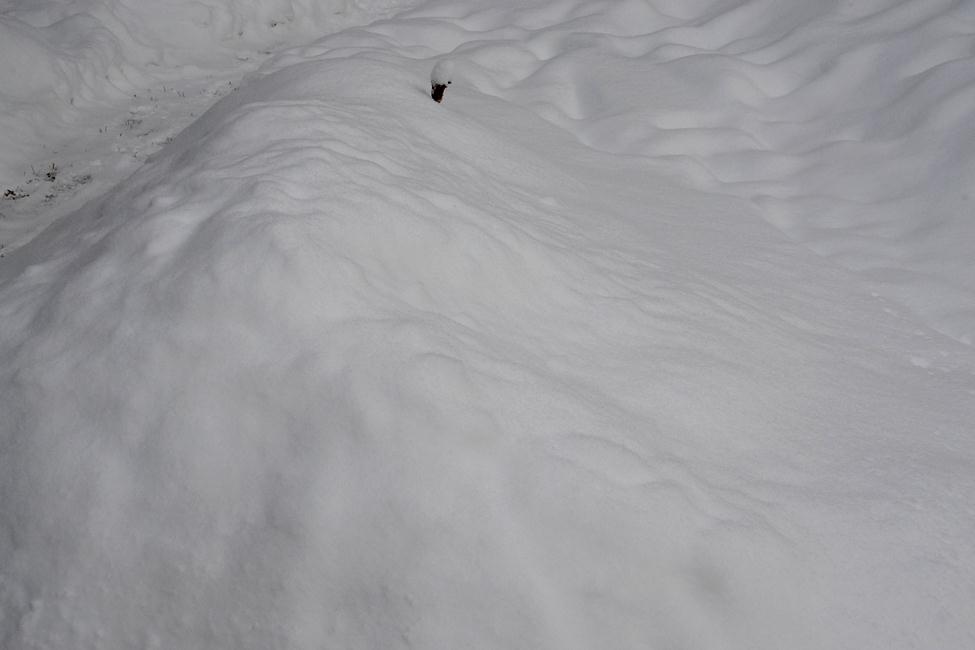
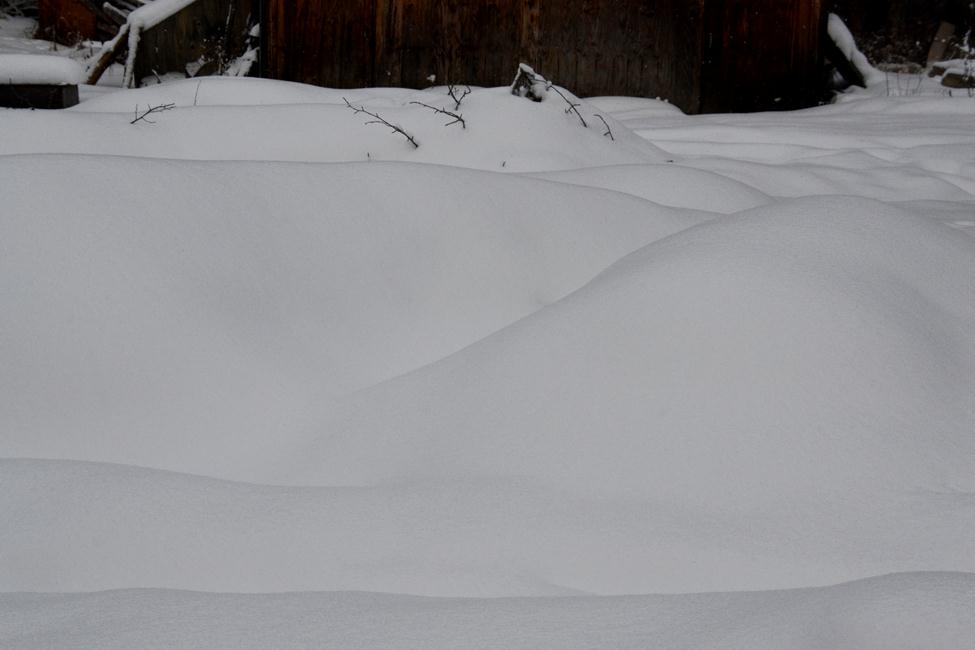
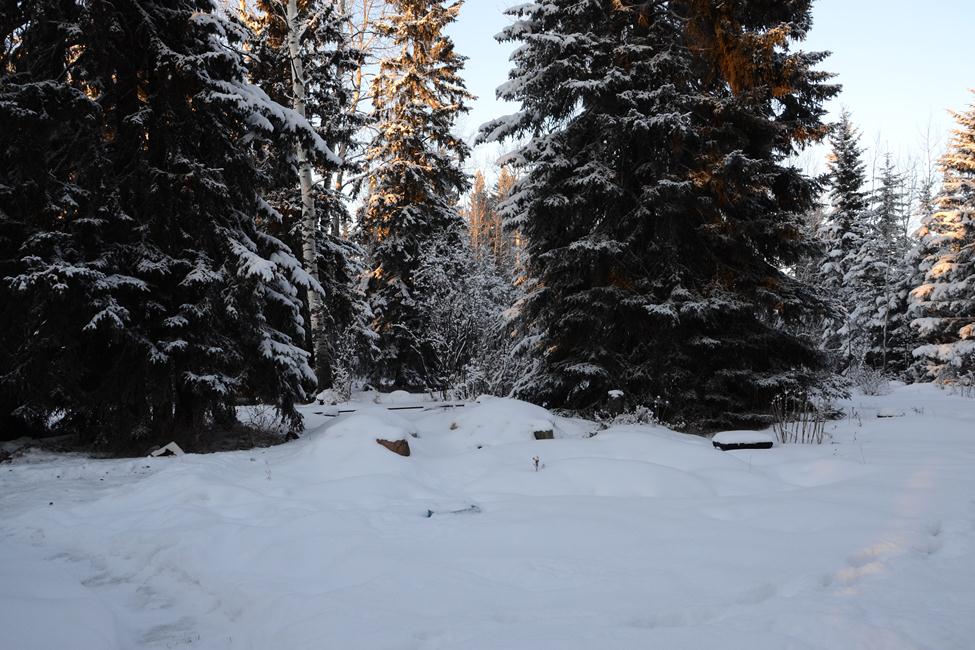
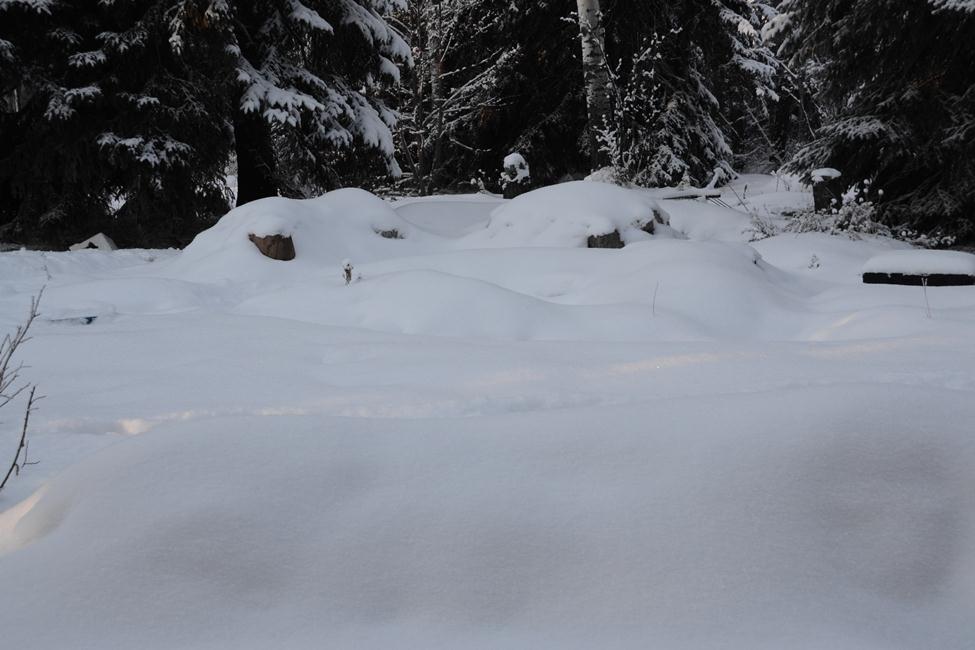
A couple views of some of my garden beds in the last couple of days-- not a whole lot to see! but you see some of the 'ridges' of the rock gardens and berms I've been developing, and looking at them this winter under snow, I've realised that these winter shapes should be taken into account at the design phase, since this is what I see for months at a time!
1-3 the rock beds in front of the house which get extra snow, being surrounded by shovelled paths; in #3 you can see a bit of the tallest Sempervivum flower stalk sticking through the snow still..
4,5 a couple of rock beds and berms in a different part of the acreage- these are in the moister part of the property, and (not counting the shovelling mentioned above) get the deepest snow
6,7 the third rock garden area, this is on the drier end of the property, and drier yet between the two large spruce trees- the two taller ridges have had the least snow cover of any of my plantings, so time will tell what plants that will favour (naturally, I am planting things that generally want to be drier in this area)


Comments
Trond Hoy
Re: What do you see on your garden walks? 2013
Sun, 05/19/2013 - 10:51pmNot a boatload, Rick but a few podloads had been nice!
Taraxacum is usually apomictic. In Norway we have about 370 "species" (or clones if you like) of Taraxacum, many endemic.
If you added a few of the pink dandelion I would be happy Rick!
Trond Hoy
Re: What do you see on your garden walks? 2013
Sun, 05/19/2013 - 11:06pmMaybe your front yard is too dry? I think they like a moist spring (if no rain they get snowmelt water) but take a drier summer fine. I will cover mine with chicken wire. Should keep the hares out but hope the elks don't come trampling.
I can send you some fresh seed if I get any - have to be there at the right time or they are gone by the wind. . . .
Claire Cockcroft
Re: What do you see on your garden walks? 2013
Mon, 05/20/2013 - 12:02pmThe garden is turning into a jungle as the temperatures warm up (slightly) and the rain eases off.
Brimeura amethystina with Iris siberica nana alba in the background
Roscoea cautleyoides
Incarvillea delavayi 'Snowtop'
Ourisia coccinea
tropicalgirl251... (not verified)
Re: What do you see on your garden walks? 2013
Mon, 05/20/2013 - 7:17pmNice pictures Claire.My Incarvillea did not comeback. #days of holidays and lots of work done at the garden and inside. The weather is fabulous.Here are some pictures taken today .
[edited to add names for searchability- MMcD]
Anemonella thalictroides
Daphne arbuscula
Dryas octopetala
Iris pumila
tropicalgirl251... (not verified)
Re: What do you see on your garden walks? 2013
Mon, 05/20/2013 - 7:19pmmore
[edited to add names for searchability- MMcD]
Primula x pruhoniciana
Primula allionii
Rananculus sp.
Sanguinaria canadensis 'Multiplex'
tropicalgirl251... (not verified)
Re: What do you see on your garden walks? 2013
Mon, 05/20/2013 - 7:22pmmore
[edited to add names for searchability- MMcD]
Saxifraga sp.
Viola jooi
Primula denticulata
Lori S. (not verified)
Re: What do you see on your garden walks? 2013
Mon, 05/20/2013 - 7:42pmThere's nothing I like better than a jungle, Claire! :D
Fabulous, Krish! I'm impressed, especially, by your Daphne. I only have Daphne retusa which struggles, managing only to put out one cluster of flowers in the last couple of years. (I mean, really.. one cluster of flowers since 2009? Obviously the wrong choice for my conditions!) How long did you have the Incarvillea delavayi? That's one that I found would only last 2-3 years for me. By contrast, I find that Incarvillea zhongdianensis and I. mairei v. grandiflora are very long-lived and dependable.
Lori S. (not verified)
Re: What do you see on your garden walks? 2013
Mon, 05/20/2013 - 7:51pmYes, undoubtedly. Maybe I will try to move them. There is little to lose, since they don't flower.
Richard T. Rodich
Re: What do you see on your garden walks? 2013
Tue, 05/21/2013 - 6:53amVery nice Krish! The sax is so cute and the primula so very happy!
I'm glad to someone else that gardens on a small lot. I have a dickens of a time trying to take photos without distracting backgrounds.
---------------------------
Duly noted, Trond. :)
Claire Cockcroft
Re: What do you see on your garden walks? 2013
Tue, 05/21/2013 - 9:47amWonderful pictures, Krish. I love the juxtaposition of dryas and daphne. I don't grow Dryas octopetala, but D. grandiflora & D. x suendermannii are rampant growers in my climate, so I don't dare try that. I have a hard time with Primula scotica. It germinates, dawdles for a while, then gives up the ghost over a winter or two with little or no flowers. Maybe I should move some seedlings into the sand bed?
Loris, the incarvillea seed was planted in January, 2009. So far, several plants have returned every year. That doesn't mean they'll continue. ;)
tropicalgirl251... (not verified)
Re: What do you see on your garden walks? 2013
Tue, 05/21/2013 - 12:09pmThanks for the comment. Lori try the Daphne with some granite pieces to cover the root. I Had one with roots tucked under tufa rocks. It was not doing well. Moved with roots under granite. Doing very well. I have Daphne lawrence crocker which is in buds now. All my three Daphne gets moderate to high sun.All are doing very well.
Longma (not verified)
Re: What do you see on your garden walks? 2013
Wed, 05/22/2013 - 6:02amAlways 'eye - catching' 8) Dodecatheon pulchellum.
Trond Hoy
Re: What do you see on your garden walks? 2013
Wed, 05/22/2013 - 11:12amVery nice plants!
Claire, does the Ourisia coccinea need much sun? or water?
Krish, magnificient Daphne!
After 3 days with record breaking warm weather we are back to normal: cold northerly wind damaging the plants. Not easy to take pics either.
These wasn't too blurred:
Ranunculus parnassifolius waiting for more sun, Maianthemum canadense(?) and Scilla lilio-hyacinthus, Erythronium sp
Claire Cockcroft
Re: What do you see on your garden walks? 2013
Wed, 05/22/2013 - 5:46pmHi Trond,
In my garden, Ourisia coccinea seems happiest where it is in part shade and gets ample water. It spreads by stolons and likes a soil mix with lots of humus, too.
Trond Hoy
Re: What do you see on your garden walks? 2013
Thu, 05/23/2013 - 2:47amThanks Claire. It's what I supposed. But I am afraid I have planted mine in too heavy shade.
This is what lots of gardens in the eastern part of Norway (where we have our cabin) look like today:
http://nrk.no/
http://www.vg.no/nyheter/vaer/artikkel.php?artid=10116755
Anne Spiegel
Re: What do you see on your garden walks? 2013
Thu, 05/23/2013 - 2:52pmTrond, that flooding is really terrible. I hope your cabin is OK. What a pity that weather (rain, snow, heat, cold) can't be distributed evenly. We have been so dry here and today we are finally enjoying a day of rain interspersed with thunderstorms.
Biggest excitement in the garden for me is that Lewisia rediviva alba has a place where it seems to be happy. I made an overhang of rock which kept it drier during the winter and it has been in bloom for some time now. I think it's the pink stamens setting off the pristine white petals that really make it special. There were 5 flowers in bloom today.
Michael Peden
Re: What do you see on your garden walks? 2013
Fri, 05/24/2013 - 9:06amThe white form of L. rediviva is lovely. I had it as 'minor' several years ago but lost it. Of all the Lewisia, rediviva seems most subject to frost heaving. I've taken to growing it in a trough where it is on the level and can anchor in well. I don't think winter wet here in the Northeast will ever be a problem for Lewisia. I sense they might even enjoy it ;)
deesen (not verified)
Re: What do you see on your garden walks? 2013
Fri, 05/24/2013 - 11:35amEven though I struggle with Lewisia rediviva (and under glass too) I covet L. rediviva alba ;D
Anne Spiegel
Re: What do you see on your garden walks? 2013
Fri, 05/24/2013 - 2:39pmIt's one I've had difficulties keeping in the past. Maybe the alba form is easier. Lewisia tweedyi seems to be the easiest and lasts for years. L.cotyledon, grown by some people like dandelions, for me seems susceptible to being wet at the wrong time and the leaves quickly show their distaste, becoming orange or yellow, and in extreme cases, turning to jelly, yuk.
tropicalgirl251... (not verified)
Re: What do you see on your garden walks? 2013
Fri, 05/24/2013 - 3:58pmHi Anne
nice Lewisia.I have a clump of Lewisia rediviva alba for the last three years.It flowers every year but not increasing in size. I got some seeds from NARGS which are germinating now.Hopefully more will be there.Two years ago I visited a Calgary garden where they had it on the vertical stone wall flowering nicely.
Michael Peden
Re: What do you see on your garden walks? 2013
Fri, 05/24/2013 - 6:36pmCertainly that wall has well spit those plants out by now! The Lewisia in the wall idea is drifting.... drifting.....
tropicalgirl251... (not verified)
Re: What do you see on your garden walks? 2013
Fri, 05/24/2013 - 7:56pmToday it is raining all day. Did not go out to take pictures.These once are taken yesterday
tropicalgirl251... (not verified)
Re: What do you see on your garden walks? 2013
Fri, 05/24/2013 - 7:59pmMichael the wall was not really vertical but slanting slightly.I thing it as a very good idea for drainage.
Gene Mirro (not verified)
Re: What do you see on your garden walks? 2013
Fri, 05/24/2013 - 9:45pmLilium mackliniae:
[attachthumb = 1]
Lilium pyrenaicum:
[attachthumb = 2]
Molopospermum peloponnesiacum (try saying that three times quickly):
[attachthumb = 3]
Two sturdy stems of Nomocharis:
[attachthumb = 4]
Nomocharis flower:
[attachthumb = 5]
Gene Mirro (not verified)
Re: What do you see on your garden walks? 2013
Fri, 05/24/2013 - 9:53pmArisaema heterophyllum:
[attachthumb = 1]
A spathe within a spathe:
[attachthumb = 2]
First time I've ever seen that.
Claire Cockcroft
Re: What do you see on your garden walks? 2013
Sat, 05/25/2013 - 10:02amThe lilies and nomocharis are fantastic, Gene.
Strange arisaema!
Trond Hoy
Re: What do you see on your garden walks? 2013
Sat, 05/25/2013 - 1:48pmAnne, my cabin is fortunately safe. It sits on higher ground and the flooding are worse in the valleys. Although the weather is better now the water is moving down the valleys and flooding new places.
Lewisia is one of my favorite genera but I have decided to wait growing them till I get a usable place for them!
Nomocharis too is a fave, but you know, the slugs . . . . .
Lori S. (not verified)
Re: What do you see on your garden walks? 2013
Sat, 05/25/2013 - 9:02pmCastilleja integra! Fantastic, Krish! How did you acquire it?
The Nomocharis is mouth-watering, Gene.
It started raining on Thursday morning and continued through Friday - 3" by our gauge. It had been very dry but, after that, we should be good for a while.
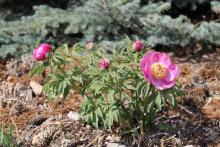
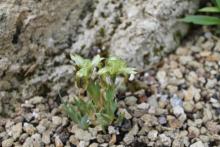
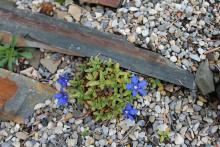
First peony in bloom out in the front yard; a slightly rain-soaked Iris sp. ex. Burdur, Turkey - purchased from an expert member at the CRAGS sale earlier in May; Gentiana verna is suddenly looking rather sad this year and is only putting up a few blooms:
Muscari and Linum; Penstemon nitidus is starting to bloom in the front yard:
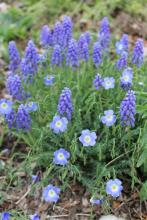
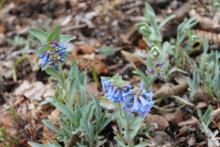
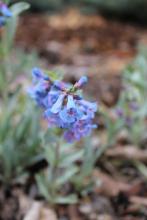
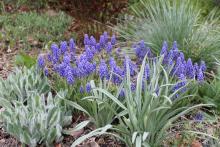
The glaucous foliage of Zigadenus elegans with Muscari and Hieracium villosum in the front yard:
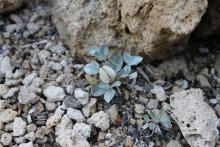
The first, modest bloom on Astragalus loanus, from NARGS Seedex seed in 2012:
Anne Spiegel
Re: What do you see on your garden walks? 2013
Sun, 05/26/2013 - 9:33amLori, the bloom on Astragalus loanus may be modest, but it's a start. Maybe there's even a chance it will set a seed pod. The pods are really nice on this astragalus. In my climate, I can get astragalus and other dryland peas to live and flower but very rarely to set seed. My early summer/late spring weather does not seem to be to their liking. It's stopped raining after several days - back to planting and setting new rocks!
Lori S. (not verified)
Re: What do you see on your garden walks? 2013
Sun, 05/26/2013 - 7:03pmYou must have great arm muscles, Anne. ;D The beauty of your gardens makes all that exercise worthwhile. I hope you will post lots of photos of the existing gardens and the new areas.
A few from today...
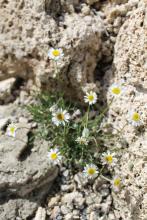
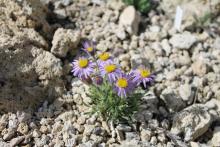
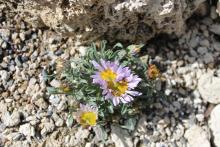
Erigeron leptophylla; Erigeron nanus; a funny fasciated Townsendia parryi (BTW - the odd purple one beside it died; I should have known that imminent death was the reason for the weird colour):
I'm pleased that last year's Penstemon pumilus seedling will bloom this year!
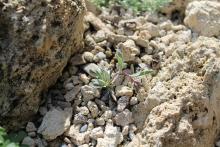
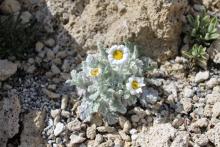
Pyrethrum leontopodium in bloom (flowers a bit messed up from the rain):
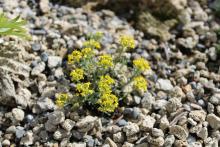
Alyssum sp. from seed last year - the flowers are very tiny; collected by Mojmir Pavelka at 1500m in Tahtali Dag, Turkey, from limestone hills. I think it will be very nice and densely-flowered as it matures.
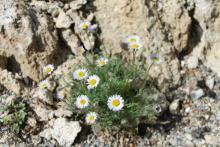
Erigeron compositus var. discoideus:
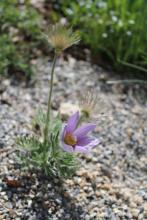
Pulsatilla halleri, or so it was said to be... although I am starting to mistrust all Pulsatilla IDs (until the experts have passed judgement!)
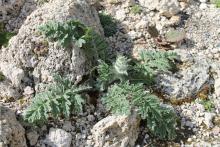
Eremostachys speciosa (the plant that bloomed last year http://nargs.org/smf/index.php?topic=1088.msg18070#msg18070) will have two stalks this year! :)
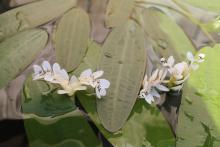
And switching gears completely... water hawthorn, Aponogeton distachyos:
Lori S. (not verified)
Re: What do you see on your garden walks? 2013
Sun, 05/26/2013 - 7:09pmThere is not much in bloom yet after that cold April. Finishing off...
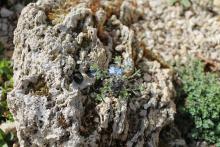
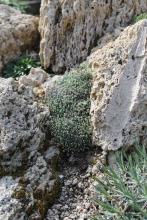
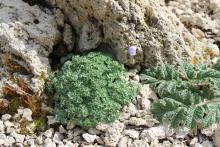
Eritrichium pauciflorum ssp. sajanense; Asperula boissieri has recovered now from the hard winter of 2012 and will have lots of flowers:
Paraquilegia... ONE flower? Oh come on! :rolleyes: (Well, I'm glad it survives at least. Maybe someday it will turn on the charm. ;D)
Gene Mirro (not verified)
Re: What do you see on your garden walks? 2013
Sun, 05/26/2013 - 9:40pmA group of Corydalis scouleri, which loves water, growing in my blueberry patch:
[attachthumb = 1]
Edraianthus serpyllifolius major, sown January 8, 2013, grown under lights, transplanted into 5-inch deep bands:
[attachthumb = 2]
Edit 5/27/13: I don't think this is Edraianthus serpyllifolius. Does anybody know what it is?
Anne Spiegel
Re: What do you see on your garden walks? 2013
Mon, 05/27/2013 - 4:15amLori, the paraquilegia foliage looks so healthy. The flowers will come eventually, but the plant is looking happy and settled. Congratulations.
tropicalgirl251... (not verified)
Re: What do you see on your garden walks? 2013
Mon, 05/27/2013 - 1:13pmLove to see all the pictures from the garden. Lori i got the castiileja seeds from Alplains. Did not know it needs companion plant and lots of seedlings died.Just in time to save the last one.
Lori S. (not verified)
Re: What do you see on your garden walks? 2013
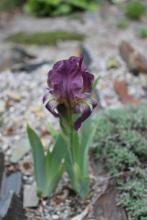
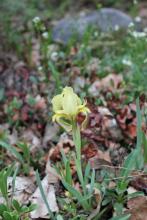
Mon, 05/27/2013 - 8:18pmIris taochia and Iris taurica:
Androsace chamaejasme; Pulsatilla ambigua:
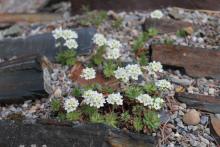
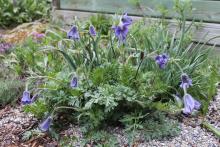
A tiny forest of Mitella nuda stems under the canopy of Betula apoiensis in the acid bed:
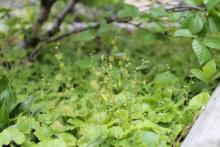
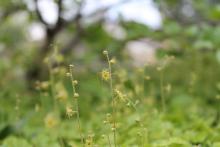
tropicalgirl251... (not verified)
Re: What do you see on your garden walks? 2013
Mon, 05/27/2013 - 9:31pmMy garden is slowly awakening. Took lots of pictures. Some are posted here
tropicalgirl251... (not verified)
Re: What do you see on your garden walks? 2013
Mon, 05/27/2013 - 9:34pmmore pictures
tropicalgirl251... (not verified)
Re: What do you see on your garden walks? 2013
Mon, 05/27/2013 - 9:37pmlast of my pictures
Lori S. (not verified)
Re: What do you see on your garden walks? 2013
Mon, 05/27/2013 - 9:46pmYou're growing lots of interesting things, Krish! Love the daphnes!
Gene Mirro (not verified)
Re: What do you see on your garden walks? 2013
Mon, 05/27/2013 - 10:41pmKrish, how do you grow the Phacelia sericea? What soil mix? I have never been successful with it. Maybe it's because my climate is too wet and dark in Spring. But I don't know what the problem is.
Trond Hoy
Re: What do you see on your garden walks? 2013
Tue, 05/28/2013 - 7:22amTwo reliable species today - very different in their requirements though.
Corydalis buschii spreading in the woodland and Ranunculus parnassifolius on the roof!
tropicalgirl251... (not verified)
Re: What do you see on your garden walks? 2013
Tue, 05/28/2013 - 9:29amHi Gene
I grow them at two different places. One in the rockgarden where the soil is lean,sunny and dry and the other one in a less sunny regular soil. Both came back and flowered for me for two years. The one in regular soil grew more and loose inflorescence. In fact I want to grow them very lean with tighter inflorescence.I am going to change the place to more harsher environment. In my climate it looks like it is easy to grow.
Margaret Young
Re: What do you see on your garden walks? 2013
Tue, 05/28/2013 - 11:37amKrish, might I ask you to return to your previous posts to ad the plant names to the text of your post? - this enables the search engine to find the pictures. :)
tropicalgirl251... (not verified)
Re: What do you see on your garden walks? 2013
Tue, 05/28/2013 - 12:19pmsorry Ian I will do that.I did not realize that the search engine wont pickup the names of the plants if I do this way
Mark McDonough
Re: What do you see on your garden walks? 2013
Tue, 05/28/2013 - 3:05pmGood reminder Maggi, I had actually edited a number of previous posts to add in names, but I'm on another of my blitz training efforts and working all hours day and night before an upcoming trip for work.
Krish, earlier I added names to some of your posts here:
http://nargs.org/smf/index.php?topic=1239.msg23498#msg23498
Also see the topic "FAQ - Images - Adding image names to the body of a post" in the "Announcements from Moderators and Administrators" board.
http://nargs.org/smf/index.php?topic=401.0
Cheers,
Mark
Margaret Young
Re: What do you see on your garden walks? 2013
Wed, 05/29/2013 - 7:12amCheers, Krish! ;)
Maggi
Michael J Campbell (not verified)
Re: What do you see on your garden walks? 2013
Sat, 06/01/2013 - 10:58amEdraianthus pumilio
Trond Hoy
Re: What do you see on your garden walks? 2013
Sat, 06/01/2013 - 1:18pmMichael, have you picked off all the leaves :o Just kidding ;)
Toole (not verified)
Re: What do you see on your garden walks? 2013
Sat, 06/01/2013 - 2:16pmWow :-* :-* :-*
Cheers Dave.
Michael J Campbell (not verified)
Re: What do you see on your garden walks? 2013
Sat, 06/01/2013 - 2:34pm;D ;D ;D
Pages