
We are 11 days late on this topic!
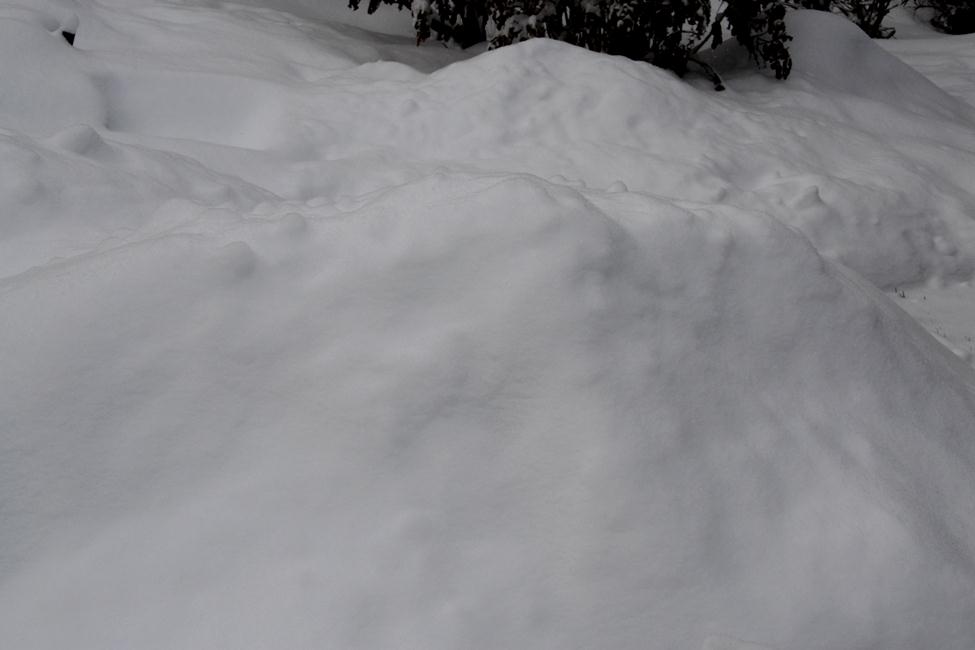
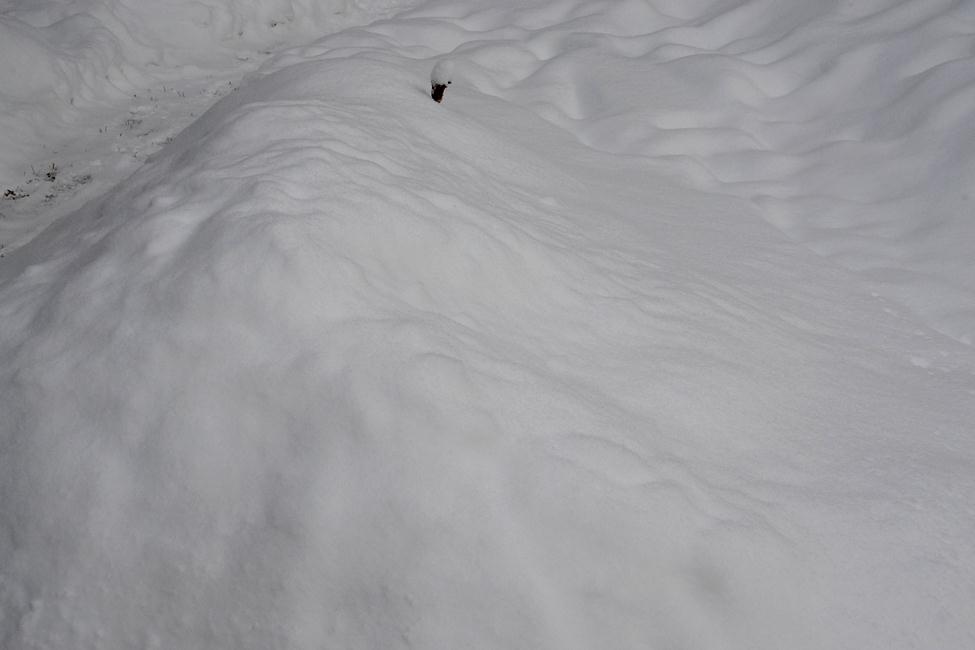
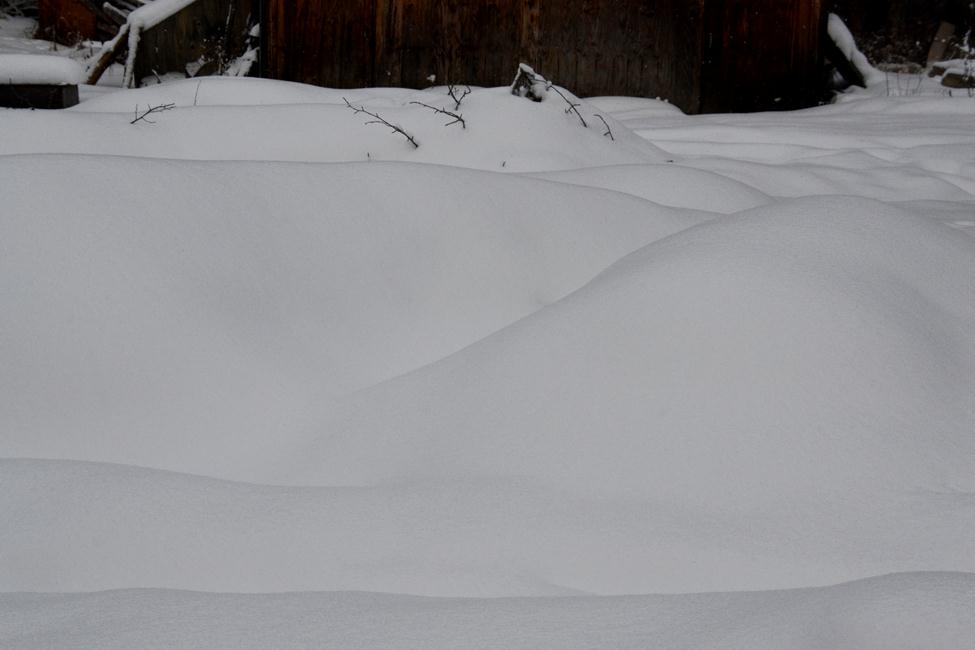
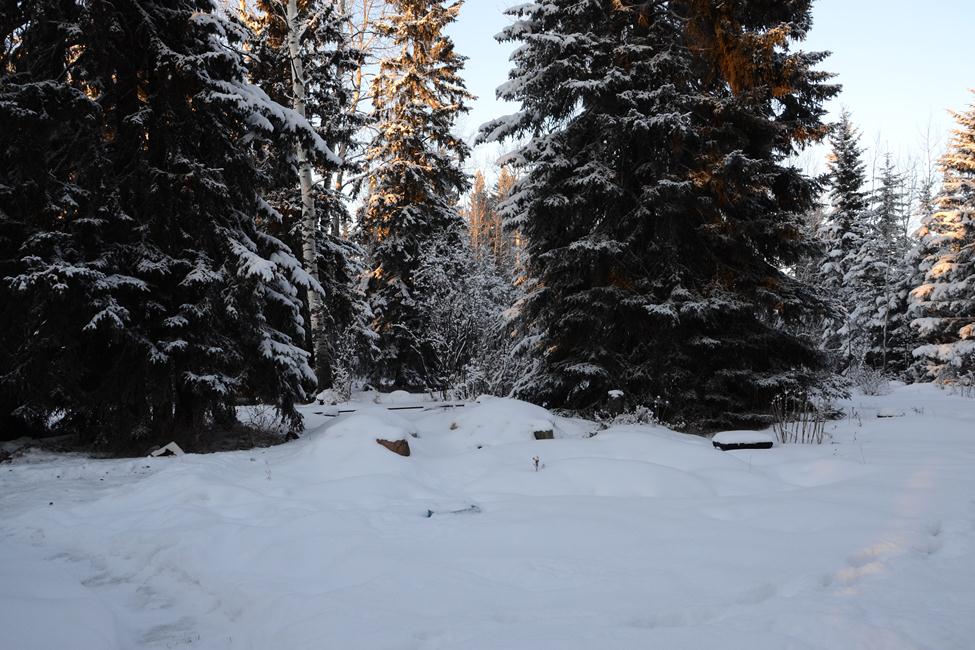
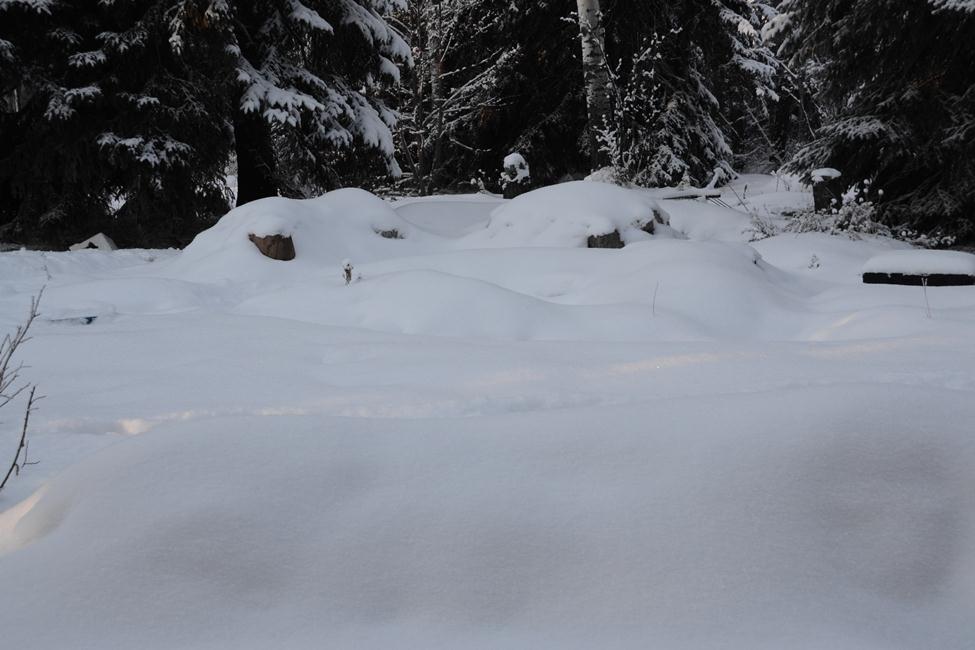
A couple views of some of my garden beds in the last couple of days-- not a whole lot to see! but you see some of the 'ridges' of the rock gardens and berms I've been developing, and looking at them this winter under snow, I've realised that these winter shapes should be taken into account at the design phase, since this is what I see for months at a time!
1-3 the rock beds in front of the house which get extra snow, being surrounded by shovelled paths; in #3 you can see a bit of the tallest Sempervivum flower stalk sticking through the snow still..
4,5 a couple of rock beds and berms in a different part of the acreage- these are in the moister part of the property, and (not counting the shovelling mentioned above) get the deepest snow
6,7 the third rock garden area, this is on the drier end of the property, and drier yet between the two large spruce trees- the two taller ridges have had the least snow cover of any of my plantings, so time will tell what plants that will favour (naturally, I am planting things that generally want to be drier in this area)


Comments
cohan (not verified)
Re: What do you see on your garden walks? 2013
Fri, 04/19/2013 - 2:37pmTrond- nice crocus patches! Love the pink Hepatica too :)
Lori- I have often thought the mess under a bird feeder- esp but not only sunflower seeds- would be a pain on a city lot, so over the composter is a great idea. I didn't know there were grey squirrels in Calgary- there were lots of them in downtown Toronto, and they could be troublesome there, far more than the native squirrels here, but then they didn't have the semi/wild areas to feed in there, had to eke out a living from the postage stamp yards and street trees, apart from parks of course.
Trond Hoy
Re: What do you see on your garden walks? 2013
Sun, 04/21/2013 - 12:24amThanks Tim! Hope you get some seed ;)
In fact the slope isn't perfect. It is facing SW and I have some trees to the south casting long shadows in early spring. I cut down two of them last winter to get more sun. But it is very good drainage.
Rick, this year the crocuses flower over a longer period and with less leaves due to the persistent cold weather we have had.
Spiegel, I don't think hot summers will ever be a problem here. I have lost plants twice and I am not sure why but I'll try again! Have to find the right spot seemingly.
Lori S. (not verified)
Re: What do you see on your garden walks? 2013
Sun, 04/21/2013 - 3:51pmA cold April so far, with snow continuing every weekend. Why does it have to be on the weekends? :rolleyes: Enough already!!
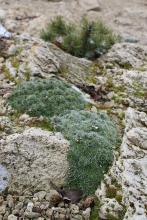
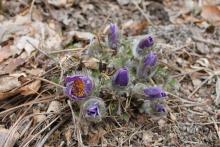
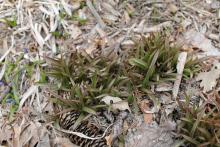
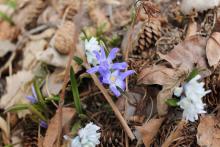
But, despite that...
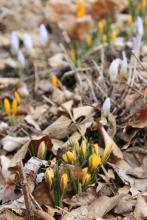
Buds and flowers on Arabis androsacea; Primula vulgaris; Tulipa tarda foliage; first Chionodoxa, with Puschkinia:
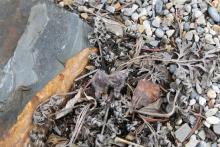
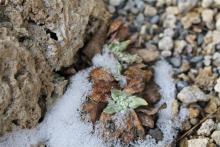
First visible bud on Hepatica transylvanica; Primula algida in bud; crocus x2; Pulsatilla grandis 'Best Blue' (assuming that really is a cultivar name?); Primula scotica in bud with yesterday's lingering snow:
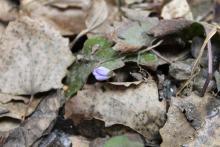
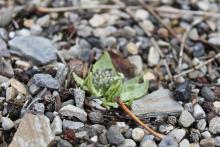
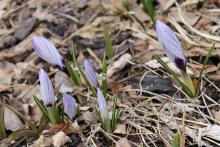
Lori S. (not verified)
Re: What do you see on your garden walks? 2013
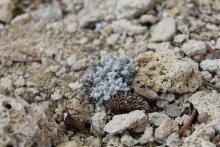
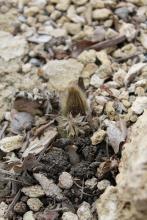
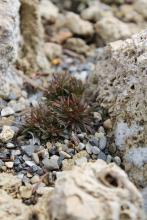
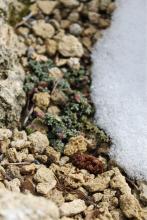
Sun, 04/21/2013 - 3:58pmCancrinia tianshanica; one of last year's Pulsatilla patens in bud; buds on Androsace lactea and on a small Saxifraga oppositifolia:
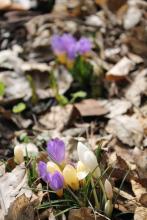
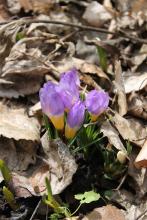
More crocus:
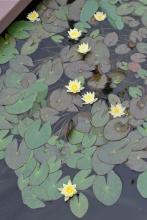
And in Stuart's greenhouse, Nymphaea 'Helvola':
Trond Hoy
Re: What do you see on your garden walks? 2013
Mon, 04/22/2013 - 10:47amLori, your spring is about as advanced as mine!
How deep is Stuart's waterlily pond?
cohan (not verified)
Re: What do you see on your garden walks? 2013
Tue, 04/23/2013 - 10:14amLooking great, Lori! I have signs of growth on a few things, and crocus noses, but that's it so far..
Snow only on weekends? It's been more like every day here! Still tons of it unmelted too, in many places.. We are a couple days past 6 months of uninterrupted snowcover, now, with some time to go yet- many bare spots, but a foot to several in others..
Gene Mirro (not verified)
Re: What do you see on your garden walks? 2013
Thu, 04/25/2013 - 11:48amDaphne cneorum 'Lila Haines' :
[attachthumb = 1]
Gene Mirro (not verified)
Re: What do you see on your garden walks? 2013
Thu, 04/25/2013 - 3:29pmTulipa hageri 'Little Beauty' :
[attachthumb = 1]
Tulipa saxatilis:
[attachthumb = 2]
Anne Spiegel
Re: What do you see on your garden walks? 2013
Fri, 04/26/2013 - 12:59pmI think spring has sprung, no ice in the dog's water dish this morning. Despite nightly frosts the plants have been gearing up in the crevice gardens.
Just a few pictures of things starting to bloom or bud. Such an exciting time of year.
Trond Hoy
Re: What do you see on your garden walks? 2013
Sat, 04/27/2013 - 2:55pmNice tulips, Gene! Those are some of my favorite from that genus!
Anne, pretty peas! I try to establish some in my garden too!
The plants haven't geared up much here despite the lack of nightly frost! The daytime temperature isn't much to boast of although today was not bad +10C and sun but cold northerly wind.
Some plants though do flower, like this Sanguinaria canadensis and Cardamine enneaphylla (40 days later than last year!). and also this Saxifraga oppositifolia.
Gene Mirro (not verified)
Re: What do you see on your garden walks? 2013
Sat, 04/27/2013 - 5:52pmHaberlea rhodopensis, started from seed in 2008:
[attachthumb = 1]
Gene Mirro (not verified)
Re: What do you see on your garden walks? 2013
Sat, 04/27/2013 - 7:47pmLewisia leana, in the greenhouse:
[attachthumb = 1]
Lori S. (not verified)
Re: What do you see on your garden walks? 2013
Sat, 04/27/2013 - 9:16pmWow, things are looking great all over!
Gene, you certainly have some beautiful plantings - love the species tulips. The only ones that have naturalized well here are Tulipa tarda and T. urumiensis. It's interesting to see that your wonderful Lewisia leana have the same old basal growth as I see on the one out in my tufa garden; I was wondering if it was something to do with the conditions but as it seems to be the same even in ideal (greenhouse) conditions, I guess it's a characteristic of the plant.
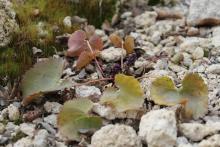
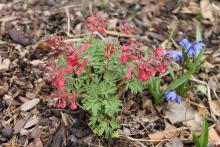
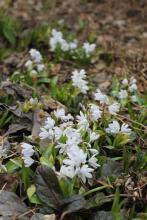
Buds on Synthyris platycarpa; Saxifraga oppositifolia - not a very nice form, though; Puschkinia; Corydalis solida; Scilla mischtschenkoana:
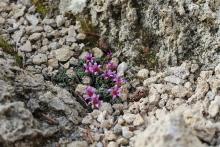

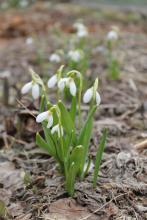
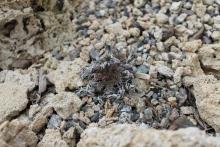
Galanthus; Phacelia sericea; Pulsatilla patens bud; Smelowskia calycina; crocus:
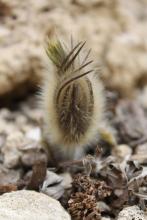
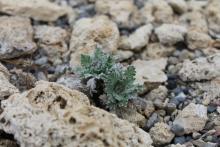
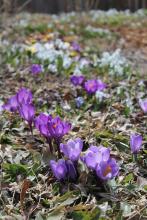
Lori S. (not verified)
Re: What do you see on your garden walks? 2013
Sat, 04/27/2013 - 9:23pmAnd more...
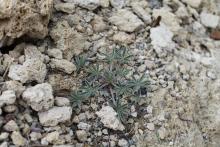
The seedlings of Lupinus lepidus var. utahensis that I moved around last year are looking good;
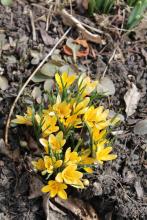
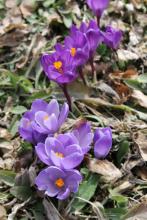
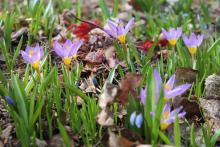
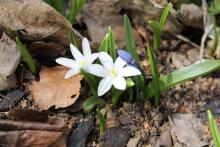
The crocuses and other small bulbs (Puschkinia, Chionodoxa, Scilla siberica)are putting on a show:
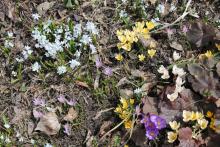
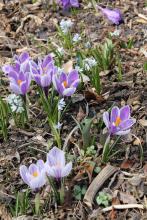
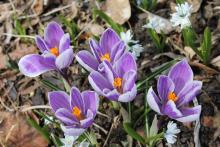
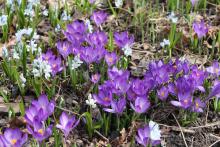

Lori S. (not verified)
Re: What do you see on your garden walks? 2013
Sat, 04/27/2013 - 9:29pmAnd yet more...
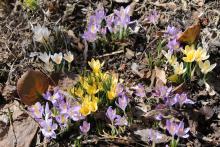
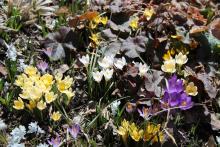
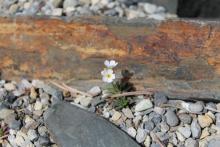
There are flowers on a couple of teensy, self-seeded Androsace carnea:
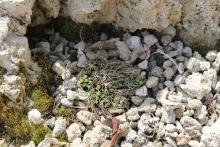
And in hopes of flowers to come, here's Paraquilegia grandiflora emerging:
Richard T. Rodich
Re: What do you see on your garden walks? 2013
Sun, 04/28/2013 - 6:31amGosh Lori, you are leaps ahead in zone 3 than me am in USDA zone 4 !
In my little hot garden on the south side of my brown house, the first couple individual Corydalis solida flowers opened yesterday. All my others are (mostly) not even showing, with a few a couple mm's peaking.
What is this one
http://nargs.org/smf/index.php?action=dlattach;topic=1239.0;attach=43336...
and what is that lavender "ball" behind the blue bud?
Lori S. (not verified)
Re: What do you see on your garden walks? 2013
Sun, 04/28/2013 - 8:39amWhite chionodoxa and a bud of Scilla siberica - sorry, I was lazy, I should have labelled it!
Merlin (not verified)
Re: What do you see on your garden walks? 2013
Sun, 04/28/2013 - 5:00pmLooks like most everyone's garden are starting to pop. It has been a cool spring here in Idaho so things are a bit behind this year. here are a few photos i took yesterday afternoon.


Hogepog of various stuff, castilleja scabrida showing it's incredible red
Second generation Penstemon acaule
Astragalus coccineus
Colomia debilis from Wyoming
Trifolium Owyheense
High altitude form of Clematis columbiana, non vining
Claire Cockcroft
Re: What do you see on your garden walks? 2013
Sun, 04/28/2013 - 5:59pmMarvelous pictures, truly inspiring, Jim!
externmed (not verified)
Re: What do you see on your garden walks? 2013
Sun, 04/28/2013 - 10:24pmSandbed in NE Massachusetts USA
Charles S Z6A sunny and breezy -- sort of "normal" unsettled spring for a change, early winter more of a new normal, warm early, then cold. Lost the more hardy of 2 Delospermas in this bed; but John Proffitt still covers a too large swath.
Gene Mirro (not verified)
Re: What do you see on your garden walks? 2013
Mon, 04/29/2013 - 8:58amCorydalis nobilis:
[attachthumb = 1]
Podophyllum pleianthum:
[attachthumb = 2]
Trillium ovatum: the flowers change color as they age:
[attachthumb = 3]
[attachthumb = 4]
[attachthumb = 6]
[attachthumb = 5]
cohan (not verified)
Re: What do you see on your garden walks? 2013
Mon, 04/29/2013 - 11:24amWow- miss a couple days and almost too many photos for my internet connection to load!
Lots of beauties everyone!
Anne, great to see the Oxytropis and others;
Jim- great stuff, the A coccineus is always stunning;
Lori- your bulbs are spreading nicely :)
Gene- love the tulips!
Took so long to load the pic I forgot to add-- Trond- love the Cardamine :)
Here a total of 4 Crocus flowers yesterday (today back to snow!) but I'm pleased to see the increase in the plants in only their second spring-just cheap garden centre stuff;
Some C solida shouldn't be too long, though that bed is much later to come out of the snow than the Crocus in front of the house. I was amazed when I pulled back the mulch to see shoots a couple of inches tall, in frozen soil!
Anne Spiegel
Re: What do you see on your garden walks? 2013
Mon, 04/29/2013 - 12:07pmGreat plants, Jim. Love the Astragalus coccineus but most of all, loved the Trifolium owyheense, unfortunately no longer in my garden thanks to some nameless marauder. Even when not in bloom it is so attractive with its silver marked leaves.
Lori S. (not verified)
Re: What do you see on your garden walks? 2013
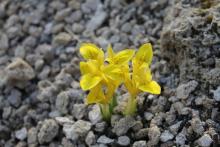
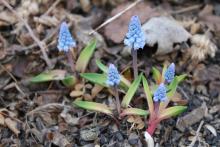
Wed, 05/01/2013 - 9:27pmAfter snow on the weekend and two nights of -7 deg C, these flowers are unfazed... Iris danfordiae and Muscari azureum:
... however a potted skunk-cabbage is lying in a heap - darn thing didn't even bloom.
Trond Hoy
Re: What do you see on your garden walks? 2013
Thu, 05/02/2013 - 12:04amGlad to see you have at least some flowering plants in your garden, Cohan!
Some very eye-catching plants you have folks! I am envious. Here the winter will not recede. Still no leafing out - the birches should have been green by now :(
Gene Mirro (not verified)
Re: What do you see on your garden walks? 2013
Thu, 05/02/2013 - 10:38amDodecatheon pulchellum:
[attachthumb = 1]
Camassia quamash ssp azurea, with Dracunculus vulgaris in back:
[attachthumb = 2]
Trillium cernuum:
[attachthumb = 3]
Cypripedium ? :
[attachthumb = 4]
Corydalis scouleri:
[attachthumb = 5]
Longma (not verified)
Re: What do you see on your garden walks? 2013
Fri, 05/03/2013 - 6:47amSome from the 'more formal' :rolleyes: part of our garden today. If anyone can add names it would be appreciated.
Richard T. Rodich
Re: What do you see on your garden walks? 2013
Fri, 05/03/2013 - 8:15amExcellent images, everyone.
Ron,
Photo #1:
The iris looks like the yellow form of I. suaveolens if it is a species. It does seem to be more hefty than most. Perhaps just very well grown, as you Brits (and Europeans) are know for. My four accessions of the species are look more "wild" in my more austere garden.
Trond Hoy
Re: What do you see on your garden walks? 2013
Fri, 05/03/2013 - 10:19amThe yellow primula is P veris:
Lori S. (not verified)
Re: What do you see on your garden walks? 2013
Fri, 05/03/2013 - 11:03amThe tulips appear to be Tulipa hageri 'Little Beauty' or similar.
Longma (not verified)
Re: What do you see on your garden walks? 2013
Sat, 05/04/2013 - 5:19amThank you, Rick, Trond and Lori, for putting me straight on those species. 8)
I noticed this one today in an area that needs a good weeding, :-[ . It is I think Anemone nemorosa, although we don't remember planting it (but of course we must have done), and it is usually an early species. :-\
Trond Hoy
Re: What do you see on your garden walks? 2013
Sat, 05/04/2013 - 6:16amI think your last one is Anemone nemorosa 'Bracteata Plena'. Take a look here: http://www.pottertons.co.uk/pott/view_product.php?pid=2999
Longma (not verified)
Re: What do you see on your garden walks? 2013
Sat, 05/04/2013 - 8:53amThanks Trond, I'm sure you've called that one correctly ;D . Much appreciated. 8)
Gene Mirro (not verified)
Re: What do you see on your garden walks? 2013
Sun, 05/05/2013 - 12:27pmCalochortus tolmiei, perfectly hardy in NW Oregon and Washington, if given sandy soil that dries in summer:
[attachthumb = 1]
Trond Hoy
Re: What do you see on your garden walks? 2013
Sun, 05/05/2013 - 2:15pmNice Calochortus! Seems to be something to look for!
Here are some plants from the garden today - the first day with some decent weather for weeks :-\
Saxifraga caucasica (I think). a dwarf Narcissus struggling in old grass, an Ornithogalum - it is not umbellatum which is much later and another selfsown Rhododendron.
Richard T. Rodich
Re: What do you see on your garden walks? 2013
Sun, 05/05/2013 - 6:31pmThat Calochortus tolmiei is way cool. I didn't realize they got that hairy.
Good size ovaries already, too.
Gene Mirro (not verified)
Re: What do you see on your garden walks? 2013
Sun, 05/05/2013 - 7:23pmArenaria montana, one of my favorites, even though it's not very exotic or difficult:
[attachthumb = 1]
Richard T. Rodich
Re: What do you see on your garden walks? 2013
Mon, 05/06/2013 - 8:19pmSpring is finally here!
Fritillaria meleagris
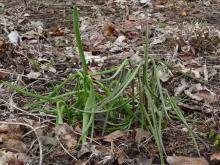
Dodecatheon media alba
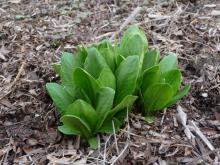
Sanguinaria canadensis 'Multiplex'
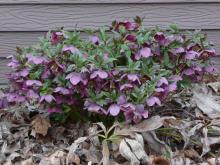
Helleborus Royal Heritage
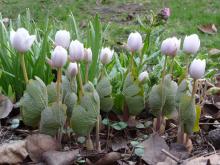
Taraxacum pseudoroseum (Thanks, Wim!)

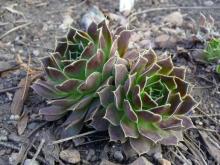
Jovibarba heuffelii
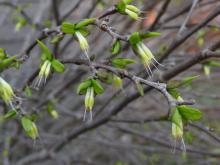
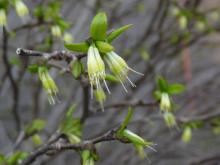
Dirca palustris - tiny flowers, but quite attractive to insects.
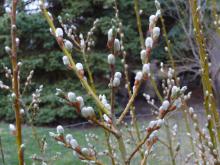
While all my other Salix spp. are pretty much done, Salix schraderiana is just starting.
Anne Spiegel
Re: What do you see on your garden walks? 2013
Tue, 05/07/2013 - 2:56amThe garden was open Sunday for the Garden Conservancy and it was perfect weather and a wonderful turnout. It's still early days in the garden with recent warmth forcing bloom so that early and middle bloomers are seen together - unusual, but that seems to be the new normal.
cohan (not verified)
Re: What do you see on your garden walks? 2013
Tue, 05/07/2013 - 10:59amMore beauties- Gene- some great clumps you have, including the Dodecatheon!
Longma- Ron? - love the Irises with Salix! Still no really dwarf Salix here, but high on my list- haven't had a chance to buy plants and never see seeds available or in the wild, but still watching :)
Anne- bet the garden visitors really enjoyed your property :)
Trond- that little Crocus patch has really been performing- especially some of the flavus with five or six flowers on one little plant. First flowers are done, but still new ones coming. A few things in other spots now too- Townsendia, Pulsatilla etc. Last couple of days were summer- mid 20's to almost 30C yesterday, back to spring today with 15C, rest of week from 13 to 27C, and nights from 0- +9, some of my many pots of seed outdoors should start sprouting, was only Draba up to now..
Richard T. Rodich
Re: What do you see on your garden walks? 2013
Tue, 05/07/2013 - 7:01pmViability is lost very quickly with Salix seeds. Some purportedly in just several days!
Gene, why did you think Calochortus tolmiei is unimpressive?
See here:
http://www.srgc.net/forum/index.php?topic=1110.msg25659#msg25659
Gene Mirro (not verified)
Re: What do you see on your garden walks? 2013
Tue, 05/07/2013 - 8:43pmRick, compare the color of tolmiei to the ones in that SRGC post. It's a nice collector's plant, but let's face it, it's pretty homely compared to the California species. It's like wearing a burlap sack to the Emmy awards. But you'll notice that I still grow it. That's because it has the usual qualities that tempt me: it's very difficult and slow; almost nobody can grow it; and it has at least nominally interesting flowers. Sure, a plant like that may be impressive to us, but we make up about 0.001% of the gardening marketplace in the USA.
Now here are some plants that are very difficult and slow, and which almost nobody can grow, but which are VERY impressive:
http://nargs.org/smf/index.php?topic=1090.0 .
Richard T. Rodich
Re: What do you see on your garden walks? 2013
Tue, 05/07/2013 - 9:23pmWell then, I can still say that you took a very impressive photo of C. tolmiei! :o :o ;D
I finally have a couple batches of seedling Nomocharis growing now, along with one from last season, that hopefully will emerge again.
Wish me luck!
Gene Mirro (not verified)
Re: What do you see on your garden walks? 2013
Tue, 05/07/2013 - 9:39pmNomocharis in Minnesota, eh? You make me look like a slacker. Let's see, what does Minnesota's climate have in common with a Himalayan meadow? Um...um...hmmm...
Richard T. Rodich
Re: What do you see on your garden walks? 2013
Wed, 05/08/2013 - 5:50amI never would expect Nomocharis to survive our winters. (But wouldn't it be cool if it did?)
However I did have a small L. mackliniae bulb that was given to me that survived for several winters before I accidentally massacred it. :'(
It never bloomed, though, so I can't verify its identity.
Gene Mirro (not verified)
Re: What do you see on your garden walks? 2013
Wed, 05/08/2013 - 8:04amIf I were growing Nomocharis or Lilium mackliniae in Minnesota, I would probably try the following:
1. Heavy mulch in winter to slow the rate of freezing and thawing.
2. Shade cloth in summer, and/or grow them where they get morning sun and afternoon shade.
3. Mulch in summer to keep the soil cool.
4. Herbaceous companion plants to shade the soil and control soil moisture. No shrubs or trees; they are too competitive.
5. Try to adjust soil pH to around 6 - 6.5.
This assumes that you've got some decent sandy loam soil, and you've got your animal and insect pests under control.
I've found that the conditions for keeping these plants alive (cool, shady, soil not too wet or rich) will also slow them down a little. So patience is required. The dryland lilies of the western US are an extreme example of this. Push them too much with water and fertilizer, and they are gone.
There are some good lily growers in the midwest. Have any of them tried Nomocharis?
By the way, there is something funny going on with germination of Nomocharis and Lilium mackliniae from the seed exchanges. Germination in the first season is consistently terrible, maybe one or two seeds out of ten. But another one or two will come up over the next two years. So keep your seed flats. Don't let the seed flats get below 25F or above 80F, keep them out of the sun, and don't let them get too dry. The only way to build a population of these plants is one or two at a time, over a period of years. Or you could buy bulbs.
Richard T. Rodich
Re: What do you see on your garden walks? 2013
Wed, 05/08/2013 - 2:20pmThanks, Gene!
My experiences with seed ex seed is the same, or worse. Little if any the first season with more the next. I don't think I've had any emerge the third year.
I don't know if anyone up here has tried them. If anyone in Minnesota has had much success, I'm pretty sure I would have heard about it.
Gene Mirro (not verified)
Re: What do you see on your garden walks? 2013
Wed, 05/08/2013 - 2:46pm"My experiences with seed ex seed is the same, or worse."
Either people are sending in old seed, or the stocks of these rare plants is badly inbred. I think they are inbred, and Judith Freeman of lily hybridizing fame agrees. Someone really needs to get serious about controlled propagation of rare plants, and restoring some genetic diversity. Why can't the plant societies do this?
Richard T. Rodich
Re: What do you see on your garden walks? 2013
Wed, 05/08/2013 - 7:28pmAn interesting thought.
When Peter Korn was here doing his speaking tour, I had dinner with him. We got to talking about lilies and he asked me if I had tried any Nomocharis. I told him I had the dickens of a time getting good germination, and he suspected seeds were not viable. He never mentioned inbreeding, but he thought fresh seed worked much better. He said he had observed Nomocharis seed germinating while still in the pod.
Anne Spiegel
Re: What do you see on your garden walks? 2013
Fri, 05/10/2013 - 1:19pmA few more plants in the garden. I'm excited that the Darmera peltata has apparently made it through the winter.
Pages