
We are 11 days late on this topic!
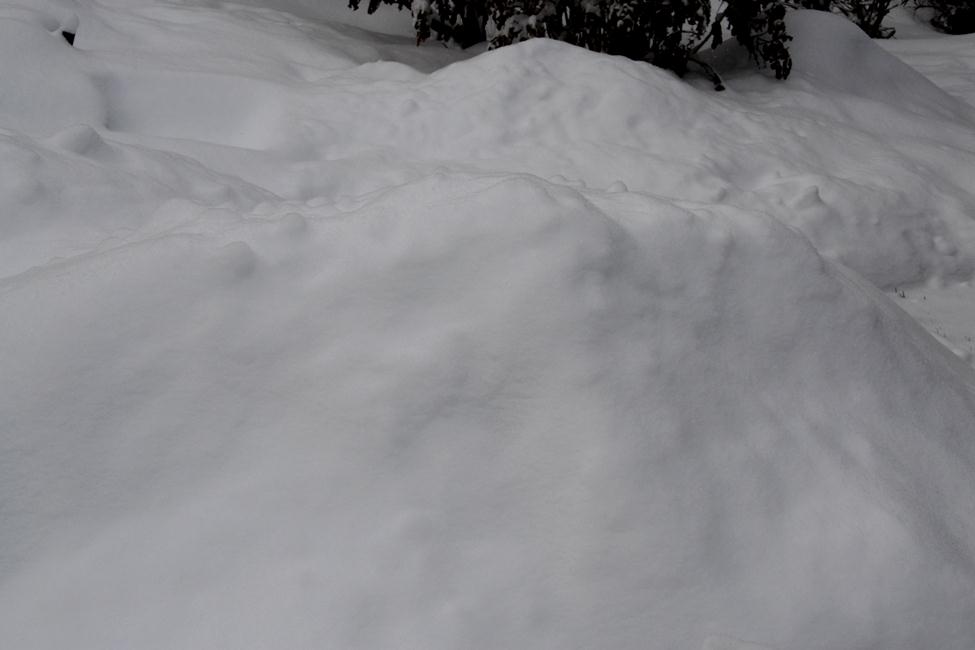
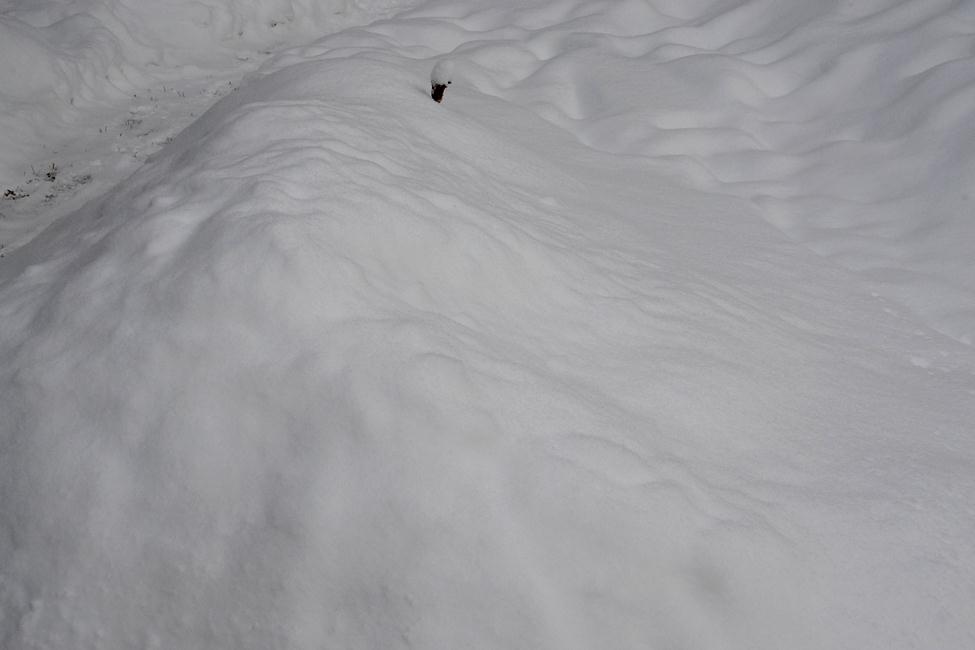
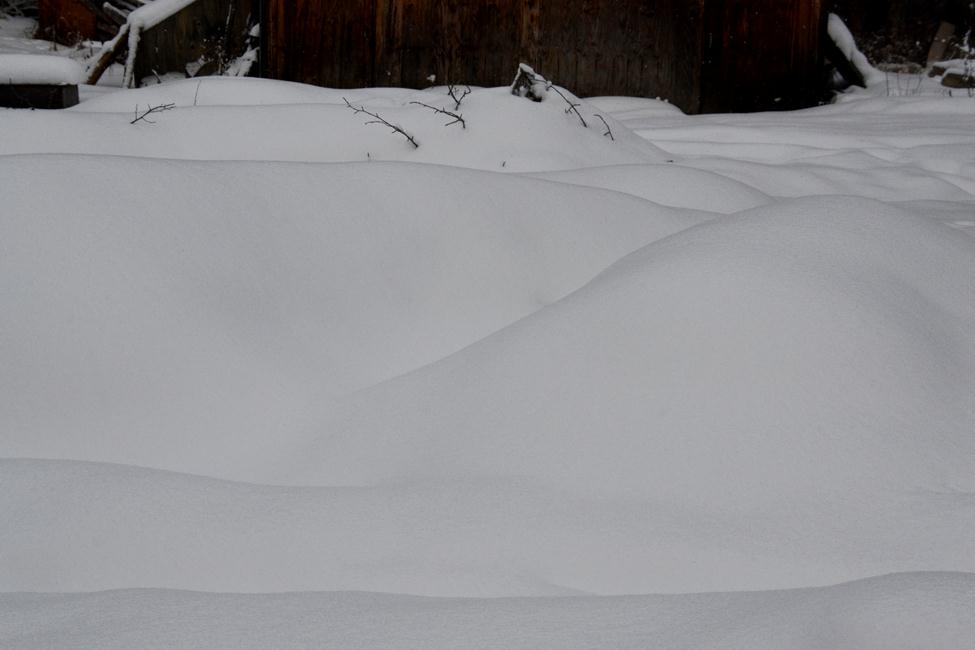
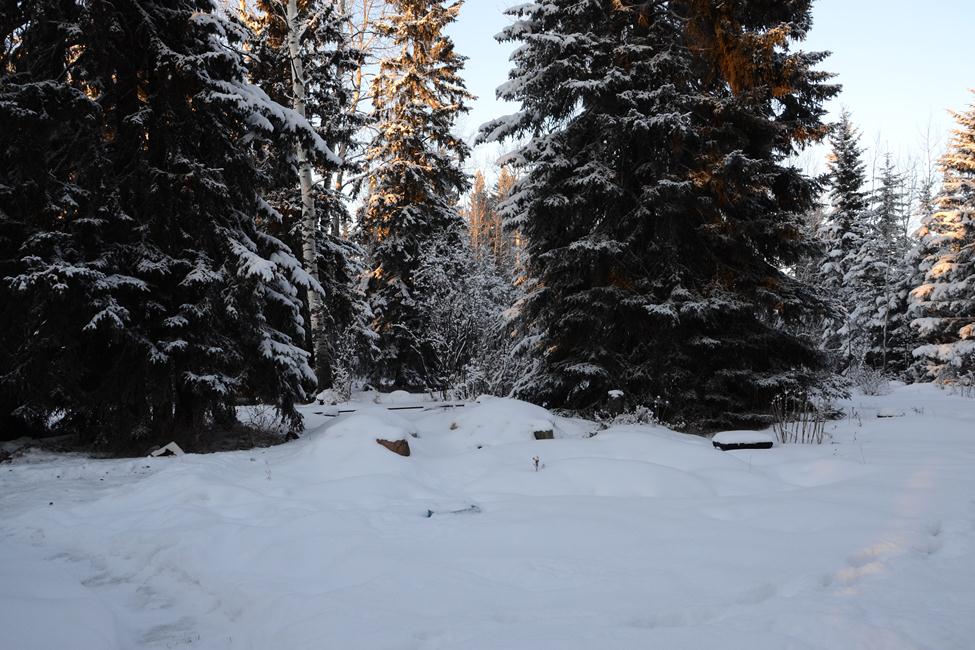
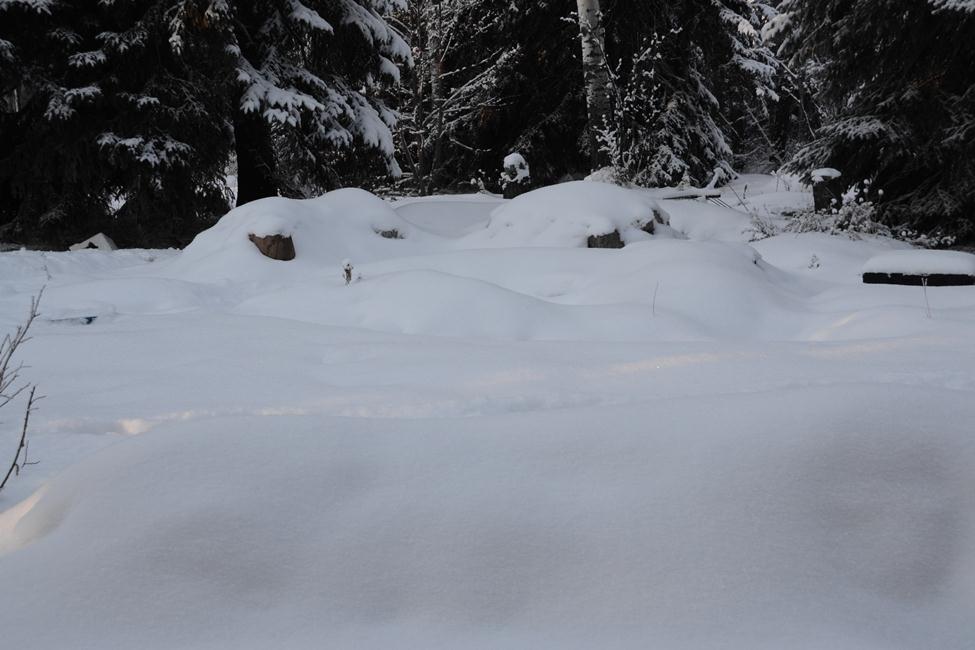
A couple views of some of my garden beds in the last couple of days-- not a whole lot to see! but you see some of the 'ridges' of the rock gardens and berms I've been developing, and looking at them this winter under snow, I've realised that these winter shapes should be taken into account at the design phase, since this is what I see for months at a time!
1-3 the rock beds in front of the house which get extra snow, being surrounded by shovelled paths; in #3 you can see a bit of the tallest Sempervivum flower stalk sticking through the snow still..
4,5 a couple of rock beds and berms in a different part of the acreage- these are in the moister part of the property, and (not counting the shovelling mentioned above) get the deepest snow
6,7 the third rock garden area, this is on the drier end of the property, and drier yet between the two large spruce trees- the two taller ridges have had the least snow cover of any of my plantings, so time will tell what plants that will favour (naturally, I am planting things that generally want to be drier in this area)


Comments
Tim Ingram (not verified)
Re: What do you see on your garden walks? 2013
Mon, 04/08/2013 - 5:33amWhat with Fermi's Lycoris and Dave's Lapageria it feels like summer might not be too far away after all (although I've never had success with either of these). Spring is at last on the move, with the star plants probably being some of the tuberous anemones that seed around on the sand beds, and I couldn't resist showing the American Synthyris stellata too, which has been in bud since mid-February waiting for warmer weather.
Anne Spiegel
Re: What do you see on your garden walks? 2013
Tue, 04/09/2013 - 6:58amI think spring has sprung. It will be 70 today. We seem to have gone from 40s and skipped over the 50s and 60s. It is also very dry. We really need some rain. In bloom today in the garden.
Helleborus niger
Helleborus 'Pink Teacup'
The first is always the earliest of the hellebores. The second seems to be quite as tough but blooms a couple of weeks later.
Trond Hoy
Re: What do you see on your garden walks? 2013
Tue, 04/09/2013 - 9:48amDave, the Lapageria is beautiful! I can't grow it outside but once I had a plant from seed in my greenhouse. It lived and flowered for many years but nothing like that! Unfortunately if froze to death some years ago (and so did a pretty Callistemon I had there too) :'(
Trond Hoy
Re: What do you see on your garden walks? 2013
Tue, 04/09/2013 - 9:53amTim, I can't grow Anemones like that although I have tried! I haven't had much luck with Synthyris either so far but I am still trying!
Anne, beautiful Hellebosus! All mine have lost their bud this winter and spring in the freeze-drying weather we have had for 3 months.Seems we will have a change tomorrow!
cohan (not verified)
Re: What do you see on your garden walks? 2013
Tue, 04/09/2013 - 10:45amNice to see the flowers, all! Nothing yet here- I was excited to see some exposed soil for a while, though it was all covered up again the other day...lol
I did have some busy days working on a long area on the forest edge behind the house that is going to get some development for food gardens (hugelkultur and other permaculture approaches) as well as some native and dryland plantings.
Anne - love the hellebores- I managed to kill the free ones I got as supermarket leftovers last year, before I could get them outside, but I just got three more yesterday the same way, so I will have to be more attentive with these ones until it's warm enough to start hardening them off outside- many weeks of frost yet here...
Tim- interestng Anemones! what do they do foliarly?
Gene Mirro (not verified)
Re: What do you see on your garden walks? 2013
Tue, 04/09/2013 - 8:51pmA group of mixed Erythronium species and hybrids:
[attachthumb = 1]
After you've grown Erythroniums from seed for a while, you will need a place like this for mystery plants.
Some of them have very dark mottling on the leaves:
[attachthumb = 2]
Does anyone know if this is a named hybrid? I looked up White Beauty, and it does not have mottling this dark.
Claire Cockcroft
Re: What do you see on your garden walks? 2013
Wed, 04/10/2013 - 9:37amThat's a wonderful mix of erythroniums, Gene. Here's a little patch of self-sown bulbs that found a place to their liking under an Edgeworthia chrysantha. The leaves in the background are all Trillium sulcatum seedlings that need a new home.
The second picture is of 'White Beauty' in my garden. You are right, the mottling is not nearly as dark as yours. Your form is gorgeous.
Tim Ingram (not verified)
Re: What do you see on your garden walks? 2013
Wed, 04/10/2013 - 10:46amGene and Claire - wonderful plantings of erythroniums. After many years I am beginning to get them self-sowing a little and hope to get drifts like that in a few years time. I do have one plant of E. californicum, grown from seed, with really good leaves just as they start growing. Great plants.
Cohan - the anemones have palmate cut leaves but go summer dormant very quickly, so never make large plants - effectively they are 'bulbs'. A few people have managed to establish them in short turf (at Blackthorn and Ashwood nurseries for example) and they look stunning like this en masse.
Trond - I've also tried Synthyris a couple of times before and not kept it in the garden - so fingers crossed - but it's a very lovely woodlander (would have thought it would do well with Clintonia?).
The saxifrages are in a cool crevice trough in a friend's garden - I find they burn off very easily but these are sited perfectly. In another part of the garden is probably the best plant of Helichrysum coralloides I've ever seen - I wonder how it compares with plants in Nature?
Gene Mirro (not verified)
Re: What do you see on your garden walks? 2013
Wed, 04/10/2013 - 11:57amTim, those leaves are a match for mine, no question.
Trond Hoy
Re: What do you see on your garden walks? 2013
Wed, 04/10/2013 - 1:25pmYou do know how to tease me, do you, Gene and Claire! All those beautiful erythroniums :o None of mine has emerged yet :-\ However I have some nice potfulls of seedlings thanks to a generous forumist!
Tim I do agree - but I suspect that the slugs are to blame and not the climate.
Anne Spiegel
Re: What do you see on your garden walks? 2013
Wed, 04/10/2013 - 2:23pmTim, the sax. in the crevices was beautiful. Any idea which one it is? Not that that will make any difference here - they seem to hate drought plus wind.
If you can't water them, they're very quickly gone.
Michael Peden
Re: What do you see on your garden walks? 2013
Sat, 04/13/2013 - 6:23amAnne, how did you make out with Saxifraga cotyledon I gave you years back and suggested you might try it in your new woodland/brook area by road in well rotted wood chips? these things are tough as nails. I just snapped this photo of a trough, among the most neglected on the property, where S. cotyledon (hyb?) seeded itself years ago. The trough is right at the west wall of my house so it does not get sun all day. I watch this thing turn yellow in the heat of August thinking it will dry up and die. It doesn't! Two more toughies here: Arabis bryoides and Sedum aizoon(?). The Potentilla nitida did finally throw in the towel last summer, which was very hot and dry. There's also a second seedling Sax.
Lori S. (not verified)
Re: What do you see on your garden walks? 2013
Sat, 04/13/2013 - 8:55amEach brief, hopeful period of melting has been followed by another snowfall here... another 20cm is forecast for today, phooey!
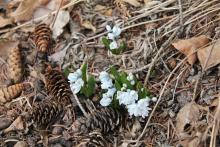
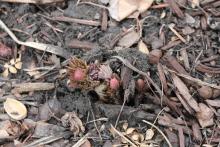
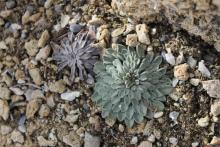
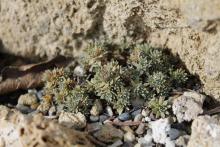
Bulbocodium vernum is looking bedraggled from all the repeated snows and melts. There have been a few scattered crocus, scilla and puschkinia in bloom over the last 3 weeks... at least that's some encouragement!
Puschkinia; Corydalis nobilis; pretty rosettes of Townsendia parryi (the colour difference between these seed-grown plants is interesting); buds on a saxifrage planted last year:
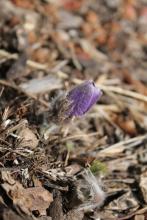
This early-bird Pulsatilla vulgaris has been in stasis the last week... I'm sure it would open if the sun would just come out!
cohan (not verified)
Re: What do you see on your garden walks? 2013
Sat, 04/13/2013 - 3:35pmFar ahead of here, Lori! I've realised, though, that all of my spring flowers so far are in rather slow, or at best, medium-late to melt parts of the property-- I'm giving a lot of thought to those south/west edges of spruce trees/woods through the property, which are free of snow many weeks before the middle, and weeks more before the shady places.. Of course early exposure means much more exposure to cold, but worth experimenting.. I did notice some bulbs poking up today- crocus or snowdrop- they seem very pale, so I think they may have actually started before the snow was gone over them! Meltwater from the rock garden above must have thawed the ground.... And I think I see signs of growth on a couple of Polemonium boreale in various beds- not sure if they will be ready to flower this year...
It's been snowing here all day, but just starting to accumulate, as it was melting on the ground (except on the still significant white areas!)
They've reduced our forecast now- to 5-10cm today and flurries for the next 3 days (was for up to 25cm by tomorrow..)...
Richard T. Rodich
Re: What do you see on your garden walks? 2013
Sat, 04/13/2013 - 5:27pmAnd ahead of me in Minnesota, too. Only some Corydalis solida, a few snowdrops and Hellebores peaking, and of course they're all under snow again now. Though everything is late by the calendar, things actually seem to be emerging earlier than normal here according to temperature. (We are consistently running 15-20F below normal.) Usually nothing happens until all traces of snow disappear because the soil freezes so deeply. But the ground has already thawed, and I actually have snowdrops emerging while there is still lingering aged winter snow.
Those Townsedia parryi are wonderful, Lori!
Zonedenial (not verified)
Re: What do you see on your garden walks? 2013
Sat, 04/13/2013 - 9:32pmEvery year I buy one plant that shouldn't survive in the open here in Iowa; as a result I have a secret cigar box containing labels I no longer need, but also have some pretty odd plants growing in my garden. Maybe my biggest surprise is the return this spring of last year's flyer: Scoliopus bigelovii, endemic to wet spots in coastal California. I lived for a number of years in Berkeley and San Francisco, and hiked a lot in Marin County, where there are a number of colonies. I have it growing in peaty soil in a large tub with some drain holes drilled in the bottom. It was up this spring while there was still some patchy snow on the ground, and it smells like a dead mouse that had rolled in orange zest. There are always a few gnats flying around it. It's pretty (very) iffy for this climate (especially our hot summers), so I'm calling it a guest for now.
Trond Hoy
Re: What do you see on your garden walks? 2013
Sun, 04/14/2013 - 12:27amI grow Scoliopus too and they like the climate here but slugs like the plants so it isn't that easy to grow them. I am anxious now with the weather we have had this winter though. With no snow and a lot of frost and sun all my hellebores are completely dead above ground. The ground is still frozen solid in many places and even the toughest plants struggle. The snowdrops have mostly been fine (they're over the peak now) and the crocuses are in flower with much smaller flowers than usual and almost no leaf out. Iris 'Katharine Hodkin' opened yesterday on the ground with no leaves at all - very pretty and probably more "natural" but very unusual here.
Lori S. (not verified)
Re: What do you see on your garden walks? 2013
Sun, 04/14/2013 - 8:36amIt's great to hear that Scoliopus is hardier than one might expect, Don. It's a very intriguing plant and one I'd certainly give a try to (despite the odds against) if I ever come across it.
cohan (not verified)
Re: What do you see on your garden walks? 2013
Sun, 04/14/2013 - 3:49pmScoliopus is one I'm interested in too, so we're rooting for you!
Some overviews of my rock gardens today- some of them were free of snow recently before a couple of new snows, other parts had not yet fully melted out.
Several of these were just built last year, so not many plants, or only very small ones.
I've put them in a couple of distinct parts of the property- dry and wetter especially- to hopefully suit different groups of plants.. album here:
https://www.facebook.com/media/set/?set=a.10151562468549015.1073741827.5...
I'll just select a few shots for here..
1- part of the 'Rockies' new 'dry' beds- sharply sloped and in the dry end of the yard; berm at the back (left) for non-rock plants and to help shelter from the north.. this area was mostly bare some time ago, except for some of the lowest areas. excavated between beds to hold water temporarily as a reservoir.
Interesting: Polemonium boreale planted on a high dry spot emerged green weeks ago, then old leaves all yellowed, seems to have new growth in core, last I looked; same species on beds in front of house, which did not melt as soon and so missed the coldest nights, have remained mostly green since emerging from snow.
2- in the front of the high beds are lower but gravelly 'foothills' and dryland beds
3- view of 'Alp 1' semp etc bed in front of house planted year before last; this bed was bare before
4-Jovibarba allioni in Alp 1
5-Waldheimia tomentosa in Alp 1- doesn't look like much now, but seems to have lots of live growing points..
6-Townsendia parryi in Alp 1; this one was just flowering in mid/late October when the snow came; not sure if that means it will die now?
Lori S. (not verified)
Re: What do you see on your garden walks? 2013
Sun, 04/14/2013 - 3:59pmLooks good, Cohan. The rounded "river rock" gives a different sort of character; looks very much like glacial washout - I like it! Looking forward to seeing it again when more is visible.
Townsendia parryi has been perennial for me (which is good!) so I assume the same for your plant.
cohan (not verified)
Re: What do you see on your garden walks? 2013
Sun, 04/14/2013 - 4:00pmContinuing,
1-Alp 2, also in front of the house, and based on Sempervivum et al, but this time named forms. This was also bare before recent snow, though the bottom/back only very recently.
2- One of the Polemonium boreale in this bed
3-Prometheum (Rosularia) aizoon - couldn't find much hardiness info on this when I got, but it has survived outdoors here for several years, first year in the ground now..
In the wetter end of the yard, these beds have not yet been fully exposed, though the upper parts were before recent snows.
4-Himalaya 2 built last year, lightly planted, but there are several Viola species, Geum montanum etc.. some (most?) of the Violas flowered last year already, so hoping for a nice show this year..
5-Looking toward the north side of Himalaya 2 (dimpled look where rocks had melted out before surrounding soil; I'm looking more at how the beds will look buried in snow as part of the overall design!); foreground is a combination berm/trench where I plan to plant some mostly native wetland plants and meadow species mixed with edible plants; the branches are part of winter cover to keep mulch/soil in place on the steep sides
cohan (not verified)
Re: What do you see on your garden walks? 2013
Sun, 04/14/2013 - 4:02pmThanks, Lori! This is the kind of stone left here by glaciers, so that's what I have to work with without spending money, and so I've tried to aime for sort of a glacial till/moraine kind of look.. Visually I'd rather have even more rocks, but I have to make them stretch...lol
Good to hear about the Townsendia- esp since it came from seed from you :)
Anne Spiegel
Re: What do you see on your garden walks? 2013
Sun, 04/14/2013 - 6:02pmCohan, I see you're growing Waldheimia tomentosa. Please give me some specifics. I'vehad no success. Isn't this a very high alpine plant? It may be my warm, muggy summers doom me to disappointment
tropicalgirl251... (not verified)
Re: What do you see on your garden walks? 2013
Sun, 04/14/2013 - 6:05pmhere are some pictures taken today from my garden. Still lots of snow around to the house. These pictures are from the south side where the snow is gone a little bit.
Dianthus simulans
Dianthus haematocalyx
Draba aizoides
tropicalgirl251... (not verified)
Re: What do you see on your garden walks? 2013
Sun, 04/14/2013 - 6:08pmmore pictures
Richard T. Rodich
Re: What do you see on your garden walks? 2013
Sun, 04/14/2013 - 6:54pmIt's really encouraging to see how things are progressing in various gardens that more closely mimic my own growing. We all know from experience the joy we get from our own, seemingly little successes, even though a photo might not convey our level of enthusiasm.
I say, kudos to you all!
Mark McDonough
Re: What do you see on your garden walks? 2013
Sun, 04/14/2013 - 8:43pmI second that motion, it is indeed encouraging to see spring slowly inching forward, in this very slow spring. Here it has been slow too, with bright starts then stops with cold spells. Overall, I'd say it is a delayed spring but with some good results.
Crocus suaveolens is one of the slowest growing species, taking almost ten years to build up into this small patch. Beautiful nearly stemless flowers, striped on the outside, opening into sumptuous rose-purple chalices.
The rarely seen Crocus kosaninii, with small narrow flowers of medium purple with dark purple stripes at the base of the perianth and tube, with golden Crocus angustifolius in the background.
The tiny spring blooming Colchicum doerfleri, in its third week of bloom and still looking good, in this view the hairy leaves of the variant on the right is visible.
Iris 'Sheila Ann Germaney' on the left, and I. 'Frank Elder' on teh right, with Galanthus nivalis behind.
Jasminum nudiflorum really flowering well this year. In past years, the first flowers opened in February; this year they were delayed a whole month and a few blooms opened in March, but it's really putting on a show here in mid April.
Helleborus niger making a great show. On the left is a very old plant, in this form the flowers age a deep ruddy pink color. On the right is a 4-year old seedling (from my scratch-and-sown-in-place technique), also showing the deep pink coloration; only one seedling plant so far has shown white flowers that are lightly tinged pink.
Corydalis solida is popping up all over, the very color weather holding them back somewhat, but here are two nice ones that caught my attention today. On the left is a unique very deep cranberry colored form. On the right is what was sent to me as "blind dug" bulbs of C. solida 'Penza Strain' selected from a light blue form, although I got other colors, this one a lovely pure white. It is just starting to bloom, many flower spikes are at the ready.
Lori S. (not verified)
Re: What do you see on your garden walks? 2013
Sun, 04/14/2013 - 9:13pmSpectacular, Mark! Lovely to see what spring, delayed or not, brings to your garden. The dark purple Corydalis is extraordinary.
Richard T. Rodich
Re: What do you see on your garden walks? 2013
Sun, 04/14/2013 - 10:18pmReally nice stuff, Mark.
Love the Corydalis for its unusual color, but I am especially fond of the Crocus suaveolens, with its short stature, wide petals and defined pencil marked tepal backs.
cohan (not verified)
Re: What do you see on your garden walks? 2013
Sun, 04/14/2013 - 11:34pmAnne- I grew the Waldheimia from seed from Pavelka (without looking it up, hope that's right...lol) I think the data is:Zanskar, Baralacha Pass, 4800m (again without digging for the info, that's from an email from someone I sent seed to...lol).. so yes, high alpine.
I got exactly one seedling from the original seed, it was planted out in 2011, a tiny thing, and flowered (1!) last year and did very nicely, apart from being munched by slugs for a while till I realised what was going on and put some bait out. It's in a pretty basic bed with a lot of semps etc, built from sod and native clayey loam with rocks and gravel in upper layers, and sloped for further drainage, so I hope it doesn't stay soggy, but at the same time I doubt it ever really dries out. Of course it doesn't have to deal with heat- we just barely hit 30C a few times last year, although the bed is in front of the house, so it should be warmer than some spots. Sun most of the day in summer, but probably not early morning, nor late afternoon/evening.
Panayoti has mentioned they have not been able to grow it there either... I got some seed from that one flower, so I will try to start some more, but wish it had been a pink flowered form :(
Krish- good to see spring coming there- sounds like much of Saskatchewan and Manitoba have had a much colder and snowier winter than us.
Rick- enthusiasm is the word- just to see plants exposed from the snow is a big deal here- growing and flowering can come later...lol
Mark- nice collection of Crocuses you are getting there! The colour on that Cory is very nice too!
Trond Hoy
Re: What do you see on your garden walks? 2013
Mon, 04/15/2013 - 9:43amCohan,nice "rockies" and other mountains you have! Reminds me of the moraine landscape often seen here.
Krish, hope the snow melts quickly! Hope to your plants in flower soon ;)
Mark, nice colour of the Corydalis!
Here some pictures taken today in my garden, no rain at the moment!
The earliest Corydalis is this C. bracteata(?) but the yellow flowers are almost invisible against the background.
Iris 'Katharine Hodkin' is the earliest Iris.
An unnamed primula.
The first rhodo this year seems to be Rh. sutchuenense, about a month late. It's from seed several years ago.
Not a green grass in the lawn! The snowdrops are finished and some of the crocuses too but other have just started. The soil is still bone hard.
I have dared to put the Tulbaghia outside now :D
cohan (not verified)
Re: What do you see on your garden walks? 2013
Mon, 04/15/2013 - 10:57amTrond- glad to hear my beds remind you of moraines- that's what I was aiming for :)
Good to see your spring is finally getting going, even if late.. the 'dead' grass is what we always have in spring..
Anne Spiegel
Re: What do you see on your garden walks? 2013
Mon, 04/15/2013 - 5:50pmCohan, thanks for all the great info re: Walheimia. Pretty low germination rate. I hope it does well this year so you can photo again.
Tim Ingram (not verified)
Re: What do you see on your garden walks? 2013
Tue, 04/16/2013 - 1:44amWonderful to see spring really getting going and I go with all the comments about Mark's garden - some beautiful bulbs (I've never seen a form of Corydalis solida so dark), and what is it you need to grow Helleborus niger? Most gardeners here fail with it although its hybrids do very well.
In the last few days the temperature has soared to nearly 20°C in the shade and it is as though plants have been released from hibernation! The first flower opened on Pulsatilla grandis on Sunday, Trillium hibbersonii is flowering demurely on a raised humus bed, and for the lovers of the weird the Mandrake (Mandragora officinarum) is doing its thing. A new plant to me, Scopolia carniolica (just obtained from Beeches Nursery) also has a few flowers. Roll on the alpines on the sand bed which should be getting going before too long.
Margaret Young
Re: What do you see on your garden walks? 2013
Tue, 04/16/2013 - 9:48amcohan : good to see your beds making some appearance from the snow. Hope they stay uncovered soon.
Richard T. Rodich
Re: What do you see on your garden walks? 2013
Tue, 04/16/2013 - 10:30amReally interesting photo subjects, Tim.
I'd like to see the mandrake in full flower.
I know nothing about it, but it has such a cool name! ;D
cohan (not verified)
Re: What do you see on your garden walks? 2013
Tue, 04/16/2013 - 11:27amAnne- the seed for the Waldheimia may not have been that fresh, the ages of the seed are listed by the Czech vendors, but I don't remember now what it was for that one; that one seedling was tough though- survived indoors for some time, and a long time in the pot outdoors before I got it planted in ground.. I haven't yet sown my own seed to see how that is..
Maggi- thanks- its nice to see the plants emerging, should be some more evident growth soon :) I do have crocus noses in one bed :)
Tim- great stuff- I have seed outdoors of Scopolia-hoping for good things.. I agree with Rick- the Mandragora is interesting.. I remember some discussion about it on SRGC, but I don't have any clear mental image of what the plant overall looks like.. will have to look into hardiness etc..
Trond Hoy
Re: What do you see on your garden walks? 2013
Tue, 04/16/2013 - 12:46pmFrom this site:http://harrypotter.wikia.com/wiki/Mandrake
Regarding the mandrake, look here Rick:
http://harrypotter.wikia.com/wiki/Mandrake
http://www.avramdavidson.org/mandrake.htm
Tim Ingram (not verified)
Re: What do you see on your garden walks? 2013
Tue, 04/16/2013 - 2:33pmGreat stuff Trond! I remember that excerpt from Harry Potter very well. There is an autumn species (M. autumnalis) too, but I don't know it, and an extraordinary plant from China, M. caulescens with black flowers that may just hover in cultivation.
Lori S. (not verified)
Re: What do you see on your garden walks? 2013
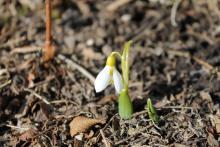
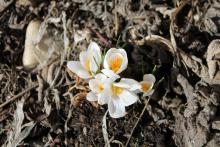
Wed, 04/17/2013 - 6:11pmA few things in bloom:
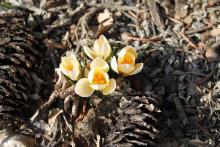
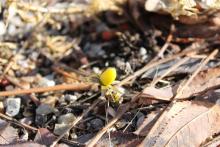
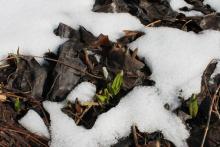
Allium ovalifolium var. ovalifolium emerging:
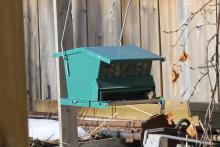
And a cute little mouse who got tired of waiting for the birds to drop seeds in the composter and, instead, is getting his sunflower seeds right from the source:
Fermi de Sousa
Re: What do you see on your garden walks? 2013
Thu, 04/18/2013 - 1:38amThe nerines are starting and the most vibrant is N. rosea
cheers
fermi
Anne Spiegel
Re: What do you see on your garden walks? 2013
Thu, 04/18/2013 - 8:54amFantastic color on the nerine, Fermi. Seen this morning in the garden
Tim Ingram (not verified)
Re: What do you see on your garden walks? 2013
Thu, 04/18/2013 - 9:28amAnne - I've just been reading about Epigaea repens growing at Camla (a garden made in the 1930's near to Ingwersen's Nursery). Very beautiful to see it growing in a garden now. Most UK growers must keep it in a pot.
For Rick - this is a close up of the Mandrake flowers now they are fully opening. Really quite attractive for a relative of the potato!
cohan (not verified)
Re: What do you see on your garden walks? 2013
Thu, 04/18/2013 - 1:05pmLori- nice leaves on the Allium! is the bird feeder right up against a fence? Does that mean you don't have squirrels?
Anne- you are in full swing now :)
Tim- very nice flowers on the mandrake :) looks like nice foliage too- seems flat? I still have to look it up, I chose not to refer to Harry Potter for botanical information..lol
Trond Hoy
Re: What do you see on your garden walks? 2013
Thu, 04/18/2013 - 1:09pmLori,
seems you have a lot of thing going now!
Fermi,
I had Nerine bowdenii in the garden for several years but I dreamed of growing other species!
Anne,
I particularly like that Epigea! Have tried it several times but not been lucky :-\
Tim,
I have planned to try mandrake for several years and now you have inspired me once more ;D
Trond Hoy
Re: What do you see on your garden walks? 2013
Thu, 04/18/2013 - 1:15pmAlthough the freezing weather has left us it is still rather low temperatures so the plants develop very slowly.
Some of the early crocuses have finished but a lot of others are coming now - sorry without names. Some are seedlings appearing everywhere. Also the Hepaticas are in flower. Here is a wild collected redflowered seedling.
Tim Ingram (not verified)
Re: What do you see on your garden walks? 2013
Thu, 04/18/2013 - 2:23pmReally nice to see crocus naturalising like that - looks like a perfect spot on a sunny slope. I will try to remember to save seed from the Mandragora.
Richard T. Rodich
Re: What do you see on your garden walks? 2013
Thu, 04/18/2013 - 3:14pmOoooh, the dusky blue-grey is really fitting on the mandrake. And the leaves flatten with age?
And the color on that nerine! Oh my gosh!
Trond, that crocus meadow gets better and better!
Lori S. (not verified)
Re: What do you see on your garden walks? 2013
Thu, 04/18/2013 - 9:57pmThe bird feeder is suspended overtop the composters which are against the fence... Seems a good way to manage all the sunflower seed shells and spilled seed. Yes, we do have introduced grey squirrels -black phase mostly - and unfortunately don't get any native red squirrels (i see them in the coniferous woods along the river). They don't do any significant harm, in any case.
Anne Spiegel
Re: What do you see on your garden walks? 2013
Fri, 04/19/2013 - 4:15amCohan, the dance is starting but not yet in full swing. We're still getting cold and not that much sun - a lot of cool, gray days.
Hoy, it took me years to establish the Epigaea repens. Linc Foster suggested that the first year I cover it with pine needles and the next year to remove half of the needles etc. It worked. I don't have a really natural area for this but have manufactured one at the north end of a large rock. The rock seems to keep the roots cool and the worst of the sun away. It has survived our hot and humid summers this way.
Pages