I am on my third year of sowing the seed in pure seramis (I use cat litter) as shown by Wisley. So far the results are super with very strong growing bulbs being formed. I have sown in small pots are then potted on the resulting seedlings which is easy for me on a small scale.
I am hopeful of my first flowers in year four on crassiflolia and erhartii.
I am on my third year of sowing the seed in pure seramis (I use cat litter) as shown by Wisley. So far the results are super with very strong growing bulbs being formed. I have sown in small pots are then potted on the resulting seedlings which is easy for me on a small scale.
I am hopeful of my first flowers in year four on crassiflolia and erhartii.
Did everyone notice the rippling of the petal edges on that one? Way cool, Dave! 8)
I have to agree Rick, the F. affinis Dave shows us is superb, such a distinctive species in its own right, but this form is really fine and so well grown, I'm jealous!
Did everyone notice the rippling of the petal edges on that one? Way cool, Dave! 8)
Gee Rick -- you are so observant :) This was it's first flowering from seed ---in view of your comments i went and viewed my pics of the other F.affinis that flower later on here --none of those show rippling of the petal edge ......
McDonough wrote:
I have to agree Rick, the F. affinis Dave shows us is superb, such a distinctive species in its own right, but this form is really fine and so well grown, I'm jealous!
Thanks Mark --hopefully it will set seed so i can pass it around.
Most Frit. affinis of the type shown by Dave Toole - which used to be known as F. lanceolata and F. lanceolata tristulis- usually have those marvelous reptilian ripples on the petal edges. It really highlights the waxy, sturdy nature of the blooms.
Most Frit. affinis of the type shown by Dave Toole - which used to be known as F. lanceolata and F. lanceolata tristulis- usually have those marvelous reptilian ripples on the petal edges. It really highlights the waxy, sturdy nature of the blooms.
Maggi
Thanks Maggi --I'm still learning --in fact i think I'll always be 'an apprentice of many and a master of none' :'( as my horticultural interests are so wide .
Now if it was NZ natives alpines we were talking about .............................................................. I'd probably still need help ! ;D ;)
Most Frit. affinis of the type shown by Dave Toole - which used to be known as F. lanceolata and F. lanceolata tristulis- usually have those marvelous reptilian ripples on the petal edges. It really highlights the waxy, sturdy nature of the blooms.
Maggi
Meant to say - don't they remind you of Rick R's. 'little shop of horrors' plant in his avatar ? ;) ;D
"Scottie" says long time no see, T00lie- hopes you are well and looking forward to a great summer.
Hello Ron (Longma), welcome to NARGS Forum. I really like the net-textured leaves of this species, have admired beautiful pots of them on SRGC and elsewhere, it's on my list of frits to try.
By the way, please excuse the delay in processing NARGS Forum registration requests, Thursday was Thanksgiving Day holiday here in the US, with family visiting, and then I'm still needing to work overtime in preparation for a major convention next week.
Hello Ron (Longma), welcome to NARGS Forum. I really like the net-textured leaves of this species, have admired beautiful pots of them on SRGC and elsewhere, it's on my list of frits to try.
By the way, please excuse the delay in processing NARGS Forum registration requests, Thursday was Thanksgiving Day holiday here in the US, with family visiting, and then I'm still needing to work overtime in preparation for a major convention next week.
Thanks very much Mark. It is a most unusual Fritillaria, but not very difficult to grow ( flowering it is another thing! ). It has roots almost all year round and needs to be kept moist to very moist, in an open free draining 'woodsy' style mix. I have a number in pots and they are outside spring, summer, fall then into a shaded greenhouse for winter when I keep them on the drier side, until flowering ( hopefully!) in spring. Is it allowed to send 'rice grains' to USA? If so let me know in spring if you'd like me to send some in summer. I completely forgot :rolleyes: :rolleyes: that Thursday was Thanksgiving Day holiday. I hope you and all Forum members had a wonderful holiday. I am very pleased to be here now, am looking forward to learning, and hope I can contribute in some way.
I believe you don't have to wait much longer Arne. I have been led to understand that the long awaited Kew monograph on Fritillaria will be published next year ( 2013). ;) I have also seen these titles, that you refer to, on Amazon and wonder what they are about. I follow the published papers re Fritillaria very carefully and cannot get a grasp on these offers. I think that if you have any questions regarding these Frits ( F.falcata etc. ), then much better to post your query on this forum, than pay for these 'whatevers'!! I am sure there are people here who can address any queries you have. ;D
I'm saving my pocket money too Arne in anticipation of a quality publication. ;D ;D
The Frit sprouting is incredibly early and will certainly be damaged through the winter if exposed to your Norwegian climate. What species do you think it is? and what conditions are you able to give it? If its sprouted and then gets frozen it may not make it! :(
Do anyone have any experience with these. Can you find the same articles searching the Web?
Hello Arne, welcome to the NARGS Forum!
Regarding the Amazon.com link, it is a strange and curious situation indeed. I spent some time trying to figure out what these things are, they don't appear to be real books. Using a different link by searching on Google, I started down an intricate web of what appears to be nefarious scamming. One link listed this "book" as "Publication Date: July 27, 2012, High Quality Content by WIKIPEDIA articles!, by Ronald Cohn & Jesse Russell.
Googling the authors, leads to various booksellers, including Alibris, with hundreds up hundreds of books by Ronald Cohn & Jesse Russell, all of which have no details whatsoever and seem to be some sort of mysterious offering. Some are very high priced, none have been reviewed, many or most are in various languages, all are listed as published 2012. To see the list, use this link (but don't buy, these are surely scam offerings): http://www.alibris.com/search/books/author/Jesse%20Russell,%20Ronald%20Cohn
On a graphic image on the side on one Amazon link, it lists Bookvika publishing, on a 2nd image, Pubmix.com, and elsewhere found references to Book on Demand Ltd. (July 27, 2012). There is indeed a new phenomenon called POD or Print on Demand, where publishers will print books by individual order, the technology today allowing books to be stored digitally and printed per order. But I think what we're seeing here in this case is a network of scam offers. See this user-response page on Amazon: http://www.amazon.co.uk/review/RB3IPJIBXIZW4 One reviewer wrote "Bookvika Publishing are well known scammers. All of their books are copied and pasted from Wikipedia articles. PLEASE DO NOT WASTE YOUR MONEY"
So, Ron I'm glad you posted the news about an upcoming monograph on Fritillaria. Do you know who the author(s) will be? I know that when it comes out, I certainly must get a copy.
(PS: if much discussion on this book fraud situation, I can more it to its own topic. It is worth being aware of these shady dealings that somehow are allowed to carry out their business on respected sites like Amazon and Alibris)
Luckily I have a frost free room in my garage with windows to set the sprouting seeds, so the lack of light in a dark winter will be the biggest challenge. Most of them were sown i January (oliqua, caucasica, verticillata) and one in September (striata). Same happened last year, from late November and onwards. I guess there will be more to come (I have plenty of pots with seeds).
Thankyou for welcome and furthrter information of the socalled books. I will certenly not buy any.
So, Ron I'm glad you posted the news about an upcoming monograph on Fritillaria. Do you know who the author(s) will be? I know that when it comes out, I certainly must get a copy.
Mark - it has been the 'hot gossip' ( or should I be saying the 'skinny' or 'scuttlebutt' now I'm here ;D ) this year that the long awaited for Kew Monograph on Fritillaria by Martyn Rix is being completed by Bob Wallis and will be published next year. Rix's monograph has long been waited for and there have been numerous 'false dawns' I know. This time it is looking good. 8)
Thanks for the welcome Rick. I'm keen to learn from the wide range of 'know how' that is so obvious from a read through many wonderful posts. :)
Some nice species there Arne, including one of my 'loves', F.striata. This is usually the first of the Liliorhiza to show and flower for me here in UK. Usually this is in late December, but I know further south at ( Royal Horticultural Society Gardens ) Wisley they have had it emerge in early November. http://www.alpinegardensociety.net/diaries/Wisley/+November+/237/
Then my F. striata seeds are not so early at all :) I had been looking for those seed for a while, seeds from the more unusual American fritts are not easy obtainable. These came from the Fritillaria Groups seed exchange.
Odd really Ron, I'd never thought of you as a fabled winged horse with dragon scales ;D
Fire breathing as well David!
Frit davidii now seems quite well established in cultivation with flowering plants being shown.
I bought a bulb named as F. delavayi last January from China and it is clearly davidii. It was covered in rice grain bulbils which I took off. No growth occurred this year either on the parent bulb or the off sets but now this autumn they are in full growth as is another clone given me by a friend. None of my other frits are showing although root growth is visible through the bottom of the pots. Slugs just love the new growth on this species
It was covered in rice grain bulbils which I took off.
A good pointer Tony, for anyone receiving Fritillaria bulbs from China. If the bulb has these 'rice grains' then it can only be F.davidii, F.dagana, F. camschatcensis or F.maximowiczii. All but F.davidii are stoloniferous species ( only partly true in F.camschatcensis however, depending upon region ). Good to hear that you have them established now. You must have quite a few if you removed all of the rice grains, ;D ;) I'll be looking to exchange some pollen in the spring time ;)
Can anyone please help me track down the natural pollinators of the members of the subgenus Liliorhiza?
F.recurva and F.gentneri have Hummingbirds recorded in various articles. Is there a specific one species of bird? Can anyone verify this by personal observation please?
I know many NARGS members like to get out into the wilds, and enjoy the beautiful countryside of the West Coast. If anyone has any observations of insects on Fritillaria flowers ( something as simple as a bee or a fly etc. are perfectly OK ) I would dearly love to hear your observations / experiences. :) Records for these seem very sparse in the written record ( at least that I can find ). Any pointers in this direction would also be most welcome.
Thank you so much to those NARGS Forum members who have contacted me suggesting that this, Annas Hummingbird, is the pollinator of F.recurva and F. gentneri, 8) 8)


Comments
Toole (not verified)
Re: Fritillaria 2012
Fri, 10/19/2012 - 2:27amGreat pics and information Rick.
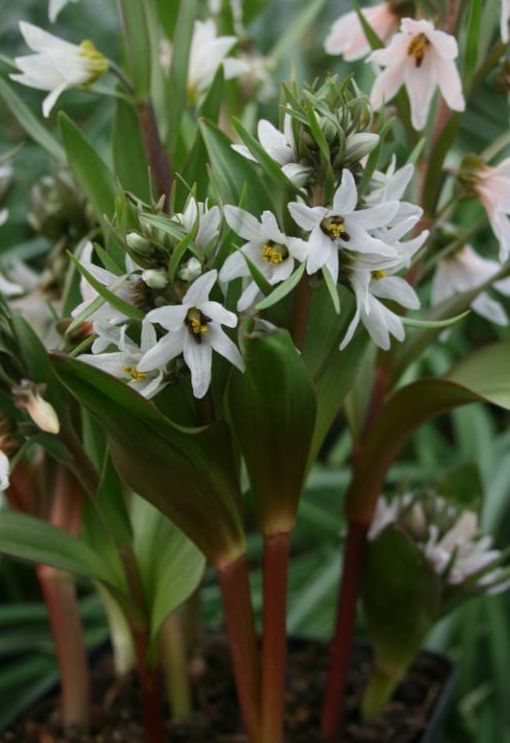
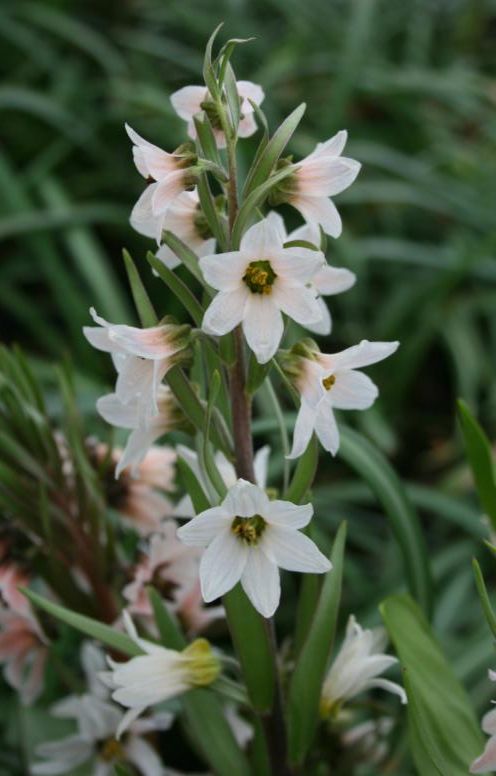
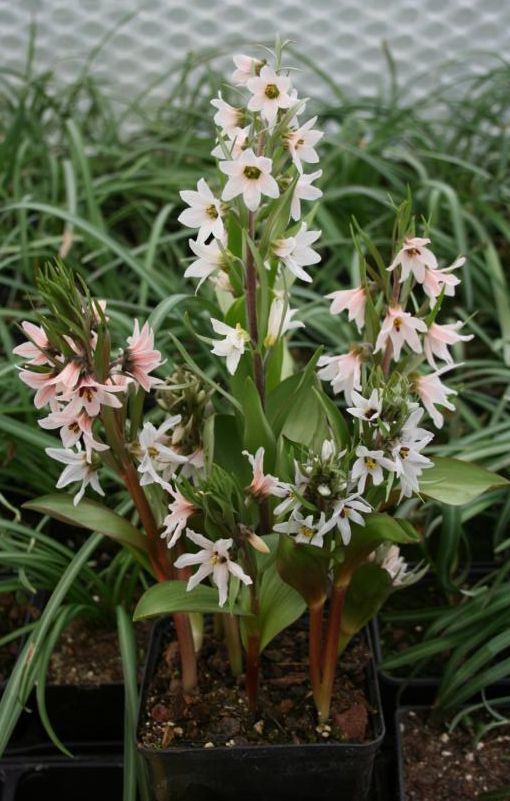
Here are a few out at the moment ....
A nice coloured form of F.acmopetala.
F.cirrhosa.
F.conica.
F.crassifolia i think.
F.drenovskii.
Cheers Dave.
Richard T. Rodich
Re: Fritillaria 2012
Fri, 10/19/2012 - 7:30amA really nice, varied grouping, Dave. And such perfect flowers!
Thanks for taking the very detailed pics, too.
Michael J Campbell (not verified)
Re: Fritillaria 2012
Fri, 10/19/2012 - 10:40amVery Nice Dave.
Trond Hoy
Re: Fritillaria 2012
Sat, 10/20/2012 - 11:11amRick, it is interesting to see the bulbs although still small! I have not dared trying many Frits from seed yet but are tempted!
Very nice, Dave! Seems I have to try more seed though to get all those kinds ;D
Tony Willis (not verified)
Re: Fritillaria 2012
Sat, 10/20/2012 - 12:58pmI am on my third year of sowing the seed in pure seramis (I use cat litter) as shown by Wisley. So far the results are super with very strong growing bulbs being formed. I have sown in small pots are then potted on the resulting seedlings which is easy for me on a small scale.
I am hopeful of my first flowers in year four on crassiflolia and erhartii.
Trond Hoy
Re: Fritillaria 2012
Sun, 10/21/2012 - 10:17amNever heard of seramis before. Is it cat sand?
Tony Willis (not verified)
Re: Fritillaria 2012
Sun, 10/21/2012 - 12:31pmGoogle seramis and you will find a desription.
It is quite expensive and 'non clumping' cat litter is made of the same stuff and much cheaper.
The theory was written up in the Wisley Alpine Log but I cannot find the article but it was also in the September 2009 Plantsman
Trond Hoy
Re: Fritillaria 2012
Mon, 10/22/2012 - 1:07pmThanks. I have The Plantsman - have to dig out that issue ;D - and go looking for cat litter sand :o
Toole (not verified)
Re: Fritillaria 2012
Wed, 10/31/2012 - 11:49pmA few more ....
An early Frit. affinis -- others in troughs elsewhere in the garden are a couple of weeks away from blooming.
Raised from seed as F.hispanica which i think is now called F.lusitanica........
and a nice black form of F.acmopetala.
Cheers Dave.
Michael J Campbell (not verified)
Re: Fritillaria 2012
Thu, 11/01/2012 - 3:11amNice Frits Dave.
Richard T. Rodich
Re: Fritillaria 2012
Thu, 11/01/2012 - 7:03pmThose are some big anthers on F. affinis!
Did everyone notice the rippling of the petal edges on that one?
Way cool, Dave! 8)
Mark McDonough
Re: Fritillaria 2012
Thu, 11/01/2012 - 7:12pmI have to agree Rick, the F. affinis Dave shows us is superb, such a distinctive species in its own right, but this form is really fine and so well grown, I'm jealous!
Toole (not verified)
Re: Fritillaria 2012
Sun, 11/04/2012 - 1:01amThanks Michael.
Gee Rick -- you are so observant :) This was it's first flowering from seed ---in view of your comments i went and viewed my pics of the other F.affinis that flower later on here --none of those show rippling of the petal edge ......
Thanks Mark --hopefully it will set seed so i can pass it around.
Cheers Dave.
Margaret Young
Re: Fritillaria 2012
Mon, 11/05/2012 - 10:07amMost Frit. affinis of the type shown by Dave Toole - which used to be known as F. lanceolata and F. lanceolata tristulis- usually have those marvelous reptilian ripples on the petal edges. It really highlights the waxy, sturdy nature of the blooms.
Maggi
Toole (not verified)
Re: Fritillaria 2012
Tue, 11/06/2012 - 3:08pmThanks Maggi --I'm still learning --in fact i think I'll always be 'an apprentice of many and a master of none' :'( as my horticultural interests are so wide .
Now if it was NZ natives alpines we were talking about .............................................................. I'd probably still need help ! ;D ;)
Kind regards to 'Scottie'.
Cheers Dave.
Margaret Young
Re: Fritillaria 2012
Thu, 11/08/2012 - 10:20amMeant to say - don't they remind you of Rick R's. 'little shop of horrors' plant in his avatar ? ;) ;D
"Scottie" says long time no see, T00lie- hopes you are well and looking forward to a great summer.
M
Longma (not verified)
Re: Fritillaria 2012
Sat, 11/24/2012 - 8:52amThe first leaves on Fritillaria davidii are well underway now. Hoping for flowers in this pot this coming spring. ;D
Mark McDonough
Re: Fritillaria 2012
Sat, 11/24/2012 - 9:07amHello Ron (Longma), welcome to NARGS Forum. I really like the net-textured leaves of this species, have admired beautiful pots of them on SRGC and elsewhere, it's on my list of frits to try.
By the way, please excuse the delay in processing NARGS Forum registration requests, Thursday was Thanksgiving Day holiday here in the US, with family visiting, and then I'm still needing to work overtime in preparation for a major convention next week.
Longma (not verified)
Re: Fritillaria 2012
Sat, 11/24/2012 - 9:20amThanks very much Mark.
It is a most unusual Fritillaria, but not very difficult to grow ( flowering it is another thing! ). It has roots almost all year round and needs to be kept moist to very moist, in an open free draining 'woodsy' style mix. I have a number in pots and they are outside spring, summer, fall then into a shaded greenhouse for winter when I keep them on the drier side, until flowering ( hopefully!) in spring. Is it allowed to send 'rice grains' to USA? If so let me know in spring if you'd like me to send some in summer.
I completely forgot :rolleyes: :rolleyes: that Thursday was Thanksgiving Day holiday. I hope you and all Forum members had a wonderful holiday. I am very pleased to be here now, am looking forward to learning, and hope I can contribute in some way.
Arne (not verified)
Re: Fritillaria 2012
Sat, 11/24/2012 - 12:23pmWhile waiting for a new comprehensive fritillaria book :( I found a series of these on Amazon.
http://www.amazon.co.uk/Fritillaria-Falcata-Jesse-Russell/dp/551224969X/...
Do anyone have any experience with these. Can you find the same articles searching the Web?
Longma (not verified)
Re: Fritillaria 2012
Sat, 11/24/2012 - 12:39pmI believe you don't have to wait much longer Arne. I have been led to understand that the long awaited Kew monograph on Fritillaria will be published next year ( 2013). ;)
I have also seen these titles, that you refer to, on Amazon and wonder what they are about. I follow the published papers re Fritillaria very carefully and cannot get a grasp on these offers. I think that if you have any questions regarding these Frits ( F.falcata etc. ), then much better to post your query on this forum, than pay for these 'whatevers'!! I am sure there are people here who can address any queries you have. ;D
Arne (not verified)
Re: Fritillaria 2012
Sat, 11/24/2012 - 1:15pmThanks, that was good news, I will save my money until then :) No praticular questions at the moment, more a search for knowledge.
A cold Norwegian summer and atumn has already got the first Fritillaria seeds to sprout here.
Arne
Longma (not verified)
Re: Fritillaria 2012
Sat, 11/24/2012 - 1:37pmI'm saving my pocket money too Arne in anticipation of a quality publication. ;D ;D
The Frit sprouting is incredibly early and will certainly be damaged through the winter if exposed to your Norwegian climate. What species do you think it is? and what conditions are you able to give it? If its sprouted and then gets frozen it may not make it! :(
Mark McDonough
Re: Fritillaria 2012
Sat, 11/24/2012 - 4:36pmHello Arne, welcome to the NARGS Forum!
Regarding the Amazon.com link, it is a strange and curious situation indeed. I spent some time trying to figure out what these things are, they don't appear to be real books. Using a different link by searching on Google, I started down an intricate web of what appears to be nefarious scamming. One link listed this "book" as "Publication Date: July 27, 2012, High Quality Content by WIKIPEDIA articles!, by Ronald Cohn & Jesse Russell.
Googling the authors, leads to various booksellers, including Alibris, with hundreds up hundreds of books by Ronald Cohn & Jesse Russell, all of which have no details whatsoever and seem to be some sort of mysterious offering. Some are very high priced, none have been reviewed, many or most are in various languages, all are listed as published 2012.
To see the list, use this link (but don't buy, these are surely scam offerings):
http://www.alibris.com/search/books/author/Jesse%20Russell,%20Ronald%20Cohn
On a graphic image on the side on one Amazon link, it lists Bookvika publishing, on a 2nd image, Pubmix.com, and elsewhere found references to Book on Demand Ltd. (July 27, 2012). There is indeed a new phenomenon called POD or Print on Demand, where publishers will print books by individual order, the technology today allowing books to be stored digitally and printed per order. But I think what we're seeing here in this case is a network of scam offers. See this user-response page on Amazon:
http://www.amazon.co.uk/review/RB3IPJIBXIZW4
One reviewer wrote "Bookvika Publishing are well known scammers. All of their books are copied and pasted from Wikipedia articles. PLEASE DO NOT WASTE YOUR MONEY"
This link is showing that a large number of sites are basically lifting (stealing) Wikipedia information and selling it or posting it as their own information, sigh :(
http://en.wikipedia.org/wiki/Wikipedia:Mirrors_and_forks/Abc#Bookvika_Pu...
So, Ron I'm glad you posted the news about an upcoming monograph on Fritillaria. Do you know who the author(s) will be? I know that when it comes out, I certainly must get a copy.
(PS: if much discussion on this book fraud situation, I can more it to its own topic. It is worth being aware of these shady dealings that somehow are allowed to carry out their business on respected sites like Amazon and Alibris)
Richard T. Rodich
Re: Fritillaria 2012
Sat, 11/24/2012 - 5:36pmThat really is interesting foliage on F. davidii. And very un-monocot looking! :o
As you can see, Ron, our participants here span the gamut of know how. That you "hope you can contribute in some way" is real understatement! Welcome!
Arne (not verified)
Re: Fritillaria 2012
Sat, 11/24/2012 - 11:16pmLuckily I have a frost free room in my garage with windows to set the sprouting seeds, so the lack of light in a dark winter will be the biggest challenge. Most of them were sown i January (oliqua, caucasica, verticillata) and one in September (striata). Same happened last year, from late November and onwards. I guess there will be more to come (I have plenty of pots with seeds).
Thankyou for welcome and furthrter information of the socalled books. I will certenly not buy any.
Arne
Longma (not verified)
Re: Fritillaria 2012
Sun, 11/25/2012 - 9:40amMark - it has been the 'hot gossip' ( or should I be saying the 'skinny' or 'scuttlebutt' now I'm here ;D ) this year that the long awaited for Kew Monograph on Fritillaria by Martyn Rix is being completed by Bob Wallis and will be published next year. Rix's monograph has long been waited for and there have been numerous 'false dawns' I know. This time it is looking good. 8)
Thanks for the welcome Rick. I'm keen to learn from the wide range of 'know how' that is so obvious from a read through many wonderful posts. :)
Some nice species there Arne, including one of my 'loves', F.striata. This is usually the first of the Liliorhiza to show and flower for me here in UK. Usually this is in late December, but I know further south at ( Royal Horticultural Society Gardens ) Wisley they have had it emerge in early November.
http://www.alpinegardensociety.net/diaries/Wisley/+November+/237/
Arne (not verified)
Re: Fritillaria 2012
Sun, 11/25/2012 - 12:14pmThen my F. striata seeds are not so early at all :) I had been looking for those seed for a while, seeds from the more unusual American fritts are not easy obtainable. These came from the Fritillaria Groups seed exchange.
Longma (not verified)
Re: Fritillaria 2012
Sun, 11/25/2012 - 12:19pmNot so early at all Arne. 8) 8) ;D
I'm expecting my latest sowing of F.striata to be showing within the next few weeks also, ;D ;D
I have sown most of my subgenus Liliorhiza seed now, but do have a few species left to sow. I find the latest sowing time here is end December, :)
PM me if you would like some of the species I have left.
deesen (not verified)
Re: Fritillaria 2012
Mon, 11/26/2012 - 1:58amOdd really Ron, I'd never thought of you as a fabled winged horse with dragon scales ;D
Tony Willis (not verified)
Re: Fritillaria 2012
Tue, 11/27/2012 - 3:26amFire breathing as well David!
Frit davidii now seems quite well established in cultivation with flowering plants being shown.
I bought a bulb named as F. delavayi last January from China and it is clearly davidii. It was covered in rice grain bulbils which I took off. No growth occurred this year either on the parent bulb or the off sets but now this autumn they are in full growth as is another clone given me by a friend. None of my other frits are showing although root growth is visible through the bottom of the pots. Slugs just love the new growth on this species
Longma (not verified)
Re: Fritillaria 2012
Tue, 11/27/2012 - 3:56amA good pointer Tony, for anyone receiving Fritillaria bulbs from China. If the bulb has these 'rice grains' then it can only be F.davidii, F.dagana, F. camschatcensis or F.maximowiczii. All but F.davidii are stoloniferous species ( only partly true in F.camschatcensis however, depending upon region ).
Good to hear that you have them established now. You must have quite a few if you removed all of the rice grains, ;D ;)
I'll be looking to exchange some pollen in the spring time ;)
Longma (not verified)
Re: Fritillaria 2012
Fri, 12/07/2012 - 9:06amCan anyone please help me track down the natural pollinators of the members of the subgenus Liliorhiza?
F.recurva and F.gentneri have Hummingbirds recorded in various articles. Is there a specific one species of bird? Can anyone verify this by personal observation please?
I know many NARGS members like to get out into the wilds, and enjoy the beautiful countryside of the West Coast. If anyone has any observations of insects on Fritillaria flowers ( something as simple as a bee or a fly etc. are perfectly OK ) I would dearly love to hear your observations / experiences. :)
Records for these seem very sparse in the written record ( at least that I can find ). Any pointers in this direction would also be most welcome.
Longma (not verified)
Re: Fritillaria 2012
Sun, 12/09/2012 - 2:01pmThank you so much to those NARGS Forum members who have contacted me suggesting that this, Annas Hummingbird, is the pollinator of F.recurva and F. gentneri, 8) 8)
http://www.allaboutbirds.org/guide/Annas_Hummingbird/id
A most beautiful bird and that song is most unusual. 8) 8)
Love them to pop into my greenhouses to visit my flowers in Spring 2013 :o :o :o :rolleyes: :rolleyes:
Thank you to all those members who passed on this information to me, :)
Pages