
Moderator note:
With a new year comes a new thread! Here is the first post in "Image of the Day - 2012", which continues on from:
http://nargs.org/smf/index.php?topic=24.1560
Edit by Lori
Nothing in flower here either but with each day a second or two longer now, here are some mountain scenes and some local alpines to make us yearn for spring! Happy New Year, all!
Lovely pics Lori
Lori, your pictures always make me feel guilty - guilty of sitting lazy in the sofa instead of getting out there where the diamonds are to be found ;)
I know how you feel Hoy ...well sort of :) Here i'm stuck finishing off a job for a client spraying with a knapsack around 5000 newly planted natives ,all the while i'm itching to get back up into the hills --anyway regardless of the work situation i've decided i'm away botanizing next weekend.
Here's a wee beauty-- Brodiaea terrestris with thick looking almost succulent like petals .Enjoying the dry warm conditions of the last 3 weeks .
Cheers Dave.
Comments
cohan (not verified)
Re: Image of the day - 2012
Sat, 09/22/2012 - 11:37pmThanks, Tim- yes, tons of beautiful close images out there right now, and an overall golden glow. As Lori mentions, we, like the rest of the province, are having a very warm September, as well as, for me, the driest spell we've had all year, and the driest fall we've had in several years- good for farmers needing to harvest! The warm weather is a bit of a comfort for me, since I did some rather late plantings, and was hoping things would have some time to get settled in- the irony is that I've had to do some watering of new plantings, when I scarcely watered all summer, even small seedpots stayed moist...
I thing we've had enough frost to kill tender annuals too, though I don't really have any to be sure- in town there are still flowers looking undamaged, though we've definitely had rooftop frosts and several nights reportedly below 0C- enough to encourage the trees to turn, native plants to colour and garden plants to show a little extra foliage colour, though Geranium, Achillea, Cyclamen have still been flowering, as are some native asters, with others in seed..
Nice view, Lori- were you up there for work? Thank goodness the blackflies don't make it this far south! And mosquitoes have finally settled down in the last couple of weeks, not gone, but no longer overwhelming..
Nice flower, Fran- were you just visiting there, or do you have a work connection to the greenhouse? Nice to have access to some kind of indoor greenspace as the days get shorter and cooler...
Another couple shots from the acreage, Viburnum edule lovely in its fall colour, even if the smell of the plants in fall is less than sweet-- they are common here, and a patch can scent the area for some metres around them; All our fall reds are in the understory,and there are some good ones, but all the deciduous native trees turn yellow, just the occasional aspen partly/barely hitting orange..
Cornus canadensis (just can't remember that new name yet without looking it up) These are common enough to dot the forest floor with red in some spots without a lot of taller understory, and to shine through the grasses, shrubs and forbs in other places..
Lori S. (not verified)
Re: Image of the day - 2012
Mon, 09/24/2012 - 7:34pmYes, a geology field trip... and from our hike this weekend, here's a glimpse of larch season in the mountains:
cohan (not verified)
Re: Image of the day - 2012
Tue, 09/25/2012 - 11:19amGreat view! The tamaracks are just barely starting to turn here, usually they are the last of the native trees to do so..
Here's an aspen in the yard...
Trond Hoy
Re: Image of the day - 2012
Tue, 09/25/2012 - 12:33pmThat Orthosiphon (never heard of the genus though) reminds me of a Cleome :o Very nice!
You seem to have some great colours yourself, Cohan ;)
Lori, nice view and walk! We have no native laches in Norway but several species are planted. It is a small larch wood not far from here. It always gets nice yellow colour in fall - but later!
cohan (not verified)
Re: Image of the day - 2012
Wed, 09/26/2012 - 11:33pmThanks, Trond- I always wish we had more red and orange in the fall colours ( I loved the fall colours when I lived in Toronto- many more colours, and it lasted much longer)- lots of colour in the understory here, but only yellow for the native trees, and I have no red exotics either.. I have some Acer rubrum planted, but they are only a few inches tall, and other things even smaller...lol
We don't have many exotic trees, and my favourite is Tilia cordata for its shape, but that turns yellow too...
Things are fairly glowing right now though with many of the poplars at full gold..
More yellow, a Salix sp, growing wild in the strip of land (road allowance) between us and the neighbours
And a different fall colour- white! Viburnum edule, in a paler colour than the usual pink and red.. judging by the holey leaves, the slugs had a good year not only in my yard-many/most of the plants in the forest seem chewed up!
Hieracium umbellatum (if I've correctly id'd this common plant here) may be showier in its fall guise than at any other time- especially in the shady places it often appears.. still haven't got a photo I really like, but you get the idea of the ghostly foliage floating above the carpet of dark clover (dang weed), moss and aster foliage etc..
Finally, a Petasites I always hesitate to name them, since all leaf forms from pure arrow to fully palmate occur in great numbers here, often very close to one another.. this is an intermediate shape; all these photos are on our 6 acres..
Trond Hoy
Re: Image of the day - 2012
Thu, 09/27/2012 - 3:26amWhitish colours are rare here although I have seen it. The commonest colours are yellow-brown.
Cohan are you sure it isn't caterpillars or beetles gnawing on the leaves in the wood?
cohan (not verified)
Re: Image of the day - 2012
Thu, 09/27/2012 - 11:07amTrond, no I'm not sure what is gnawing on the plants, and likely it's many things! but the plants do have the overall look that some plants in my garden got when I finally realised the slugs were going crazy when it was so wet in mid-summer-- usually I wasn't outside in the evening since the mosquitoes would be unbearable as soon as the sun goes behind the trees (or a cloud), but when my sister's family was visiting I was out later once, it had rained in the afternoon, so it was nice and damp and the slugs were out in droves, crawling all over the rock gardens and up plants several feet off the ground etc... that's when I got the slug pellets...lol
Here are some more whites- provided mainly by Equisetum..
Trond Hoy
Re: Image of the day - 2012
Thu, 09/27/2012 - 12:18pmCohan, that forest floor looks very alien! But it makes me think of a song by Mike Oldfield: "Moonlight shadow" ;D
cohan (not verified)
Re: Image of the day - 2012
Fri, 09/28/2012 - 11:56pmIt is rather like moonlight, isn't it? The horsetails in this little patch of woods are quite charming at several times of year- it's a very nice effect in green, too.. here are a couple of summer views, not exactly the same spot, but nearby, the second one is a bit farther back where it's wetter, the horsetails are taller...
Trond Hoy
Re: Image of the day - 2012
Sat, 09/29/2012 - 12:53amWhich species of horsetail is it?
The butterbur seems to have a spreading habit but I like the ground covering effect of it. Have you showed the inflorescence somewhere?
Mark McDonough
Re: Image of the day - 2012
Sat, 09/29/2012 - 6:32pmSmilacina racemosa spreads into sizeable colonies, making gorgeous clusters of fruit on cascading stems. When the berrirs first color up, they are richly speckled. These photos were taken mid September, a couple weeks ago, now the fruits are blood red. I pull out lots of seedlings as they spread a bit too easily, but since they're slow to get establish and grow to any significant size, they don't pose any real risk of weediness.
http://plants.usda.gov/java/profile?symbol=MARAR
Richard T. Rodich
Re: Image of the day - 2012
Sat, 09/29/2012 - 8:24pmI really like the speckled stage of the berries. They were common in the woods where I grew up and survived in the soil between the forks of the root flares of old trees in the yard... With his lawn mower, Dad couldn't get them there! ;D
Mark McDonough
Re: Image of the day - 2012
Sat, 09/29/2012 - 8:43pmToo funny... this species can be considered weedy, and can flourish even in very dry root-ridden shade, but when one considers its overall attributes, it really is a fine plant, one of those that will grow, flower, and fruit in dry shade, conditions that are normally considered hopeless by the general public.
Trond Hoy
Re: Image of the day - 2012
Sat, 09/29/2012 - 11:47pmSmilacina racemosa/Maianthemum racemosum is a favorite of mine! I have two clones but neither get berries :-\ Not strange though as on colony has dwindled and not flowered the last years, seems it doesn't like competition from Ichtyoselmis macrantha (Dicentra m.) and Impatiens omeiana.
Maybe I should try to increase the genetic diversity! Anybody who has berries to spare ;)
cohan (not verified)
Re: Image of the day - 2012
Sun, 09/30/2012 - 12:07amTrond, no idea of Equisetum species! There may well be a couple in those woods- at least there are the very dwarf woodland ones, and not sure if these larger bodies are related to them or something else, and taller still in the wetter places, but that may just be the conditions....
Nice Smilacina/Maianthemum, Mark, this one occurs in Alberta, but I haven't seen them personally; I have naturally occurring canadense, stellatum and trifolium ( the last I guess being real Maianthemum, and not Smilacina) all on my acreage,they all have nice speckled berries when immature. It would be nice to get some racemosum sometime as well, since the flower clusters are so different..
I did succeed in getting seed of trifolium this year, last year just could not find or missed it- I think Trond wanted some? Anyone else? I could possibly still collect seed of canadense if anyone asks for it, though it would need to be soon... I think stellatum has already dropped berries, though there might be a few around, so speak up now if anyone is interested ;D
Trond Hoy
Re: Image of the day - 2012
Sun, 09/30/2012 - 1:20amCohan, I am interested in all 3 species!
Trond Hoy
Re: Image of the day - 2012
Sun, 09/30/2012 - 1:47amHere is a picture taken today of the Impatiens omeiana, swamping its neighbours! It is very late flowering and buds have barely formed. Usually they open in October. This year it is very late due to the rainy and cool weather we have had the last months.
Lori S. (not verified)
Re: Image of the day - 2012
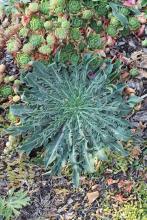
Sun, 09/30/2012 - 9:02amSymmetry... Carduncellus pinnatus:
Tim Ingram (not verified)
Re: Image of the day - 2012
Sun, 09/30/2012 - 10:19amTrond, that Impatiens is a tremendous sight - it seems to be all the while wilting with us. It really doesn't look as though it would be hardy. I have grown Dicentra macrantha fleetingly; it is a very beautiful plant but again needs more moisture than we can give it - its new name makes it sound like a dinosaur!
cohan (not verified)
Re: Image of the day - 2012
Sun, 09/30/2012 - 11:33amTrond, I'll stick some bags in my pocket when I go out this afternoon and watch for Maianthemum seeds; Looks like our free ride of a warm dry fall is about to end- Monday 20C, then Tuesday 6C as a high;Thursday morning low of -6, and rain several days, possible snow Wed; I've still been our digging and moving soil and rocks etc, that will have to end very soon as I'll have to get at cutting firewood!
I forgot to answer earlier about the Petasites- as I've mentioned, we have plants that look like sagittatus, plants that look like frigidus v palmatus, and and every variation between the two. The 'pure' sagitattus tend to be in more open (though not always, they still take some shade at times) and wet areas, the 'pure' palmatus are in woodland areas, not really dry spots, but not necessarily wet, and the intermediate forms can be in open wet places through the wetter edges of mesic woods; Flowers of all are similar, though there are variations between plants with more or less female/male flowers, and some plants that have more purple on backs of ligules etc; I haven't clearly tied those flower differences to leaf differences, except that the mesic woodland (palmatus forms) plants don't flower much, just the occasional inflorescence, which is usually more open and less showy than the others...
here are a few photos of flowers, showing some of the variation- some of which is also age of inflorescence of course; these are mostly sagittatus types, still digging for a palmatus inflo..
I'm going to copy this over to a new Petasites thread with more pics...
http://nargs.org/smf/index.php?topic=1169.new#new
cohan (not verified)
Re: Image of the day - 2012
Sun, 09/30/2012 - 11:35amGreat foliage on the Impatiens, looking forward to seeing it in flower too..
Lori, nice flat dense rosette on the Carduncellus!
Trond Hoy
Re: Image of the day - 2012
Sun, 09/30/2012 - 2:03pmSymmetry - and very disadvantageous for the any neighbours ;)
It is quite hardy but very late flowering! Some years it don't reach to open the flower buds before the onset of winter.
- and Ichtyoselmis sounds very fishy in my opinion!
Cohan, hope you find some ;)
Thank you for the info about the Petasites. I have been afraid of that genus as the species I know get too big and invasive, but your species seems to behave itself!
Trond Hoy
Re: Image of the day - 2012
Sun, 09/30/2012 - 2:20pmHere is the fishy plant now - or some of it, among ferns:
Lori S. (not verified)
Re: Image of the day - 2012
Sun, 09/30/2012 - 3:35pmNo, they sure don't! I have grown it (twice... I'm a slow learner :P) and pulled it all out after it started popping up everywhere. They seem to be just as invasive as the rest of their kind.
Cohan, the jays and squirrels have disposed of all the bur oak acorns already here but perhaps it would be too big for your liking anyway? Ours is "a small tree" though definitely tree-sized... about 20' now. It was here when we moved in, so is probably 18-20-ish years old. Our neighbor's, across the street, is slightly larger... about the largest I've seen here. At the western edge of their range, in Riding Mt. N. P., Manitoba, they were quite small, maybe 10' in the competition of the hardwood forest.
cohan (not verified)
Re: Image of the day - 2012
Sun, 09/30/2012 - 4:03pmTrond, Lori is right, our Petasites still spread- I have never yet had or seen one in a garden situation, but where they grow naturally there is never just one ;D I am going to try some in some plantings, of both species/forms, but they will not be close to anything delicate, and I will probably have them with either wild and/or mowed areas next to them..
I sent some pieces to Stephenb a couple of years ago, you could ask him how/what they are doing!
I think some bits of palmatus might be okay in one of your semi-wild woodland areas where they'd have enough competition- and they do not get as large by a long shot as the Japanese species- although I haven't measured, the largest leaf span for palmatus here is maybe something like 20cm, usually less, sometimes much less, and not very tall either. sagiattatus leaves probably get to around 30 cm long
On my wishlist is small northern frigidus/palmatus with actually pink flowers.... I've seen pictures..
Lori- 20 feet would be okay in some spots here, though 10 feet would be even better :) I wouldn't mind a few small trees of various sorts in that 10-15 foot range!
cohan (not verified)
Re: Image of the day - 2012
Sun, 09/30/2012 - 8:28pmThanks, Lis, I'll have to check that out..
Mark McDonough
Re: Image of the day - 2012
Mon, 10/08/2012 - 5:43pmI'm watching the seed "cone" development on Arisaema sikokianum carefully, as my two largest plants set impressive spires of developing seed. These plants miraculously survived the storm-induced felling of an enormous sugar maple tree that caused considerable damage of nearly trees and plants, additional damage from unavoidable trampling by expert tree cutters. But now I have a new fear, with the demise of this tree, and a whole swath of screen plants and younger trees alongside the country road where I live, these plants are now plainly in view from the street.
This afternoon I noticed some people who were walking by, they stopped and were pointing to something in the garden; when I approached they quickly continued on their walk; when I looked around to see what might be catching their attention, surely it is these large corn-like fruit structures, plainly visible now that the foliage is dying off. Once these turn brilliant red, my worry is someone will help themselves.
One whole cone is allocated to my friend who gave me this species in the first place. She became ill and gave away most of her plants when she planned to move away, but fortunately she recovered, decided to stay where she is, and now would like to grow these plants again; she's a terrific grower of woodland plants including Arisaema. Myself, I am going to make a dedicated sowing on the other seed "cone" to make a major increase in how many plants I have, a one-time push for significant plant increase.
Richard T. Rodich
Re: Image of the day - 2012
Mon, 10/08/2012 - 6:13pmThose fruit cones certainly are impressive, Mark. I think your fear is well founded. It just amazes me that people think that picking flowers out of someone else's yard is not stealing, let alone a woodland garden.
You'll never stop people who really want to steal, but I think your only option is to cage them in with chicken wire (over the top, too) to show that they are for you only.
Mark McDonough
Re: Image of the day - 2012
Mon, 10/08/2012 - 7:08pmI think you're right... this afternoon I was totally out of wire-fabric, need to buy more. I definitely will do exactly that, wire them in to show they are protected and not for general picking.
Trond Hoy
Re: Image of the day - 2012
Mon, 10/08/2012 - 11:09pmMark, are the two plants one clone or different specimens? If they are different I would keep half of each cone and give away the other half of each to increase genetic diversity.
Hopefully nobody steals any!
Occasionally kids pick flowers along the road but only once to my knowledge, did somebody pick seed. And those were from a special peony; they weren't ripe either :-\
Harold Peachey
Re: Image of the day - 2012
Tue, 10/09/2012 - 8:02amMark-A. consanguinium grows quite well in full sun so no worry there, also you will find that they produce copious numbers of side bulbs , more than enough to replenish your needs and those of friends and family.
Mark McDonough
Re: Image of the day - 2012
Tue, 10/09/2012 - 6:33pmHarold, sadly I can't grow Arisaema consanguineum (thus far), I tried several times, both from seed and as tubers. In my latest experiment, I planted out about 50-60 seedlings in 2011, and this spring just 3-4 seedlings showed up very late (in late June or July), and quickly either went dormant or died off. Maybe as you suggest, I should try them in full sun, I had planted them in shade.
Harold Peachey
Re: Image of the day - 2012
Wed, 10/10/2012 - 5:21amA. consanguinium emerge late here also, but immediately reach full size, often four feet or more. They remain green and handsome up to hard frost. I have them in a variety of situations as they reproduce so rapidly I always have many to give away. They seem to thrive in average garden soil with decent drainage, not particularly well drained necessarily-good luck. I always have corms to spare so if we cross paths sometime I will gladly pass a few on-I attended one BNARGS meeting this year and plan to attend a few next year also- will let you know and perhaps we can meet there.
cohan (not verified)
Re: Image of the day - 2012
Wed, 10/10/2012 - 12:05pmI've showed this plant elsewhere, but since this is the artsiest image, thought I'd put it here:
Townsendia parryi
more info here:
http://nargs.org/smf/index.php?topic=65.new#new
Richard T. Rodich
Re: Image of the day - 2012
Wed, 10/10/2012 - 7:42pmDefinitely more artistic, and a perfect image of the day!
Great color hue.
I really like photos that show clearly parts of the plant, too, and this one is both. :)
cohan (not verified)
Re: Image of the day - 2012
Thu, 10/11/2012 - 11:41amThanks, Rick! After the white flowers on my Waldhemia (right beside this plant, actually) I was happy to see a nice strong colour on this one :) Of course if it flowers in better weather in spring I presume stems will be longer and the flower will get paler as its open more..
cohan (not verified)
Re: Image of the day - 2012
Tue, 10/23/2012 - 11:14amA view outside the house last night... this snow was several days old, it's whiter now, as we've had another 10cm or more today and still coming down..
Cliff Booker
Re: Image of the day - 2012
Tue, 10/23/2012 - 11:48pmAs an antidote to the snow ... Gran Paradiso Alpine Garden, Italy this summer.
Cliff Booker
Re: Image of the day - 2012
Wed, 10/24/2012 - 12:41amLeontopodium alpinum
cohan (not verified)
Re: Image of the day - 2012
Wed, 10/24/2012 - 5:45pmThanks. Cliff- antidotes always welcome :)
Richard T. Rodich
Re: Image of the day - 2012
Wed, 10/24/2012 - 7:55pmAnd the Edelweiss photo has such detail.
I've never looked "into" one before...
Thanks, Cliff!
Cliff Booker
Re: Image of the day - 2012
Fri, 10/26/2012 - 6:54amThanks guys.
Ranunculus glacialis and Myosotis alpestris co-habiting on an exposed ridge overlooking the Marmolada glacier and Lake Fedai at Porta Vescova, Arabba, Dolomites. Italy.
Trond Hoy
Re: Image of the day - 2012
Fri, 10/26/2012 - 11:12amExcellent pictures as usual, Cliff! Make me long for summer :)
Got some hail and sleet last night and I was awakened by thunder early this morning.
Some plants still keep going though like this Fuchsia 'Mrs Popple'.
Todd Boland
Re: Image of the day - 2012
Sat, 10/27/2012 - 4:31amI wish Fuchsia were hardy here...I tried magellanica one year but no go.
Campanula makaschavilii is still blooming....we still have not had a frost or any sort so many spring bloomers are starting to flower again...not good.
Todd Boland
Re: Image of the day - 2012
Sat, 10/27/2012 - 1:43pmA pot of Crocus tournefortii at our Botanical Garden
Mark McDonough
Re: Image of the day - 2012
Sat, 10/27/2012 - 6:54pmVery fine pot full of C. tournefortii there Todd!
Cliff Booker
Re: Image of the day - 2012
Sun, 10/28/2012 - 1:02amTrollius Europaeus (Globe Flower) at Cinque Torre in the Dolomites.
Cliff Booker
Re: Image of the day - 2012
Sun, 10/28/2012 - 2:28amTiny gentian in a hollow in a limestone boulder, Dolomites.
Howey (not verified)
Re: Image of the day - 2012
Sun, 10/28/2012 - 3:34amTodd: I, too, have a Campanula makaschavilii? flowering out of season. At least it looks like that is what it is. Cliff, like the way you have whited out the corners of your flower photos - makes the flowers look even more precious. Fran
Frances Howey
London, Ontario, Canada
Zone 5b
Mark McDonough
Re: Image of the day - 2012
Sun, 10/28/2012 - 10:16amFrances, nice to have such a pretty wand of campanula bloom so late in the season. Not familiar with the name Campanula makaschvilii, I looked it up; listed as a species from the Caucasus in Graham Nicholls "Dwarf Campanulas" book, stating "it resembles a smaller less hairy C. alliariifolia", and The Plant List considers it a synonym of C. alliariifolia. Here are a few links to photos of C. alliariifolia.
http://www.robsplants.com/plants/CampaAllia
http://jardinsmichelcorbeil.com/images/camp.%20alliar.jpg
http://luirig.altervista.org/cpm/albums/bot-units04/campanula-alliariifo...
My guess is your plant is actually Campanula punctata, particularly the form going around as C. takesimana, considered a synonym of C. punctata by both Graham Nicholls and The Plant List. I've grown many forms of C. punctata, which took me a decade to eradicate (mostly), but I fear I have lost the battle with C. "takesimana"; the only way to deal with it invading my lawn and garden and surrounding woods, will be to move to a new location. It is most floriferous, with voluminous showers of big white pink-tinged bells, a beautiful plant but an aggressive invader all the same. I consider this the most invasive plant I have ever witnessed in my near half century gardening in New England. The slightest piece of the stringy white roots and runners left behind when digging out the plant, gleefully sprout many new plants. The dust like seed wind-disperse far and wide, germinating most anywhere too. So watch your plant very carefully for signs of spreading, you might want to take drastic action.
Campanula "takesimana" seeded into a lawn area, then spread into an are under a large Katsura tree. I've not been able to eradicate it once it gets into the lawn, it has been impossible to remove when entwined through the tough surface roots of the Katsura tree.
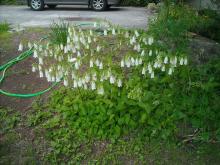
Campanula "takesimana" will show some variation in color (white through pinkish and lavender shades), degree of color spotting, flower shape and degree of petal tip flaring. Beautiful in flower, but I shudder when I see the wands of bloom, and all the seed and runners it'll be making.
Campanula punctata alba, that sowed itself in front of the stone wall that fronts my property and the street. There are numerous color deep forms of punctata, all are beautiful, all are to be avoided. Even when grown in pots, the roots will come out of the drainage holes and invade any nearly soil medium.
Pages