
Moderator note:
With a new year comes a new thread! Here is the first post in "Image of the Day - 2012", which continues on from:
http://nargs.org/smf/index.php?topic=24.1560
Edit by Lori
Nothing in flower here either but with each day a second or two longer now, here are some mountain scenes and some local alpines to make us yearn for spring! Happy New Year, all!
Lovely pics Lori
Lori, your pictures always make me feel guilty - guilty of sitting lazy in the sofa instead of getting out there where the diamonds are to be found ;)
I know how you feel Hoy ...well sort of :) Here i'm stuck finishing off a job for a client spraying with a knapsack around 5000 newly planted natives ,all the while i'm itching to get back up into the hills --anyway regardless of the work situation i've decided i'm away botanizing next weekend.
Here's a wee beauty-- Brodiaea terrestris with thick looking almost succulent like petals .Enjoying the dry warm conditions of the last 3 weeks .
Cheers Dave.
Comments
Todd Boland
Re: Image of the day - 2012
Wed, 08/15/2012 - 1:42pmGrown from seed this year and currently blooming is this species obtained from the AGS called delphinium aff. smithianum...which it certainly is not! Nice enough but with 277 species in China alone, unlikely to ever be named.
Lori S. (not verified)
Re: Image of the day - 2012
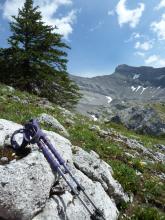
Wed, 08/15/2012 - 1:44pmFrom our hike the other day...
Richard T. Rodich
Re: Image of the day - 2012
Wed, 08/15/2012 - 1:56pmLooks like they all wanted to be in the photo, Cliff!
And they've been "captured" perfectly. ;D
In fact I was just trying to photograph some scutellaria in the wild here, and they did not want to cooperate at all! :-\
cohan (not verified)
Re: Image of the day - 2012
Wed, 08/15/2012 - 3:39pmBeautiful, Cliff!
We have a species here, S galericulata, which grows in wetlands- lovely plant but obviously not as compact or dense as the alpine species..
Rick what species do you have there?
Lori- great site!
Todd-- 277! Are they really distinct or in need of some lumping?
Richard T. Rodich
Re: Image of the day - 2012
Wed, 08/15/2012 - 7:50pmYes Cohan, the species I alluded to that grows here is Scutellaria galericulata, too. And it seems I did get some nice pics out of the many I took. (Thank goodness for digital cameras!) I'll be posting them in the travel section along with many others, once I've gone through them all. ;D
cohan (not verified)
Re: Image of the day - 2012
Thu, 08/16/2012 - 10:41amLooking forward to seeing how the species looks in your area, Rick :) I've been so focussed on garden building this year, I haven't even been out onto the farm (beside my acreage on two sides) to look at plants in ages :(
Trond Hoy
Re: Image of the day - 2012
Thu, 08/16/2012 - 11:14amCliff, perfect picture!
I have tried to grow this species (Scutellaria alpina) from seed but never got germination. Anybody growing it?
G. galericulata grows here too often on beaches. I thin it is a pretty plant. I grow G. lateriflora in my garden (it is called American scullcap (amerikansk skjoldbærer) in Norwegian).
Todd, it's nice, and in some months only! All my Delphiniums grow slowly if they survive - leaves are eaten by slugs.
Lori, just an afternoon walk or a long one?
From the inner wall of my compost bin, possibly a Coprinus: Edit: More likely a slime mold!
Lori S. (not verified)
Re: Image of the day - 2012
Fri, 08/17/2012 - 8:18amTrond, I have several Scutellaria alpina plants, both the usual purple/white-flowered and a white-flowered with only a purple flag... one of these was originally purchased as a named cultivar ('Romana'?)
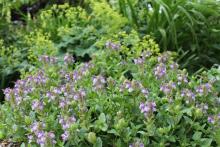
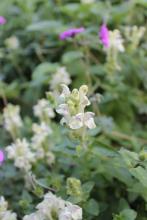
Anyway, if I get out there and collect seeds, I can send you some. Most of the species I've tried have germinated in a relatively short time at room temperature.
Trond, isn't Coprinus a mushroom? Or are there fungi with less structure in that genus too?
Another hike photo... I'll post a few photos in the Trips section, and describe it a bit more:

Trond Hoy
Re: Image of the day - 2012
Fri, 08/17/2012 - 9:27amLori,
- yes please, name doesn't matter!
- yes, Coprinus is a mushroom; and if you look close you can see the small "bulbs" which are the initiated young mushrooms or to be precise: the fruiting bodies. The weft is the mycelium and hence the mushroom.
As said it is more likely a slime mold as the "slimy" outer edges (feeding plasmodium) suggest. The threads are mature plasmodium and the "bulbs" are maturing sporangia.
- please do ;)
Mark McDonough
Re: Image of the day - 2012
Sat, 08/18/2012 - 7:14amTodd, beautiful color on that Delphinium, whatever species it is, an elegant slender spire. The few species I have in the garden are typically chewed up by rabbits, possibly by a marauding woodchuck (ground hog) that I battle with.
cohan (not verified)
Re: Image of the day - 2012
Sat, 08/18/2012 - 3:32pmtrond- cool mushroom- it's interesting to see what would usually be going on below ground out of sight.. there are a lot of fungi and mushrooms here, of course you typically see only the fruiting body, I imagine the undisturbed soils are full of them..
Lori, the Scutellaria is looking good (both forms).. is it growing in the border as opposed to rock garden, or does it just look that way from the photo?
Behind one of the new rock beds I'm building, I have another 'ridge' which is just a berm of soil, and will have a bit of gravel in the top couple of inches only, I'm planning to put some things there (like Hieraciums for example) which don't seem to need the rock garden (and/or may be too tall in flower) but will still be raised for display and drainage, so I'm thinking of things I can stick in that sort of planting too...
Lori S. (not verified)
Re: Image of the day - 2012
Sat, 08/18/2012 - 3:44pmYes, very educational about the mushroom... I would have guessed it was a slime mold or some such thing.
Cohan, those scutellarias are in the border, as they don't need the rock garden conditions (and predated having any rock gardens ;) ). I imagine they would be very nice in the rock garden or berm, and I haven't seen any undesirable habits (e.g. excessive self-seeding or spreadiness). I can send you some seed if you like.
cohan (not verified)
Re: Image of the day - 2012
Sat, 08/18/2012 - 3:49pmSeed would be nice if you end up with spare, though really not necessary: I think it will take all winter/spring to get through my backlog of seed- I thought I was doing well this year at sowing, but Philippe sent me so many things I could never catch up!
Good to know there is another thing I could use in that sort of planting :) I guess a lot of the things that are sub/alpine meadow plants would work in that kind of setting...
Mark McDonough
Re: Image of the day - 2012
Sat, 08/18/2012 - 5:36pmSince there has been some talk about "scoots" (Scutellaria species), it reminded me to go check my planting of Scutellaria incana. This one is proving to be better and better every year, climbing to the top of my favorite perennials list, as it has no bad habits. Growing about 3-1/2' tall, it does not run or sucker, slowly builds in size over the years, is totally drought tolerant, has very attractive leaves and sturdy stems that don't flop, and long period of late season bloom with masses of crisp blue flowers, then with wonderful ornamental pinkish-red seed "box" structures.
It is flowering a little bit later than normal this year; took a couple of photos which didn't turn out great but I include one anyway, check out the links from previous NARGS topics for better profile pics.
Scutellaria incana, NARGS topic with good photos:
http://nargs.org/smf/index.php?topic=88.0
Scutellaria incana - ornamental seed heads:
http://nargs.org/smf/index.php?topic=336.msg4438#msg4438
Scutellaria incana, USDA plant profile - 3 varieties:
http://plants.usda.gov/java/profile?symbol=SCIN
Trond Hoy
Re: Image of the day - 2012
Sat, 08/18/2012 - 10:56pmLori, maybe you are right! I jumped to the conclusion it was a Coprinus since that one is the common mushroom in my bin and its mycelium is found all over the contents. I found this one when I emptied the bin and assumed it was the same but when I look at it now I doubt it. It looks more like a slime mold at the edges. The edges escaped me, I was looking at the mycelium-like weft but now I think it is the mature plasmodium of a slime mold with developing fruiting bodies called sporangiums. In my defence I have to tell that the mushroom Coprinus sp usually cover all the content of the bin! The mycelium looks very similar on some stages.
I have emptied the bin so it is impossible to take a new look at it.
Trond Hoy
Re: Image of the day - 2012
Sun, 08/19/2012 - 12:06pmI am looking for meadow rues with big flowers although they are hard to come by. Thalictrum chelidoni is in that category and very lovely. A peculiar trait is the bulbils that form in the leaf axils.
cohan (not verified)
Re: Image of the day - 2012
Sun, 08/19/2012 - 4:23pmThat 'scoot' is nice indeed, Mark, (and a good list of positive characters) :) as is Trond's Thalictrum- our local species is one I like a lot, but you could not call the flowers showy even being generous (I've always assumed it to be T venulosum, but looking at the maps right now, there are two other species not that far away, I haven't really keyed them..)
Todd Boland
Re: Image of the day - 2012
Tue, 08/21/2012 - 1:26pmWhat an intriguing Thalictrum!
It is not often I buy alpine plants in local nurseries but this Sedum was just too unusual top pass up. Sedum hakonense 'Chocolate Ball'
cohan (not verified)
Re: Image of the day - 2012
Tue, 08/21/2012 - 2:38pmGreat colour! Is this a largish plant like reflexum etc?
Richard T. Rodich
Re: Image of the day - 2012
Tue, 08/21/2012 - 9:08pmWay cool thalictrum, Trond! 8) Does it have individual male and female plants?
Really dark color on that sedum, Todd. What time of year was the pic taken?
Todd Boland
Re: Image of the day - 2012
Wed, 08/22/2012 - 4:54pmThe Sedum was shot a couple of days ago. It is much smaller than the lanceolatum types.
Tim Ingram (not verified)
Re: Image of the day - 2012
Thu, 08/23/2012 - 11:14amNice little collection of plants - Scutellaria incana does look a nice thing and a lot larger than species I am used to; should suit our dry garden I imagine. The Thalictrum is very delicate and beautiful; for a short time I grew diffusiflorum which has very large flowers on a short plant, but it didn't prove easy. For us the dry tolerant orientale and tuberosum do well, especially the former.
The genus Diascia was all the rage here some years ago, but few proved really hardy and persistant. This is one of the best and has probably been in the garden for 10 years or more, D. fetcaniensis. They are all wonderfully long flowering and make great container plants mixed with other things.
Trond Hoy
Re: Image of the day - 2012
Thu, 08/23/2012 - 1:29pmTodd, I had bought that Sedum too! I've never seen it for sale here.
Agree to both of you ;D
The thalictrum has perfect flowers, Rick, and makes seed but i don't know whether they contain embryos.
Tim, I have tried Th diffusiflorum twice but it is very shortlived here. Don't know whether it is the winter or slugs that destroy it. I have tried neither Th tuberosum nor orientale but would love to!
I have a Diascia which looks very similar to yours but it isn't so floriferous. I have had it for many years (from Silverhill).
Lori S. (not verified)
Re: Image of the day - 2012
Tue, 08/28/2012 - 8:41amA touch of frost has intensified colours in the higher parts of the alpine tundra... more to follow here:
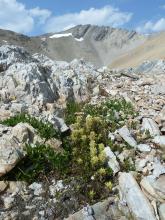
http://nargs.org/smf/index.php?topic=1153.msg19486#msg19486.
Cliff Booker
Re: Image of the day - 2012
Tue, 08/28/2012 - 9:47amGlorious image, Lori ... can't wait to see more please.
Trond Hoy
Re: Image of the day - 2012
Tue, 08/28/2012 - 1:54pmYes agree, but I don't want any frost yet! The latest rhodo (R auriculatum) has just started flowering. The flowers are nicely perfumed :)
cohan (not verified)
Re: Image of the day - 2012
Tue, 08/28/2012 - 10:36pmIs that a Castilleja, Lori? Nice colour, there are a few here that colour, but of course, taller plants... Rocky Mtn House has had frost warnings several times already, but we haven't seen any yet, wont likely be long though!
Lori S. (not verified)
Re: Image of the day - 2012
Wed, 08/29/2012 - 11:43amYes, Castilleja. Interesting, I've only seen the orange-red flowered ones below the subalpine in this area (and further east in the parkland and boreal forest).
cohan (not verified)
Re: Image of the day - 2012
Thu, 08/30/2012 - 12:03amIt was suggested to me last year by a Castilleja guy from the U.S., on flickr, that these populations (there was someone else who'd photographed similar, I forget the spot now, but I'd say Sundre-ish) were likely hybrid populations, possibly between C miniata and -I forge- lutescens? which is interesting, since in my area there are only miniata and the 'hybrids' no other stands of another clear species; however, miniata is also supposed to have colour variations, and from palest salmon through scarlet are very common here, and creamy colours are not at all unusual. I'm not sure where the boundary of miniata ends and the 'hybrids' start, since the colours I mention above I've seen in a number of places, and then just the one colony I've shown before with the wild mixed bi/tri colour plants which I've shown here in the Castilleja thread(I'm sure its not the only colony, just the only one I've seen-- hundreds of miles of back roads and farmland, I just happen to have passed that site).
Here's the old thread, which I added some more images to just now, and a couple pics from there as a teaser...
http://nargs.org/smf/index.php?topic=592.msg19524#msg19524
There is another varied population close to me, but not as varied as that one, I'll try to add some pics of that later..
Just found an album of the second colony I mentioned, this one is right up the road from me...
https://picasaweb.google.com/111492944361897930115/July102011Castilleja
Trond Hoy
Re: Image of the day - 2012
Thu, 08/30/2012 - 1:10pmIt seems to be two or more pairs of genes controlling the production of red pigment in those plants.
cohan (not verified)
Re: Image of the day - 2012
Thu, 08/30/2012 - 4:00pmSomething interesting going on, though I don't know what it is :) There are a couple of yellow-ish flowered species that I have not seen in my area but by the map are not that far away, so miniata could have mixed with one of them..
I should point out that in some of the pics it may look like two differently coloured flowers- eg pale and orange- are on the same plant, they aren't, there are just a lot of plants growing very close at times..
Trond Hoy
Re: Image of the day - 2012
Sat, 09/01/2012 - 12:27pmLast week we visited a friend's garden. This lily was impressive! 2 m tall and 1m wide (started with one bulb some years ago). No name though.
cohan (not verified)
Re: Image of the day - 2012
Sat, 09/01/2012 - 12:40pmImpressive for sure! :o
A different kind of impressive- near the Athabasca Glacier, Columbia Icefields, swathes of Dryas, Arctostaphylos and Arctous..
Trond Hoy
Re: Image of the day - 2012
Sun, 09/02/2012 - 8:17amA magnificent view! It begs for a hike ;)
Lori S. (not verified)
Re: Image of the day - 2012
Sun, 09/02/2012 - 8:31amReally interesting to see the Castilleja in your area, Cohan. The leaves on some of the light coloured ones in your album look very distinctly different (broad and rounded)... I'm surprised that they would not be a different species?
Fabulous lily, Trond! With the continuing onslaught from lily beetles here (it seems they are able to get through at least 2 cycles, or at least were able to in this warm summer), I'm starting to consider getting rid of mine... not that I ever grew any so well as that anyway!
Great view, Cohan.
cohan (not verified)
Re: Image of the day - 2012
Sun, 09/02/2012 - 11:51amI really don't know more about the Castilleja, Lori, I was hoping for more input from the guy in the U.S., but he probably forgot and I haven't got around to pestering him..lol. There is a lot of variety in those populations, and I haven't actually tried to group other characters with flower colours. It doesn't seem the pale ones could be a distinct species, since they only occur (that I've seen) in these mixed populations. When I see scattered plants or small groups of plants, they tend to look like plain miniata. Perhaps, if they are hybrid, the leaf character goes along with flower (bract) colour.. checking now, miniata leaves are said to be 'narrowly lanceolate to ovate, 3-nerved, usually glabrous or sparingly pubescent, entire or sometimes shallowly 3-lobed above' lots of room for variation in that!
Looking now at C occidentalis, it seems a likely candidate in the hybrid- pale yellow bracts, often with purplish bases, as in my mixed plants; 'leaves linear to lanceolate, entire or sometimes with 1-2 linear lobes' . this species appears on the map farther to the west of me, but I have never seen a population of all yellow plants. It is said to intergrade with rhexifolia (also a range of colours including possible bi-colours, varying leaves and hairiness), which also intergrades with miniata and hispida!
Interestingly, Flora of Alberta says occidentalis' relationship to elegans (not described for Alberta) remains to be established- images on Google show some bi-coloured bracts also, though mostly they are much to red-violet for anything here..
Also interesting, hispida (rather scarce on the map, and farther southwest of me) shows quite a range of colours; bracts typically more cleft, but it is supposed to intergrade with rhexifolia which intergrades with miniata and occidentalis...
So I'm not really any farther ahead...lol While miniata is the only species clearly in my area according to the range maps, occidentalis, lutescens, hispida, rhexifolia and sessiliflora are all no farther away than other plants that I have definitely found... Of those, occidentalis and rhexifolia at least look like possibilities in the mix.. I guess next year I have to measure flower parts, and pay closer attention to amount/type of hairiness..
Trond Hoy
Re: Image of the day - 2012
Sun, 09/02/2012 - 1:22pmYou know, Cohan, the different forms could have had overlapping distributions earlier.
cohan (not verified)
Re: Image of the day - 2012
Sun, 09/02/2012 - 2:45pmYes, exactly- the distribution maps are only as complete as the groundwork- just in my small area there are roads every 2 miles north/south and 1 mile east/west and I've travelled many but not all of them around here, and find different things in many places, besides which its all private land, and no idea at all what grows away from the roadsides! I have no idea what botanising the maps are based on, no doubt pieced together from many different people's work. I've found a number of plants in my area not showing right here on the map, and the situation is changing over time: before european settlement, the natives burned the forest here to draw in grazing herds, obviously encouraging a flora suited to that pattern, later farmers and oil work create another patchwork of vegetation types, and it seems some plants follow the roadways in from the foothills and prairies in what would otherwise be mostly boreal forest..
All of which is a longwinded way of saying- other species could have been here before, and both species and hybrid populations are still on the move.. I'm pretty sure these hybrid plants are derived from other hybrid plants rather than directly from the parents, - I imagine the 2 or more species coming together in the foothills and their hybrid progeny spreading from there, but it's only speculation on my part..
Todd Boland
Re: Image of the day - 2012
Tue, 09/11/2012 - 5:52pmThat Lily is spectacular!
Todays image is a Rhododendron at our Botanical garden. It is an unregistered hybrid we called Frilled Ivory. Currently, the plant has nearly 30 trusses open! Almost as many as it did last May. Bizarre!
Richard T. Rodich
Re: Image of the day - 2012
Tue, 09/11/2012 - 7:14pmSo Frilled Ivory saves some flower buds for spring bloom, or is it just weird this year?
Anne Spiegel
Re: Image of the day - 2012
Wed, 09/12/2012 - 4:19amEverything seems to be weird this year. Any number of plants have been blooming at the wrong time. Do you think this will spoil the spring bloom on the rhododendron, Todd?
Anne Spiegel
Re: Image of the day - 2012
Wed, 09/12/2012 - 4:21amBlooming now and label gone. Can anyone i.d. this for me?
Panayoti Kelaidis
Re: Image of the day - 2012
Wed, 09/12/2012 - 5:07amThis is the compact form of Succisa pratensis, Ann--a cousin to the Scabiosas from Europe and naturalized in Canada. I have grown this dwarf form which is delightful (and lost it--do save seed!)...
Check Richard's: http://www.alpinegardensociety.net/diaries/Northumberland/+August+/122/
Regular Succisa pratensis is much larger.
Anne Spiegel
Re: Image of the day - 2012
Wed, 09/12/2012 - 6:52amThanks, Panayoti. Would you like some seed?
Todd Boland
Re: Image of the day - 2012
Wed, 09/12/2012 - 3:06pmFrilled Ivory still has tight buds so it will still have a decent spring display. last year it produced one out of season bloom but this year, nearly 30 trusses is outrageous!
cohan (not verified)
Re: Image of the day - 2012
Mon, 09/17/2012 - 11:37amYesterday, just out back of the house, only a few feet from the mowed zone.. fall colour on Epilobium angustifolium
cohan (not verified)
Re: Image of the day - 2012
Tue, 09/18/2012 - 11:22amThis shot was in full shade, so not very exciting lighting, but a nice combination of plants for early fall--
Maianthemum stellatum, Symphoricarpos albus, Petasites palmatus behind, which will turn its own subtle colours; Cornus canadensis and Pyrola asarifolia behind.. this is in the woods behind my house..
Tim Ingram (not verified)
Re: Image of the day - 2012
Tue, 09/18/2012 - 1:14pmNice vignette of foliage just spiced up by those two berries! Autumn is a great time to catch pictures like this if you are lucky enough to find them. We are surrounded by housing and fields with little natural vegetation so it must be nice to walk out of your back door and find plants like this.
Howey (not verified)
Re: Image of the day - 2012
Sat, 09/22/2012 - 4:39amPrettiest flower today in the Western University greenhouse is something called Orthosiphon - a medicinal plant from South Asia. Did this from a cutting a couple of years ago. Fran
Frances Howey
London, Ontario, Canada
Zone 5b
Lori S. (not verified)
Re: Image of the day - 2012
Sat, 09/22/2012 - 9:46amLove the subtle colours, Cohan... and what a contrast with the exotic flower you are showing, Fran.
Here's some fall colour from along the Clearwater River in NE Alberta, east of Fort McMurray... Autumn has been very mild all over the province - we were told there has not even been frost up there yet! (The presence of a goodly number of blackflies seemed to support that!)
Here, we had our first frost in the third week of August - on the roofs only, not on the ground - followed by a frost hard enough to kill tender annuals in the second week of September.
Pages