
Moderator note:
With a new year comes a new thread! Here is the first post in "Image of the Day - 2012", which continues on from:
http://nargs.org/smf/index.php?topic=24.1560
Edit by Lori
Nothing in flower here either but with each day a second or two longer now, here are some mountain scenes and some local alpines to make us yearn for spring! Happy New Year, all!
Lovely pics Lori
Lori, your pictures always make me feel guilty - guilty of sitting lazy in the sofa instead of getting out there where the diamonds are to be found ;)
I know how you feel Hoy ...well sort of :) Here i'm stuck finishing off a job for a client spraying with a knapsack around 5000 newly planted natives ,all the while i'm itching to get back up into the hills --anyway regardless of the work situation i've decided i'm away botanizing next weekend.
Here's a wee beauty-- Brodiaea terrestris with thick looking almost succulent like petals .Enjoying the dry warm conditions of the last 3 weeks .
Cheers Dave.
Comments
Todd Boland
Re: Image of the day - 2012
Tue, 02/14/2012 - 4:23pmAnd I wonder why western alpines don't do it Newfoundland! Ours are currently encased in ice....had 65mm of rain two days ago so the remaining 1-2 feet of snow is pure ice. On the plus side, my crevice garden seems to be in a wind zone where no snow gathers so they are completely snow and ice free. I might just have the right place for drylanders!
cohan (not verified)
Re: Image of the day - 2012
Tue, 02/14/2012 - 5:35pmTodd, when I lived in Toronto, I used to explain the difference in winter (in part) this way- in Alberta, cold and wet are two completely different seasons! (not always exactly true in fall, but as a general rule..) I'm not as dry as Lori is here, either.. for some things I think need to be drier I am also trying to build more sharply sloped beds for wetter periods; time will tell how well I succeed!
Trond Hoy
Re: Image of the day - 2012
Fri, 02/17/2012 - 2:52amHere cold (or cool - we never have a proper winter as the monthly mean temperature never drops below 0C) and wet always are the same season. In fact we have a long (half year) spring and then a long fall. No real summer and no real winter.
Our summes are far to cold for many species and our winters are to mild and wet for others :-(
cohan (not verified)
Re: Image of the day - 2012
Fri, 02/17/2012 - 7:12amAh, but Trond- there must be many species well suited to the year round moderation? NZ alpines? things from wetter parts of southern South America? alpine South Africa, and of course many Asian things?
Richard T. Rodich
Re: Image of the day - 2012
Fri, 02/17/2012 - 6:00pmI was thinking more of the North American west coast natives in Oregon, Washington and British Columbia....
cohan (not verified)
Re: Image of the day - 2012
Fri, 02/17/2012 - 11:24pmThose too of course ;D
Trond Hoy
Re: Image of the day - 2012
Sat, 02/18/2012 - 12:26amYea, of course! But many of those species have been hard to come by - the nurseries here in west have the same plants as the nurseries in continental east have. NZ plants are almost not to find at all. It is also more difficult to import from abroad as we are not a member of EU. Seeds are the only practical option.
Plants from these areas have not been more available than NZ ones, you know. The big garden centers all have the same - and most people go for roses and other common, big-flowered shrubs and perennials. Although it is many gardens in Norway it is rather few with a more specialised interest. Only the last few years some more interesting often one-man enterprises of online providers of special plants have popped up.
Todd Boland
Re: Image of the day - 2012
Sat, 02/18/2012 - 3:35amTrond, I feel your pain in regards to the rather limited number of alpines we can successfully grow compared to many other parts of the Northern hemisphere. I can get access to some interesting alpines, but they often do not make it here. I have a plan though. My crevice garden is small enough that I could place a sheet of plywood over it in winter, keeping the plants dry beneath. I have inverted pots over some plants in the past and it worked great for protecting the fuzzies. Why not do it on a larger scale! (yes, I'm desperate to grow westerners and Turkish delights!)
Cliff Booker
Re: Image of the day - 2012
Sat, 02/18/2012 - 7:38amTodd,
Why restrict light? Would you have access to large double glazed units that are being replaced by local householders? These could be incorporated into a simple timber frame stretched over your beds thereby giving light, insulation and protection from rain and snow. The units are also weighty enough not to be lifted across your garden by gale force winds. Many householders are quite happy to dispose of intact old units as they aren't easy to recycle.
Also try local manufacturers, they often have incorrectly measured or scratched units to dispose of.
Trond Hoy
Re: Image of the day - 2012
Sat, 02/18/2012 - 1:56pmYes, Todd, I have an idea where and how to build a place for alpines craving drier conditions. However I have to complete some other projects first ;)
I built my greenhouse of used double glassed very big and heavy windows! A huge job but fortunately I had the neighbor's son (a champion weightlifter at that time ;D ) to help me carry them!
cohan (not verified)
Re: Image of the day - 2012
Sat, 02/18/2012 - 5:16pmI know what you mean about plant availability, Trond-- there are a couple of good mail order alpine places in Canada- but you have to have enough money at once to make an order- as opposed to stopping by a nursery or garden centre and buying a plant or two--and they are not all that exciting around here anyway- a couple have a fairly large number of plants, but tending more to hybrids than species, and grown in warmer places, so you don't even know if they are hardy or not.. I can find a few interesting things by chance locally -but more things for the perennial beds than rock gardens, the rock garden plants available are mostly common or hybrid ones-- so for the really cool plants, its all from seed also- but there is a lot of that around internationally!
Its even more true for my other plant interests- various tender things grown indoors- cacti, succulents, SA bulbs- almost nothing available in Canada (outside private trade and small vendors at clubs in big cities) except unnamed mass market stuff, so its seed there too-- and worst of all is my so far mostly theoretical interest in small cool tropical plants- completely unavailable in Canada, and no seed available internationally even! Vendors exist in U.S. which either just do not ship to Canada, or you need to spend hundreds of dollars to order anything...
Mark McDonough
Re: Image of the day - 2012
Sun, 02/19/2012 - 5:50amWith our unusually mild sunny and snowless winter, I expect we'll have a much earlier spring season this year, unless we finally get whacked by some real winter weather. In one of my troughs, the buds on an unnamed draba are already starting to swell, as are Townsendia rothrockii buds. Checking photographs from spring 2011, here's my Draba species flowering on 04-09-2011, with the winter reddened foliage of Penstemon breviculus in front of it. I bet the draba will be in bloom one full month earlier this year.
Lori S. (not verified)
Re: Image of the day - 2012
Sun, 02/19/2012 - 11:54amA nice sunny-looking Draba there, Mark. In this climate, where flowers in winter are an impossibility, it's hard to even imagine your unusual season!
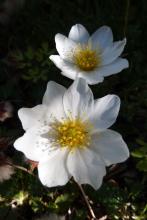
Here's a rock garden stalwart, Dryas octopetala:
cohan (not verified)
Re: Image of the day - 2012
Sun, 02/19/2012 - 12:18pmAgreed! We've been having an extraordinarily mild winter also, but there has still been snow on the ground since the beginning of November...lol
Love the Dryas.. I only have drummondii in the garden so far..
Lori S. (not verified)
Re: Image of the day - 2012
Mon, 02/20/2012 - 11:01amWhile it's fresh in my mind (from just having potted on a bunch of seedlings), here's Aubrieta canescens:
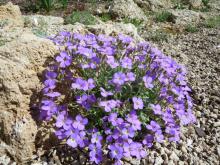
Seeds were collected by Pavelka at 2500m, Bolkar Dag, Turkey, from a habitat of limestone rocks. It was a great performer all summer last year!
For being such easy to grow plants, I find Aubrieta quite spectacular!
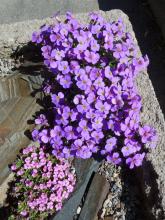
Here's Aubrieta deltoidea 'Blue Indigo', looking huge in contrast to the pink-flowered Dianthus myrtinervius ssp. caespitosus:
Anne Spiegel
Re: Image of the day - 2012
Mon, 02/20/2012 - 7:15pmLori, I saw the Aubrita canescens in Wisley's new crevice garden t\last April. It definitely made my "want" list. I especially liked the foliage.
cohan (not verified)
Re: Image of the day - 2012
Mon, 02/20/2012 - 11:00pmWe got something like 10-15cm of snow yesterday- one set in the morning (and or Sat night) then another batch in the evening, so we finally had to go out and do a full shovelling again (after which of course the neighbour came this morning with his bobcat and did more clearing...lol).. I took a few shots, but the heaviest snow had stopped already, still kind of fun... the flash on the new camera handles the snowflakes a bit differently- old camera made them look like stars, this one makes them look like moons!
cohan (not verified)
Re: Image of the day - 2012
Mon, 02/20/2012 - 11:19pmA few shots from today (Monday, that is, it's still 'today' until I go to bed!)
The cat doing his rounds, just ahead of him the driveway after the neighbour scraped it .....
Large and small wild spruce on the acreage...
Todd Boland
Re: Image of the day - 2012
Tue, 02/21/2012 - 10:41amLooks like you have almost as much snow as I do....yours is fluffy...mine is pretty much ice!
cohan (not verified)
Re: Image of the day - 2012
Tue, 02/21/2012 - 11:01amOur snow is only fluffy on top, then there is a crust, since we hadn't had much since early December, and while there was still snow in many places, the surface had melted and frozen many times.. luckily we very rarely get the amounts of snow in one event that you had in Newfoundland and elsewhere a while back-- a major snowfall for us would be 30cm over a couple of days, and that doesn't happen too often..
Richard T. Rodich
Re: Image of the day - 2012
Tue, 02/21/2012 - 1:29pmCohan, I kinda like the "celestial" shots. ;)
We just got 3-4 inches of wet stuff. Our winter has been very, very dry.
cohan (not verified)
Re: Image of the day - 2012
Wed, 02/22/2012 - 12:24amThanks, Rick- I have almost never used flash over the years, but have found this quite fun..
Our winter has not been as dry as many places in North America (mostly thanks to a lot of snow in November!) but not as much snow as last year.. we've still got months to go, though...
Friday, Saturday and Sunday call for snow, periods of snow and flurries, respectively... We are also heading for another cool down- after +6C/43F Tuesday, we have a forecast high of -12C/10F on Saturday...
Trond Hoy
Re: Image of the day - 2012
Wed, 02/22/2012 - 1:09amNot much snow here either (it is at our mountain cabin as the spring is underway at home). The snow that is is fluffy and don't carry even a mouse (a little exaggerated) lest a man with ski.
Fermi de Sousa
Re: Image of the day - 2012
Wed, 02/22/2012 - 2:23pmLikewise, Anne!
Lori, they look great in your rock garden,
cheers
fermi
Lori S. (not verified)
Re: Image of the day - 2012
Wed, 02/22/2012 - 10:21pmThanks, Fermi!
Some colours and textures provided by Sedum lanceolatum, Salix, lichen and rocks:
Steve Newall (not verified)
Re: Image of the day - 2012
Thu, 02/23/2012 - 12:09amWas out waddling about on The Catlins coastline yesterday and saw some of Mother Nature's topiary (using plants of Coprosma propinqua ) . The Catlins is an area on the SW corner of the South Island of NZ and it takes full advantage of the Roaring Forties . On land the plants take on a lean and near the beach big wave surfers turn up after big storms .
With a bit of imagination the first picture looks the bison , the second perhaps a troup of gorillas with the largest male in the lead and the third tried to grow tall but then it all went sideways
cohan (not verified)
Re: Image of the day - 2012
Thu, 02/23/2012 - 11:24amGreat views Lori and Jandals (is it Steve?)
Lori- is that the Sedum in the tight rosettes? I haven't seen the plant for years, and never at that stage..
Steve-- the natural bonsais are quite amazing! seems like they must be quite vigorous in order to get that much growth in spite of the obviously powerful wind..
Steve Newall (not verified)
Re: Image of the day - 2012
Thu, 02/23/2012 - 9:12pmYes , I'm Steve . Jandals is my nickname as I'm usually wearing jandals (flip-flops) and yes the Coprosma are strong growers . At this site they were the only shrubs capable of upward growth . Some of the steep ridges were at right-angles to the prevailing winds (SW and NE) so the shrubs one side of the ridge were leaning at 180 degrees to the shrubs on the other side , something like / \ .
Does Sedum lanceolatum flower for you Lori?
and does anyone recognise this Penstemon sp ? Picture taken in August Mosquito Pass CO 12500ft . Cheers
Lori S. (not verified)
Re: Image of the day - 2012
Thu, 02/23/2012 - 9:51pmCohan, yes, the tight rosettes are the Sedum lanceolatum.
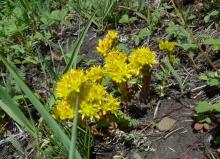
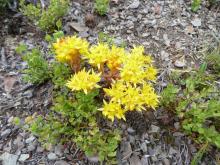
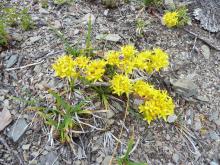
Steve, I don't actually grow Sedum lanceolatum - that picture is from the wild (the neighboring eastern slope Rockies where it's a common plant in the alpine-subalpine), where it does bloom well, as in these photos (also from the wild):
Steve, your penstemon looks like Penstemon whippleanus.
Trond Hoy
Re: Image of the day - 2012
Thu, 02/23/2012 - 11:49pmSteve, I am familiar with windy coastland but the shrubs here usually are quite flattened by the wind and not exotic plants like Coprosma apes ;)
An example is the common juniper (Juniperus communis):
Trond Hoy
Re: Image of the day - 2012
Fri, 02/24/2012 - 12:16amLori, although you say you don't grow this Sedum, I think it is a worthy rock garden plant! It reminds me of S reflexum which is wild but nevertheless I grow it at my summerhouse together with other sedums. (Sorry no pictures of reflexum - have to mend that). so here are some others instead:
Sedum album, Sedum spurium (red), Sedum spurium (white), Sedum
unknowngracile.Lori S. (not verified)
Re: Image of the day - 2012
Fri, 02/24/2012 - 6:47pmMore natural pruning by wind and cold... kruppelholz alpine firs:
cohan (not verified)
Re: Image of the day - 2012
Fri, 02/24/2012 - 11:34pmall nice Sedums, Trond; if I've seen a white spurium, I don't remember it... I have a pink one, and I may have seen yellow?
S lanceolatum (Lori can correct me if I'm wrong) is a much less ambitious plant than reflexum, forming just small clumps of not very tall stems, the few times I've seen it(long ago), just scattered plants much smaller than the ones Lori showed even... I really want to grow S lanceolatum, and have been hoping to find some wild seed, but have not run into the plant in recent years.. I've seen one Alberta vendor occasionally offering it as plants, but have not been able to make an order so far (they had some kind of minimum order); Alplains has offered it as seed, and if I don't find an Alberta source, I will go that route...
Steve Newall (not verified)
Re: Image of the day - 2012
Sat, 02/25/2012 - 1:11amThanks Lori
Trond-The locals call the Coprosma "Monkey Scrub" because when they grow in dense thickets the only through is over
Trond Hoy
Re: Image of the day - 2012
Sat, 02/25/2012 - 2:31pmMonkey Scrub! I've heard of Monkey Puzzle ;) (In fact it is some big ones down in the town ;D Maybe they should refurbish and plant some Monkey Scrubs :o)
S spurium comes in all colours from white through pink to red but not yellow. The yellow is probably S hybridum or some other yellow flowered species.
Todd Boland
Re: Image of the day - 2012
Sun, 02/26/2012 - 11:28amNewfoundland has its fair share of wind-stunted conifers too....we call them "tuckamore". Here is a stunted version of Picea glauca.
Lori S. (not verified)
Re: Image of the day - 2012
Sun, 02/26/2012 - 6:25pmIt's amazing to see white spruce so reduced in size!
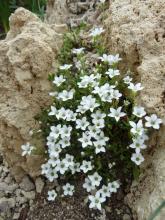
A nice one I grew from seed a couple of years ago - Minuartia erythrosepala. The seeds were from M. Pavelka, collected at Tahtali Dag, Turkey, from an area of limestone rocks; the seeds germinated in warm conditions in about 8 days.
Todd Boland
Re: Image of the day - 2012
Mon, 02/27/2012 - 7:39amI wish I could grow these Turkish lime-lovers...between the rain and acidic soil here, it is a lost cause. I really can't take advantage of Halda, Pavelka, et al. I need someone to collect and sell seeds from acid-wet zones of the Himalayas! I'm sure Trond would agree!
Trond Hoy
Re: Image of the day - 2012
Mon, 02/27/2012 - 12:24pmCertainly, Todd! Do we start a business? - or arrange our own trip someday? ;)
cohan (not verified)
Re: Image of the day - 2012
Tue, 02/28/2012 - 10:45amMaybe let some of the existing collectors know there is a demand for those seeds-- and they might pop over to the next valley!
cohan (not verified)
Re: Image of the day - 2012
Tue, 02/28/2012 - 11:04amA couple of nights ago, I was out around 1AM getting firewood (just in front of the house) and I could hear some snapping sounds not far away- but where the house light didn't reach.. I suspected some of the local wildlife was pruning our apple trees again, so I peered over that way, and could just make out a couple of large ears far above the ground- moose!
In spite of me being out, not more than 10 metres away (maybe less) it continued munching- so I shooed it away, but I didn't hear any sounds of it running off into the bush, and in fact by the time I had put my armload of wood into the fire, it was back at the apple tree, so I went back in for camera and flashlight.. I couldn't really see the animal, but could tell where it was by sound and flashlight glimpses, so I took some blind flash shots- from a distance only lighting up its eyes,
and using the slight zoom on my camera got a few shots.. it didn't take off (even after all the light and flashes!) until I went around the corner of a snow mound onto the part of the driveway it was standing on.. BTW, that snow its so casually standing in is knee deep or more, where its shovelled off the driveway..
Still didn't go far...
Then I took some more photos around the yard, and as I went around the other side of the house, heard another moose, and got a few shots of that one-- this one was no more shy and didn't leave till I chased it..
I suspect neither went far and came back when I'd gone inside.. probably no apples and not much for sour cherries this year again!
I'll put a couple of the other outdoor night shots in my Alberta thread later...
Todd Boland
Re: Image of the day - 2012
Tue, 02/28/2012 - 3:25pmWe have at least one resident moose at our BG.....he ate all the flowers off our Sorbus cashmeriana last year and coppiced most of our willow collection!
cohan (not verified)
Re: Image of the day - 2012
Tue, 02/28/2012 - 11:29pmSorbus seem to be a particular favourite here of moose/deer-- we have one- I forget if its the American or European, figured it out by fuzzy buds (or not) but already forgot.. anyway, it should be a good sized tree at its age, but it took several decades for it to manage to get some shoots tall enough to be out of browsing range, so it's more like a large multi-stemmed shrub with a tall cluster of stems in the middle... still gets pruned all around in reach (and moose can reach high!) then of course birds eat all the berries they second they are ripe-or just before- nothing has bothered the flowers though.. other Rosaceae like Amelanchier (and domestic Prunus and Malus) are also faves for browsing, as are Cornus.. C sericea is common wild here, and its very very rare to find a single unpruned stem of it in the yard or bush... small wonder many other native shrubs are thorny...
Anne Spiegel
Re: Image of the day - 2012
Wed, 02/29/2012 - 9:13amNo moose here, just too many deer. Snowing now and covering the few things I photographed. They are more than a month ahead.
Anne Spiegel
Re: Image of the day - 2012
Wed, 02/29/2012 - 9:16amForgot the crocus sp which has naturalized over many years and always blooms at the same time as the eranthis. Anyone know for sure wht this one is?
Richard T. Rodich
Re: Image of the day - 2012
Wed, 02/29/2012 - 9:32amIt's the European Mountain ash that has the fuzzy buds. The outer bud scales of the American species, at least the two in Minnesota (Ss. americana, decora), are smooth and often sticky. Inner bud scales are a bit hairy, but not fuzzy.
In late October, I've seen wild Mountain ash in central Minnesota and northern Minnesota, long after leaves have dropped. The glistening, almost translucent red berries look so scrumptious, but I have never seen any evidence of bird consumption. Perhaps they will come later in the winter.
I have no idea if this is true, but I recently read on another forum that bird brains are programmed to look for red berries in the early part of the season, and blue in the latter. Anyone ever heard of this? (Todd?)
Richard T. Rodich
Re: Image of the day - 2012
Wed, 02/29/2012 - 9:43amMy hellebores still aren't budging, despite the warm weather. Ann, how did you get the leaf stems to frame the flowers in the photo so perfectly? :D
Love the eranthis. Did you plant them all, or are they naturalizing?
All I have are the early pussywillows, but they are caked in ice now....
Trond Hoy
Re: Image of the day - 2012
Wed, 02/29/2012 - 11:55amLooks very similar to C tomassianus which I have and it blooms at the same time as eranthis here too. Here's a picture from last year. It is too cloudy here these days so the flowers do not open.
Trond Hoy
Re: Image of the day - 2012
Wed, 02/29/2012 - 12:06pmCan't believe all bird species are programmed like that - but some sound reasonable.
Here the birds take the white berries of Chinese mountain ash early in the season and blueberries (both American and European) as soon as or even before they ripen. Common mountain ash and relatives (whitebeam) are taken throughout the fall and so are the blue Aronia berries.
BTW I have some nice Sorbus species around here if anybody is interested in seed (have to wait though).
Anne Spiegel
Re: Image of the day - 2012
Wed, 02/29/2012 - 12:56pmThanks for the crocus i.d., Trond. I thought that was what it might be.
Rick, the eranthis has been naturalizing for a while now but some years I've helped it along. I dig up a small clump while in bloom and place it in the vicinity of the others. Now it's a large carpet that goes right over the front cliff (that part it did on its own!). The hellebore is growing in a raised bed and at this time of year I can walk around and choose the best photo op, which was what I did. Later on that wouldn't be possible. This has never bloomed here before early April. This winter has been a non-event depsite the fact that it's snowing at the moment.
Pages