Although I like to see Opuntias and photos in other people's gardens, I don't grow any myself. I like cactus, but prefer to shy away from those with "inescapable" glochids. The exception would be if I could find a tree form (ex: O. imbricata) cold hardy enough for me.
The reason I ask this question is that a lot of rock gardening people don't like to deal with the glochids. And I didn't want to bore the members since O. polyacantha has so many varieties and the distinctions between them, are very confusing.
Of all the cylindropuntias, C. imbricata is the hardiest, but in your climate it would be very marginal. I wish you luck in finding a clone that will grow in your area. The good thing is, it only takes a small branch cutting to get a start going.
I never met an opuntia I didn't like, but I transplanted all (or almost all) of my polyacanthas to the front yard next door, because they take up so much room and there was plenty of room next door (and my neighbor likes cactus). And because I have the habit of putting my hands on them when I'm weeding in my front yard. There aren't any forms of O. polyacantha that I know of that are as wicked as O. rufida, which fortunately proved not to be hardy in the place where I put it, though I recently got a dwarf form of O. basilaris that's nothing but glochids. It's staying in a pot outdoors this winter. Now, cylindropuntias, different story. There is a forest of them in the front yard. And a large collection in the back. I still manage to walk backwards into one every so often.
Bob It's good to hear that you like Opuntias. They do indeed like a bit of space if allowed to do their thing unchecked. I trim all my patches to keep them within bounds and out of the paths. That usually means I have plenty of pads to share. O. polyacantha has a very wide distribution across central and western North America with several varieties recognized. There are a lot of unrecognized local forms with names that are not considered valid or in dispute at this time. In general O. polyacantha is a highly adaptable species across it's range and hybridizes readily with several other Opuntia species. Due to it's genetic flexability, there is a wide range of physical characteristics within the complex. The differant forms grow as low spreading mounds. Flower colors are normally in a range of intensities, in the colors pink or yellow. Spine counts, color, thickness, length and density vary widely across it's range. The fruits are always dry when ripe.
I started growing O. polyacantha about thirty years ago with plants collected from The northern Great Plains. The variety found there is Opuntia polyacantha var. polyacantha. This is one of the hardiest cacti found in North America and can handle frigid winter temperatures. As you will see from the photos there is a range of yellow to cream colors displayed by the clones I grow. The red stamen filaments setting off the green stigma and medium length spines seem to be consistant in this Great Plains native.
This clone was collected in the Badlands of South Dakota.
This one from Emmons county North Dakota.
This one is a selection that has been given the name 'Crystal Tide'
And here is an over view of the general appearance of this variety.
A Prickly Pear was the very first plant I started growing as a boy. I got a pad from someone (have forgotten who) and it eventually grew to 2m in a pot at home. I still have a piece of it but a more mangable size. I dream of trying some in the garden but I think it is too wet here in winter :-\ Your plants are beautiful, John ;)
When I visited Galapagos I remember well the tall Opuntia trees there. A very special forest. Sorry, no pictures as all are on slides but it looked like this:
This species is more tolerant of winter moisture than most. It shrivels, losing half it's volume, as the days grow short in the fall, preparing for winter. In the winter, at freeze up, it is dormant and not affected by the frozen moisture. I have seen this variety survive many windy -20f > spells with just a light blanket of snow. I think being inbedded in ice for long periods causes the most damage but even then I have never lost the whole plant. I don't know if it would bloom well for you, it likes some late spring heat to flower well.
When I visited Galapagos I remember well the tall Opuntia trees there. A very special forest. Sorry, no pictures as all are on slides but it looked like this:
Holy Cow! I never imagined they could grow like that! :o I just planted my first O. humfusa this year in a new & very small rock garden. Hopefully it will bloom at some point. I am always amazed at the way the pads shrivel up and droop to the ground in winter, looking like they are dead. But come spring..up they pop! So cool!!
...I think being inbedded in ice for long periods causes the most damage...
That is interesting. One year, during a brief January thaw, the area where I had stored my potted Coryphantha (Escobaria) vivipara became a "lake" (unbeknownst to me). It then froze for the remainder of the winter, and the entire pots and plants were encased in solid ice. I could hardly believe my eyes when normal growth and flowering commenced the following spring and summer.
--------------
Trond, those Galapagos Opuntia trunks are massive!!!
Thought I'd post a couple of shots of pink flowered O. polyacantha variety polyacantha. These two plants were collected in Wyoming. Note the longer spines on these clones it is not uncomon to see the spine length increase, the further south you go in their range.
The first photo shows the longer spine. This clone blooms a magenta pink color and was collected in Cheyenne, Wyoming.
This plant was collected near Medicine Bow, Wyoming.
Trond I do not save the seed. I would if I knew people wanted them. They can be hard to germinate.
Here is information about germinating them from Dr Deno's "Seed Germination: Theory and Practice"
Opuntia (Cactaceae). Seeds are in a fruit and were WC.for 7 d. 0. tuna germ 70D GA-3(5/40 in 8th w) and 70D(none), but the seedlings quickly rotted.Extensive experiments on 0. phaecantha have failed to give a single germination although this species self sows here. It is significant that seedlings appear years afterthe plants-have been removed. Some germination was obtained immediately at 70 for 0: aurea,. humifusa, imbricata, leptocaulis, phaecantha, polycantha, rhodanthe, and rutila, but these were qualitative experiments performed twenty years ago. It has been reported that cactus have impervious seed coats. Extensive experiments on 0. phaecantha showed that at least for this species impervious seed coats are not the problem. Some sources on germinating them say that four-five year old seed, germinate at a higher percentage rate than fresh seed. Every year I send pads to cactus gardeners around the country as trade items. That is how I have collected the plants I grow.
This next group of O. polyacantha clones are from an unrecognized variety. Variety rhodantha falls under the umbrella of variety polyacantha, since it has never been validated by a published botanical paper. Dave Ferguson, Curator of the Rio Grande Botanical Garden, Albuquerque, MN, has communicated to me, that he believes, it would have a good chance of attaining varietal standing if such a paper were published. These unrecognized 'rhodantha' clones tend to have thicker pads, with heavy, stout spines than are found in other O. polyocantha varieties. They are found in the areas of the Colorado River drainage of Utah, north into southern Idaho. Dave noted that, in Utah, the closer a clone grows to the Colorado river the more oval and elongated the pads become. I am assuming, this gradual change in pad shape would be a sign of genetic specification rather than environmental influences. This trait can be seen in the last photo of this post.
This clone is from southern Idaho.
This is also an Idaho clone. The flower color is unique, it is a translucent pink with lime green mid ribs.
This clone is from Utah and shows the elongated pads found along the Colorado river area.
Opuntia polyacantha is very easy from seed. I sow them in late fall inside the unheated greenhouse. Now and then during winter I put snow on the pots. It melts and feezes. I have good germination in early May - june. Allways use mineral soil and no plastik cover. As much sun as the grown up plants but that particular thing may be different for you people down south. Remember that most opuntioids are very thirsty but dislikes standing air and organic soil.
Martin I will give it a try, yet again. I just do not have any luck germinating them. I use the vernalization method and sow them in the fall on a mineral substrait. We get freeze thaw cycles almost every day in the winter. I would expect the dormancy of the seed to break at some point but have not hit the right combination. I guess. :-\
How deep are you sowing the seed? I cover the ones, I've tried, about three times the thickness of the seed. I assume you do not nick the seed coating either.
I dont do anything with the seed no. I alway cover the seed in the same depth and the thicknes of the seed. So that would be one time and not 3. Btw,you have some stunning plants!
Here we have variety hystricina. Opuntia polyacantha var. hysticina is found in southern Utah, south eastern Nevada, and the northern portions of Arizona and New Mexico. It is a cactus of the southern Colorado river drainage. In General the pads are elongated ovals densly covered with stout long spines. The spines on the upper third of the pads ascending with the lower spines descending. The spines can be varied in color usually white, bronze, or even black. Flower colors can be yellow through pink. I have only seen pink flowered clones.
These are from the variety erinacea. Opuntia polyacantha var. erinacea is found across the Southern Great Basin, Mohave and upper Sonoran Deserts of NV, CA, UT, and AZ. In general the spines of this variety are long, thin, flexable, dense and white/gray. On older pads they can be up to six inches long, wavy, and flowing almost obscuring the pads. On younger pads they tend to point strait outward from the plain of the pads. Flowers as in all polyacantha are pink or yellow.
Not a polyacantha, of course, but I noticed some comments on opuntias from seed. They seed around here with abandon, more or less. (Funny, the most prolific seeder I've found is Pediocactus knowltonii.) This summer I was weeding around the group of Cyl. imbricata, both the purple form and the white, and found several of these. (It was growing upright but fell over some time and started growing upright again, as you can see.)
Bob Always cool to find babies in the garden. I have a friend who grew Opuntias for years and let the fruits fall were they may. Well he hasn't raised Opuntias for six years now but a few sprout every year, even in the cracks of the sidewalk in front of his house.
Depends on how you find them. I usually find them by putting my hands on them, since I think there's nothing there. Like acantholimons. The plant people say doesn't seed around. It does.
Named Hybrids and selections abound. Here is a small parade of a few that have flowered for me.
Opuntia polyacantha Claude Barr hybrid I do not know the original name of this one. It has been passed from gardener to gardener to gardener etc.... for years and came to me unnamed. It looks like a possible hybrid with O. aurea. If anyone knows the name I'd like to know.
'Utah Sunset'
'Taylor's Red'
'Snow Ball'
One of the better purple padded ones 'Purple Desert'
Nice. I got one called 'Dark Knight', with purple pads, and went out to look for it, to take its picture, all shriveled up, but I couldn't find it. Maybe it's next door. Weeding around, and in, them is no fun. One reason why I moved most of the tunas next door. Huge-spined forms of Opuntia macrorhiza, etc. You really need a big wide-open space to grow the tuna types, like Kelly has at Timberline, in his display garden. Next door, they're growing in blue grama. There's a funny story about 'Crystal Tide' and the Grapeseed sisters (who I think originally had the plant), but I can't tell it right. Maybe there's someone, somewhere, who can.
Bob Aaron and I are friends with LaMar Orton the owner of Plantasia Cactus Gardens, located in Twin Falls Idaho. Here is a link to pictures he has posted on his web sight of his display garden. http://plantasiacactusgardens.com/Pictures_of_our_garden.php
Aaron Yours are great too, especially the second photo. That is one big patch!! :o
I like the red one at the end too!! It got a name attached to it?
Looks like some more trades may be in order. ;)
Thanks. :)
The red one at the end my mother-n-law got off the road someplace in Arizona. They winter in Yuma, so it must have came from western AZ? They thought it was so pretty they broke a pad off. :rolleyes: :D
You can have anything I can dig up and send off, hell I owe ya my first born. :D
Hey here is a hybrid penstemon pics I found in my pics. I wish I would have got some seeds off it.
Aaron Nice Pent. You can take stem cuttings off Pents. If you want to know how, check out the American Penstemon Societies web sight. http://apsdev.org/propagation/index.html
Bob Aaron and I are friends with LaMar Orton the owner of Plantasia Cactus Gardens, located in Twin Falls Idaho. Here is a link to pictures he has posted on his web sight of his display garden.
Very cool. Lots of maintenance, I see. (I tried to find someone to help me in the garden, but to no avail.) I mostly like chollas and echinocereus, because the free space in my garden is shrinking rapidly. They do well in containers, though.
Aaron Nice Pent. You can take stem cuttings off Pents. If you want to know how, check out the American Penstemon Societies web sight. http://apsdev.org/propagation/index.html
More exiting plants, Aaron and John! I am starting to think I ought to build a glasshouse to be ready to my coming collection of hardy Opuntias! ..that is when I get some spare time..... I have tried hardy Opuntias (can't recall the names though) three times but they never shrivel even in late fall and end up as a mess in a year or two. Too wet autumns and winters.
have tried hardy Opuntias (can't recall the names though) tree times but they never shrivel even in late fall and end up as a mess in a year or two. wrote:
Always a bad sign. I find it interesting that plants from cold climates, where the onset of cold weather is later than here, often enter dormancy later, and can be damaged or killed by cold, even though at their peak of dormancy they would endure the same cold temperatures. And that you can see this process in the garden. The native Cylindropuntia imbricata has already lost its moisture and is ready for anything, but plants from lower latitudes, like C. spinosior (which seems to be getting quite tired of me and my garden) are not.
I find it interesting that plants from cold climates, where the onset of cold weather is later than here, often enter dormancy later, and can be damaged or killed by cold, even though at their peak of dormancy they would endure the same cold temperatures. And that you can see this process in the garden. The native Cylindropuntia imbricata has already lost its moisture and is ready for anything, but plants from lower latitudes, like C. spinosior (which seems to be getting quite tired of me and my garden) are not.
It must be due to a physiological reaction to the length of day more than to the onset of cold weather.
Don't they use the term "photoperiodism" to discribe this type of reaction to changing length of day? Or is there a better term to use?
It must be due to a physiological reaction to the length of day more than to the onset of cold weather.
Predictive dormancy is used by plants (generally) adapted to the local climate to enter the dormant period, and this is usually based on day length. Technically, it's based on night length, but nobody ever goes around saying "night length". Consequential dormancy is another strategy, when a plant is triggered into dormancy by a cold snap, or by cold experienced prior to the time it would ordinarily undergo predictive dormancy. So you can have two plants of the same species that are equally cold hardy, but the one from North Dakota will go dormant before the one from southern New Mexico. In fact you can see this happen. Both the catalpa down the street and the desert willow in my front yard start losing their leaves at the same time, but the chitalpa next door gets its leaves frozen. So do desert willows from places like Arizona. (There are about 8 of them here, from all over the southwest.) My desert willow is from a famous plant south of Santa Fe, has endured everything Denver's weather can throw at it for over 20 years, but the chitalpa's desert willow half is apparently from a more southerly accession and doesn't go into dormancy as early. (Tashkent, where the chitalpa was bred, is not particularly cold, so they would have had no reason to look for a specially cold-hardy form of desert willow.)
Predictive dormancy is used by plants (generally) adapted to the local climate to enter the dormant period, and this is usually based on day length. Technically, it's based on night length, but nobody ever goes around saying "night length". Consequential dormancy is another strategy, when a plant is triggered into dormancy by a cold snap, or by cold experienced prior to the time it would ordinarily undergo predictive dormancy. So you can have two plants of the same species that are equally cold hardy, but the one from North Dakota will go dormant before the one from southern New Mexico. In fact you can see this happen. Both the catalpa down the street and the desert willow in my front yard start losing their leaves at the same time, but the chitalpa next door gets its leaves frozen. So do desert willows from places like Arizona. (There are about 8 of them here, from all over the southwest.) My desert willow is from a famous plant south of Santa Fe, has endured everything Denver's weather can throw at it for over 20 years, but the chitalpa's desert willow half is apparently from a more southerly accession and doesn't go into dormancy as early. (Tashkent, where the chitalpa was bred, is not particularly cold, so they would have had no reason to look for a specially cold-hardy form of desert willow.)
Bob
I have seen this happen in my garden with Opuntias collected in North Dakota as compared to those collected in Arizona. It doesn't matter to the North Dakota plants, if it is 80f and damp or 40f and dry, every year they will go dormant and shrivel right on cue.
I have seen this happen in my garden with Opuntias collected in North Dakota as compared to those collected in Arizona. It doesn't matter to the North Dakota plants, if it is 80f and damp or 40f and dry, every year they will go dormant and shrivel right on cue.
Yep. And for some cactus, the gymnocalcyium with the tissue damage for example, if it had had time to lose enough moisture before getting its rear end (literally, that was the back side of the cactus) frozen, it might have made it through much colder temperatures later on. This happened with an enormous Agave havardiana x scabra cross that I had planted in the front garden to startle visitors during the 2002 NARGS tours. A 70 degree drop in temperature in November turned the thing to complete mush within a day. (Scabra isn't really hardy here but I thought I'd give it another try.)
I finally got 'Claude Arno' last summer, at the DBG plant sale, after looking for it for years. 'Claude Arno' was the reason why Mary Ann called me all those years ago, she was looking for it too, having been friends with Barr .....
The trouble with opuntias, and it is big trouble, is the Cactus-Sucking Bug. I'm sure it has real name, but they attack pads and puncture them and then you have all these light green circles all over your cactus pads. Dr. Bronner's takes care of them, but I decided it wasn't worth the trouble. At least we don't have the giant cactus beetle here.
Chelinidea vittiger aequoris is the one a friend was plagued with a few years ago. He said he had not noticed them until he saw the nymphs scury for cover one day on a stroll through his garden. It didn't take long to get rid of them but he had to treat the whole garden to do it.
Here are some links to information on the "little offenders". They even have mugshots. >:(
Of all the cylindropuntias, C. imbricata is the hardiest, but in your climate it would be very marginal. I wish you luck in finding a clone that will grow in your area. The good thing is, it only takes a small branch cutting to get a start going.
I've heard that C. davisii is one of the cold hardiest of all the chollas. I know of one in a Massachusetts garden that grows well without a mark on it, so it can handle some moisture too. C. whipplei is very hardy too though the hardier forms tend to stay lower and spread.
Named Hybrids and selections abound. Here is a small parade of a few that have flowered for me.
Opuntia polyacantha Claude Barr hybrid I do not know the original name of this one. It has been passed from gardener to gardener to gardener etc.... for years and came to me unnamed. It looks like a possible hybrid with O. aurea. If anyone knows the name I'd like to know.
[attachthumb=1]
You gave me two pads of this one John and I would say it is very likely a polyacantha x aurea hybrid or possibly even polyacantha x pinkavae. Its doing ok here so far.

Comments
Richard T. Rodich
Re: Anyone have an interest in O. polyacatha?
Mon, 11/21/2011 - 4:26pmAlthough I like to see Opuntias and photos in other people's gardens, I don't grow any myself. I like cactus, but prefer to shy away from those with "inescapable" glochids. The exception would be if I could find a tree form (ex: O. imbricata) cold hardy enough for me.
John P. Weiser
Re: Anyone have an interest in O. polyacatha?
Mon, 11/21/2011 - 5:34pmThe reason I ask this question is that a lot of rock gardening people don't like to deal with the glochids.
And I didn't want to bore the members since O. polyacantha has so many varieties and the distinctions between them, are very confusing.
Of all the cylindropuntias, C. imbricata is the hardiest, but in your climate it would be very marginal. I wish you luck in finding a clone that will grow in your area. The good thing is, it only takes a small branch cutting to get a start going.
Robert Nold
Re: Anyone have an interest in O. polyacatha?
Mon, 11/21/2011 - 6:03pmI never met an opuntia I didn't like, but I transplanted all (or almost all) of my polyacanthas to the front yard next door, because they take up so much room and there was plenty of room next door (and my neighbor likes cactus). And because I have the habit of putting my hands on them when I'm weeding in my front yard.
There aren't any forms of O. polyacantha that I know of that are as wicked as O. rufida, which fortunately proved not to be hardy in the place where I put it, though I recently got a dwarf form of O. basilaris that's nothing but glochids. It's staying in a pot outdoors this winter.
Now, cylindropuntias, different story. There is a forest of them in the front yard. And a large collection in the back. I still manage to walk backwards into one every so often.
Bob
John P. Weiser
Re: Anyone have an interest in O. polyacatha?
Tue, 11/22/2011 - 11:23amBob
It's good to hear that you like Opuntias. They do indeed like a bit of space if allowed to do their thing unchecked. I trim all my patches to keep them within bounds and out of the paths. That usually means I have plenty of pads to share.
O. polyacantha has a very wide distribution across central and western North America with several varieties recognized. There are a lot of unrecognized local forms with names that are not considered valid or in dispute at this time.
In general O. polyacantha is a highly adaptable species across it's range and hybridizes readily with several other Opuntia species. Due to it's genetic flexability, there is a wide range of physical characteristics within the complex. The differant forms grow as low spreading mounds. Flower colors are normally in a range of intensities, in the colors pink or yellow. Spine counts, color, thickness, length and density vary widely across it's range. The fruits are always dry when ripe.
I started growing O. polyacantha about thirty years ago with plants collected from The northern Great Plains.
The variety found there is Opuntia polyacantha var. polyacantha. This is one of the hardiest cacti found in North America and can handle frigid winter temperatures.
As you will see from the photos there is a range of yellow to cream colors displayed by the clones I grow. The red stamen filaments setting off the green stigma and medium length spines seem to be consistant in this Great Plains native.
This clone was collected in the Badlands of South Dakota.
This one from Emmons county North Dakota.
This one is a selection that has been given the name 'Crystal Tide'
And here is an over view of the general appearance of this variety.
Trond Hoy
Re: Anyone have an interest in O. polyacatha?
Tue, 11/22/2011 - 12:05pmA Prickly Pear was the very first plant I started growing as a boy. I got a pad from someone (have forgotten who) and it eventually grew to 2m in a pot at home. I still have a piece of it but a more mangable size.
I dream of trying some in the garden but I think it is too wet here in winter :-\ Your plants are beautiful, John ;)
When I visited Galapagos I remember well the tall Opuntia trees there. A very special forest. Sorry, no pictures as all are on slides but it looked like this:
http://www.mountainsoftravelphotos.com/Galapagos%20Islands/Day%202/slide...
John P. Weiser
Re: Anyone have an interest in O. polyacatha?
Tue, 11/22/2011 - 1:53pmThis species is more tolerant of winter moisture than most. It shrivels, losing half it's volume, as the days grow short in the fall, preparing for winter. In the winter, at freeze up, it is dormant and not affected by the frozen moisture. I have seen this variety survive many windy -20f > spells with just a light blanket of snow. I think being inbedded in ice for long periods causes the most damage but even then I have never lost the whole plant. I don't know if it would bloom well for you, it likes some late spring heat to flower well.
Amy Olmsted
Re: Anyone have an interest in O. polyacatha?
Tue, 11/22/2011 - 2:20pmHoly Cow! I never imagined they could grow like that! :o
I just planted my first O. humfusa this year in a new & very small rock garden. Hopefully it will bloom at some point. I am always amazed at the way the pads shrivel up and droop to the ground in winter, looking like they are dead. But come spring..up they pop! So cool!!
Richard T. Rodich
Re: Anyone have an interest in O. polyacatha?
Tue, 11/22/2011 - 9:19pmThat is interesting. One year, during a brief January thaw, the area where I had stored my potted Coryphantha (Escobaria) vivipara became a "lake" (unbeknownst to me). It then froze for the remainder of the winter, and the entire pots and plants were encased in solid ice. I could hardly believe my eyes when normal growth and flowering commenced the following spring and summer.
--------------
Trond, those Galapagos Opuntia trunks are massive!!!
DesertZone (not verified)
Re: Anyone have an interest in O. polyacatha?
Tue, 11/22/2011 - 9:38pmI love them, but I try and stay away from them because they are not good for the reptiles in my garden. My lizards run into the spines. :-\
John P. Weiser
Re: Anyone have an interest in O. polyacatha?
Wed, 11/23/2011 - 6:11amI would have been rubbing my eyes in disbelief also. Luck was on your side. :)
I wish they would live in my yard. I'm just too far from the edge of town.
John P. Weiser
Re: Anyone have an interest in O. polyacatha?
Wed, 11/23/2011 - 1:33pmThought I'd post a couple of shots of pink flowered O. polyacantha variety polyacantha. These two plants were collected in Wyoming. Note the longer spines on these clones it is not uncomon to see the spine length increase, the further south you go in their range.
The first photo shows the longer spine. This clone blooms a magenta pink color and was collected in Cheyenne, Wyoming.
This plant was collected near Medicine Bow, Wyoming.
DesertZone (not verified)
Re: Anyone have an interest in O. polyacatha?
Wed, 11/23/2011 - 5:17pmThat has some good color. 8)
Trond Hoy
Re: Anyone have an interest in O. polyacatha?
Thu, 11/24/2011 - 4:04amJohn, does any of your O. polyacantha set seed? - and do you sell ;)
John P. Weiser
Re: Anyone have an interest in O. polyacatha?
Thu, 11/24/2011 - 9:34amTrond
I do not save the seed. I would if I knew people wanted them.
They can be hard to germinate.
Here is information about germinating them from Dr Deno's "Seed Germination: Theory and Practice"
Opuntia (Cactaceae). Seeds are in a fruit and were WC.for 7 d. 0. tuna germ 70D GA-3(5/40 in 8th w) and 70D(none), but the seedlings quickly rotted.Extensive experiments on 0. phaecantha have failed to give a single germination although this species self sows here. It is significant that seedlings appear years afterthe plants-have been removed. Some germination was obtained immediately at 70 for 0: aurea,. humifusa, imbricata, leptocaulis, phaecantha, polycantha, rhodanthe, and rutila, but these were qualitative experiments performed twenty years ago. It has been reported that cactus have impervious seed coats. Extensive experiments on 0. phaecantha showed that at least for this species impervious seed coats are not the problem.
Some sources on germinating them say that four-five year old seed, germinate at a higher percentage rate than fresh seed.
Every year I send pads to cactus gardeners around the country as trade items. That is how I have collected the plants I grow.
Trond Hoy
Re: Anyone have an interest in O. polyacatha?
Thu, 11/24/2011 - 11:41amProbably it had been too risky to send pads to Norway ;D
But if you once take the trouble saving seed I would like to try some!
John P. Weiser
Re: Anyone have an interest in O. polyacatha?
Thu, 11/24/2011 - 2:28pmThis next group of O. polyacantha clones are from an unrecognized variety. Variety rhodantha falls under the umbrella of variety polyacantha, since it has never been validated by a published botanical paper. Dave Ferguson, Curator of the Rio Grande Botanical Garden, Albuquerque, MN, has communicated to me, that he believes, it would have a good chance of attaining varietal standing if such a paper were published.
These unrecognized 'rhodantha' clones tend to have thicker pads, with heavy, stout spines than are found in other O. polyocantha varieties. They are found in the areas of the Colorado River drainage of Utah, north into southern Idaho. Dave noted that, in Utah, the closer a clone grows to the Colorado river the more oval and elongated the pads become. I am assuming, this gradual change in pad shape would be a sign of genetic specification rather than environmental influences. This trait can be seen in the last photo of this post.
This clone is from southern Idaho.
This is also an Idaho clone. The flower color is unique, it is a translucent pink with lime green mid ribs.
This clone is from Utah and shows the elongated pads found along the Colorado river area.
Martin Tversted (not verified)
Re: Anyone have an interest in O. polyacatha?
Fri, 11/25/2011 - 9:04amOpuntia polyacantha is very easy from seed. I sow them in late fall inside the unheated greenhouse. Now and then during winter I put snow on the pots. It melts and feezes. I have good germination in early May - june. Allways use mineral soil and no plastik cover. As much sun as the grown up plants but that particular thing may be different for you people down south. Remember that most opuntioids are very thirsty but dislikes standing air and organic soil.
Martin
John P. Weiser
Re: Anyone have an interest in O. polyacatha?
Fri, 11/25/2011 - 9:25amMartin
I will give it a try, yet again. I just do not have any luck germinating them. I use the vernalization method and sow them in the fall on a mineral substrait. We get freeze thaw cycles almost every day in the winter. I would expect the dormancy of the seed to break at some point but have not hit the right combination. I guess. :-\
How deep are you sowing the seed? I cover the ones, I've tried, about three times the thickness of the seed.
I assume you do not nick the seed coating either.
Martin Tversted (not verified)
Re: Anyone have an interest in O. polyacatha?
Sat, 11/26/2011 - 12:01amI dont do anything with the seed no. I alway cover the seed in the same depth and the thicknes of the seed. So that would be one time and not 3. Btw,you have some stunning plants!
Robert Nold
Re: Anyone have an interest in O. polyacatha?
Sat, 11/26/2011 - 8:25amHere's a polyacantha that originally came from Intermountain Cactus. I forget the name given to it.
(The picture is framed so there are reflections.)
Bob
John P. Weiser
Re: Anyone have an interest in O. polyacatha?
Sat, 11/26/2011 - 9:00amBob
Truly a lovely piece of art!!
Thank you for sharing a little of your collection with us.
John P. Weiser
Re: Anyone have an interest in O. polyacatha?
Sat, 11/26/2011 - 11:00amHere we have variety hystricina. Opuntia polyacantha var. hysticina is found in southern Utah, south eastern Nevada, and the northern portions of Arizona and New Mexico. It is a cactus of the southern Colorado river drainage. In General the pads are elongated ovals densly covered with stout long spines. The spines on the upper third of the pads ascending with the lower spines descending. The spines can be varied in color usually white, bronze, or even black. Flower colors can be yellow through pink. I have only seen pink flowered clones.
This first is a white spined clone.
This is a bronze spined clone
This last is a black spined clone
John P. Weiser
Re: Anyone have an interest in O. polyacatha?
Sun, 11/27/2011 - 2:38pmThese are from the variety erinacea. Opuntia polyacantha var. erinacea is found across the Southern Great Basin, Mohave and upper Sonoran Deserts of NV, CA, UT, and AZ. In general the spines of this variety are long, thin, flexable, dense and white/gray. On older pads they can be up to six inches long, wavy, and flowing almost obscuring the pads. On younger pads they tend to point strait outward from the plain of the pads. Flowers as in all polyacantha are pink or yellow.
Robert Nold
Re: Anyone have an interest in O. polyacatha?
Sun, 11/27/2011 - 3:59pmNot a polyacantha, of course, but I noticed some comments on opuntias from seed.
They seed around here with abandon, more or less. (Funny, the most prolific seeder I've found is Pediocactus knowltonii.)
This summer I was weeding around the group of Cyl. imbricata, both the purple form and the white, and found several of these.
(It was growing upright but fell over some time and started growing upright again, as you can see.)
Bob
John P. Weiser
Re: Anyone have an interest in O. polyacatha?
Sun, 11/27/2011 - 4:39pmBob
Always cool to find babies in the garden.
I have a friend who grew Opuntias for years and let the fruits fall were they may. Well he hasn't raised Opuntias for six years now but a few sprout every year, even in the cracks of the sidewalk in front of his house.
Robert Nold
Re: Anyone have an interest in O. polyacatha?
Sun, 11/27/2011 - 6:58pmDepends on how you find them. I usually find them by putting my hands on them, since I think there's nothing there.
Like acantholimons. The plant people say doesn't seed around. It does.
Bob
Trond Hoy
Re: Anyone have an interest in O. polyacatha?
Mon, 11/28/2011 - 1:30pmYou have some very impressive polyacanthas, John!
DesertZone (not verified)
Re: Anyone have an interest in O. polyacatha?
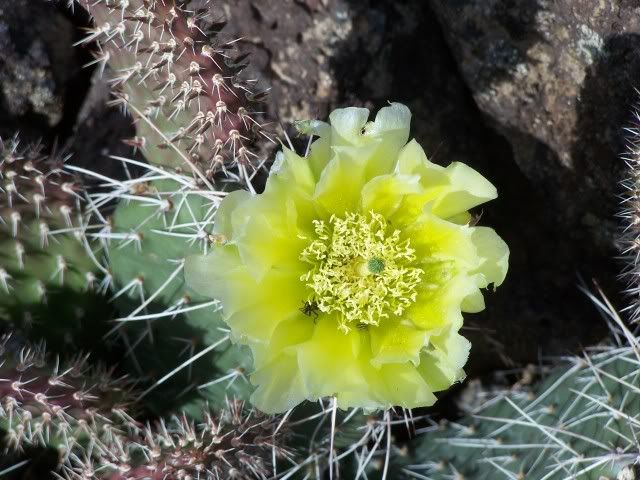
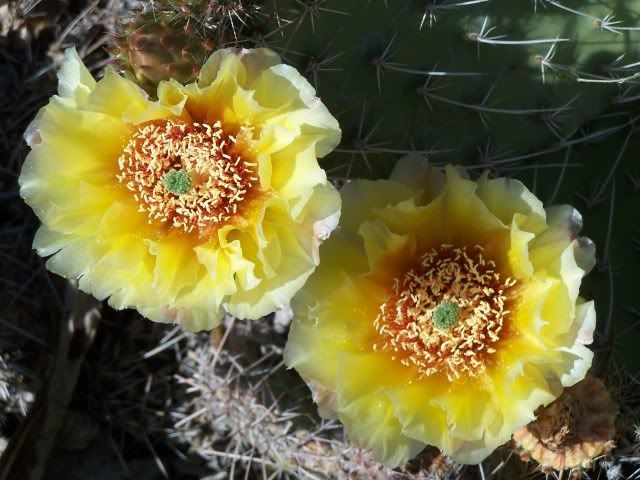
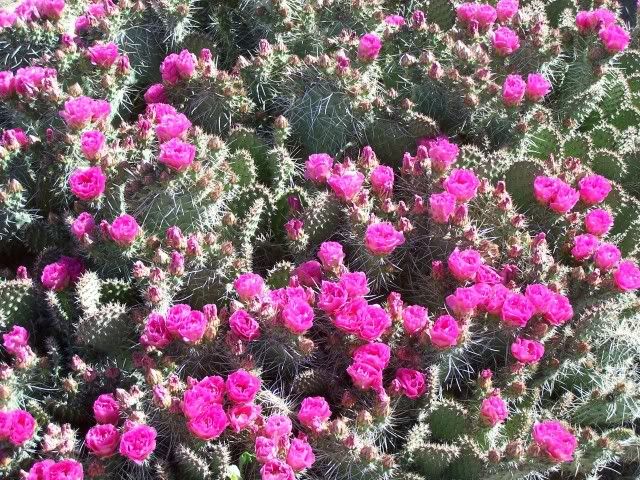
Mon, 11/28/2011 - 7:59pmI don't know if these are interesting but are a few i have in my yard.


DesertZone (not verified)
Re: Anyone have an interest in O. polyacatha?
Mon, 11/28/2011 - 8:01pmYes very nice John.
John P. Weiser
Re: Anyone have an interest in O. polyacatha?
Mon, 11/28/2011 - 8:15pmAaron
Yours are great too, especially the second photo. That is one big patch!! :o
I like the red one at the end too!! It got a name attached to it?
Looks like some more trades may be in order. ;)
John P. Weiser
Re: Anyone have an interest in O. polyacatha?
Tue, 11/29/2011 - 4:56pmNamed Hybrids and selections abound. Here is a small parade of a few that have flowered for me.
Opuntia polyacantha Claude Barr hybrid I do not know the original name of this one. It has been passed from gardener to gardener to gardener etc.... for years and came to me unnamed. It looks like a possible hybrid with O. aurea. If anyone knows the name I'd like to know.
'Utah Sunset'
'Taylor's Red'
'Snow Ball'
One of the better purple padded ones 'Purple Desert'
Robert Nold
Re: Anyone have an interest in O. polyacatha?
Tue, 11/29/2011 - 5:26pmNice.
I got one called 'Dark Knight', with purple pads, and went out to look for it, to take its picture, all shriveled up, but I couldn't find it. Maybe it's next door.
Weeding around, and in, them is no fun. One reason why I moved most of the tunas next door. Huge-spined forms of Opuntia macrorhiza, etc.
You really need a big wide-open space to grow the tuna types, like Kelly has at Timberline, in his display garden. Next door, they're growing in blue grama.
There's a funny story about 'Crystal Tide' and the Grapeseed sisters (who I think originally had the plant), but I can't tell it right. Maybe there's someone, somewhere, who can.
Bob
John P. Weiser
Re: Anyone have an interest in O. polyacatha?
Tue, 11/29/2011 - 5:42pmBob
Aaron and I are friends with LaMar Orton the owner of Plantasia Cactus Gardens, located in Twin Falls Idaho. Here is a link to pictures he has posted on his web sight of his display garden.
http://plantasiacactusgardens.com/Pictures_of_our_garden.php
DesertZone (not verified)
Re: Anyone have an interest in O. polyacatha?
Tue, 11/29/2011 - 6:13pmThanks. :)
The red one at the end my mother-n-law got off the road someplace in Arizona. They winter in Yuma, so it must have came from western AZ? They thought it was so pretty they broke a pad off. :rolleyes: :D
You can have anything I can dig up and send off, hell I owe ya my first born. :D
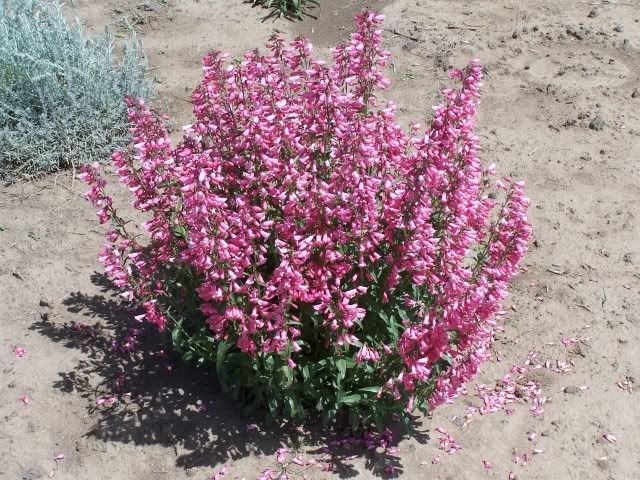
Hey here is a hybrid penstemon pics I found in my pics. I wish I would have got some seeds off it.
John P. Weiser
Re: Anyone have an interest in O. polyacatha?
Tue, 11/29/2011 - 6:40pmAaron
Nice Pent. You can take stem cuttings off Pents. If you want to know how, check out the American Penstemon Societies web sight.
http://apsdev.org/propagation/index.html
Robert Nold
Re: Anyone have an interest in O. polyacatha?
Tue, 11/29/2011 - 8:11pmVery cool. Lots of maintenance, I see. (I tried to find someone to help me in the garden, but to no avail.)
I mostly like chollas and echinocereus, because the free space in my garden is shrinking rapidly. They do well in containers, though.
Bob
DesertZone (not verified)
Re: Anyone have an interest in O. polyacatha?
Wed, 11/30/2011 - 11:51amThank you! I put that website to my favorites. 8)
Trond Hoy
Re: Anyone have an interest in O. polyacatha?
Wed, 11/30/2011 - 12:58pmMore exiting plants, Aaron and John! I am starting to think I ought to build a glasshouse to be ready to my coming collection of hardy Opuntias! ..that is when I get some spare time.....
I have tried hardy Opuntias (can't recall the names though) three times but they never shrivel even in late fall and end up as a mess in a year or two. Too wet autumns and winters.
Robert Nold
Re: Anyone have an interest in O. polyacatha?
Wed, 11/30/2011 - 2:53pmAlways a bad sign. I find it interesting that plants from cold climates, where the onset of cold weather is later than here, often enter dormancy later, and can be damaged or killed by cold, even though at their peak of dormancy they would endure the same cold temperatures.
And that you can see this process in the garden. The native Cylindropuntia imbricata has already lost its moisture and is ready for anything, but plants from lower latitudes, like C. spinosior (which seems to be getting quite tired of me and my garden) are not.
Bob
John P. Weiser
Re: Anyone have an interest in O. polyacatha?
Fri, 12/02/2011 - 12:07pmIt must be due to a physiological reaction to the length of day more than to the onset of cold weather.
Don't they use the term "photoperiodism" to discribe this type of reaction to changing length of day? Or is there a better term to use?
Robert Nold
Re: Anyone have an interest in O. polyacatha?
Fri, 12/02/2011 - 1:18pmPredictive dormancy is used by plants (generally) adapted to the local climate to enter the dormant period, and this is usually based on day length. Technically, it's based on night length, but nobody ever goes around saying "night length".
Consequential dormancy is another strategy, when a plant is triggered into dormancy by a cold snap, or by cold experienced prior to the time it would ordinarily undergo predictive dormancy.
So you can have two plants of the same species that are equally cold hardy, but the one from North Dakota will go dormant before the one from southern New Mexico.
In fact you can see this happen. Both the catalpa down the street and the desert willow in my front yard start losing their leaves at the same time, but the chitalpa next door gets its leaves frozen. So do desert willows from places like Arizona. (There are about 8 of them here, from all over the southwest.)
My desert willow is from a famous plant south of Santa Fe, has endured everything Denver's weather can throw at it for over 20 years, but the chitalpa's desert willow half is apparently from a more southerly accession and doesn't go into dormancy as early. (Tashkent, where the chitalpa was bred, is not particularly cold, so they would have had no reason to look for a specially cold-hardy form of desert willow.)
Bob
John P. Weiser
Re: Anyone have an interest in O. polyacatha?
Fri, 12/02/2011 - 2:52pmI have seen this happen in my garden with Opuntias collected in North Dakota as compared to those collected in Arizona. It doesn't matter to the North Dakota plants, if it is 80f and damp or 40f and dry, every year they will go dormant and shrivel right on cue.
Robert Nold
Re: Anyone have an interest in O. polyacatha?
Fri, 12/02/2011 - 7:16pmYep. And for some cactus, the gymnocalcyium with the tissue damage for example, if it had had time to lose enough moisture before getting its rear end (literally, that was the back side of the cactus) frozen, it might have made it through much colder temperatures later on.
This happened with an enormous Agave havardiana x scabra cross that I had planted in the front garden to startle visitors during the 2002 NARGS tours. A 70 degree drop in temperature in November turned the thing to complete mush within a day.
(Scabra isn't really hardy here but I thought I'd give it another try.)
Bob
John P. Weiser
Re: Anyone have an interest in O. polyacatha?
Fri, 12/02/2011 - 8:13pmBob
I meant to comment on your last photo. Did you drug that poor droopy Imbricata? It is extremely limp!! ;)
We all know how O. polyacantha can hybridize with other Opuntias here are a few examples I grow.
'Claude Arno' O. polyacantha x O. fragilis
Possible hybrid O. macrorhiza x O. polyacantha
Devils Tower, Wyoming O. polyacantha x O. fragilis
Robert Nold
Re: Anyone have an interest in O. polyacatha?
Sat, 12/03/2011 - 6:58amI finally got 'Claude Arno' last summer, at the DBG plant sale, after looking for it for years. 'Claude Arno' was the reason why Mary Ann called me all those years ago, she was looking for it too, having been friends with Barr .....
The trouble with opuntias, and it is big trouble, is the Cactus-Sucking Bug. I'm sure it has real name, but they attack pads and puncture them and then you have all these light green circles all over your cactus pads.
Dr. Bronner's takes care of them, but I decided it wasn't worth the trouble.
At least we don't have the giant cactus beetle here.
Bob
John P. Weiser
Re: Anyone have an interest in O. polyacatha?
Sat, 12/03/2011 - 7:44amChelinidea vittiger aequoris is the one a friend was plagued with a few years ago. He said he had not noticed them until he saw the nymphs scury for cover one day on a stroll through his garden. It didn't take long to get rid of them but he had to treat the whole garden to do it.
Here are some links to information on the "little offenders". They even have mugshots. >:(
http://www.gatescss.org/Pests/Opuntia%20Bug%20Cactus%20Bug%20Opuntia%20B...
http://colinlmiller.com/wildlife/hemiptera/hemiptera_pricklypear.htm
Andy71 (not verified)
Re: Anyone have an interest in O. polyacatha?
Sun, 01/29/2012 - 10:22amI've heard that C. davisii is one of the cold hardiest of all the chollas. I know of one in a Massachusetts garden that grows well without a mark on it, so it can handle some moisture too. C. whipplei is very hardy too though the hardier forms tend to stay lower and spread.
Andy71 (not verified)
Re: Anyone have an interest in O. polyacatha?
Sun, 01/29/2012 - 10:28amYou gave me two pads of this one John and I would say it is very likely a polyacantha x aurea hybrid or possibly even polyacantha x pinkavae. Its doing ok here so far.
Richard T. Rodich
Re: Anyone have an interest in O. polyacatha?
Sun, 01/29/2012 - 10:33amWelcome to the forum, Andy!
I am always keeping an eye out for the hardiest cholla, and one that might stand heavy snowfall better. You just never know...
Andy71 (not verified)
Re: Anyone have an interest in O. polyacatha?
Sun, 01/29/2012 - 10:59amThanks Rick!
Here's a pic of that C. davisii growing in Northhampton, Mass. It may have been flattened a bit from the October snowstorm.
Pages