
The following posts from spring 2010 will help kickstart this topic as we head towards spring 2011.
Two photos of Iris cristata 'Sam's Mini', a low growing and floriferous variety found by Sam Norris of Kentucky.


The next photos show the early spring rhizomes when first emerging. The rhizomes run on top of the soil, in fact, they prefer to slowly romp through the top layer of woodland duff or well decomposed bark mulch. In this particular cultivar, the rhizomes amusingly look like they're leaping up and over like spawning salmon as they progress upstream.


Having never harvested seed on Iris cristata, I wanted to experiment with seed-grown plants to see what sort of variability could be expected. I also needed to learn how to harvest the seed; when is the seed ready? Every few days I picked a pod and snapped it in half to test the progress of developing seed inside. Eventually a few pods started to show a small degree of whitening in color, and a few other pods actually dropped off (although remained unopened), surely ready to pick. The succulent green pods of Iris cristata and some Chinese woodland irises are attractive to some sort of insect that gets to the pods before fully ripe; dastardly chipmunks & squirrels munch them too, so harvesting early when the seed is ripe enough makes sense.
In the photo on the left showing the seed pods, on the right notice the lobster-claw like leaf bracts that each hold twin seed pods, the long styles are persistent. Initially when testing seed for readiness, the seeds were nearly clear or translucent... so I waited until they were a semi-translucent to nearly opaque tan or yellow color. Harvesting the seed is as easy as snapping the pods in half, then gently squeezing the seed out. They were sown fairly thick in flats, covered with fine decomposed pine bark mulch, covered with wire mesh to prevent digging by chipmunks and squirrels, and they'll spend the year outside, hopefully to germinate spring 2011.


Comments
Mark McDonough
Re: Iris cristata and small woodland Iris
Thu, 02/24/2011 - 10:13amTwo photos showing the mats of surface rhizomes on Iris cristata 'Edgar Anderson' in early April 2010, a relatively giant form of I. cristata, with the new growth more erect than most Iris cristata forms. One can tell from the start, the cultivar 'Edgar Anderson' is going to be larger than most cristata forms based on the vigorous tall shoots.
Iris cristata 'Edgar Anderson' flowered the same time as yellow Iris koreana, making me wonder about possible hybrids. Got a large batch of seed, all was sown. Most other Iris cristata varieties bloomed later when we had very hot days to 94-95 F (35 C), and as a result the flowers went by in just a couple days, and almost no seed set on those. Got one seed pod on I. cristata alba, which I sowed next to the mother plant.
For several years my Iris koreana barely flowered and shrank in size, so I moved it a couple years ago to a new location. I believe it was too dry where it was; the new location gets more light and has better humus-rich moisture retentive soil, and it jumped in size, flowered well, and now set lots of seed.
Interestingly, in 2010 Garden Vision Epimediums offered pre-sales on I. koreana "Select", reported as a "very floriferous clone" and "one that propagates well", promising that a cultivar name will be registered before the fall shipment.
Mark McDonough
Re: Iris cristata and small woodland Iris
Thu, 02/24/2011 - 10:16amI've never had good luck harvesting seed on Chinese Iris species. It helps being retired (wish I was) or unemployed (wish I wasn't, sort of), because I get to observe in much more timely detail about what plants are up to. Year after year, I see big, fat, 3-sided pods on species like Iris koreana and I. odaesanensis, two wonderful Chinese woodland Iris species, but rarely ever get any seed, although do find seedlings of I. odaesanensis here and there.
I discovered that the seed pods are much like other ephemeral seeders such as Jeffersonia, Epimedium, and Corydalis, they are actually ripe and mature when they're still green, when they're "al dente" and not "fully cooked", but even more so with Iris koreana. Harvesting the large seed pods while green (noticing that a few had gone over to yellow, but with nothing inside), and snapping the green pods in half, there's good seed in there, like golden kernels of corn with starchy appendages (elaiosomes) that are attractive to ants.
Iris koreana does a pretty good emulation of I. cristata, only with yellow flowers. Darrell Probst tells me that he has tried crossing the two species, but thus far no hybrids. One reason I'm interested in growing on the seed, maybe the bees will have better luck.
I also collected seed on I. odaesanensis and I. henryi much earlier that I would normally, and found a good percentage of viable looking seed. Time will tell whether my early seed sowing efforts are the proper recipe for success. Iris koreana was blooming at the same time, and within close proximity of I. cristata 'Edgar Anderson', so I'm interested in finding out whether the bees were up to any productive hanky-panky.
Mark McDonough
Re: Iris cristata and small woodland Iris
Thu, 02/24/2011 - 10:18amIris minutoaurea took several years to "settle down" before it started to flower well. In 2010 there was a fairly good flowering (2 photos), but the plant is being encroached upon and shaded by Epimedium x setosum; eventually I moved the Epimedium to afford more room for the Iris. No seed again this year, it got very hot when the plants bloomed and they went over too quickly. I always forget to use some sort of scale object when photographing this plant, as it is so tiny in flower that it is hard to capture a true sense of scale.
Both I. koreana (left) and I. minutoaurea (right) have the undesirable habit of expanding their foliage significantly after flowering, making larger (and untidy) foliage clumps than one anticipates, as compared to I. cristata that maintains the spring foliage size.
Mark McDonough
Re: Iris cristata and small woodland Iris
Thu, 02/24/2011 - 10:21amI have never grown Iris cristata in pots, but have heard they are not the most amenable creatures for pot culture. Here in New England, northeastern USA, they are among the easiest and most satisfying Iris to grow, rapidly spreading and flowering prolifically. The mistake people sometimes make with them, is to plant the rhizomes too deep. As you can see in the rhizome views I have shown, they like to run right on the surface, so are best planted in a layer of woodland duff or decomposed bark mulch.
Typically they make lots of seed, but I've never bothered collect seed until spring 2010. My large mat of I. cristata 'Shenandoah Sky' growing under a Stewartia pseudocamelia tree, flowered prolifically as always (photo from 2008), but with several days of unusual heat (94 F - 35C) the flowers went over quickly and made no seed at all, I suspect because the process of fertilization did not have enough time as the flowers were toasted.
Same thing with two newbies in the garden, I. cristata 'Mountain Girl' (left) and I. cristata alba (right). Both were planted in 2009, as 2-fan starts, and I'm pleased with how much they grew in just one year, and flowered spring 2010, but the flowers were no match for the heat. I was lucky to get one pod on alba even with the heat. The one named 'Mountain Girl' is a 2007 introduction by Joe Pye Weed's Garden (Marty Schafer & Jan Sacks, breeders of amazing Iris), lovely light blue flowers lacking any yellow among the white signal patches.
Mark McDonough
Re: Iris cristata and small woodland Iris
Thu, 02/24/2011 - 10:26amI have I. henryi and I. odaesanensis growing on a dry embankment, I. henryi seems to love the location, with about 200 blooms in 2010 (but only 4 plump seed pods) and for some reason the same year, I. odaesanensis barely bloomed at all, I think just 3 flowers, although the plant has spread to about a meter across and looks healthy otherwise. I might split it and try growing some pieces in a more moist location. Iris henryi and I. odaesanensis seem to grow as "turf" species, the old foliage persistent (evergreen, but still persistent in I. henryi), and in spring grow out of the mass of older foliage.
left photo: March 2010, enbankment with I. henryi on the left, the evergreen foliage trailing down nearly 2' (60 cm), with the dead persistent foliage of I. odaesanensis on the right (don't even think about foliage cleanup, not worth the tedious effort).
right photo: late April 2010, the plants coming to life, I. henryi budded (lots of buds), and new foliage of Iris odaesanensis in the background, taking over the persistent old foliage.
Iris henryi, lots and lots of bloom, about 200 flowers. This is a bi-flowered species, and a couple days after the first flush, it repeats itself with a second flush of the same number of flowers. The flower color is the palest smokey blue, hard to capture in photos, but exquisite in every detail.
Iris henryi, setting lots of pods, but a false promise, as only 4 out of hundreds of pods would end swelling into a round lime-like ball to produce seed; in this photo one swelling pod can be seen.
Foliage of I. henryi and I. odaesanensis taken mid June 2010, really good on a slope where the foliage hangs down to follow the slope.
A photo from October 2008, showing the embankment after we've had some frost, the very narrow grass-like leaves of I. henryi on the left looking very much like the leaves on Carex caryophyllea on the right, with the turfy mass of I. odaesanensis taking on some yellow frost-induced color in the center.
Mark McDonough
Re: Iris cristata and small woodland Iris
Thu, 02/24/2011 - 10:29amChina has many lovely woodland Iris. At a 2010 garden tour at Joe Pye Weed's Garden, the amazing garden and nursery of Marty Schafer and Jan Sacks here in Massachusetts, USA, there was a planting with numerous Darrell Probst Iris collections from China. I show just one such collection in bloom that day, a gorgeous little woodland Iris, among many listed as "Iris species novum" along with a collection number. I hope some of these lovelies make it into horticultural commerce soon, and knowing of Jan & Marty's cultivation skills, and of Darrell's, maybe we won't have to wait too long.
There were many such clumps of various Iris species novum there; one had black stems and striking black bud spathes, the outer side of the ready-to-pop buds were light yellow, although Darrell assures me it opens to a light blue flower. My photos came out lousy, so I only show one photo of another Iris species novum.
Also shown is Iris gracilipes 'Cobblewood Charm', a 2008 Joe Pye Weed's garden introduction, a cross between the I. gracilipes "Buko Form" (tiny miniature white form, found on Buko San [mountain] in Japan) and the regular taller blue-violet form. In flower it is about 6-8" (15-20 cm) tall.
Mark McDonough
Re: Iris cristata and small woodland Iris
Thu, 02/24/2011 - 10:32amIn June 2010 I divided a clump of Iris cristata alba, and thought it might be a good opportunity for photo documentation.
In the upper center is I. cristata alba. The previous year it was a two-fan plant, purchased from Garden Vision Epimedium in May 2009, for $6 US. Certainly has filled out nicely in just one year. To the left of it is a similar size clump of I. cristata 'Mountain Girl', and to the right the tiny plants are seedlings. These plants grow at the base of Stewartia pseudocamellia, a tree with incredibly dense matting surface roots that make underplanting impossible for most plants, but Iris cristata can easily skim the surface bark mulch layer. In this photo, I used a sharp spade and trowel to mix the existing mulch layer into the loosened earth, the surface tree roots chopped out just to give the Iris divisions one season of competition-free growing.
Iris cristata alba clump uprooted. Don't be fooled by the seemingly dense root ball, most of those roots are Stewartia tree roots!
Typical division; usually the fans are paired, sometimes there is a third side fan. In the center of paired fans is the spent bloom stalk and bracts. Most roots are from the older joined portion of rhizome, but you can also see a couple new white roots emerging from the two fans, ready to dig in and anchor those fans, later this season to sprout forth with fresh new paired fans advancing the colony.
Left: close-up of the paired fans and just-emerging anchor roots.
Right: paired fans spaced and ready to plant, with 14 divisions, a 14:1 increase in 1 year.
Divisions planted and watered in. It's hard to tell, but the rhizomes are left on the surface or just barely covered, but I do carefully place soil/mulch over the new anchor roots. These divisions will get special attention and watering for the next month.
In the center, a 2-year seedling with 5 closely spaced fans that are attached to a developing rhizome, and a 1-year seedling on the right that germinated last summer; it does not have a developed rhizome yet. I photographed these with the adult-size fans in view, to give an idea of size of these youngsters.
cohan (not verified)
Re: Iris cristata and small woodland Iris
Thu, 02/24/2011 - 12:45pmInteresting profile, I'll be watching for any of these that might be hardy enough; I like species Iris, and anything with 'woodland' in the description is a good starting point for me.. I don't mind the 'turf' effects, and plenty of space to let them do their thing...
Trond Hoy
Re: Iris cristata and small woodland Iris
Thu, 02/24/2011 - 1:03pmVery interesting, Mark!
I have for years thought to start growing some of these irises. No you have persuaded me to make an attempt this summer ;D - if I can lay may hands of some nice plants! Too long to wait for seedlings to grow.
Amy Olmsted
Re: Iris cristata and small woodland Iris
Fri, 02/25/2011 - 6:00amThanks for this Mark. Very informative and it gives me inspiration & confidence to get out & collect seed from my Iris cristata 'Powder Blue Giant' and 'Alba' this spring! I purchased an I. odeasanensis from Jan & Marty last year at the EWWSW and I'm looking froward to seeing its bloom!
WimB (not verified)
Re: Iris cristata and small woodland Iris
Sun, 02/27/2011 - 8:34amVERY nice, Mark.
You're going to get me hooked on a new plant-addiction (and I already have to many ;)). I wonder where I can find these in Europe...
I like Iris cristata 'Sam's Mini', Iris minutoaurea and Iris species novum the most.
Todd Boland
Re: Iris cristata and small woodland Iris
Wed, 03/09/2011 - 6:01pmFor some reason I have no luck with Iris cristata :-[
Lori S. (not verified)
Re: Iris cristata and small woodland Iris
Wed, 03/09/2011 - 6:08pmI've never managed to winter I. cristata over here either, maybe for different reasons - who knows? Do other Calgarians out there grow it successfully?
Mark McDonough
Re: Iris cristata and small woodland Iris
Thu, 03/10/2011 - 8:15pmHmm, I have never given it a second thought, about Iris cristata hardiness. They never show the slightest indication of winter kill, so I just assumed if they perform this well in USDA Zone 5, they might do nearly as well in Zone 4. Checking the USDA Plant Profile for Iris cristata, I see that it is definitely a Eastern USA species centered in central to southern States, with a disjunct distribution to include little ol' Massachusetts (in USDA, Massachusetts not included in FNA). So it surprises me to learn it is not growable in Alberta nor Newfoundland!
http://plants.usda.gov/java/profile?symbol=IRCR
Trond Hoy
Re: Iris cristata and small woodland Iris
Thu, 03/10/2011 - 11:05pmI have never tried it over here, Mark, but if I get the chance I'll give it a try both at home and at my seaside cabin.
Todd Boland
Re: Iris cristata and small woodland Iris
Fri, 03/11/2011 - 7:45amI don't think hardiness is a problem here...I just don't seem to have the right conditions...frost heaving is a b***h around here and Iris cristata with its rather shallow roots, gets nailed. I think we have one member in our society that grows it in her actual woodland, among Cornus canadensis, Clintonia borealis and Trilliums. She can also grow Soldanella, another species I have absolutely no luck with.
Richard T. Rodich
Re: Iris cristata and small woodland Iris
Fri, 03/11/2011 - 2:00pmI hardly give Iris cristata a second thought here, just like Mark. It does its thing without any special care. At least for Todd, outright cold can't be the deciding factor. He has warmer winters than me. The only thing I have found with Iris cristata is transplanting in fall is usually deadly. But that's apparently not so uncommon in that iris section or with bearded irises.
Iris lacustris is carefree here, too.
Mark McDonough
Re: Iris cristata and small woodland Iris
Fri, 03/11/2011 - 6:01pmRick, I think you hit the nail on the head, late planting is fatal with them. In my photo exposé of dividing and planting Iris cristata, the exercise took place on Jun 21, 2010. This is a point after flowering where new rhizomes above the soil have expanded and just starting to tap down into the soil with "anchor roots" (the photo of an uprooted division shows this), the best time to divide. Since the rhizomes basically sit on top of the soil, they depend on well developed and mature "anchor roots" to get them through the winter.
Last winter we had much less snow and I photographed the bare ground where a large patch of Iris cristata 'Shenandoah Sky' grows under a Stewartia pseudocamellia tree. In January & February I'd look at the exposed rhizomes and cringe, but they do just fine. 2010 was an exceptionally early spring, here is the bare mass of rhizomes in March.
Close by I have an old clump of Iris gracilipes "Buko Form", a tiny miniature form with white flowers. Since it was an early spring, I got over anxious and cleaned up the old foliage, which makes a thatch concealing the budded rhizomes. It was a mistake. A day after the cleanup, we had a deep freeze, and slowly over the next few weeks, parts of the large clump starting dying off. Eventually I only saved a small piece... fortunately I had a few 2-3 year seedlings coming along. A friend warned me the year before, "you really should divide up that clump", but I got lazy and didn't do it. The seedlings had no problem with the sudden cold snap.
Next to it I grow Iris gracilipes 'Cobblewood Charm', a hybrid by Darrell Probst of "Buko Form" with the regular larger I. gracilipes. It too had no problem with the cold snap, even though I cleaned up the thatch. While the emerging rhizomes of the "Buko Form" and 'Cobblewood Charm' look the same size, the "Buko Form" ones are minuscule! My attempt at getting a good side by side comparison photo didn't work too well, so in the last shot I overlaid the image of 'Cobblewood Charm' at the same scale, to be closer to the "Buko Form" 2-3yr plant, to show the difference in shoot size.
Richard T. Rodich
Re: Iris cristata and small woodland Iris
Sat, 03/12/2011 - 7:57amMark,
Did you do anything to "save" the remaining Buko Form, or just let nature take its course?
And had you cleaned the seedlings too, and they still sruvived? Maybe there just wasn't much old foliage for protection anyway.
Mark McDonough
Re: Iris cristata and small woodland Iris
Sat, 03/12/2011 - 9:08amYes, I tried to save it, divided up the entire clump and replanted smaller pieces, but the growth points just sat there and most shriveled away. I got only one remnant piece to survive. The super hot & dry summer didn't help, even though I watered the divisions religiously.
The 2 & 3 year seedling plants had been "de-thatched" too, but were okay with the sudden deep freeze. I think the mother plant's rhizomes had just become too large, dense, and weakened with age, and were in need of division years before.
Mark McDonough
Re: Iris cristata and small woodland Iris
Sat, 05/21/2011 - 6:35amA few repeats, but they are all so comely this season that I snapped some photos. Does anyone get Iris cristata seeding around much? I rarely get seedlings, even with lots of seed-filled pods typically produced, but I hypothesize these largely get eaten, they seem a favorite of squirrels and chipmunks. But a do have a few self-sown seedlings, here's one that is flowering for the first time, nothing special, just a nice light slate blue.
Two Iris cristata forms in opposing forms, both are the earliest cultivars to bloom. The first set of photos is 'Sam's Mini', very low growing and neat, excellent low arching foliage, and highly floriferous. A strong fast spreader too. The second set of photos is 'Edgar Anderson', the relative GIANT form, also making fine foliage mats but much larger and taller, and floriferous with crystalline frilly-edged mid blue flowers. Exploring cultivars such as these is a good reminder just how variable a plant species can be, and gardeners certainly do horticulture a service by recognizing these differences and embracing the more unique forms. It is worth noting, all Iris cristata forms survived last year's record breaking drought without a scratch.
Iris cristata 'Sam's Mini'
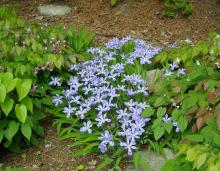
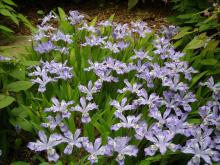
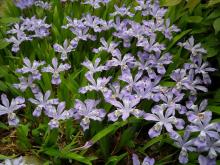
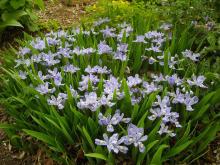
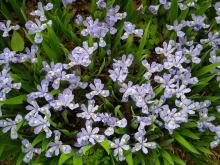
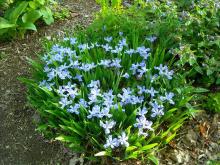
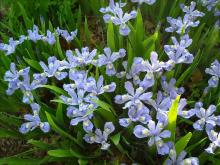
Iris cristata 'Edgar Anderson': the 2 photos on the right in early morning sunlight, making the flowers appear more blue.
The flowering of Iris henryi (left) was somewhat ruined by extended periods of rain, and I missed much of the flowering while I was traveling, managed to get a snapshot one rain morning. Same with yellow Iris minutoaurea (right). This one is starting to flower less, I believe it needs to be divided and replanted to "refresh" the plants for better growth and flowering in the future. I. henryi is also earmarked for division.
Mark McDonough
Re: Iris cristata and small woodland Iris
Sun, 09/11/2011 - 6:31pmLooking around the garden recently, I noticed how different some of the leaf forms of Iris cristata can be. In the photo on the left is I. cristata 'Shenandoah Sky', with fairly broad leaves with gracefully arching tips. In the photo on the right, you can see 'Shenandoah Sky' on the left side of the photo, and in the center foreground is I. cristata 'Mountain Girl', with bold narrow-leaved sharp fans of foliage; quite a different look about it. On the upper right is I. cristata 'Alba' with the more typical arching leaves.
Mark McDonough
Re: Iris cristata and small woodland Iris
Sun, 09/11/2011 - 6:39pmMy original Iris odaesanensis has flowered poorly the last couple years, barely at all. So I'm trying them in various spots in the garden to find a spot more to its liking. In this view, is a seedling grown plant, which actually flowered this year (4 yrs from seed) with a couple white flowers. I noticed that in late summer and fall, the rhizomes bulk up with lots of narrow blue-green fans and shoots... I think they take a while to become established.
Lori S. (not verified)
Re: Iris cristata and small woodland Iris
Sun, 09/11/2011 - 6:56pmI'm not sure how I missed this thread earlier, but your irises are just incredible, Mark! :o :o
Mark McDonough
Re: Iris cristata and small woodland Iris
Sun, 09/11/2011 - 7:20pmThese Iris are such easy-doers here... pot up an Iris cristata form and try to sell it for 1$ or even just 50 cents at a New England NARGS meeting, and it's like trying to sell some weeds, no one wants them because they're so commonplace here. I find them all totally delightful and satisfying regardless.
Richard T. Rodich
Re: Iris cristata and small woodland Iris
Sun, 09/11/2011 - 8:09pmI potted up some Iris cristata in the spring a few years ago and forced them the following winter very successfully with just natural light. They were blooming door prizes at an early March NARGS Minnesota chapter banquet. Bill Dougherty of Summer Chase Gardens spoke on iris. He is very good. Iris that I potted up in late summer/early fall did not survive.
So if you have an overabundance, you can play with them in the winter, too.
WimB (not verified)
Re: Iris cristata and small woodland Iris
Mon, 09/12/2011 - 12:35am:o :o
Just come and sell them over here, Mark. You could ask 5 euro's for a pot of I. cristata and they'll sell very easily...
Mark McDonough
Re: Iris cristata and small woodland Iris
Mon, 09/12/2011 - 6:48pmTrue enough, but it would probably cost 10 euros per pot to ship them ;)
Funny how in a global context, some plants receive little fanfare while elsewhere the same plants can be coveted.
WimB (not verified)
Re: Iris cristata and small woodland Iris
Sun, 09/25/2011 - 1:22amIris 'Eco Little Bluebird' is showing a flower now, a bit out of season :rolleyes:
Mark McDonough
Re: Iris cristata and small woodland Iris
Sun, 09/25/2011 - 6:13amExcellent! I've never had one of these through a bloom in the fall. Since we were talking about how much a named Iris cristata might cost in Europe, how much did you get it for, or was it shared by a friend. With the name 'Eco Little Bluebird' this has to be one named by Don Jacobs from Decatur Georgia (Eco Gardens)... all his named selections are named in the form of Eco-this or Eco-that.
Richard T. Rodich
Re: Iris cristata and small woodland Iris
Sun, 09/25/2011 - 8:03amI don't think I have ever had an Iris cristata bloom out of season.
I actually like the Eco- this/that, Lakeside this/that, this/that zam system. It tells me more about the cultivars at a glance.
WimB (not verified)
Re: Iris cristata and small woodland Iris
Mon, 09/26/2011 - 2:21amMark,
it's a selection from Don Jacobs indeed. I bought it for only 5 euro's from a local nursery....not very expensive :D but it was the only cultivar they were selling...they don't grow any other I. cristata cultivars.
BTW, they sold it as I. 'Little Bluebird'. But after a search on the web...it was clear the original name was "ECO little Bluebird'
Mark McDonough
Re: Iris cristata and small woodland Iris
Sat, 10/01/2011 - 1:01pmWim, then it was a "good find" to come across a named form. Most of mine are "shutting down" for the season, with the leaves yellowing and passing into dormancy. Iris verna on the other hand, is looking spiffy and perky with dark shiny foliage. In the photo taken today is I. verna var. smalliana 'Brumback Blue' that I purchased from Garden Vision Epimediums this spring, it was $8.00. It was past flowering season when I bought it, but I'm pleased that it has already more than doubled in size with more low-ascending fans. This cultivar is supposed to be a "prolific bloomer" so I'm anxious to see flowers next spring.
Some links on Iris verna and its two varieties (var. smalliana, var. verna)
http://www.fs.fed.us/wildflowers/beauty/iris/dwarfwoodland/iris_verna.shtml
http://plants.usda.gov/java/profile?symbol=IRVE
http://plants.usda.gov/java/profile?symbol=IRVES
http://efloras.org/object_page.aspx?object_id=8461&flora_id=1
Flower photos, the best forms are deep blue and have bold gold flare spots:
http://tenn.bio.utk.edu/vascular/database/vascular-photos-enlarge.asp?CategoryID=Monocots&FamilyID=Iridaceae&GenusID=Iris&SpeciesID=verna%20var.%20smalliana&PhotoNameID=ir_vern&PhotographerNameID=Mark%20Pistrang
http://tenn.bio.utk.edu/vascular/database/vascular-photos-enlarge.asp?CategoryID=Monocots&FamilyID=Iridaceae&GenusID=Iris&SpeciesID=verna%20var.%20smalliana&PhotoNameID=ir_vern_smal1&PhotographerNameID=B.%20Eugene%20Wofford
http://www.flickr.com/photos/alan_cressler/3464938050/
http://www.flickr.com/photos/22032600@N04/5614180632/
WimB (not verified)
Re: Iris cristata and small woodland Iris
Sat, 10/01/2011 - 1:06pmYeah, I thought so too ;D ;D
Wow,
just took a look at the flower-pics. That's a very nice species, I'll be on the lookout for that one.
Mark McDonough
Re: Iris cristata and small woodland Iris
Sat, 11/19/2011 - 6:57pmOn this cold mid November day, I took a photo showing the difference between Iris henryi on the left (very narrow foliage, evergreen) and I. odaesanensis on the right (persistant dried remains of foliage, not evergreen). Both species are planted at the top of a mound, so they are grown rather dry. Plants of Iris odaesanensis on flat ground elsewhere in the garden have leaves in a semi-dormant state... some green at the base but drying and going into dormancy, but with strong green shoots in evidence at the base.
Iris minutoaurea, one of the tiniest Iris in bloom, has surprisingly long foliage after bloom, that persists all season long. In this photo you can see it has mostly gone brown and drying, but it is extremely tough and persistent, and must be cut off in spring to enjoy the best display in sping. This clump is long overdue for being divided.
Mark McDonough
Re: Iris cristata and small woodland Iris
Sat, 04/21/2012 - 5:17amThe wonderful Iris koreana is in splendid bloom right now, fully a month earlier than normal due to our extra warm spring season. Iris koreana and I. odaesanensis are species that Darrell Probst has introduced from Korea, and glad he did, because they are easy and delightful small woodland plants, a perfect compliment to our familiar woodland Iris such as I. cristata.
http://www.signa.org/index.pl?Iris-koreana
http://www.signa.org/index.pl?Iris-odaesanensis
http://www.plantdelights.com/Iris-odaesanensis-Perennial-Mt-Odae-Iris/pr...
This clump of I. koreana has grown well and spread to a sizeable clump in three years. Before that, I had it planted in another location where it was shrinking in size and barely bloomed; probably too dry a location previously. Funny, the buds opened on the south side of the clump first, and now progressing south to north :D
As I'm only able to catch a few photo after work at dusk, the photos are a bit dark, maybe I'll get a better photo today (weekend day) with better light.
Mark McDonough
Re: Iris cristata and small woodland Iris
Sat, 04/21/2012 - 7:31amTo compare, here is the other Korean species, Iris odaesanensis, apparently named for a Mt. Odae in Korea where the species is found. I have a large patch that used to flower well, but no longer flowers, or sputters out only a couple of blooms. The patch shown in the first photo is a combination of some self-sown seedlings, and a few seed-grown plants from my sowing, the division between my two groupings now grown in and merged into one patch. This year it has a smattering of blooms, but not a shear mass of bloom as I have seen them at Garden Vision Epimediums nursery, not sure what will stimulate better bloom. My plan is to move them around to various parts of the garden to find a spot to its liking, as has happened with Iris koreana.
Iris odaesanensis. Notice the yellow spot or halo in the closeup view. Darrell Probst also selected a form that looks similar, except for a fine brown line around the yellow halo, both forms have been available from Garden Vision Epimedium.
A closeup of Iris koreana today:
Lori S. (not verified)
Re: Iris cristata and small woodland Iris
Sat, 04/21/2012 - 10:22amYour irises are spectacular, Mark! I wonder how hardy those species are? Can anyone comment?
Richard T. Rodich
Re: Iris cristata and small woodland Iris
Sat, 04/21/2012 - 4:20pmThey are darling, Mark.
I have some year old seedlings of odaesanensis and koreana from SIGNA seed that I will be planting out this spring. We'll see how they do.
Mark, keep us informed if you make anymore determinations regarding climate preference. I think we would all benefit.
Iris minutoaurea will be making a show soon...
cohan (not verified)
Re: Iris cristata and small woodland Iris
Sat, 04/21/2012 - 9:04pmGreat Irises, Mark :)
Lori, if you find out, let me know ;D
Mark McDonough
Re: Iris cristata and small woodland Iris
Sat, 04/21/2012 - 9:11pmRegarding hardiness, they certainly have no problem with Zone 5, so maybe try them in Zone 4. So far as getting shy-flowering species to flower more, I know that Garden Vision Epimediums has actually selected a form of I. koreana for its free flowering capability. Yet for me, just moving it to a different spot meant the difference between a plant that refused to flower to one that flowers in spectacular fashion, yet I have little idea about what accounts for the difference, other than being is a spot not so dry, yet the new spot is still on the dry side.
If I find out what makes I. odaesanensis flower better, I shall certainly report back.
Trond Hoy
Re: Iris cristata and small woodland Iris
Sat, 04/21/2012 - 11:48pmHope you find a spot to its likening, Mark! It's beautiful! The both are, of course ;)
WimB (not verified)
Re: Iris cristata and small woodland Iris
Sun, 04/22/2012 - 10:03amThere you go again, making me jealous with those wonderful shade-loving Irisses which are impossible to find in Europe! :-[ :-[ :'(
Mark McDonough
Re: Iris cristata and small woodland Iris
Sun, 04/22/2012 - 10:19amMaybe there will be some seed set this year (last year there was none, on both species). With I. koreana, even with good seed set in the past, so far I've only had 1 seedling ever germinate! With odaesanensis I've had slightly better results.
WimB (not verified)
Re: Iris cristata and small woodland Iris
Sun, 04/22/2012 - 10:23am;D
Don't worry Mark. I'm sure I'l find it sooner or later!
Richard T. Rodich
Re: Iris cristata and small woodland Iris
Sun, 04/22/2012 - 9:18pmFlowers are a bit shorter this year due to the dry spring (and winter): 2 inches high, as oppose to the usual 3 inches.
Iris minutoaurea, given to me as a seedling Iris sanguinea by a fellow NARGS chapter member. Had she known what she had, she may not have been so generous!
cohan (not verified)
Re: Iris cristata and small woodland Iris
Mon, 04/23/2012 - 11:29amThat's a sweet one, Rick!
Mark McDonough
Re: Iris cristata and small woodland Iris
Mon, 04/23/2012 - 3:44pmMy mature clump of Iris minutoaurea must need division, because instead of smothering itself in flowers as it has in the past, it only has a sprinkling of 10-12 tiny blooms. Rick, glad you got a good photo of yours. After a long dry spell, it rained pretty good yesterday, thus the crummy photo I'm showing, and then overnight the heavens let loose with deluge downpours and wild winds; everything is beaten down from the downpours. Iris koreana was at near peak, glad I got some good photos while the weather was better, before squashed from the downpours.
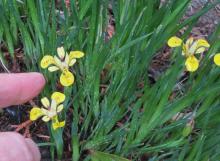
Anyway, I uploaded this photo of I. minutoaurea, to give a sense of scale, the flowers aren't much bigger than my thumbnail? Do you think this tightly clumping Iris get too congested, and that's the reason for the floral decline?
Just noticed the first bloom on I. henryi is partially open, and the form of I. odaesanensis with the brown-rimmed signal spot is budded at long last.
Iris minutoaurea scale:
Richard T. Rodich
Re: Iris cristata and small woodland Iris
Mon, 04/23/2012 - 6:30pmI received it as a first year seedling in 2005 - not long enough to know if it needs periodic division. It only began flowering in 2009, a long wait for an iris, in my opinion. There are a lot of advantages to having photographic records of your plant materials. Here's a progression of the one plant:
2009 2010
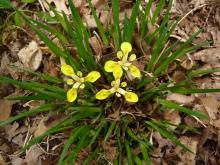
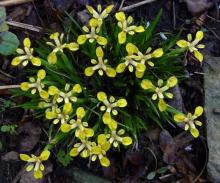
2011 2012
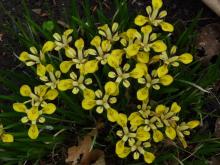
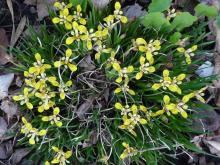
Mine are bigger than my thumb. :D The flower measures exactly one inch across.
Mark McDonough
Re: Iris cristata and small woodland Iris
Mon, 04/23/2012 - 7:02pmI must have fat thumbs ;). Interesting to see that annual progression, I can detect the tendency for this iris species to create a "rhizome donut", with flowers and growth moving to the outer ring.
Pages