
I thought I'd kick off the Allium 2011 topic, even though way too early for signs of plant growth outdoors. A NARGS member was inquiring about Allium tricoccum over on the Pacific Bulb Society mail list, so I'm jumping in with a photo of variegated forms of Allium tricoccum (Ramps) found by Darrell Probst in Massachusetts.

There's lots of interest in Ramps, including ramps festivals and dinners celebrating this pungent edible wildflower, so google to heart's delight to find out more, but here are a few links.
Ramps, the King of Stink:
http://www.kingofstink.com/
Connecticutt Wildflowers (the glossy round seeds are very attractive):
http://www.ct-botanical-society.org/galleries/alliumtric.html
nine photos here:
http://www.thismia.com/A/Allium_tricoccum.html
Comments
Mark McDonough
Re: Allium 2011
Wed, 06/01/2011 - 3:24amStephen, that's so funny to see those labels. Can't say for sure if I have true A. schoenoprasum 'Corsican White' white any more, it was the smallest thready-leaved form of chives I know of, but over time, all the chive forms intergrade and I've not been successful keeping most of them separate and isolated. except for my A. schoenoprasum 'Curly Mauve'. Can't remember what my selection 'Sweet Pepper' is like; I remember it being a seedling of 'Pink Pepper', another casualty to an overly demanding work and life schedule and parts of my garden becoming swallowed up by weeds for several years... sigh. Now, off to work I go!
Stephen Barstow
Re: Allium 2011
Wed, 06/01/2011 - 5:34amI liked the label "(yet) another glaucum"....
I don't have a picture of Sweet Pepper or Pink Pepper, but I have a couple of pictures (a bit overexposed) of Summer Pink (see below) taken on my last visit in 2008 (I didn't notice your name then).
How did they end up in Gøteborg in 1997?
By the way, I planted seed propagated Corsican White (AGS seed) last year in my garden and they have made it through the winter (last time I tried they died). Why Corsican?
Stephen
Trond Hoy
Re: Allium 2011
Sun, 06/05/2011 - 1:20pmWhat do you think of these onions, Onion man - or others?
Lori S. (not verified)
Re: Allium 2011
Sun, 06/05/2011 - 1:22pmThey look very tasty... say on a baked potato with butter and sour cream. ;D
Nice colour variation.
Trond Hoy
Re: Allium 2011
Sun, 06/05/2011 - 1:29pmWell, I wouldn't eat them. They grow on a road verge and the verge is sprayed with herbicide every summer >:( :o
Mark McDonough
Re: Allium 2011
Sun, 06/05/2011 - 5:31pmGood chive forms Trond. Your top one looks like one I grow that I have nicknamed Allium schoenoprasum "silver tips" because of the way the pointy ends of the tepals fold back to catch glints of light. I used to keep my various chive collections separate, maintaining the cultivars, but after many years, I'm afraid they have all blended into assorted array of pleasing forms. Here are three photos showing this form. It is also interesting, some chive forms are thrifty of foliage (such as this one) and other forms are much leafier. I like the dark spathes on this form.
I have a number of white forms (Trond, your white one with darker veins is very nice), this one showed up a couple years ago but is overcrowding my Allium flavum tauricum plants so must move it.
From several dwarf white forms, they have interbred, and I get all sorts of pastel colors.
Mark McDonough
Re: Allium 2011
Sun, 06/05/2011 - 5:36pmThe name 'Corsican White' was based on the fact I grew a very dwarf form chives originally collected in Corsica, from seed sent to me by Richard Dadd in the UK. I have long since lost the label and the actual collection location, but among the various lavender mauve forms, one white-flowered form arose, and this I propagated and distributed under the name A. schoenoprasum 'Corsican White'.
I used to get the yearly Index Seminum from Gøteborg years ago, and I believe I had sent them some Allium varieties as well, but frankly, I don't remember now, it's been so long.
As for Allium 'Pink Pepper', here is a photo from September 2010; I'm surprised it looked as good as it did because of our record-breaking heat and frought last summer and fall, these plants had virtually no water all summer. The "pepper" part comes into play by virtue of the pink flowers being "peppered" with yellow stamens. In flower, the plant is only 4-5" tall.
Trond Hoy
Re: Allium 2011
Sun, 06/05/2011 - 10:34pmMark, you have them all!
But I must clarify, the chives are not mine but growing wild on a road verge. However I intend to rescue some of the best forms next time I pass by ;)
Richard T. Rodich
Re: Allium 2011
Sun, 08/07/2011 - 8:26amPursuant to a more positive identification. What is your best guess now, Mark...
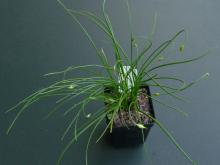
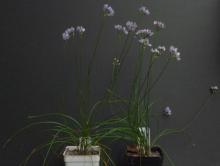
Allium sikkimense?
Mark McDonough
Re: Allium 2011
Sun, 08/14/2011 - 8:57amSorry about late reply, but yes, looks like Allium sikkimense to me. I find it so interesting that in some (most) forms, the buds and inflorescences are pendant to semi-pendant, but in other forms they are semi-erect to totally upright, as in your plants. Good diagnostic images.
Mark McDonough
Re: Allium 2011
Sun, 08/14/2011 - 9:27amWelcome for its late flowering, although not terribly showy, is the European Allium ericetorum.
I forgot the source of my original plants, I had a couple different sources. Gave plants to a friend (Marsha Russell) years ago of one of the forms. Over the years, I lost both forms, but fortunately Marsha has it growing, and gave me back a nice clump. Here's tow photos, one of A. ericetorum with a nice mossy-rock-outcropping background, and one showing a bit of that allium with a good display from pink-flowered A. saxatile.
Checking the species spelling on IPNI.ORG, I noticed that a new subspecies was recently published, must research to find out more about it:
Allium ericetorum Thore subsp. pseudosuaveolens (Zahar.) Ciocârlan -- Fl. Il. României 1083. 2009
On the type species, here's some information and photos from Flora of Italy:
http://luirig.altervista.org/schedeit/ae/allium_ericetorum.htm
In Spain:
http://www.asturnatura.com/especie/allium-ericetorum.html
A few photos from CalPhotos (they sometimes include photos of plants taken in different countries), here from Slovenia. It seems that some forms are much more attractive than others:
http://calphotos.berkeley.edu/cgi/img_query?stat=BROWSE&query_src=photos...
A few more pics:
http://www.flickr.com/photos/simonjoan/2811072072/in/photostream/
http://www.flickr.com/photos/simonjoan/2810225635/in/photostream/
http://www.flickr.com/photos/simonjoan/2810224747/in/photostream/
Lori S. (not verified)
Re: Allium 2011
Sun, 08/14/2011 - 4:36pmAllium ericitorum is really attractive! Nice to hear it's late-blooming - I think we are all constantly on the search for late flowers!
Richard T. Rodich
Re: Allium 2011
Sun, 08/14/2011 - 5:06pmNo need to apologize for you reply, Mark. We're all glad that you still find time to participate! Thanks so much - and for the added insight on A. sikkimense, too.
Yes, the Slovenian form of A. ericetorum is especially attractive. But I am a little biased: three of my grandparents immigrated from western Slovenia. The species form from the Julian Alps has never been listed in the NARGS seed ex that I know of. I would have snapped it up, even not knowing how nice it looks! Najlepše! (Most beautiful!)
Mark McDonough
Re: Allium 2011
Thu, 09/15/2011 - 6:08pmI've missed much of the season this year, and now with days growing short and waning daylight, I don't get to see the garden until the weekend.
Just noticed last week (09-05-2011) that Allium callimischon ssp. callimischon was blooming, nearly swamped by Oenothera fremontii. This particular Oenothera is taprooted and not stoloniferous, although the radial stems go 2' in each direction so make a robust circular plant 4' (1.3 m) across! I do like it however, for the extra large yellow flower that continue until frost, each flower fading to orange by morning. I plan on moving the Allium to some spot with less competition and where I can better enjoy at close hand its small dimensions.
Sorry about the poor quality photo, it was nearly dark, and the digital camera I've been using (shared with my daughter) has now traveled with my daughter for her freshman year in college, so I'm using my telephone's built-in camera... 8 megapixel but with very limited presets and configurations, takes good photos indoors but terrible one in the landscape.
Seedlings of Allium fedtschenkoanum from Kazakhstan... I will be a happy man if they survive and mature to show gorgeous golden-yellow flowers as seen in the following links:
http://www.srgc.org.uk/smf/index.php?topic=5766.msg173205#msg173205
http://www.srgc.org.uk/smf/index.php?topic=7511.msg206332#msg206332
I've grown a number of Mexican species over the years collected by the late Thad Howard, a few species no longer with me. Several have proved very hardy. The following one was simply listed as Allium sp. collected Oaxaca, Mexico in moist soil... I believe it is Allium subteretifolium. It only flowered once of twice about 10 years ago, can't remember what time of year it flowered, had few-flowered umbels of white dark-veined flowers. For these past years it grows and increases happily outdoors in the ground, but NEVER blooms.
Another poor quality photo taken in low light, late flowering forms of Allium stellatum at their peak now.
Richard T. Rodich
Re: Allium 2011
Thu, 09/15/2011 - 7:01pmIt looks like the foliage of Allium callimischon ssp. callimischon has already died back? Love the flowers, too!
Mark McDonough
Re: Allium 2011
Thu, 09/15/2011 - 7:25pmYes, this species is one of those tricky surprise fall bloomers; the foliage dies back in summer, leaving just bare stems and bud spathes that are so narrow to be indistinguishable from the stems, then suddenly in late summer they come back to life and pop into bloom.
Mark McDonough
Re: Allium 2011
Sat, 09/17/2011 - 8:55pmStill waiting on Allium aff. thunbergii DJH (Dan J. Hinkley), which I believe is actually the closely related A. sacculiferum, notice how tight the budded heads are.
I was at the Garden In The Woods today, the display garden of the New England Wildflower Society... great plants to see there, and there were lots of seed heads on ramps, Allium tricoccum. They're distinctive in how the shiny black pellet-like seed seem glued to the open capsules, having a bluish cast that catches and reflects light. In its seed disposition, and early-season broad leaves that go dormant in summer, it shows affinity with Allium victorialis.
Mark McDonough
Re: Allium 2011
Sat, 10/01/2011 - 9:15amAn update to Allium aff. thunbergii DJH (Dan J. Hinkley) shown in bud in the post above; I was away traveling for a week to return to see the small colony in full bloom. To help compare with typical Allium thunbergii (and the selection 'Ozawa'), I have put some photos side by side.
The heads of A. thunbergii 'Ozawa' on the left, have fewer florets on pedicels that arch out and droop in an informal relaxed way. In the middle is a robust seedling from A. thunbergii 'Ozawa' with more dense heads on taller stems, yet the drooping nature of the florets is still seen. On the right is the Dan Hinkley selection going around as A. thunbergii but is closer to A. succuliferum in my opinion, the heads are densely flowered in firm spherical heads, without droopy pedicels.
Here's a general view showing the clump of A. sacculiferum, along with a small Gentiana clausa on the left, and Saxifraga fortunei just starting to flower in the lower-center left.
Mark McDonough
Re: Allium 2011
Sat, 10/01/2011 - 1:45pmAnother view of Allium aff. thunbergii DJH (Dan Hinkley) probably A. sacculiferum. Nice to have dependable small growing bulbs for the woodland or shaded garden for autumn bloom.
Mark McDonough
Re: Allium 2011
Sun, 10/02/2011 - 8:17amI'm cross-posting into the Allium topic, where one might better expect to find such information:
Allium robinsonii is a rare species that is found primarily along the Columbia River Gorge, but also found "inland" in a few counties in Central Washington State, it is considered extirpated (no longer found) in northern Oregon at the confluence of the John Day River with the Columbia River.
http://biology.burke.washington.edu/herbarium/imagecollection.php?ID=2438
http://web.ewu.edu/ewflora/Liliaceae/Allium%20robinsonii.html
...this image show the habitat, growing in pure sand, amongst scattered rocks of black basalt:
http://biology.burke.washington.edu/herbarium/imagecollection/imagelarge...
Back in the 1980s I spent a lot of time looking for this rarity, and found it growing among "sand benches", low flat areas just above the high water mark, sharing company with Salvia dorrii, often catching a bit of shade or protection at the base of these low gnarly shrubs:
http://biology.burke.washington.edu/herbarium/imagecollection.php?ID=2372
...and delightful Erigeron poliospermus:
http://biology.burke.washington.edu/herbarium/imagecollection.php?ID=444
http://www.wnps.org/plants/erigeron_poliospermus.html
Trond Hoy
Re: Allium 2011
Mon, 10/10/2011 - 1:29amMark, do you have these onions ;)
http://yuzawa-engei.net/11English/02Allium/Allium_page.html
Mark McDonough
Re: Allium 2011
Mon, 10/10/2011 - 6:35amI do! Trond, an excellent nursery link (they have seed too) of many desirable plants.
Mark McDonough
Re: Allium 2011
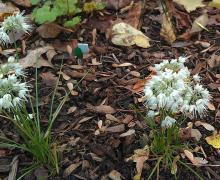
Sat, 10/15/2011 - 12:03pmI love the autumn alliums, and I'm happy to have found plants listed as Allium thunbergii alba at a local nursery this late summer, but in fact since it is such a small grower (about 3-4" tall, 7.5-10 cm)) and fewer-flowered than most thunbergii forms, maybe this is a white form of Allium virgunculae instead. After drenching rains for several days, the flowers look perfect today.
View of Allium "thunbergii" or virgulculae alba with Saxifraga fortunei blooming in the background:
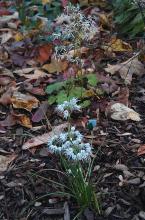
Two closeup views showing the perky pure white flower clusters:
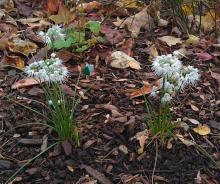
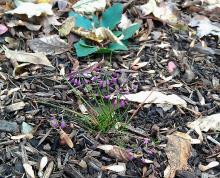
Still waiting for the tiny Allium virgunculae to open its flowers, now still in tight bud, with flower stems at about 2" (5 cm) tall.
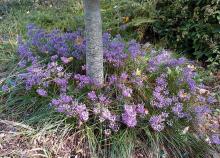
A reliable old planting of Allium thunbergii 'Ozawa' planted at the base of a Magnolia tree.
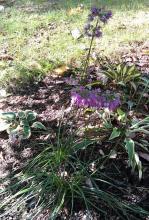
Two views of a tall form of Allium thunbergii sent to me by a friend last year.
Richard T. Rodich
Re: Allium 2011
Sat, 10/15/2011 - 6:47pmThose little guys are so sweet!
You lucked out, Mark!
Mark McDonough
Re: Allium 2011
Thu, 10/27/2011 - 7:06pmA miscellany of Alliums to post.
The issue of harvesting seed on the late blooming alliums comes up sometimes. Some are starting to set seed pods, and depending on the year and the weather, it is sometimes possible to get some seed. In this photo we see some developing pods on Allium aff. thunbergii (probably A. sacculiferum) collected by Dan Hinkley. If the pods are left on to mature, it is likely they'll succumb to soaking rain and snow, so they can be picked in the green and allowed to dry out inside to get some viable seed.
The very small form of Allium virgunculae that I showed in bud earlier finally opened its flowers, this shot taken Oct. 25, 2011... a tiny delight.
Allium thunbergii 'Ozawa' and white Allium thunbergii alba still going strong.
A seedling grown from Allium thunbergii 'Ozawa' has for the last 4-5 years proved to be a rather tall robust form of A. thunbergii. This year it is flowering later than normal, still just mostly in bud with a few first florets opening.
Below... a seed-grown plant from Jim Jones' variegated form of Allium nutans shows variable amounts of variegation, some leaves nearly totally variegated, other leaves partially variegated, and many leaves all green. The flowers are "uggo" (ugly) but I'm happy to have at least one of the seedlings grow on and show some level of strong variegation.
Last photo, I was sent bulbs from the Netherlands of an Allium simply called Allium 'Cameleon' (I am told, the European spelling of the word leaves out the "h" or "chameleon" as we spell it in the US. This plant was reputedly an American species, but is actually a Mediterranean species; mostly likely A. trifoliatum of A. longanum. The fact the foliage emerges in the fall and remains through the winter (and the broad hairy-ciliate edged leaves) 100% rule this out as an American species; it is most certainly one of the two species I mentioned.
Stephen Barstow
Re: Allium 2011
Fri, 10/28/2011 - 2:07amGreat pictures, Mark. I particularly liked the virgunculae...
I was in Kew Gardens in London on 1st October, a day when record temperatures for the time of year were being recorded. It was over 30C that day. In the alpine house there were a couple of thunbergiis which were both still in bud. The first is "Ozoke", the other with no cultivar name. Both were pot grown:
Mark McDonough
Re: Allium 2011
Fri, 10/28/2011 - 5:17amStephen, I like the really grassy clump-forming one in the second photo, looks more like a virgunculae variety. I used to have such a form, would like to rebuild my collection of these sweet little fall bloomers. Need to refresh my memory of the recent revised taxonomy on the thunbergii-virgulculae clan (that I had posted on SRGC), here are some links:
Allium virgunculae var. kiiense, var. koshikiense (published 2009), var. yakushimense (published 1998), and the species pseudojaponicum, austrokyushuense, jump into the fray with thunbergii as well.
http://www.srgc.org.uk/forum/index.php?topic=5766.msg170443#msg170443
http://www.srgc.org.uk/forum/index.php?topic=5766.msg169576#msg169576
Map of Allium virgunculae varieties:
http://www.srgc.org.uk/forum/index.php?topic=5766.msg169700#msg169700
Richard T. Rodich
Re: Allium 2011
Thu, 11/03/2011 - 7:53pmAllium thunbergii 'Ozawas' is finally in best bloom now.
Mark McDonough
Re: Allium 2011
Fri, 11/04/2011 - 6:24pmVery nice Rick. In your photos, the pedicels look dark charcoal color instead of green, which is particularly attractive!
Richard T. Rodich
Re: Allium 2011
Fri, 11/04/2011 - 8:14pmA trait that occurs only with the onset of cold (freezing?) weather. But the stems are similarly colored, too.
Stephen Barstow
Re: Allium 2011
Sat, 11/05/2011 - 1:06amNice onion, Rick! Notice that Ozoke from Kew which I posted above also has dark pedicels!
Mark McDonough
Re: Allium 2011
Sat, 11/05/2011 - 1:49pmHmmm, I'll have to go look at my various thunbergii forms for pedicel color. Stephen, at first I didn't notice the reddish color to the A. thunbergii 'Ozawa' picture you posted. By the way, just to keep the naming straight, the spelling 'Ozoke' is a name corruption for 'Ozawa' that's often encountered in cultivation... even at Kew ;)
Todd Boland
Re: Allium 2011
Mon, 11/14/2011 - 4:29pmI got this as a dwarf form of thunbergii but could it be virgunculae?
Mark McDonough
Re: Allium 2011
Mon, 11/14/2011 - 4:48pmVery nice Todd, rather profuse flowering isn't it. Well, the taxonomy on these little Japanese autumn blooming onions is something to wade through, check the links above for information on recently described species in the thunbergii-virgunculae alliance, and three varieties of Allium virgunculae, or use this link: http://nargs.org/smf/index.php?topic=576.msg11906#msg11906
These link back to lengthy discussions on the SRGC forum.
I believe lots of the smaller "thunbergii" forms going around out there might in fact be one of the varieties of A. virgunculae... here's a photo link to A. virgunculae var. kiiense.
http://hanamist.sakura.ne.jp/flower/tansiyo/yuri/kiito.html
deesen (not verified)
Re: Allium 2011
Thu, 12/01/2011 - 6:00amJust obtained seed of Allium platycaule the originals of which were a Jim Archibald collection under JCA 12988. Should I treat them as a winter or summer grower please?
Mark McDonough
Re: Allium 2011
Thu, 12/01/2011 - 8:30amSeed of most Western American Allium species requires cold stratification, I recommend sowing now, you should get germination in spring. Allium platycaule is a spring growing/flowering onion, it goes dormant immediately after flowering and stay dormant for the rest of the year. Accordingly, can't get much growth out of these in a year, so it typically takes minimum 3-5 years for flowering. Good luck, it's a worthwhile species to wait for.
deesen (not verified)
Re: Allium 2011
Thu, 12/01/2011 - 10:52amMany thanks for that Mark.
deesen (not verified)
Re: Allium 2011
Thu, 12/08/2011 - 12:01pmA friend on mine in Germany has obtained seeds of Nothoscordum montividense ssp minorum and is seeking advice as to the best time to sow them. Can anyone help please?
Mark McDonough
Re: Allium 2011
Thu, 12/08/2011 - 3:59pmDavid, one of my favorite little bulbs, I only have one small windowsill where I overwinter some of these cute little yellow Nothoscordums.
Nothoscordum montevidense and ssp. minarum are easy from seed. Since it flowers twice a year, late fall to winter and again in spring, one can get seed in spring, and if indoor autumn blooms are hand pollinated, one can get late season seed too. Mine are throwing up some blooms now, but I haven't bothered to pollinate them much less look at them, because I don't see them during the week (it's dark when I leave in the morning and dark when I get home). Seed sown, watered, and kept frost free (warm) germinates easily.
deesen (not verified)
Re: Allium 2011
Fri, 12/09/2011 - 1:36amMany thanks for that Mark, I'll pass it on.
Pages