
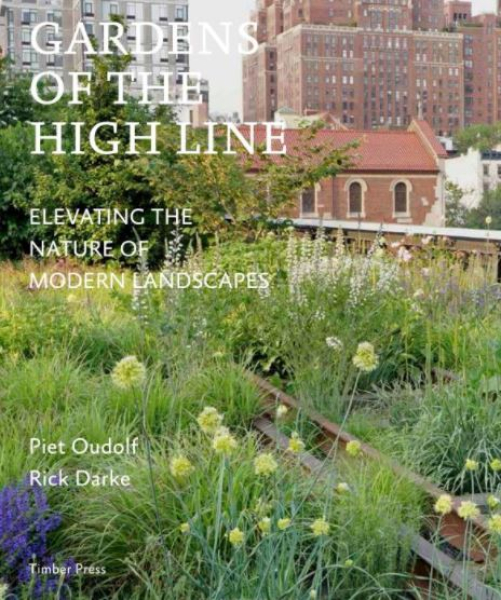
Gardens of the High Line: Elevating the Nature of Modern Landscapes by Piet Oudolf and Rick Darke. Portland, Oregon: Timber Press, 2017. 320 pp. $45.00 list, $31.23 Amazon.
This large book is filled with Rick Darke’s gorgeous photography that captures the High Line’s garden beds juxtaposed with their gritty urban surroundings, shown in all seasons and ranging from aerial views to delicate closeups. But this is not just another pretty coffee table book. The photos themselves tell the story of a series of gardens enriched by their historical setting and well used by the city dwellers. Each garden area contains an evolving community of plants selected for their appropriateness for the site rather than a contrived mix of plants chosen primarily for flower color, unusual foliage and period of bloom.
The accompanying text details the garden’s creation and the design ethic used to create and maintain it. Piet Oudolf’s approach for this design was to “combine locally adapted, mutually compatible long-lived plants in layered associations that draw from wild communities but don’t attempt to replicate them literally” (from the opening chapter “Elevating the Nature of Modern Landscapes”, p. 37). The gardens were carefully designed but may give the impression of having sprung up spontaneously from the ruins of the rail line. The rails themselves are part of the design. They had to be lifted during the initial construction to repair the underlying structure, and the wooden ties were reinstalled with wider spacing to allow more room for plants.
After the introductory information, the book details each of the thirteen High Line gardens, beginning with the Gansevoort Woodland and ending with the Rail Yards. It provides a wealth of photographs, design details, and information on the primary species in each garden. It also shows the transitions from each garden to the next. Maintenance processes and seasonal changes are also discussed.
This book emphasizes the dynamic nature of the garden and the garden’s principle of minimal intervention (with the corresponding decrease in garden maintenance). The design emphasizes plants well suited to their location. However, individual species have sometimes claimed more space than was allotted in the original design. An example in the Meadow Walk area is Korean feather-reed grass which has self-seeded and outcompeted many other species planned for the area. Oudolf and the garden staff accepted this as a strength and added plants well-matched in vigor such as blackberry lily and fernleaf yarrow. The very success of the garden has impacted it also, with new construction around it increasing the shade that falls on the beds. For example, in the Washington Grasslands two of the original grass species could not adapt to the shade caused by new high-rise buildings along the east side of the High Line.
I took note of the High Line’s use of some interesting species. The ‘White Spire’ cultivar of gray birch, featured in the Gansevoort Woodland, is resistant to bronze birch borer, similar to river birch, but it has white bark and is tolerant of hot, dry conditions. Viburnum × bodnantense 'Dawn' provides color and fragrance as an understory shrub in the Woodland and is listed by Cornell as being highly resistant to Viburnum leaf beetle. Carex laxiculmus ‘Hobb’ is a low growing native sedge with silver-blue foliage used as a groundcover in the Chelsea Thicket. Tricyrtis ‘Sinonome’, found in the Washington Grasslands, is a drought tolerant variety of toad lily with deep green shiny foliage
There are so many details of interest in the text and photographs. I love seeing what species are combined to comprise each garden. For example, twisted-leaf onion (Allium obliquum) with its lemon-yellow balls of flower looks fantastic planted with Knautia macedonica and with Salvia ‘Rhapsody in Blue’ in the Chelsea Grasslands. Amsonia hubrichtii and Amsonia ‘Blue Ice’ are employed as groundcovers in the Washington Grasslands.
I look forward to studying the High Line Gardens in person someday soon. This book provides a great reference to prepare for and to accompany that visit. And it looks great on a coffee table.
Deborah Banks maintains a large garden in the hills above Oneonta, NY, and recently retired from her day job.