
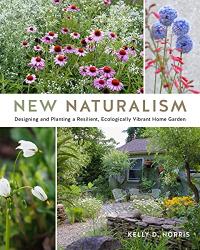
New Naturalism: Designing and Planting a Resilient, Ecologically Vibrant Home Garden by Kelly D. Norris, Beverly, MA: Cool Springs Press, 2021. 208 pp.
$30.00 list price, $25.20 Amazon. $14.99 Kindle.
As an obsessive gardener, I have often been the recipient of helpful comments from those around me that my garden is too large and that I will be unable to maintain the current size of my one-woman enterprise for much longer. My husband opines that we should move so I can downsize to a small garden. I find these dire warnings premature by several years surely. Still, I read New Naturalism by Kelly D. Norris with interest.
Norris states that we can learn a great deal from natural plant communities. They evolve but are self-sustaining without large inputs of time and materials from a gardener. New Naturalism describes the interactions between plants that form a plant community. It says that when designing a garden, we should consider the ways in which plants interact with each other, not just how they look together.
A high diversity of species in the plant community helps to stabilize it, with each available niche in the environment ideally being filled by more than one species. If one species fails, another is there to take its place. The plant community is not stable if all the niches are not filled. Proud plant collectors that surround each of their treasures with a sea of mulch to display them are inviting a host of opportunistic weeds to jump in. Norris recommends establishing interconnected associations of plants rather than focusing on specimen care. This is better for our limited resources and better for the planet.
Norris includes many concepts related to the goal of building a resilient garden that requires less from the gardener. The first section of the book focuses on plant ecology but could also be called plant sociology. How a species functions in its community and the environment for which it is adapted tells you how long-lived it will be, how dispersed it will be and how well it will maintain its population under various stresses. This is good stuff. He also delves into the details of location and the importance of matching plants to place, a more familiar topic to gardeners. Taking cues from wild habitats similar to our own, emphasizing native plants to nourish the bird and native bee populations, and planning the layers of the garden are discussed.
Norris also has answers for those who feel that this style of gardening is too wild or weedy looking. He frames views of natural garden areas with paths and adds ornamental shrubs or structural perennials at key points. Sprinkling an area viewable by neighbors with seasonal bulbs such as alliums contributes to the sense that this is a planned garden.
A new concept for me is that improving soil fertility is a gardening practice that tends to destabilize the garden. Highly competitive species quickly dominate in a garden with enhanced fertility, increasing the cost of managing the landscape. Norris notes that keeping the soil lean helps to maintain plant diversity.
The second half of the book describes planting palettes for a variety of habitats. Norris describes each habitat in general terms to make it applicable for similar conditions around the globe. For each habitat, such as grassland, steppe, woodland and wetlands, he details the habitat conditions and suggests a diverse mix of plant species for each layer of the garden.
New Naturalism includes a generous number of photographs of plantings in many locations. Wave Hill, Chanticleer and Great Dixter are only a few of the selections. There is much I can learn from this book in my attempts to make my garden more sustainable. The beautiful pictures provide the inspiration.
Deborah Banks maintains a large garden in the hills above Oneonta, NY. She also is gainfully employed at a ‘Information Technology’ company in her spare time.