
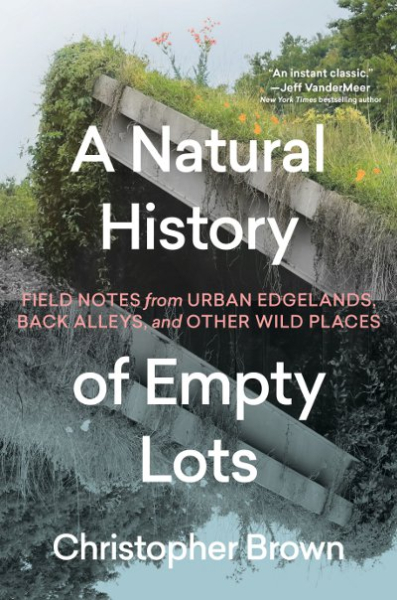
A Natural History of Empty Lots: Field Notes from Urban Edgelands, Back Alleys and Other Wild Places. By Christopher Brown, photography by Christopher Brown. Portland: Timber Press, 2024. hardcover, $30.00 $25.14 Amazon.
I like plants, all kinds of plants be they natives or exotics, all plants from trees, shrubs, groundcovers, bulbs, perennials, annuals, which means I enjoy all sorts of gardens, be they large formal gardens that employ staff to modest cottage gardens, small city gardens, even window boxes and flowerpots. Then there are always places where plants have their natural home, from forest to meadow, mountainside or dessert, but the plants don't care about what people like. They also grow in the places where some project - a building, a roadway, something - was started and then abandoned, deserted, discarded, left empty, neglected, rejected. Have you ever noticed such a place, and wondered how the plants came to grow, the insects, birds, and animals formed this ecosystem?
Living in Texas, a lawyer, a science fiction author, an observer of the ramshackle dilapidated world around where he built his home, surprised one night by a gray fox trotting down the street, then transiting under the chain link fence that keeps people and vehicles away. Looking into the remnants of nature; not exactly, perhaps more like seeing what he is looking at. Other people use these places but in different ways - his daytime field walks turn up used condoms and hypodermic needles.
A Natural History of Empty Lots reads rather like an autobiography. Stories of his ancestral family who came from abroad. Just as people immigrated so, too, have plants that were either intentionally or accidentally brought here. Some aggressively out-compete the natives. What he learned from the landscape in Iowa as a boy, at one point in his day-to-day time travel, at a different point as an adult. In the 1980s his mother restored to oak savanna some heavily wooded, mostly useless for farming Iowa land by burning it over. Can we demand a return to what once was? Should we? Is that even possible?
Christopher Brown and his family built a home, Edgeland House, in Austin, Texas and established a prairie-based green roof on top. It takes maintenance: hand pulling non-native "weeds" in earlier years. After that, he tried using what sounds like the Flaming Dragon weed burner. And once the prairie roof was established, with all its companion insect life, using only the intimate hand pulling. Intimate observations of insects mating, laying eggs, hatching, pupating. Outdoors, indoors. Bugs, birds and bats that feed on them. Lizards and coral snakes and black widow spiders, too.
A path leads up to Edgeland House, with living quarters on one side, bedrooms on the other. Approach more closely, for a better view of the two pavilions and green roof prairie. At night, with the same appeal as a campfire's light.
Reading this book is like joining Christopher Brown on his journey of exploration. There is no index, but then, this is not a botany or gardening book. There are a few less than full size black and white images. Since the book is printed on uncoated paper they are not as sharp as they would be on coated stock. His last name should be Green. It is a splendid read. Why we sing about God Bless the Grass And perhaps why Christopher Brown wrote "A Natural History of Empty Lots."
Long time NARGS member Judy Glattstein has always enjoyed growing what she refers to as buried treasures, those plants with lumpy underground structures that erupt into flowers. No longer an instructor at the New York Botanical Garden where she taught a required course about bulbs for School of Professional Horticulture students and curated a Buried Treasures exhibit, to keep herself somewhat occupied she writes BelleWood Gardens, a blog where this review first appeared. You are welcome to visit: http://www.bellewood-gardens.com